
0 ITEMS

Hemp Farming Financial Model Excel Template
The Hemp Farming Financial Model Template helps entrepreneurs, farm owners, consultants, analysts, and business plan writers turn a hemp cultivation idea into a structured financial forecast. Instead of starting with a blank spreadsheet, users can work from a ready-made model designed around the main economics of hemp farming, including cultivated land, crop mix, yields, selling prices, direct production costs, operating expenses, payroll, capital investment, and cash flow. It provides a practical framework for estimating whether a hemp farm can generate enough revenue, margin, and long-term profitability to support launch, growth, or funding discussions. This template is especially useful for users preparing investor materials, lender submissions, internal budgets, or feasibility studies for a hemp farming venture. It connects revenue assumptions with the operational drivers that matter most in this business, such as hectares under cultivation, allocation across hemp products, price per kilogram, production yield, processing costs, labor requirements, equipment investment, and land strategy. By adjusting editable inputs, users can evaluate how changes in crop mix, CBD biomass pricing, input costs, payroll, or expansion pace affect the overall financial outcome. The model supports financial planning by organizing startup costs, operating expenses, cost of goods sold, payroll, revenue streams, cash flow, profitability, and balance sheet outputs in one connected structure. It helps users understand early cash burn, funding requirements, working capital pressure, and the timing of profitability. The included break-even analysis and performance metrics also make it easier to see when the business may become sustainable and which assumptions have the greatest impact on results. Built for practical decision-making, the Hemp Farming Financial Model is fully customizable and suitable for both early-stage planning and established farm expansion. Users can test low, base, and high scenarios, review bank-ready reports, examine return metrics, and present a professional forecast to stakeholders. Whether the goal is to secure financing, compare growth strategies, evaluate land leasing versus ownership, or build a credible hemp business plan, this financial model template gives buyers a clear and editable foundation for informed planning.
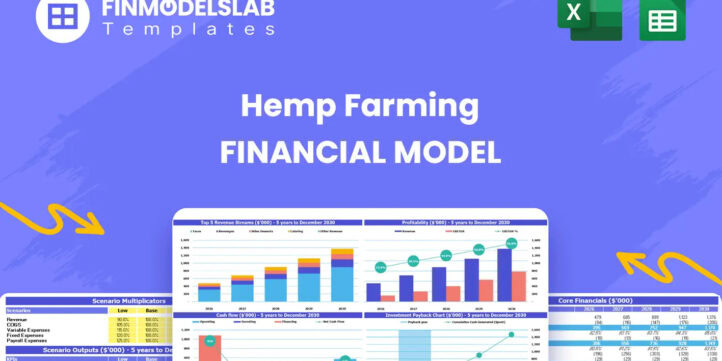


Financial Model Overview
The Hemp Farming Financial Model Financial Model Template is a structured planning tool for evaluating the financial performance of a hemp cultivation business before launch, expansion, or funding discussions. Hemp farming can be highly sensitive to crop mix, yield per hectare, selling price per kilogram, input costs, land strategy, processing costs, labor requirements, and capital investment. This model brings those assumptions into one connected forecast so users can estimate revenue, expenses, profitability, cash flow, and funding needs without building a complex spreadsheet from scratch. It is designed for entrepreneurs, farm operators, consultants, financial analysts, founders, and business plan writers who need a practical, investor-ready way to explain how a hemp farm may perform over time. By entering editable assumptions into the model, users can review the effect of different revenue drivers, production costs, payroll plans, startup investments, and financing decisions on projected financial statements and key performance metrics.
All-in-One Dashboard
The all-in-one dashboard gives users a centralized view of the most important inputs and outputs in the Hemp Farming Financial Model. It is designed to help users quickly understand the overall business case by connecting key assumptions, such as cultivated hectares, crop allocation, yield, selling price, production costs, operating expenses, payroll, and capital investment, with high-level financial results. Instead of searching through multiple tabs to understand performance, users can review the core forecast outputs in one place, including revenue, gross profit, EBITDA, net income, cash position, and selected return metrics. This component is especially useful for business planning and stakeholder communication because it summarizes the financial story of the hemp farm in a format that is easier to review, update, and present. For founders and advisors, the dashboard also acts as a control center, allowing quick checks on whether the model assumptions are producing a financially viable plan or whether further adjustments are needed before approaching investors, lenders, or partners.
Low, Base, and High Scenario Analysis
The low, base, and high scenario analysis component helps users evaluate how the hemp farm may perform under different operating and market conditions. Hemp farming forecasts can change significantly based on assumptions such as CBD biomass pricing, total yield per hectare, crop loss, market demand, land expansion pace, operating efficiency, input costs, and financing structure. This section allows users to compare conservative, expected, and optimistic cases so they can understand a range of possible outcomes rather than relying on a single forecast. The low case may reflect weaker selling prices, slower scaling, or higher costs, while the base case can represent the most realistic operating plan, and the high case can show the upside potential if yields, prices, and margins improve. For investor discussions and internal decision-making, this component is valuable because it highlights risk, supports contingency planning, and shows how resilient the business may be if market conditions shift. It also helps users answer practical questions about how much cash buffer is needed and which assumptions create the largest swing in profitability.
Professional Charts
The professional charts component turns the financial forecast into clear visual outputs that can be used in presentations, business plans, lender meetings, and investor reviews. Hemp farming models often include many interconnected assumptions, and charts help make the results easier to interpret by showing trends over time. This section may visualize revenue growth, crop revenue mix, gross margin, EBITDA, net profit, cash flow, capital expenditure, debt service, and return metrics. Because the charts update as assumptions change, users can immediately see how a change in yield, price, cost structure, land expansion, or payroll affects the overall financial trajectory. This is useful for communicating the business case to stakeholders who may not want to review detailed spreadsheet tabs but still need to understand whether the farm can scale profitably. The charts also help users spot potential planning issues, such as periods of negative cash flow, margin compression, excessive capital spending, or delayed profitability. For consultants and founders, this component adds a polished presentation layer to the model and supports more confident financial storytelling.
ROE Components and DuPont Analysis
The ROE components and DuPont analysis section helps users understand what is driving return on equity in the hemp farming business. Rather than showing only a single return percentage, this component breaks performance into underlying drivers such as profitability, asset efficiency, and financial leverage. In a capital-intensive hemp farm, return on equity can be affected by margins from high-value crops, the amount of equipment and land investment required, the speed at which assets generate revenue, and the mix of debt and equity used to fund the operation. By reviewing these components, users can see whether projected returns are coming from strong operating performance, efficient use of assets, or increased leverage. This is particularly useful for investors and business owners because it clarifies the quality of the returns and helps identify strategic levers for improvement. For example, stronger CBD biomass yield, better pricing, improved processing efficiency, or more efficient capital deployment may improve return metrics, while excessive debt or underused assets may increase risk. This component supports more disciplined decision-making around financing, expansion, and profitability management.
Revenue Inputs
The revenue inputs section is where users define the main assumptions that drive hemp farm sales. This component may include cultivated land, crop mix percentages, yield per hectare, selling price per kilogram, product categories, timing of production, and growth in acreage over time. In a hemp farming model, revenue assumptions are especially important because different hemp products can have very different economics. CBD floral biomass, fiber, grain, seeds, and other outputs may vary widely in price, yield, demand, processing requirements, and margin potential. By allowing users to enter or adjust these assumptions, the model helps translate the operating plan into a revenue forecast that reflects the specific business strategy. This section is useful for comparing different crop allocation strategies and understanding how much revenue depends on high-value products versus volume-driven products. It also supports funding preparation because investors and lenders will want to see how revenue projections were built and whether the assumptions are realistic. A clear revenue input structure makes the forecast easier to audit, explain, and update as market conditions change.
Bank-Ready Reports
The bank-ready reports component organizes the financial outputs in a format that is suitable for lenders, financing partners, and formal funding discussions. Hemp farming often requires significant capital for equipment, irrigation, land preparation, facilities, processing, working capital, and early operating losses, so clear financial reporting is essential when seeking loans or investment. This section may include projected profit and loss statements, cash flow statements, balance sheets, debt schedules, repayment capacity, profitability summaries, and key financial ratios. The goal is to present the forecast in a lender-friendly structure that shows how the business expects to generate income, manage expenses, maintain liquidity, and service debt. For users preparing loan applications or investor packets, this component saves time by producing organized outputs from the assumptions already entered into the model. It also helps identify whether the financing request is aligned with the cash needs of the farm and whether projected cash flows can support repayment. Clear bank-ready reporting improves credibility and makes it easier to discuss the business with external stakeholders.
Revenue Breakdown
The revenue breakdown component gives users a more detailed view of how total revenue is generated across hemp products, crop categories, or revenue streams. Instead of looking only at total sales, users can see which products contribute the most to the forecast and how the mix changes over time. This is particularly important in hemp farming because high-value products, such as CBD-rich floral biomass, can have a very different impact on revenue and profitability compared with lower-priced fiber or grain outputs. The component may calculate revenue by multiplying land allocation, hectares planted, yield per hectare, and price per kilogram for each product category. It can then summarize the contribution of each revenue stream to total sales, helping users identify concentration risk, pricing sensitivity, and strategic dependence on specific crops. For planning and decision-making, this section helps users evaluate whether their crop mix supports the desired financial results and whether diversification would improve risk management. It is also useful for investor presentations because it clearly shows where the business expects its income to come from.
KPI Dashboard
The KPI dashboard tracks the performance metrics that matter most for monitoring a hemp farming business. This component may include revenue growth, gross margin, EBITDA margin, net profit margin, cash balance, cash burn, return on equity, internal rate of return, payback period, yield per hectare, revenue per hectare, cost of goods sold as a percentage of revenue, payroll as a percentage of revenue, and other operational or financial indicators. By bringing these metrics into one view, the model helps users quickly assess whether the business is moving in the right direction and whether assumptions are producing sustainable results. The KPI dashboard is useful during business planning because it gives founders and advisors a way to benchmark performance, track progress against targets, and identify areas that need adjustment. If margins are too low, cash flow is negative for too long, or returns are below expectations, users can return to the input assumptions and test improvements. For stakeholder reporting, the KPI dashboard provides a concise summary of business health and makes the financial model easier to discuss in meetings.
Startup and Operating Cost Planning
The startup and operating cost planning component helps users estimate the investment required to launch and run the hemp farm. Startup costs may include tractors, harvesters, irrigation systems, land preparation, storage facilities, drying and processing equipment, licensing, legal setup, initial insurance, deposits, early marketing, and working capital reserves. Operating costs may include seeds, soil inputs, fertilizers, pest control, testing, post-harvest processing, transportation, utilities, insurance, repairs, professional services, administrative expenses, and ongoing farm overhead. The model connects these cost assumptions to the broader financial forecast so users can see how capital expenditure and recurring expenses affect cash flow, profitability, and funding requirements. This component is valuable because hemp farming can require substantial cash before revenue is fully realized, and underestimating startup costs can create serious liquidity problems. By organizing launch and operating expenses in a structured way, the template helps users prepare more realistic budgets, compare leased versus owned assets, plan equipment purchases, and determine how much financing may be needed before the business reaches stable operations.
Break-Even and Funding Requirements
The break-even and funding requirements component helps users understand when the hemp farm may become profitable and how much capital is needed to reach that point. Break-even analysis can be based on revenue, gross margin, fixed costs, variable costs, EBITDA, operating profit, or cash flow, depending on the planning objective. For a hemp farm, this section is especially important because the business may show improving operating profitability while still facing significant cash pressure from equipment purchases, land costs, payroll, working capital, or debt service. By estimating the timing of break-even and the minimum cash position during the forecast period, users can determine whether the business requires equity investment, bank financing, working capital support, or a larger cash reserve. This component supports practical decision-making by showing whether the planned crop mix, price assumptions, cost structure, and scaling timeline are realistic. It also helps users prepare for investor and lender questions about how much funding is required, how the funds will be used, when the business can support itself, and what conditions must be met for the farm to become financially sustainable.
File types:
Excel – Single-User: .xlsx
Excel – Multi-User: .xlsx
Similar ProductsOther customers were also interested in...


 HenrySheykin
Cattle Farming Financial Model Excel Template
The Cattle Farming Financial Model helps users turn a cattle farm concept, expansion plan, or fundin... Read more
Hydroponics Financial Model Excel Template
The Hydroponic Farming Financial Model helps entrepreneurs, growers, consultants, analysts, and busi... Read more
Dairy Farming Financial Model Excel Template
Purchase Dairy Farming Financial Projection. Sources & Uses, Profit & Loss, Cash Flow statem... Read more
Aquaponics Financial Model Excel Template
The Commercial Aquaponics Financial Model helps users turn a capital-intensive aquaponics concept in... Read more
Sheep Farming Financial Model Excel Template
The Sheep Farming Financial Model helps entrepreneurs, farm owners, consultants, analysts, and busin... Read more
Garden Nursery Financial Model Excel Template
The Garden Nursery Financial Model helps entrepreneurs, nursery owners, consultants, analysts, and b... Read more
Horse Boarding Financial Model Excel Template
The Horse Boarding Financial Model helps turn a stable, equestrian center, or horse boarding concept... Read more
Garlic Farming Financial Model Excel Template
The Garlic Farming Financial Model helps entrepreneurs, growers, consultants, analysts, and business... Read more
Plant Nursery Financial Model Template
The Plant Nursery Financial Model helps entrepreneurs, nursery owners, consultants, analysts, and bu... Read more
Cow-Calf Operation Financial Model Excel Template
The Cow-Calf Operation Financial Model helps ranch owners, agricultural entrepreneurs, consultants, ... Read more
Reviews
 Hemp Farming
You must log in to submit a review.