
0 ITEMS

Hotel Acquisition REFM Financial Model Excel Template
The Hotel Acquisition Financial Model helps buyers, investors, developers, consultants, and analysts evaluate the financial feasibility of acquiring, renovating, financing, and exiting hotel assets. Instead of starting with a blank spreadsheet, users get a structured financial model template designed around the key questions lenders and acquisition partners typically ask first, including purchase price, sources and uses of funds, debt service, cash flow, profitability, investor returns, and timing of exit proceeds. It is especially useful for hotel acquisition strategies where value is created through buying assets, funding improvements, managing renovation timelines, and selling renovated properties at a targeted valuation. This template supports financial planning by connecting deal assumptions to projected outcomes over a multi-year forecast period. Users can customize acquisition dates, renovation budgets, revenue assumptions, exit sale values, startup costs, operating expenses, payroll, financing terms, and corporate overhead to reflect a specific hotel investment thesis. The model is built to help users understand how much capital may be required, when cash flow pressure may peak, how long the project may take to recover its investment, and whether the proposed deal structure can produce acceptable profitability and returns. The Hotel Acquisition Financial Model is suitable for entrepreneurs, real estate investors, hotel buyers, private equity teams, business owners, consultants, and founders preparing business plans, investment memos, lender packages, or funding documents. It helps organize the assumptions behind a hotel purchase and renovation strategy in a way that is easier to review, update, and present. With scenario planning, revenue breakdowns, professional charts, KPI views, and bank-ready reports, the model supports clearer decision-making before committing capital to a hotel acquisition. The template also helps users evaluate risk. A hotel acquisition can be highly capital intensive, with significant upfront costs, renovation spending, payroll, operating expenses, and debt obligations before sale proceeds or stabilized returns arrive. By modeling cash flow, profitability, break-even analysis, and investor return metrics, users can test whether the plan is realistic under low, base, and high scenarios. The result is a practical, editable tool for comparing assumptions, improving deal structure, and presenting a more credible financial plan to lenders, investors, partners, and internal stakeholders.
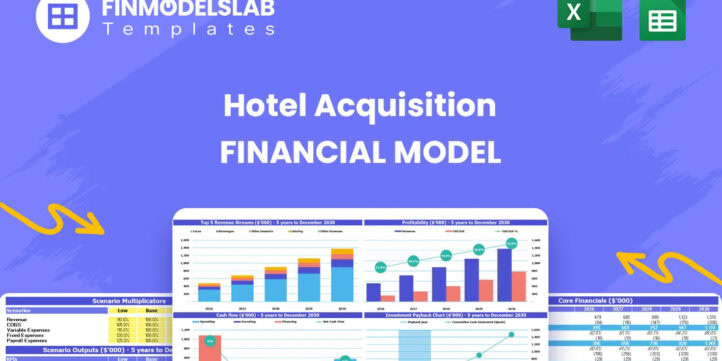


Financial Model Overview
The Hotel Acquisition Financial Model is a ready-to-use financial model template built for analyzing the purchase, renovation, financing, and eventual sale of hotel assets. It is designed for buyers, real estate investors, hospitality entrepreneurs, consultants, analysts, and acquisition teams that need a structured way to evaluate whether a hotel deal can support its capital requirements, debt service, operating expenses, renovation costs, and investor return expectations. The model helps users move from a broad investment idea to a detailed forecast by organizing assumptions around acquisition timing, purchase price, construction or renovation budgets, sale proceeds, payroll, overhead, cash flow, profitability, and return metrics. Because hotel acquisition projects can involve large upfront funding needs and delayed revenue from exits, this template is especially useful for identifying cash flow gaps, testing deal timing, preparing lender-friendly reports, and making better decisions before committing capital. It is fully editable, compatible with Excel and Google Sheets, and structured to support five-year planning, investor presentations, internal budgeting, and funding discussions.
All-in-One Dashboard
The all-in-one dashboard brings the most important assumptions and outputs into one central view so users can quickly understand the overall economics of a hotel acquisition strategy. This component is useful because hotel acquisition analysis often requires reviewing many moving parts at the same time, including purchase price, renovation spend, sale timing, funding needs, cash balance, debt service, EBITDA, IRR, return on equity, and payback period. The dashboard helps users enter or review core inputs, then see how those assumptions affect the model’s primary financial outputs. For example, a change in acquisition cost, construction duration, exit valuation, or financing structure can flow through to cash flow, profitability, and investor returns. This makes the dashboard valuable for high-level decision-making, partner discussions, and fast deal screening. Instead of searching through multiple tabs to understand whether a hotel acquisition is viable, users can use the dashboard as a command center for reviewing the model, identifying pressure points, and communicating the investment story clearly.
Low, Base, and High Scenario Analysis
The low, base, and high scenario analysis section allows users to test how the hotel acquisition plan may perform under different market conditions and operating assumptions. This component helps users compare a downside case, a primary planning case, and an upside case by adjusting variables such as acquisition prices, renovation budgets, sale proceeds, timing of exits, debt terms, overhead costs, or project delays. In a hotel acquisition project, small changes in valuation, construction costs, or sale timing can have a major impact on cash flow and returns, so scenario analysis is essential for understanding risk before moving forward. The low case can show what happens if the market softens, costs run above budget, or exit values fall below expectations. The base case supports the user’s main investment plan, while the high case illustrates potential upside from better purchase terms, stronger exit pricing, or faster project execution. This component is useful for investor presentations, lender conversations, internal approvals, and strategic planning because it shows whether the deal remains financially sound when assumptions change.
Professional Charts
The professional charts section turns the model’s financial results into visual reports that are easier to interpret and present. Hotel acquisition projects often involve complex financial information, including multi-year cash flow, revenue from property sales, renovation spending, debt obligations, profitability trends, and return metrics. Charts help translate those numbers into clear visuals that stakeholders can understand quickly. This component may include visualizations for revenue progression, EBITDA, cash position, funding requirements, cumulative cash flow, return metrics, and major cost categories. These outputs are useful when presenting to investors, lenders, partners, acquisition committees, or management teams because they make it easier to explain the timing and financial logic of the deal. Professional charts also help users spot patterns that may not be obvious in raw spreadsheet data, such as the depth of the cash flow trough before the first exit, the point at which profitability improves, or the relationship between acquisition spend and future sale proceeds. By providing presentation-ready visuals, this section supports clearer communication and more confident decision-making.
ROE Components and DuPont Analysis
The ROE components and DuPont analysis section helps users understand what drives return on equity in the hotel acquisition plan. Rather than showing only a single return metric, this component breaks performance into underlying drivers that may include profitability, asset efficiency, leverage, equity contribution, and capital structure. This is valuable because hotel acquisition returns are influenced by more than the final sale price. Purchase price discipline, renovation cost control, financing terms, holding period, corporate overhead, and debt levels all affect the equity outcome. By using a DuPont-style framework, users can see whether return on equity is being driven by genuine profitability, efficient asset turnover, or financial leverage. This helps investors and analysts evaluate the quality of the projected return, not just the headline number. It also supports better decision-making by showing which assumptions should be improved to strengthen the deal. For example, if ROE depends too heavily on leverage, the user may revisit debt assumptions or funding structure. If profitability is weak, the user may adjust purchase price, construction budget, or exit valuation assumptions.
Revenue Inputs
The revenue inputs section captures the assumptions that drive projected income for the hotel acquisition strategy. In this type of model, revenue may be less focused on daily hotel operations and more focused on the eventual sale proceeds from acquired and renovated hotel properties, especially when the strategy is to acquire, improve, and exit assets over a defined timeline. This component allows users to input or adjust assumptions such as property sale values, exit dates, acquisition pipeline timing, expected appreciation, renovation completion schedules, and asset-specific revenue events. It can also support assumptions for ancillary income or interim operating revenue if the hotel generates income during the holding period. The value of this section is that it connects the deal timeline with the financial forecast, showing when revenue is expected to arrive and how dependent the plan is on specific exit milestones. Because hotel acquisitions often require significant upfront investment before sale proceeds are received, accurate revenue inputs are critical for evaluating liquidity, debt service, profitability, and investor returns. Users can adjust revenue assumptions to match their own deal pipeline and market outlook.
Bank-Ready Reports
The bank-ready reports section provides lender-friendly financial outputs that help users present the hotel acquisition plan in a structured and professional format. Lenders and financing partners often want to review clear projections for sources and uses of funds, debt service, cash flow, operating costs, asset sale proceeds, profitability, and repayment capacity. This component helps organize those outputs so the financial plan can be shared as part of a loan application, acquisition financing package, refinancing discussion, or investor due diligence process. The reports may include profit and loss summaries, cash flow forecasts, balance sheet projections, debt schedules, funding requirements, and key financial ratios. This section is useful because it helps users move beyond informal deal assumptions and present a more complete view of the project’s financial structure. It also helps identify whether the acquisition strategy can support lender expectations, including adequate liquidity, realistic repayment sources, and transparent assumptions. For consultants and analysts preparing materials for clients, bank-ready reports can save time and create a more polished financial package.
Revenue Breakdown
The revenue breakdown section provides a detailed view of the revenue streams or exit proceeds associated with each hotel asset in the acquisition plan. Rather than showing only total revenue, this component helps users separate the contribution of individual properties, sale events, or investment phases. For example, users can model proceeds from one hotel sale separately from another, compare the timing of exits across a portfolio, and evaluate how much each asset contributes to the overall return. This is especially useful for a multi-property acquisition strategy where each hotel may have a different purchase price, renovation budget, holding period, sale date, and exit value. The section can help users determine whether the investment thesis depends too heavily on one large sale or whether returns are diversified across several assets. It can also support discussions with investors by showing where projected cash inflows come from and when they are expected. By breaking revenue into clear categories, the model makes it easier to validate assumptions, update individual asset forecasts, and understand how the overall acquisition strategy performs.
KPI Dashboard
The KPI dashboard focuses on the key performance indicators that matter most in a hotel acquisition and renovation investment. This component may track metrics such as internal rate of return, equity multiple, return on equity, payback period, EBITDA, cumulative cash flow, minimum cash balance, debt service coverage, break-even timing, cost overruns, and exit value assumptions. The purpose of this section is to give users a concise performance view without requiring them to analyze every line of the model. For acquisition teams, business owners, and investors, KPI tracking helps determine whether the project is meeting the financial targets needed to justify the investment. It also supports benchmarking against internal goals, lender expectations, or broader hospitality and real estate investment standards. If a metric falls below the user’s required threshold, the KPI dashboard can signal that the deal needs adjustment before moving forward. This may include renegotiating the purchase price, changing the financing structure, delaying an acquisition, reducing renovation costs, or revising the exit strategy. The KPI dashboard is useful for both day-to-day analysis and stakeholder reporting.
Sources and Uses of Funds
The sources and uses of funds section is an added component that helps users understand how the hotel acquisition will be financed and where the capital will be allocated. In a hotel acquisition model, funding may come from sponsor equity, investor equity, acquisition loans, construction financing, bridge debt, seller financing, or other capital sources. Uses of funds may include purchase price, closing costs, due diligence expenses, renovation and construction budgets, startup costs, working capital, contingency reserves, financing fees, corporate overhead, and payroll. This section is useful because it provides a clear capital plan before the project begins and helps identify whether the proposed funding package is sufficient. It also helps users distinguish between entity-level startup expenses and deal-specific acquisition costs, which is important when preparing for lender discussions or investor presentations. By showing how much capital is needed, when it is needed, and what it will be used for, this component supports better budgeting and reduces the risk of unexpected funding gaps. It also helps users assess whether the capital structure is balanced between debt and equity.
Break-Even and Payback Analysis
The break-even and payback analysis section is an added component that helps users determine when the hotel acquisition strategy is expected to recover its investment and begin generating cumulative positive returns. Because acquisition and renovation strategies often involve substantial early cash outflows, this analysis is critical for understanding the timing of financial recovery. The section may use inputs such as acquisition costs, renovation costs, operating expenses, payroll, debt service, sale proceeds, and cumulative cash flow to calculate the break-even month, payback period, and total capital at risk before recovery. This is useful for investors because it shows how long capital may remain tied up and whether the timeline aligns with their return expectations. It is also helpful for lenders and management teams because it identifies the period of greatest financial pressure and the major assumptions required to reach break-even. If the break-even point is too far out, users can test ways to improve it, such as reducing purchase price, shortening renovation timelines, increasing exit values, staggering acquisitions, or securing better financing terms. This component turns the model into a practical tool for evaluating timing risk and capital efficiency.
File types:
Excel – Single-User: .xlsx
Excel – Multi-User: .xlsx
Similar ProductsOther customers were also interested in...


 HenrySheykin
Condominium Development REFM Financial Model Excel...
The Condo Development Financial Model helps developers, investors, analysts, consultants, and busine... Read more
Condo Hotel Financial Model Excel Template
The Condo Hotel Financial Model helps users turn a condo hotel concept, launch plan, or investment o... Read more
 Pushkar
Commercial Real Estate – Lease or Sell Quart...
Commercial Real Estate - Lease or Sell Quarterly Excel Model with 3 Statements, Valuation, and Devel... Read more

 Giorgos
Hotel Acquisition – 10 Year Financial Model
10-Year financial model for a hotel acquisition projecting revenue, operating expenses, and cash flo... Read more
 JILL LIU
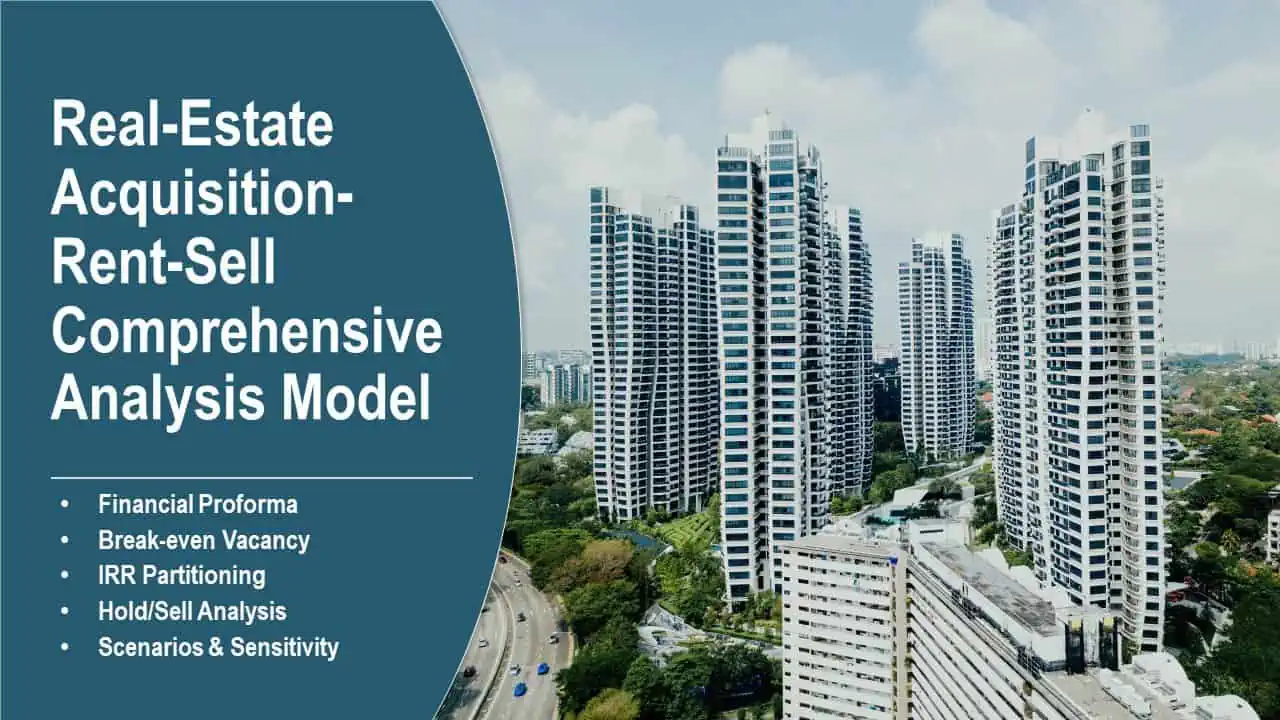
Real Estate Acquisition-Rent-Sell Comprehensive An...
An integrated, dynamic and ready-to-use Real Estate Acquisition-Rent-Sell Comprehensive Analysis Mod... Read more
 anthony
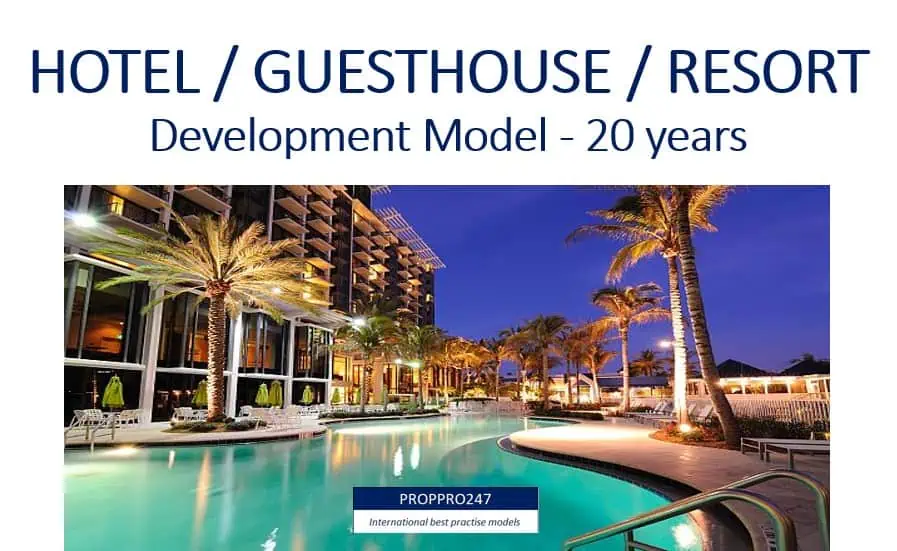
Hotel/Guesthouse/Resort Development Model and Valu...
This Hotel / Holiday Resort Development Model will take you through a 20-year period of Three Statem... Read more

Real Estate Acquisition Financial Model (Commercia...
10-Year financial model for a real estate acquisition projecting revenue, operating expenses, and ca... Read more

Yacht Marina Acquisition – 10 Year Financial Mod...
10-Year financial model for a yacht marina acquisition projecting revenue, operating expenses, and c... Read more
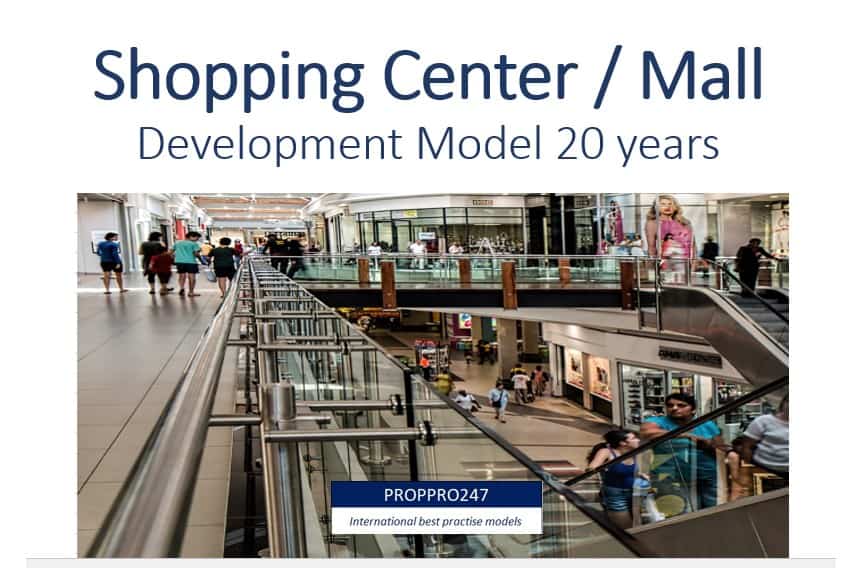
SHOPPING CENTER or MALL DEVELOPMENT MODEL – ...
This Shopping Center or Mall Development Model will take you through the development timeline accord... Read more
You must log in to submit a review.