0 ITEMS

Chart of Accounts for Bakery Business: Full Guide
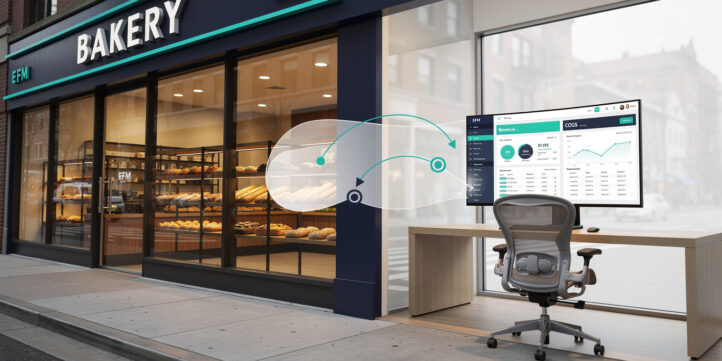
A bakery chart of accounts is a numbered list of every financial account your business uses to record transactions, organized into six master categories: assets, liabilities, equity, revenue, cost of goods sold, and operating expenses. Without this structure, a flour purchase, an oven lease payment, and a wedding cake deposit all look the same in your bank feed. With it, each transaction tells you exactly where money came from and where it went. This guide gives you specific account codes, bakery-specific sub-accounts, worked transaction examples, and guidance on adapting the structure to different bakery models.
Key Takeaways
- A bakery chart of accounts (COA) uses a 5-digit numbering system: assets 1000-1999, liabilities 2000-2999, equity 3000-3999, revenue 4000-4999, COGS 5000-5999, and operating expenses 6000-6999.
- Food cost (COGS) for bakeries typically runs 28-35% of revenue, making granular COGS tracking one of the highest-leverage accounting decisions you can make.
- Spoilage and waste deserve their own dedicated account (6150) because bakery waste rates average 5-15% of production, a figure that directly erodes gross margin if left unmonitored.
- Bakeries with multiple revenue channels (retail, wholesale, catering, online) need separate revenue accounts for each stream to identify which channel is actually profitable.
- Commercial baking equipment depreciates over 5-7 years under IRS MACRS rules, so a dedicated accumulated depreciation account is required from day one.
- FIFO (first-in, first-out) inventory valuation is the recommended method for perishable bakery ingredients because it matches cost flow to physical spoilage reality.
The Chart of Accounts Framework for Bakery Businesses
A chart of accounts (COA) is the master index of every ledger account your bookkeeping system uses. Think of it as a filing system: each account has a unique number, a name, and a type (asset, liability, equity, revenue, or expense). Every financial transaction you record maps to at least two accounts under double-entry bookkeeping, the accounting method where every debit has a matching credit.
For bakeries, the standard numbering convention assigns ranges by account type. Assets occupy 1000-1999, liabilities 2000-2999, equity 3000-3999, revenue 4000-4999, cost of goods sold 5000-5999, and operating expenses 6000-6999. The Financial Accounting Standards Board (FASB) sets the Generally Accepted Accounting Principles (GAAP) that govern how these accounts must be structured for compliant financial reporting under the FASB Accounting Standards Codification.
Bakeries face three accounting challenges that most retail businesses do not: perishable inventory that can spoil before it sells, high-energy equipment that drives utility costs above typical retail norms, and multi-channel revenue that mixes retail walk-in sales, wholesale accounts, and custom orders. A COA built for a generic retail store will not capture these nuances.
Complete Bakery Chart of Accounts with Account Codes
The table below shows a production-ready COA for a small to medium bakery. Every account listed here maps to a real transaction type you will encounter in daily operations.
| Account # | Account Name | Type | Notes |
|---|---|---|---|
| 1010 | Cash – Checking | Asset | Primary operating account |
| 1020 | Cash – Savings | Asset | Reserve / tax savings |
| 1030 | Accounts Receivable | Asset | Wholesale and catering invoices |
| 1100 | Raw Ingredient Inventory | Asset | Flour, dairy, eggs, etc. |
| 1110 | Packaging Inventory | Asset | Boxes, bags, labels |
| 1120 | Finished Goods Inventory | Asset | Baked items ready for sale |
| 1200 | Prepaid Expenses | Asset | Insurance, permits paid in advance |
| 1500 | Baking Equipment | Asset | Ovens, mixers, proof boxes |
| 1510 | Display Cases & Refrigeration | Asset | Retail floor equipment |
| 1520 | Leasehold Improvements | Asset | Build-out costs for rented space |
| 1590 | Accumulated Depreciation | Asset (contra) | Offsets equipment book value |
| 2010 | Accounts Payable | Liability | Supplier invoices due |
| 2020 | Sales Tax Payable | Liability | Collected but not yet remitted |
| 2030 | Payroll Liabilities | Liability | Wages withheld, employer taxes |
| 2100 | Short-Term Loans Payable | Liability | Due within 12 months |
| 2200 | Long-Term Equipment Loans | Liability | Financed equipment |
| 3010 | Owner’s Capital | Equity | Initial and additional investment |
| 3020 | Owner’s Draw | Equity (contra) | Cash taken out by owner |
| 3030 | Retained Earnings | Equity | Accumulated net income |
| 4010 | Retail Sales – In-Store | Revenue | Walk-in counter sales |
| 4020 | Wholesale Revenue | Revenue | Accounts billed on net terms |
| 4030 | Catering Revenue | Revenue | Event and corporate catering |
| 4040 | Custom Order Revenue | Revenue | Wedding cakes, specialty items |
| 4050 | Online Sales Revenue | Revenue | E-commerce and delivery orders |
| 4060 | Seasonal / Holiday Revenue | Revenue | Holiday boxes, gift sets |
| 5010 | Flour & Grains | COGS | Primary baking ingredient |
| 5020 | Dairy Products | COGS | Butter, cream, milk |
| 5030 | Sweeteners | COGS | Sugar, honey, syrups |
| 5040 | Eggs | COGS | Shell eggs and liquid egg products |
| 5050 | Fats & Oils | COGS | Shortening, vegetable oil |
| 5060 | Yeast & Leavening Agents | COGS | Yeast, baking powder, baking soda |
| 5070 | Flavorings & Extracts | COGS | Vanilla, cocoa, spices |
| 5080 | Packaging Materials – COGS | COGS | Boxes, bags used per unit sold |
| 5090 | Direct Labor – Production | COGS | Baker wages tied to production |
| 6010 | Rent & Occupancy | Expense | Storefront or commercial kitchen |
| 6020 | Utilities – Electric | Expense | Oven and refrigeration power |
| 6030 | Utilities – Gas | Expense | Gas ovens and proofers |
| 6040 | Payroll – Front of House | Expense | Counter staff, cashiers |
| 6050 | Payroll Taxes | Expense | Employer FICA, FUTA, SUTA |
| 6060 | Health & Business Insurance | Expense | Commercial kitchen policy |
| 6070 | Health Permits & Licenses | Expense | Food handler permits, inspections |
| 6080 | Marketing & Advertising | Expense | Social media, print, promotions |
| 6090 | Delivery & Shipping | Expense | Local delivery, online order shipping |
| 6100 | Equipment Maintenance | Expense | Oven calibration, mixer service |
| 6110 | Recipe Testing & Development | Expense | Ingredients used in R&D |
| 6120 | Office & Admin Supplies | Expense | Paper, printer ink, POS supplies |
| 6130 | Professional Services | Expense | Accountant, attorney fees |
| 6140 | Depreciation Expense | Expense | Annual equipment write-down |
| 6150 | Waste & Spoilage | Expense | Unsold or damaged product |
| 6160 | Bank Fees & Merchant Fees | Expense | Credit card processing, bank charges |
Asset Accounts: Equipment, Inventory, and Property
Bakery asset accounts split into two groups: current assets (converted to cash within 12 months) and fixed assets (long-term property and equipment). Getting this split right matters because it affects your balance sheet ratios and your depreciation schedule.
Current assets include your three inventory accounts: raw ingredient inventory (1100), packaging inventory (1110), and finished goods inventory (1120). Separating these three lets you calculate ingredient turnover independently from finished goods turnover, which is critical when spoilage is a factor.
Fixed assets require particular attention for bakeries. A commercial deck oven can cost $8,000-$25,000, a spiral mixer $3,000-$12,000, and a walk-in cooler $5,000-$15,000. The IRS classifies most commercial food service equipment as 5-year MACRS property under IRS Publication 946, meaning you depreciate it over 5 years using the accelerated MACRS schedule. Leasehold improvements (account 1520) for a rented bakery space depreciate over 15 years under MACRS rules.
Record each piece of equipment in account 1500 at its purchase price. Each year, debit account 6140 (Depreciation Expense) and credit account 1590 (Accumulated Depreciation) for the annual write-down amount.
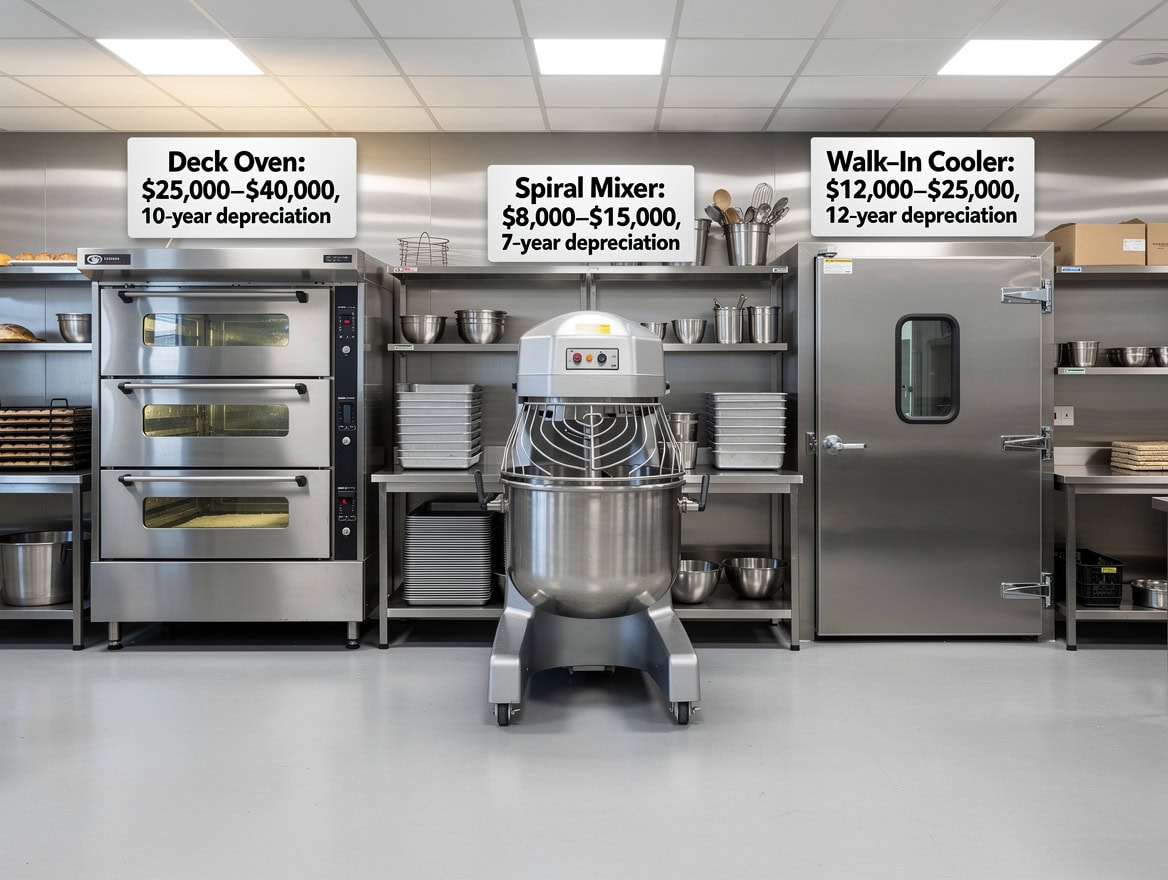
Commercial baking equipment depreciates over 5 years under IRS MACRS rules, making accurate fixed asset tracking essential from purchase day.
Revenue Accounts: Categorizing Multiple Bakery Income Streams
Separate revenue accounts for each sales channel are the single most important structural decision in a bakery COA. A bakery that lumps all sales into one revenue account cannot tell whether its wholesale channel is profitable or whether catering orders are worth the labor they require.
Here is how each revenue account works in practice:
- 4010 Retail Sales – In-Store: Every over-the-counter sale, whether paid by cash, card, or mobile payment. Your POS system should post daily totals here.
- 4020 Wholesale Revenue: Sales to coffee shops, restaurants, or grocery stores billed on net-15 or net-30 terms. These flow through accounts receivable (1030) first, then clear to 4020 when paid.
- 4030 Catering Revenue: Event catering billed as a package. Track deposits separately as a liability (deferred revenue) until the event is delivered.
- 4040 Custom Order Revenue: Wedding cakes and specialty items. A 50% deposit received before baking sits in a liability account until you deliver the order, at which point you recognize it as revenue.
- 4050 Online Sales Revenue: E-commerce and third-party delivery platform sales. Keep this separate from in-store retail to measure your digital channel’s contribution margin.
- 4060 Seasonal / Holiday Revenue: Holiday gift boxes, seasonal specials. Tracking this separately helps you plan inventory and staffing for peak periods.
Cost of Goods Sold: Bakery-Specific COGS Accounts
COGS for a bakery includes every cost directly tied to producing a baked item: ingredients, packaging used per unit, and the wages of bakers working on production. Food cost as a percentage of revenue typically runs 28-35% for bakeries, according to industry benchmarks published by the National Restaurant Association. Tracking COGS at the ingredient level (accounts 5010-5080) lets you spot when flour prices spike or dairy costs creep up before they destroy your margin.
Direct labor (account 5090) belongs in COGS, not in operating expenses, because it is a production cost. A baker mixing dough and loading ovens is producing inventory. A counter staff member ringing up sales is an operating expense (account 6040). This distinction matters for calculating your true gross profit margin.
FIFO inventory valuation (first-in, first-out) is the recommended method for perishable bakery ingredients. Under FIFO, the cost of the oldest inventory is assigned to COGS first, which matches how you physically use ingredients (oldest flour gets used before new stock). The IRS permits FIFO for tax purposes, and it produces a more accurate cost of goods sold for perishable goods than weighted average costing. Businesses that change their inventory valuation method must file a Form 3115 with the IRS, as a change in accounting method requires IRS approval under Revenue Procedure 2015-13, as explained in IRS Publication 538.
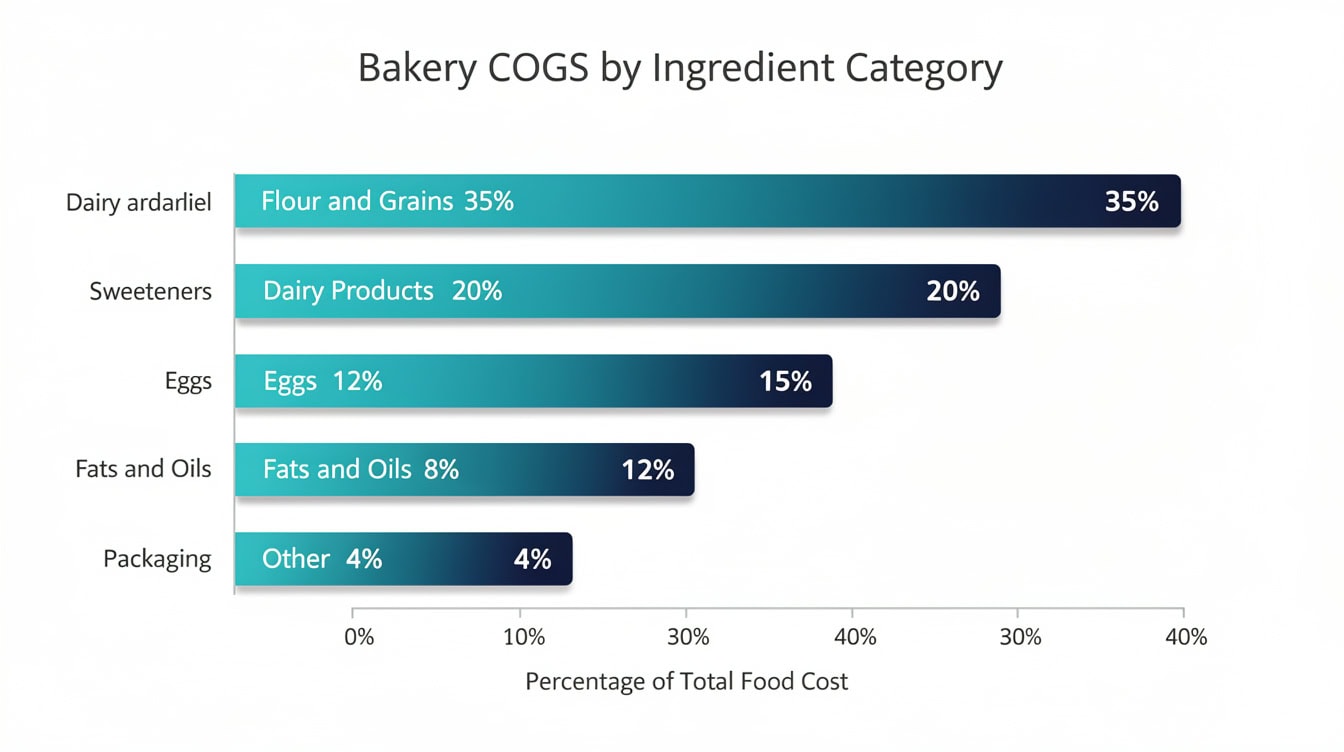
Flour and grains typically represent the largest single COGS category for most bakeries, making account 5010 the most important ingredient account to monitor.
Worked Example: Coding 5 Common Bakery Transactions
Here is how five typical bakery transactions map to specific accounts.
Transaction 1: Flour purchase, $420, paid by check
- Debit 5010 Flour & Grains: $420
- Credit 1010 Cash – Checking: $420
Transaction 2: Custom wedding cake deposit received, $300 (50% of $600 order)
- Debit 1010 Cash – Checking: $300
- Credit 2040 Deferred Revenue (Customer Deposits): $300
When the cake is delivered: Debit 2040 $300, Credit 4040 Custom Order Revenue $300, and record remaining $300 payment.
Transaction 3: Monthly oven lease payment, $850
- Debit 6010 Rent & Occupancy (or a dedicated Equipment Lease account under 6000): $850
- Credit 1010 Cash – Checking: $850
Transaction 4: Baker wages for production week, $1,200
- Debit 5090 Direct Labor – Production: $1,200
- Credit 2030 Payroll Liabilities: $1,200 (cleared when payroll is funded)
Transaction 5: Unsold croissants written off as spoilage, $85 cost value
- Debit 6150 Waste & Spoilage: $85
- Credit 1120 Finished Goods Inventory: $85
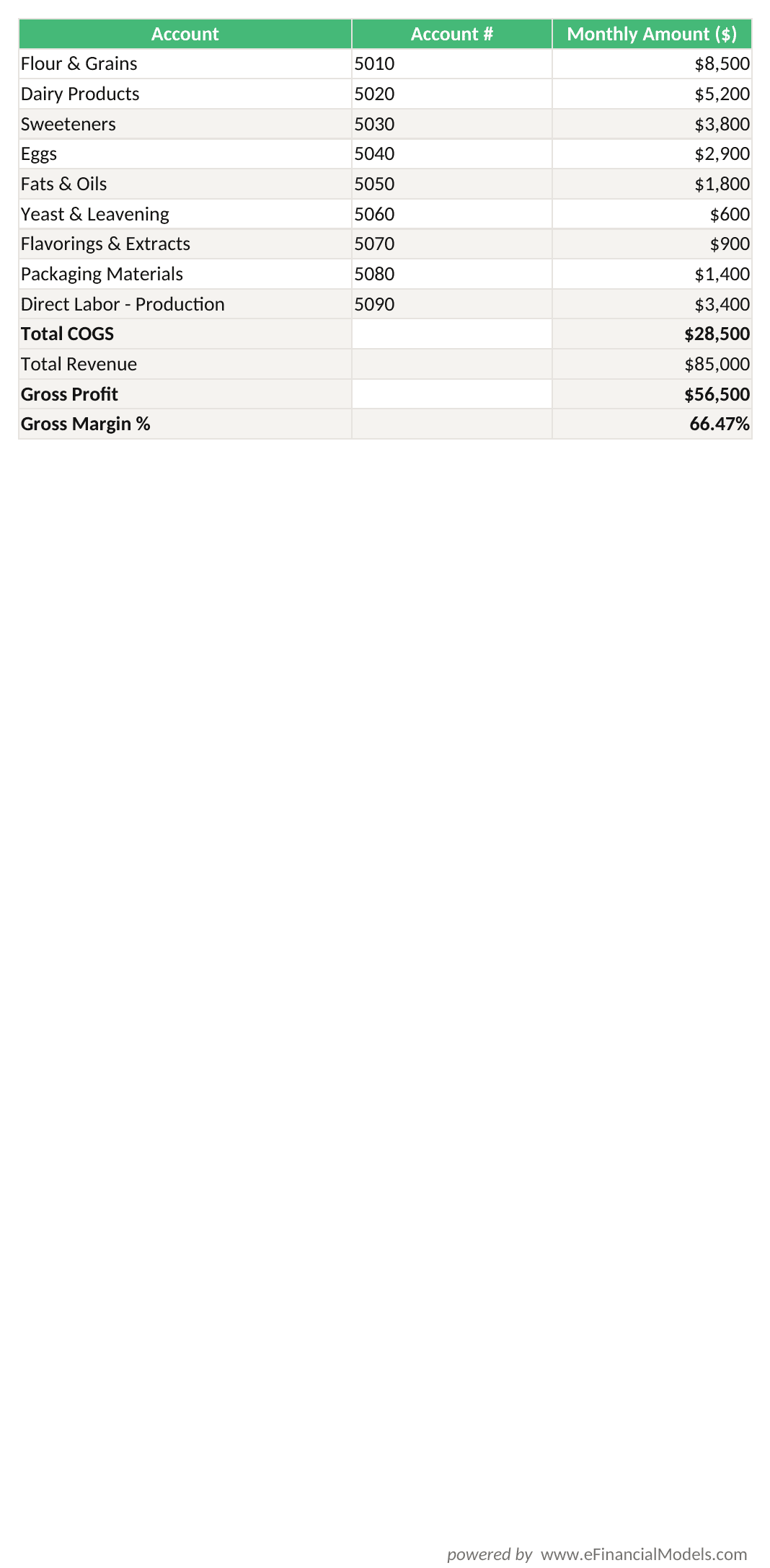
Gross Margin = (Revenue – COGS) / Revenue. With $28,500 COGS on $85,000 revenue, gross margin is 66.5% — within the healthy 65-72% range for retail bakeries.
These five entries cover the most common classification questions bakery bookkeepers face. The deposit treatment for custom orders is the one most often coded incorrectly: recording a deposit as revenue before delivery violates the revenue recognition principle under FASB ASC 606.
Operating Expense Accounts for Bakery Operations
Bakery operating expenses carry two costs that exceed typical retail norms: utilities and spoilage. A commercial deck oven running 8-10 hours per day can consume 15-20 kWh per hour, making electricity one of the top 3 expense line items for most bakeries. Tracking electric (6020) and gas (6030) utilities in separate accounts lets you measure energy cost per unit produced and evaluate whether equipment upgrades pay off.
Account 6150 (Waste & Spoilage) deserves particular attention. Bakery waste rates average 5-15% of production value depending on product mix and demand forecasting accuracy. Without a dedicated account, spoilage hides inside COGS and inflates your apparent ingredient cost, making it impossible to distinguish between a purchasing problem and a waste problem.
Account 6070 (Health Permits & Licenses) captures annual food handler permits, commercial kitchen inspections, and state food service licenses. These are operating expenses, not assets, because they provide no future economic benefit beyond the current license period. The IRS requires businesses to expense license and permit costs in the year paid rather than capitalizing them, as confirmed under the general rules for business deductions in IRS Publication 535.
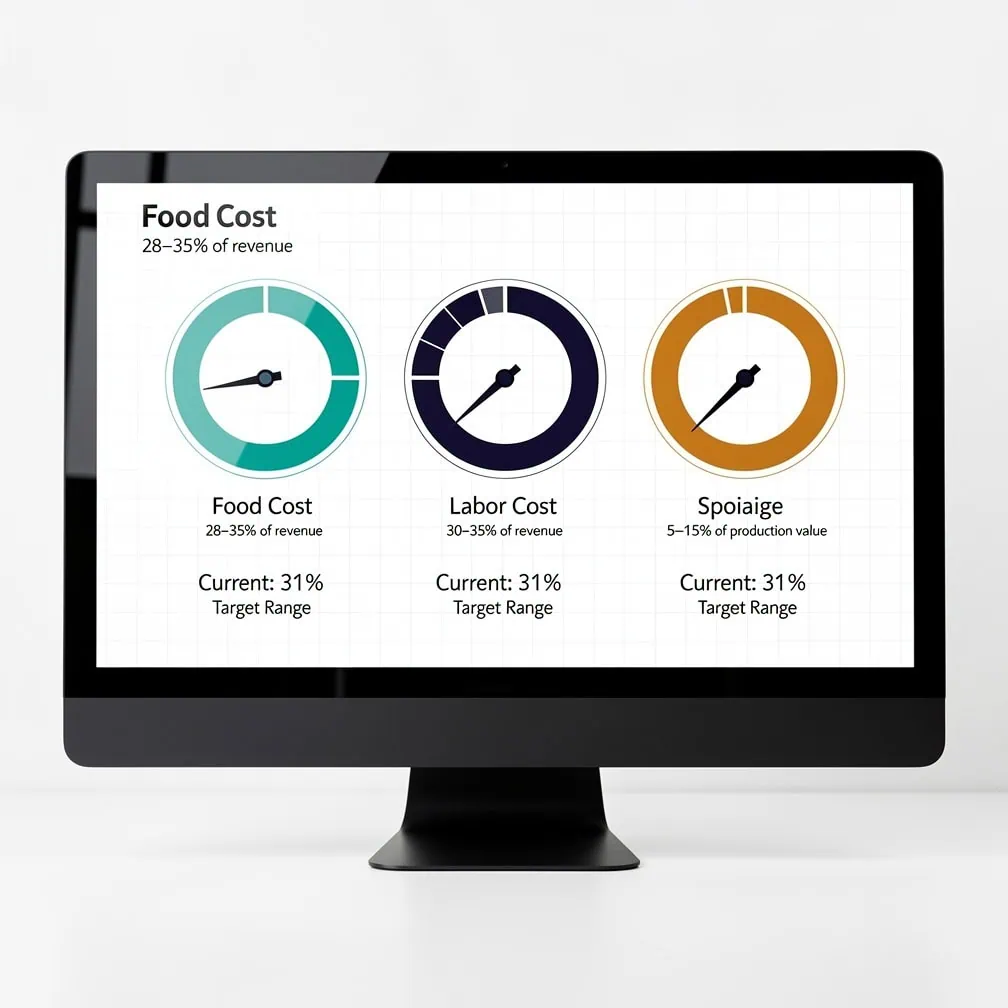
Monitoring these three ratios monthly gives bakery owners an early warning system for margin erosion before it shows up in net income.
Customizing Your COA for Different Bakery Models
The right COA structure depends on your bakery’s operating model. Four common models require different account emphasis.
| Bakery Model | Key Revenue Accounts | Key COGS Focus | Special Accounts Needed |
|---|---|---|---|
| Retail Storefront | 4010 (in-store), 4040 (custom) | 5010-5080 ingredients, 5090 direct labor | 6150 Spoilage, 6020/6030 Utilities |
| Wholesale-Only | 4020 (wholesale) | 5010-5080 ingredients, 5090 direct labor | 1030 AR, 6090 Delivery |
| Hybrid Retail/Wholesale | 4010, 4020, 4030, 4040 | Full ingredient breakdown | All expense accounts active |
| Home-Based Licensed | 4010, 4040, 4050 (online) | 5010-5070 ingredients | 6070 Permits, 6010 (home office portion) |
A home-based bakery operating under a cottage food license needs to track the business-use percentage of home utilities and allocate only that portion to account 6020. The IRS home office rules in IRS Publication 587 govern this calculation and require consistent methodology year over year.
For forecasting purposes, wholesale-only bakeries should build accounts receivable aging reports from account 1030 monthly, since net-term accounts can create cash flow gaps even when revenue is strong.
Best Practices for Maintaining Your Bakery Chart of Accounts
A COA is not a set-and-forget document. Three maintenance practices keep it accurate and useful.
Monthly reconciliation: Reconcile every bank and credit card account to your ledger before closing the month. Any unreconciled transaction is a potential misclassification.
Quarterly account review: Check whether new transaction types have appeared that do not fit existing accounts. A bakery that starts selling merchandise (branded aprons, cookbooks) needs a new revenue account (4070 Merchandise Sales) rather than lumping it into retail sales.
Year-end inventory count: Count raw ingredient inventory, packaging inventory, and finished goods inventory physically. Adjust account balances to match the count. For perishable ingredients, apply FIFO costing to value the ending inventory. This directly affects your COGS calculation and your taxable income.
For performance tracking purposes, calculate these three ratios from your COA data each month: gross margin (revenue minus COGS divided by revenue), food cost percentage (COGS divided by revenue), and labor cost percentage (total labor divided by revenue). Bakery food cost targets typically fall between 28-35%, and labor cost targets between 30-35% of revenue.
You can also use your COA data to build a pro-forma income statement that projects future performance based on current cost ratios, which is essential for loan applications and investor conversations.
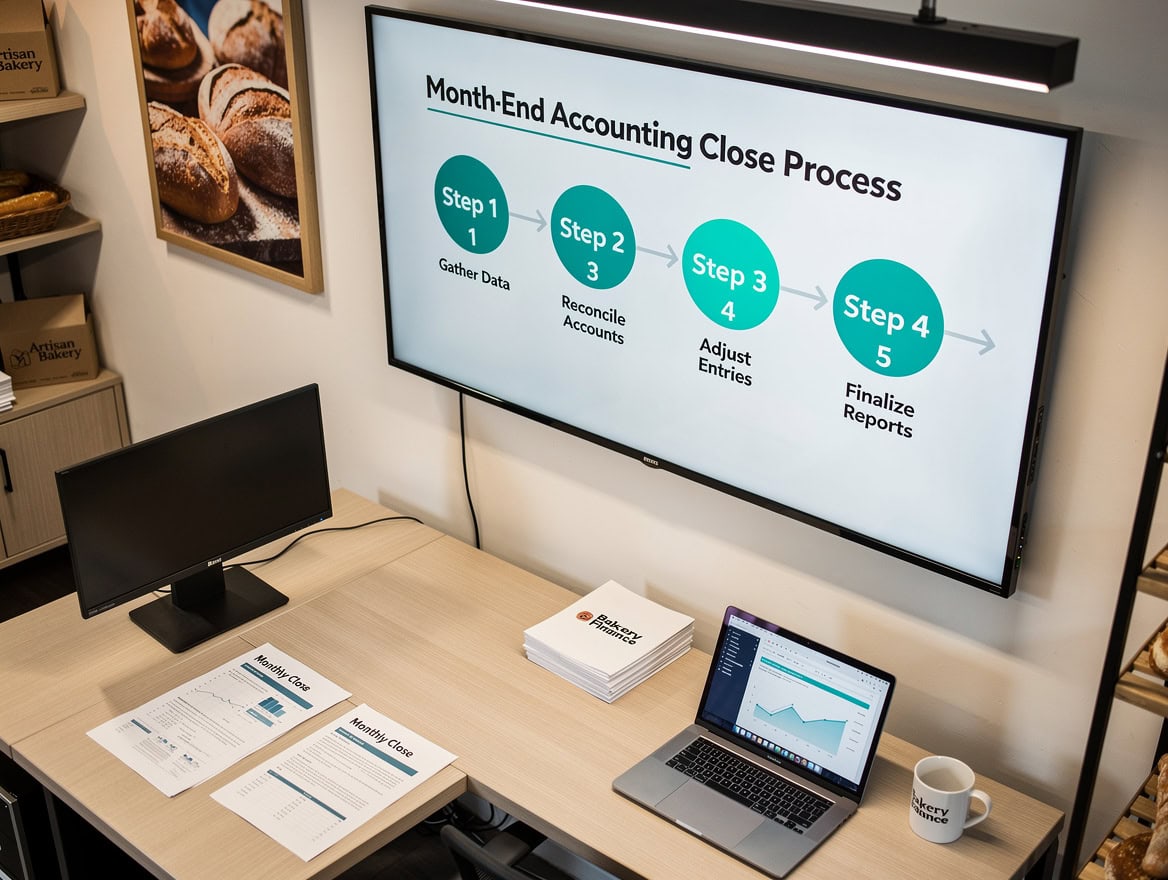
A consistent month-end close routine ensures your COA data produces accurate financial statements every period, not just at year-end.
Frequently Asked Questions
What account number range should I use for bakery assets?
Use the 1000-1999 range for all asset accounts. Current assets (cash, inventory, accounts receivable) typically occupy 1000-1299, while fixed assets (equipment, property, leasehold improvements) occupy 1300-1599. Accumulated depreciation, a contra-asset account that reduces the book value of fixed assets, sits at 1590 or similar. This numbering convention aligns with standard small business COA practice and makes financial statements easier to read. Most accounting software like QuickBooks uses this same range by default, so your custom bakery accounts will slot in without restructuring.
How do I record a customer deposit for a custom wedding cake?
Record the deposit as a liability, not revenue, when you receive it. Debit your cash account (1010) and credit a Deferred Revenue or Customer Deposits account (2040) for the deposit amount. When you deliver the cake and collect the balance, debit 2040 to clear the deposit, debit cash for the remaining payment, and credit account 4040 (Custom Order Revenue) for the full order value. This treatment follows FASB ASC 606 revenue recognition rules, which require revenue to be recorded only when the performance obligation (delivering the cake) is satisfied. Recording deposits as immediate revenue overstates income in the period received.
What is the difference between COGS and operating expenses for a bakery?
COGS (accounts 5000-5999) includes only costs directly tied to producing baked goods: ingredients, packaging used per unit, and baker wages during production. Operating expenses (accounts 6000-6999) cover costs of running the business regardless of production volume: rent, utilities, front-of-house staff wages, marketing, insurance, and permits. The distinction matters because gross profit (revenue minus COGS) measures production efficiency, while operating income (gross profit minus operating expenses) measures overall business efficiency. A bakery with a 65% gross margin but high rent and labor operating expenses can still lose money. Keeping these categories separate reveals exactly where profitability is being eroded.
How should I handle bakery spoilage in my accounts?
Record spoilage by debiting account 6150 (Waste & Spoilage) and crediting the relevant inventory account (1100 for raw ingredients, 1120 for finished goods) at cost value. Do not record spoilage at retail price. For example, if 20 croissants with a total ingredient cost of $12 go unsold and are discarded, debit 6150 for $12 and credit 1120 for $12. Track spoilage weekly and calculate it as a percentage of production cost. Industry data suggests bakery waste averages 5-15% of production value. If your spoilage account consistently exceeds 10% of COGS, investigate demand forecasting, production scheduling, or storage practices before the problem compounds.
Which inventory valuation method is best for a bakery?
FIFO (first-in, first-out) is the best method for bakeries because it matches accounting cost flow to physical reality. Flour purchased on Monday gets used before flour purchased on Friday, so FIFO assigns the older (Monday) cost to COGS first. This produces a more accurate gross margin calculation for perishable goods than weighted average costing, which blends all purchase prices together. FIFO also tends to produce a higher ending inventory value during periods of rising ingredient prices, which strengthens your balance sheet. The IRS permits FIFO under Publication 538, and most accounting software supports it natively. Once you choose a method, you must apply it consistently year over year unless you file for an accounting method change with the IRS.
Do I need separate accounts for retail and wholesale revenue?
Yes, and this is one of the most valuable structural decisions in your COA. A bakery selling the same croissant at $3.50 retail and $1.80 wholesale to a coffee shop has very different margin profiles for each channel. Without separate revenue accounts (4010 for retail, 4020 for wholesale), you cannot calculate channel-specific contribution margins or make informed decisions about which channel to grow. Wholesale accounts also require accounts receivable tracking (account 1030) and aging reports, since net-term billing creates cash flow timing differences that retail cash sales do not. Separate accounts make this analysis straightforward and support better business valuation if you ever seek financing or plan to sell.
How often should I update my bakery chart of accounts?
Review your COA quarterly and update it whenever a new transaction type appears that does not fit an existing account. Common triggers for adding accounts include launching a new revenue channel (adding 4050 Online Sales when you start e-commerce), purchasing a new category of equipment, or hiring staff in a new role that requires separate payroll tracking. Do not add accounts for every minor variation, as an overly granular COA becomes difficult to maintain. A good rule: if a transaction type occurs fewer than once per month, it probably does not need its own account. Delete or merge unused accounts at year-end to keep the COA clean. Most accounting software allows you to make accounts inactive without deleting historical data.