0 ITEMS

SBA Loan vs SAFE vs Equity Raise: Cost Comparison
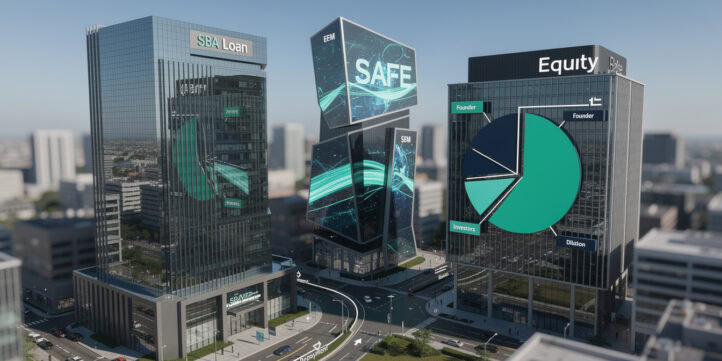
Choosing between an SBA loan, a SAFE, and a priced equity round isn’t a matter of preference — each one puts you in a fundamentally different relationship with your capital: debtor, future shareholder, or current shareholder. The math below shows why that choice matters: at a $50M exit, a $500K SAFE at a $4M cap costs founders $6.25M in foregone proceeds, while the same $500K borrowed from the SBA costs $327,640 in interest.
Key Takeaways
- SBA 7(a) loans carry zero dilution but require a personal guarantee and cap out at $5 million per SBA program rules, making them ideal for revenue-generating businesses with collateral.
- A SAFE (Simple Agreement for Future Equity) with a 20% YC-standard discount converts into equity at a priced round, meaning a $500K SAFE at a $4M cap can hand investors 12.5% of your company before you raise a single dollar of Series A.
- Direct seed equity rounds typically dilute founders by 10% to 20% per round according to Carta’s 2022 dilution analysis, and that dilution compounds with every subsequent round.
- The SBA approved 57,362 loans totaling $27.5 billion in FY2023, with an average loan of $479,000 — meaning most SBA borrowers are not funding moonshot startups but stable small businesses.
- Regulation Crowdfunding caps equity raises at $5 million per 12-month period per SEC rules, limiting non-accredited investor access to early-stage deals.
- Personal guarantee exposure on SBA loans is not a footnote: if your business fails, your personal assets are on the line for the full loan balance.
- Hybrid strategies — layering SBA debt with a SAFE or small equity round — can minimize dilution while preserving growth capital, but require careful sequencing to avoid covenant conflicts.
Three Fundamentally Different Capital Structures
SBA loans, SAFEs, and equity raises are not variations of the same thing — they represent three distinct relationships between a founder and their capital source: creditor, future shareholder, and current shareholder. Choosing the wrong structure at the wrong stage can cost you ownership, cash flow, or both.
Here’s the core distinction:
- SBA 7(a) loan: You borrow money and repay it with interest. You retain 100% ownership. The lender has no equity stake, but they hold a personal guarantee and often a lien on business assets.
- SAFE (Simple Agreement for Future Equity): An investor gives you money today in exchange for the right to receive equity later, at a discount or capped valuation, when you close a priced round. No interest, no repayment schedule, but guaranteed future dilution.
- Equity raise: An investor buys shares in your company right now at an agreed valuation. You give up ownership immediately and permanently (unless you buy it back).
Each structure suits a different business profile. The sections below break down the mechanics, costs, and trade-offs with real numbers.
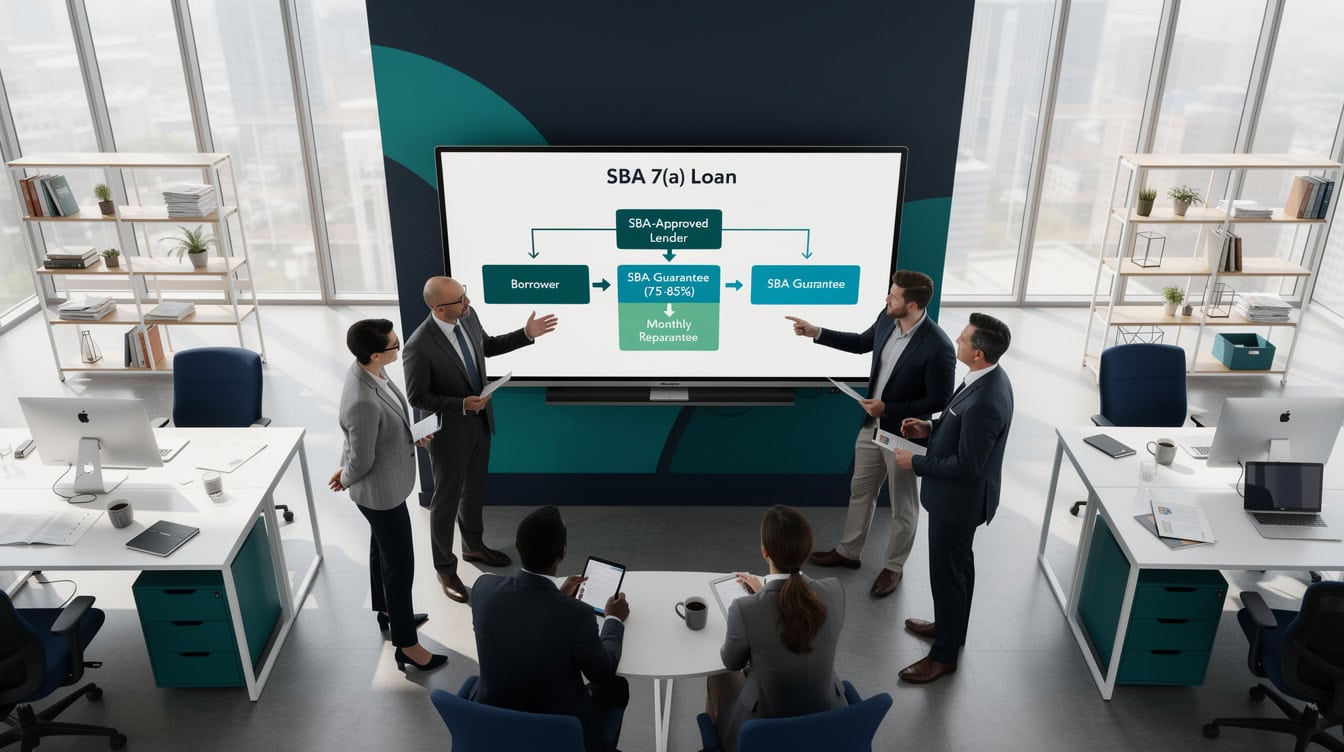
The SBA guarantees 75-85% of the loan balance, reducing lender risk — but the personal guarantee means founders remain fully exposed if the business defaults.
SBA 7(a) Loans: Debt Financing Mechanics and True Cost
SBA 7(a) loans are government-backed term loans designed for small businesses that can demonstrate repayment capacity. The SBA does not lend directly — it guarantees a portion of the loan made by an approved lender, which reduces the lender’s risk and allows more favorable terms than conventional bank debt.
The SBA approved 57,362 loans totaling $27.5 billion in FY2023 U.S. Small Business Administration (SBA) (2023), with an average loan amount of $479,000. That average tells you something important: SBA loans are not startup rocket fuel. They serve established small businesses with revenue, assets, and credit history.
Key mechanics:
- Maximum loan amount: $5 million SBA (2024)
- Government guaranty: 85% for loans of $150,000 or less, 75% for loans above $150,000 SBA (2023)
- Typical terms: 10 years for working capital, up to 25 years for real estate
- Interest rates: Variable, typically Prime + 2.25% to Prime + 4.75% depending on loan size and term. With Prime at approximately 8.5% in mid-2024, effective rates range from roughly 10.75% to 13.25% annually.
- Personal guarantee: Required from any owner with 20% or more equity in the business
- Collateral: Required when available; lenders must take all available business assets
Qualification requirements:
You need a credit score above 680 (most lenders prefer 700+), at least 2 years in business, positive cash flow sufficient to cover debt service, and a debt service coverage ratio (DSCR — annual net operating income divided by annual debt payments) of at least 1.25x. The SBA Express program can deliver a lending decision in as fast as 36 hours (SBA), compared to the standard processing timeline of 30 to 90 days for conventional 7(a) applications.
True cost over 10 years:
On a $500,000 SBA 7(a) loan at 11.5% interest over 10 years, your monthly payment is approximately $6,897. Total payments over the life of the loan equal roughly $827,640, meaning you pay $327,640 in interest on top of the $500,000 principal. That’s a 65.5% total cost premium over the borrowed amount — but you keep 100% of your equity.
The personal guarantee risk:
This is not a minor footnote. If your business defaults, the lender can pursue your personal bank accounts, home equity, and other personal assets. For founders with significant personal net worth, this exposure can be existential. Factor it into your risk calculus before signing.

A $500K SAFE at a $4M valuation cap converts to 12.5% ownership at Series A — regardless of the Series A price, illustrating how caps protect early investors at founders’ expense.
SAFE Agreements: Quasi-Equity Conversion Math
A SAFE (Simple Agreement for Future Equity) is a contract where an investor gives you cash today and receives equity in the future, at a priced round, based on pre-agreed conversion terms. Y Combinator introduced the SAFE in 2013 as a simpler alternative to convertible notes — no interest accrual, no maturity date, no debt on your balance sheet.
Y Combinator’s standard post-money SAFE template includes a 20% discount to the price per share in the equity financing if no valuation cap is used Y Combinator (2023). Most SAFEs in practice use a valuation cap (the maximum company valuation at which the SAFE converts), a discount rate, or both. YC has issued its SAFE documents under a free, open-source model since 2013, and the post-money SAFE it introduced in 2018 is now the most widely used early-stage investment instrument in the U.S. startup ecosystem (Y Combinator).
Conversion mechanics with a valuation cap:
Suppose you raise $500,000 on a SAFE with a $4 million post-money valuation cap. At your Series A, investors price the round at a $10 million pre-money valuation. Here’s how the SAFE converts:
- SAFE investor’s effective price per share = based on the $4M cap, not the $10M Series A price
- SAFE ownership = $500,000 / $4,000,000 = 12.5% of the company (post-money at conversion)
If the same $500,000 had been raised at the Series A price ($10M pre-money), the investor would have received only 5% ownership. The cap effectively gives the SAFE investor a 60% discount to the Series A price in this scenario — far more than the standard 20% discount.
Conversion mechanics with a discount only (no cap):
Using YC’s 20% discount standard: if the Series A price is $1.00 per share, the SAFE converts at $0.80 per share. A $500,000 SAFE converts into 625,000 shares vs. 500,000 shares at the Series A price — a 25% ownership premium for the SAFE investor relative to Series A investors at the same dollar amount.
SAFE overhang:
SAFE overhang refers to the accumulated unconverted SAFEs sitting on your cap table before a priced round. If you’ve issued $2 million in SAFEs at various caps, all of them convert simultaneously at your Series A, creating a sudden and sometimes surprising dilution event for founders. Model this before you issue multiple SAFEs.
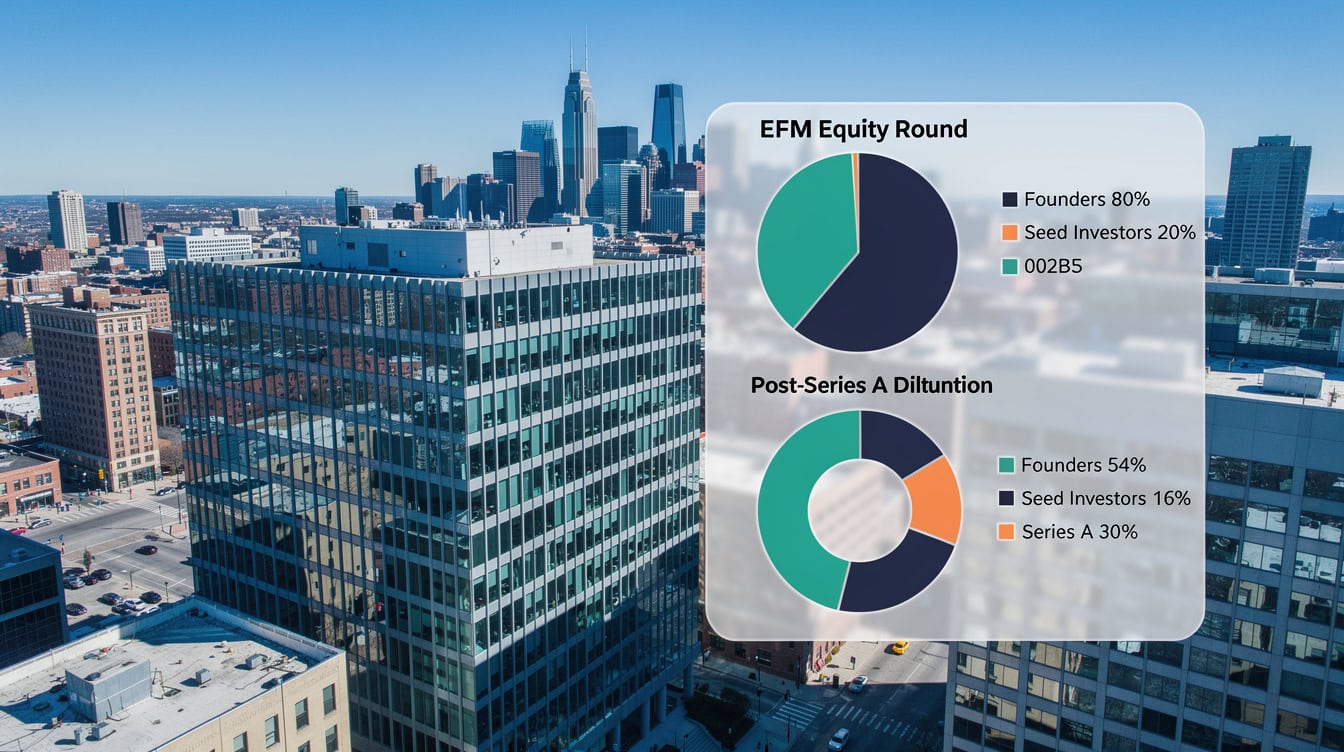
Seed equity dilution of 20% compounds with each subsequent round — founders who start at 80% post-seed often hold 50-55% by Series A close after option pool and SAFE conversions.
Equity Raises: Direct Dilution and Valuation Dynamics
A direct equity raise means selling shares at a fixed price today, based on an agreed pre-money valuation. The investor receives ownership immediately, and the founder’s percentage drops the moment the round closes.
In a typical seed equity round, founders can expect dilution of roughly 10% to 20% for new investors Carta (2022). At a Series A, institutional investors typically take 20% to 30%. Each round compounds the dilution from prior rounds. According to Carta’s state of private markets data, the median pre-money valuation for seed rounds was approximately $9 million in 2022 (Carta), meaning a $1.5 million seed raise at that median valuation would result in roughly 14% dilution for founders.
Equity raise mechanics:
- Pre-money valuation: What the company is worth before the investment
- Post-money valuation: Pre-money + investment amount
- Investor ownership = Investment / Post-money valuation
- Founder ownership post-round = Pre-round founder % × (Pre-money / Post-money)
Governance costs:
Equity investors at seed stage often require a board seat (or at minimum board observer rights), protective provisions (veto rights over major decisions like selling the company, issuing new shares, or taking on debt), and pro-rata rights to participate in future rounds. These governance costs are real and ongoing — they constrain your operational freedom in ways that debt and SAFEs do not.
Friends, family, and institutional seed rounds differ significantly:
A $200,000 friends-and-family round at a $1M pre-money valuation gives away 16.7% at a low absolute dollar cost. An institutional seed round of $2M at a $8M pre-money valuation gives away 20% but brings board-level oversight, investor expectations for a Series A within 18-24 months, and implicit pressure toward a venture-scale exit. These are not the same transaction.
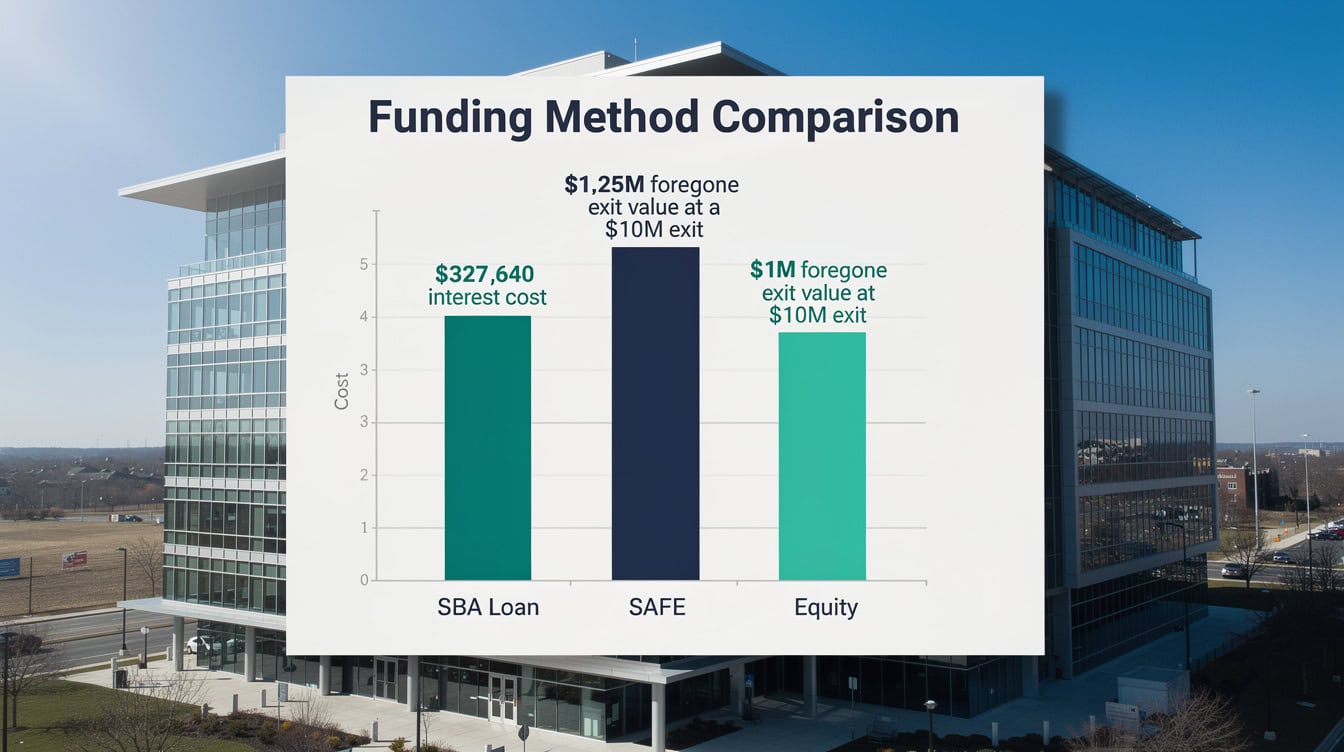
At a $10M exit, SBA loan interest costs $327,640 versus $1.25M in foregone proceeds from a SAFE — but at a $50M exit, that SAFE cost rises to $6.25M while loan interest stays fixed.
Total Cost of Capital: Worked Comparison at $500K and $2M
The true cost of each financing method depends on your exit outcome. Debt has a fixed cost regardless of success. Equity and SAFEs cost more the more successful you become, because you’ve given away a percentage of a larger pie.
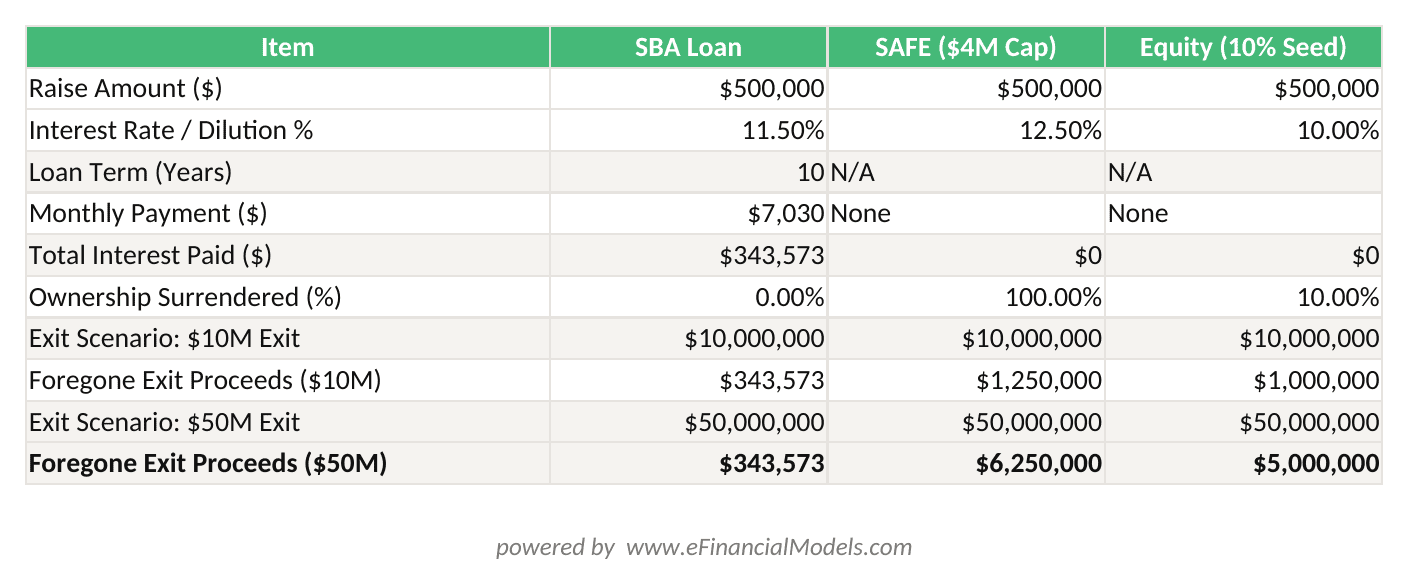
At a $50M exit, a $500K SAFE at a $4M cap costs founders $6.25M in foregone proceeds versus $327,640 in SBA loan interest — a 19x difference in capital cost.
Interpretation of the $500K scenario:
At a $10M exit, the SBA loan costs $327,640 in interest (paid over 10 years) and you keep 100% of $10M. The SAFE (12.5% ownership at conversion) costs you $1.25M in foregone exit proceeds. Direct equity at 10% dilution costs $1M in foregone proceeds. The SBA loan wins decisively — if you can qualify and service the debt.
At a $50M exit, the SAFE investor’s 12.5% stake is worth $6.25M. You paid $500K to give away $6.25M in exit value. The SBA loan still costs only $327,640. This is why high-growth founders should be cautious about low-cap SAFEs: the cost scales with your success.
The $2M raise comparison:
- SBA loan at $2M, 11.5%, 10 years: Monthly payment ~$27,588. Total interest paid: ~$1.31M. Ownership retained: 100%.
- SAFE at $2M with $8M cap: Converts to 25% ownership at priced round. At $50M exit, that’s $12.5M in foregone proceeds.
- Equity raise at $2M, $8M pre-money ($10M post-money): Investors own 20%. At $50M exit, that’s $10M in foregone proceeds.
For a $2M raise, the SBA loan’s $1.31M interest cost looks cheap compared to $10-12.5M in equity value surrendered at a successful exit — but only if your business generates enough cash flow to service $27,588 per month from day one.
Founder ownership drops from 100% to 54.4% across a SAFE, Series A, and 10% option pool — each round’s dilution compounds the previous one.
Founder Ownership Retention: Cap Table Scenarios
Founder dilution compounds across rounds. Here’s a realistic multi-round cap table for a startup that uses a SAFE at seed, then raises a Series A.
Starting point: 2 founders, 10M shares, 100% ownership each at 50%.
Round 1 — $500K SAFE at $4M cap: No immediate dilution. SAFE sits on cap table unconverted.
Round 2 — Series A: $3M at $10M pre-money ($13M post-money):
- SAFE converts first: $500K / $4M cap = 12.5% post-money ownership = 1,428,571 new shares issued
- Series A investors: $3M / $13M post-money = 23.1% ownership
- Founders’ combined ownership after both conversions: 100% – 12.5% – 23.1% = 64.4% (32.2% each)
Option pool (10% reserved for employees): If the option pool is created before the Series A (standard practice), founders absorb the dilution. After a 10% option pool, founders hold approximately 54.4% combined (27.2% each).
This is why SAFE overhang matters: the $500K SAFE that felt painless at signing cost founders 12.5% of the company by Series A close.
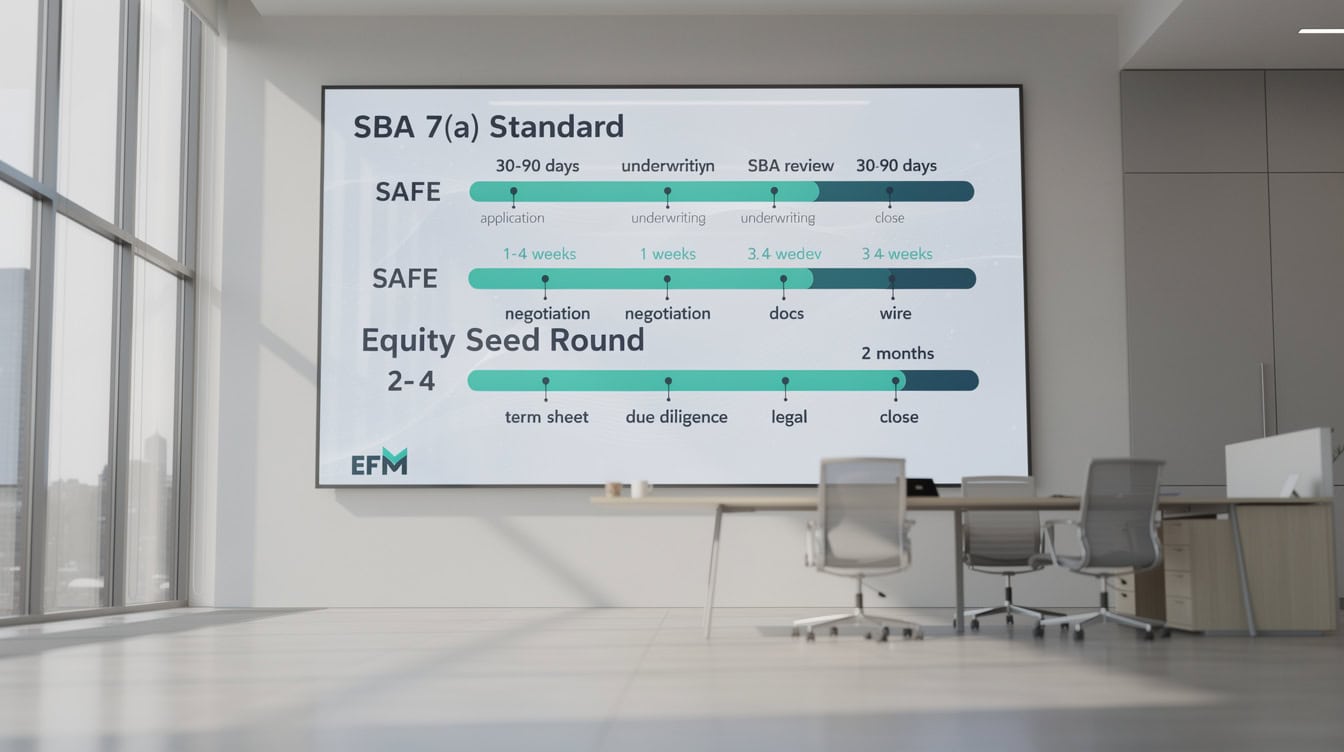
A SAFE closes in weeks; an SBA loan takes 30-90 days; a priced equity round takes 2-4 months — speed has real value when you’re burning runway.
Qualification Requirements and Access Constraints
Each financing method has different gatekeepers, and understanding who can access what is as important as understanding the cost.
SBA 7(a) requirements: You need 2+ years in business, a credit score above 680, positive cash flow, a DSCR of 1.25x or higher, U.S. citizenship or permanent residency, and collateral when available. Pre-revenue startups almost never qualify. The personal guarantee requirement means your personal financial history matters as much as your business’s.
SAFE and equity access: SAFEs and equity raises are typically restricted to accredited investors (individuals with $200,000+ annual income or $1M+ net worth excluding primary residence) under Regulation D. Regulation Crowdfunding allows non-accredited investors to participate, but caps the total raise at $5 million per 12-month period SEC (2024). Non-accredited investors face individual investment limits of the greater of $2,500 or 5% of the lesser of their annual income or net worth SEC (2024).
Timeline comparison:
| Method | Typical Timeline | Key Bottleneck |
|---|---|---|
| SBA 7(a) Standard | 30-90 days | Underwriting, appraisal, SBA review |
| SBA Express | 5-10 days | Lender approval only |
| SAFE (angel/seed) | 1-4 weeks | Negotiation, legal docs |
| Equity seed round | 2-4 months | Due diligence, term sheet, legal close |
| Reg CF campaign | 1-3 months | Platform review, investor campaign |
SBA loans impose operational covenants but no equity governance; SAFEs defer governance costs to conversion; equity raises impose board oversight and protective provisions immediately.
Control, Covenants, and Governance Implications
Financing always comes with strings. The question is which strings you can live with.
SBA loan covenants restrict your operational freedom in specific ways: you cannot pay dividends or distributions above a reasonable salary without lender approval, you cannot take on additional debt above certain thresholds, you must maintain minimum DSCR levels, and you must notify the lender of major business changes. Violating covenants can trigger technical default even if you’re current on payments.
SAFE holder rights are limited before conversion. SAFE investors typically have no voting rights, no board seats, and no information rights beyond what you voluntarily provide. After conversion at a priced round, they become equity holders with whatever rights that round’s term sheet specifies. The governance cost of a SAFE is deferred, not eliminated.
Equity investor rights at seed stage commonly include: one board seat (or observer rights), pro-rata rights in future rounds, information rights (quarterly financials, annual audited statements), and protective provisions requiring investor approval for major decisions. At Series A, these provisions become more extensive and more binding.
| Feature | SBA Loan | SAFE | Seed Equity |
|---|---|---|---|
| Voting rights | None | None (pre-conversion) | Yes |
| Board seat | None | None | Often yes |
| Dividend restrictions | Yes | No | Possible |
| Debt covenants | Yes | No | Rare |
| Personal guarantee | Yes | No | No |
| Information rights | Lender reporting | Voluntary | Yes |
| Exit pressure | None | Implicit | Strong |
The financing decision starts with your revenue profile: established businesses with cash flow should explore SBA debt first; pre-revenue startups should default to SAFEs until priced round readiness.
Optimal Use Cases: Decision Framework by Business Model
The right financing structure depends on three variables: your revenue profile, your growth trajectory, and your exit intentions.
Choose SBA 7(a) debt when:
- Your business generates consistent revenue and positive cash flow
- You have 2+ years of operating history and a credit score above 680
- You want to preserve 100% ownership and have no plans for a venture-scale exit
- You need capital for equipment, real estate, working capital, or acquisition
- You can service the monthly payments without straining operations
Choose a SAFE when:
- You’re pre-revenue or early-revenue and cannot qualify for debt
- You expect a priced equity round within 12-24 months
- You want to delay valuation negotiation until you have more traction
- Your investors are angels or seed funds comfortable with SAFE mechanics
- You understand the conversion math and have modeled the dilution impact
Choose a direct equity raise when:
- You need institutional capital with strategic value beyond the check (networks, expertise, follow-on capacity)
- You’re ready to set a formal valuation and build a governed cap table
- Your growth trajectory justifies the dilution cost (i.e., you expect the company to be worth 10x+ at exit)
- You need a priced round to unlock employee option grants or downstream financing
The business model test: A profitable restaurant or manufacturing company with $1M in annual revenue should almost always explore SBA debt before equity. A SaaS startup with $200K ARR and 150% net revenue retention should almost always use a SAFE or seed equity round. The financing structure should match the business model’s cash flow profile.
Hybrid Financing Strategies: Layering Debt and Equity
Hybrid strategies can minimize dilution while preserving growth capital, but they require careful sequencing.
SBA debt + SAFE: A business with some revenue history can use an SBA loan to fund operations and a SAFE to fund growth initiatives that don’t yet generate cash flow. The SBA lender must approve additional debt obligations, so disclose the SAFE upfront. SAFEs don’t appear as debt on your balance sheet (they’re equity instruments), which helps with covenant compliance.
SAFE bridge before Series A: If you’re 6-9 months from a Series A but need runway, a SAFE bridge from existing investors is faster and cheaper than a new priced round. Use a higher cap than your last SAFE to reward early investors without creating a cap table mess.
SBA debt after equity: Post-Series A companies with revenue can use SBA loans to fund non-dilutive growth (equipment, real estate, working capital) while preserving equity for strategic hires and R&D. This is the most capital-efficient hybrid structure for companies that have crossed into profitability.
For founders managing multiple financing instruments simultaneously, a multiple loan repayment planning model helps track debt service obligations alongside equity dilution scenarios. Understanding the pros and cons of equity financing before layering instruments is essential to avoid covenant conflicts. Founders raising their first institutional round should also review how to raise Series A funding to understand what priced round mechanics mean for SAFE conversion timing.
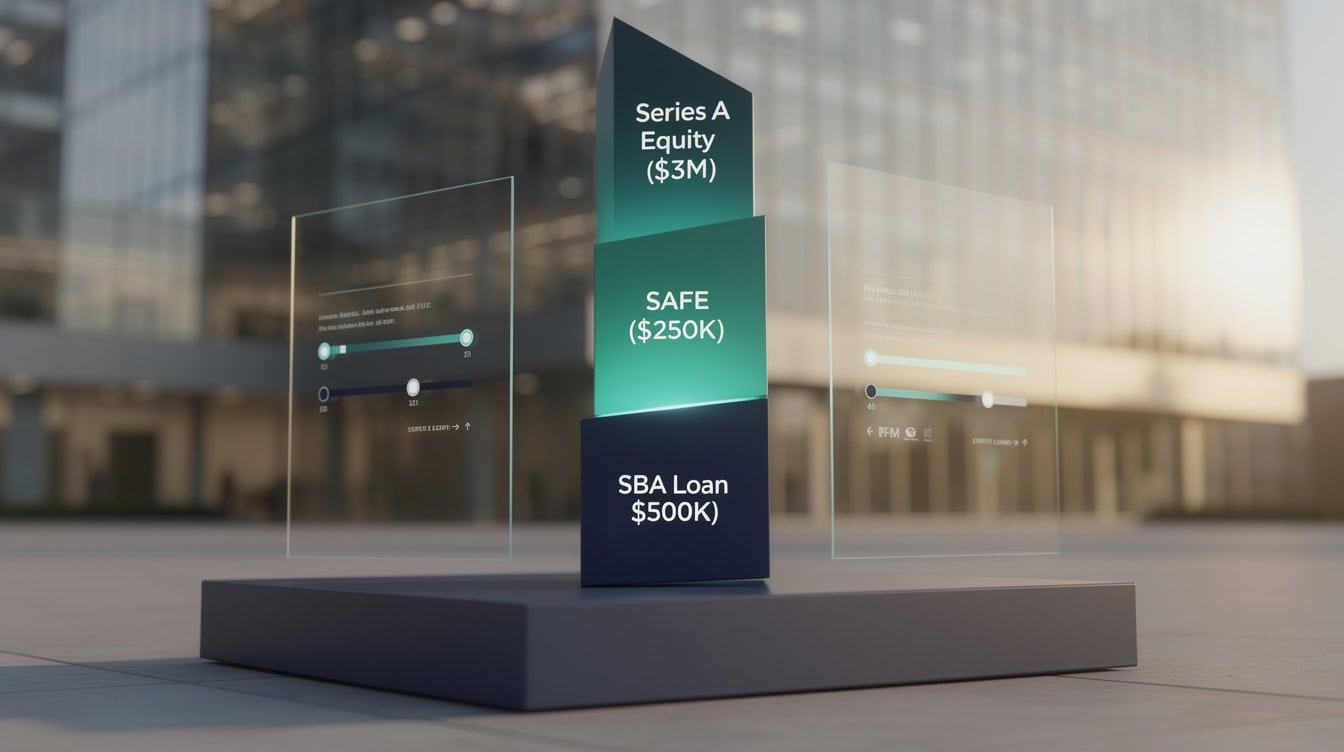
A hybrid strategy layers non-dilutive SBA debt for operations, a SAFE for growth initiatives, and Series A equity for scale — minimizing dilution at each stage while preserving optionality.
Frequently Asked Questions
Can I use an SBA loan and a SAFE at the same time?
Yes, but you must disclose the SAFE to your SBA lender. SAFEs are classified as equity instruments rather than debt, so they don’t technically violate most SBA debt covenants. However, SBA lenders review your full capital structure during underwriting, and some lenders may view unconverted SAFEs as a contingent liability. The safest approach is to close your SBA loan first, then issue SAFEs for growth capital. Reversing the order can complicate SBA underwriting if the lender views SAFE investors as having claims on business assets. Always have your attorney review the specific covenant language before layering instruments.
What credit score do I need for an SBA 7(a) loan?
Most SBA-approved lenders require a personal credit score of at least 680, with 700+ preferred for larger loan amounts. The SBA itself does not set a hard minimum, but lenders use the SBSS (Small Business Scoring Service) score, which incorporates both personal and business credit history. A score below 155 on the SBSS scale (out of 300) typically results in automatic decline for loans above $350,000. Beyond credit score, lenders evaluate your DSCR (debt service coverage ratio, meaning net operating income divided by total annual debt payments) and require it to be at least 1.25x. Two years of tax returns demonstrating consistent revenue are standard documentation requirements.
How does a SAFE valuation cap actually work in practice?
A valuation cap sets the maximum company valuation at which your SAFE converts into equity, regardless of the actual Series A valuation. If your SAFE has a $5M cap and your Series A prices the company at $15M pre-money, your SAFE investor converts as if the company were worth $5M — giving them 3x more shares per dollar than Series A investors. Here’s the math: a $250,000 SAFE at a $5M cap converts to 5% ownership ($250K / $5M). The same $250,000 at the $15M Series A price would buy only 1.67% ownership. The cap effectively rewards early investors for taking risk before the company had a proven valuation. Always model your cap table at multiple exit scenarios before setting a cap.
What happens to my SAFE if I never raise a priced round?
This is one of the most underappreciated risks of SAFEs. If your company never closes a priced equity round (the standard conversion trigger), the SAFE may never convert. Most SAFEs include a dissolution provision: if the company is sold or winds down, SAFE investors receive their money back before common shareholders (founders) receive anything. Some SAFEs also include a liquidity event conversion clause that triggers conversion at an acquisition. If you’re building a company you plan to sell rather than take public or raise venture capital for, review your SAFE documents carefully — your investors may have priority claims on acquisition proceeds that significantly reduce founder payouts.
Is the interest on an SBA loan tax-deductible?
Yes. Interest paid on SBA 7(a) loans is generally tax-deductible as a business expense under IRS rules, reducing your effective after-tax cost of debt. For a business in the 21% federal corporate tax bracket, an 11.5% nominal interest rate has an after-tax cost of approximately 9.1% (11.5% × (1 – 0.21)). Equity distributions and SAFE conversions do not generate tax deductions. This tax shield makes debt financing even more attractive relative to equity on an after-tax basis, particularly for profitable businesses. Consult a CPA to confirm deductibility based on your specific entity structure and tax situation.
How long does it take to close a SAFE vs. an equity round?
A SAFE with a single angel investor can close in as little as 1-2 weeks: negotiate the cap and discount, sign the YC standard SAFE document (2-4 pages), wire the funds. Legal costs run $1,000-$3,000. A priced seed equity round takes 2-4 months: negotiate the term sheet (2-4 weeks), conduct due diligence (2-4 weeks), draft and negotiate the definitive agreements including a Stockholders Agreement, NVCA-standard documents, and option plan amendments (4-8 weeks), then close. Legal costs for a priced round typically run $15,000-$50,000 for founders’ counsel alone. The speed and cost advantage of SAFEs is real — but remember that speed defers, rather than eliminates, the complexity of setting a valuation and negotiating investor rights.
What are the hidden costs of each financing method?
SBA loans carry origination fees (typically 0.5% to 3.5% of the guaranteed portion), appraisal costs for collateral, and ongoing lender reporting requirements. The personal guarantee means your personal credit score and assets are exposed for the loan’s full term. SAFEs have low upfront legal costs but create cap table complexity that increases legal costs at your Series A — attorneys must model all SAFE conversions before pricing the round, adding $5,000-$15,000 to closing costs. Equity raises carry the highest upfront costs: $15,000-$50,000 in legal fees, ongoing board management time (estimate 5-10 hours per month), and the implicit cost of investor reporting, board meetings, and governance overhead that scales with the number of investors.
Conclusion
SBA loans, SAFEs, and equity raises each serve a distinct founder profile. Debt preserves ownership but demands cash flow and personal guarantee exposure. SAFEs defer dilution but guarantee it at conversion, often at a cost that scales dramatically with your exit outcome. Direct equity raises maximize governance costs and dilution but bring strategic capital and institutional credibility.
The worked examples above show that at a $50M exit, a $500K SAFE at a $4M cap costs founders $6.25M in foregone proceeds — versus $327,640 in SBA interest. The math is clear: if you can qualify for debt, use it. If you can’t, model your SAFE conversion scenarios before you sign.
I recommend downloading the EFM Startup Financing Decision Model to compare the all-in cost and dilution impact of SBA debt, SAFEs, and equity across your specific raise amount, growth projections, and exit scenarios. The model includes pre-built cap table scenarios for multiple financing rounds so you can see exactly what each dollar of capital costs you at exit.