0 ITEMS

Ireland’s 50 Distilleries: What the 2026–2031 Outlook Means

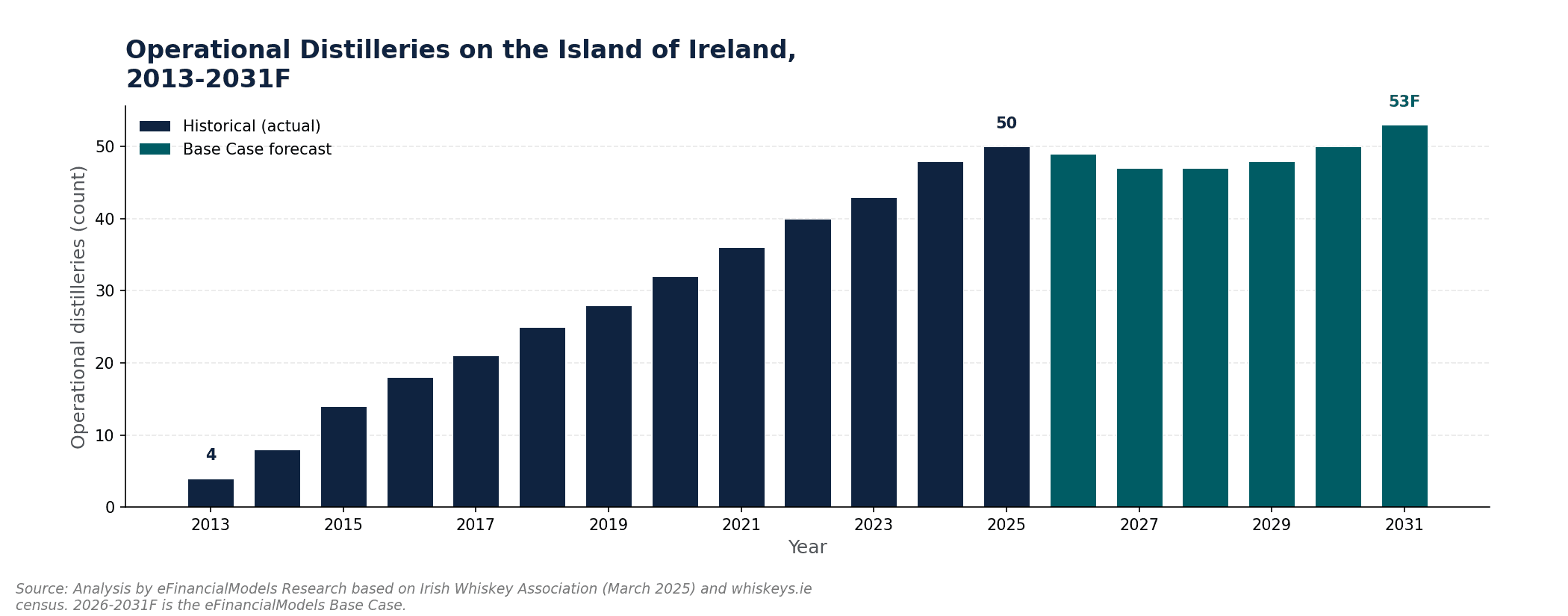
Irish whiskey grew from 4 operational distilleries in 2013 to 50 by March 2025, then hit three simultaneous shocks in 2025 that reset every financial model in the category.
Key Takeaways
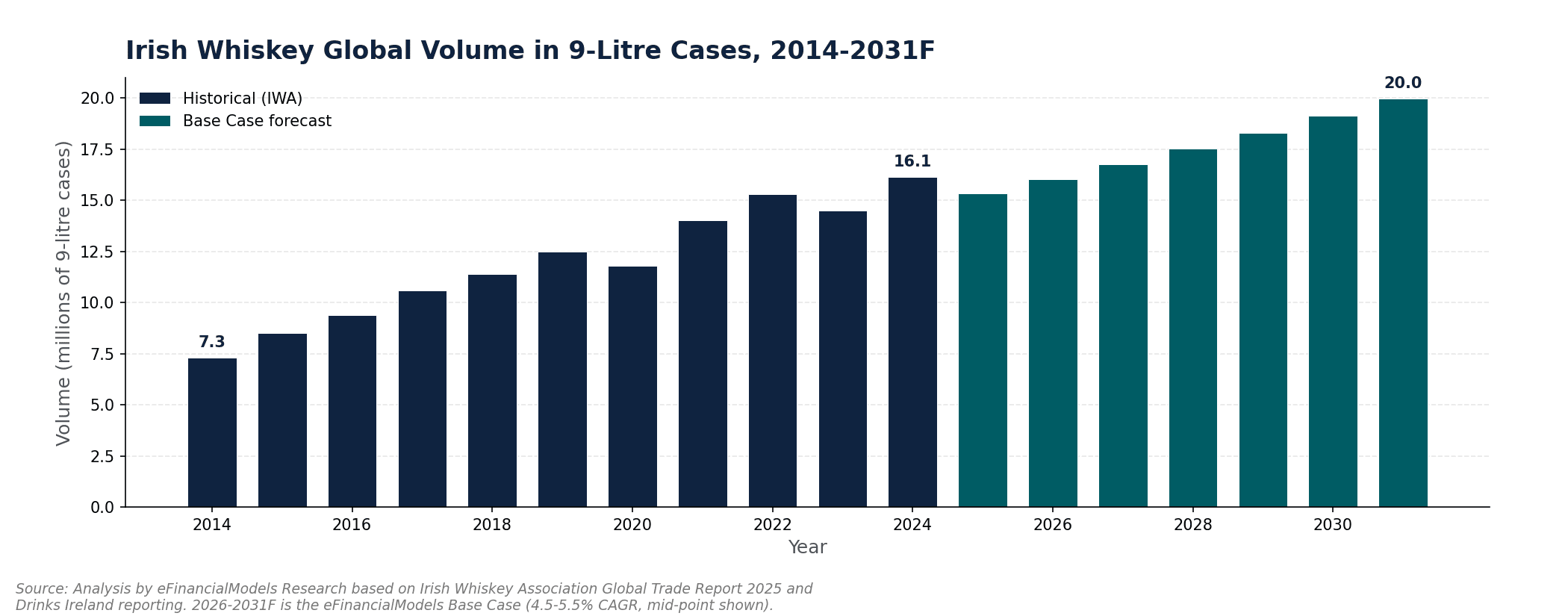
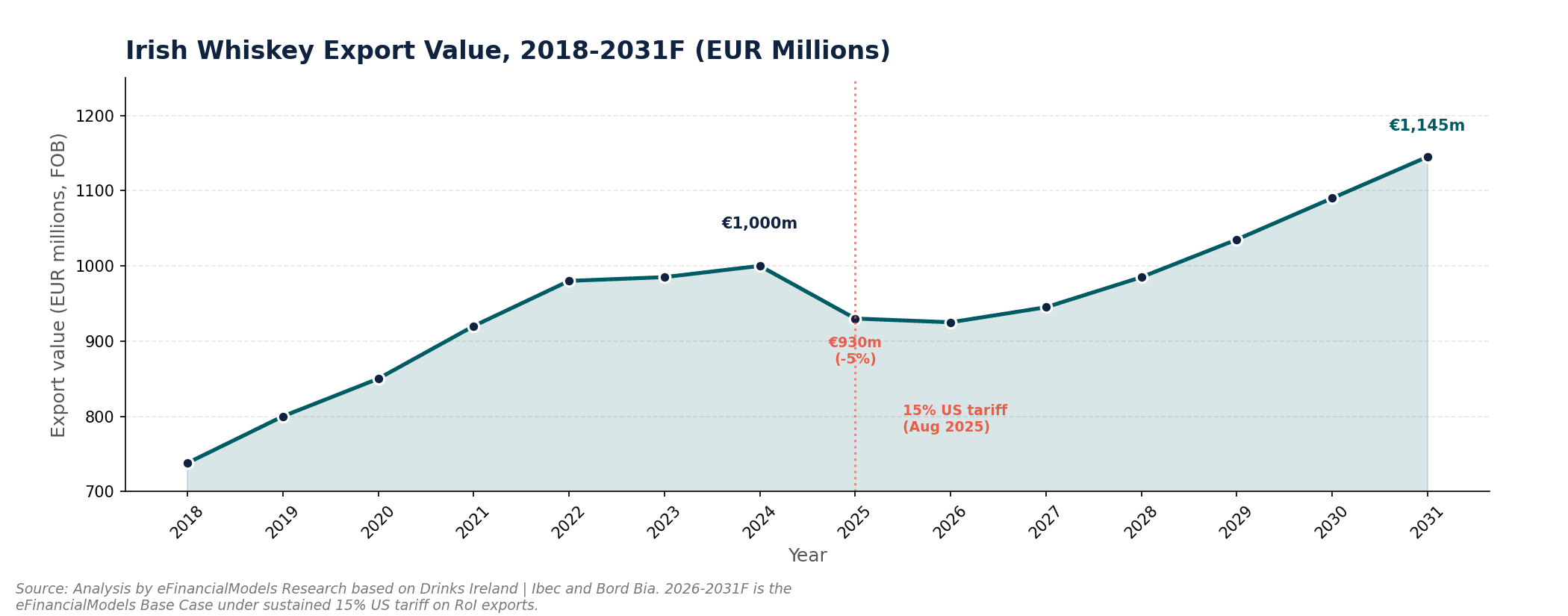
- Global Irish whiskey volume reached a record 16.15 million 9-liter cases in 2024, but export value fell 5% to EUR 930 million in 2025, the first decline since 2009.
- A 15% US tariff on Republic of Ireland spirits, imposed from August 2025, is the single largest 2026–2031 variable for any RoI-headquartered producer.
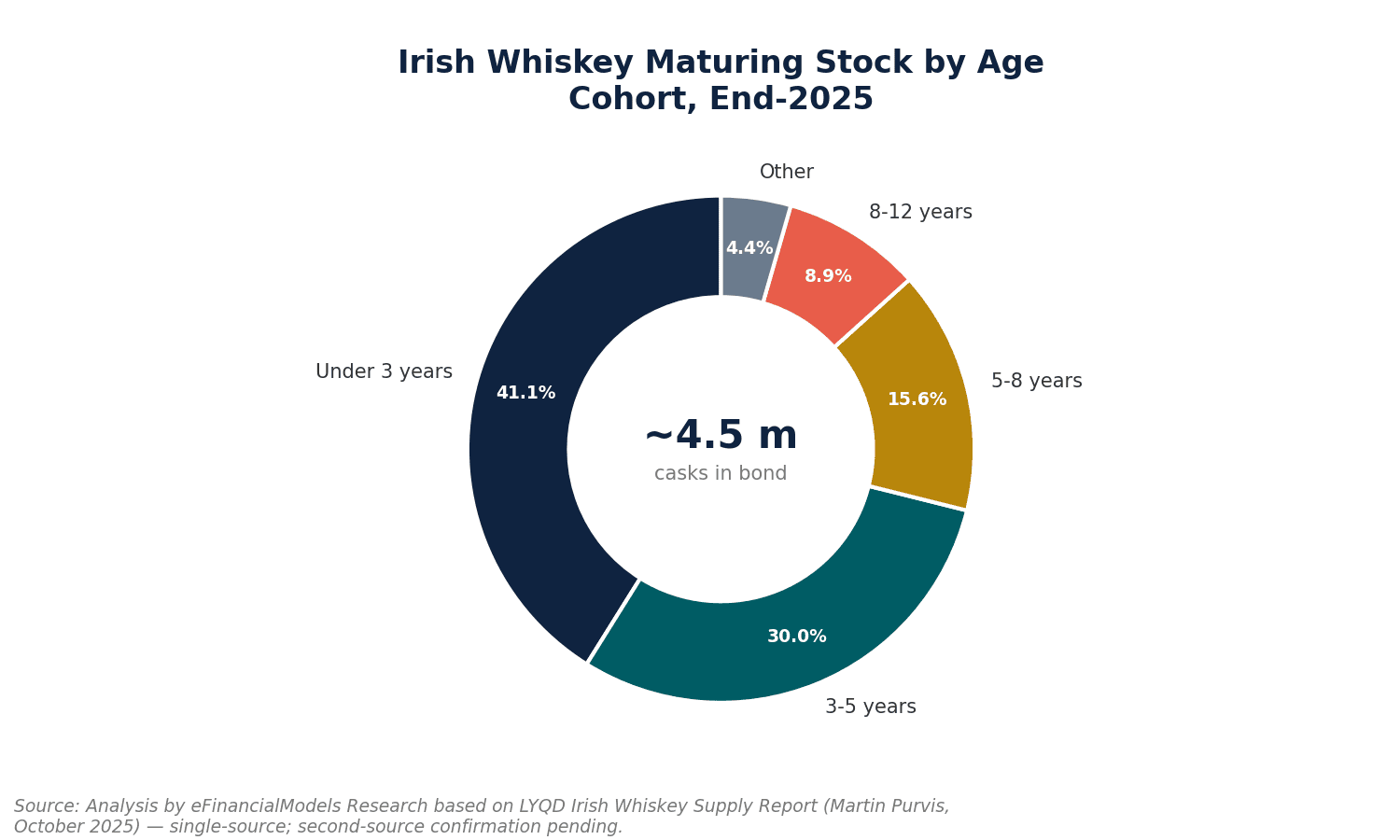
- Roughly 4.5 million casks sit in bond as of October 2025, equivalent to approximately 9 years of global demand at current run-rates, creating a significant inventory overhang.
- The base case (55% probability) projects 4.5–5.5% volume CAGR to 2031, recovering export value to roughly EUR 1.15 billion, with the distillery count stabilising near 50.
- India grew 107% in 2024 and a further 57% in 2025, overtaking the UK to become the fourth-largest Irish whiskey market.
- A representative craft distillery (200,000 LPA nameplate) reaches cumulative cash breakeven around year 8, with EBITDA in the EUR 9–15 million range by year 7.
- 2026 is the most attractive distressed-asset entry window since 2018: discounted bulk inventory, craft distillery acquisitions, and mature cask positions are all available below historical transaction multiples.
The State of Ireland’s Distilleries Right Now
Irish whiskey enters 2026 in a category-wide pause, not a structural collapse. More than 90% of distilleries curtailed production in 2025 as three shocks converged: the US tariff, a demand slowdown in the world’s largest market, and an inventory overhang that bulk new-make prices could not absorb. The Irish Whiskey Association’s Global Trade Report 2025 recorded export value at EUR 930 million, down from the EUR 1 billion milestone crossed for the first time in 2024. Craft operators bore the sharpest pain: Waterford, Powerscourt, Killarney Brewing & Distilling, and Blackwater all entered examinership or receivership by end-2025, and roughly 12 distilleries are currently paused.
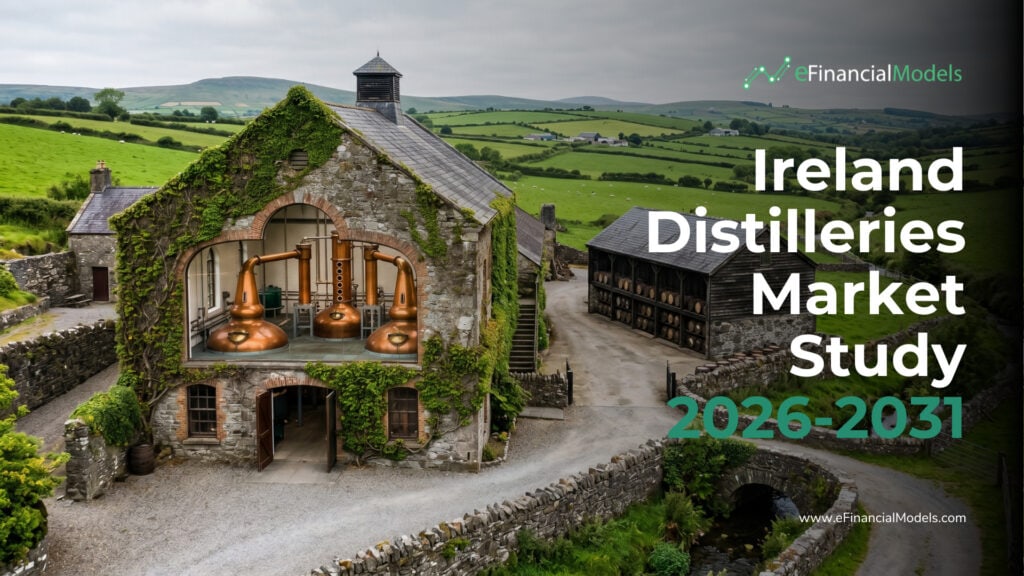
The big three — Pernod Ricard/Irish Distillers, Proximo/Bushmills, and William Grant/Tullamore D.E.W. — still account for roughly 75–80% of category volume according to the Ireland Distilleries Market Study 2026–2031. Their scale gives them options that craft operators simply don’t have: Pernod Ricard’s EUR 250 million Midleton expansion is delayed, not canceled, and Great Northern Distillery’s 70% curtailment in 2025 is a production decision, not a closure. The craft cohort, by contrast, faces a structural working-capital problem in years 4–7 of maturation — exactly the window the current correction is hitting hardest.
The US Tariff: How the Math Works for Producers
The 15% ad-valorem tariff on Republic of Ireland spirits is the dominant financial variable for the 2026–2031 period. Understanding how it flows through the P&L requires tracing the full US route-to-market: producer to importer to distributor to retailer.
Here’s the math for a standard-tier product. A 15% tariff on the FOB (free on board, meaning the price at the Irish port) value of a shipment does not translate to a 15% shelf-price increase. The absorption is split across the supply chain:
- Producers absorb roughly half through a reduced shipper-gate price.
- Distributors absorb a portion through compressed margin.
- Consumers absorb the balance through a 3–4% shelf-price increase.
The net producer-EBIT (earnings before interest and tax) effect on a representative export-heavy producer is roughly -12% to -18% in the first 12–18 months of tariff implementation, according to analysis in the Ireland Distilleries Market Study 2026–2031. For a producer with EUR 200 million in revenue and 50% US export exposure, that translates to an EBIT reduction of EUR 10–15 million in year one before any mitigation.
Northern Ireland producers face a different regime. The UK-US trade arrangement holds the NI tariff at 10% through 2031, creating a 500 basis point landed-cost advantage for NI-distilled product versus RoI product in the US market. That divergence is a structural edge for any investor evaluating a Northern Ireland distillery acquisition or greenfield build.
Three Scenarios: Bear, Base, and Bull
The 2026–2031 outlook depends almost entirely on how the US tariff regime resolves. The study frames three scenarios with explicit probability weights.
| KPI | Bear (25%) | Base (55%) | Bull (20%) |
|---|---|---|---|
| 2031 volume (m 9LC) | 18.0 | 21.0 | 24.5 |
| 2031 export value (EUR m) | 950 | 1,145 | 1,450 |
| Volume CAGR 2025–2031 | 2.5% | 5.0% | 7.5% |
| US tariff regime | 15% full window | 15% to 2027, partial relief | Zero-for-zero late 2026 |
| Distillery count 2031 | 42–44 | 50–53 | 55–58 |
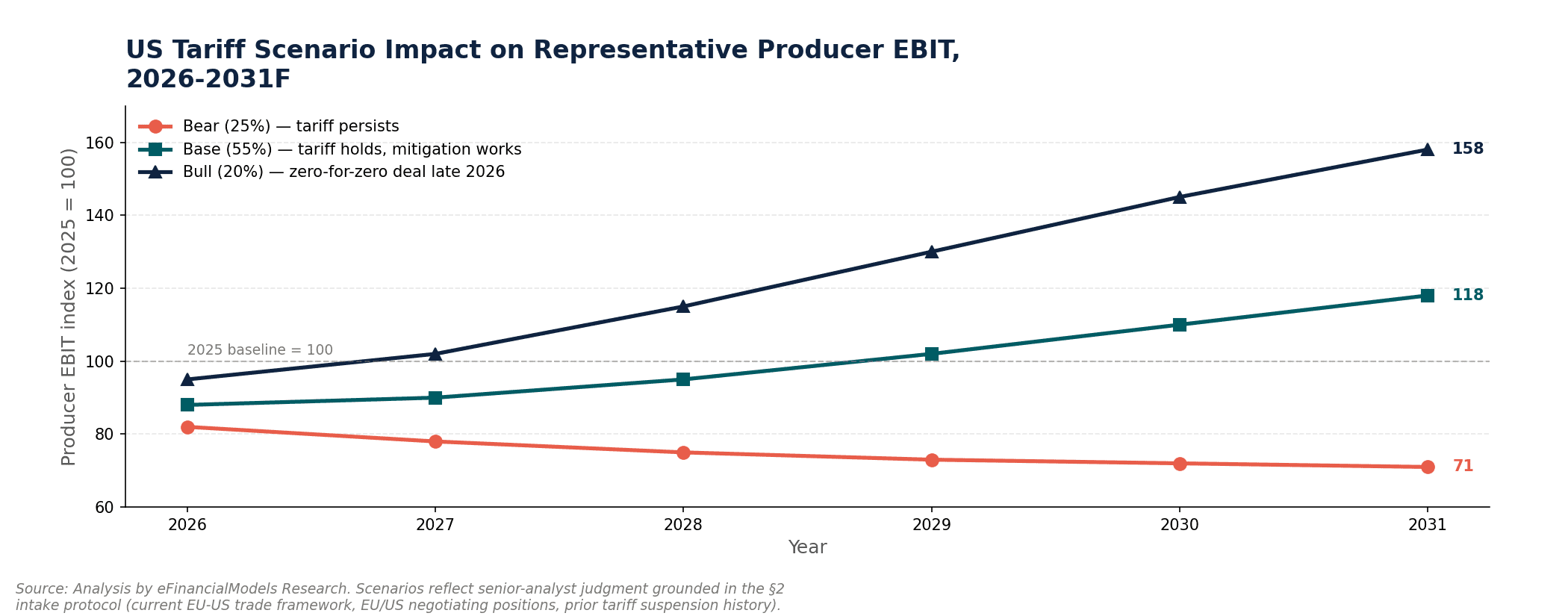
| EBIT index 2031 (2025=100) | 71 | 118 | 158 |
| Bulk new-make price index (2020=100) | 98 | 110 | 135 |
The bear case (25% probability) assumes the 15% tariff holds for the full window, India growth moderates to 15–20% CAGR after the 2024–2025 surge, and the inventory overhang persists into 2030. The result: 8–12 distillery closures or mergers between 2025 and 2028, and an EBIT index of 71 by 2031 for a representative producer.
The base case (55% probability) assumes partial tariff relief from 2028 onward as EU-US trade dialogue produces a calibrated arrangement on spirits and wine. India CAGR holds at 35–40% through 2027 before easing. The inventory overhang clears by 2028. The bull case (20% probability) assumes a zero-for-zero spirits agreement in late 2026, a structural return to the 1997–2018 regime, and rapid US volume recovery.
Demand Rebalancing: India, Germany, and the Premiumization Shift
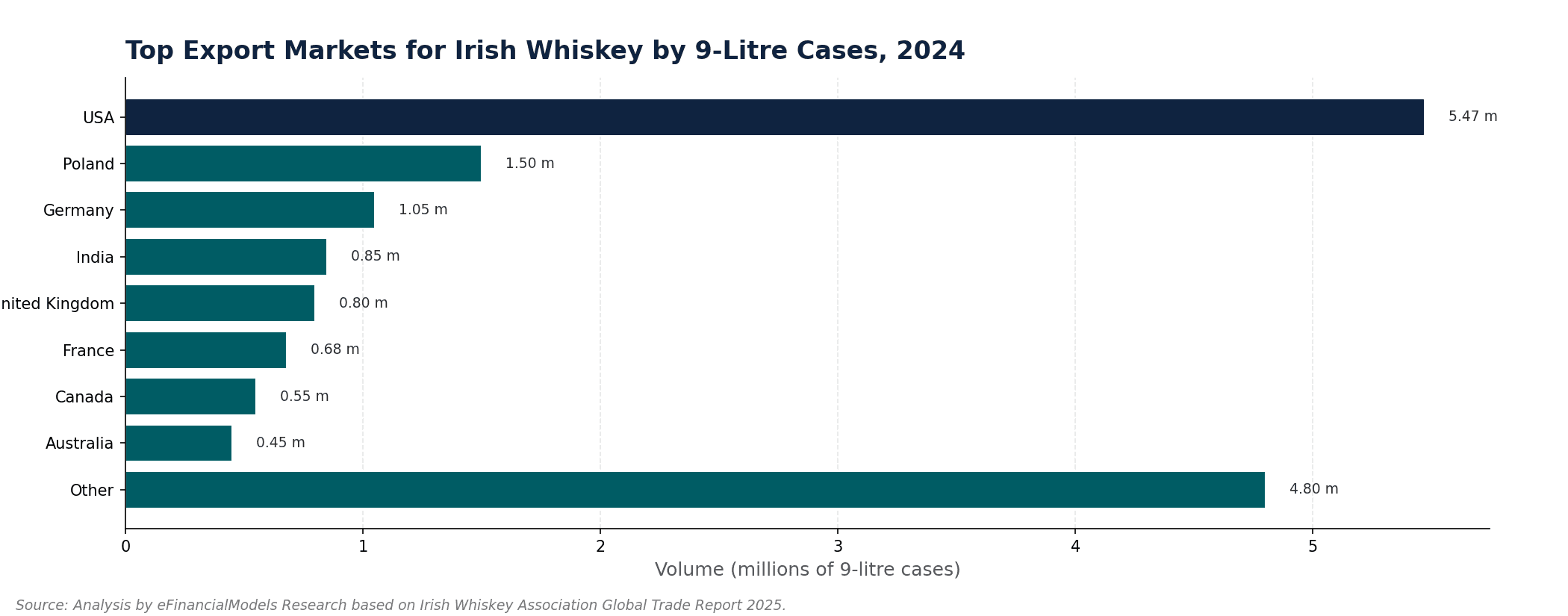
The US remains the inescapable axis of Irish whiskey demand, at 5.47 million 9-liter cases in 2024 and roughly 34% of category volume. But the export mix is reordering faster than the headline suggests.
India is the standout structural change. Exports to India rose 107% in 2024 and a further 57% in 2025, according to the Irish Whiskey Association Global Trade Report 2025, displacing the UK from the top five markets entirely. Germany grew at 11% and Poland held share; Japan doubled off a small base. These markets don’t replace the US in volume terms, but they provide meaningful diversification for producers willing to invest in route-to-market infrastructure outside the three-tier US distribution system.
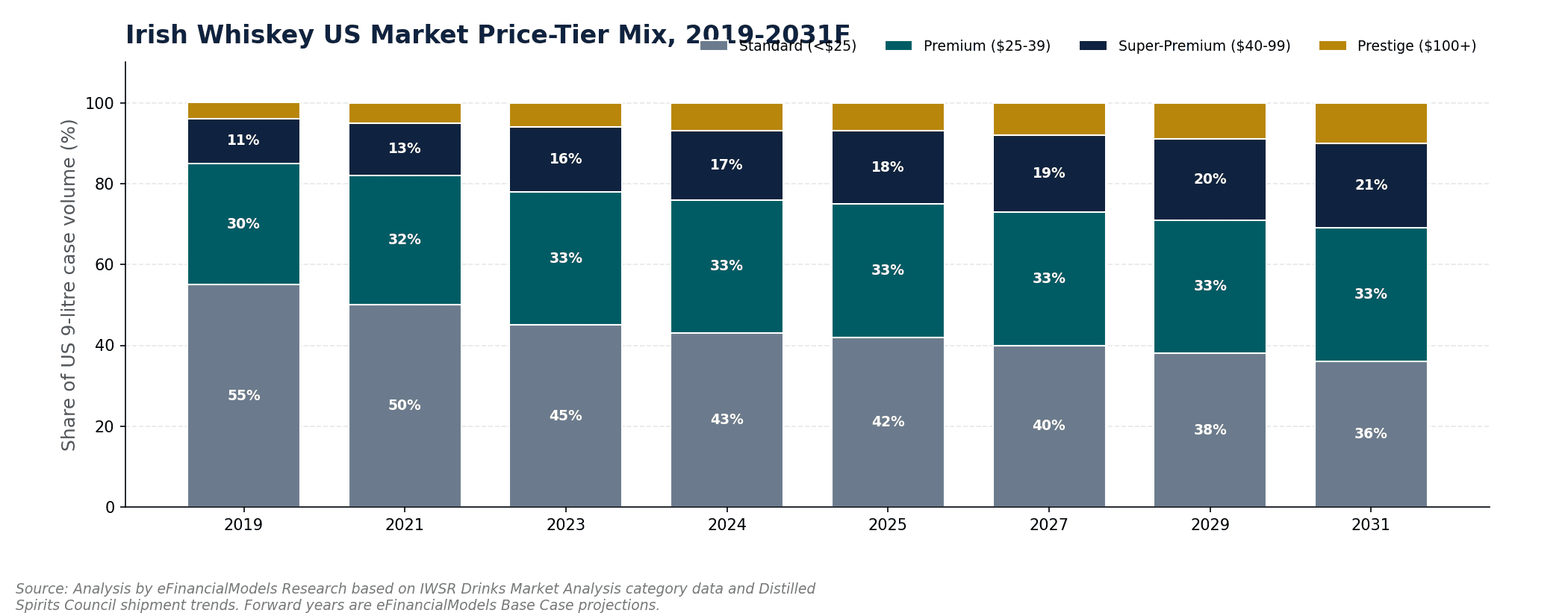
Premiumization (the shift of category volume toward higher price tiers, defined by IWSR as super-premium at USD 40–99 per 9-liter case and prestige at USD 100+) is the principal demand-side mechanism for the next five years. Super-premium and prestige tiers are projected to lift from 24% of US case volume in 2024 to roughly 31% by 2031, according to IWSR Drinks Market Analysis category data. Standard-tier volume share is projected to decline from 43% to 36% over the same period. The practical implication: producers who can credibly occupy the premium tier absorb tariff pass-through with materially less volume drag than standard-tier producers.
Craft Distillery Unit Economics: The Maturation Cash Drag
The defining economic characteristic of Irish whiskey production is the maturation cash drag. A craft distillery must hold spirit in cask for a minimum of 3 years before it legally qualifies as Irish whiskey under the EU and UK Geographical Indication (GI) rules (European Commission). In practice, most premium craft brands target 5–12 years of maturation, which means the cash outflow window is long and the revenue window is delayed.
A typical craft distillery sinks EUR 12–18 million of capital expenditure to commission, then continues to invest in inventory build for 3–7 years before the first material revenue from own-label bottled product arrives. The bridging revenue stack — bulk and private-label sales of new-make spirit, visitor-center income, cask-buyer programs, and contract distilling for third-party brands — is what determines survival, not the quality of the eventual flagship bottling. The Scotch industry’s analogous craft wave between 2008 and 2018 produced roughly 50 new distilleries; approximately 70% reached cash breakeven within their planned 7–10 year window, and the failures were almost entirely working-capital failures rather than demand-side failures.
Worked Example: 200,000 LPA Craft Distillery Cash Flow
Here’s how the numbers work for a representative 200,000 LPA (liters of pure alcohol) craft project under the base case, using the eFinancialModels Liquor Distillery Financial Plan template as the modeling framework:
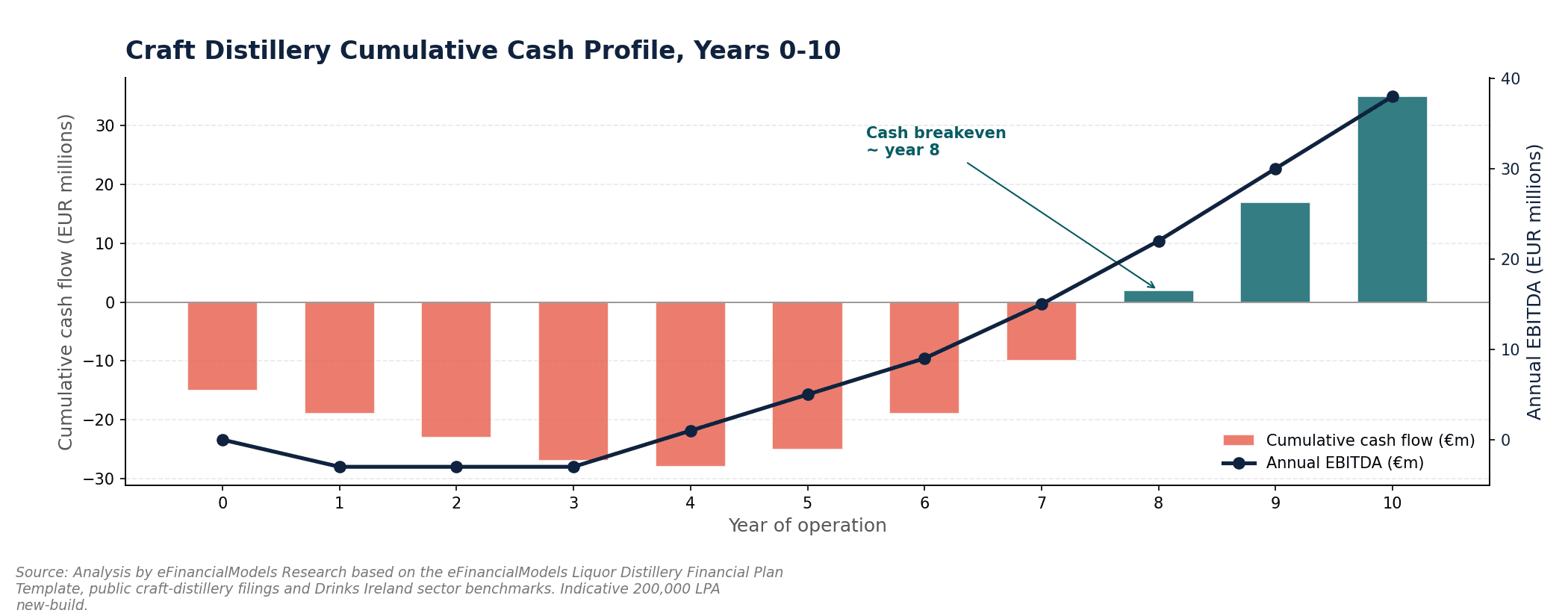
Year 1–3: Capital expenditure of EUR 15 million (midpoint of the EUR 12–18 million range). Revenue is near zero from own-label product. Bridging revenue from bulk new-make sales and visitor center covers roughly 20–30% of annual operating costs.
Year 4–7: The maturation cash drag is at its peak. The distillery holds 3–7 year casks in bond but cannot yet bottle premium product. Bulk pricing in this cohort corrected approximately 25% between 2024 and 2025, directly compressing the bridging revenue line. Annual EBITDA (earnings before interest, tax, depreciation, and amortisation) is negative or marginally positive.
Year 7–8: The first 5-year mature stock enters bottling. Annual EBITDA reaches EUR 9–15 million. Cumulative cash breakeven occurs around year 8.
IRR sensitivity: The risk-adjusted internal rate of return (IRR, the annualised return that makes the net present value of all cash flows equal to zero) is highly sensitive to bulk-price trajectory in years 4–7. A 25% bulk-price reduction in that window — consistent with the 2024–2025 correction — reduces the project IRR by approximately 3–5 percentage points versus the pre-correction base case.
Supply-Side Concentration and the Capacity Ceiling
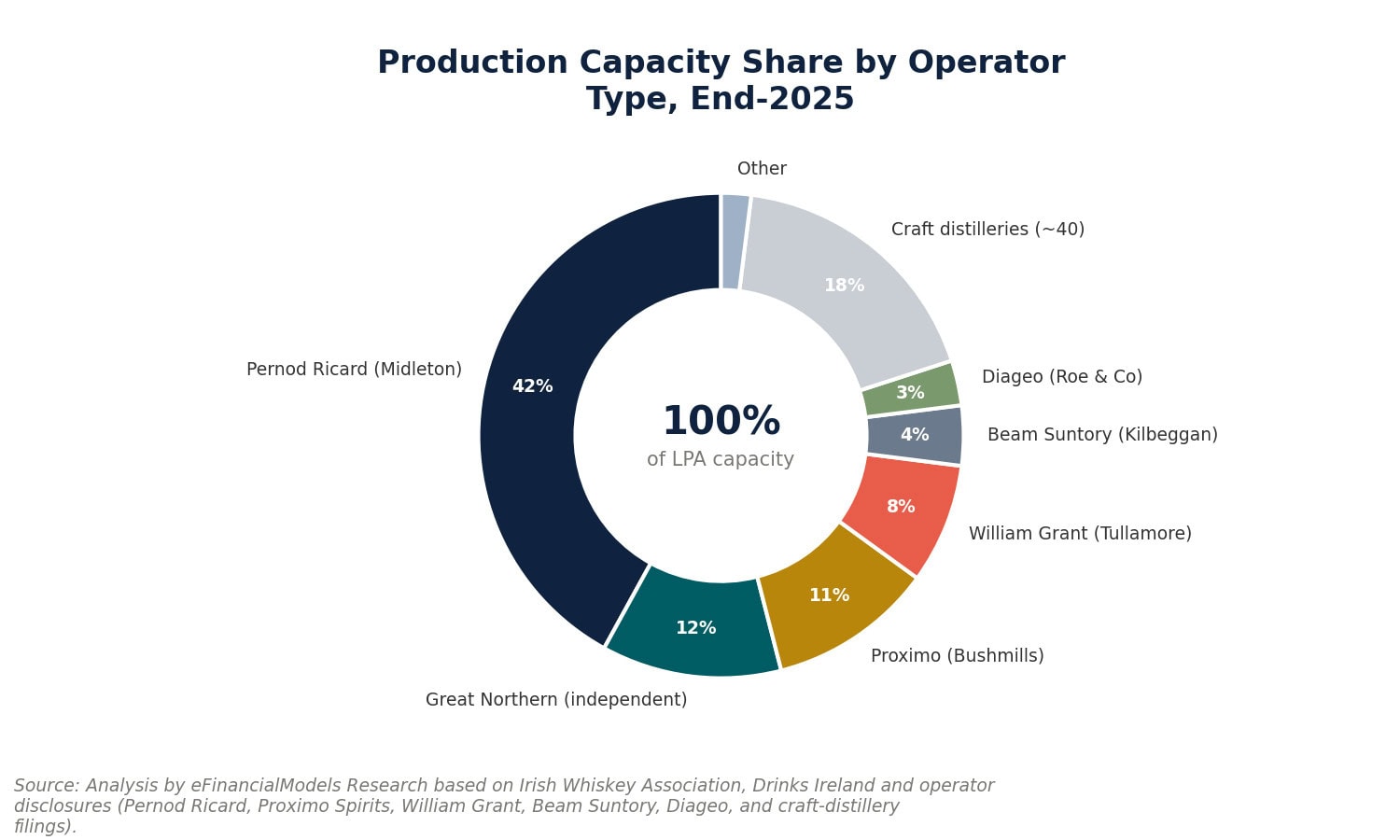
Five operators control the vast majority of Irish whiskey distillation capacity. Pernod Ricard holds roughly 42% of nameplate distillation capacity at approximately 75 million LPA, according to Irish Whiskey Association and operator disclosures. Great Northern Distillery (22 million LPA) operates primarily as a contract and bulk producer. Proximo/Bushmills (20 million LPA), William Grant/Tullamore D.E.W. (14 million LPA), and Beam Suntory (7 million LPA) round out the top five. Together, these five operators represent a combined nameplate capacity of approximately 138 million LPA, according to Irish Whiskey Association operator disclosures, meaning the top five alone hold capacity equivalent to more than 8 times current annual global demand of roughly 16 million 9-liter cases.
Pernod Ricard’s EUR 250 million Midleton expansion sets the long-cycle capacity ceiling for the category. Originally scheduled for a 2025 ribbon-cutting, the project is now delayed by the category slowdown. When it completes, it will shape the 2027–2029 supply window — the same window where craft distillers either reach their first mature-stock revenue or exhaust their working capital. Great Northern Distillery curtailed distillation by 70% in 2025 as energy costs tripled. Diageo paused Roe & Co in Dublin mid-2025. None of these moves is permanent, but all of them reduce incremental supply and support the bulk new-make price recovery the base case requires.
Sustainability: A Hard Cost, Not a Soft Commitment
The Irish Whiskey Association’s Sustainable Together roadmap commits the industry to support Ireland’s 2050 Net Zero target and sets an interim milestone of approximately 6.5 kWh per LPA distilled by 2030. The current industry average is roughly 11.5 kWh per LPA. Best-in-class operations using biomass combined heat and power (CHP) or anaerobic digestion already operate below the 2030 target at approximately 5.8 kWh per LPA, according to the IWA Sustainable Together roadmap (2022, updated 2024).
The capital expenditure required to move a typical existing distillery from 11.5 to 6.5 kWh is in the EUR 3–8 million range depending on plant size. For a craft operator already stretched by the maturation cash drag, that is a material additional burden. The 2026–2028 window is the right time to act: SEAI (Sustainable Energy Authority of Ireland) grant programs are available, and sequencing energy upgrades before flagship brand launches reduces the total capex burden.
The Public Health (Alcohol) Act 2018, Section 12 health-warning label requirement has been deferred to 3 September 2028 (from the original 22 May 2026 date). The relief is temporary: mandatory labeling cost is delayed, not removed, and producers should begin label redesign now to avoid a compressed compliance sprint in 2027–2028.
Common Mistakes Investors and Operators Make
Five specific errors recur across distillery investment decisions in the current environment.
1. Underestimating the maturation cash drag in years 4–7. Most current valuations stress-test the first three years of capex but under-model the working-capital requirement in years 4–7, when the distillery holds significant inventory in bond but generates limited own-label revenue. The fix: model cash runway explicitly to year 8 under bear-case bulk pricing (approximately 25% below the 2024 peak through 2028).
2. Treating the US as the only market. Producers with 50%+ US export exposure face a binary tariff outcome. The fix: build India and Germany route-to-market infrastructure now, while US-focused competitors are distracted by tariff mitigation.
3. Ignoring the NI tariff arbitrage. The 500 basis point US landed-cost advantage for Northern Ireland-distilled product is a structural edge that most RoI-focused investors have not modeled. The fix: evaluate NI acquisition or build-out options explicitly.
4. Buying distressed assets without a bridging revenue plan. Distressed craft distilleries are available at significant discounts to historical transaction multiples, but the discount is irrelevant if the acquirer cannot fund the remaining maturation period. The fix: acquire the asset only if you can also fund the bridging revenue stack (visitor center, cask club, contract distilling) through to year 8.
5. Deferring energy upgrades. Operators who defer the EUR 3–8 million energy capex will face it anyway by 2030, but without the SEAI grant support available in 2026–2028. The fix: sequence energy upgrades before flagship launches.
Tools and Templates for Distillery Financial Modeling
Market-level data from the Ireland Distilleries Market Study 2026–2031 provides the sector context: demand drivers, competitive landscape, regulatory framework, pricing dynamics, and scenario analysis. To build project-level financial cash flows for a specific distillery investment, you need a dedicated financial model that handles maturation cash drag, capex phasing, and DCF (discounted cash flow) valuation.
For investors evaluating marketplace-style cask trading platforms or digital exchange investments alongside distillery assets, the Online Marketplace Financial Model Excel Template provides a relevant structural framework. For broader market context on the investment landscape, the Market Studies library at eFinancialModels covers adjacent categories.
For financial modellers specifically: apply a 12–18% EBIT haircut for the first 18 months of tariff implementation, model the bear-case bulk pricing as the binding cash-runway constraint in years 4–7, and use the IMAP transaction-multiple framework as a calibration reference for distressed-asset acquisitions.
Frequently Asked Questions
How many operational distilleries does Ireland have in 2025?
Ireland had 50 operational distilleries as of March 2025, up from just 4 in 2013. However, the operational count is distinct from the licensed count: roughly 42 distilleries held active maturing stock as of end-2025, while approximately 12 were paused and several were in examinership or receivership. The rapid expansion from 2013 to 2025 was driven by craft and new-wave entrants; the correction underway in 2025–2026 is expected to reduce the count to 50–53 under the base case by 2031, or as low as 42–44 under the bear case. The big three operators (Pernod Ricard, Proximo, William Grant) account for roughly 75–80% of category volume regardless of the total distillery count.
What is the US tariff on Irish whiskey and how long will it last?
The US imposed a 15% ad-valorem tariff on Republic of Ireland spirits from August 2025. Northern Ireland-distilled product faces a lower 10% rate under the UK-US trade arrangement. The study assigns a 55% probability to the base case, in which the 15% RoI tariff holds through 2027 and partial relief arrives from 2028 onward. There is a 25% probability the tariff holds for the full 2026–2031 window (bear case) and a 20% probability of a zero-for-zero spirits agreement in late 2026 (bull case). For a representative producer with EUR 200 million revenue and 50% US exposure, the tariff reduces EBIT by roughly 12–18% in the first 12–18 months before mitigation measures take effect.
What is the inventory overhang and why does it matter?
The inventory overhang refers to the approximately 4.5 million casks currently held in bond across Ireland, equivalent to roughly 9 years of global demand at current run-rates, according to the LYQD/Martin Purvis Irish Whiskey Supply Report (October 2025). This overhang formed because distilleries expanded production aggressively between 2018 and 2023, then demand growth slowed and the US tariff arrived simultaneously. The practical effect is that bulk new-make prices corrected approximately 25% between 2024 and 2025, compressing the bridging revenue that craft distillers in years 4–7 of maturation depend on. Under the base case, the overhang clears by 2028–2029 as production curtailment removes incremental supply and the under-3-year cohort matures into use.
Why is India suddenly so important for Irish whiskey?
India grew 107% in 2024 and a further 57% in 2025, according to the Irish Whiskey Association Global Trade Report 2025, making it the fourth-largest Irish whiskey market and displacing the UK from the top five entirely. The growth reflects a combination of rising middle-class disposable income, a cultural shift toward premium imported spirits, and the relative absence of the tariff headwinds affecting the US market. India’s CAGR is projected at 35–40% through 2027 under the base case before easing. For producers looking to diversify away from US exposure, India and Germany (growing at 11% in 2024–2025) are the two markets where trade-marketing reallocation delivers the fastest volume recovery.
What does premiumization mean for Irish whiskey economics?
Premiumization is the shift of category volume toward higher price tiers: super-premium (USD 40–99 per 9-liter case at shelf) and prestige (USD 100+), as defined by IWSR. These tiers are projected to lift from 24% of US case volume in 2024 to roughly 31% by 2031. The economic significance is that premium-tier products absorb tariff pass-through with materially less volume drag than standard-tier products, because the tariff represents a smaller percentage of the total shelf price and the consumer is less price-sensitive. Standard-tier volume share is projected to decline from 43% to 36% of US volume over the same period. Producers who can credibly occupy the premium tier through single-pot-still expressions, age-statement releases, or cask-finish innovation are structurally better positioned for the 2026–2031 window.
When is the best time to acquire a distressed Irish distillery?
The study identifies 2026 as the most attractive distressed-asset entry window since 2018. Roughly 9–12 craft distilleries face acute financial pressure through 2027, and mature stock, warehouse assets, and brand IP can be acquired at significant discounts to historical transaction multiples. The IMAP transaction-multiple framework provides a calibration reference for valuation. The critical caveat: the discount is only valuable if the acquirer can fund the remaining maturation period and build a bridging revenue stack (visitor center, cask club, contract distilling) through to year 8. Acquiring a distressed asset without a funded bridging plan simply transfers the working-capital problem to the new owner.
What sustainability requirements apply to Irish distilleries by 2030?
The Irish Whiskey Association’s Sustainable Together roadmap sets an interim milestone of approximately 6.5 kWh per LPA distilled by 2030, versus a current industry average of roughly 11.5 kWh. Best-in-class operations using biomass CHP or anaerobic digestion already operate below the 2030 target at approximately 5.8 kWh. The capital expenditure to move a typical distillery from 11.5 to 6.5 kWh is EUR 3–8 million depending on plant size. SEAI grant programs are available in the 2026–2028 window, making this the optimal time to act. Separately, the Public Health (Alcohol) Act 2018 Section 12 health-warning label requirement applies from 3 September 2028; producers should begin label redesign now to avoid a compressed compliance sprint.
Conclusion
Irish whiskey’s 2026–2031 window is defined by three numbers: a 15% US tariff, 4.5 million casks in bond, and a category that grew from 4 to 50 distilleries in 12 years. The correction is real, but so is the opportunity. The inventory overhang clears by 2028–2029 under the base case. India is growing at 57% per year. Distressed craft assets are available at the lowest entry multiples since 2018. The producers and investors who survive the 2025–2027 working-capital squeeze will enter the 2028–2031 premium-tier growth phase with a structural cost and stock advantage over anyone who waits.
I recommend starting with the Ireland Distilleries Market Study 2026–2031 to get the full scenario analysis, pricing model assumptions, and stakeholder-specific action checklists before committing capital to any position in this category.