0 ITEMS

Maldives Resort Market: 2.25M Arrivals, $5.4B Revenue
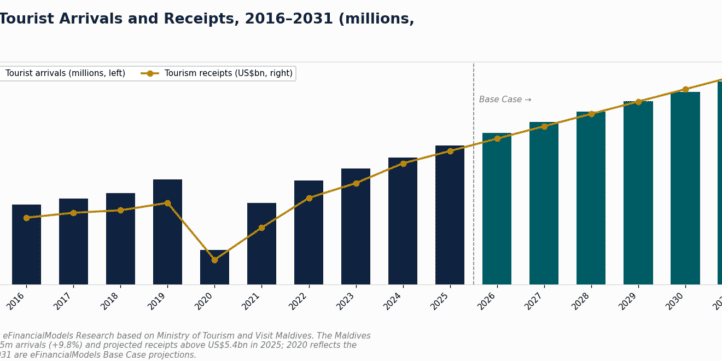
The Maldives enters 2026 as the world’s defining luxury-resort destination, posting an all-time arrivals record in 2025 and generating tourism receipts that exceeded its own government target.
Key Takeaways
- The Maldives welcomed roughly 2.25 million visitors in 2025, up 9.8% year-on-year, generating projected receipts above US$5.4 billion against a US$5 billion government target (eFinancialModels Research, 2026).
- Luxury overwater villas with private pools price at US$1,385 to US$1,900 per night, commanding a 40% to 80% premium over comparable beach villas in the same resort.
- The Base Case scenario projects luxury RevPAR (revenue per available room) growth of 4.5% per year through 2031, with arrivals reaching roughly 3.28 million.
- New resort supply is gated by government island tenders: the 2025 round offered only 14 plots on 50-year leases, with a minimum investment of US$100,000 per room.
- The 2025 fiscal tightening added a 17% Tourism GST (up from 16%), a doubled Green Tax of US$12 per guest per night, and higher airport fees, all of which fall most lightly on the luxury tier.
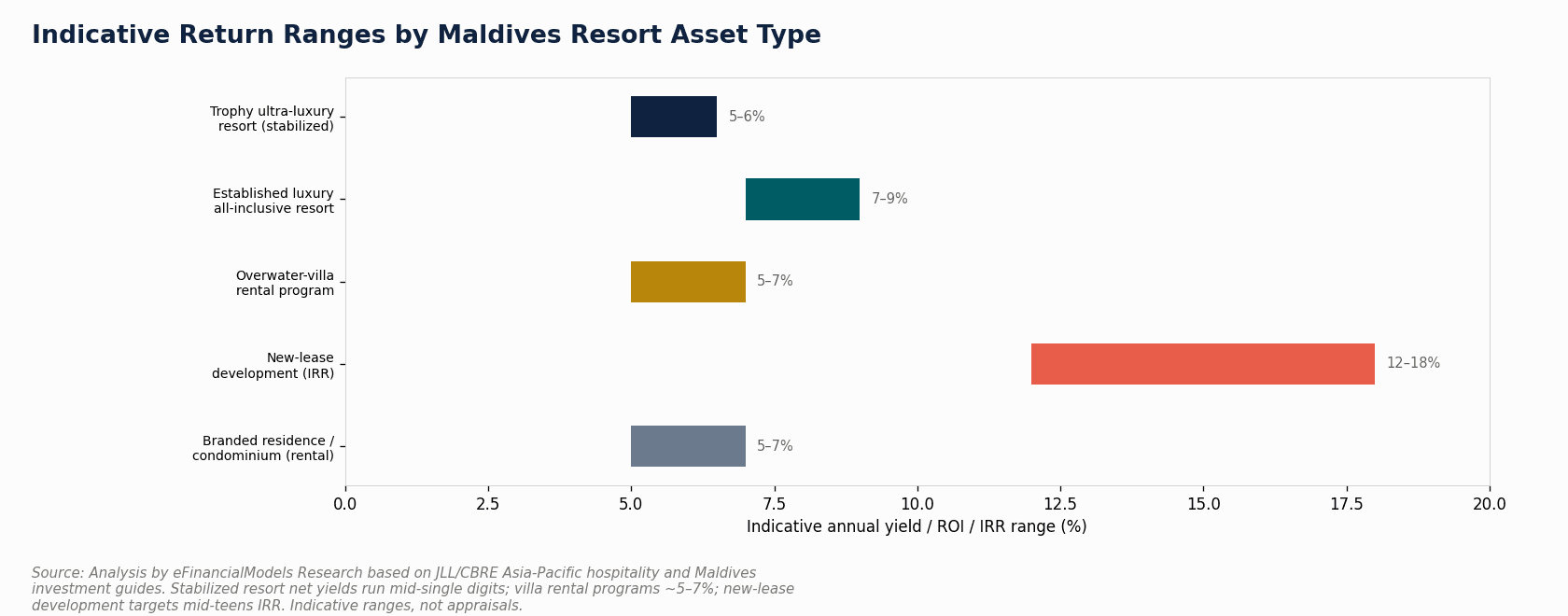
- Stabilized resort net yields run approximately 5% to 7%, while new-lease development IRRs range from 12% to 18% depending on brand, location, and lease term.
- Climate risk is the sector’s most critical long-run threat: sea-level rise and reef bleaching are modeled as recurring capital expenditure items, not tail risks.
What Defines the Maldives Resort Market in 2026

The Maldives resort market is structurally unlike any other luxury destination because every resort occupies its own private island, eliminating the budget hotel base that dilutes revenue in other markets. The one-island-one-resort model means every arriving guest is, by definition, a high-value guest whose entire on-property spend flows to a single operator.
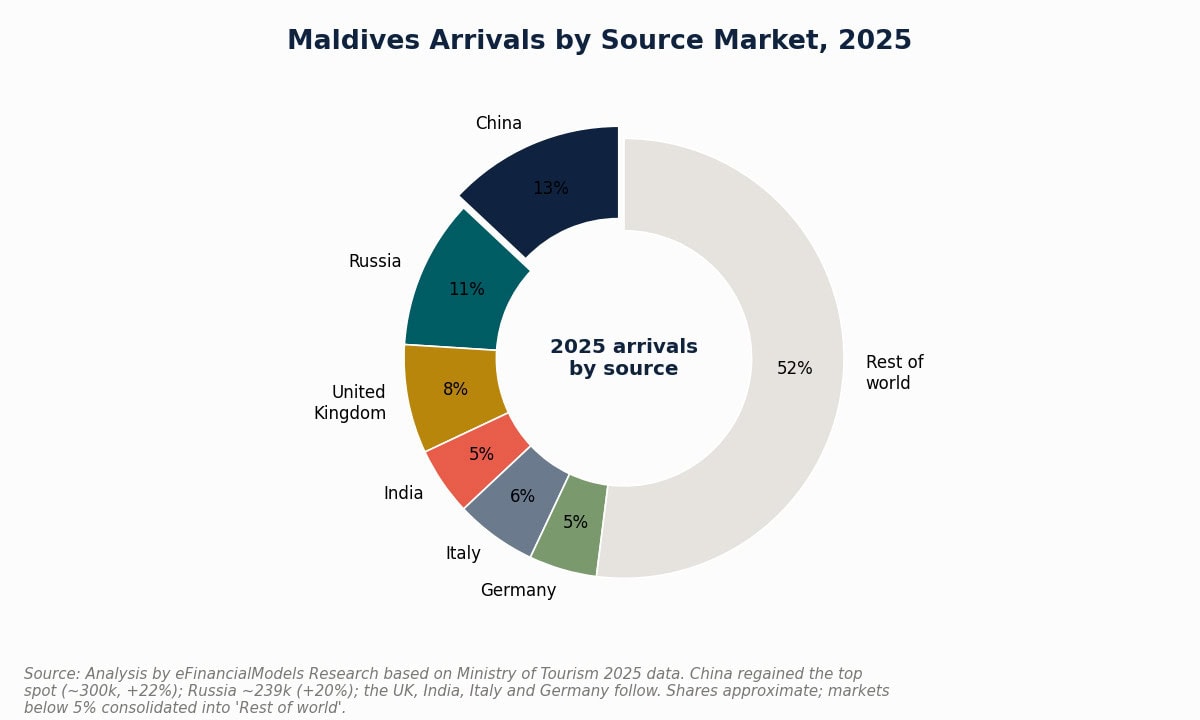
The country recorded roughly 2.25 million arrivals in 2025, up about 9.8% and an all-time high, according to eFinancialModels Research based on Maldives Ministry of Tourism data. Tourism receipts exceeded US$5.4 billion against a US$5 billion government target, confirming that the market prices on rate rather than volume. China regained the top source-market position with roughly 300,000 visitors, up about 22%, while Russia grew about 20% to roughly 239,000. The United Kingdom, India, Italy, and Germany round out the leading markets, so no single country dominates the demand base.
Connectivity is both the enabler and a genuine constraint. Almost every guest arrives through Velana International Airport, whose new terminal opened in 2025 and whose passenger-capacity target has been lifted toward 25 million (Maldives President’s Office). Guests then transfer by seaplane or domestic flight and speedboat. The Maldives operates the world’s largest seaplane network, and the daylight-only nature of seaplane operations caps how fast the outer atolls can grow. According to the World Tourism Organization, international tourist arrivals globally reached approximately 1.4 billion in 2023 (UNWTO), underscoring how the Maldives’ 2.25 million figure represents a highly concentrated, premium slice of that worldwide total.
Supply-Side Analysis: Disciplined Growth and the 2026-2027 Pipeline
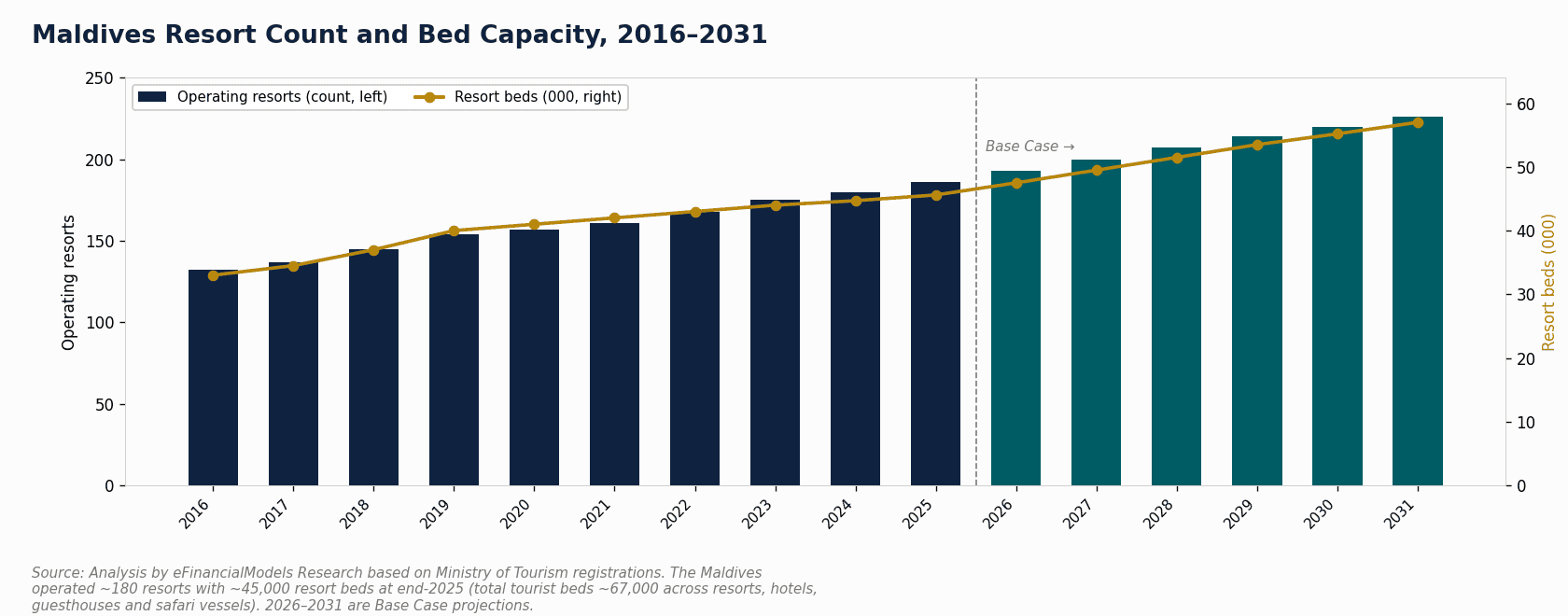
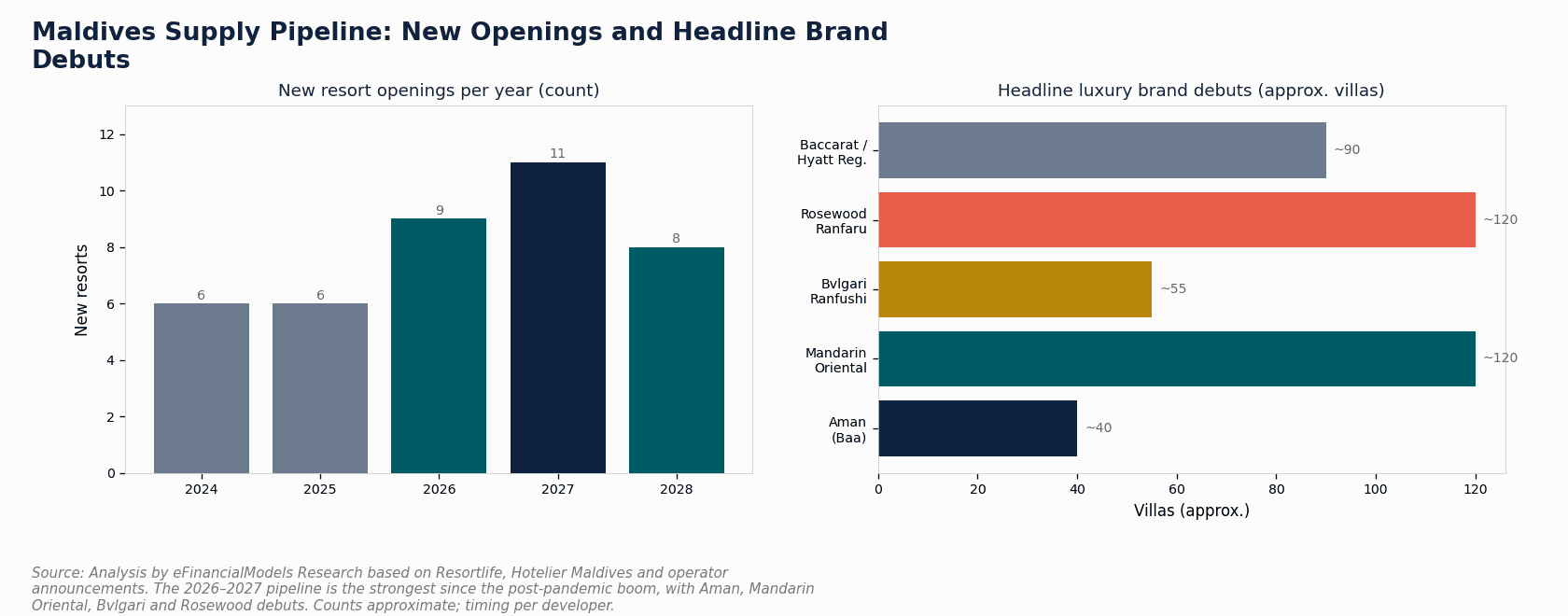
New resort supply in the Maldives grows in the low-to-mid single digits per year because every new property requires a government-tendered island, not just a building permit. The 2025 island tender offered about 14 plots on 50-year leases, with bidders required to commit a minimum of US$100,000 per room, according to eFinancialModels Research based on Maldives Tourism Act filings and Travel Trade Maldives reporting.
The 2026-2027 pipeline is the strongest since the post-pandemic building boom. Key debut properties include:
- Aman Maldives in Baa Atoll, inside the UNESCO Biosphere Reserve near Hanifaru Bay
- Mandarin Oriental Maldives, approximately 120 villas split between overwater and beach
- Bvlgari Resort Ranfushi on Raa Atoll, targeting 2027 with roughly 55 villas
- Rosewood Ranfaru in South Malé Atoll, targeting 2027 with roughly 120 villas
- Baccarat Hotel and Residences and a Hyatt all-villa property, both targeting approximately 2027
The arrival of Aman, Bvlgari, Rosewood, and Mandarin Oriental concentrates brand density at the ultra-luxury end rather than diluting it. Each new property is a discrete, financeable event with its own lease, villa mix, and rate positioning.
Lease Tenure: The Single Biggest Modeling Difference
Island lease tenure is the most important structural variable in any Maldives resort model. The Maldivian constitution bars foreign freehold ownership of land, so every resort is a leasehold operating business. Legacy resorts hold leases of up to 99 years; the 2025-tendered plots carry 50-year leases. The 16th Amendment to the Tourism Act opened a reduced-fee lease-extension window from December 2025 through June 2026, giving legacy operators a one-time opportunity to lengthen their tenure.
For the analyst, this means terminal value is bounded by the remaining lease term, not by perpetual freehold appreciation. A resort with 20 years left on its lease is a fundamentally different asset from one with 80 years remaining, and the model must reflect that difference explicitly.
Demand-Side Analysis: Rate, Wealth, and Seasonality
Maldives demand is globally sourced, structurally growing, and almost entirely luxury, which is why the market prices on rate rather than occupancy. The relevant demand metric is not just headcount but the combination of arrivals, length of stay, and per-guest spend.
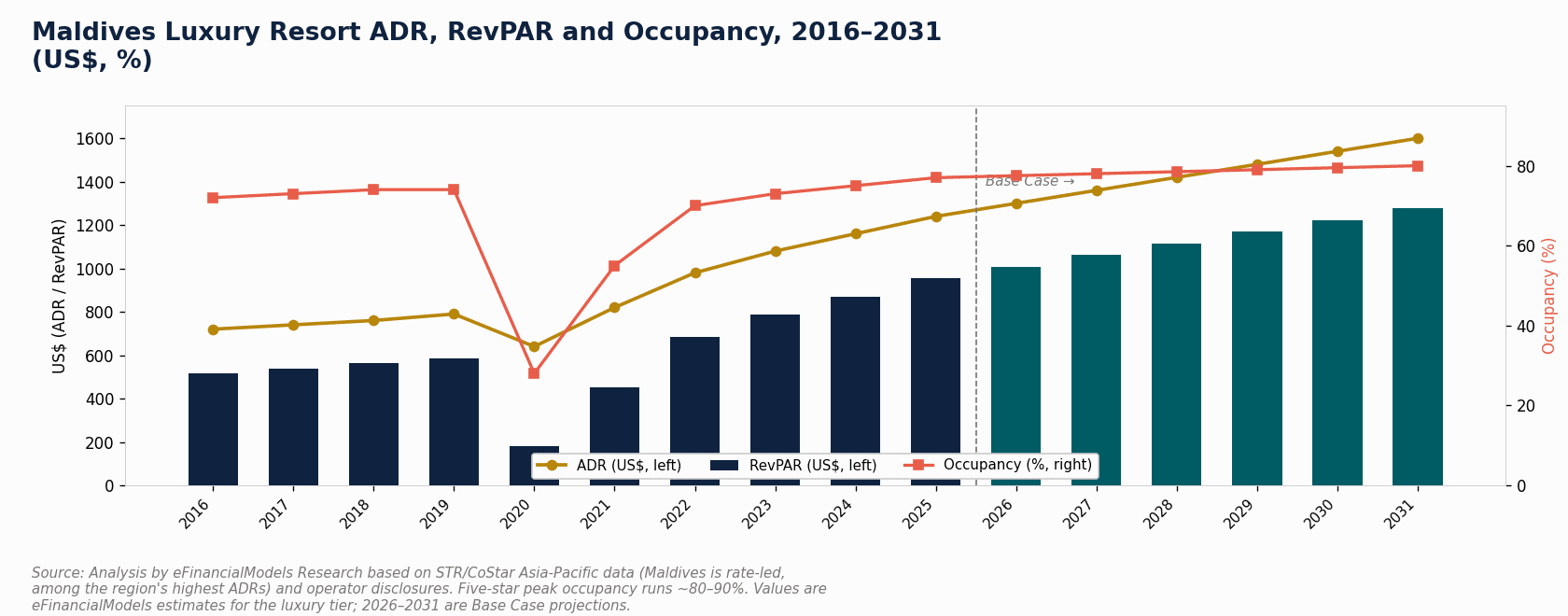
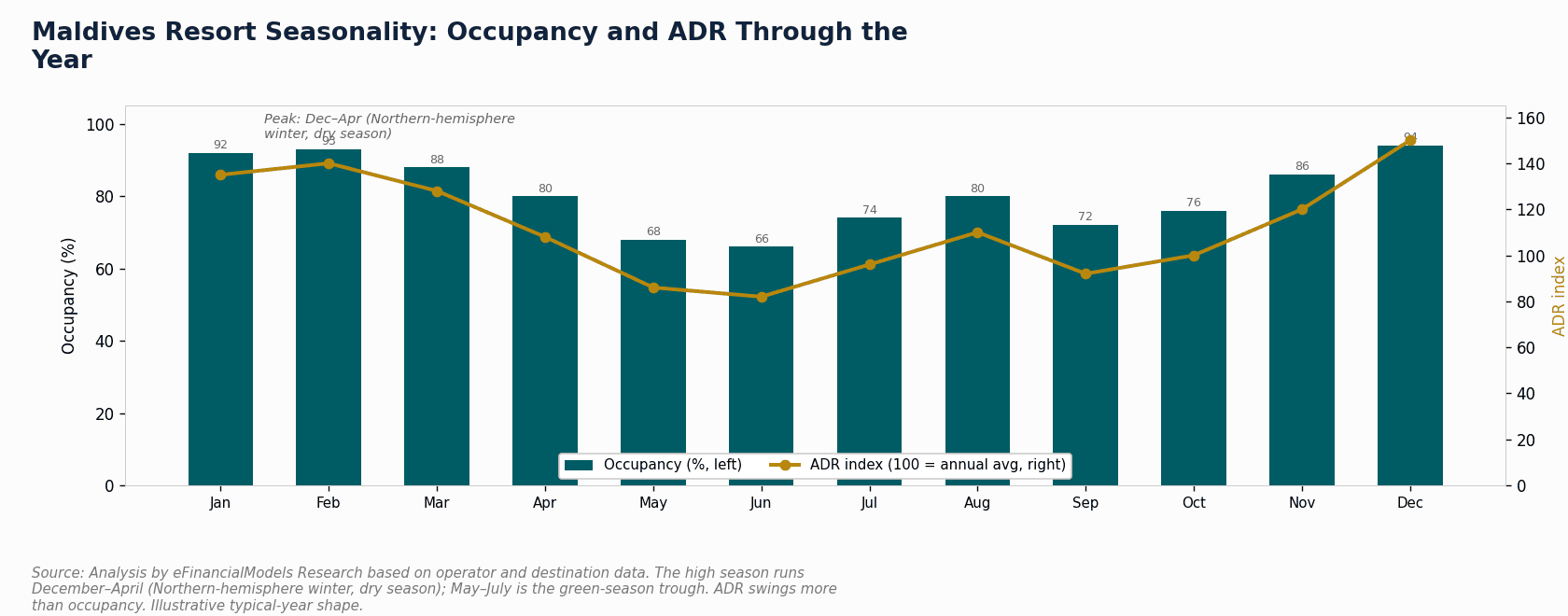
Seasonality is pronounced and should be modeled month by month. The high season runs from December through April, when occupancy and ADR (average daily rate, the average room or villa revenue per occupied night) both peak. The green-season trough from May through July softens demand as monsoon weather arrives. ADR swings more than occupancy across the year, so a resort earns a disproportionate share of its gross operating profit in the peak months.
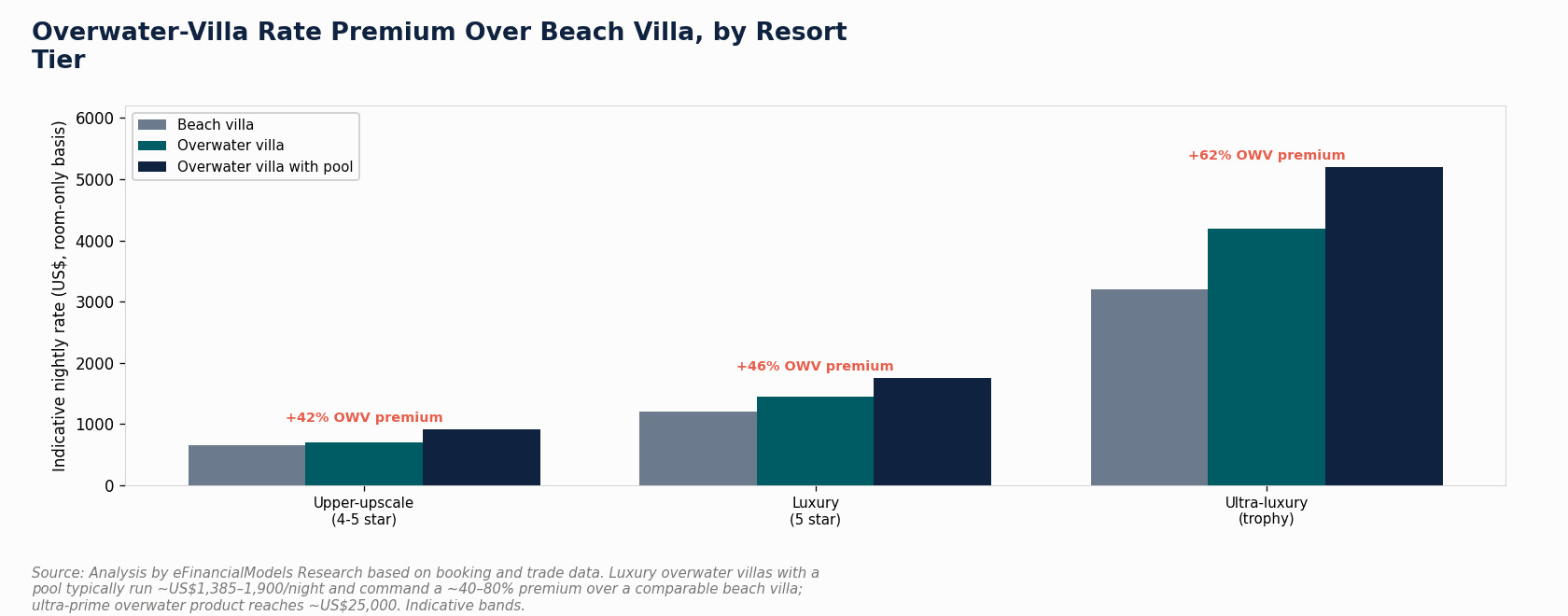
The second demand driver is global luxury wealth. A luxury overwater villa with a pool prices at roughly US$1,385 to US$1,900 per night, and ultra-prime product reaches US$25,000, according to eFinancialModels Research based on booking and trade data. These rates have risen on scarcity and brand premium rather than on occupancy gains. The rate assumption in any Maldives model should be driven by villa mix, brand positioning, and product scarcity, not by occupancy, which is already high in peak season. For context on how luxury hospitality benchmarks globally, STR data shows that luxury hotel RevPAR in the Asia-Pacific region averaged approximately US$152 in 2023 (STR Global Hotel Review, 2024), a figure the Maldives luxury tier surpasses by a factor of roughly 8 to 10 times at peak season rates, illustrating the exceptional pricing power of the one-island-one-resort model.
Pricing, Economics, and Investment Returns
The Maldives prices on scarcity and on-property capture. Rate is the principal lever, the overwater villa sets the ceiling, the all-inclusive plan maximizes capture, and the leasehold structure shapes net margin and terminal value.
The All-Inclusive Revenue Build
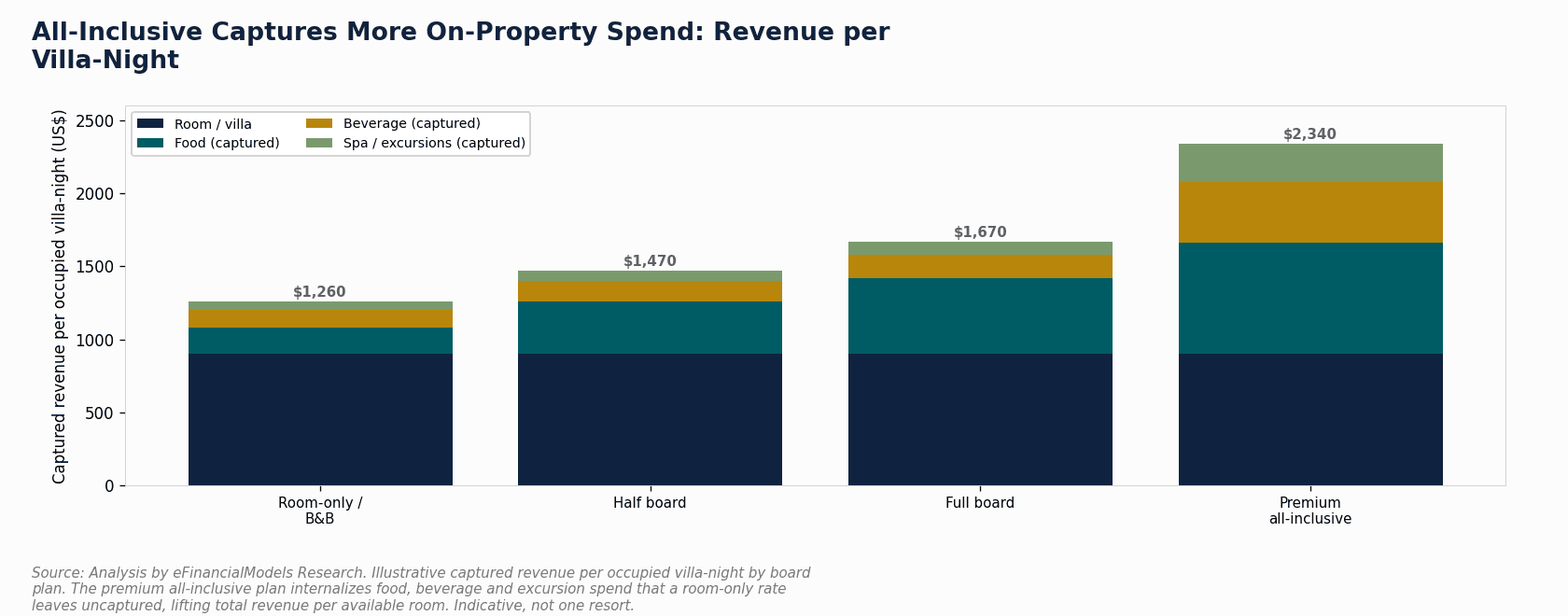
The all-inclusive (AI) plan is a margin and revenue-capture mechanism, not merely a marketing device. On a closed resort island, the operator controls every point of sale. A premium all-inclusive plan converts what would be uncertain, leak-prone à la carte spend into a single high rate that internalizes food, most beverages, and many excursions. The result is a materially higher TRevPAR (total revenue per available room, including food-and-beverage, spa, and excursions) than a room-only or half-board base at the same occupancy.
Operators including Atmosphere Core (the Kanifushi Plan), Sun Siyam, and Crown and Champa’s Kudadoo have built the global reference economics for premium all-inclusive resorts. The trade-off is that the resort carries the consumption risk and the cost of delivering the bundle, so the model must capture realistic capture rates, beverage and excursion cost-of-sales, and the rate uplift the plan commands.
Worked Numerical Example: All-Inclusive vs. Room-Only RevPAR
Here’s the math for a 100-villa luxury resort operating at 78% occupancy:
Room-Only Base:
- Blended ADR: US$1,200 per night
- Occupancy: 78%
- RevPAR: US$1,200 × 0.78 = US$936 per available villa per night
- On-property F&B and excursion capture (estimated 30% of room rate): US$360 per occupied villa
- TRevPAR: US$936 + (US$360 × 0.78) = US$936 + US$281 = US$1,217
Premium All-Inclusive Plan:
- Bundled AI rate: US$1,650 per night (includes meals, beverages, excursions)
- Occupancy: 78% (same)
- RevPAR: US$1,650 × 0.78 = US$1,287 per available villa per night
- Incremental AI delivery cost (estimated 20% of the AI premium): US$(1,650 – 1,200) × 0.20 = US$90 per occupied villa
- Net TRevPAR after delivery cost: US$1,287 – (US$90 × 0.78) = US$1,287 – US$70 = US$1,217 net, but with full revenue certainty and no leakage
The AI plan locks in the full US$1,650 rate with no leakage to off-island restaurants or excursion operators, converting uncertain à la carte spend into a predictable, fully captured revenue line. The model must show where the margin comes from, not bury it in a single blended ADR.
The 2025 Tax Stack
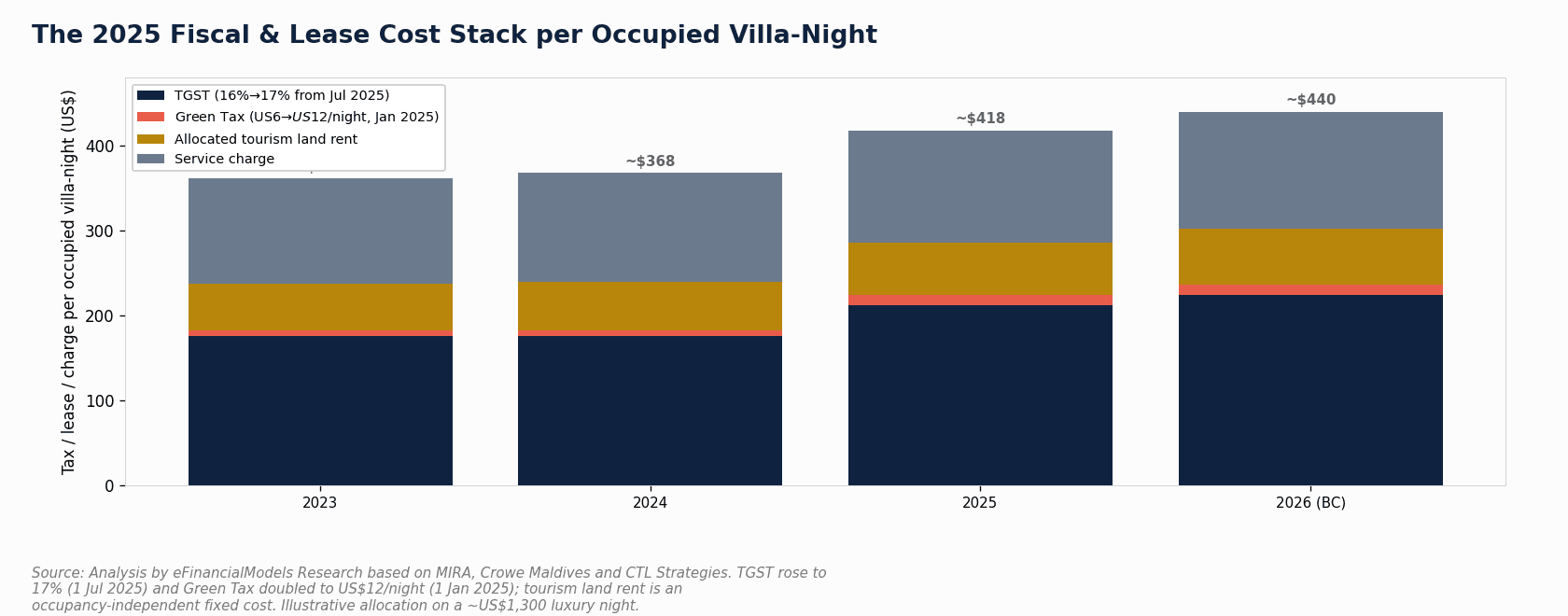
The fiscal regime tightened sharply in 2024-2025. The Tourism Goods and Services Tax (TGST) rose to 17% from 16% effective July 1, 2025, according to Crowe Maldives. The Green Tax doubled to US$12 per guest per night for resorts from January 1, 2025, according to Travel Trade Maldives. Airport departure and development fees rose across all cabins from December 2024. An occupancy-independent tourism land rent, banded by leased land area, applies regardless of how many rooms are sold.
These are modelable cost lines, not background noise. They fall hardest on lower-rate product and most lightly on the rate-rich luxury tier. A US$12 Green Tax represents less than 1% of a US$1,500 luxury villa rate but a meaningful share of a US$500 entry-level rate, which structurally advantages the top of the market. To put the TGST rate in regional perspective, the Maldives’ 17% tourism-specific GST compares with the standard VAT rate of 10% applied to accommodation in many Southeast Asian competitors (KPMG Asia Pacific Indirect Tax Guide, 2024), meaning the Maldives fiscal burden on tourism is among the highest in the region and must be modeled as an explicit cost line rather than a rounding item.
Three Scenarios to 2031
The three scenarios below span the realistic outcome range for the Maldives luxury resort sector through 2031, based on eFinancialModels Research analysis.
| Scenario | Probability | RevPAR CAGR | 2031 Arrivals | Peak Occupancy | Overwater Premium | Dev. IRR |
|---|---|---|---|---|---|---|
| Bear Case | 25% | ~2.0%/yr | ~2.85M | ~76% | ~40% | Below hurdle |
| Base Case | 50% | ~4.5%/yr | ~3.28M | ~79% | ~55% | Mid-teens |
| Bull Case | 25% | ~6.5%/yr | ~3.65M | ~80% | ~70% | High-teens+ |
The Base Case (50% probability) projects luxury RevPAR growth of about 4.5% per year and arrivals reaching roughly 3.28 million, as a diversified demand wave meets disciplined, lease-constrained supply and the luxury tier absorbs the higher tax stack through pricing power.
The Bear Case (25% probability) projects about 2.0% RevPAR growth and roughly 2.85 million arrivals on a global travel slowdown, a source-market shock such as a renewed China or Russia disruption, and heavier cost and climate friction.
The Bull Case (25% probability) projects about 6.5% RevPAR growth and roughly 3.65 million arrivals on sustained luxury demand, expanded airlift and seaplane capacity, and a genuine shortage of brand-grade overwater product.
Competitive Landscape: Domestic Pioneers vs. International Groups
The Maldives luxury field is contested by domestic operators who built the resort and all-inclusive model and by international groups racing to plant flags. The competitive dynamic increasingly turns on who can secure scarce islands and operate the overwater-and-all-inclusive product at a high margin.
Domestically, Universal Resorts opened the country’s first resort, Kurumba, in 1972 and remains a major owner-operator. Crown and Champa runs the ultra-luxury all-inclusive Kudadoo. Atmosphere Core built the premium all-inclusive Kanifushi Plan. Sun Siyam markets all-inclusive across five resort islands. Soneva anchors the ultra-luxury, sustainability-led top end.
Internationally, Marriott operates the broadest footprint through Ritz-Carlton, W, St. Regis, JW Marriott, Westin, and Sheraton. Hilton brings Waldorf Astoria, Conrad, and SAii. IHG brings InterContinental, Six Senses, and Kimpton. Accor brings Raffles, Fairmont, Sofitel, and Pullman. Four Seasons, Banyan Tree, and Jumeirah hold luxury anchors.
The competitive moats are scale, brand equity, capital depth, operating know-how, and access to the limited supply of islands. Provisioning a remote island, managing seaplane logistics, and running an all-inclusive bundle profitably are capabilities that are hard to replicate quickly.
Common Modeling Mistakes and How to Fix Them
Maldives resort models fail in predictable ways. Here are the 5 most common mistakes and their fixes.
Mistake 1: Using a single blended ADR instead of a villa-mix rate ladder.
Fix: Build an explicit rate ladder with beach villa, overwater villa, and overwater-with-pool categories. The overwater premium of 40% to 80% over a beach villa is the single biggest driver of blended ADR, and burying it in a single rate hides the product-mix risk.
Mistake 2: Treating the all-inclusive plan as a marketing line rather than a revenue-capture mechanism.
Fix: Attach a capture rate and a cost ratio to each revenue line (rooms, food, beverage, spa, excursions). Model the net uplift over room-only after incremental delivery cost, not the gross bundled rate.
Mistake 3: Applying a perpetual freehold terminal value to a leasehold asset.
Fix: Set terminal value to the remaining lease term. A 50-year lease with 20 years remaining is not worth the same as a 99-year legacy lease. Use the 16th Amendment extension window as a terminal-value lever for legacy assets.
Mistake 4: Ignoring the occupancy-independent tourism land rent.
Fix: Model land rent as a fixed cost that raises the occupancy break-even. It applies whether the resort is full or empty, so it has an outsized impact on low-occupancy scenarios.
Mistake 5: Treating climate risk as a tail risk rather than a recurring capital line.
Fix: Include resilience and sustainability capital expenditure as a recurring line item. Let climate exposure inform the discount rate and terminal value, not just a footnote.
Tools, Templates, and Financial Models
Building a credible Maldives resort model requires a framework that handles the leasehold structure, the all-inclusive revenue build, and the villa-mix rate ladder simultaneously. Generic hotel models miss all three.
For resort and hotel project valuation, the Resort/Hotel Project Valuation model with NPV and IRR calculations from eFinancialModels covers the construction and operation phases with explicit leasehold-adjusted terminal value inputs. For broader market context and comparable investment structures, the Investment Marketplace Financial Model provides a flexible framework for multi-asset underwriting. Analysts building demand-side projections can also reference the Market Studies tag for comparable sector research.
The Appendix A assumptions from the eFinancialModels Maldives Resort Market Study 2026-2031 provide the Base Case starting points: five-star peak occupancy of approximately 77% to 79%, luxury ADR growth of 4% to 5% per year, a 17% TGST, a US$12 Green Tax per night, and stabilized net yields of 5% to 7%.
Frequently Asked Questions
What is the all-inclusive model in the Maldives and why does it matter for investors?
The all-inclusive (AI) plan is a bundled board plan covering meals, most beverages, and many activities at a single nightly rate. In the Maldives, it matters more than in almost any other destination because the resort island is a closed system: guests cannot walk off the island to eat or drink elsewhere. This means the operator captures 100% of on-property food, beverage, and excursion spend when a guest is on an AI plan, versus losing a portion of that spend to leakage on a room-only or half-board rate. Operators like Atmosphere Core (Kanifushi Plan) and Crown and Champa (Kudadoo) have demonstrated that a well-run premium AI plan lifts TRevPAR materially above a room-only base at the same occupancy. For the investor, the AI plan converts uncertain à la carte spend into a predictable, fully captured revenue line, which improves forward visibility and smooths the seasonal revenue curve.
How does the leasehold structure affect Maldives resort valuations?
Every Maldives resort sits on a government island lease, not freehold land. The Maldivian constitution bars foreign freehold ownership of land, so an investor is underwriting a finite-life leasehold cash flow. Legacy resorts hold leases of up to 99 years; the 2025-tendered plots carry 50-year leases. This makes terminal value a function of remaining lease term rather than perpetual appreciation. A resort with 20 years left on its lease is worth significantly less than one with 70 years remaining, even if current cash flows are identical. The 16th Amendment to the Tourism Act opened a reduced-fee lease-extension window from December 2025 through June 2026, giving legacy operators a one-time opportunity to extend tenure at a lower cost. Any Maldives model that applies a perpetual freehold cap rate to a leasehold asset will materially overstate value.
What is the overwater villa premium and how is it modeled?
The overwater villa premium is the percentage uplift in nightly rate that an over-lagoon villa commands over a comparable beach villa in the same resort on the same board plan. According to eFinancialModels Research based on booking and trade data, this premium runs approximately 40% to 80%. A beach villa priced at US$900 per night in a given resort might see its overwater equivalent priced at US$1,260 to US$1,620. The premium reflects the scarcity of lagoon geography, the higher marine construction and maintenance cost of overwater structures, and the trophy positioning of the product. For the model, the analyst must build an explicit villa-mix rate ladder rather than assuming a single blended ADR, because the overwater share of the villa mix is the single biggest driver of blended rate and therefore of RevPAR.
What are the three scenario outcomes for the Maldives resort market through 2031?
The eFinancialModels Research Base Case (50% probability) projects luxury RevPAR growth of about 4.5% per year and arrivals reaching roughly 3.28 million by 2031, with five-star peak occupancy of approximately 79% and a new-lease development IRR in the mid-teens. The Bear Case (25% probability) projects about 2.0% RevPAR growth and roughly 2.85 million arrivals, driven by a global travel slowdown, a source-market shock such as a China or Russia disruption, and heavier cost and climate friction, with development IRRs falling below the hurdle rate. The Bull Case (25% probability) projects about 6.5% RevPAR growth and roughly 3.65 million arrivals, driven by sustained luxury demand, expanded airlift and seaplane capacity, and a genuine shortage of brand-grade overwater product, with development IRRs in the high-teens or above.
How does the 2025 tax stack affect resort economics?
The 2025 fiscal tightening added three significant cost lines. The TGST rose to 17% from 16% effective July 1, 2025. The Green Tax doubled to US$12 per guest per night for resorts from January 1, 2025. Airport departure and development fees rose across all cabins from December 2024. An occupancy-independent tourism land rent also applies, banded by leased land area. The combined effect raises the cost of every guest night, but the burden is regressive in reverse: it is a small share of a US$1,500 luxury villa rate and a large share of a US$500 entry-level rate. This structurally advantages the luxury tier and makes rate growth the primary offset strategy. A model that treats these as background rather than explicit line items will understate costs and overstate margins, particularly in the Bear Case.
What are the biggest risks to the Maldives resort investment thesis?
The dominant long-run risk is climate. The Maldives is one of the planet’s lowest-lying nations, and sea-level rise threatens the land itself. Warming seas bleach the coral reefs that are the foundation of the guest experience. Storm and erosion exposure raises both insurance and capital costs. For the investor, this is not a tail risk but a central modeling input: resilient design, coastal protection, and reef stewardship are recurring capital items, and climate exposure argues for a higher discount rate and a conservative terminal value. The near-term risks are source-market and connectivity shocks. Because almost all guests arrive through one airport and transfer on a daylight-only seaplane network, a disruption to a leading source market or to airport and transfer capacity can soften arrivals quickly. The 2025 source-market diversification across China, Russia, Europe, and India is a structural mitigant, but the prudent model stresses arrivals, rate, and resilience capital expenditure together.
What investment returns can a Maldives resort generate?
Stabilized resort net yields run approximately 5% to 7%, with trophy ultra-luxury properties at the lower end of that range due to their higher acquisition cost, according to eFinancialModels Research based on JLL and CBRE data. New-lease development IRRs range from approximately 12% to 18%, reflecting the construction cost, ramp-up period, and lease risk of building on a remote island. The Base Case mid-teens IRR assumes a well-located island, a premium villa mix, a disciplined all-inclusive revenue build, and rate growth of 4% to 5% per year. Returns are driven by rate growth and on-property revenue capture, not by occupancy (already high in peak season) or by perpetual asset appreciation (foreclosed by the finite lease). The 2025 tax stack is absorbable at luxury price points but must be modeled explicitly to avoid overstating net operating income.
Conclusion
The Maldives resort market enters the 2026-2031 window with the strongest structural position in its history: a record arrivals base, a diversifying source-market mix, a supply-constrained luxury product, and a brand-intensification wave that is concentrating the premium tier rather than diluting it. The all-inclusive plan and the overwater villa are linked but distinct revenue engines, and the analyst who models them separately will understand the margin dynamics that a blended approach hides. The 2025 tax stack, the leasehold structure, and climate risk are not footnotes: they are explicit, sizable inputs that shape net margin, terminal value, and the discount rate.
I recommend pairing this market study with the Resort/Hotel Project Valuation model with NPV and IRR calculations from eFinancialModels, which is purpose-built to handle the construction phase, the all-inclusive operating build, and the leasehold-adjusted terminal value that a Maldives resort demands.