
0 ITEMS

Wind Energy Farm Financial Model
The Wind Farm Financial Model provides a powerful 40-year forecast, capturing critical data on energy production, revenues, operating costs, and debt repayments. Accurate energy forecasting forms the backbone of a reliable wind energy model, where analysts integrate site-specific wind data to estimate electricity generation and revenues. By leveraging site-specific data, seasonal trends, and probability scenarios (P50, P75, P90), developers can assess energy production and financial viability. The model calculates critical financial metrics such as Net Present Value (NPV), Internal Rate of Return (IRR), Payback Period, and Cash Flow Projections by incorporating upfront construction costs, operating expenses, financing structures, and tax effects.
This comprehensive analysis empowers users to make informed, data-driven decisions, reducing risk and optimizing returns. Whether you are looking to attract investment or ensure the long-term success of your wind farm project, this model offers the insight needed for strategic planning and sustainable profitability.


Harness Wind Energy with Confidence Using Our Comprehensive Financial Model
As climate change accelerates, the global demand for renewable energy continues to grow, with wind energy emerging as a scalable, eco-friendly solution. Wind farms, particularly offshore and hybrid renewable projects, are becoming key players in global energy transformation. However, launching a wind farm involves substantial capital costs, long-term operational challenges, and fluctuating energy prices, making accurate financial modeling critical to success.
Key trends shaping the industry include:
- Offshore Expansion: Coastal wind farms leverage higher wind speeds for increased output.
- Hybrid Systems: Combining wind, solar, and battery storage ensures consistent power delivery.
The Wind Farm Financial Model Template provides a 40-year projection that integrates energy production, costs, and financial metrics like NPV, IRR, and payback periods, helping users assess profitability, risks, and project feasibility. Designed for entrepreneurs, investors, and business owners, it enables strategic planning and sustainable success throughout the wind energy project’s lifecycle.
Optimizing Wind Farm Location and Turbine Selection for Maximum Efficiency
Deciding the Location for a Wind Farm
The performance of a wind farm is heavily influenced by the wind speed and its consistency, which are affected by factors like altitude, topography, and seasonal variations.
When selecting a site for a wind farm, it is crucial to assess the wind potential of the location, as this directly impacts expected electricity production.
Onshore wind farms typically have an installed capacity ranging from 20 to 100 MW, consisting of 10 to 50 turbines. In contrast, offshore wind farms are much larger, often exceeding 200 MW, with 50 to 200 turbines.
Identifying sites with optimal wind conditions—where wind speed is consistent and strong—is vital to ensure maximum power generation and profitability. The more consistent the wind speed, the higher the energy yield and the more profitable the farm will be.
Selecting the Right Wind Turbines and Its Capacity
The selection of wind turbines depends on the site-specific wind characteristics and the scale of the project. Various turbine sizes offer different advantages based on wind conditions and energy requirements:
- 1 MW turbines: Ideal for smaller farms with moderate wind resources. They are more affordable upfront but may underperform in areas with high wind speeds.
- 2 MW turbines: A balanced option for moderate to high-wind sites, providing cost-efficiency and reliable performance.
- 3 MW turbines: Best for high-wind locations, offering high efficiency and suitable for large-scale projects. Although they require a higher initial investment, greater energy production can offset these costs.
Choosing the right wind turbine size is crucial for maximizing energy output and operational efficiency. The optimal choice aligns with local wind speeds, capacity factors, and the overall economic feasibility of the project, factoring in maintenance and reliability.
Leveraging Probability Scenarios for Wind Yield and Financial Insights
Accurately forecasting wind yield is essential for evaluating the viability of a wind farm project. Developers can predict energy production and assess financial resilience by leveraging site-specific wind data, seasonal patterns, and probability scenarios.
Understanding Annual Energy Production (AEP)
Annual Energy Production (AEP) measures the total amount of energy a wind farm generates annually. It depends on:
- Turbine Capacity: Combined output of installed turbines.
- Capacity Factors: Typically, 30–50% for onshore and higher for offshore.
- Loss Factors: Accounting for grid downtime, maintenance, and inefficiencies.

Probability Scenarios for Wind Yield
- P50 (Median Production): A baseline scenario with a 50% probability of meeting or exceeding projected yield, ideal for standard revenue projections.
- P75 (High Confidence): A more conservative estimate with a 75% probability, often used for debt coverage analysis.
- P90 (Low Production): A stress-tested forecast with a 90% probability representing lower-than-expected wind conditions.
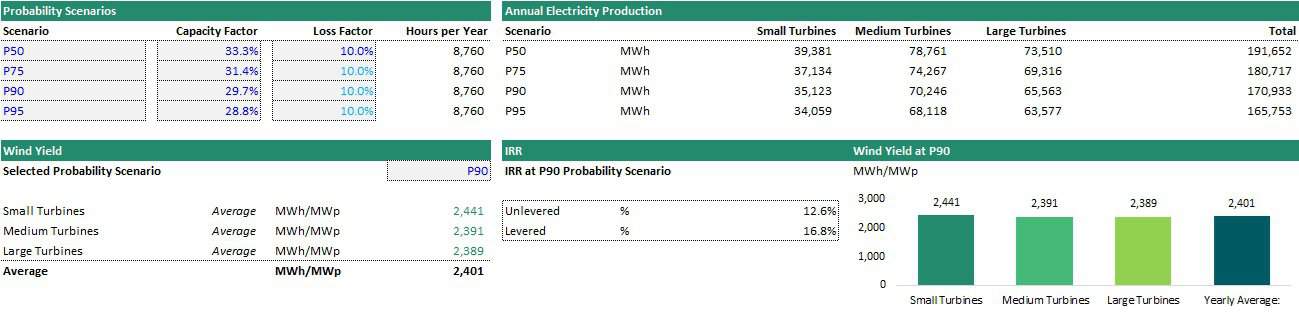
These scenarios provide a range of outcomes, enabling developers to model revenue and risk-adjusted cash flows under varying conditions.
Seasonal Variability and Monthly Distribution
Wind production fluctuates throughout the year. Seasonal trends, represented in monthly distribution curves, reflect historical wind patterns to ensure energy yield forecasts align with real-world conditions.

Essential Insights the Wind Farm Model Template Provides
Launching a wind energy project requires careful planning and analysis to mitigate risks and maximize returns. Our template provides answers to these essential questions:
- Power Purchase Agreement (PPA) via Fixed Price or Renewable Energy Certificate (REC) – What pricing strategies should you negotiate and adopt for PPA or REC to make wind energy farm projects financially feasible?
- Financial Feasibility – Are projected returns sufficient to attract investors and surpass the cost of capital?
- Bank Financing – How much bank financing can the project carry? How is the financial debt going to be repaid? Can the project’s cash flow service all its debt financing obligations?
- Levelized Cost of Electricity – What are the resulting costs of the electricity produced, and how do those costs compare to the costs of other electricity generation projects? How competitive is your project compared to other renewable energy sources?
- Phasing Plan or Expansion Opportunities – Are there any possibilities to expand the wind farm by adding more panels or a battery and generating higher and more consistent electricity output?
- Scenarios – What are the risks of my wind farm projects? How would any change in key assumptions affect the financial outcome? How can I mitigate those risks?
- Project Valuation – What will the expected valuation of the project be going forward based on the discounted free cash flow (DCF) analysis?
- Investor Cash Flows – Investor Cash Flows are not necessarily the same as project cash flows as they depend on the amount of bank financing received and how much equity stake each investor gets. Each investor will contribute different parts of the required funding depending on the investment structure.
- Project Flipping – At what valuation can I potentially exit my project by flipping the project to a new developer or buyer who will finish the construction?
Discover the Key Features of Our Wind Farm Financial Model
The Wind Farm Financial Model Template is built on years of expertise, drawing from real-world applications with developers and investors in the renewable energy sector. It has been refined through extensive use in evaluating large-scale wind farm projects, ensuring that it captures all critical aspects of wind energy development, from initial feasibility assessments to securing project financing.
- Timeline Planning: Modern wind farms are designed to operate for 20–30 years. Some can extend to 35–40 years with effective maintenance or repowering. Plan construction phases, commissioning, and the start of operations for up to three stages with clear milestones and timelines.
- Probability Scenarios and Wind Yield: Accurately forecasting wind yield using site-specific data, seasonal trends, and probability scenarios (P50, P75, P90) enables developers to assess energy production and financial viability.
- Revenue Modeling: Comprehensive projections for electricity sales, PPA/REC agreements, and additional revenue opportunities such as carbon credits.
- Energy Production Forecasting: Precise calculations based on wind yield data, turbine specifications, and site installed capacity to estimate energy output.
- Pricing Forecasts: Adjust inputs for pricing assumptions, escalation rates, and market price trends.
- Comprehensive Financial Statements: Project income statements, balance sheets, and cash flow statements over a 40-year horizon to capture long-term performance.
- Debt Schedule: A detailed schedule covering debt drawdowns, interest payments, and repayment structures, with key financial ratios for investor and lender analysis.
- Financial Metrics: Analyze IRR, payback period, NPV, and cash-on-cash yield for unlevered and levered scenarios.
- Funding Analysis: Estimate funding requirements and sources and uses of funds to streamline investment planning.
- Tax Modeling: Integrate tax credits, incentives, and obligations to assess project profitability.
- Scenario Analysis: Sensitivity tools to explore risks and potential outcomes from various assumptions.
- Presentation-Ready Outputs: Printable summaries, charts, and tables for use in investor pitches or internal reviews.
With key features that enable detailed financial forecasting and risk evaluation, it helps users make informed decisions, secure financing, and optimize returns. Whether planning a new project or refining an existing one, the template is invaluable for transforming wind energy projects into sustainable, profitable ventures.
Download now to unlock powerful insights and drive your wind farm project to success!
Designed for entrepreneurs, investors, and energy professionals, our Wind Farm Financial Model Template simplifies complex calculations and provides actionable insights. Whether you’re planning an onshore or offshore project, this Excel-based tool equips you with the confidence to secure funding, evaluate risks, and optimize returns.
Download today and transform your renewable energy vision into a profitable, sustainable reality.
The financial model template comes pre-filled with a Wind Energy Farm example forecast to illustrate clearly how the spreadsheet works. The forecast can be easily changed by altering the assumptions in blue and light blue font color.
The latest model version is 4.2. The template is fully editable and is provided as a .xlsb file (similar to .xlsx, only faster), which can be opened with any standard MS Excel program. A free Demo Version as a downloadable PDF File (.pdf file format) is also available.
File Types:
- .xlsb (Microsoft Excel)
- .pdf (Adobe Acrobat Reader)
This template is also included in the Renewable Energy Financial Model Bundle. If you want to purchase templates related to the Renewable Energy Industry, you can get the Bundle instead.
Similar ProductsOther customers were also interested in...



 eFinancialModels
Battery Energy Pricing Model
The Battery Energy Pricing Model calculates the required energy price for an industrial-scale batter... Read more
Renewable Energy Financial Model Bundle
This is a collection of financial model templates for projects or ventures in the Renewable Energy I... Read more
Green Ammonia from Renewable Energy Financial Mode...
This comprehensive 40-year tool aid investors in evaluating potential risks and returns and assess t... Read more
Green Hydrogen Production from Wind Energy Financi...
The Green Hydrogen from Wind Financial Model aims to comprehensively forecast a horizon of 40 years ... Read more
Green Hydrogen (Electrolysis) Production Financial...
This green hydrogen financial model template builds a multi-year financial plan to analyze the finan... Read more
 Pushkar
Wind Farm Development Model
Wind Farm Excel Model Template is an excellent tool to assess the financial feasibility a proposal t... Read more
Renewable Energy Financial Model Template Bundle
Take this opportunity and get a discount by getting the Renewable Energy Bundle where you get Solar,... Read more
Wind Farm – 3 Statements Financial Model Tem...
Wind Farm - 3 Statements Financial Model with Flexible Timeline, NPV, IRR, Debt Covenants,... Read more
 Jason Varner
Wind Farm Financial Model
Strategically design the financial framework for launching a wind farm, incorporating up to five dis... Read more
 Giorgos
Wind Farm – Project Finance Model
Project Finance Model for a Wind Farm projecting revenue, operating costs, and cash flow based on tu... Read more
Reviews
 Impressive model
Thank you for sharing the financial model analysis of finflows, revenue , cost and debt. I would say it is informative and provided basic structure to analyse the financial model of wind power, biogas and solar plants.
2015 of 3977 people found this review helpful.
Help other customers find the most helpful reviews
Did you find this review helpful?
 Great tool
Only setback is there is a lot of information and I think a bit of guidance and further explanation on the specific influence of certain line items could help. The notes certainly help but perhaps I’m just not as adept as I need to be. It works well as a plug and play but I had trouble readjusting a massively negative NPV. Worked good in the long run but was somewhat time consuming.
Thank you for your feedback.
2103 of 4095 people found this review helpful.
-
See the updated version
2022 of 3905 people found this review helpful.
Help other customers find the most helpful reviews
Did you find this review helpful?

You must log in to submit a review.