
0 ITEMS

Laundromat Business – Financial Plan Template
The Laundromat and Dry Cleaning Business Financial Plan Template offers great assistance when studying the feasibility and the financial prospects when starting a new Laundromat Business.







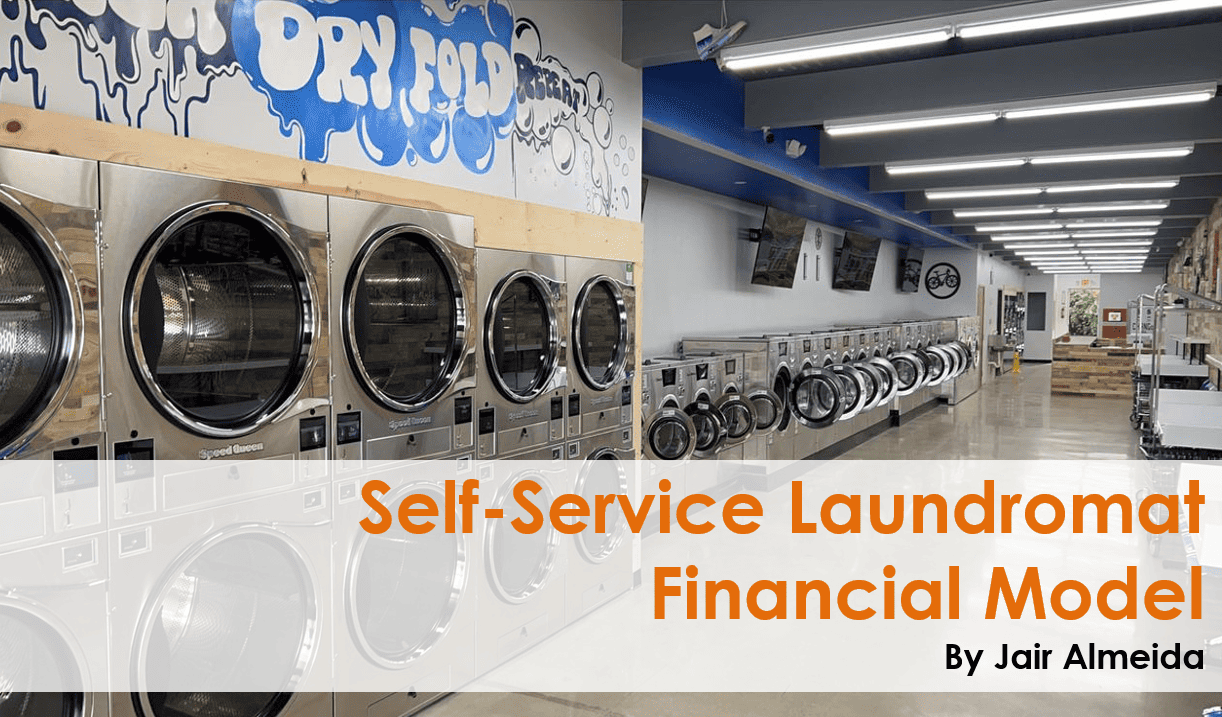
Gone are the days when people only do laundry at home. Setting up a laundromat business offers convenience for travelers and residents alike who can get their laundry done. When starting such a business, the key question is how profitable such a business idea might be. This financial model template allows you to reduce the guesswork and instead use financial analysis to find out more about how the economics of your next laundromat business might turn out.
Sources of Revenues for a Laundromat
This template is suitable for planning the setup of a new laundromat or dry cleaning business. The Excel financial plan template offers a set of assumptions to plan the expected profits and cash flows over the next 5 years by using a monthly forecast which then is aggregated into a yearly forecast. The template foresees the following sources of revenues:
- Self Service Wash and/or Dry
- Wash & Fold Service
- Dry Cleaning Service
- Home Delivery Service
- Alterations
- Sale from Vending Machines
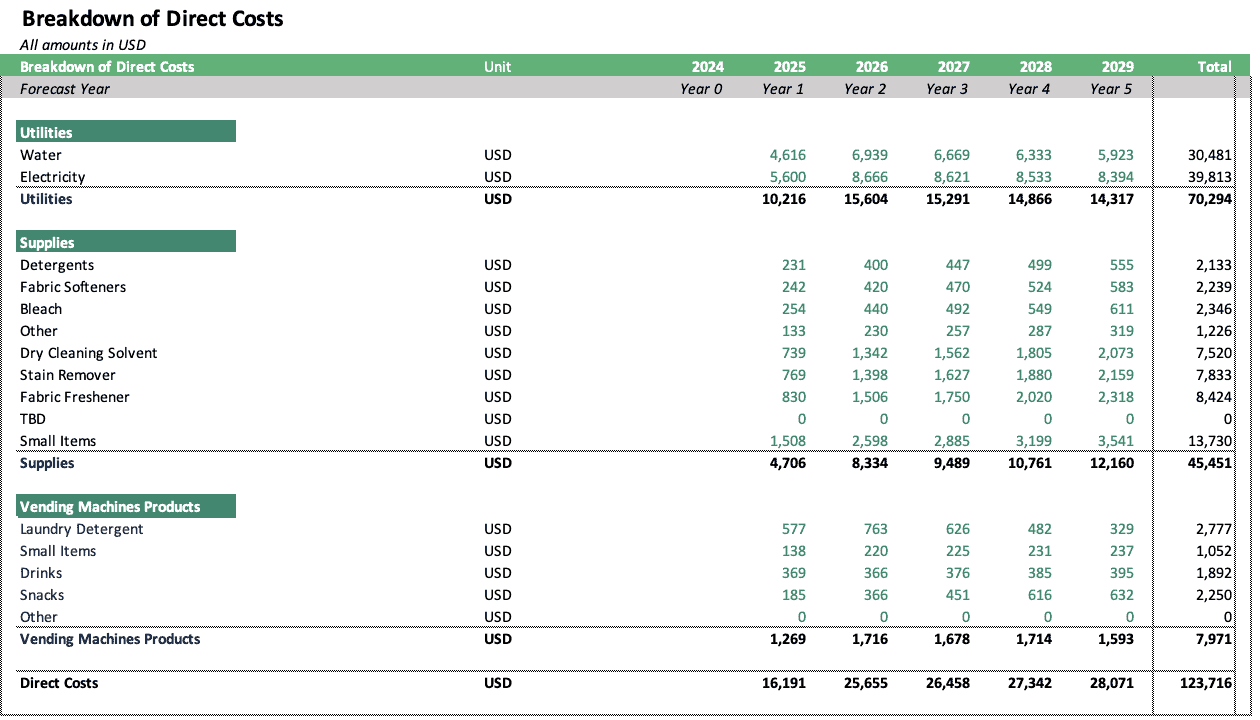
The template is built bottom-up, starting with the expected number of daily customers, their expected purchases of the services offered, the anticipated consumption of utilities and supplies, and the expected cost items. The template’s assumptions offer deep insights into the financial implications when changing the mix of revenues, prices, customer purchase behavior, costs, required investment, and debt financing assumption.
The template allows Entrepreneurs to assess better the financial viability of their new laundromat project and a better understanding of how the economics of their business might work.
The Content of the Laundromat Business Financial Model
This Excel spreadsheet template clearly lays out the required assumptions for planning a laundromat or dry cleaning business. Follow and update the assumptions marked up in blue and follow the navigation links built inside the spreadsheet template. The contents of this financial model template are the following:
Assumptions include general assumptions such as the currency, first forecast year, and timeline followed by assumptions on how many daily customers will be expected upon starting to stabilize the business. Further assumptions are then used to forecast how many of these visitors will purchase which service, the expected purchased quantities, the pricing of such, costs, required investment, and anticipated debt financing assumptions.
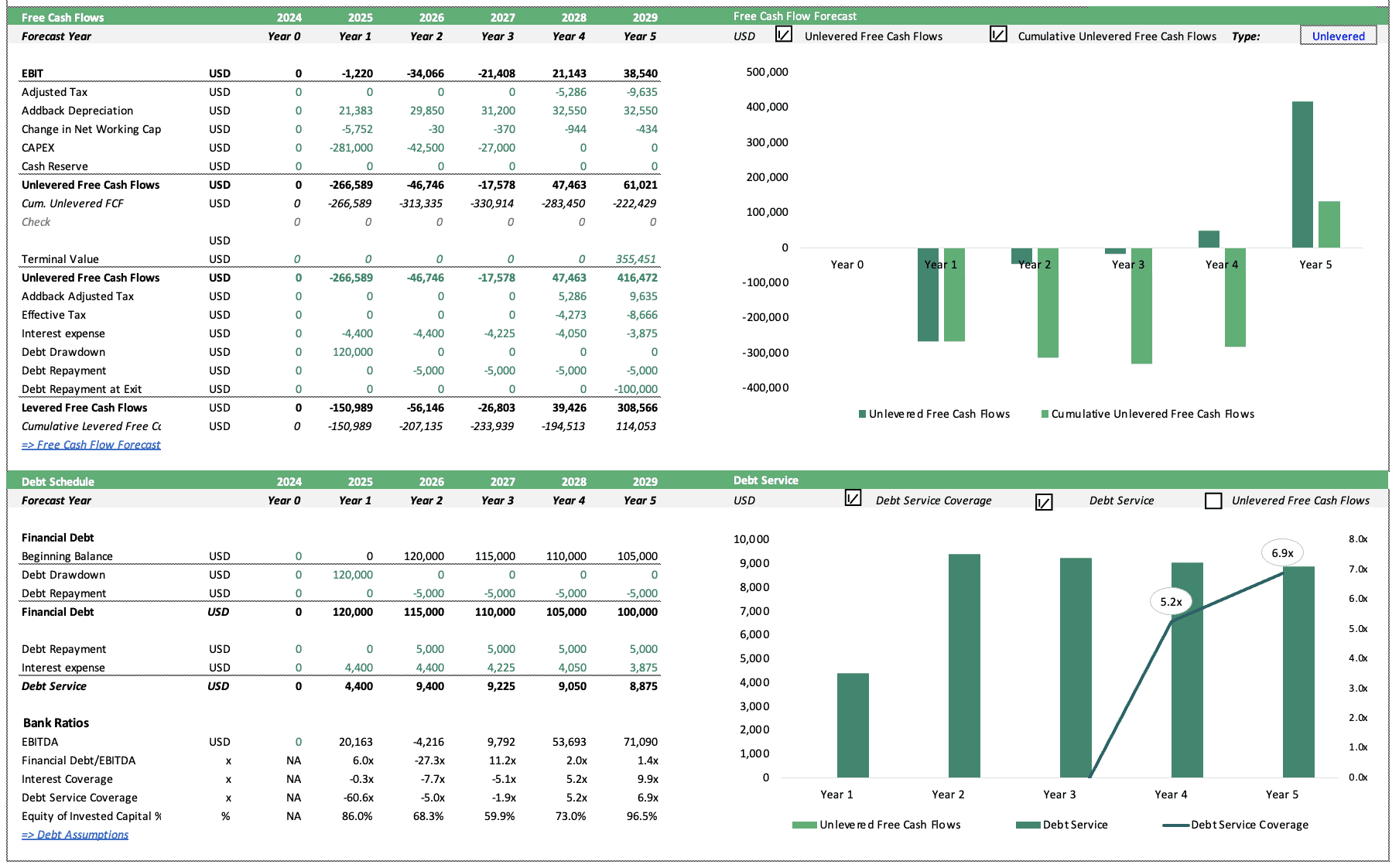
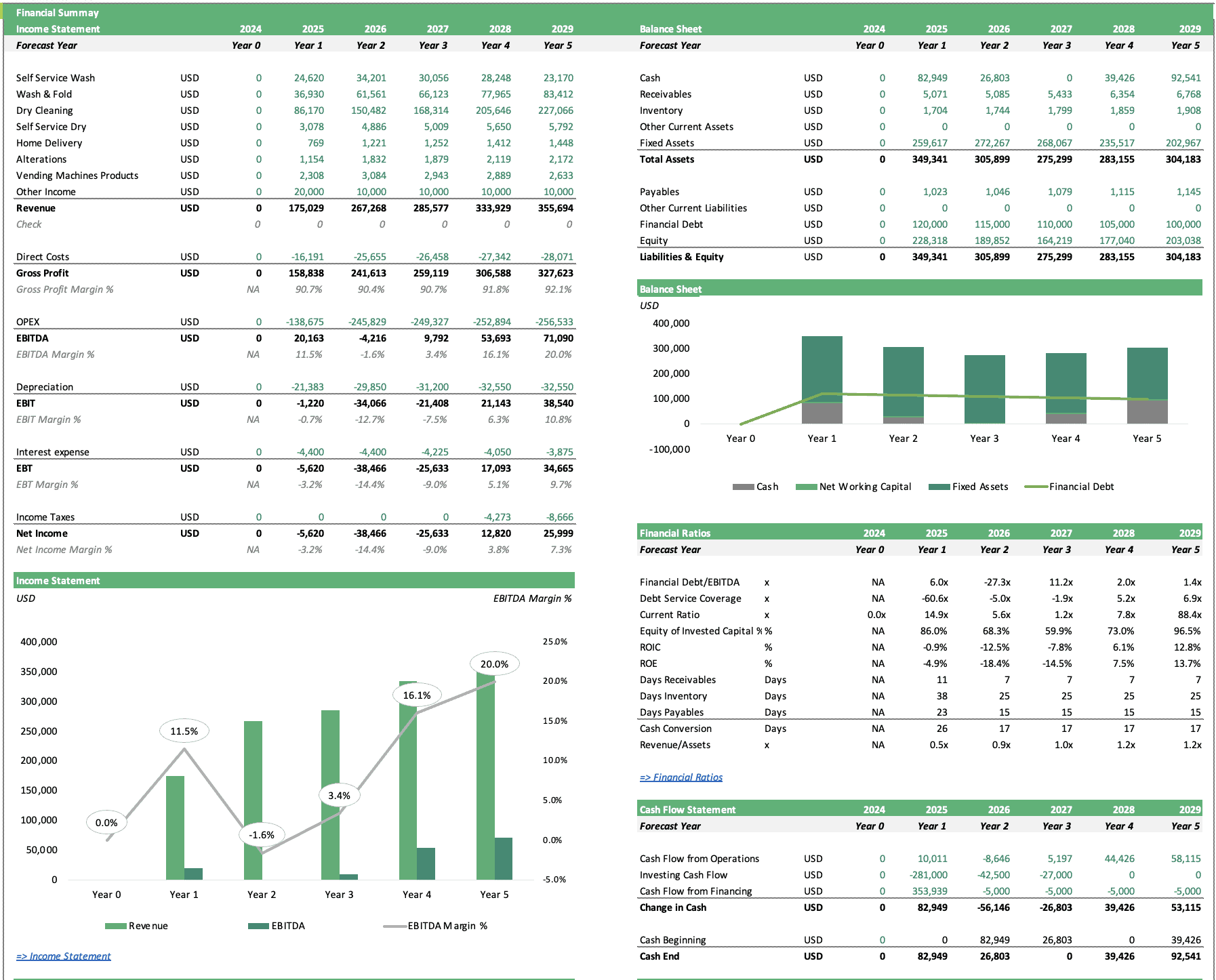
Executive Summary & Detailed Summary include charts and table which summarize the forecasted financial statements – Income Statement, Balance Sheet, Cash Flow Statement – as well as the expected number of customers, machine capacity utilization, revenue and gross profit per customer, uses and sources of funds, debt schedule, free cash flow forecast and key financial metrics such as IRR, Cash on Cash Yield, Payback Period to assess the financial viability of the envisaged business. The plan also includes a forecast of the anticipated business value.
Monthly and Yearly Worksheets include the calculations of all forecasted figures and their derivation of it. The forecast is calculated on a 5-year monthly forecast period which then is aggregated into a 5-year annual financial plan.
Time to Start your own Laundromat Business now!
This is a great spreadsheet template for anybody looking to enter the laundromat business. Instead of getting your hands dirty with a messy spreadsheet, benefit from a well-laid-out planning framework and a concise financial plan template to understand if a laundromat business in your location might be financially feasible or not. Analyze how much funding will be needed and what are the expected returns in the first few years of the business. This handy spreadsheet tool will guide you in understanding your very own laundromat business from new angles and prepares you for discussions with a bank or other capital providers.
The current model version is 1.1. The model is available as a fully editable Excel template or as a PDF Demo version.
The file type is .xlsx and you will need MS Excel to open and use this file.
Similar ProductsOther customers were also interested in...


 Jair
Jair
Self-Service Laundromat Financial Model and Budget...
The financial model for a self-service laundromat is a comprehensive tool that allows owners and inv... Read more
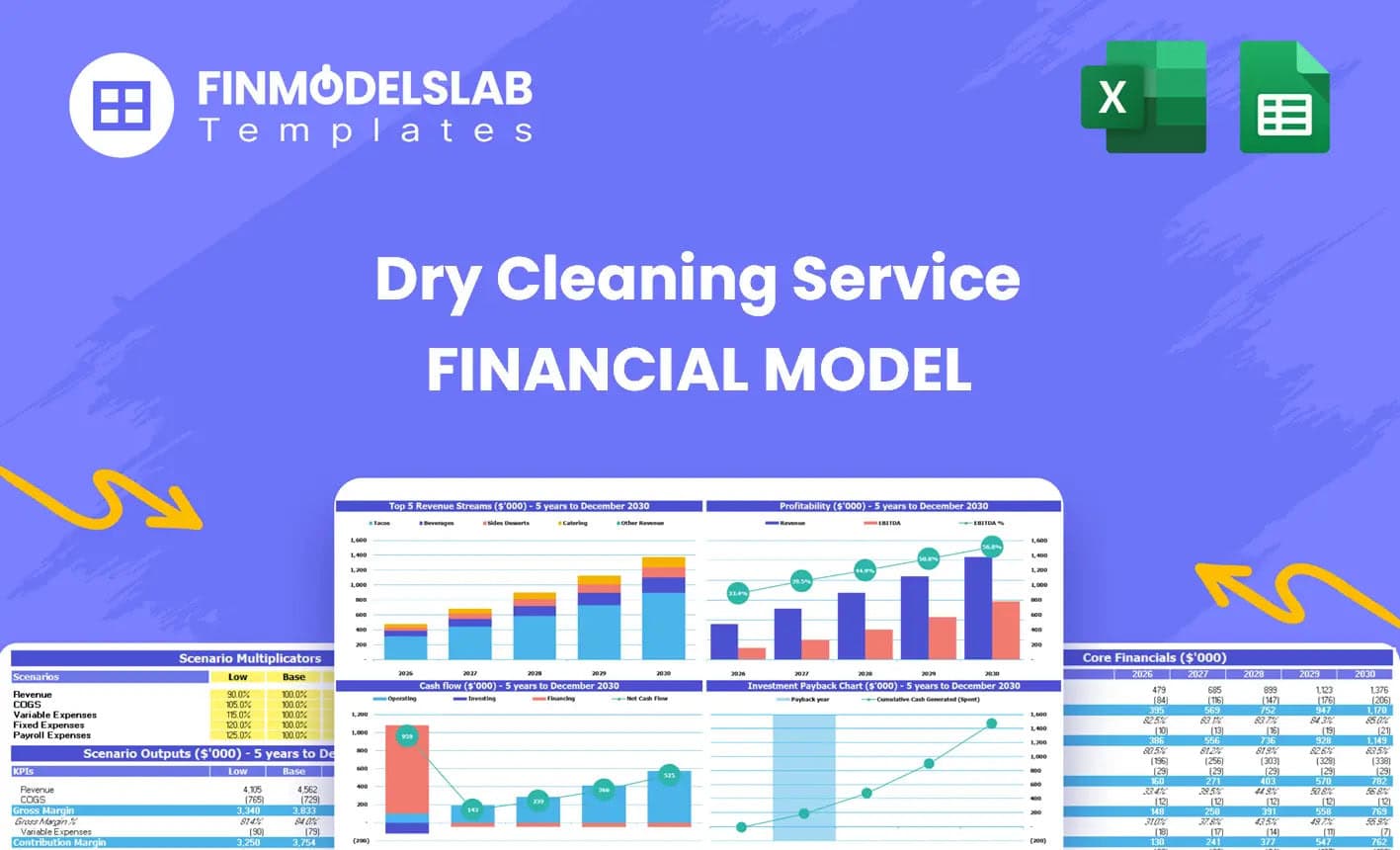
Dry Cleaning Financial Model and Budget Control Te...
The financial model for a dry cleaner is designed to help owners and investors in the industry make ... Read more
 Jason Varner
Services Industry Financial Model Bundle
Bundle of financial model templates for Service Industry businesses and its related sectors such as ... Read more
 Giorgos
Car Wash Financial Model – Dynamic 10 Year B...
Financial Model providing a dynamic up to 10-year financial forecast for a startup or existing Car W... Read more
Laundromat Financial Model – 10 Year
This template allows the user to produce financial statements based on assumptions specific to the l... Read more
 D'Errico Financial S...
Car Wash Development Model
The Car Wash Development model projects annual future cash flows from a car wash facility from the p... Read more
 HenrySheykin
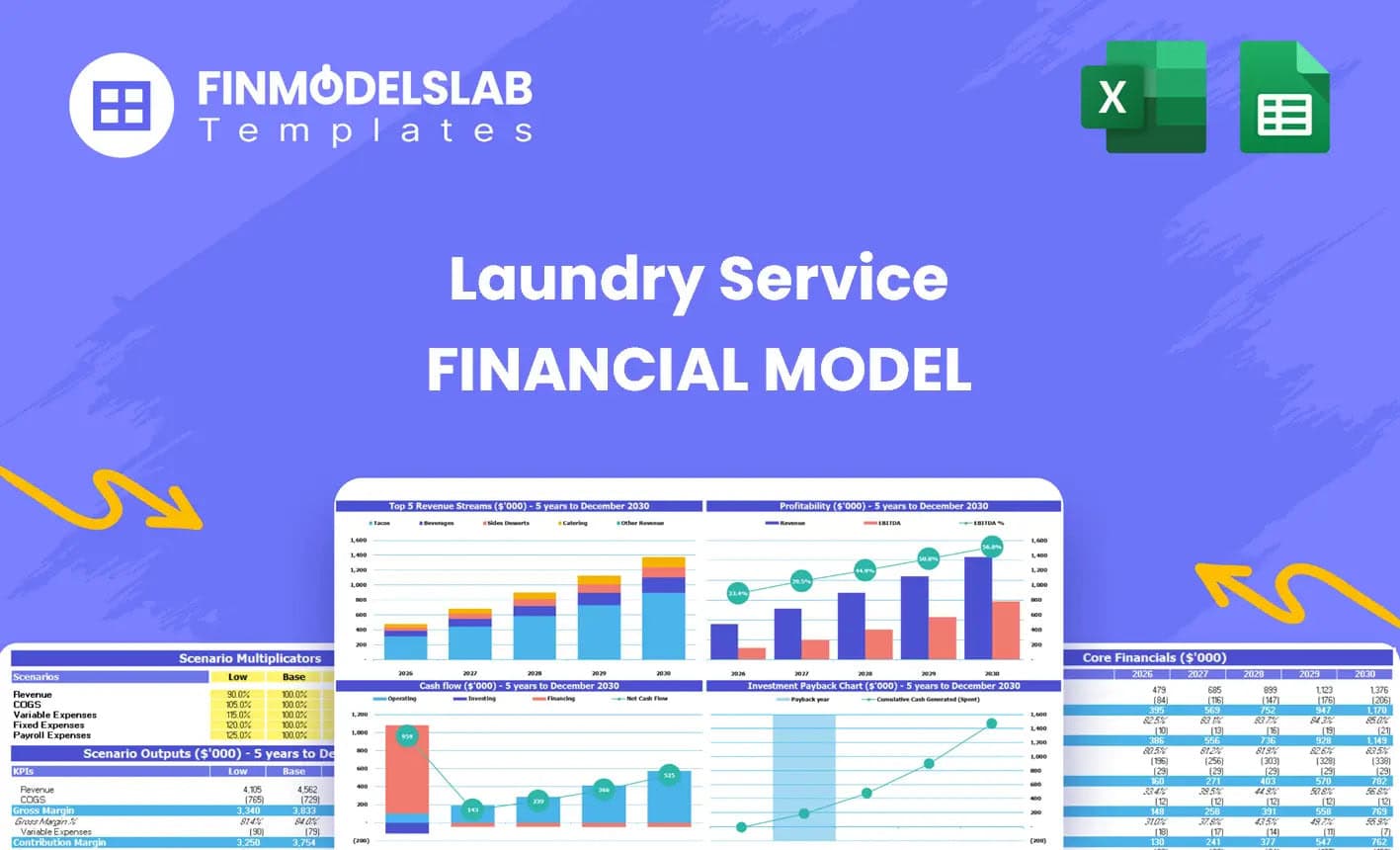
Laundry Financial Model Excel Template
The Laundry Service Financial Model helps entrepreneurs, business owners, consultants, analysts, and... Read more
Dry Cleaner Financial Model Excel Template
The Dry Cleaning Service Financial Model helps entrepreneurs, business owners, consultants, analysts... Read more
 eFinancialModels
Gasoline and EV Charging Station Financial Model
Investors can assess the viability of setting up and investing in gasoline stations with a charging ... Read more
 JILL LIU
Household Service Marketplace Financial and DCF Va...
A complete and fully dynamic financial and DCF valuation model for a household service marketplace b... Read more
Reviews
 Good model with some items missing
I would buy if these things are added.
Gas for heating. Electricity, gas and water are the important utilities.
Rent abatement, common for the first couple of months, up to a year, and/or spread out for the first three years.
Buildout, I miss Tenant improvements (TI) fund.
CAPEX, I miss vending machines.
For the service pickup, you may also have delivery.
Furniture: chairs and tables.
Lease is typically 15 years, model 5 years.
Need to remodel equipment every 7 years.
A few other things, ask.
454 of 882 people found this review helpful.
Help other customers find the most helpful reviews
Did you find this review helpful?
-
Dear Peter,
The Template is fully editable so you can customize it according to your specifications.
Most of the points you addressed can be applied by simply updating the Inputs/Assumptions and calibrating the model.
Below are highlights addressing your key concerns:– Utilities (Gas, Electricity, Water) – Electricity and Water are included under Utilities in Direct Costs. Additional expenses like Gas can be added in the Operating Expenses section by updating the labels and inputting corresponding costs.
– Rent Abatement and Lease Terms – Adjust the Rent Expenses section to include rent abatements or longer leases (e.g., 15 years) by modifying the lease term, rent amounts, and extending the projection period.
– Tenant Improvements (TI) Fund and CAPEX – Include costs like Tenant Improvements, Vending Machines, and Furniture in the CAPEX section by updating labels and inputting detailed costs, lifespan assumptions, and depreciation schedules.
– Equipment Replacement – As the model focuses on a 5-year forecast, adjust the EV/EBITDA multiple to account for future CAPEX needs beyond Year 5.
– Delivery Fee – Update "Home Delivery" to "Delivery Fee" under the Upsell Revenue section to incorporate charges for pickup/drop-off services, adjusting related costs under Operating Expenses.
For additional customizations, we offer services at $180/hour. Feel free to contact us with your requirements and edited model template then we’ll provide an estimate before proceeding.
Many thanks and we look forward to hearing back from you.
441 of 1091 people found this review helpful.
Help other customers find the most helpful reviews
Did you find this review helpful?

 Robust and Informative
The model has plenty to offer and certainly helps guide the user through strategic decisions of their business
Thank you for your feedback.
395 of 1092 people found this review helpful.
You must log in to submit a review.