
0 ITEMS

E-Waste Recycling Plant Financial Model: Electronics Recycling, WEEE, ITAD and Data Destruction, Circuit Board Recovery, Project Finance
Annual Excel model for an e-waste (WEEE) recycling plant with an optional ITAD business: six device categories, a 12-fraction material mass balance, five processing configurations from manual demanufacturing to shred-and-separate, US state program presets, sculpted DSCR debt and three integrated statements. Fully unlocked, no macros.
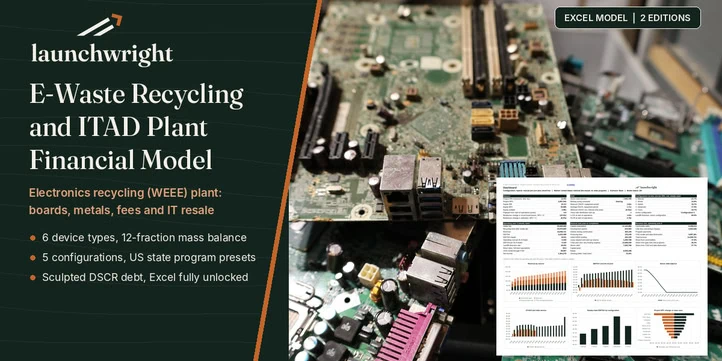
Plan an electronics recycling plant the way processors actually make money: gate fees, state program payments, commodity sales and IT asset resale, net of the labor and disposal costs that sink most e-waste business plans. We found no other e-waste model on eFinancialModels that breaks the stream down this far.
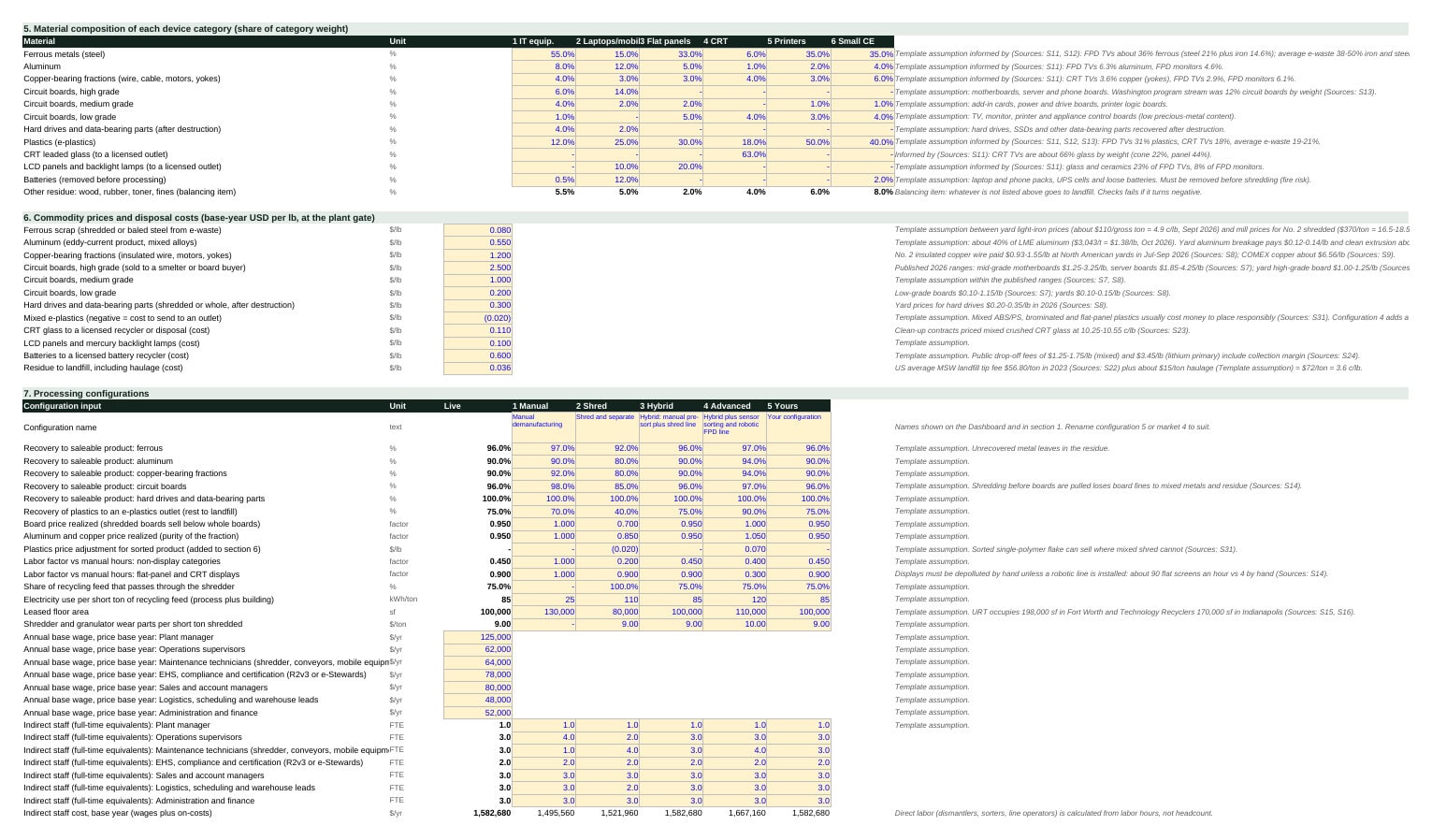
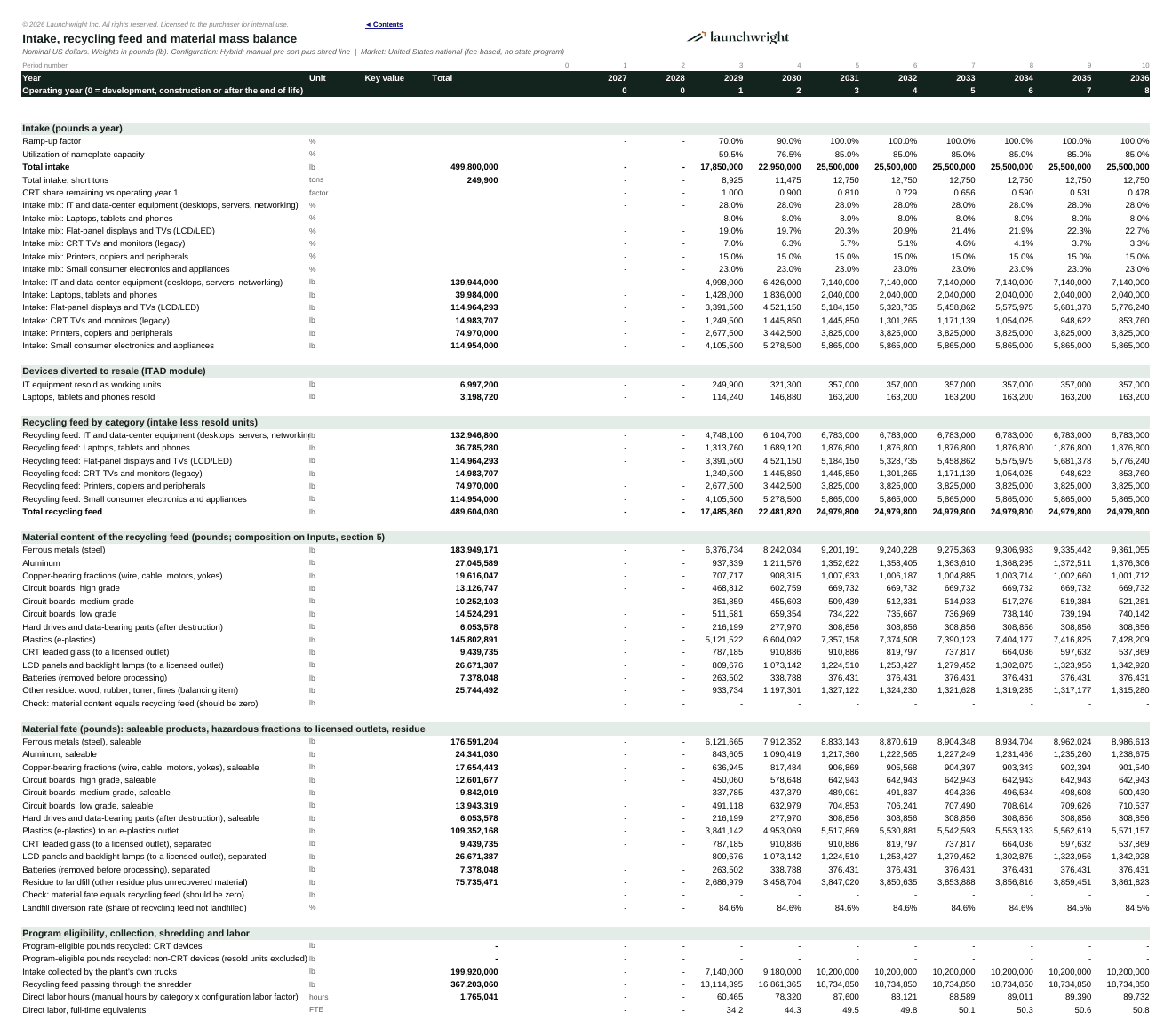
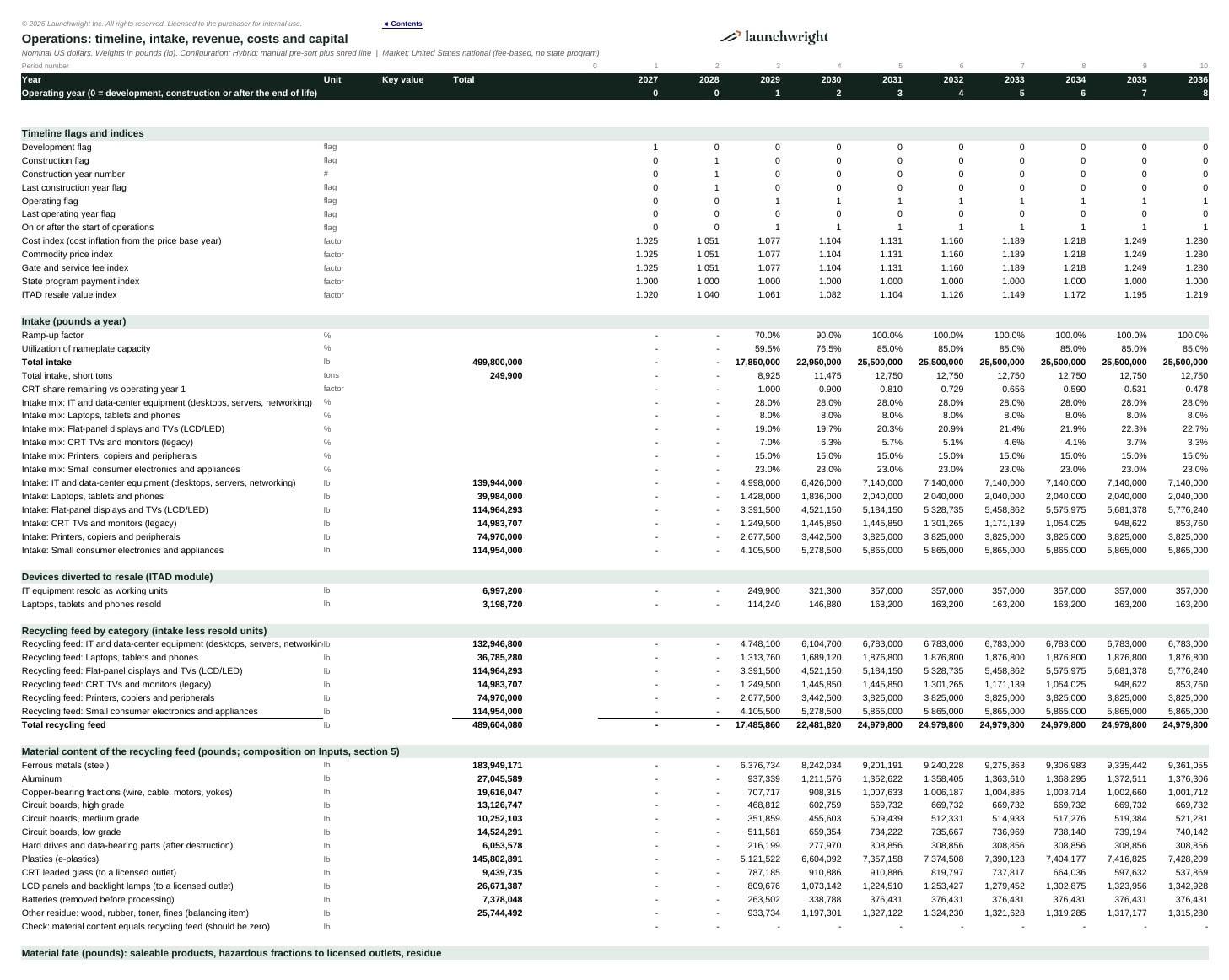
Intake is split into six device categories: IT and data-center equipment; laptops, tablets and phones; flat-panel displays; CRT TVs and monitors; printers and peripherals; and small consumer electronics. Each category has its own material composition, which the model turns into 12 fractions: ferrous, aluminum, copper-bearing, high, medium and low grade circuit boards, hard drives, plastics, CRT glass, LCD panels, batteries and residue. A mass balance proves that every pound is sold, sent to a licensed outlet or landfilled, and reports the landfill diversion rate your clients will ask for.
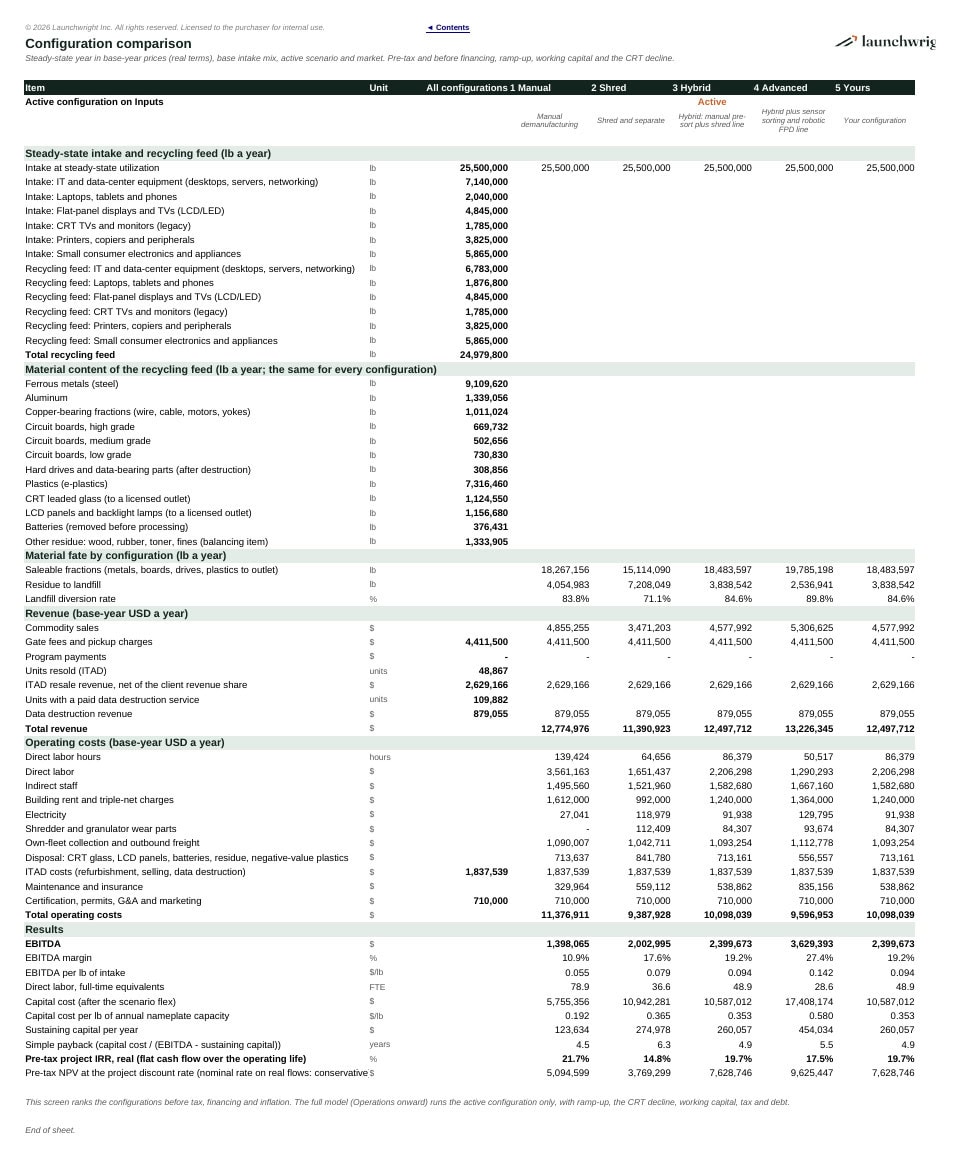
Five processing configurations are compared side by side at the same plant size: manual demanufacturing, shred and separate, a hybrid with manual pre-sort, an advanced line with sensor sorting and a robotic flat-panel line, and your own configuration. Each has its own recovery rates, board price realization, labor hours, floor area, energy use, staffing and a 14-item installed capital cost. The configuration screen shows the real trade-off: shredding saves labor but loses circuit-board value.
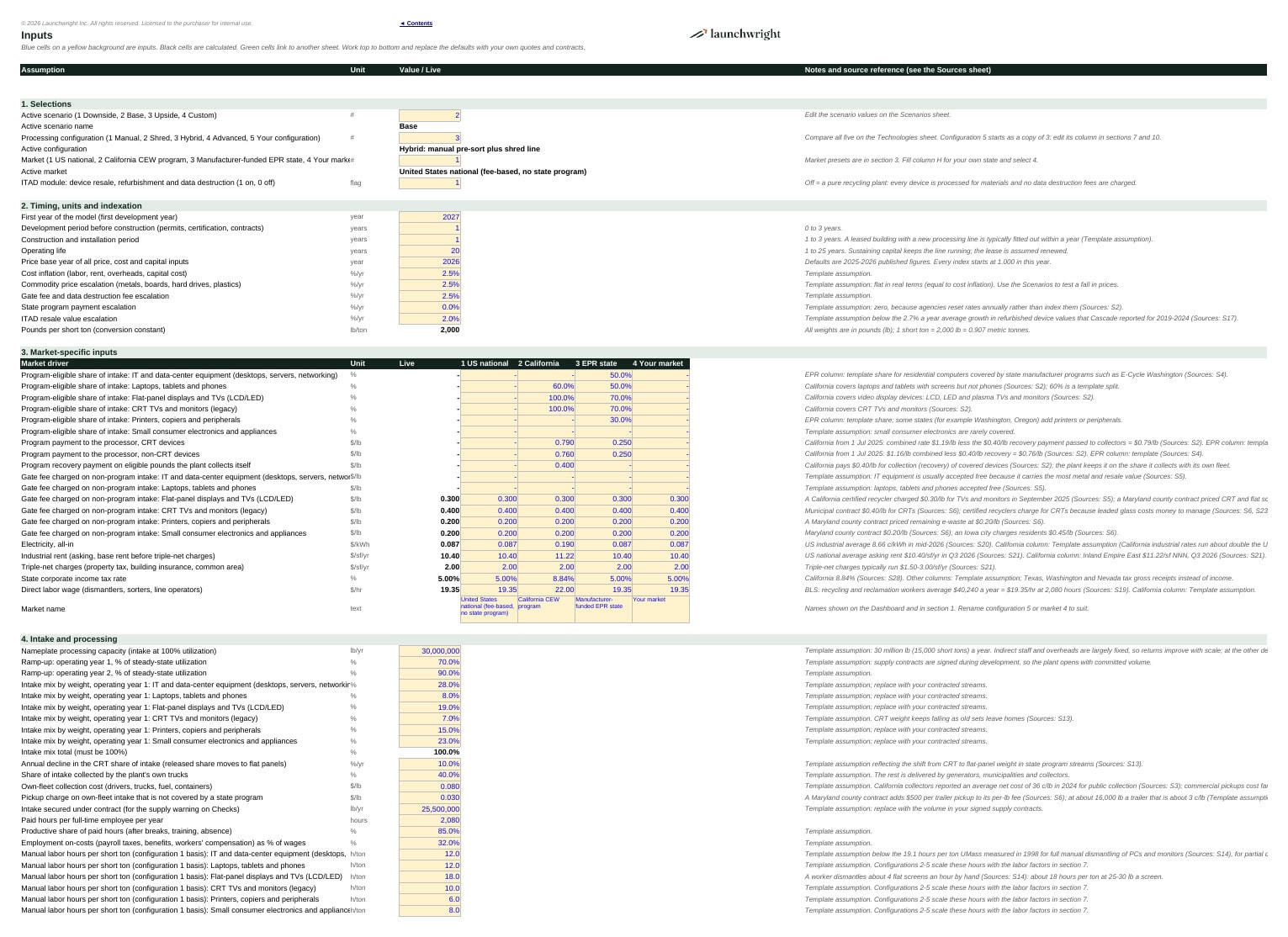
Four market presets set the revenue model: US national (gate fees only), California’s covered electronic waste program with its 2025 per-pound payment rates, a manufacturer-funded EPR state, and your own market. The optional ITAD module adds device resale, client revenue share, refurbishment costs and paid data destruction.
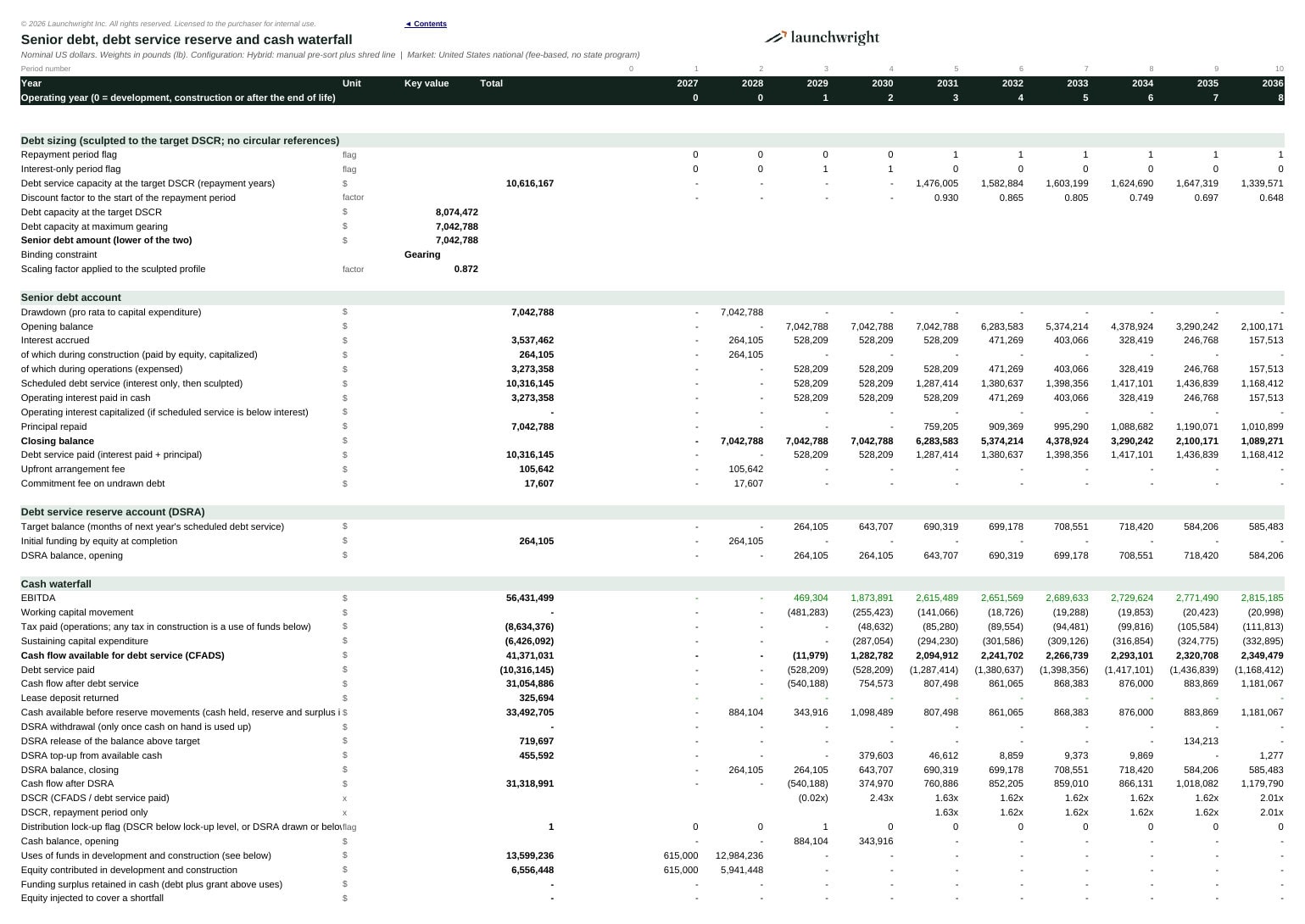
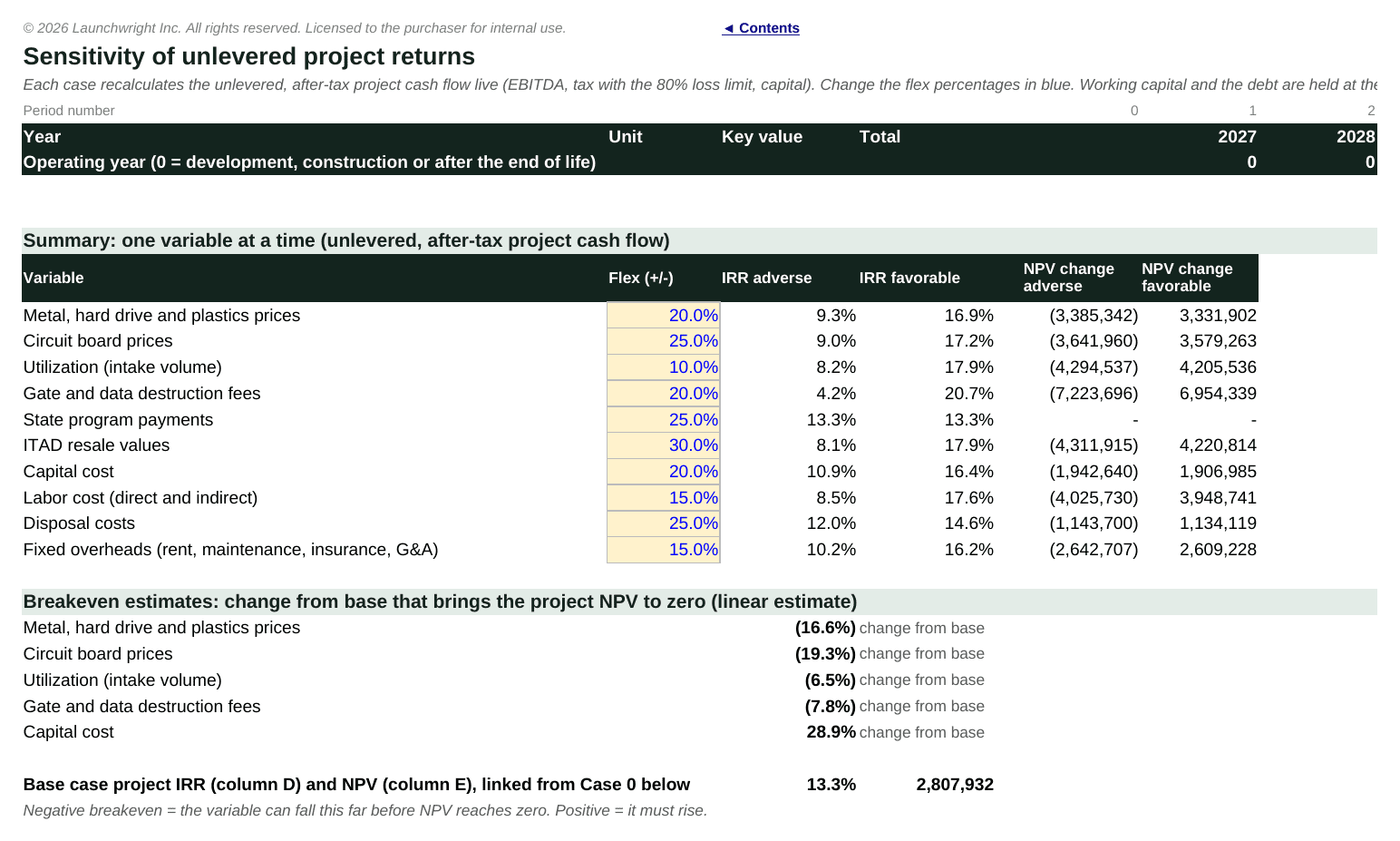
Financing is built for lenders: 0-3 years of development, 1-3 years of construction, up to 25 operating years, interest during construction, interest-only years, an optional capital grant, US tax with 100% bonus depreciation, 7-year MACRS (asset class 49.5), the 80% loss limit and taxable grants, and an income statement, cash flow statement and balance sheet that balance in every year. The Due Diligence Edition sizes and sculpts the debt to a target DSCR with a gearing cap, adds a debt service reserve, distribution lock-up, LLCR and PLCR, four editable scenarios, 20 live sensitivity cases with a tornado chart and breakeven prices.
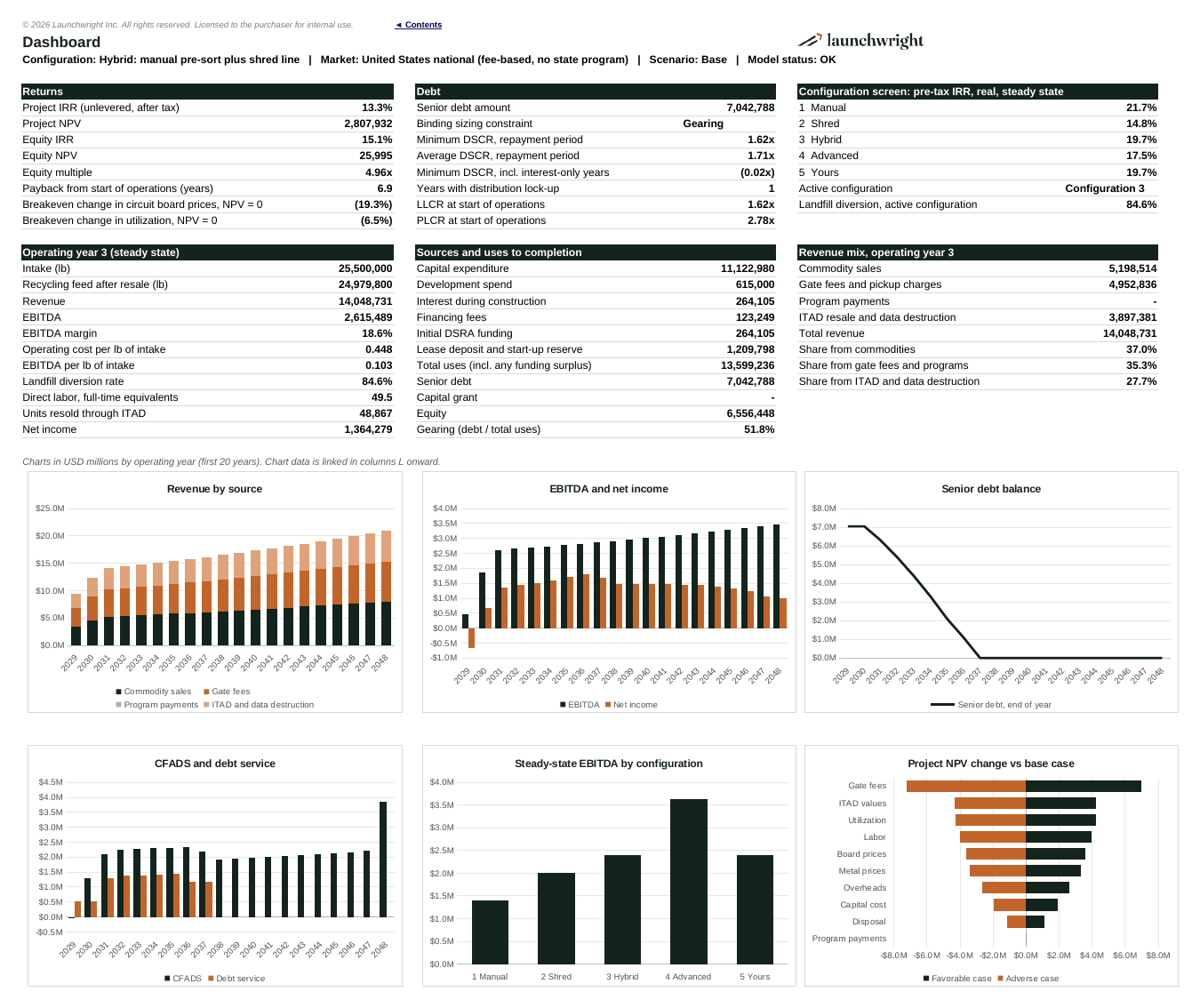
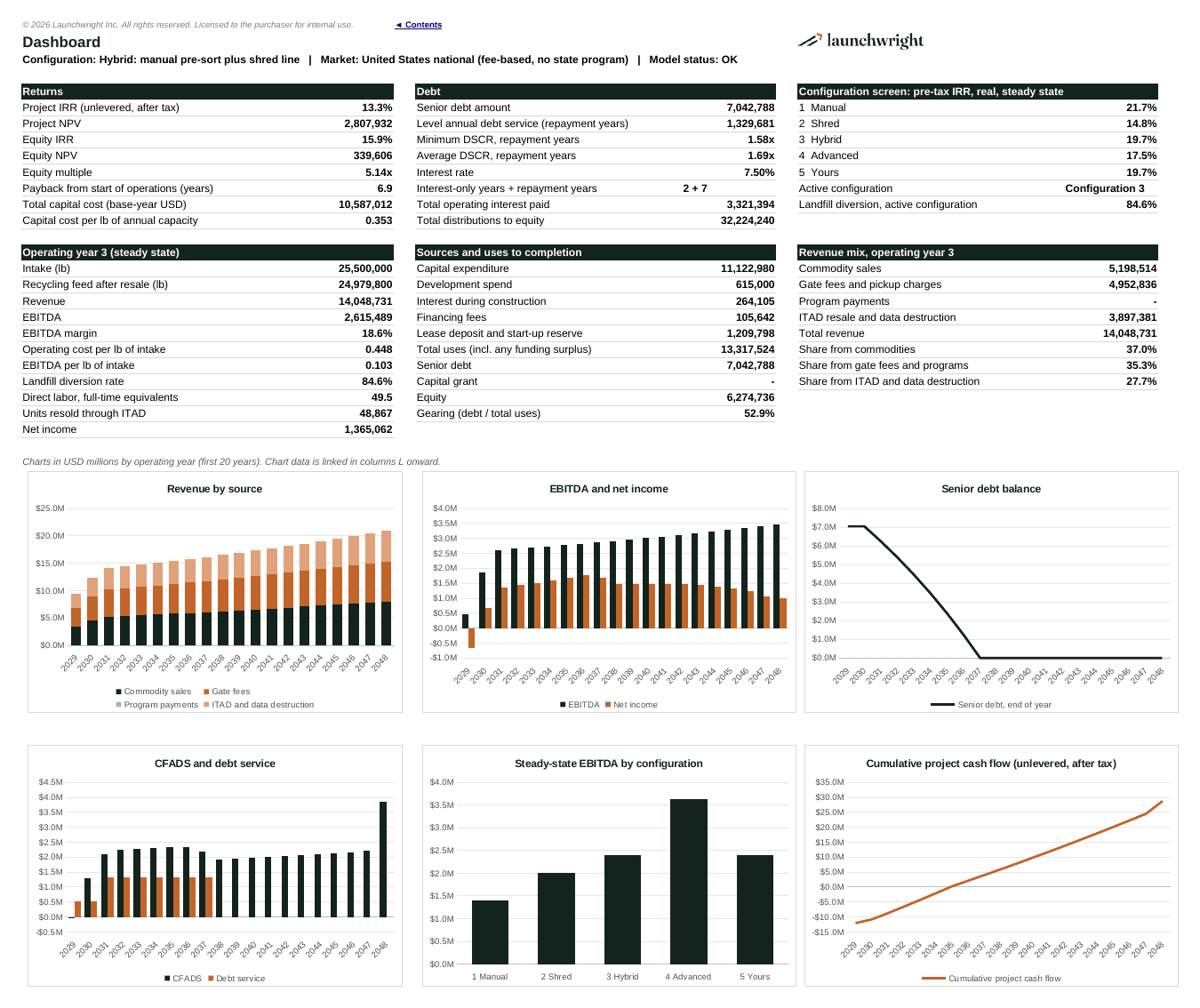
At the default inputs (hybrid line, US national market, 30 million lb a year), the Due Diligence Edition shows a project IRR of 13.3% after tax, an equity IRR of 15.1% and a minimum repayment-period DSCR of 1.62x. The model is honest about the risks: with the ITAD module switched off, the same plant does not pay back, the downside scenario turns the NPV negative, and below about 28 million lb a year the default plant no longer earns its cost of capital. Every default is cited on a Sources sheet (32 public sources) or marked as a template assumption, so you know exactly what to replace first.
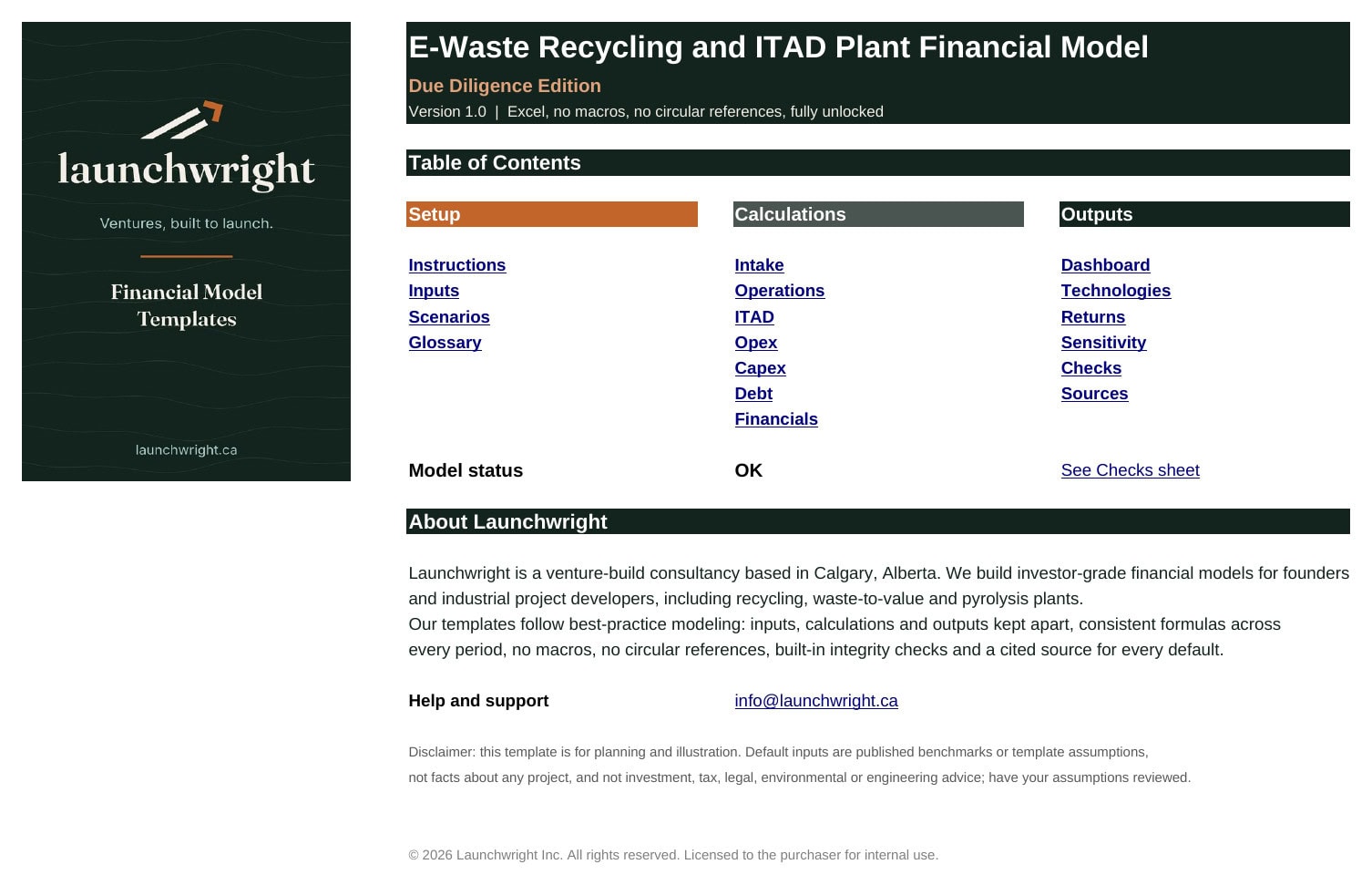
Fully unlocked Excel, no macros, no circular references, no external links, with integrity checks on every key balance.
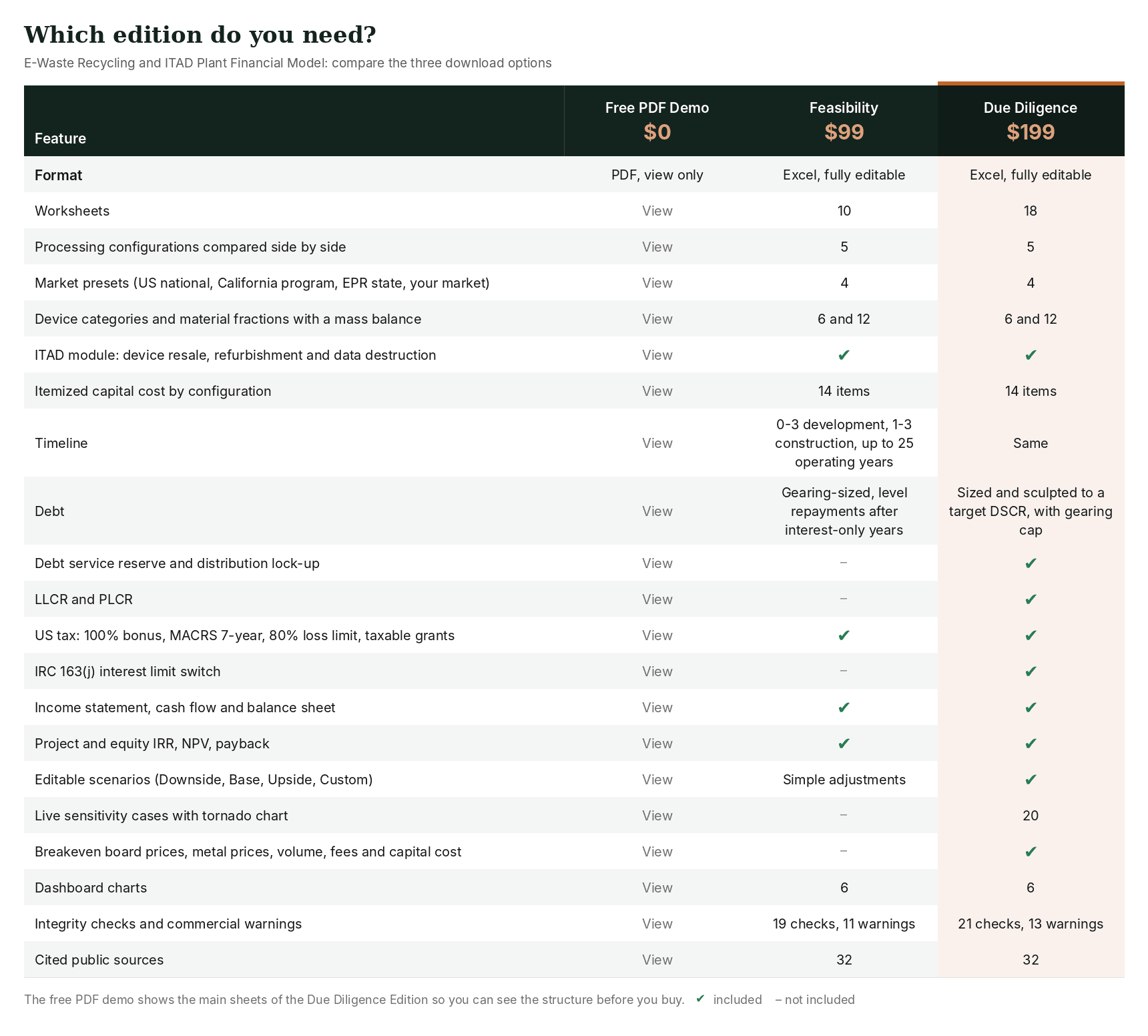
Edition comparison
Frequently asked questions
Does it work outside the United States?
Yes. Market 4 is a blank column for your own gate fees, program payments, power price, rent, wage and tax rate. Currency labels are US dollars and weights are pounds, so convert your inputs to those units. The tax depreciation follows US rules; replace the rates on Inputs for other countries.
Can I model a plant without ITAD?
Yes. Switch the ITAD module off on Inputs and every device goes to recycling. At the default US national inputs that plant does not pay back, which is the honest answer for a fee-and-commodity processor without program payments.
Where do the default prices come from?
From 32 cited public sources: CalRecycle payment rates, yard and board price trackers, LME and COMEX metal prices, the Sage (Cascade) ITAD benchmarking report, BLS wages, EIA power prices, EREF landfill fees and IRS guidance. Inputs without a published benchmark are marked Template assumption.
Which edition do I need?
The Feasibility Edition screens a project and produces three statements and returns. Choose the Due Diligence Edition for a lender or investor: sculpted DSCR debt, DSRA, lock-up, LLCR and PLCR, scenarios, sensitivities and breakevens.
Does it handle a capital grant?
Yes, as a percentage of capital cost and or a fixed amount. You choose whether it is taxable income (the default under IRC 118 since 2017) or deducted from the depreciable basis.
Is the file locked or macro-enabled?
No. Every sheet is unlocked, every formula is visible and there are no macros.
Can I get it customized?
Yes, through the eFinancialModels custom modeling service. For questions about how the template works, email us via the Contact Author button or through customer support chat.
Similar ProductsOther customers were also interested in...


 eFinancialModels
Electric Vehicle (EV) Charging Station Financial M...
With this comprehensive 5- or 10-year monthly tool, investors can assess the viability of setting up... Read more

Financial Model for Mobile App | Mobile App Busine...
The Mobile App Financial Plan Template in Excel allows you to develop financial projections when lau... Read more

 HenrySheykin
Food Truck Financial Model Excel Template
The Food Truck Financial Model helps entrepreneurs, founders, business owners, consultants, and anal... Read more

Green Hydrogen Production from Wind Energy Financi...
The Green Hydrogen from Wind Financial Model aims to comprehensively forecast a horizon of 40 years ... Read more

Simple Mutual Non-Disclosure Agreement Template
Protect your business secrets with ease using our Simple Mutual Non-Disclosure Agreement Template. S... Read more

Solar Energy Financial Model
The Solar Energy Financial Model Spreadsheet Template in Excel assists you in preparing a sophistica... Read more

 Peter Graf
The Customer-Centric Financial Model for Restauran...
Starting a restaurant without a financial plan is like driving a car blindfolded. You wouldn´t do i... Read more
You must log in to submit a review.