
0 ITEMS

Coffee Roasting Business Financial Model Excel | 60-Month Production, Inventory & Cash Flow Forecast
Plan five years of coffee roasting economics with 17 connected Excel sheets, 20 linked coffee products, 500 forecast order rows, four scenarios, three financial statements, break-even analysis and eight native charts. Includes a 23-page English guide.
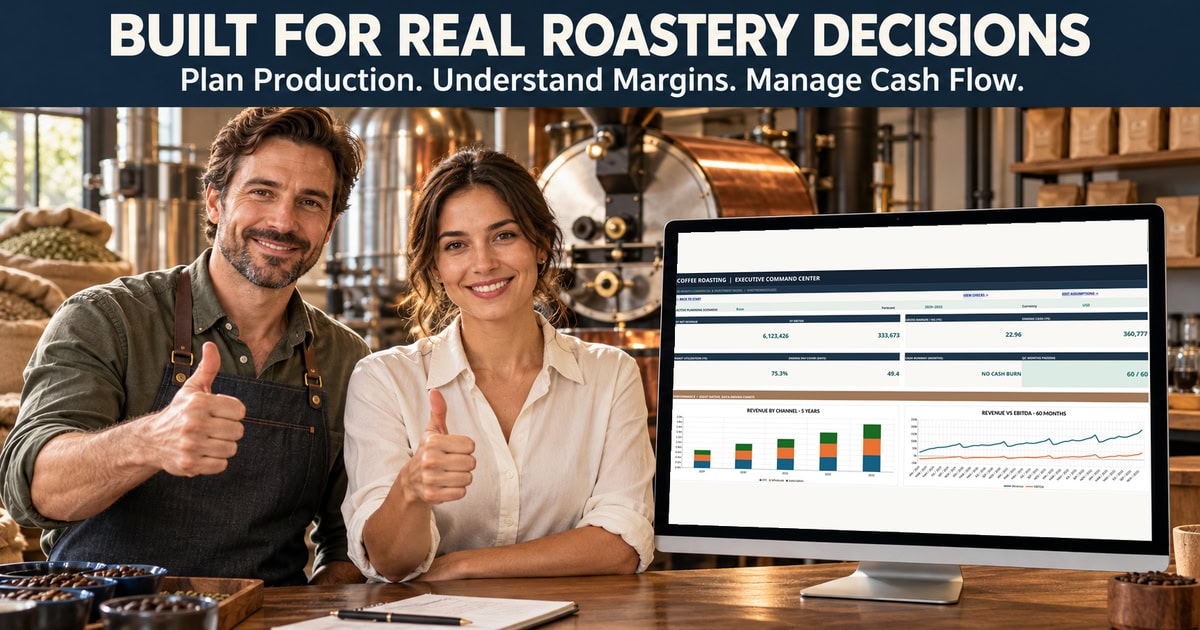
COFFEE ROASTING BUSINESS FINANCIAL MODEL | 60-MONTH PROFESSIONAL EDITION
From Green Beans to Financial Performance
Plan a specialty coffee roastery using a transparent, editable Excel forecast that connects green-bean purchasing, roasting shrinkage, equipment utilization, coffee inventory and three commercial channels to profitability, cash flow and break-even analysis.
Developed for coffee roasting founders, independent producers, finance managers and consultants. All products, prices and financial values supplied with the workbook are fictional demonstration data.
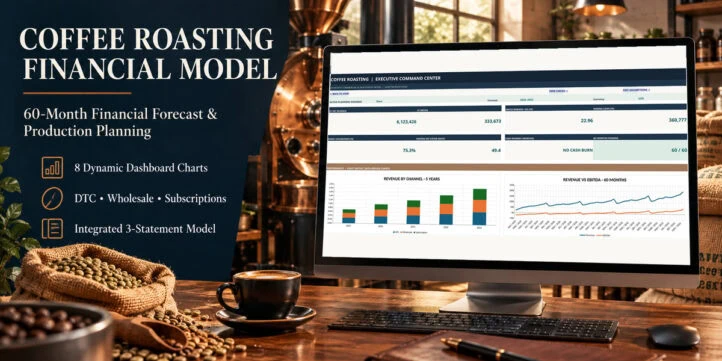
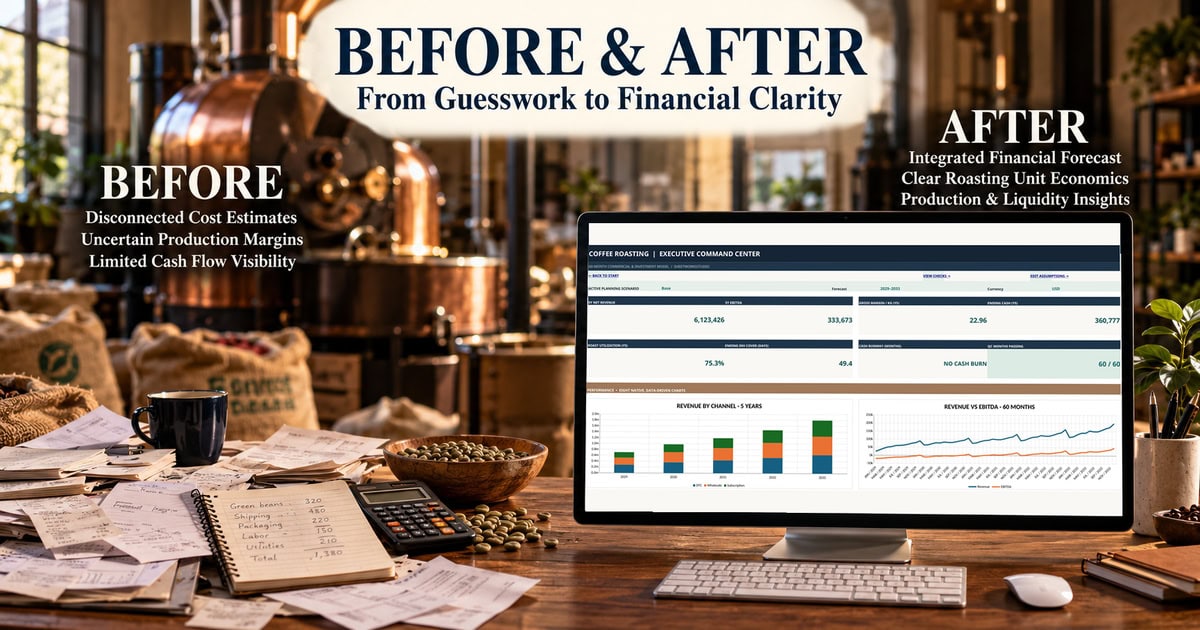
📊 EXECUTIVE DASHBOARD
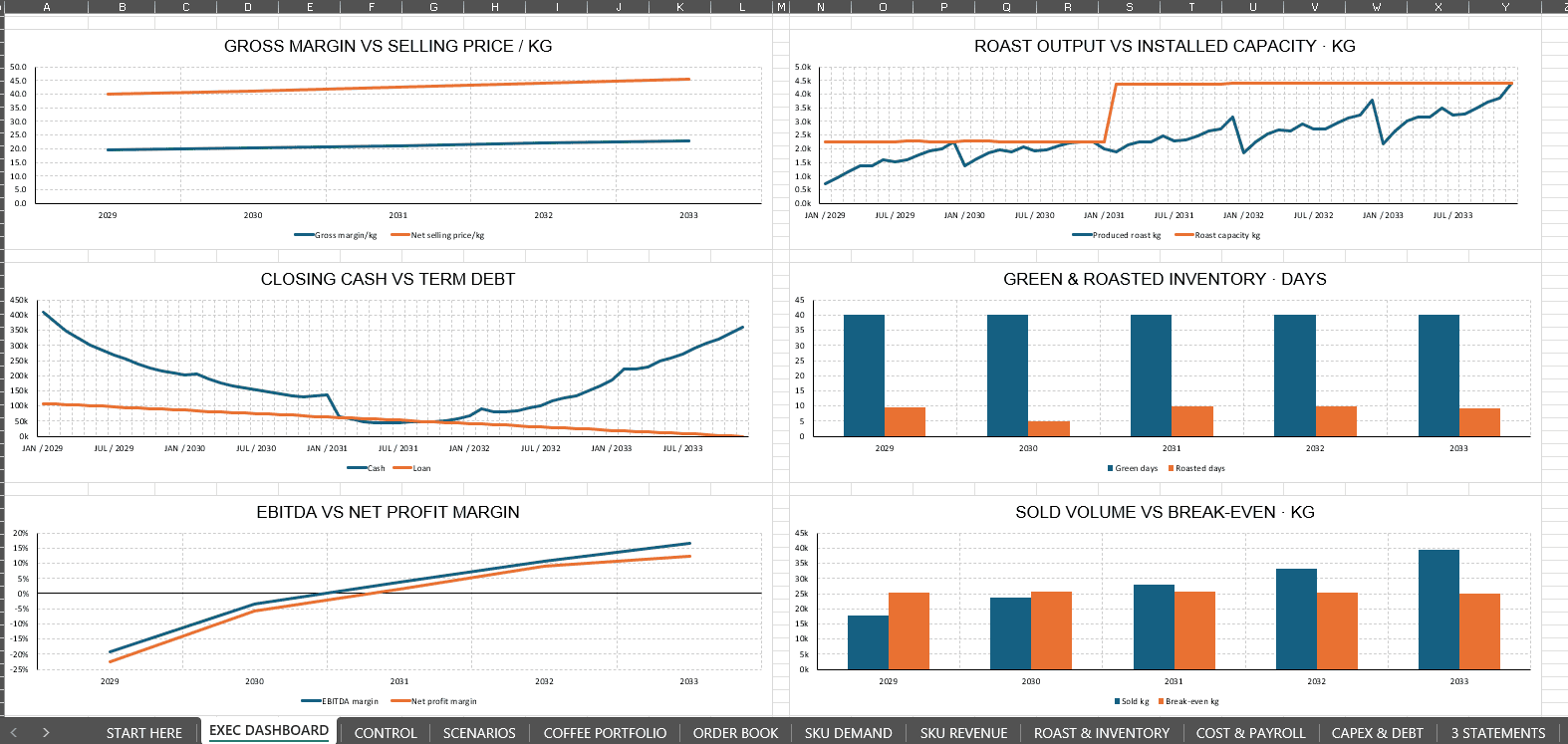
Review eight native, formula-linked Excel charts:
Revenue by Channel (5 Years), Revenue vs EBITDA (60 Months), Gross Margin vs Selling Price per kg, Roast Output vs Installed Capacity, Closing Cash vs Term Debt, Green & Roasted Inventory Days, EBITDA vs Net Profit Margin, and Sold Volume vs Break-even.
KPI cards summarize five-year revenue, five-year EBITDA, Year-5 gross profit per shipped kilogram, closing cash, roast utilization, inventory cover, cash runway and monthly model-check PASS count.
The cash-runway sentinel 999 indicates no recent operating cash burn, not 999 months of assured liquidity.
⚙️ ROASTING CAPACITY & YIELD
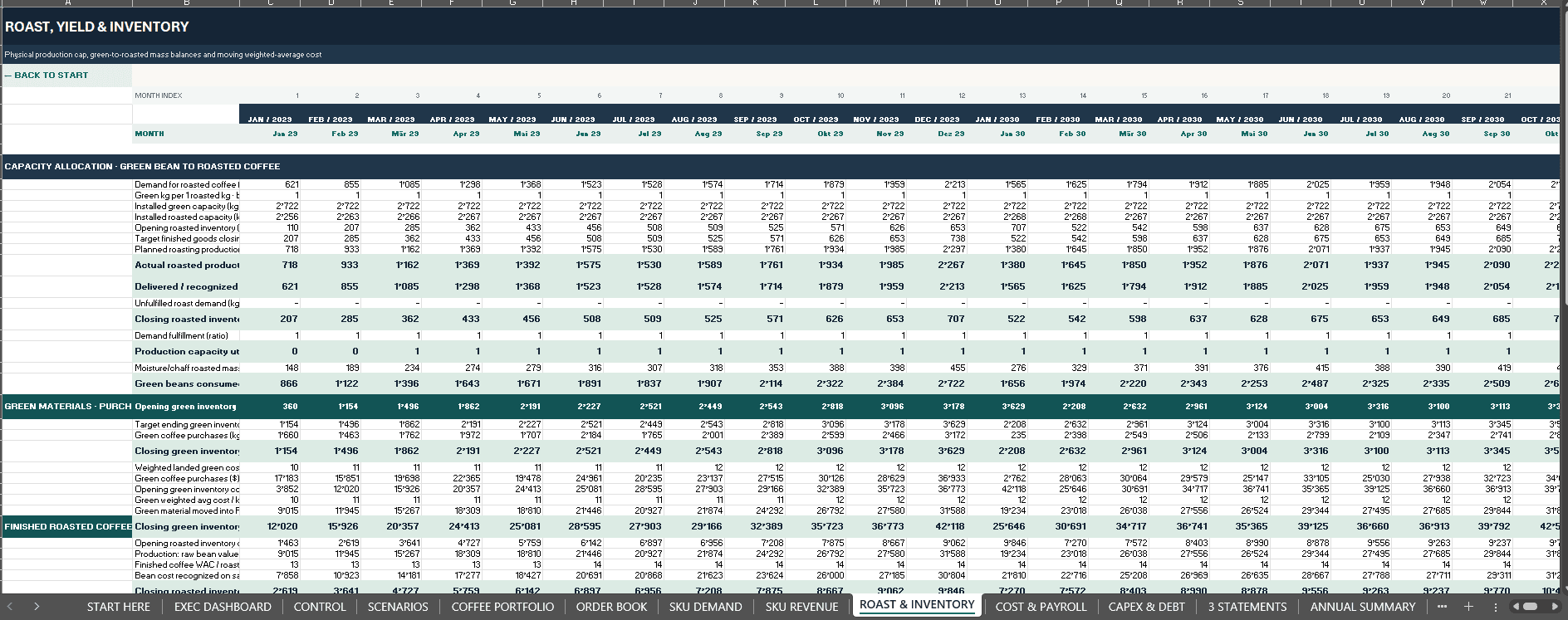
The model translates green coffee into saleable roasted kilograms using roasting loss and a linked production limit.
Installed monthly capacity depends on batch kilograms, batches per hour, roasting hours per day, operating days and utilization.
Change expansion month, larger roaster size, investment amount and useful life. Unmet customer demand does not become sales unless coffee can actually be produced and shipped.
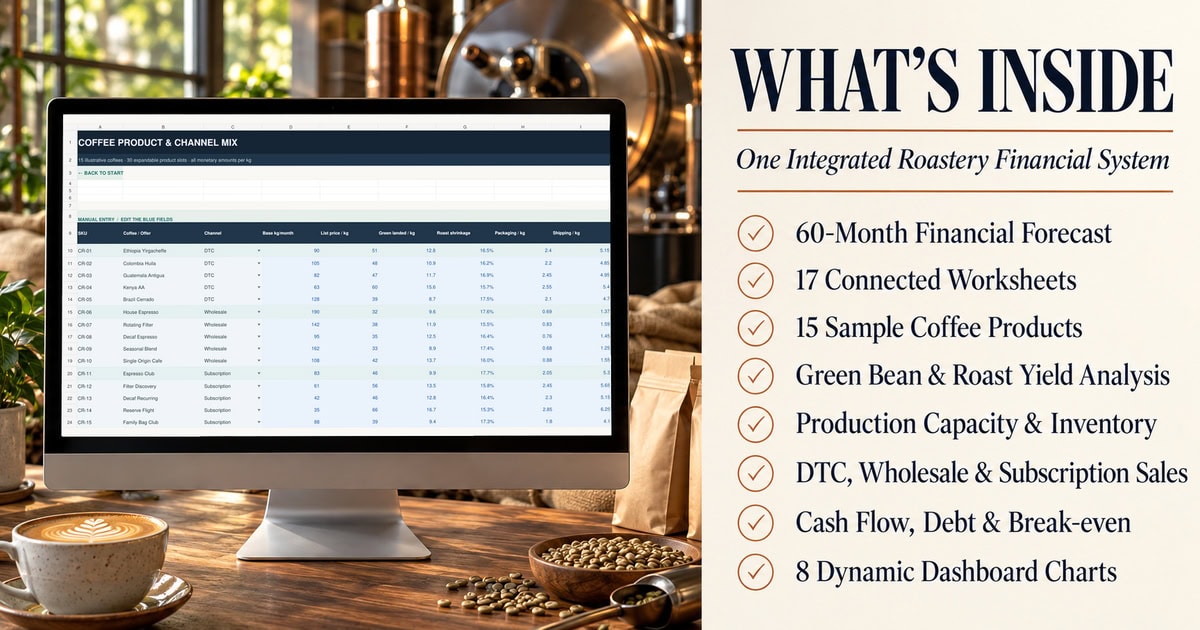
◈ COFFEE PRODUCTS & ORDER BOOK
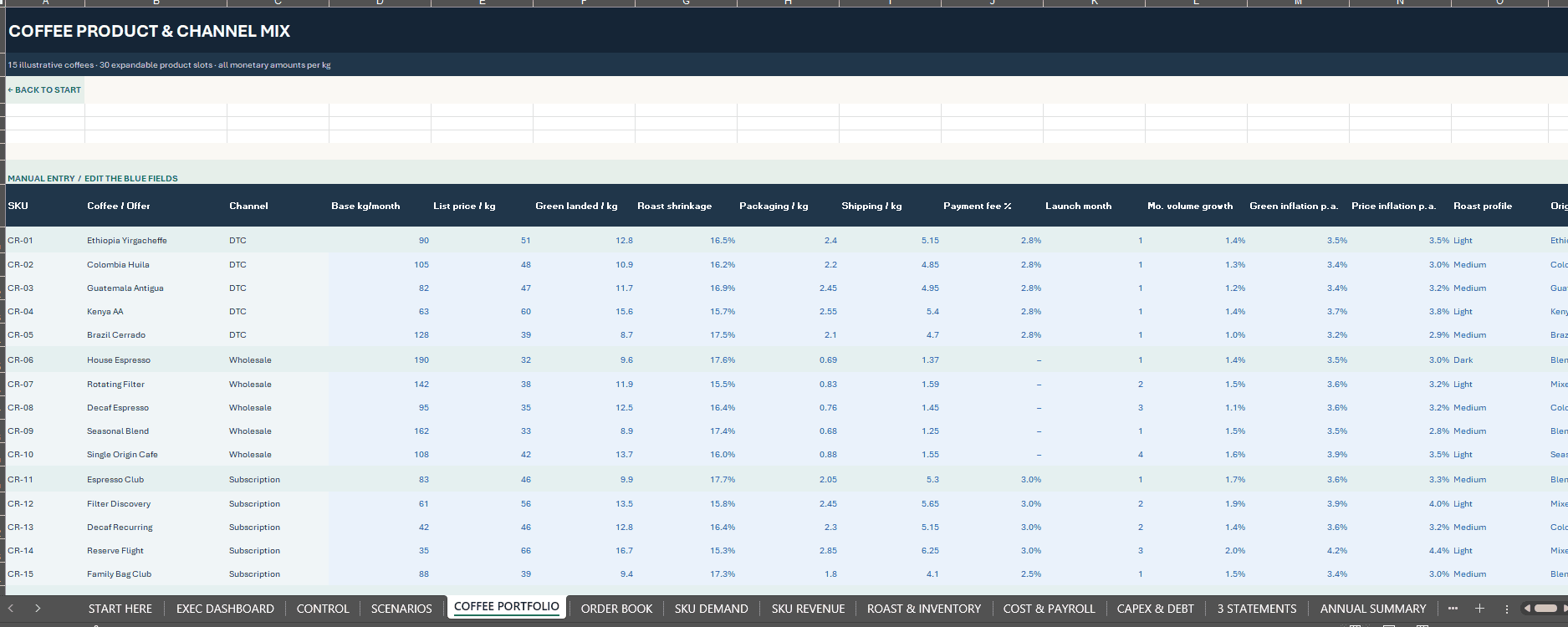
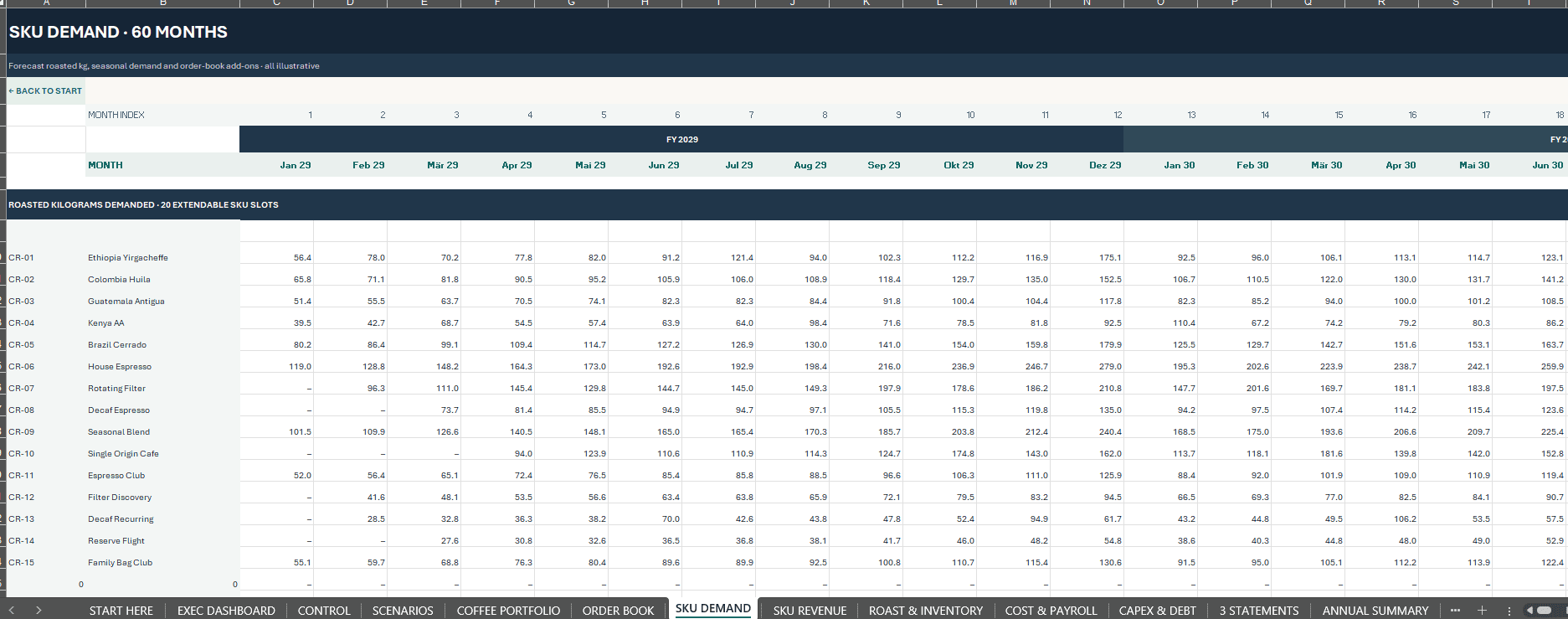
Configure 20 formula-linked coffee offers, with 15 prefilled sample records spanning direct-to-consumer, wholesale and subscription channels.
Editable assumptions include selling price, monthly demand, green-bean landed cost, roast loss, packaging, shipping, merchant fees, launch timing and annual growth.
Wholesale sales use discounts relative to list prices; subscriptions are a separate revenue channel, not a cohort-retention or billing engine.
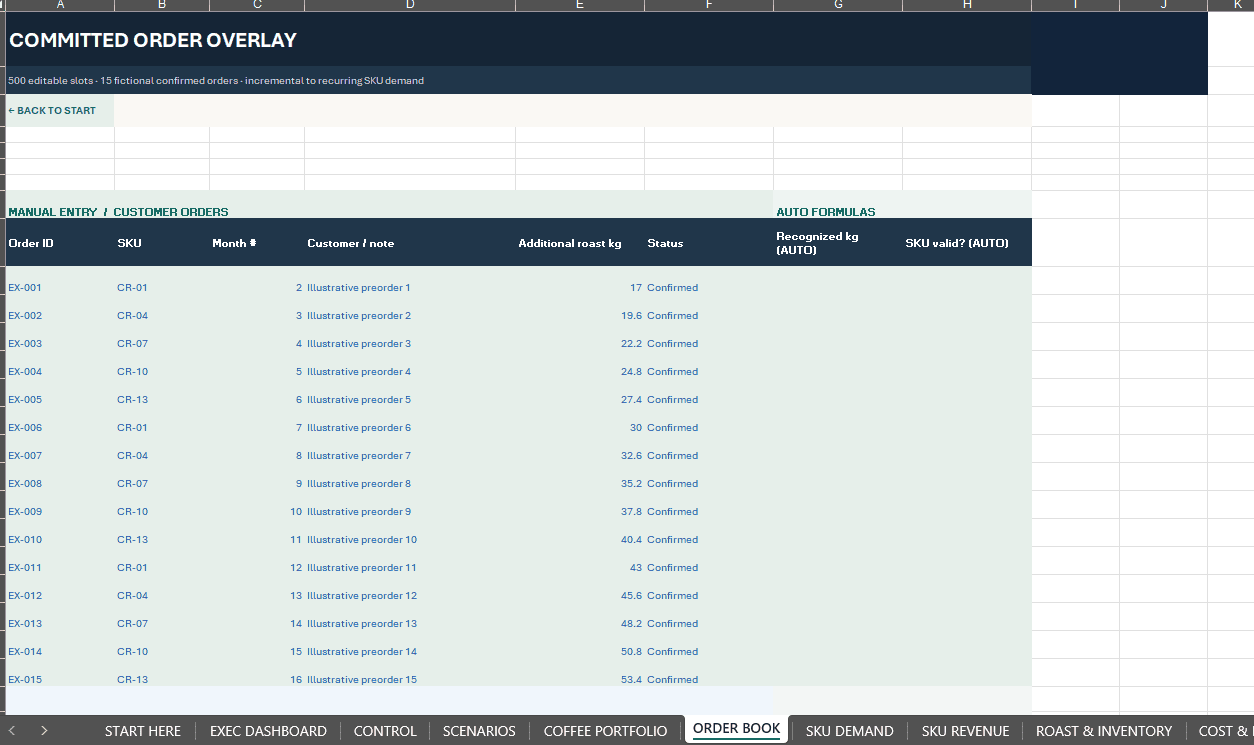
An additional 500-row ORDER BOOK overlays confirmed incremental customer demand. Only valid, confirmed order records affect the forecast. This is a prospective demand planner, not a historical invoice ledger.
📦 STOCK, COSTING & WORKING CAPITAL
Follow a physical green-bean stock ledger and a separate finished roasted coffee ledger.
The model links procurement, green kilograms consumed, shrinkage, roast output, shipments, closing stock and simplified weighted-average bean valuation.
Packaging, outbound shipping, processing fees and roasting energy affect direct costs; inventory capitalization does not constitute a full audited manufacturing cost-absorption model.
Monthly receivables, supplier payables, green inventory and roasted inventory connect operating decisions to liquidity. The model uses simplified monthly DSO/DPO assumptions, not a detailed invoice-aging forecast.
🏦 STAFFING, CAPEX & FINANCING
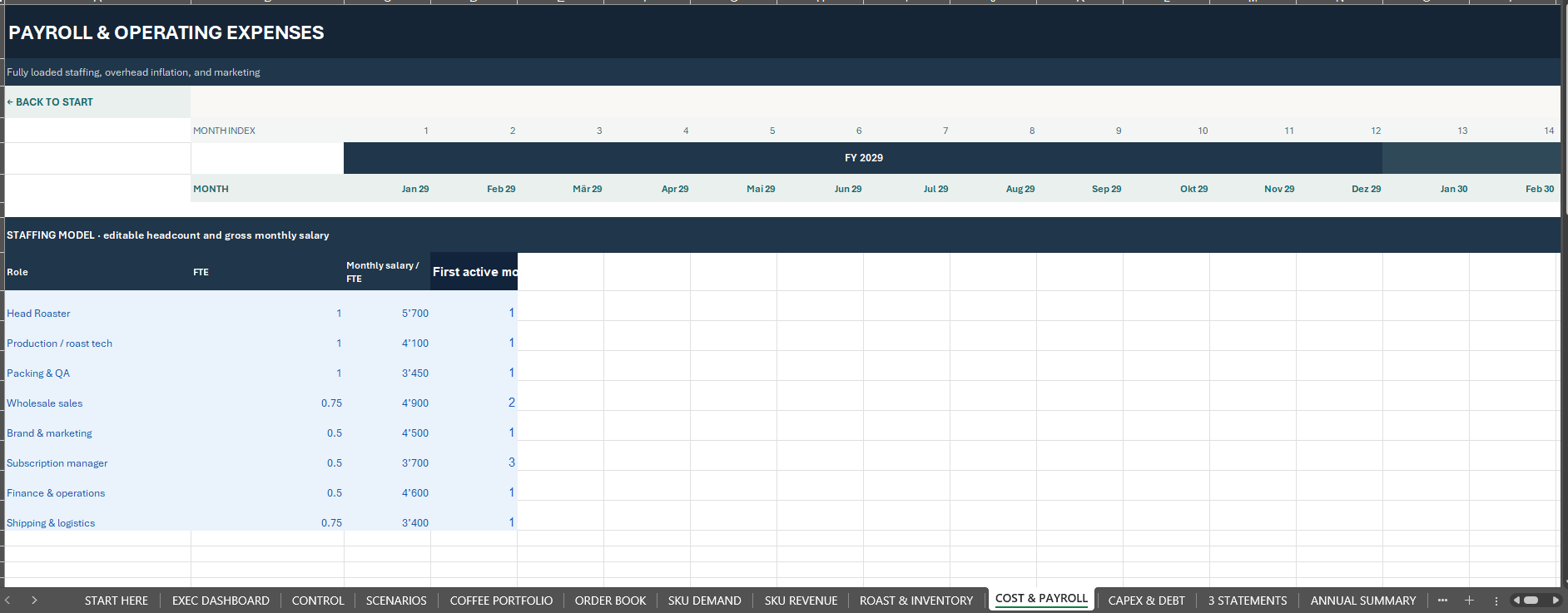
Model head roaster, production/packing, sales, marketing, administration and logistics staffing, monthly payroll and employer burden, site expenses, fixed utilities and variable roast energy.
Equipment schedules include initial commercial-roastery assets, selected roaster expansion, depreciation and a single term loan with interest and scheduled principal payments.
Expansion investment does not automatically raise fresh funding.
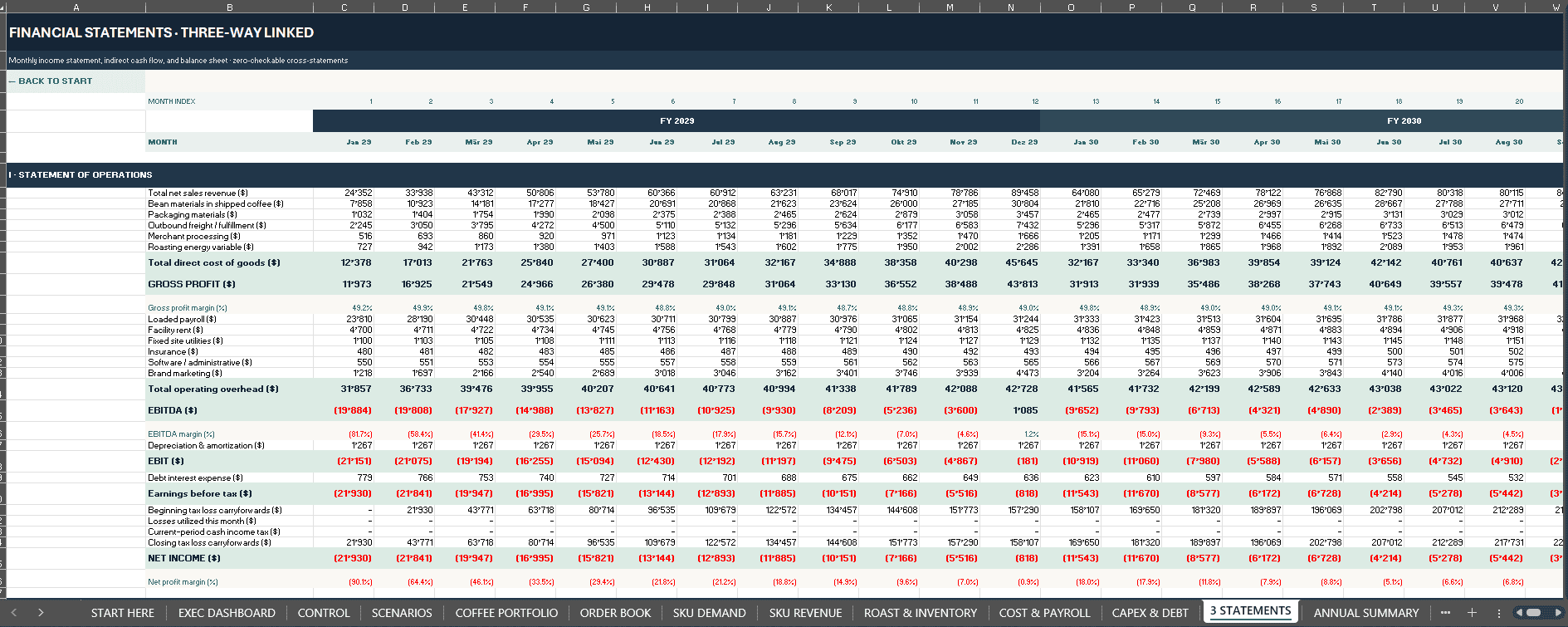
📑 THREE FINANCIAL STATEMENTS
One linked worksheet contains sixty monthly periods of the Income Statement, Cash Flow Statement and Balance Sheet.
Trace recognized sales, direct costs, EBITDA, net earnings, tax-loss carryforwards, stock investments, trade receivables and payables, debt and closing cash.
A five-year ANNUAL SUMMARY presents the resulting management and operating KPIs.
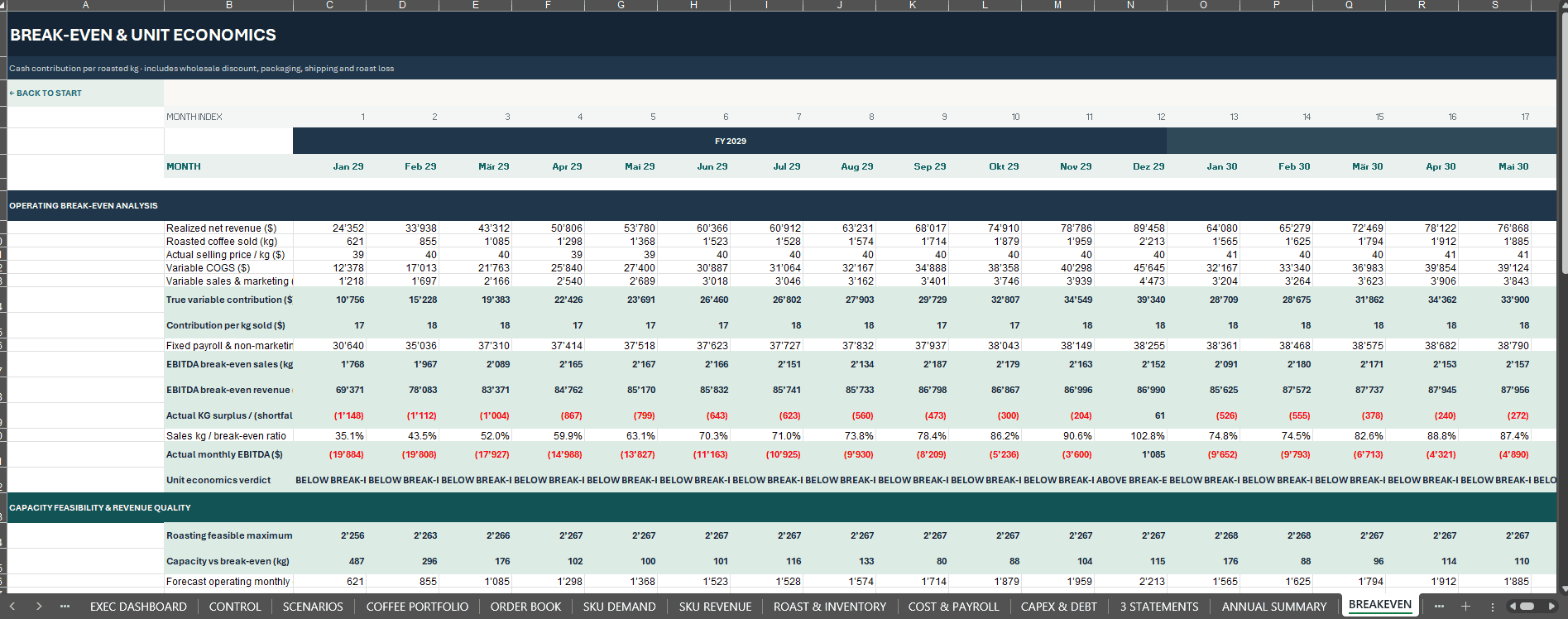
📈 BREAK-EVEN ANALYSIS
Calculate realized contribution per roasted kilogram, illustrative EBITDA break-even shipments and associated revenue.
Review whether required kilograms are commercially demanded and physically achievable. Nonpositive contribution is flagged through a special sentinel rather than a realistic positive break-even quantity.
🔀 FOUR EDITABLE SCENARIOS
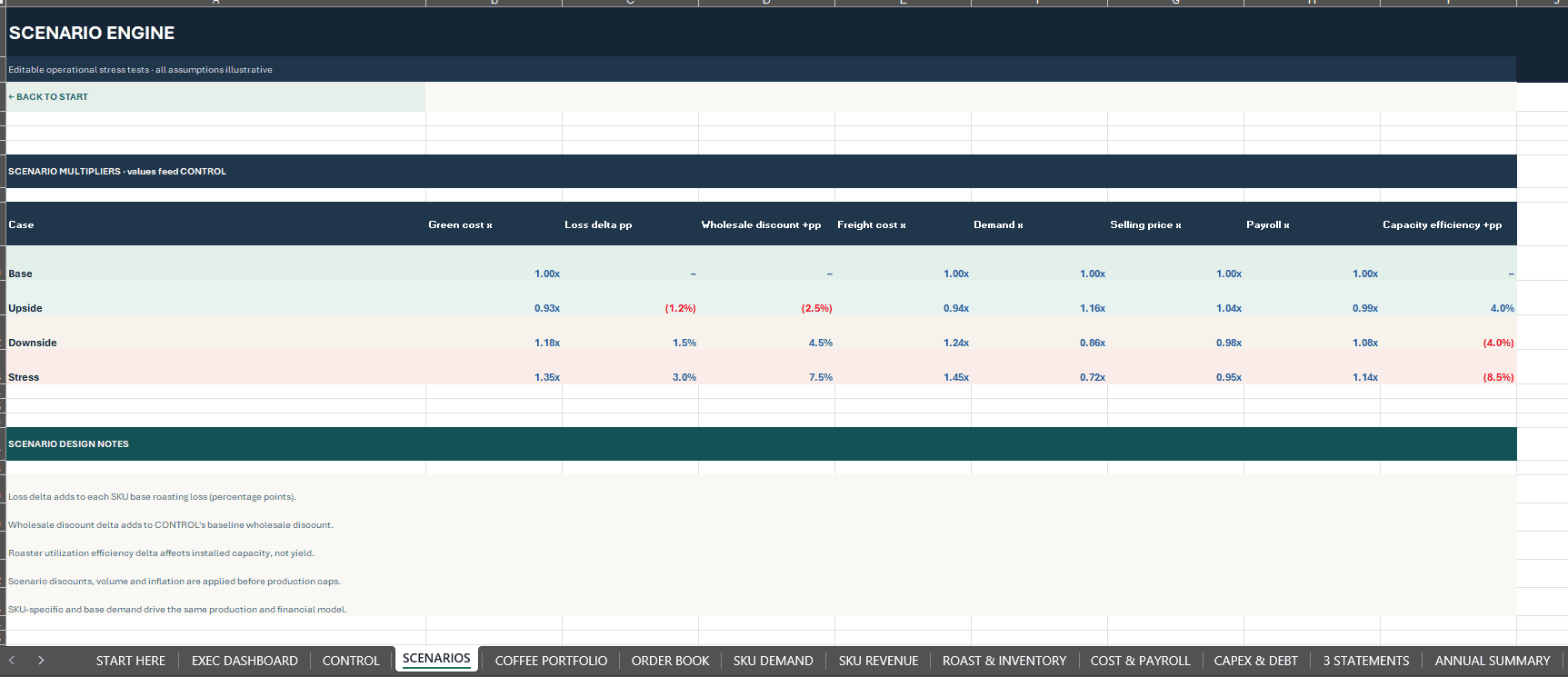
Choose Base, Upside, Downside or Stress.
Scenario factors adjust green-bean cost, roast loss, wholesale discount, freight, demand, selling price, payroll and effective capacity. The selected scenario drives the full 60-month model.
In the fictional supplied cases, Downside and Stress produce 45 and 50 months with negative cash, respectively. The workbook does not automatically fund these deficits.
Internal check PASS results confirm implemented arithmetic constraints and do not establish project viability.
📦 WORKBOOK ARCHITECTURE & DELIVERABLES
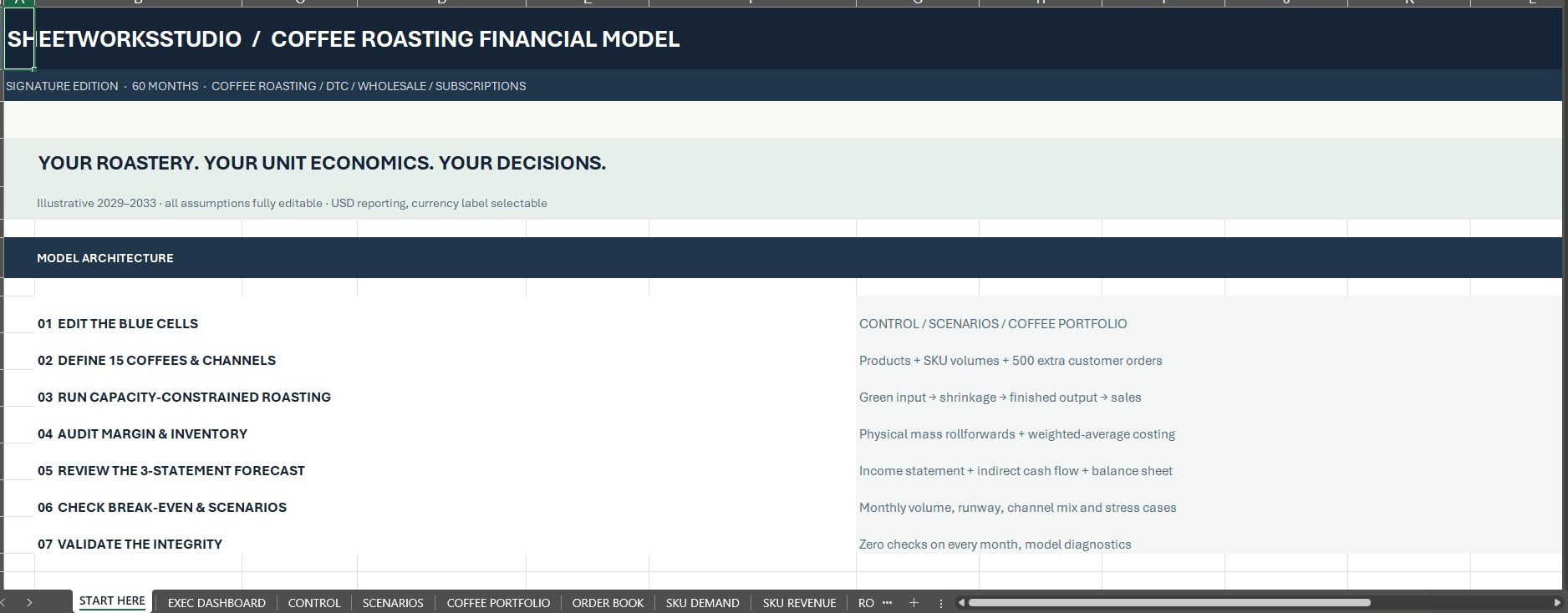
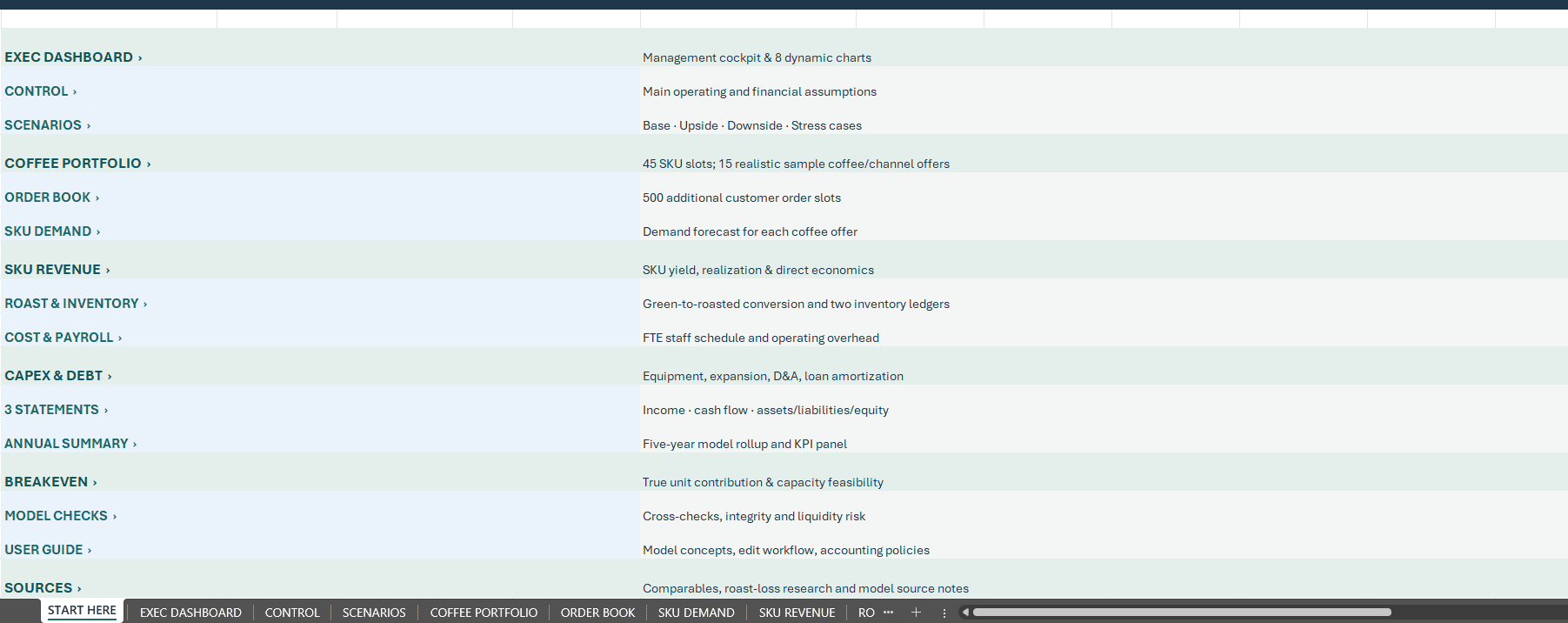
The editable XLSX contains 17 worksheets:
START HERE, EXEC DASHBOARD, CONTROL, SCENARIOS, COFFEE PORTFOLIO, ORDER BOOK, SKU DEMAND, SKU REVENUE, ROAST & INVENTORY, COST & PAYROLL, CAPEX & DEBT, 3 STATEMENTS, ANNUAL SUMMARY, BREAKEVEN, MODEL CHECKS, USER GUIDE and SOURCES.
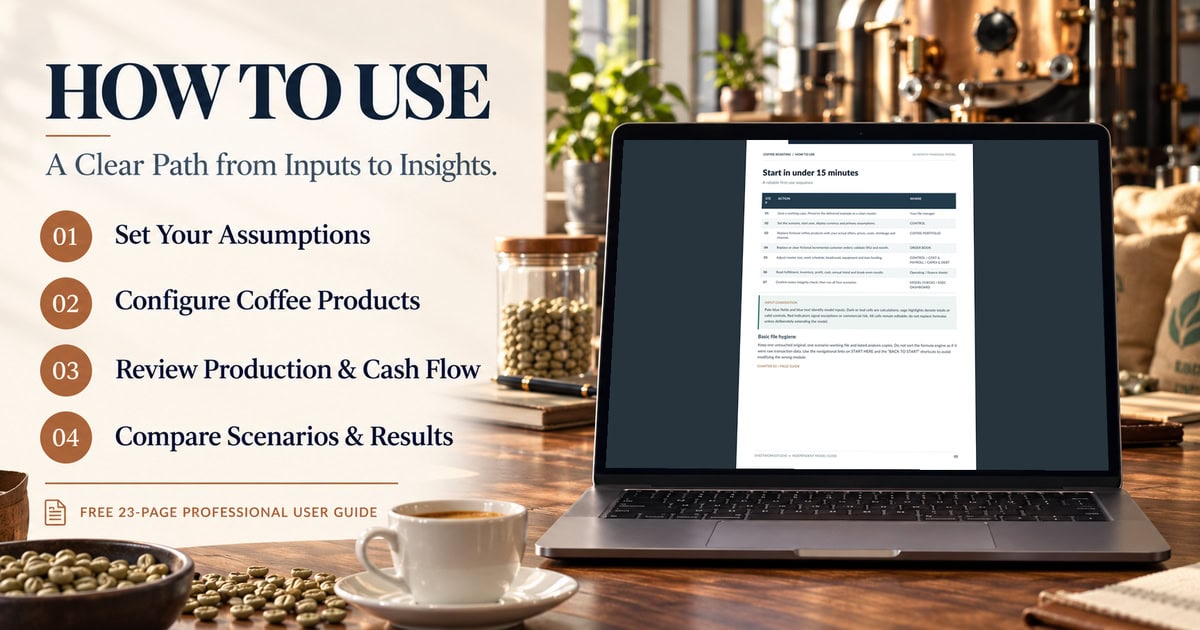
You also receive a separate 23-page professional English How-to-Use PDF covering setup, inputs, assumptions, capacity, inventory, cash flow, break-even, scenario interpretation, model checks, troubleshooting, glossary and limitations.
The PDF guide is independently available free of charge; that standalone download does not include the paid Excel workbook.
🧭 SETUP & COMPATIBILITY
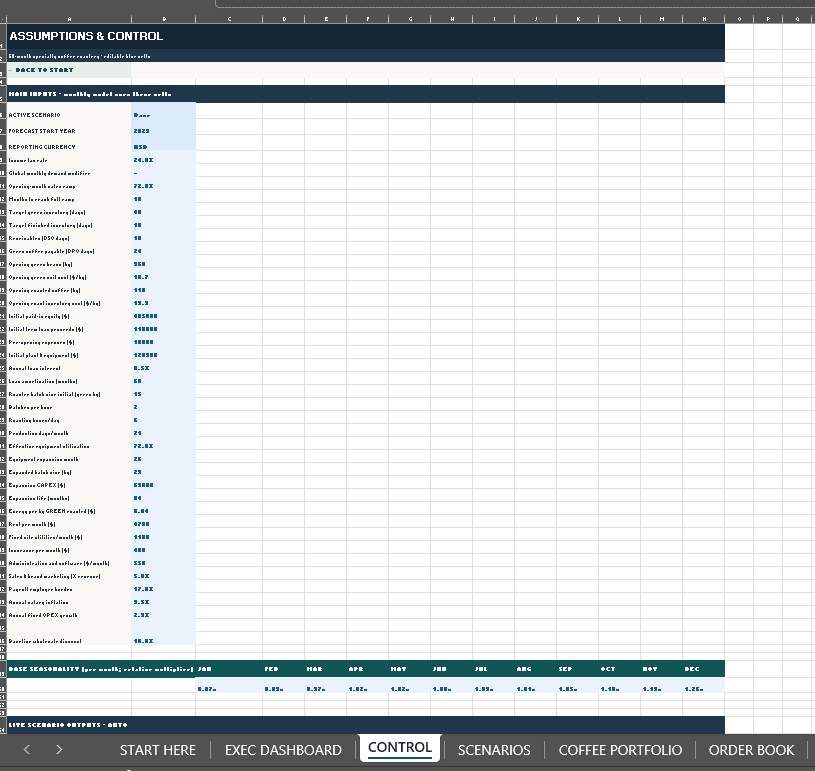
Save a project copy, select a scenario in CONTROL, replace fictional products and optional order rows, adjust roasting resources and costs, then review the financial outputs and MODEL CHECKS.
The sample forecast runs January 2029 to December 2033; changing the start year moves the calendar labels, not arbitrary mid-month launches.
Macro-free XLSX, without VBA or live data feeds.
Microsoft Excel Desktop is recommended. Actual native Excel Desktop opening/recalculation and a Google Sheets import were not independently verified for this QA package; visual and calculation parity should be checked after opening in the chosen application.
🛡️ IMPORTANT SCOPE & DISCLAIMER
This is an independent, unofficial financial-planning template, not a live coffee ERP system, subscription-payment service, lot-level inventory tracker, audited forecast, certified engineering model, guaranteed business valuation or bank-approved financing document.
All sample assumptions and outputs are illustrative. Users must independently validate equipment performance, supply contracts, taxation, working capital, financing and business viability.
No personalized investment, financial, tax, legal or accounting advice is provided. No affiliation with spreadsheet vendors or coffee-equipment manufacturers is claimed.
Created by SheetworksStudio.
Digital product only; no physical delivery.
Similar ProductsOther customers were also interested in...


 eFinancialModels
Electric Vehicle (EV) Charging Station Financial M...
With this comprehensive 5- or 10-year monthly tool, investors can assess the viability of setting up... Read more

Financial Model for Mobile App | Mobile App Busine...
The Mobile App Financial Plan Template in Excel allows you to develop financial projections when lau... Read more

 HenrySheykin
Food Truck Financial Model Excel Template
The Food Truck Financial Model helps entrepreneurs, founders, business owners, consultants, and anal... Read more

Green Hydrogen Production from Wind Energy Financi...
The Green Hydrogen from Wind Financial Model aims to comprehensively forecast a horizon of 40 years ... Read more

Simple Mutual Non-Disclosure Agreement Template
Protect your business secrets with ease using our Simple Mutual Non-Disclosure Agreement Template. S... Read more

Solar Energy Financial Model
The Solar Energy Financial Model Spreadsheet Template in Excel assists you in preparing a sophistica... Read more
 Peter Graf
The Customer-Centric Financial Model for Restauran...
Starting a restaurant without a financial plan is like driving a car blindfolded. You wouldn´t do i... Read more
You must log in to submit a review.