
0 ITEMS

Dairy Farm Financial Model – 10-Year Herd-Driven Projections, 3 Statements, IAS 41 Biological Assets & DCF Valuation (Excel)
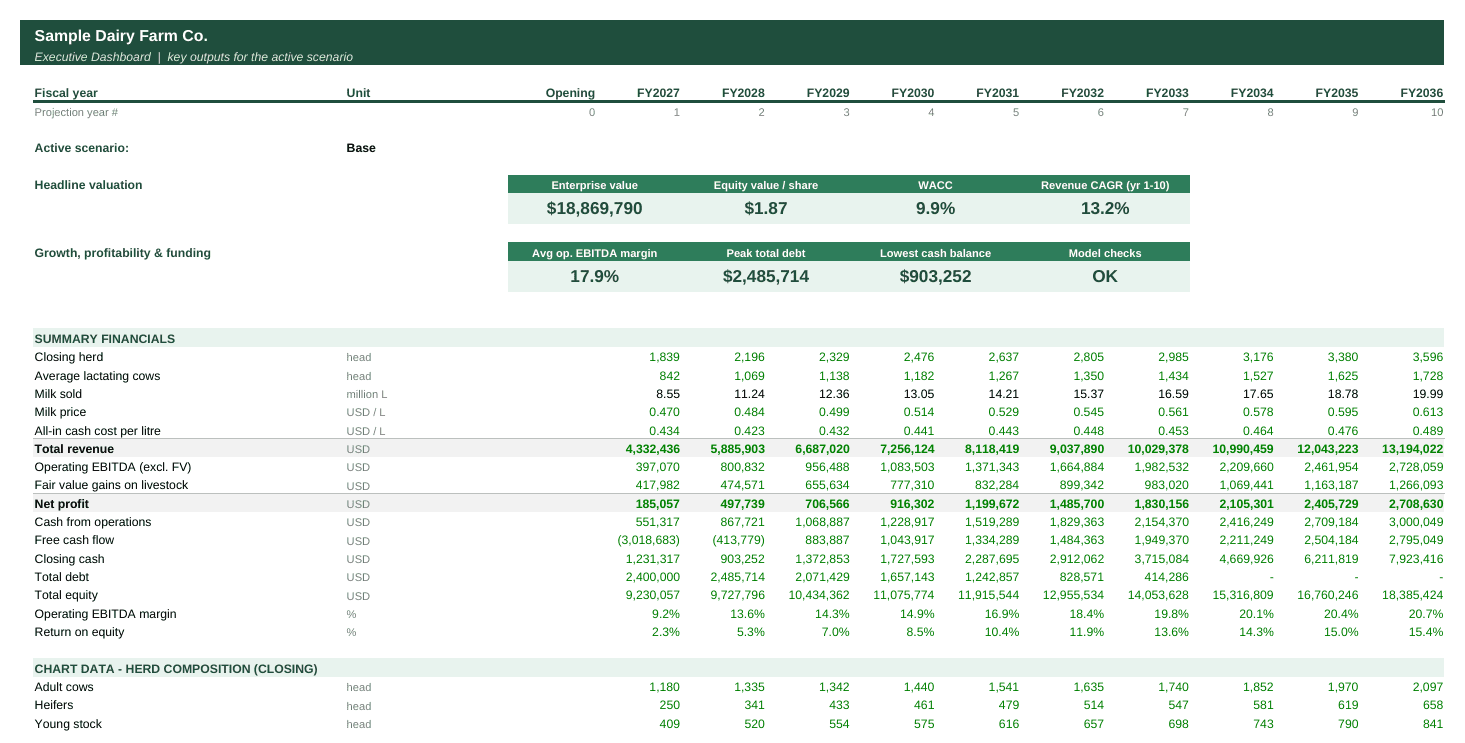
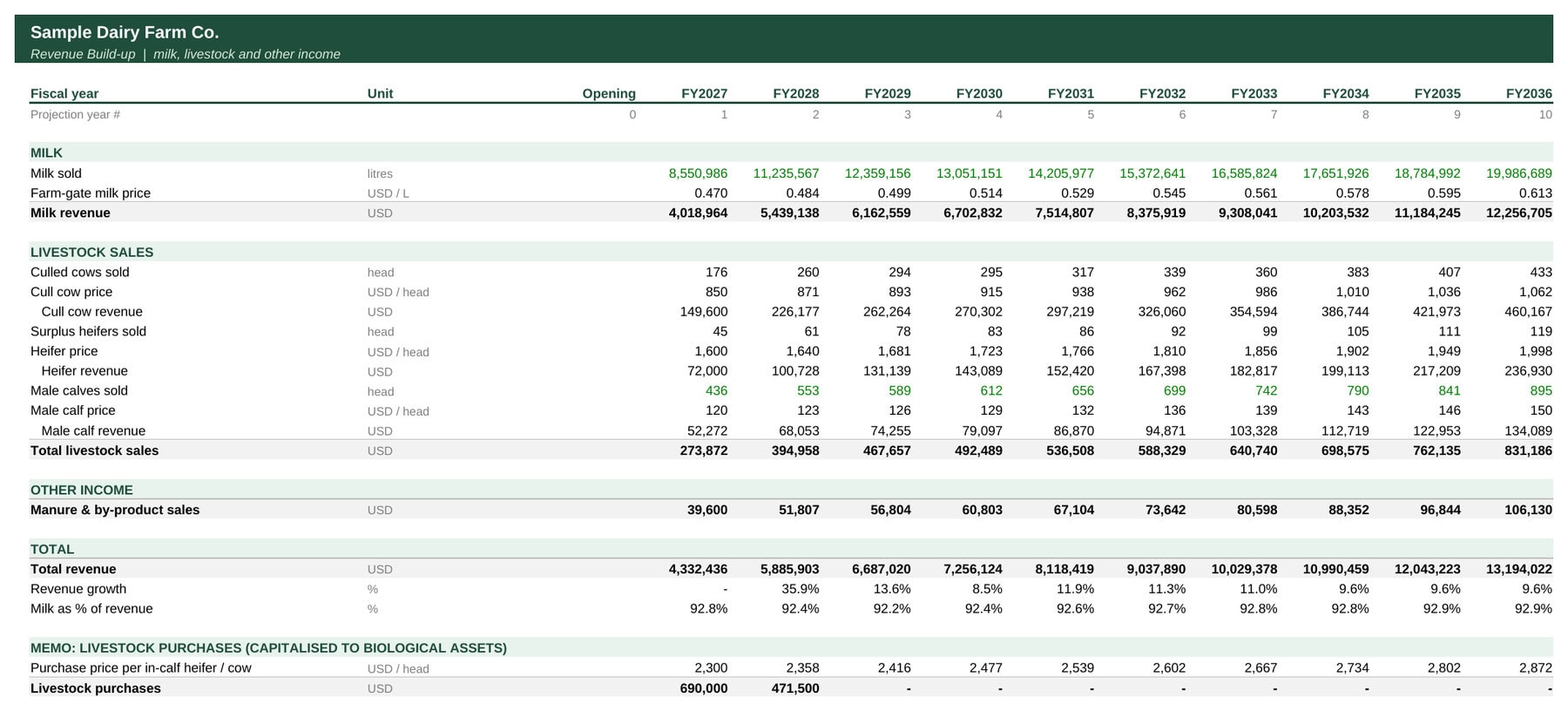
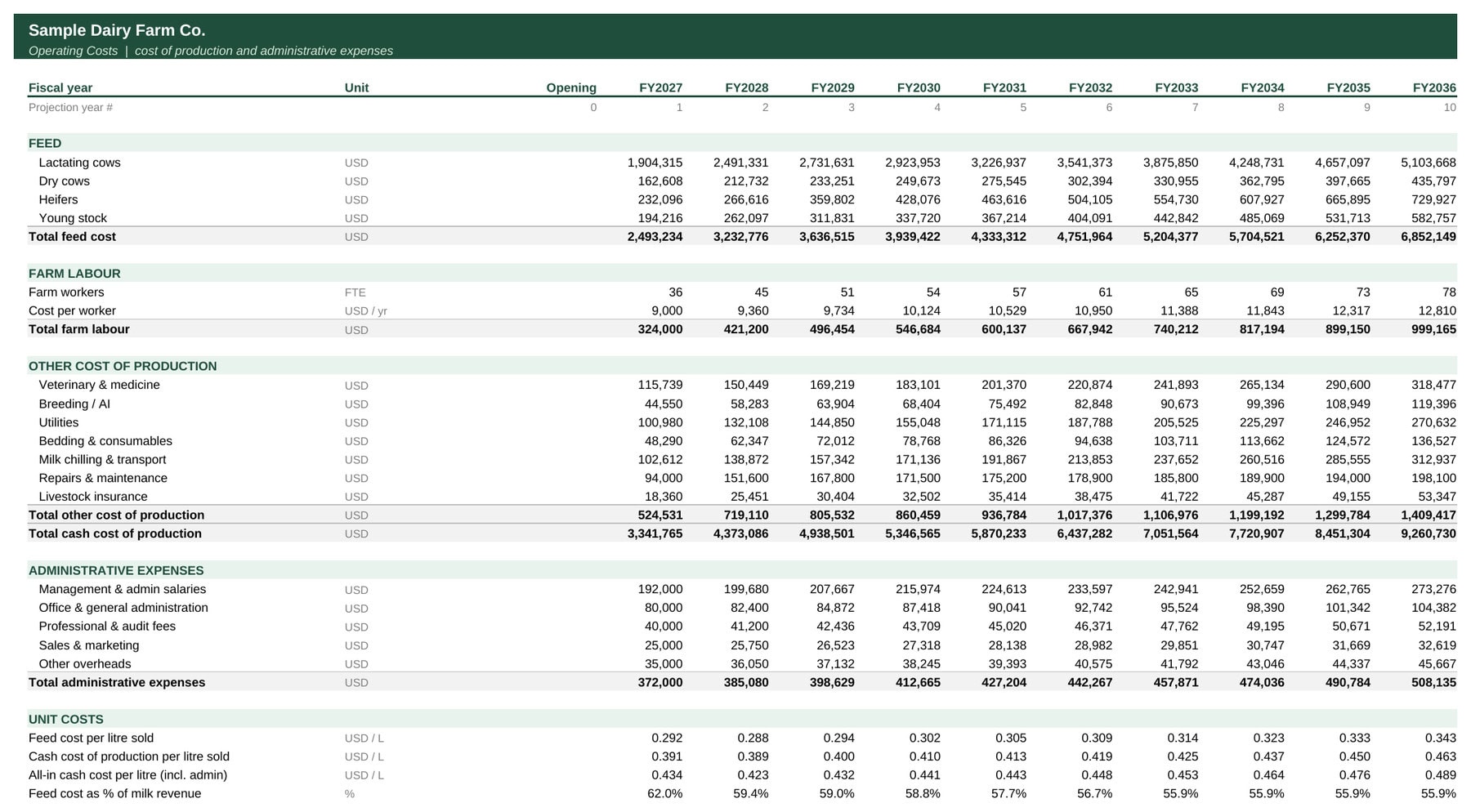
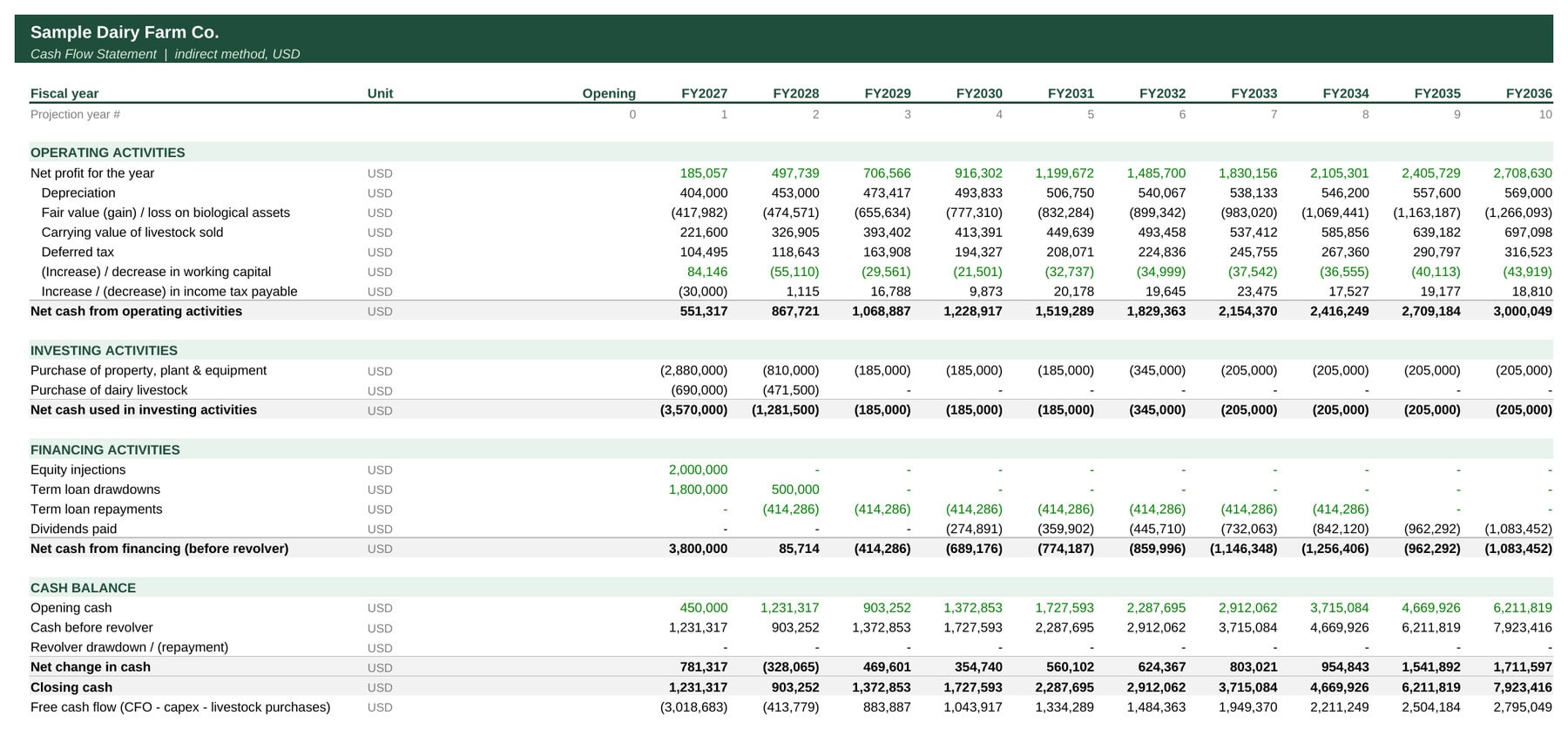
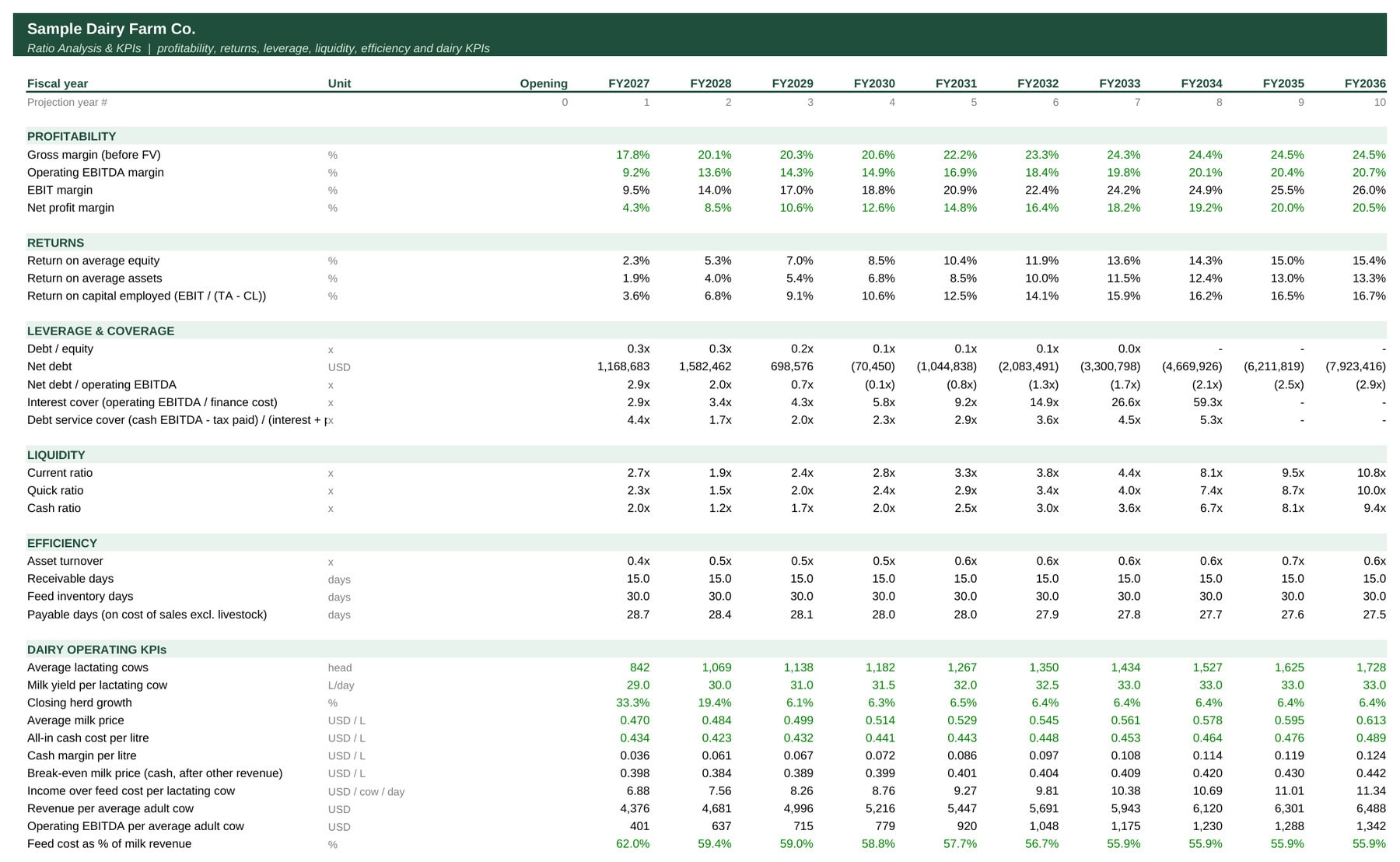
A complete, fully linked Excel financial model for dairy farms, whether you are starting a new farm or expanding an existing one. Projections are driven by a full herd model: adult cows, heifers and young stock, with calving, mortality, culling, heifer retention and livestock purchases. Milk production comes from lactating cows and yield per cow, and revenue covers milk, cull cows, surplus heifers, male calves and by-products. Feed is costed by animal class. The model produces a 10-year income statement, balance sheet and cash flow statement. It values the herd under IAS 41 (fair value less costs to sell), includes a term loan with grace period and an automatic revolving credit facility, and handles tax losses and deferred tax. It finishes with a DCF valuation and two sensitivity tables, plus 30+ ratios and dairy KPIs (cost per litre, break-even milk price, income over feed cost). A dashboard with 6 charts and a Base / Upside / Downside scenario switch round it off. All inputs sit on one sheet and integrity checks run throughout. It comes pre-filled with realistic sample data in USD and is ready to adapt for bank loan applications, investor pitches, feasibility studies and budgeting.
What is this Dairy Farm Financial Model used for?
This Excel template gives dairy farm owners, investors, lenders, consultants and agri-business analysts a bank-ready, 10-year financial plan for a dairy farming operation. Use it to test the feasibility of a new farm, plan a herd expansion, raise equity or debt financing, prepare a business plan, or value an existing dairy business. Everything starts from the herd: change the number of cows, the milk yield or the milk price, and the three financial statements, the cash flow and the valuation update instantly.
Key features and highlights
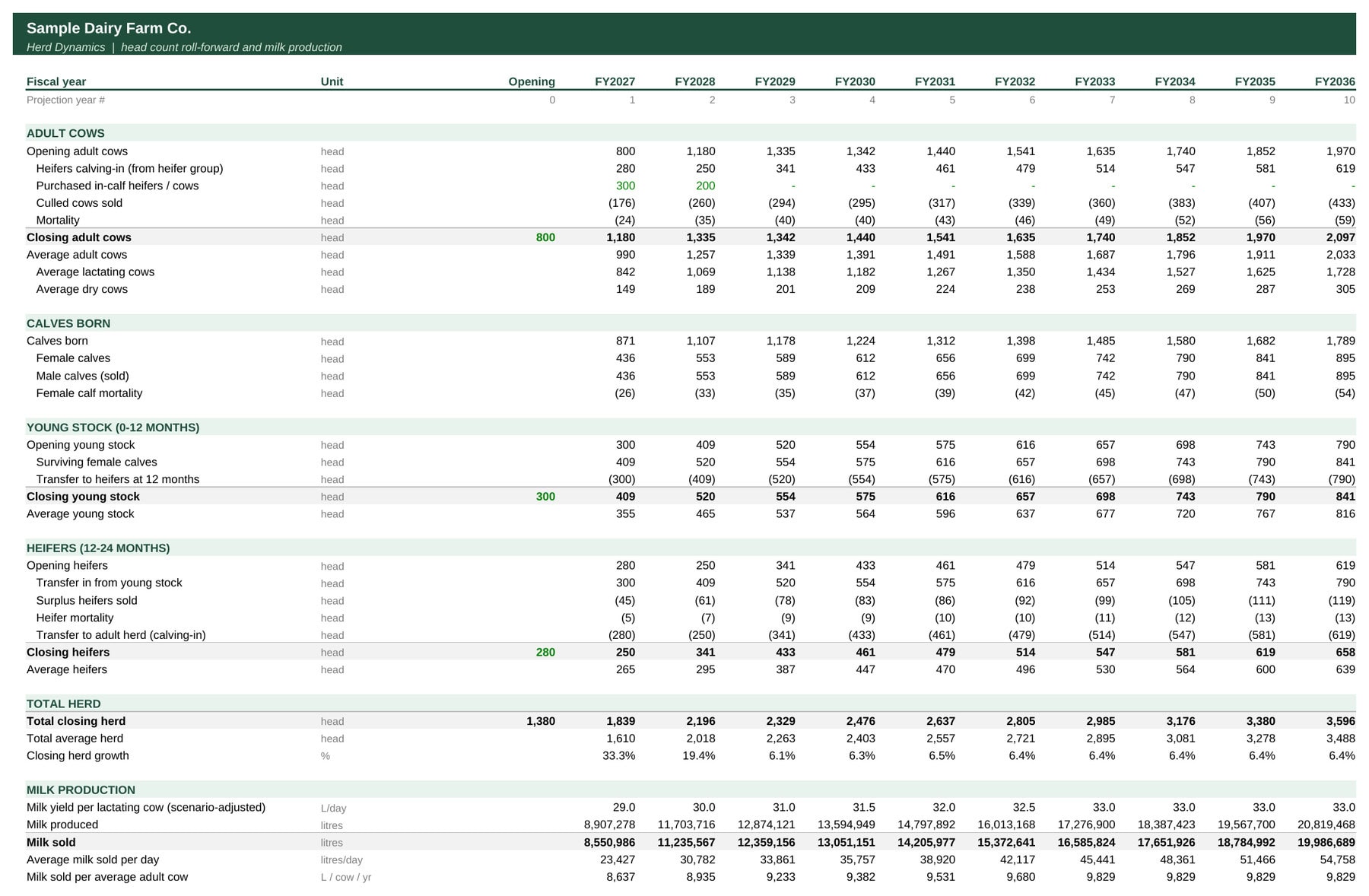
- Herd dynamics engine: opening herd by class (adult cows, heifers 12–24 months, young stock 0–12 months), calving rate, female calf share (supports sexed semen), mortality by age group, culling rate, heifer retention, surplus heifer sales and purchases of in-calf heifers.
- Milk production: lactating vs. dry cows, yield per cow per day by year, milk sold after calf feeding and losses.
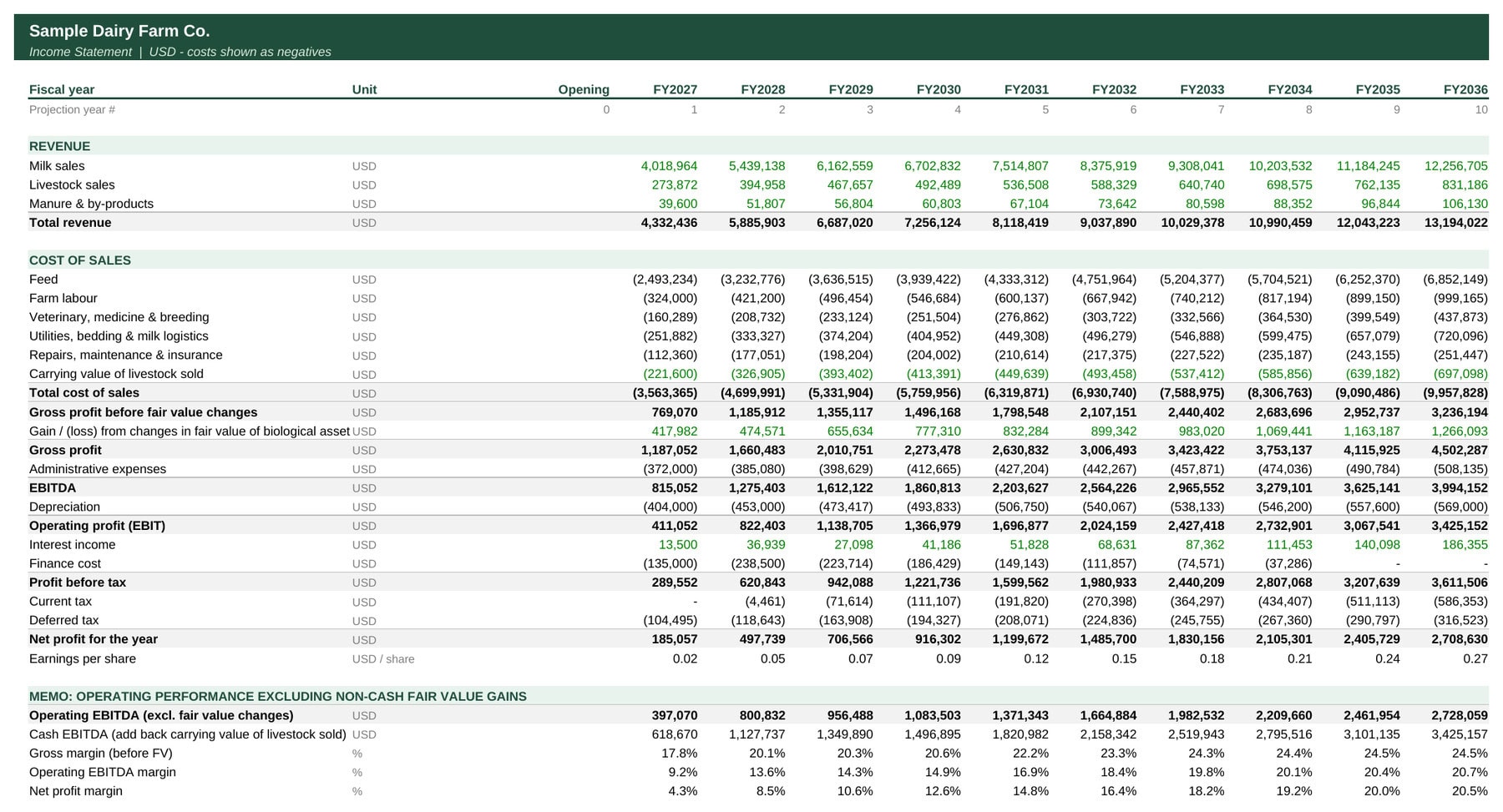
- Revenue build-up: milk sales, cull cow sales, surplus heifer sales, male calf sales and manure / by-product income, each with its own price escalation.
- Detailed cost of production: feed cost per head per day for each animal class, farm labour driven by animals per worker, veterinary and medicine, breeding / AI, utilities, bedding, milk chilling and transport, repairs and maintenance, and livestock insurance, plus administrative overheads.
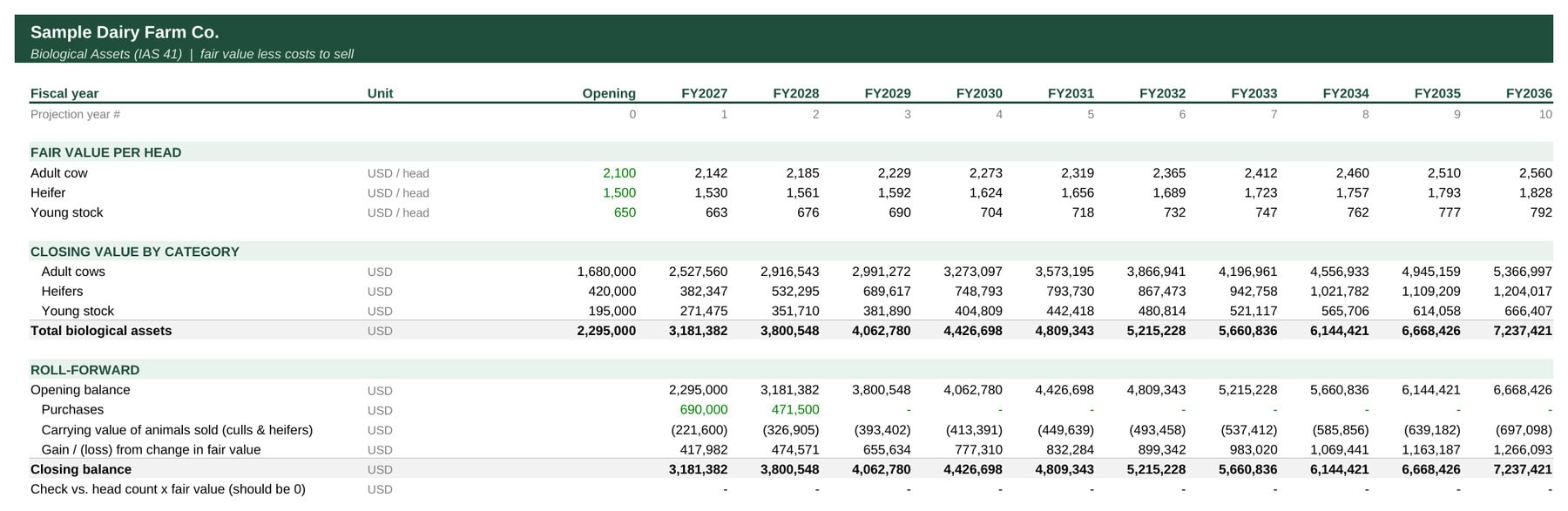
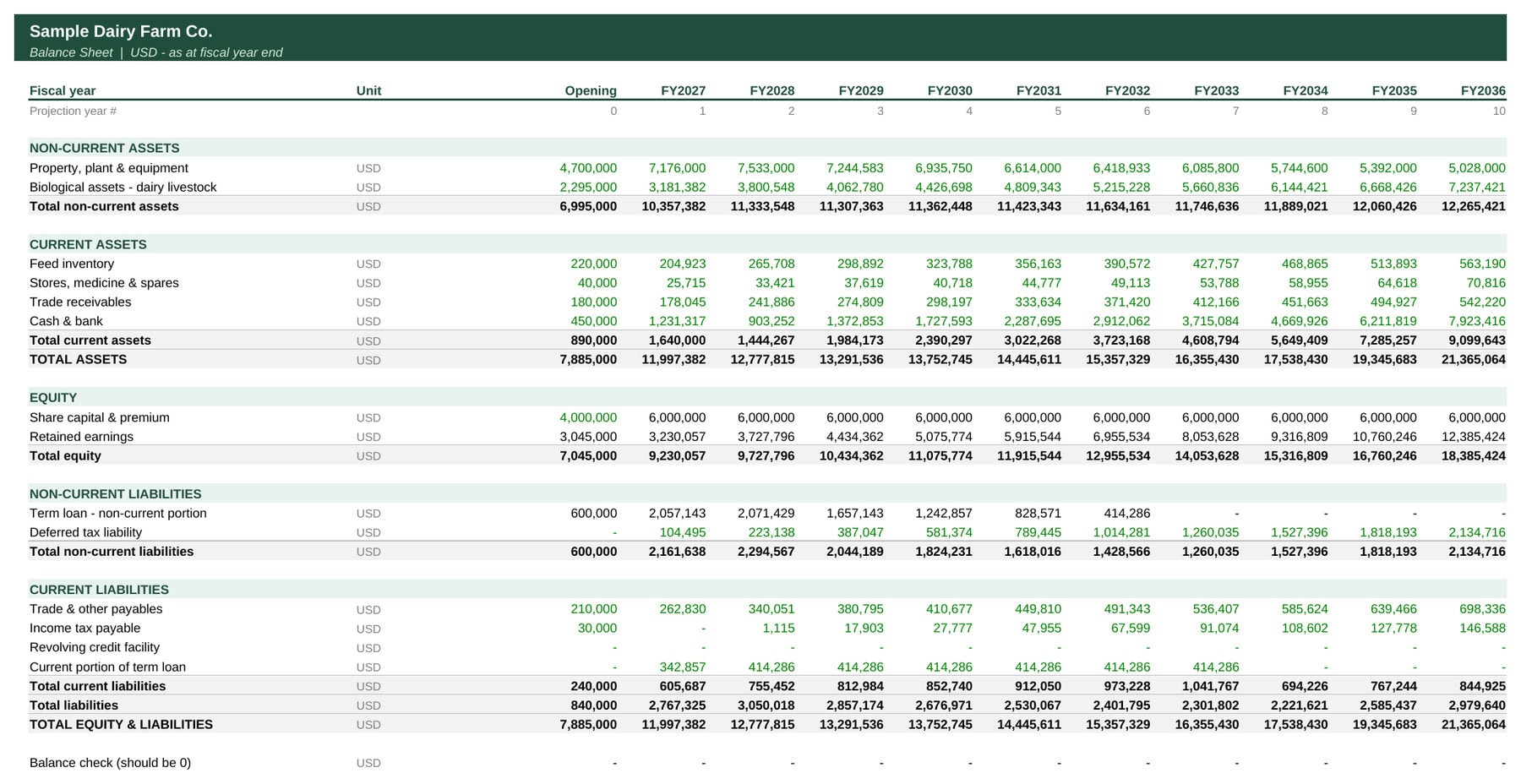
- IAS 41 biological assets: herd valued at fair value less costs to sell, with a full roll-forward showing purchases, animals sold and the fair value gain or loss through profit or loss. Operating EBITDA excluding non-cash fair value gains is shown separately.
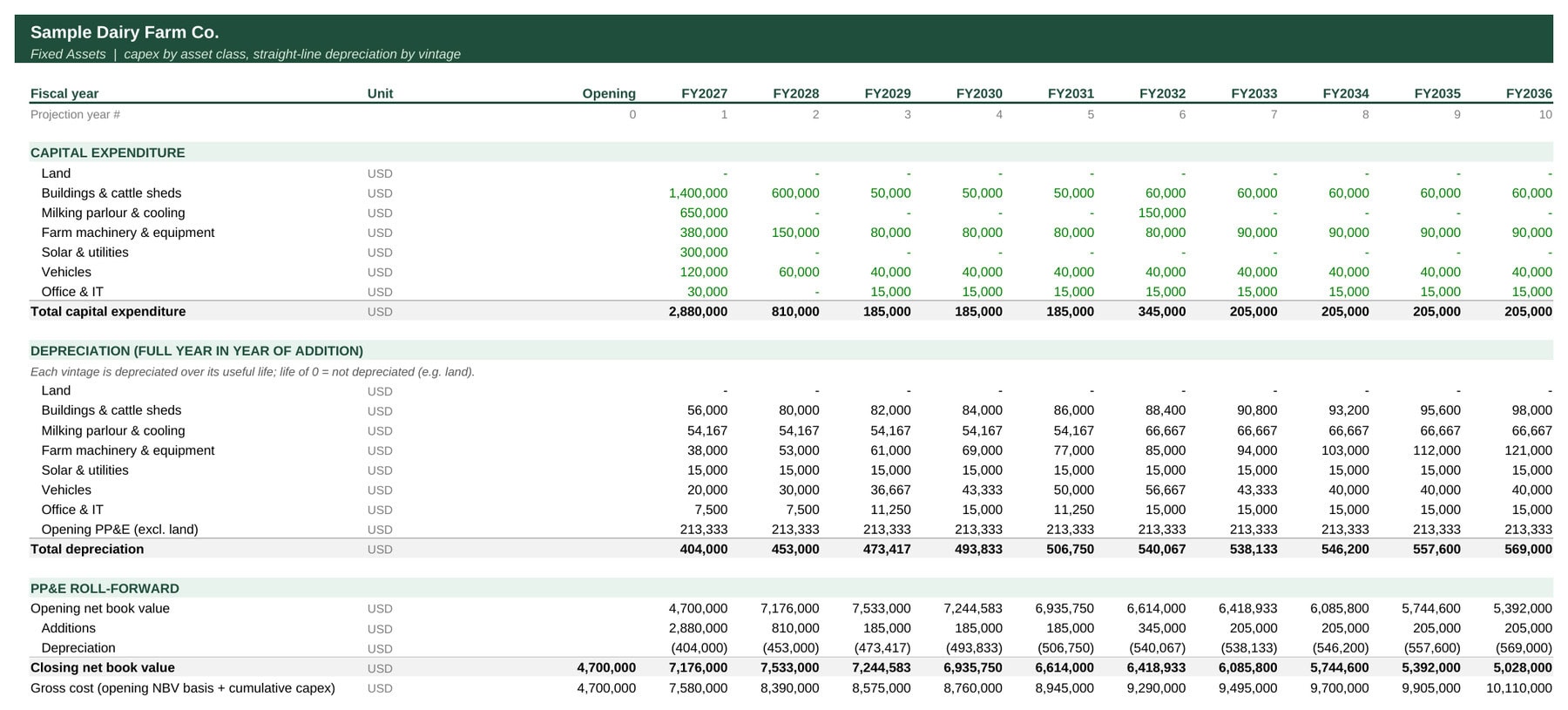
- Capex and depreciation: seven asset classes (land, sheds, milking parlour, machinery, solar, vehicles, IT) with vintage-based straight-line depreciation.
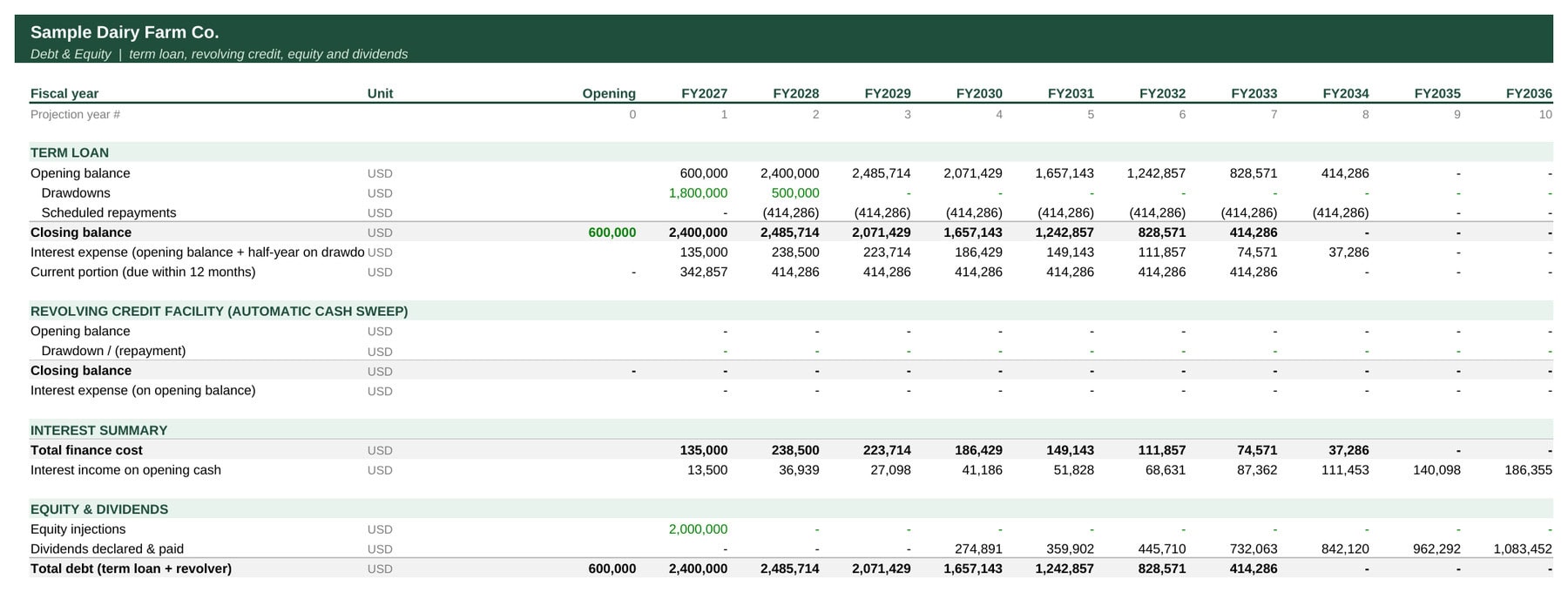
- Financing: equity injections, a term loan with grace period and amortisation, an automatic revolving credit facility that keeps a minimum cash balance, interest income and a dividend payout policy.
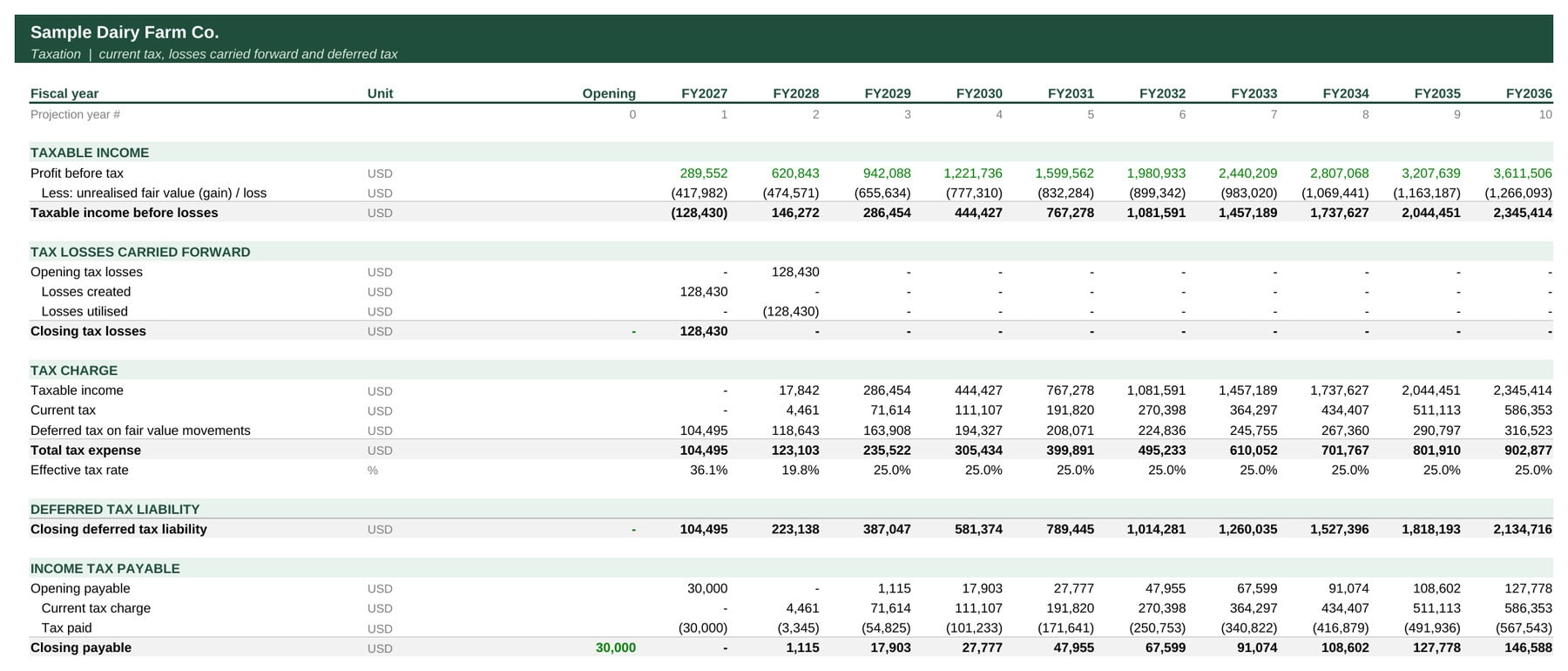
- Tax: corporate tax, tax losses carried forward, deferred tax on unrealised fair value gains, and tax payable timing.
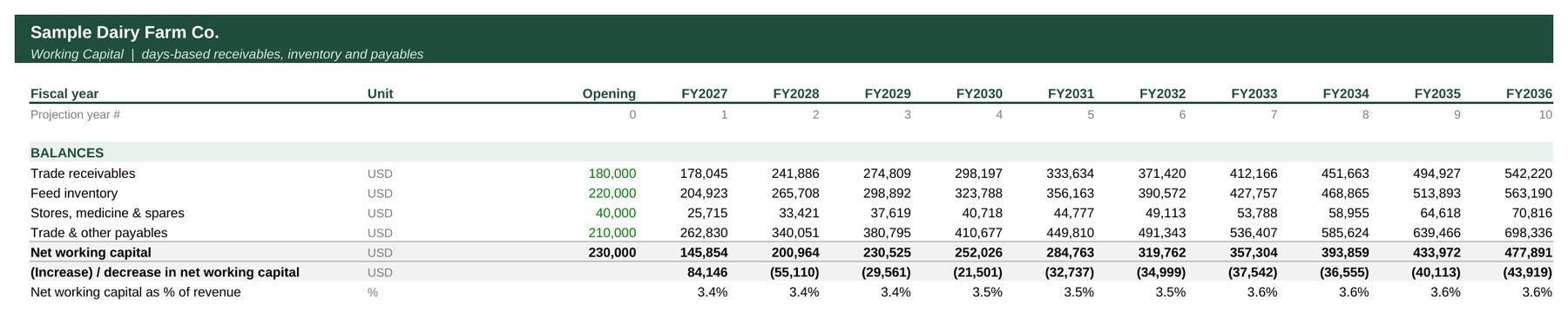
- Three fully linked financial statements: income statement, balance sheet and cash flow statement (indirect method) with balance checks.
- Ratios and dairy KPIs: margins, ROE, ROA, ROCE, debt / equity, net debt / EBITDA, interest cover, DSCR, liquidity ratios, working capital days, cost per litre, break-even milk price, income over feed cost (IOFC), and revenue and EBITDA per cow.
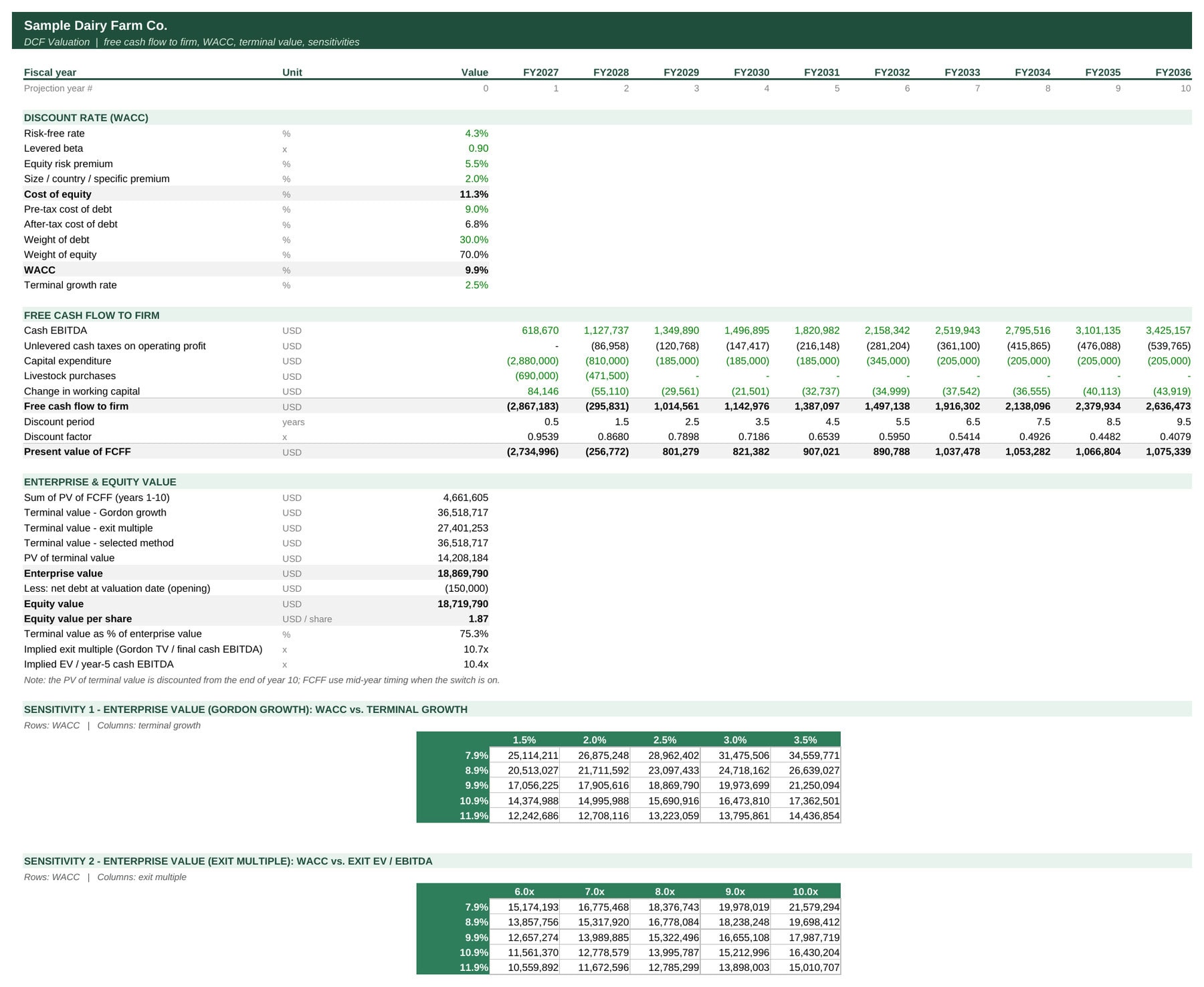
- DCF valuation: WACC built from CAPM, free cash flow to firm, Gordon growth or exit multiple terminal value, mid-year discounting switch, enterprise value, equity value and value per share.
- Sensitivity tables: enterprise value against WACC vs. terminal growth, and against WACC vs. exit multiple.
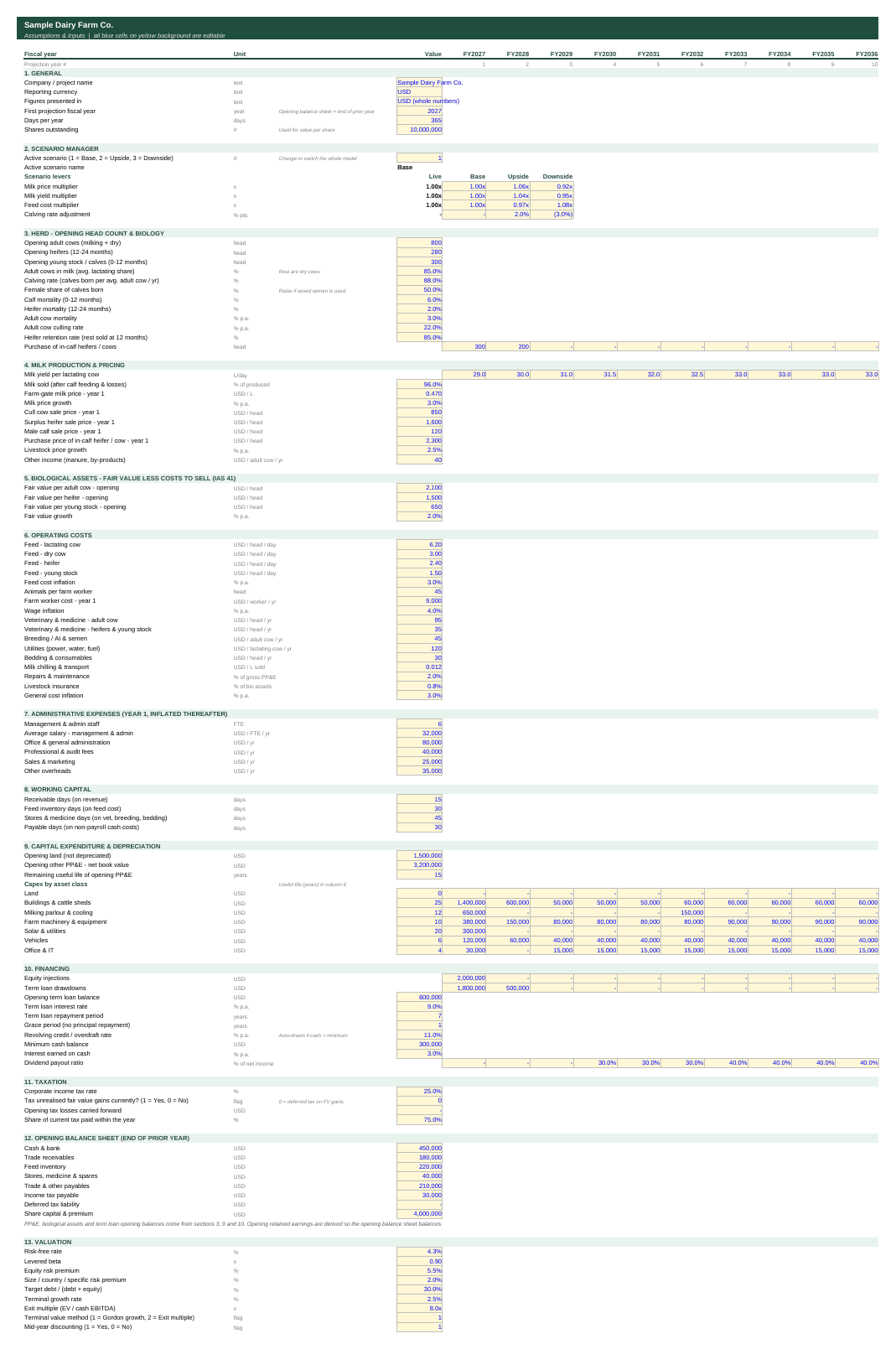
- Scenario manager: switch between Base, Upside and Downside cases (milk price, yield, feed cost and calving rate levers) with a single cell.
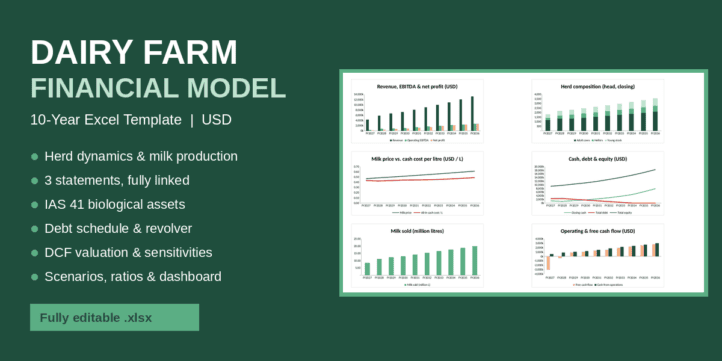
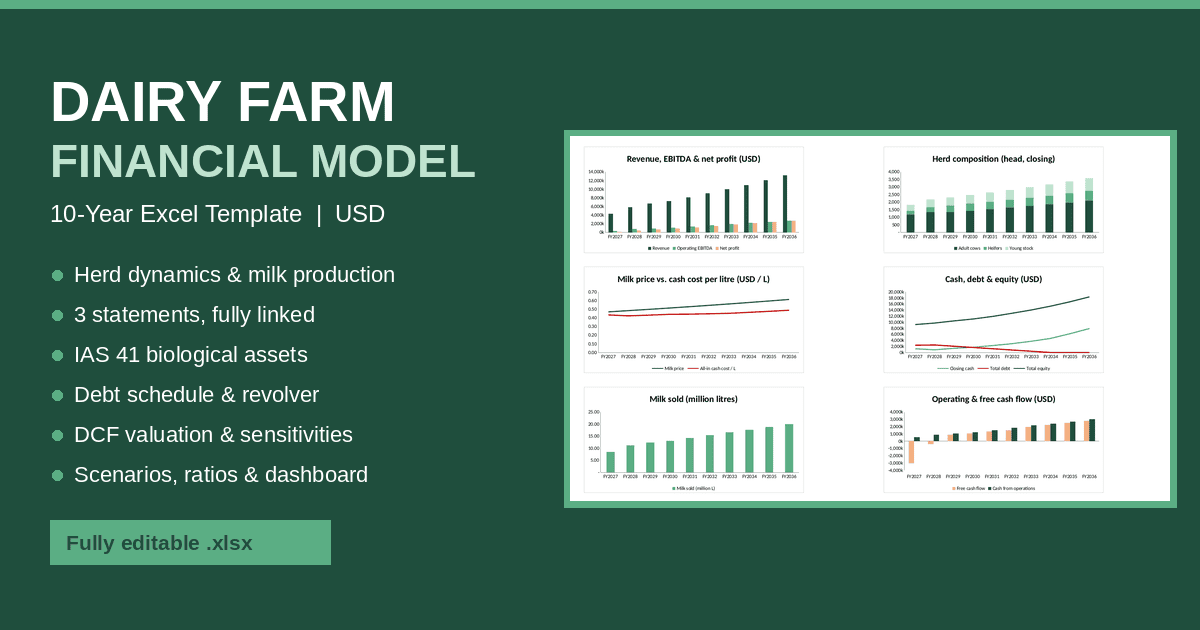
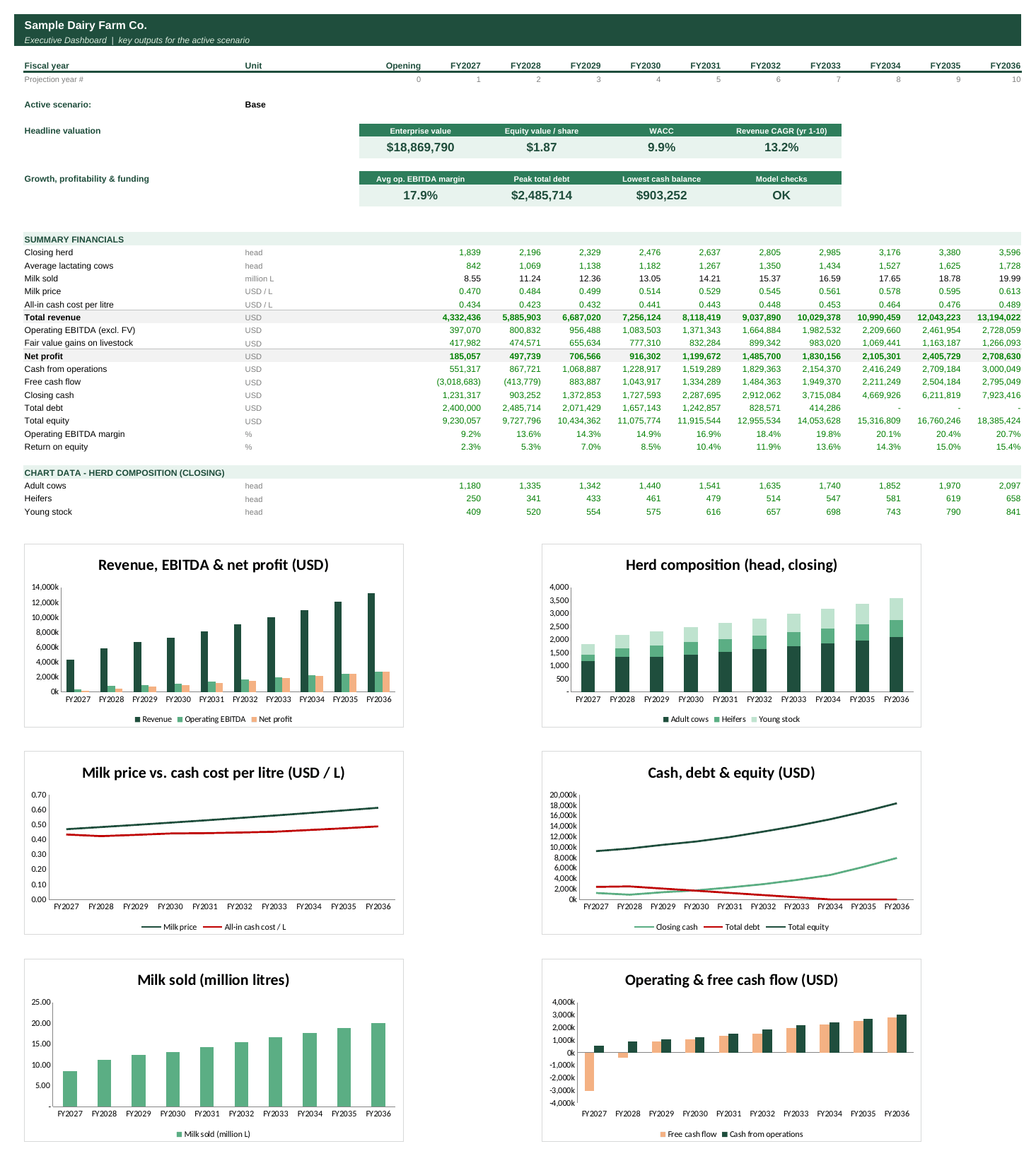
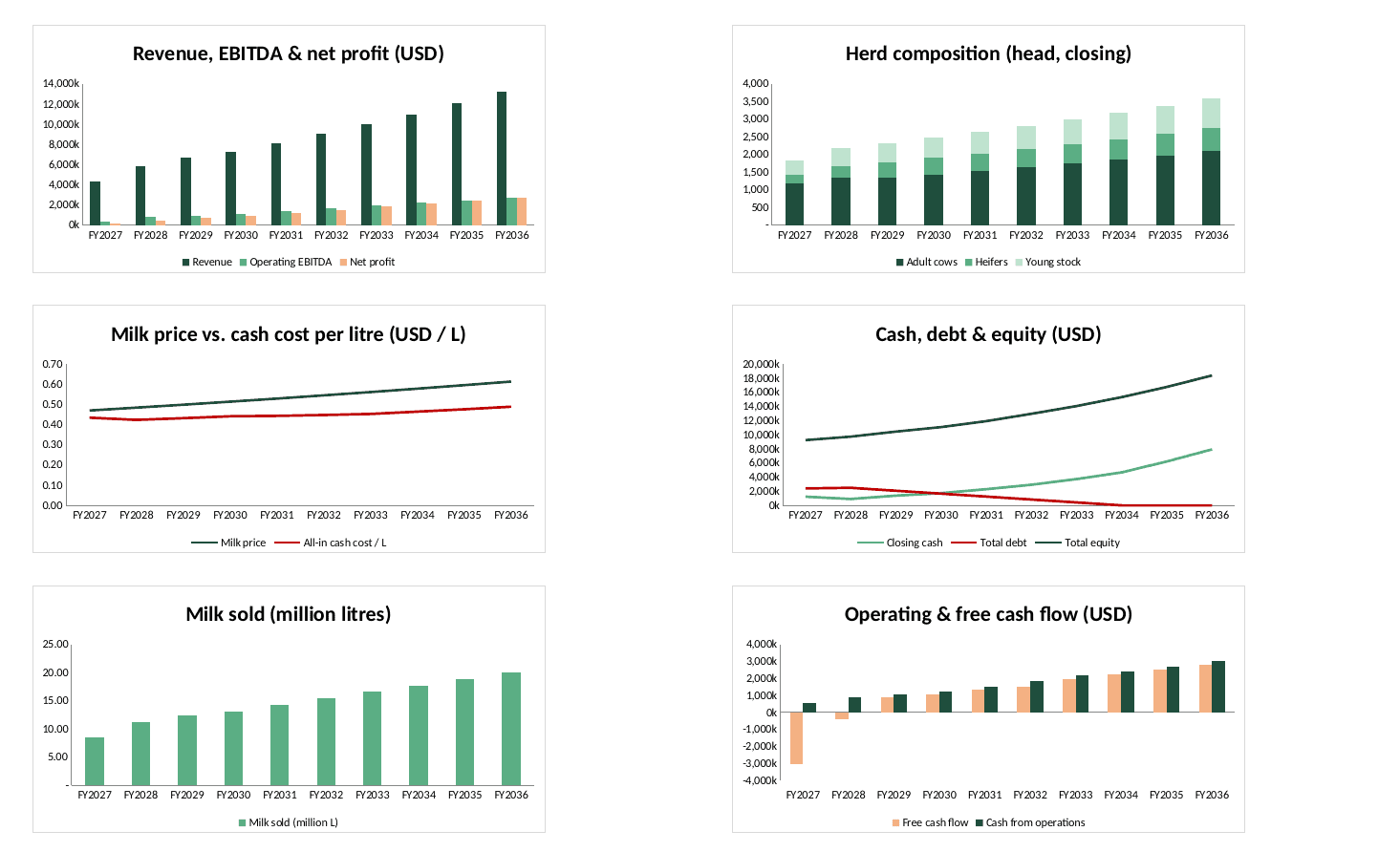
- Executive dashboard: headline KPIs, a 10-year summary and 6 charts (revenue and EBITDA, herd composition, milk price vs. cost per litre, milk volume, cash / debt / equity, operating and free cash flow).
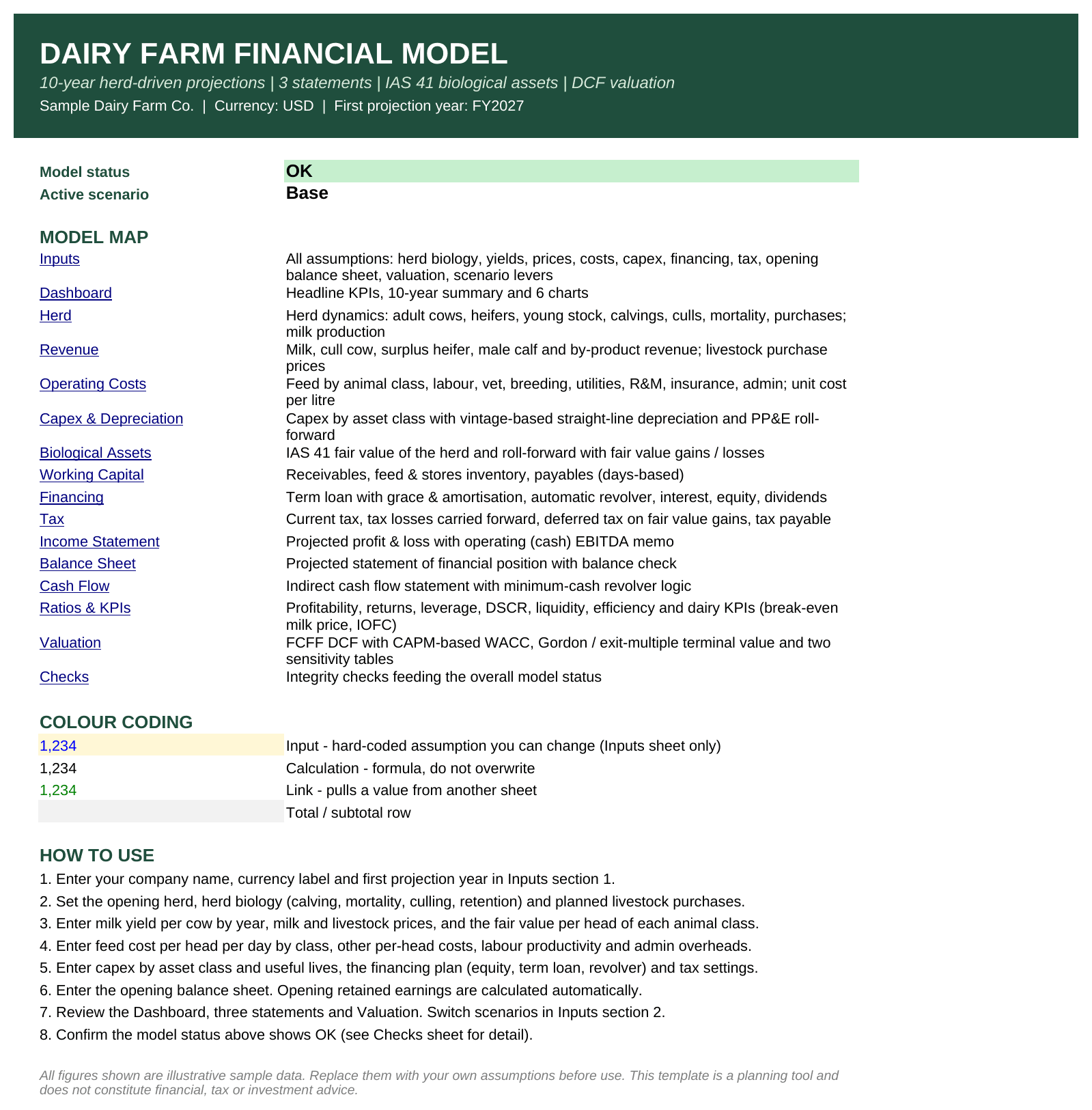
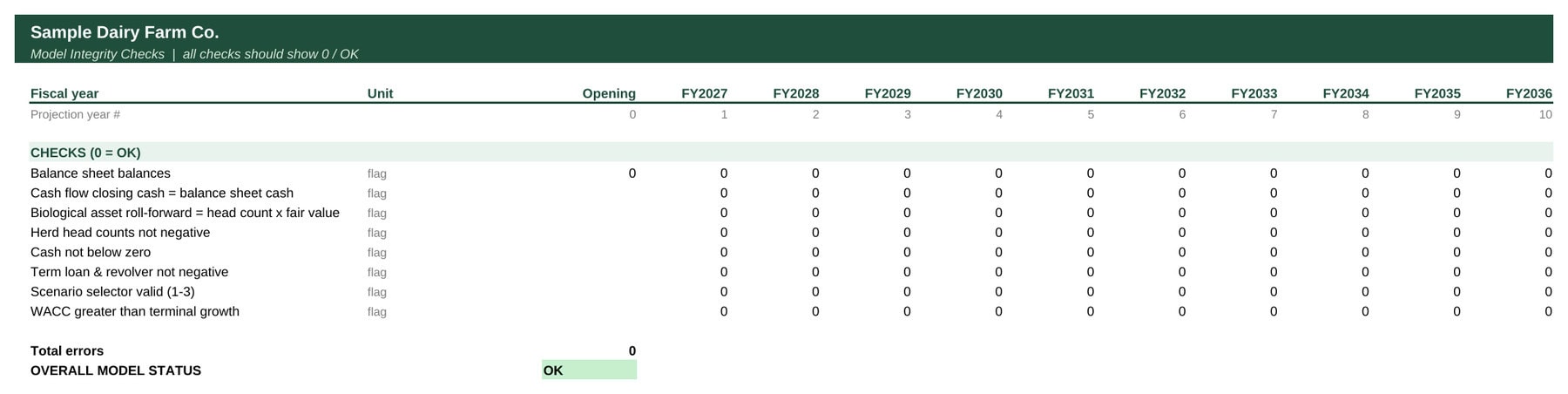
- Integrity checks: balance sheet, cash, biological asset roll-forward, herd and debt checks feed one overall model status, shown as OK or ERROR.
How to work with this template
- Open the Inputs sheet. All editable assumptions are in blue font on a yellow background.
- Enter your company name, first projection year, opening herd and herd biology parameters.
- Enter yields, milk and livestock prices, fair values per head, feed and other costs, and overheads.
- Enter your capex plan, financing plan, tax settings and opening balance sheet.
- Review the Dashboard, financial statements, ratios and valuation, and switch scenarios to stress-test the plan.
- Make sure the model status on the Cover sheet reads OK.
The model has no macros and no hard-coded results. Every output is a live formula (3,400+ formulas across 17 sheets), and it uses a consistent colour code: blue for inputs, black for calculations, green for links. It is built in Excel and also works in Google Sheets and LibreOffice.
Why you need this financial model template
Building a dairy model from scratch is slow and error-prone. The herd flows, IAS 41 accounting and debt mechanics are easy to get wrong. This template gives you a tested, transparent structure that lenders and investors recognise, so you can spend your time on the assumptions that matter: herd growth, milk yield, milk price and feed cost.
Sample figures are illustrative only. Replace them with your own assumptions.
Similar ProductsOther customers were also interested in...



 eFinancialModels
Electric Vehicle (EV) Charging Station Financial M...
With this comprehensive 5- or 10-year monthly tool, investors can assess the viability of setting up... Read more

Financial Model for Mobile App | Mobile App Busine...
The Mobile App Financial Plan Template in Excel allows you to develop financial projections when lau... Read more

 HenrySheykin
Food Truck Financial Model Excel Template
The Food Truck Financial Model helps entrepreneurs, founders, business owners, consultants, and anal... Read more

Green Hydrogen Production from Wind Energy Financi...
The Green Hydrogen from Wind Financial Model aims to comprehensively forecast a horizon of 40 years ... Read more

Simple Mutual Non-Disclosure Agreement Template
Protect your business secrets with ease using our Simple Mutual Non-Disclosure Agreement Template. S... Read more

Solar Energy Financial Model
The Solar Energy Financial Model Spreadsheet Template in Excel assists you in preparing a sophistica... Read more

 Peter Graf
The Customer-Centric Financial Model for Restauran...
Starting a restaurant without a financial plan is like driving a car blindfolded. You wouldn´t do i... Read more
You must log in to submit a review.