
0 ITEMS

RV Dealership Acquisition Financial Model
A professional Excel and Google Sheets financial model built for RV dealership buyers. Underwrite the deal, size the SBA 7(a) loan and present bank-ready numbers to your lender or investor. Includes a gross-profit-by-line engine, floorplan interest, absorption and DSCR, a 5-year pro forma, three scenarios and a one-page dashboard.
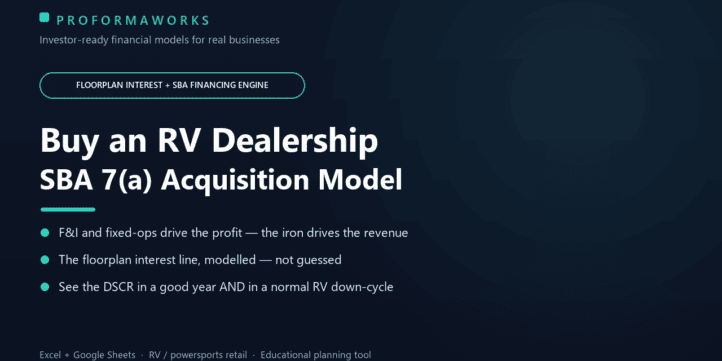


Underwrite an RV dealership acquisition the way it really works – not as one revenue blob. A dealership is four businesses under one roof, and the iron is not where the money is. This is a lender-ready, 5-year model for buying a single-store RV dealership with an SBA 7(a) loan, built around the two lines that no existing template models: the inventory floorplan interest and the fixed-ops absorption ratio.
Gross by department. Revenue and gross are built bottom-up – new units, used units, F&I (per deal x finance penetration) and parts & service – each at its own margin, so Gross Profit falls out of the mix. In the base case the new and used iron make about three quarters of the revenue and the F&I and service departments make 54% of the gross profit. That is the honest dealership thesis, and the model prices it.
The floorplan, modeled explicitly. Inventory is financed on a revolving floorplan line, kept separate from the acquisition loan (the SBA 7(a) cannot fund floorplan in the traditional sense – the SBA Dealer Floor Plan program or a lender line does). Floorplan interest = average inventory at cost x advance rate x floorplan rate, where average inventory = unit cost x days-in-stock / 365. Days-in-stock and the floorplan rate are stressable drivers – the cost that explodes when rates rise and the lot stops moving.
The honest headline: the down-cycle. The base-case DSCR looks comfortable at 1.64x – because the acquisition loan is small versus cash flow; the inventory risk lives in the floorplan, not the loan. So the model runs the test the seller’s good-year P&L never will: a normal RV unit down-cycle (-18% volumes; travel-trailers fell 14% in 2024) through the fixed overhead, which cuts SDE by 46.5% and drops DSCR to 0.56x. The bankable story is fixed-ops absorption + floorplan discipline + the down-cycle, not a leverage-amplified cash-on-cash.
What you get: an 11-sheet Excel workbook (works in Google Sheets – no macros, no add-ins, no external links), a 24-page PDF user guide, a 3-way profile toggle (towables-focused / full-line & motorized / used & fixed-ops heavy), an SBA 7(a) capital stack with the 10% injection and $5M-cap checks, a real amortization schedule, the fixed-ops absorption ratio, the floorplan interest coverage, a DSCR stress grid across days-in-stock x floorplan rate, and a conservative 5-year exit with the equity multiple.
Honest by design. SDE margin is held at a realistic 3.9% (RV dealers run thin); units-per-store and the revenue split are industry-representative estimates; the cash-on-cash and equity multiple are stated as leverage-amplified and cyclical; there is deliberately no IRR. Educational planning tool – not financial, investment, tax or lending advice. Verify the seller’s tax returns, the floorplan agreement and your SBA term sheet before relying on any number.
Similar ProductsOther customers were also interested in...


 eFinancialModels
Electric Vehicle (EV) Charging Station Financial M...
With this comprehensive 5- or 10-year monthly tool, investors can assess the viability of setting up... Read more

Financial Model for Mobile App | Mobile App Busine...
The Mobile App Financial Plan Template in Excel allows you to develop financial projections when lau... Read more

 HenrySheykin
Food Truck Financial Model Excel Template
The Food Truck Financial Model helps entrepreneurs, founders, business owners, consultants, and anal... Read more

Green Hydrogen Production from Wind Energy Financi...
The Green Hydrogen from Wind Financial Model aims to comprehensively forecast a horizon of 40 years ... Read more

Simple Mutual Non-Disclosure Agreement Template
Protect your business secrets with ease using our Simple Mutual Non-Disclosure Agreement Template. S... Read more

Solar Energy Financial Model
The Solar Energy Financial Model Spreadsheet Template in Excel assists you in preparing a sophistica... Read more

 Peter Graf
The Customer-Centric Financial Model for Restauran...
Starting a restaurant without a financial plan is like driving a car blindfolded. You wouldn´t do i... Read more
You must log in to submit a review.