
0 ITEMS

Voluntary Carbon Market (VCM) Project Developer Financial Model – Carbon Credits, Registry Costs, Buffer Pool, Basis Risk & Article 6.4 Scenario
⚡ Premium Voluntary Carbon Market (VCM) Project Developer Financial Model, A professional financial model built for carbon project developers, climate finance teams, VCM investors, REDD+ developers, cookstove projects, soil carbon projects, DAC projects, blue carbon initiatives, consultants, and sustainability finance teams. This model helps users forecast, value, and stress-test carbon credit project economics across major project types, registry standards, issuance assumptions, verification costs, buffer pool deductions, forward sales, spot sales, price basis risk, co-benefit premiums, and Article 6.4 compliance conversion scenarios.
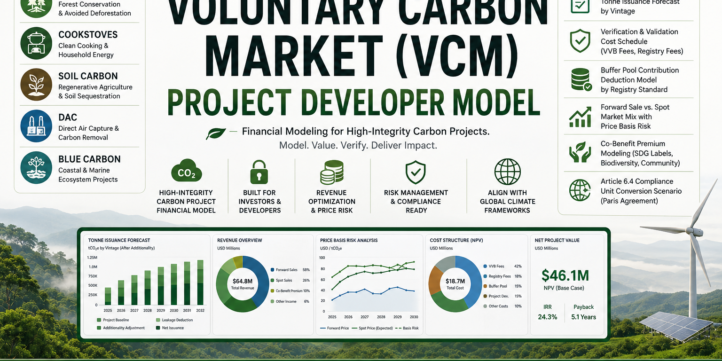


⚡ Voluntary Carbon Market (VCM) Project Developer Financial Model
This premium Excel financial model is designed for carbon project developers, VCM investors, climate finance teams, sustainability consultants, project sponsors, and organizations developing or evaluating voluntary carbon credit projects.
Carbon project economics are not simple.
A project developer must consider:
- 🌳 Project type and methodology
- 📦 Tonne issuance by vintage
- ✅ Additionality adjustments
- 🔍 Validation and verification costs
- 🏛️ Registry fees
- 🛡️ Buffer pool contribution deductions
- 💰 Forward sale vs. spot sale pricing
- 📉 Price basis risk between registries and markets
- 🌍 Co-benefit premiums
- 📜 Article 6.4 compliance conversion scenarios
- 📊 Project cash flow, valuation and investor returns
This model brings those mechanics into one structured, editable and decision-ready workbook.
What This Model Is Used For
This model helps users forecast the financial performance of a voluntary carbon market project from development through credit issuance and monetization.
It can be used for:
✅ Carbon project development planning
✅ REDD+ project economics
✅ Cookstove carbon credit projects
✅ Soil carbon project evaluation
✅ Direct Air Capture project modeling
✅ Blue carbon project financial planning
✅ Carbon credit issuance forecasting
✅ Verification and registry cost budgeting
✅ Buffer pool contribution analysis
✅ Forward sale vs. spot sale strategy
✅ Carbon price basis risk analysis
✅ Co-benefit premium valuation
✅ Article 6.4 scenario analysis
✅ Investor reporting and project finance review
✅ VCM feasibility and sensitivity analysis
The model is especially useful for projects where carbon credit revenue depends on issuance timing, registry treatment, verification cost, market pricing, and credit-quality premiums.
Key Model Modules
🌳 1. Project Type Selector
The model includes a project type selector for major carbon project categories.
Included project types:
- REDD+
- Cookstoves
- Soil carbon
- Direct Air Capture
- Blue carbon
This allows users to model different project economics without forcing every carbon project into one generic structure.
Each project type can have different assumptions for:
- Issuance profile
- Cost structure
- Verification timing
- Registry treatment
- Co-benefit potential
- Price premium or discount
- Risk and permanence profile
📦 2. Additionality-Adjusted Tonne Issuance Forecast
The model forecasts carbon credit issuance by vintage.
The issuance logic includes:
✅ Baseline tonne generation
✅ Additionality adjustment
✅ Leakage / reversal deductions
✅ Verification delay
✅ Vintage timing
✅ Net issued tonnes
✅ Cumulative issued credits
This helps users understand the actual number of saleable carbon credits after methodology and integrity adjustments.
🔍 3. Verification and Validation Cost Schedule
Carbon projects require validation and verification before credits can be issued and monetized.
The model includes a cost schedule for:
- VVB validation fees
- VVB verification fees
- Registry fees
- Issuance fees
- Monitoring, reporting and verification costs
- Periodic verification cycles
- Project-level compliance and documentation costs
This is important because verification and validation costs can materially affect project economics, especially for smaller projects.
🛡️ 4. Buffer Pool Contribution Deduction Model
Many registry standards require buffer pool contributions to manage reversal, permanence, and project risk.
The model includes:
✅ Buffer pool deduction percentage
✅ Registry-specific deduction assumptions
✅ Gross credits before buffer contribution
✅ Credits deducted to buffer pool
✅ Net tradable credits
✅ Revenue impact of buffer deductions
This allows users to see how many credits remain available for sale after required risk-buffer contributions.
💰 5. Forward Sale vs. Spot Market Mix
Carbon project developers may sell credits through forward contracts, spot market transactions, or a mix of both.
The model includes:
- Forward sale percentage
- Spot sale percentage
- Contracted price assumptions
- Spot market price assumptions
- Timing of revenue recognition
- Revenue mix by sale channel
- Forward vs. spot revenue comparison
This helps users evaluate the trade-off between price certainty and market upside.
📉 6. Price Basis Risk Analysis
A key feature of this model is price basis risk.
Carbon credits can trade at different prices depending on:
- Registry standard
- Project type
- Vintage
- Quality perception
- Co-benefit labels
- Buyer preference
- Market liquidity
- Forward contract discount
- Compliance-conversion potential
The model includes a basis risk framework to help users compare expected carbon credit price realization against reference or market price assumptions.
🌍 7. Co-Benefit Premium Modeling
High-quality carbon projects may command pricing premiums when they include strong co-benefits.
The model includes premium assumptions for:
- SDG labels
- Biodiversity benefits
- Community impact
- Nature-based project attributes
- High-integrity verification
- Buyer preference for quality credits
This helps users understand whether co-benefit labels can improve project revenue and valuation.
📜 8. Article 6.4 Compliance Unit Conversion Scenario
The model includes an Article 6.4 scenario framework for users who want to evaluate potential conversion from voluntary credit economics into a compliance-linked scenario.
Included logic:
✅ Compliance unit conversion assumption
✅ Eligibility / conversion haircut
✅ Price uplift or discount scenario
✅ Volume conversion rate
✅ Revenue impact
✅ Scenario comparison against voluntary market case
This allows users to evaluate upside or downside if part of the credit portfolio becomes compliance-relevant under Paris Agreement-related mechanisms.
Dashboards and Outputs
📊 The workbook includes professional dashboards and summary outputs.
Key outputs include:
✅ Cover
✅ Index / navigation
✅ How to Use
✅ Control Panel
✅ Project Type Selector
✅ Methodology
✅ Tonne Issuance Forecast
✅ Vintage Schedule
✅ Additionality Adjustment
✅ Verification Cost Schedule
✅ Registry Fee Schedule
✅ Buffer Pool Deductions
✅ Forward Sale Revenue
✅ Spot Market Revenue
✅ Price Basis Risk
✅ Co-Benefit Premium
✅ Article 6.4 Scenario
✅ Project Cost Summary
✅ Revenue Summary
✅ Cash Flow Forecast
✅ Project Valuation
✅ Scenario Summary
✅ Sensitivity Analysis
✅ KPI Summary
✅ Dashboard
✅ Audit Checks
✅ Disclaimer
✅ Glossary
How to Use the Model
1️⃣ Start with the Control Panel
Update project assumptions, registry assumptions, tonne issuance, costs, pricing, sale mix and scenario settings.
2️⃣ Select Project Type
Choose REDD+, cookstoves, soil carbon, DAC or blue carbon.
3️⃣ Review Tonne Issuance
Analyze gross tonnes, additionality adjustments, buffer deductions and net issued credits.
4️⃣ Review Verification and Registry Costs
Estimate VVB fees, registry charges and issuance-related cost burden.
5️⃣ Analyze Sales Strategy
Compare forward sale revenue and spot market revenue.
6️⃣ Review Basis Risk
Understand price differences between expected market pricing and realized project pricing.
7️⃣ Add Co-Benefit Premiums
Model SDG, biodiversity or community premiums where relevant.
8️⃣ Stress-Test Article 6.4 Scenario
Review potential compliance-unit conversion impact.
9️⃣ Use Dashboards and Valuation
Review KPIs, revenue, cash flow, project value and sensitivities.
🔟 Check Audit Sheet
Review model integrity checks before using outputs.
Who Should Buy This Model
This model is ideal for:
✅ Carbon project developers
✅ VCM investors
✅ Climate finance teams
✅ REDD+ project developers
✅ Cookstove project developers
✅ Soil carbon project teams
✅ DAC project analysts
✅ Blue carbon project sponsors
✅ Sustainability consultants
✅ Carbon market advisors
✅ ESG and impact investors
✅ Climate funds
✅ Corporate sustainability teams
✅ Project finance analysts
✅ Carbon credit portfolio managers
Why This Model Is Valuable
Most carbon credit spreadsheets only estimate tonnes or simple revenue.
This model goes deeper by connecting:
🌳 Project type
📦 Issuance by vintage
✅ Additionality
🔍 Verification costs
🏛️ Registry fees
🛡️ Buffer pool deductions
💰 Forward and spot sales
📉 Price basis risk
🌍 Co-benefit premiums
📜 Article 6.4 scenario logic
📊 Cash flow and valuation
This helps users evaluate carbon projects with more financial discipline and better risk visibility.
It helps answer practical questions such as:
- How many saleable credits will the project issue?
- What happens after additionality and buffer deductions?
- How much do validation and verification costs reduce returns?
- Should credits be sold forward or held for spot market upside?
- How exposed is the project to price basis risk?
- Do co-benefit labels materially improve revenue?
- What happens under an Article 6.4 conversion scenario?
- Is the project financially attractive after all registry and project costs?
Similar ProductsOther customers were also interested in...


 eFinancialModels
Electric Vehicle (EV) Charging Station Financial M...
With this comprehensive 5- or 10-year monthly tool, investors can assess the viability of setting up... Read more

Financial Model for Mobile App | Mobile App Busine...
The Mobile App Financial Plan Template in Excel allows you to develop financial projections when lau... Read more

 HenrySheykin
Food Truck Financial Model Excel Template
The Food Truck Financial Model helps entrepreneurs, founders, business owners, consultants, and anal... Read more

Green Hydrogen Production from Wind Energy Financi...
The Green Hydrogen from Wind Financial Model aims to comprehensively forecast a horizon of 40 years ... Read more

Simple Mutual Non-Disclosure Agreement Template
Protect your business secrets with ease using our Simple Mutual Non-Disclosure Agreement Template. S... Read more

Solar Energy Financial Model
The Solar Energy Financial Model Spreadsheet Template in Excel assists you in preparing a sophistica... Read more

 Peter Graf
The Customer-Centric Financial Model for Restauran...
Starting a restaurant without a financial plan is like driving a car blindfolded. You wouldn´t do i... Read more
You must log in to submit a review.