
0 ITEMS

How to Estimate M&A Synergies?
Understanding merger and acquisition synergies is essential for evaluating the true value of a deal and avoiding overestimating potential benefits.
- Synergies arise when combined companies outperform their separate performance through cost savings, revenue growth, or market expansion.
- Common types include cost, revenue, financial, and market synergies, each impacting different aspects of a business.
- Accurate calculation involves identifying synergy types, benchmarking against industry standards, and building detailed financial models.
- Validating estimates through sensitivity analysis and stakeholder reviews ensures realistic projections and better deal outcomes.
- Proper synergy estimation supports strategic decision-making and improves merger success.
This article provides practical methods to accurately measure and model M&A synergies for smarter deal planning.
What is an M&A Synergy?
Synergy happens when two or more people, teams, or companies work together and create better results than they could alone. It means combining strengths to boost performance, reach bigger goals, or solve problems faster. In business, synergy often leads to higher profits, smoother operations, or stronger products. It’s not just teamwork—it’s teamwork that multiplies impact.
An M&A synergy means the combined company is worth more than the two separate firms. It happens when merging boosts revenue, cuts costs, or improves market reach. For example, one company may bring strong sales while another adds efficient production. Together, they grow faster and save money. Synergy is a key reason deals happen—it turns overlap into value.
Here are some examples of successful merger and acquisition synergies:
- Disney and Pixar (2006): When Disney bought Pixar, it wasn’t just about adding animated films. Pixar brought fresh creativity and strong tech skills. Disney added global reach and marketing power. Together, they produced hits like Frozen and Moana. The synergy was clear: better stories, bigger audiences, and lasting impact.
- Exxon and Mobil (1999): The Exxon-Mobil merger created the world’s largest oil & gas company. They combined resources, cut overlapping operations, and gained better control over pricing and supply. Cost savings and global scale made them more efficient. This deal proved that big mergers can deliver real value.
- Facebook and Instagram (2012): Facebook bought Instagram to stay ahead in mobile and photo sharing. Instagram’s young user base and clean design filled a gap Facebook couldn’t cover alone. Facebook scaled it fast, used its social network ad system, and turned it into a revenue machine. This synergy turned a $1 billion bet into a powerhouse.

Understanding what is synergy in M&A helps explain why companies merge in the first place. It’s not just about getting bigger—it’s about creating more value together than apart. Synergy means higher profits, lower costs, and a stronger market position. Without it, a deal might not be worth it. Identifying and measuring synergy is key to a smart merger strategy.
What are the 7 Types of Synergies?
In mergers and acquisitions (M&A), companies often come together with one key goal—creating more value together than they could alone. This added value is known as synergy. Understanding synergy is essential because it reveals why deals happen and how businesses plan to grow stronger after merging. But not all synergies are the same. They come in different forms, each with its own impact on cost, revenue, and operations. Let’s look at the four main types of synergies that drive M&A success.
- Cross-Selling Synergy: Cross-selling synergy lets a merged company offer its products to a broader customer base. One firm gains quick access to the other’s clients, boosting sales without extra marketing costs. It’s a fast way to grow revenue. For example, a bank buys an insurance company and offers insurance plans to its existing customers. This boosts sales without needing new customers.
- Pricing Synergy: Pricing synergy occurs when the combined company gains stronger pricing power. Less competition or a stronger brand lets it raise prices or stop discounting. This leads to higher profits without changing cost structures. One instance is a top software firm that buys a smaller rival. With less competition, it stops discounting and sells its full-price products, raising revenue per customer.
- Cost Synergy: Cost synergy means cutting duplicate roles, streamlining operations, or negotiating better deals after a merger. It lowers expenses fast and boosts margins. The company becomes leaner and more efficient. Let’s say two airlines merge and eliminate overlapping routes, call centers, and admin jobs. They save a lot on staff and operating costs.
- Financial Synergy: Financial synergy arises when the new company gets better access to capital or lowers its borrowing cost. Combined financial strength also improves credit ratings. This reduces interest expenses and boosts valuation. When a profitable firm acquires a debt-heavy startup, the combined company gets better loan terms thanks to the stronger balance sheet.
- Market Synergy: Market synergy gives the merged company a stronger footprint or entry into new regions or customer groups. It opens doors faster than building from scratch. The result is faster expansion and greater market share. One example is a U.S. food brand that buys a European snack company. It uses the local brand to enter Europe quickly, skipping years of market testing.
- Savings in CAPEX: Savings in capital expenditure happen when companies merge and cut future capital spending by sharing equipment, facilities, or technology. They avoid duplicate investments and stretch every dollar further. This frees up cash for growth or debt reduction. Sometimes, when combining two companies, some investments become obsolete, and purchasing new machines or equipment is no longer required, compared to a standalone scenario.
- Savings in Net Working Capital: Savings in net working capital means the merged firm needs less cash in daily operations. The company improves cash flow by managing inventory, receivables, and payables. This adds flexibility and strengthens liquidity. For instance, if a retail chain acquires another and combines its supply chains. Better demand planning reduces excess inventory and collects cash faster.

Knowing the 7 types of synergies helps businesses see where real value lies in a merger. Each type shows a different way to grow stronger together. Companies use this insight to plan better deals, avoid waste, and hit growth goals faster. That’s why understanding the 7 types of synergies is key to making smart M&A decisions.



















































How Do You Calculate Merger and Acquisition Synergies?
Calculating merger and acquisition synergies means figuring out how much more value two companies create together than they did alone. It’s about adding extra profits or cost savings from combining operations—like sharing resources, cutting duplicate roles, or boosting sales through cross-selling. To get the value merger and acquisition synergies, you compare the combined company’s expected performance with the total value of both companies separately. If the result shows real financial gain, the merger makes business sense. Here are the steps on how to do it:
Step 1: Determine the Synergy Type
To calculate merger and acquisition synergies, start by identifying the type of synergy—revenue, cost, financial, or market. This first step shapes the entire analysis.
- To estimate revenue synergy, project the additional sales the combined companies can generate that neither could achieve alone. Use key drivers like cross-selling, expanded distribution, or pricing power. This often appears as incremental revenue added to post-merger projections in your model. Make sure to isolate the synergy impact from organic growth to ensure clarity.
- Cost synergy estimates focus on savings from eliminating redundancies. Identify overlapping roles, consolidated operations, or reduced vendor costs. Input these savings as reductions in operating expenses—especially SG&A—in the merged forecast. Models usually break this down by function (e.g., HR, IT) and apply phased implementation to reflect real-world timing.
- Financial synergy measures improvements in capital structure or financing. To measure financial synergies, track improvements in gross profit margin and EBITDA margin after a merger. Gross profit margin shows how much profit remains after covering direct costs. If it rises, the combined company is spending less to earn more—thanks to better pricing, reduced costs, or stronger sales. EBITDA margin measures earnings before interest, taxes, depreciation, and amortization as a percentage of revenue. A higher EBITDA margin means the merger helped lower overhead, boost efficiency, or unlock cost savings. Together, rising margins prove the merger created real financial gains.
- Market synergy arises from a stronger combined market position. It can lead to increased pricing power or new market access. In financial models, it’s embedded in revenue growth, margin expansion, or market share gains. To quantify and adjust sales volumes or prices based on competitive advantages unlocked by the merger.
By knowing the synergy type upfront, you focus only on the numbers that matter and avoid guessing. It also helps you clearly measure the added value the deal can bring.

The above M&A Synergies table shows a comprehensive breakdown of anticipated benefits from a merger. Revenue synergies are projected through combined gains in product sales, service contracts, licensing, and trading income, resulting in over $23 million in added revenues across ten years. Cost synergies appear as reduced direct costs—like product, service, and licensing expenses—yield cumulative savings of $9.8 million. Financial synergies emerge through enhanced gross profit margins and consistent EBITDA margin gains, improving from 142.2% gross profit margin impact to an impressive 175.1% EBITDA margin across the forecasted period, signaling better financial health and scalability. Market synergies are implied by the steady rise in product and service sales, suggesting increased market reach and customer base from the merger. The table quantifies the operational and financial efficiency expected from combining two entities.
Step 2: Conduct Benchmarking
The second step in calculating merger and acquisition synergies is to conduct benchmarking. This means comparing both companies to similar businesses in the market. Look at industry standards for costs, revenue, and performance. This helps you spot gaps, set realistic synergy targets, and avoid overestimating value. Benchmarking also highlights where one company outperforms the other and where improvements can happen. It gives a solid base for your synergy estimates and keeps your deal grounded in real data.
To conduct benchmarking in M&A, start by selecting peer companies in the same industry with similar size and operations. Compare key financial metrics like profit margins, cost ratios, and revenue per employee. Use this data to see where each company stands. Focus on areas with big differences—these often reveal the most synergy potential. For example, if one company runs leaner operations, the other might cut costs to match. Benchmarking gives a clear view of what’s possible and sets realistic synergy goals based on proven market standards.
Step 3: Build a Synergy Model
The third step in calculating merger and acquisition synergies is to build a synergy model. This model turns synergy ideas into numbers. Start by listing expected gains—like cost cuts, new revenue, or tax savings. Then, add timing, one-time costs, and when the benefits will show. Use simple financial projections to estimate yearly impact. Make sure to separate each synergy type for clarity. A great financial model helps decision-makers see the deal’s true value. It also lets you test best and worst-case scenarios, so the team knows the risks and rewards before moving forward.
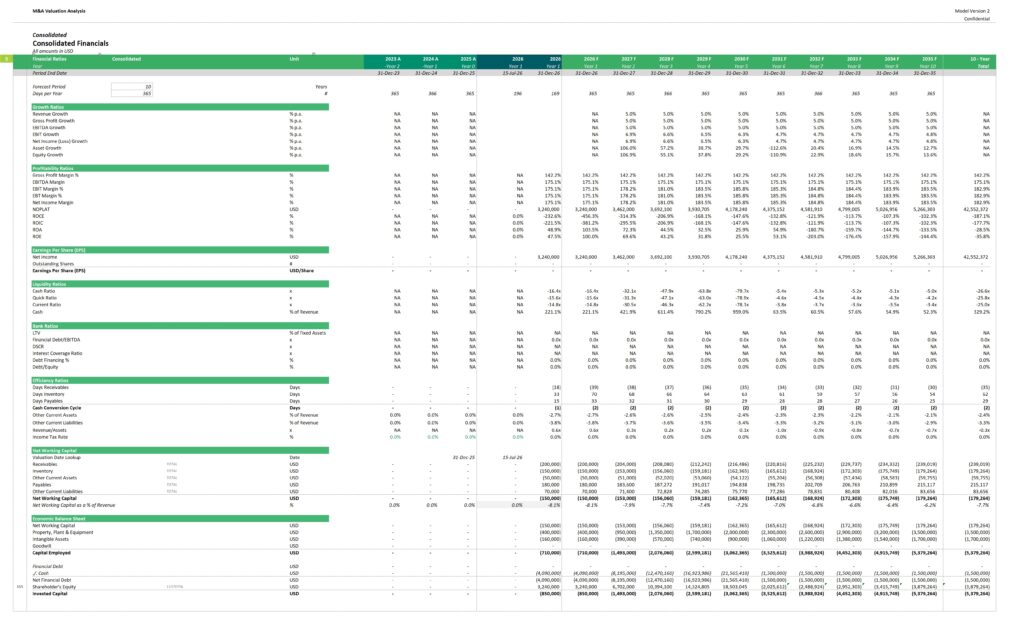
The consolidated financials sheet above reveals the risks and rewards of an M&A deal by laying out key financial ratios, growth metrics, and projected performance over 10 years. On the reward side, strong profitability margins (e.g., EBITDA margin around 30%) and steady revenue growth (5% p.a.) hint at stable future cash flows and potential valuation upside. However, risks emerge from high negative free cash flow, negative net working capital, and heavy leverage, with total financial debt exceeding equity and continued reliance on debt financing. These indicators highlight liquidity stress and capital structure imbalance, making the investment attractive only if strategic synergies outweigh operational and financial risks.
Step 4: Adjust and Validate as Needed
The final step in calculating merger and acquisition synergies is to adjust and validate the numbers. As new data comes in, update your model to stay accurate. Check if the expected benefits still make sense. Costs might rise, timelines may shift, or market conditions could change. Be flexible, but stay grounded in facts. A solid synergy estimate reflects real-world input, not just early guesses. This step keeps your analysis sharp and your deal expectations realistic.
Running a sensitivity analysis and reviewing key assumptions with stakeholders is also critical. Test how changes in costs, timing, or market trends affect results. This shows the risks and helps plan for different outcomes. Involve leaders from both sides to confirm the numbers and spot blind spots. Validating with stakeholders builds trust, aligns expectations, and helps ensure the merger delivers real value.
Financial Modeling: Your Key to Realistic M&A Synergy Forecasts
To estimate M&A synergies, start by identifying the specific synergy types—like cost reductions or revenue boosts. Then, benchmark those expectations using industry data and past deals. Build a detailed synergy model to forecast financial impacts. Lastly, validate your assumptions with real data and adjust the model as needed. This structured approach helps ensure synergy estimates are grounded, measurable, and realistic.

Financial modeling is the bridge between synergy assumptions and actionable insights. It turns rough synergy ideas into quantifiable projections and stress-test scenarios and highlights key risks. With a robust synergy model, decision-makers can confidently assess deal value and fine-tune strategies for post-merger success.
Our Merger and Acquisition Financial Model simplifies synergy estimation by guiding you through each step—from defining synergy types to validating results with real data. Built-in benchmarking tools and dynamic forecasting features empower you to make confident, data-driven decisions.
Start modeling your M&A synergies precisely—explore our M&A Financial Model today!
You might also like:
- 10 Tips to Develop a First Class Business Valuation Report
- 10 Main Elements of a Business Plan
- 5 Best Practices for Managing Days Receivables
- Understanding the Debt Service Coverage Ratio: An Essential Metric for Financial Analysis
- Developing a 5 Year Financial Projection Template
- How to Start a Distillery Business: What You Need to Know?
- Financial Planning for Small Business Owners – Taking an SBA Loan
- Debt Amortization Table
- 10-Step Financial Planning Checklist for Smart Executives
- Finding Fair Market Value: A Quick Guide to Real Estate Valuation
- Calculating Revenue Growth Rate: A Key Metric for Business Success
- Financial Modeling for Startups and Small Businesses
- Understanding what is Yield to Maturity and Why It Matters
- Financial Due Diligence
- Navigating the Car Rental Business Landscape
- Understanding the Levelized Cost of Energy Formula
- How to Value a Business Using a Discounted Cash Flow Model
- Long-Term Financial Planning: Strategies for Success
- 10 Ideas to Increase Average Revenue Per User
Tags: Mergers and Acquisitions