
0 ITEMS

Private Counseling Practice Financial Model Excel Template
The Private Counseling Financial Model helps users turn a therapy practice concept into a structured financial forecast that can support planning, funding conversations, and day-to-day decision-making. Instead of building a model from scratch, entrepreneurs, practice owners, consultants, analysts, and business plan writers can start with a ready-to-use framework designed around the economics of a private counseling office. The template helps connect practitioner capacity, session pricing, utilization rates, revenue assumptions, startup costs, operating expenses, payroll, cash flow, and profitability into one organized planning tool. Built for private counseling practices, therapy offices, mental health clinics, and founders preparing business plans or funding documents, this financial model gives users a practical way to evaluate whether the business can scale sustainably. It can be customized for different provider types, including licensed professional counselors, marriage and family therapists, clinical social workers, psychologists, and associate therapists. Users can adjust session prices, practitioner counts, utilization rates, salary assumptions, office expenses, marketing costs, and other inputs to reflect their own strategy, market, and growth expectations. The model is especially useful for understanding how decisions affect financial performance over time. Users can review revenue potential, compare operating expense levels, estimate staffing needs, analyze cash flow dynamics, and assess the path to profitability. It supports break-even analysis, scenario planning, investor return review, and bank-ready financial outputs, helping buyers see how changes in client demand, pricing, hiring, or overhead may affect the practice. This makes it valuable for launch planning, expansion planning, lender presentations, investor discussions, and internal budgeting. With editable assumptions, automated calculations, visual dashboards, and professional reports, the Private Counseling Financial Model is designed to save time while improving the quality of financial planning. It works as a practical decision-making tool for both new practices and established counseling businesses considering growth. Users can use it to test assumptions, identify funding needs, monitor projected profitability, and communicate a clear financial story to partners, advisors, lenders, or investors.
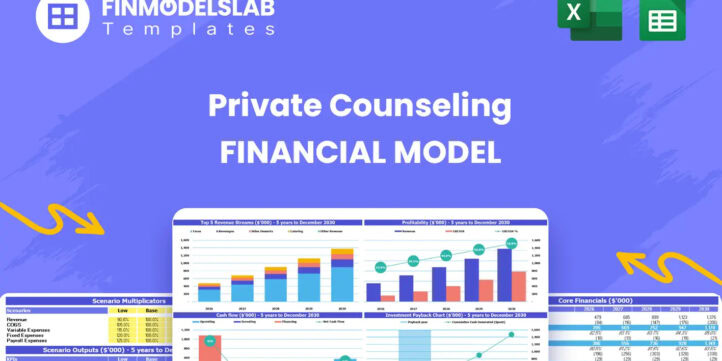


Financial Model Overview
The Private Counseling Financial Model is a ready-to-use financial model template designed to help entrepreneurs, counseling practice owners, consultants, analysts, and business plan writers forecast the economics of a private therapy practice. It gives users a structured way to evaluate revenue, expenses, startup investment, staffing, cash flow, profitability, and funding needs before launching or expanding a counseling office.
The model is built around the practical drivers of a mental health practice, including practitioner count, monthly session capacity, utilization rate, session pricing, provider mix, payroll, rent, marketing, software, and operating overhead. Instead of relying on rough estimates or building spreadsheets from a blank file, users can work from an organized, editable model that brings key assumptions and outputs together in one place.
This makes it useful for preparing business plans, discussing financing with lenders, reviewing investor returns, setting budgets, testing growth plans, and making better decisions about how the practice should scale over time.
All-in-One Dashboard
The all-in-one dashboard gives users a central view of the most important inputs and outputs in the Private Counseling Financial Model. It is designed to make the model easier to navigate by bringing core assumptions, financial results, and summary metrics into a single planning area.
Users can review the main business drivers, such as practitioner mix, session pricing, utilization rates, revenue growth, payroll assumptions, operating costs, and capital requirements, then see how those assumptions affect projected revenue, EBITDA, cash flow, profitability, and funding needs. For a private counseling practice, this is especially helpful because performance depends on several connected variables, including therapist availability, client volume, fee structure, and overhead.
The dashboard helps users avoid getting lost in separate worksheets and instead focus on the financial story behind the practice. It can be used during planning meetings, investor conversations, internal reviews, and strategy sessions to quickly identify whether the current plan supports the desired level of growth, liquidity, and profitability.
Low, Base, and High Scenario Analysis
The low, base, and high scenario analysis component helps users test how the counseling practice may perform under different business conditions. A private counseling office can be affected by changes in client acquisition speed, practitioner utilization, session prices, payroll costs, office rent, marketing efficiency, insurance reimbursement timing, and hiring pace.
This section allows users to compare a conservative case, a realistic or expected case, and an upside case without rebuilding the model each time. Inputs may include lower or higher session volumes, adjusted pricing assumptions, different expense levels, modified hiring schedules, or changes in utilization rates across provider types.
The outputs help show how these changes affect revenue, gross margin, EBITDA, net income, cash balance, payback timing, and funding requirements. This is useful for founders and investors because it shows not only what could happen if everything goes according to plan, but also how resilient the business may be if growth is slower, costs increase, or demand is stronger than expected. Scenario analysis supports more informed decision-making and helps users prepare for both risks and opportunities.
Professional Charts
The professional charts component converts the financial forecast into clear visual outputs that are easier to understand and present. Private counseling financial projections can include many moving parts, such as monthly session volume, revenue by practitioner type, payroll costs, operating expenses, EBITDA, cash flow, margins, and cash balance.
Charts help simplify these details by showing trends, comparisons, and changes over time. Users can use visual reports to communicate revenue growth, profitability improvement, cost structure, cash flow movement, and long-term performance in a format that is more accessible to lenders, investors, partners, and non-financial stakeholders.
These charts are especially useful when preparing a funding presentation or business plan because they help support the financial narrative with organized visual evidence. Instead of manually building graphs from raw data, users can rely on pre-built visuals that update as assumptions change. This saves time and helps ensure that the presentation of the financial model remains consistent, polished, and decision-ready.
ROE Components and DuPont Analysis
The ROE components and DuPont analysis section helps users understand the drivers behind return on equity and overall financial efficiency. For a private counseling practice, return performance is influenced by profitability, asset use, financing structure, and the ability to convert practitioner capacity into consistent revenue.
This component breaks return on equity into underlying elements, allowing users to see whether returns are being driven by strong margins, efficient use of invested capital, or leverage. Inputs and outputs may relate to net income, revenue, assets, equity, margins, turnover, and return ratios over the forecast period.
This is valuable for investors, owners, and financial analysts who want to go beyond headline profit numbers and understand why the business produces a certain level of return. It can also help identify strategic improvement areas, such as increasing utilization, improving pricing, managing overhead, or using capital more efficiently. In funding discussions, this section can support a more sophisticated financial conversation by showing that the model is not only forecasting profits, but also analyzing the quality and sustainability of returns.
Revenue Inputs
The revenue inputs component is one of the most important parts of the Private Counseling Financial Model because it defines how the practice generates income. It allows users to build revenue assumptions around the key operating drivers of a counseling business, including the number of practitioners, practitioner type, monthly session capacity, utilization rate, and price per session.
The model can be adapted for different provider categories, such as licensed professional counselors, licensed marriage and family therapists, licensed clinical social workers, psychologists, and associate therapists. Users can modify session fees, expected client volume, utilization ramp-up, provider availability, and growth timing to reflect their own market and business strategy. The outputs from this section flow into revenue projections, profitability calculations, staffing plans, and cash flow forecasts.
This is useful because counseling practice revenue is not simply based on a single sales number. It depends on how many sessions can realistically be delivered, how much clients or payers are charged, how quickly therapists reach target utilization, and how the mix of senior and associate providers affects average revenue. A clear revenue input structure helps users make realistic projections and test whether the practice can support its expense base.
Bank-Ready Reports
The bank-ready reports component organizes financial results into outputs that can support lender reviews, funding applications, and stakeholder presentations. Lenders and financing partners typically want to see structured projections, clear assumptions, cash flow expectations, profitability, debt service ability, and a logical explanation of how the business will operate.
This section helps users present the private counseling practice in a professional format with forecasted financial statements and key summaries that are easier for banks and advisors to review. It may include projected profit and loss, cash flow forecast, balance sheet summaries, revenue and expense schedules, EBITDA trends, funding needs, and repayment capacity indicators.
For a counseling practice seeking startup capital, working capital, equipment financing, build-out funding, or expansion financing, this component can help translate the business idea into a lender-friendly financial case. It is useful because it reduces the risk of presenting disconnected numbers and helps users communicate how capital will be used, when the practice may become profitable, and whether cash flow can support obligations over time.
Revenue Breakdown
The revenue breakdown component gives users a detailed view of income by revenue stream, provider type, or service category. In a private counseling practice, revenue may come from several practitioner groups and service offerings, such as individual counseling sessions, marriage and family therapy, clinical social work sessions, psychologist-led services, associate therapist sessions, or other counseling-related services.
This section helps users see which revenue streams are contributing most to total sales and how the mix changes over time as the practice grows. Inputs may include session price, monthly capacity, utilization, practitioner count, start dates, and growth assumptions for each category. Outputs may show monthly and annual revenue by stream, total revenue, share of revenue, and changes in revenue composition across the forecast period.
This is useful for planning because different providers may have different pricing, compensation levels, capacity limits, and profitability profiles. By reviewing the revenue breakdown, users can decide whether to hire more associate therapists, increase senior clinician capacity, adjust pricing, expand high-demand services, or focus marketing spend on the most profitable offerings. It supports more precise strategy than a single blended revenue forecast.
KPI Dashboard
The KPI dashboard helps users monitor the key performance indicators that matter most for a private counseling practice. While financial statements show the overall results, KPIs help explain what is driving those results and whether the practice is operating efficiently.
This section may track metrics such as total sessions, utilization rate, average revenue per session, revenue per practitioner, payroll as a percentage of revenue, EBITDA margin, cash balance, client volume, revenue growth, break-even progress, and return metrics. Users can compare projected performance against internal targets or industry benchmarks to identify strengths and weaknesses in the business plan.
For founders and practice managers, the KPI dashboard is useful because it turns detailed spreadsheet calculations into actionable operating insights. It can help answer questions such as whether therapists are being used efficiently, whether pricing supports profitability, whether payroll is becoming too high, whether marketing is translating into enough demand, and whether the practice is maintaining sufficient liquidity. For investors and lenders, KPI visibility adds credibility because it shows that the business is being evaluated through measurable performance drivers rather than only high-level revenue projections.
Startup Cost Breakdown
The startup cost breakdown component helps users estimate the initial investment needed to open or prepare a private counseling practice for operations. A counseling office may require capital for office furnishings, décor, therapy room setup, minor renovations, lease deposits, technology, computers, printers, practice management software, website development, licensing, legal setup, insurance, initial marketing, working capital, and other pre-opening expenses.
This section separates one-time launch costs from recurring operating expenses so users can understand how much capital is needed before the practice begins generating steady revenue. Inputs may include cost categories, estimated amounts, timing of payments, contingency allowances, and funding sources. Outputs may include total startup capital required, use of funds, pre-opening cash needs, and the starting cash position for the financial forecast.
This is useful for entrepreneurs preparing a startup budget, funding request, or investor presentation because it shows exactly what the initial investment is expected to cover. It also helps reduce undercapitalization risk by making sure the practice has enough funds for setup costs, early payroll, marketing, and working capital during the initial ramp-up period.
Break-Even Analysis
The break-even analysis component helps users identify when the private counseling practice is expected to cover its fixed and variable costs and begin generating profit. For a therapy practice, break-even depends on session volume, utilization rates, session pricing, practitioner compensation, rent, administrative expenses, software, insurance, marketing, and other overhead costs.
This section connects those assumptions to determine the revenue or activity level required for the business to become financially sustainable. Outputs may include the projected break-even month, required revenue, required number of sessions, margin needed to cover fixed costs, and the relationship between growth assumptions and profitability timing.
This is valuable for decision-making because it shows how quickly the practice needs to fill clinician capacity and control expenses in order to avoid prolonged losses. It can also help users test strategies for reaching profitability faster, such as improving utilization, adjusting prices, hiring in phases, managing overhead, or focusing on higher-margin services. For lenders, investors, and founders, break-even analysis provides a clear measure of early-stage risk and helps determine whether the business plan is realistic, adequately funded, and capable of moving from launch to sustainable operations.
File types:
Excel – Single-User: .xlsx
Excel – Multi-User: .xlsx
Similar ProductsOther customers were also interested in...


 HenrySheykin
Insurance Agency Financial Model Excel Template
The Insurance Agency Financial Model helps entrepreneurs, agency owners, consultants, analysts, and ... Read more

Architecture Firm Financial Model Excel Template
The Architectural Firm Financial Model Template helps founders, architecture practice owners, consul... Read more

Consulting Agency Financial Model Excel Template
The Consulting Firm Financial Model helps users turn a service-based consulting concept into a struc... Read more
Financial Advisors Agency Financial Model Excel Te...
The Financial Advisor Financial Model is a ready-to-use financial model template built for planning,... Read more

Notary Financial Model Excel Template
The Notary Service Financial Model helps entrepreneurs, business owners, consultants, analysts, and ... Read more
Travel Agency Financial Model Excel Template
The Travel Agency Financial Model helps entrepreneurs, founders, consultants, analysts, and business... Read more

Life Coaching Financial Model Excel Template
The Life Coaching Financial Model helps coaches, entrepreneurs, consultants, founders, and business ... Read more
Recruitment Agency Financial Model Excel Template
The Recruiting Agency Financial Model helps founders, agency owners, consultants, and analysts build... Read more
Bookkeeping Agency Financial Model Excel Template
The Accounting Firm Financial Model Template helps founders, practice owners, consultants, analysts,... Read more

 Giorgos
Consulting Firm – 10 Year Financial Model
10-year financial model for a consulting firm providing forecasts, profitability analysis, and insig... Read more
You must log in to submit a review.