
0 ITEMS

Life Coaching Financial Model Excel Template
The Life Coaching Financial Model helps coaches, entrepreneurs, consultants, founders, and business planners turn a coaching concept into a structured financial forecast. Instead of starting with a blank spreadsheet, users can work from a ready-to-use model built around the realities of a life coaching business, including individual coaching, hourly sessions, group programs, and corporate contracts. The template helps organize financial planning assumptions, estimate revenue potential, calculate startup costs, project operating expenses, and understand the level of sales activity needed to build a sustainable practice. This financial model template is useful for new coaching startups, online life coaches, independent practitioners, coaching agencies, and established businesses planning expansion. It allows users to customize pricing, client acquisition assumptions, billable hours, payroll, marketing spend, service mix, and other cost drivers so the forecast reflects their own strategy. By connecting revenue assumptions with expenses, cash flow, profitability, and investment needs, the model gives users a clearer view of how the business may perform over time and what decisions may improve financial outcomes. The template is especially valuable for business plans, investor conversations, lender submissions, internal budgeting, and strategic decision-making. It includes a five-year projection structure with financial statements, cash flow planning, profit and loss outputs, balance sheet logic, scenario analysis, visual dashboards, and key performance metrics. Users can review whether the business has enough cash to operate, when it may become profitable, how different growth assumptions affect results, and what level of startup funding may be required before launch. Built for practical use, the Life Coaching Financial Model is fully editable and designed to work in Microsoft Excel and Google Sheets. It helps users test different assumptions, compare outcomes, evaluate break-even timing, and present a more professional financial case to stakeholders. Whether preparing a funding document, validating a coaching business idea, setting pricing targets, or planning future growth, this template provides a structured framework for turning coaching goals into numbers that support better planning and more confident decisions.
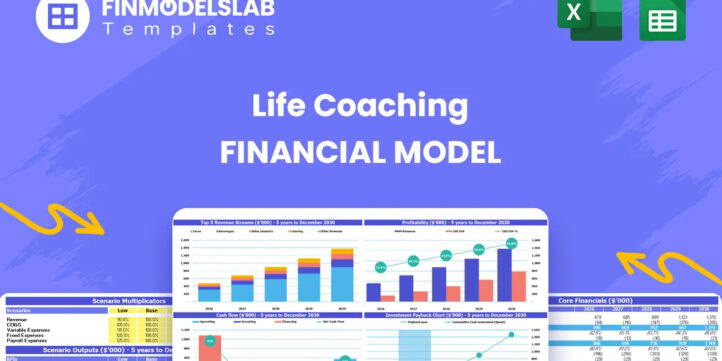


Financial Model Overview
The Life Coaching Financial Model is a ready-to-use financial model template designed to help entrepreneurs, life coaches, consultants, analysts, and business owners plan the financial side of a coaching practice with more structure and confidence. A life coaching business can generate income from several different sources, including one-to-one coaching, hourly sessions, group programs, online workshops, and corporate contracts, but each revenue stream has its own pricing, capacity, delivery time, and cost profile.
This model brings those assumptions into one connected forecast so users can estimate revenue, startup costs, operating expenses, payroll, cash flow, profitability, and investment needs over a multi-year planning period. It is useful for validating a new coaching business idea, preparing a business plan, approaching investors or lenders, comparing growth strategies, and managing performance after launch. Instead of building formulas, statements, and dashboards from scratch, users can enter their own assumptions into an organized framework and review the resulting financial outputs in a professional format.
All-in-One Dashboard
The all-in-one dashboard gives users a central place to review the most important inputs and outputs of the Life Coaching Financial Model. This component is designed to simplify financial planning by bringing together core assumptions, forecast results, and summary metrics in one view, rather than forcing users to search through multiple tabs to understand business performance.
Inputs may include pricing assumptions, client acquisition targets, marketing budget, billable hours, service mix, payroll plans, startup investment, and recurring operating costs. Outputs may include revenue, gross profit, EBITDA, net income, cash balance, margin trends, and other headline indicators that show whether the coaching business is financially viable.
For a life coaching practice, this is especially useful because a small change in client volume, average session price, or corporate contract activity can have a meaningful impact on profit and cash flow. The dashboard helps users quickly see how the model is performing, identify areas that need adjustment, and communicate the financial story to partners, lenders, investors, or internal stakeholders in a clear and efficient way.
Low, Base, and High Scenario Analysis
The low, base, and high scenario analysis component helps users plan for uncertainty by comparing different possible outcomes for the life coaching business. A single forecast can be useful, but coaching businesses are often affected by changes in client acquisition cost, referral volume, retention, conversion rates, market demand, pricing, coach utilization, and the mix between individual and corporate services.
This section allows users to model a conservative case, a realistic base case, and an optimistic growth case using different assumptions for revenue growth, marketing efficiency, operating expenses, staffing, and margins. The outputs help show how each scenario affects revenue, profitability, cash runway, funding needs, and long-term financial performance.
For example, a low scenario may show the effect of slower client acquisition or higher advertising costs, while a high scenario may reflect stronger corporate sales, better retention, or more scalable group programs. This component is valuable for decision-making because it helps users avoid relying on a single set of assumptions, stress-test their business plan, and prepare a more resilient strategy before making hiring, marketing, funding, or expansion commitments.
Professional Charts and Visual Reports
The professional charts and visual reports component turns financial data into clear visual outputs that are easier to interpret and present. Life coaching founders and consultants often need to explain their forecast to people who may not want to review detailed spreadsheet tabs, such as investors, lenders, partners, advisors, or team members.
This component helps summarize trends in revenue, operating expenses, profit margins, cash flow, client growth, and other important financial measures through presentation-ready visuals. Inputs flow from the forecast assumptions and financial statements, while outputs may include charts that show monthly or annual revenue growth, cost structure, profitability trajectory, cash balance movement, and service line performance. These visuals make it easier to identify patterns, communicate risks, and support strategic recommendations.
For funding preparation, charts can help demonstrate how the coaching business scales over time and when it becomes financially sustainable. For internal management, they help users track whether performance is moving in the right direction and where adjustments may be needed in pricing, marketing, staffing, or service delivery.
ROE Components and DuPont Analysis
The ROE components and DuPont analysis section helps users understand return on equity by breaking it into the underlying drivers of financial performance. Rather than looking only at a single return figure, this component separates the return into factors such as profitability, asset efficiency, and leverage so users can see what is actually influencing results.
In a life coaching business, return on equity may be affected by net profit margin, the level of startup investment, working capital requirements, fixed assets such as equipment or office setup, and the way the business is funded. Inputs may include net income, equity investment, total assets, revenue, and balance sheet figures generated by the model. Outputs help show whether returns are being driven by stronger margins, better use of assets, or changes in capital structure.
This is useful for investors and owners because it provides a more detailed view of financial efficiency and helps identify where performance can be improved. If margins are weak, the user may need to adjust pricing, reduce costs, or shift toward higher-value corporate coaching. If asset utilization is low, the user may need to generate more revenue from the same operating base. The result is a more analytical view of business performance than a simple profit forecast alone.
Revenue Inputs and Assumptions
The revenue inputs and assumptions component is one of the most important areas of the Life Coaching Financial Model because it defines how the business generates income. A coaching practice can have several revenue streams, each with different pricing, delivery capacity, growth potential, and profitability. This section allows users to enter assumptions for individual coaching sessions, hourly support, group programs, workshops, online offerings, and corporate contracts.
It may include inputs such as number of new clients, marketing spend, customer acquisition cost, conversion rates, average billable hours, hourly rates, package pricing, contract value, repeat purchase behavior, and ramp-up timing. The model then uses these assumptions to calculate projected revenue over time. This is useful because it connects business development strategy directly to financial outcomes.
For example, increasing the marketing budget may only improve results if the customer acquisition cost and conversion assumptions are realistic. Raising prices may improve margins, but it can also affect demand. By making these assumptions editable, the model allows users to test different service mixes, compare individual versus group coaching economics, and understand which revenue drivers matter most for growth and profitability.
Bank-Ready Financial Reports
The bank-ready financial reports component provides structured financial outputs that can support lender discussions, funding applications, and professional business planning. Banks and other financing partners typically want to see more than a revenue estimate. They need a clear view of profit and loss, cash flow, balance sheet position, debt capacity, repayment ability, and overall financial stability.
This section organizes the forecast into lender-friendly reports that show how the life coaching business is expected to perform over time. Inputs flow from the revenue forecast, expense assumptions, startup costs, payroll plan, financing assumptions, and working capital needs. Outputs may include income statement projections, cash flow statements, balance sheet forecasts, profitability summaries, debt service visibility, and key financial metrics.
For a life coaching business seeking startup funding, working capital, or expansion financing, these reports can help present a more credible and organized financial case. They also support internal planning by showing whether the business can cover monthly expenses, maintain sufficient cash reserves, and support any planned loan payments or owner distributions. The professional structure helps users save time and present financial information in a format that stakeholders are more likely to understand.
Revenue Breakdown by Service Line
The revenue breakdown by service line component helps users see exactly where income is coming from across the different offerings of a life coaching business. Rather than showing only total revenue, this section separates revenue streams such as individual coaching, hourly sessions, group programs, workshops, online programs, and corporate contracts.
Inputs may include the number of clients or contracts, price per session, average hours per client, package value, group size, program frequency, renewal rates, and expected growth by service type. Outputs help show the contribution of each service line to total revenue, the relative importance of high-touch versus scalable offerings, and the impact of shifting the business mix over time. This is useful because coaching businesses often begin with one-to-one services but may improve profitability by adding group programs, courses, corporate retainers, or repeatable packages.
The revenue breakdown helps users evaluate whether they are overly dependent on one income source, whether corporate contracts are becoming a meaningful growth driver, and whether scalable services are helping revenue grow without requiring the same increase in delivery hours. It also supports pricing decisions, marketing prioritization, and capacity planning by showing which offerings deserve the most attention.
KPI Dashboard and Benchmark Metrics
The KPI dashboard and benchmark metrics component helps users monitor performance using measurable indicators that matter for a life coaching business. Financial statements show the overall result, but key performance indicators help explain why those results are happening. This section may track metrics such as client acquisition cost, number of new clients, revenue per client, average billable hours, utilization, gross margin, EBITDA margin, cash runway, customer concentration, revenue by service line, and return metrics.
It can also support benchmark comparisons so users can evaluate whether their pricing, cost structure, margins, and growth assumptions are reasonable compared with expected industry performance. Inputs come from the model’s operating assumptions, revenue forecast, expense plan, payroll schedule, and financial statements. Outputs provide a concise view of business health and operational efficiency.
For founders and consultants, this is useful because it helps identify which levers should be managed most closely. If client acquisition cost rises, profitability may weaken even if revenue grows. If billable hours per client decline, the business may need to improve retention or package structure. If margins are below target, the owner may need to review coach compensation, software costs, marketing efficiency, or pricing. The KPI dashboard supports ongoing decision-making, not just one-time planning.
Break-Even Analysis
The break-even analysis component helps users identify when the life coaching business is expected to cover its costs and begin generating profit. This section connects revenue, fixed costs, variable costs, payroll, marketing spend, and contribution margins to determine the point at which total income equals total expenses.
Inputs may include average pricing, service mix, billable hours, direct delivery costs, coach commissions, software subscriptions, rent, insurance, administrative expenses, marketing costs, and staffing levels. Outputs may show the break-even month, required revenue level, required number of clients, and the effect of different pricing or cost assumptions on profitability timing. This is particularly useful for a life coaching startup because early months often include launch expenses, brand building, website development, initial marketing, and time spent acquiring the first clients.
By reviewing break-even timing, users can understand how much cash runway they may need, whether their pricing is strong enough, and how quickly sales activity must ramp up. The analysis also helps users compare strategies, such as focusing on higher-value corporate contracts, increasing group program participation, or keeping fixed overhead low in the early stage. For investors and lenders, break-even analysis provides a practical view of business viability and risk.
Startup Cost and Operating Expense Planning
The startup cost and operating expense planning component helps users estimate both the initial investment required to launch the life coaching business and the recurring costs needed to keep it running. Startup costs may include website development, branding, certification expenses, legal setup, office furniture, computer equipment, software subscriptions, initial marketing, deposits, professional services, and working capital reserves.
Operating expenses may include rent, scheduling tools, video conferencing software, customer relationship management systems, advertising, insurance, payroll, contractor payments, bookkeeping, training, payment processing fees, and administrative support. Inputs allow users to customize cost categories, timing, amounts, and escalation assumptions based on their specific business model. Outputs help calculate total launch funding needs, monthly overhead, annual expenses, and the impact of costs on profit and cash flow.
This is useful because many coaching businesses underestimate the financial resources required before consistent revenue begins. By separating one-time startup costs from recurring operating expenses, the model helps users create a more realistic budget, avoid cash shortfalls, and make better decisions about what to spend before launch. It also supports funding preparation by showing exactly how much capital may be needed and how that capital will be used.
File types:
Excel – Single-User: .xlsx
Excel – Multi-User: .xlsx
Similar ProductsOther customers were also interested in...


 HenrySheykin
Travel Agency Financial Model Excel Template
The Travel Agency Financial Model helps entrepreneurs, founders, consultants, analysts, and business... Read more
Architecture Firm Financial Model Excel Template
The Architectural Firm Financial Model Template helps founders, architecture practice owners, consul... Read more
Financial Advisors Agency Financial Model Excel Te...
The Financial Advisor Financial Model is a ready-to-use financial model template built for planning,... Read more

Notary Financial Model Excel Template
The Notary Service Financial Model helps entrepreneurs, business owners, consultants, analysts, and ... Read more
Bookkeeping Agency Financial Model Excel Template
The Accounting Firm Financial Model Template helps founders, practice owners, consultants, analysts,... Read more

 Giorgos
Interior Design Firm – 5 Year Financial Model
5-year financial model for an interior design firm providing revenue forecasts, cost analysis, and i... Read more

Accounting Firm – 10 Year Financial Model
10-year financial model for an accounting firm providing forecasts, profitability analysis, and insi... Read more

Law Firm – 10 Year Financial Model
10-year financial model for a law firm providing forecasts, profitability analysis, and insights to ... Read more

 eFinancialModels
Fiduciary Service Business Financial Planning
The Fiduciary Service Business Financial Model aims to plan the financial feasibility and profitabil... Read more

 ECF Consultancy
Startup Business Plan – Consulting Firm
If you dream to start a Consulting Firm Business, the template is the first step in making your drea... Read more
You must log in to submit a review.