
0 ITEMS

Mushrooms Farming Financial Model Excel Template
The Mushroom Farming Financial Model helps entrepreneurs, growers, business owners, consultants, and analysts build a structured financial forecast for a mushroom cultivation business. Instead of starting from a blank spreadsheet, users can work from a ready-to-use model designed around the economics of mushroom production, including yield assumptions, product mix, revenue streams, operating costs, staffing, capital investment, and long-term profitability. It is especially useful for people preparing a mushroom farm business plan, loan application, investor presentation, internal budget, or expansion analysis. This financial model template helps users organize the major assumptions that drive performance in a mushroom farming operation. Revenue assumptions can be built around active production units, annual yield, output loss, and sales across products such as fresh button mushrooms, oyster mushrooms, shiitake mushrooms, mushroom powder, and grow-at-home kits. The model also supports planning around startup costs, climate control systems, indoor farm infrastructure, processing equipment, delivery assets, monitoring technology, and other capital requirements that influence early cash needs. For ongoing operations, the template helps estimate cost of goods sold, substrate and packaging costs, logistics, marketing, utilities, rent, insurance, payroll, and other operating expenses. Users can review how these expenses affect margins, EBITDA, cash flow, and net profit over time. The model is built to help users assess whether the farm can support its cost structure, when it may reach break-even, how much funding may be required, and how changes in pricing, volume, yields, or expenses may affect financial outcomes. The Mushroom Farming Financial Model is designed for practical decision-making as well as stakeholder communication. It includes dashboard views, scenario analysis, professional charts, lender-friendly reports, revenue breakdowns, KPI tracking, and profitability metrics that make it easier to explain the business case. Because the template is editable in Excel and Google Sheets, users can customize assumptions for their region, supplier quotes, staffing plan, target production capacity, and sales strategy while keeping a clean, investor-ready financial planning framework.
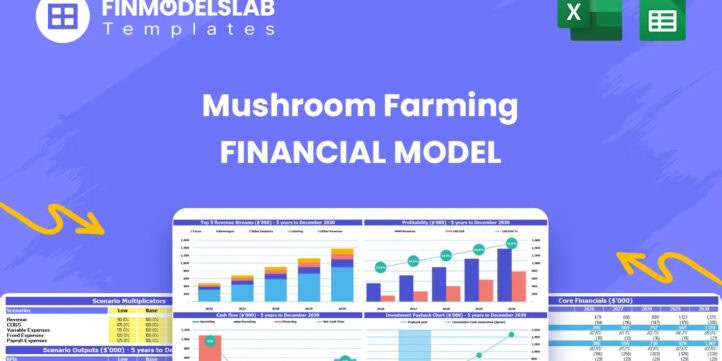


Mushroom Farming Financial Model Overview
The Mushroom Farming Financial Model is a ready-to-use financial model template built for planning, funding, and managing a mushroom cultivation business. It helps users translate production assumptions, product pricing, capital investment, staffing, and operating costs into a structured forecast that can support business plans, lender discussions, investor presentations, and internal decision-making. Mushroom farming can be capital intensive because indoor growing infrastructure, climate control systems, processing equipment, delivery capabilities, and monitoring technology often need to be in place before revenue reaches scale. This template gives entrepreneurs, growers, consultants, and analysts a practical way to estimate startup costs, forecast revenue, track profitability, understand cash flow, and test whether the business can become financially sustainable. The model is editable, presentation-ready, and designed for Microsoft Excel and Google Sheets, making it useful for both early-stage mushroom farm startups and established operators evaluating expansion.
All-in-One Dashboard
The all-in-one dashboard brings the most important inputs and outputs of the Mushroom Farming Financial Model into one organized view. This component is designed to help users quickly understand the financial health of the business without moving through every supporting worksheet. It may summarize assumptions such as production capacity, active growing units, yield per unit, output loss, average selling prices, revenue growth, operating expense levels, capital expenditures, payroll, and financing needs. On the output side, the dashboard helps present projected revenue, gross profit, EBITDA, net income, cash balance, investment requirement, payback period, and other decision-making metrics. For a mushroom farming business, this is useful because operational decisions are closely tied to financial results. A change in yield, substrate cost, pricing, or staffing can materially affect cash flow and profitability. The dashboard gives founders, lenders, investors, and internal teams a clear starting point for reviewing the forecast, identifying risks, and discussing the business plan in a structured format.
Low, Base, and High Scenario Analysis
The low, base, and high scenario analysis section helps users compare multiple versions of the mushroom farming forecast using different operating and financial assumptions. A low case may reflect slower production ramp-up, higher output loss, lower selling prices, increased input costs, or delayed customer acquisition. A base case can represent the expected operating plan, using the primary assumptions for yield, product mix, pricing, expenses, and staffing. A high case may show stronger demand, improved production efficiency, better pricing, or faster capacity utilization. This component is valuable because mushroom farming outcomes can vary based on climate control performance, biological yield, contamination rates, market demand, local competition, and distribution channels. By testing several scenarios, users can see how sensitive the business is to changes in revenue, costs, and capital needs. This supports better planning because the owner can prepare for downside risks, understand upside potential, and present a more credible range of outcomes to lenders, investors, and stakeholders.
Professional Charts
The professional charts component converts key financial outputs into clear visual reports that can be used in presentations, funding conversations, and internal reviews. Instead of relying only on rows of numbers, this section helps users show trends in revenue, gross margin, EBITDA, net income, cash balance, expense categories, and growth over time. For a mushroom farming business, charts can make it easier to explain how the farm moves from a capital-intensive startup period into a more scalable operating phase as production units increase, yields stabilize, and fixed costs are spread across larger sales volumes. These visuals can also highlight the relationship between product mix and revenue, or between capital expenditures and future capacity. Professional charts are particularly helpful when presenting to lenders, investors, grant reviewers, partners, or non-financial stakeholders who need to understand the economics quickly. They make the forecast easier to interpret, improve the quality of business plan materials, and help users communicate the financial story behind the mushroom farm with greater confidence.
ROE Components and DuPont Analysis
The ROE components section uses DuPont-style analysis to help users understand what drives return on equity in the mushroom farming business. Rather than viewing ROE as a single number, this component breaks the result into underlying drivers such as profitability, asset efficiency, and financial leverage. In practical terms, it helps users see whether returns are being driven by strong margins, efficient use of farm assets, or the way the business is financed. For a mushroom farm, this can be especially useful because large upfront investments in infrastructure, climate control systems, growing rooms, processing equipment, and delivery assets can heavily influence the balance sheet and investor returns. The model can help users assess how revenue growth, cost control, asset utilization, and debt or equity financing affect the return profile over time. This is valuable for investor-ready planning because it provides a more analytical view of performance. It also helps founders and analysts identify whether improving margins, increasing production throughput, or optimizing capital structure would have the greatest effect on shareholder returns.
Revenue Inputs
The revenue inputs section is where users define the core assumptions that drive projected sales for the mushroom farming business. This component may include active production units, annual yield per production unit, output loss percentage, harvest volumes, product categories, pricing, and annual growth assumptions. It can support multiple revenue streams, such as fresh button mushrooms sold per pound, oyster mushrooms sold per pound, shiitake mushrooms sold per pound, mushroom powder sold per ounce, and grow-at-home kits sold per kit. The model is designed to use researched assumptions as a credible starting point while allowing users to customize figures based on their own operating plan, local market prices, production methods, sales channels, and customer mix. This section is essential because revenue in mushroom farming depends on both biological production capacity and commercial execution. By clearly documenting the assumptions behind volume and pricing, users can build a more defensible forecast, test the effect of different product mixes, and determine whether projected sales are realistic enough to support payroll, overhead, debt service, and future growth.
Bank-Ready Reports
The bank-ready reports component provides lender-friendly financial outputs that help users prepare for loan applications, credit reviews, and funding discussions. Lenders typically want to see startup costs, funding needs, revenue assumptions, operating expenses, cash flow, profitability, and the point at which the business can cover its obligations. This section is designed to present those outputs in a clean, structured format, making it easier for users to show how the mushroom farming business is expected to perform. It may include projected profit and loss statements, cash flow forecasts, balance sheet summaries, funding requirement schedules, repayment capacity indicators, and key financial metrics. For a mushroom cultivation business, this is important because lenders need confidence that the startup investment is understood, that the revenue model is grounded in realistic production assumptions, and that the farm can maintain liquidity during the early ramp-up period. Bank-ready reports also save time by reducing the need to rebuild separate spreadsheets for each funding conversation, helping founders present consistent, professional financial information.
Revenue Breakdown
The revenue breakdown section gives users a detailed view of how each product stream contributes to total sales. In a mushroom farming business, revenue may come from several categories with different pricing, production requirements, margins, and customer segments. Fresh button mushrooms may serve one market, oyster and shiitake mushrooms may command different prices, mushroom powder may add value through processing, and grow-at-home kits may create a separate retail or direct-to-consumer opportunity. This component helps users allocate net production across product categories, set prices for each stream, and analyze the resulting sales mix. It can also show which products contribute the most to revenue growth and which may deserve more production or marketing focus. The revenue breakdown is useful for planning because product mix decisions affect packaging needs, labor requirements, processing costs, distribution strategy, and gross margin. It also supports investor and lender communication by making the revenue forecast more transparent. Rather than presenting one general sales figure, users can explain exactly where projected income is expected to come from.
KPI Dashboard and Performance Benchmarks
The KPI dashboard and performance benchmarks component helps users monitor the operating and financial metrics that matter most in a mushroom farming business. Key performance indicators may include production yield, output loss, revenue per production unit, gross margin, EBITDA margin, payroll as a percentage of revenue, cost of goods sold as a percentage of revenue, cash balance, payback period, return on equity, and other efficiency measures. Benchmarks and target metrics give users a way to evaluate whether the farm’s assumptions are reasonable and whether performance is improving as the business scales. For mushroom cultivation, KPI tracking is especially valuable because small changes in yield, contamination, substrate costs, packaging, logistics, or labor efficiency can have a meaningful effect on profitability. This section supports ongoing management by helping users compare actual or projected results against targets, identify weak areas, and make better decisions about pricing, production planning, staffing, and cost control. It also gives stakeholders a concise view of business performance beyond the main financial statements.
Startup Cost and Capital Expenditure Planning
The startup cost and capital expenditure planning section helps users estimate the initial investment required to launch or expand a mushroom farming operation. This component may include indoor farm infrastructure, climate control systems, growing racks, humidification and ventilation equipment, sterilization or pasteurization equipment, processing tools, cold storage, delivery vehicles, monitoring technology, facility deposits, permits, initial marketing, and working capital. Mushroom farming often requires meaningful upfront spending before the business reaches stable production, so a clear CapEx plan is essential for understanding total funding needs and timing. This section can help users schedule costs by month, separate one-time capital items from recurring expenses, and identify when the cash balance may reach its lowest point. It is useful for budgeting because it prevents important launch costs from being overlooked. It is also useful for funding preparation because lenders and investors want to know exactly how much capital is needed, what the money will be used for, and how those investments support future production capacity, revenue growth, and profitability.
Break-Even and Cash Flow Planning
The break-even and cash flow planning section helps users evaluate when the mushroom farming business may become financially self-sustaining and whether it has enough liquidity to operate through the startup and growth phases. Break-even analysis can compare projected revenue against fixed costs, variable costs, payroll, and cost of goods sold to estimate the point at which the business begins generating profit. Cash flow planning goes further by showing the timing of inflows and outflows, including startup investments, monthly operating expenses, payroll, inventory-related costs, financing proceeds, debt payments, and sales collections. This is especially important for mushroom farming because a business may show attractive long-term profitability while still needing sufficient cash to cover early losses, equipment purchases, facility costs, and production ramp-up. This component helps users identify funding gaps, plan working capital, assess the impact of delayed revenue, and decide whether additional financing is required. It also supports better decision-making by showing how pricing, yield, expenses, and growth assumptions affect the path to profitability and the ability to maintain a positive cash position.
File types:
Excel – Single-User: .xlsx
Excel – Multi-User: .xlsx
Similar ProductsOther customers were also interested in...


 HenrySheykin
Organic Gardening Financial Model Excel Template
The Gardening Service Financial Model helps users turn a lawn care, garden maintenance, or horticult... Read more
Vegetable Farming Financial Model Excel Template
The Vegetable Farming Financial Model helps users turn a farming concept, expansion plan, or funding... Read more
Cotton Growing Financial Model Excel Template
The Cotton Farming Financial Model Financial Model Template helps entrepreneurs, farm owners, consul... Read more
Fruits Farming Financial Model Excel Template
The Fruit Farming Financial Model helps users turn a fruit farm concept, orchard expansion, or agric... Read more
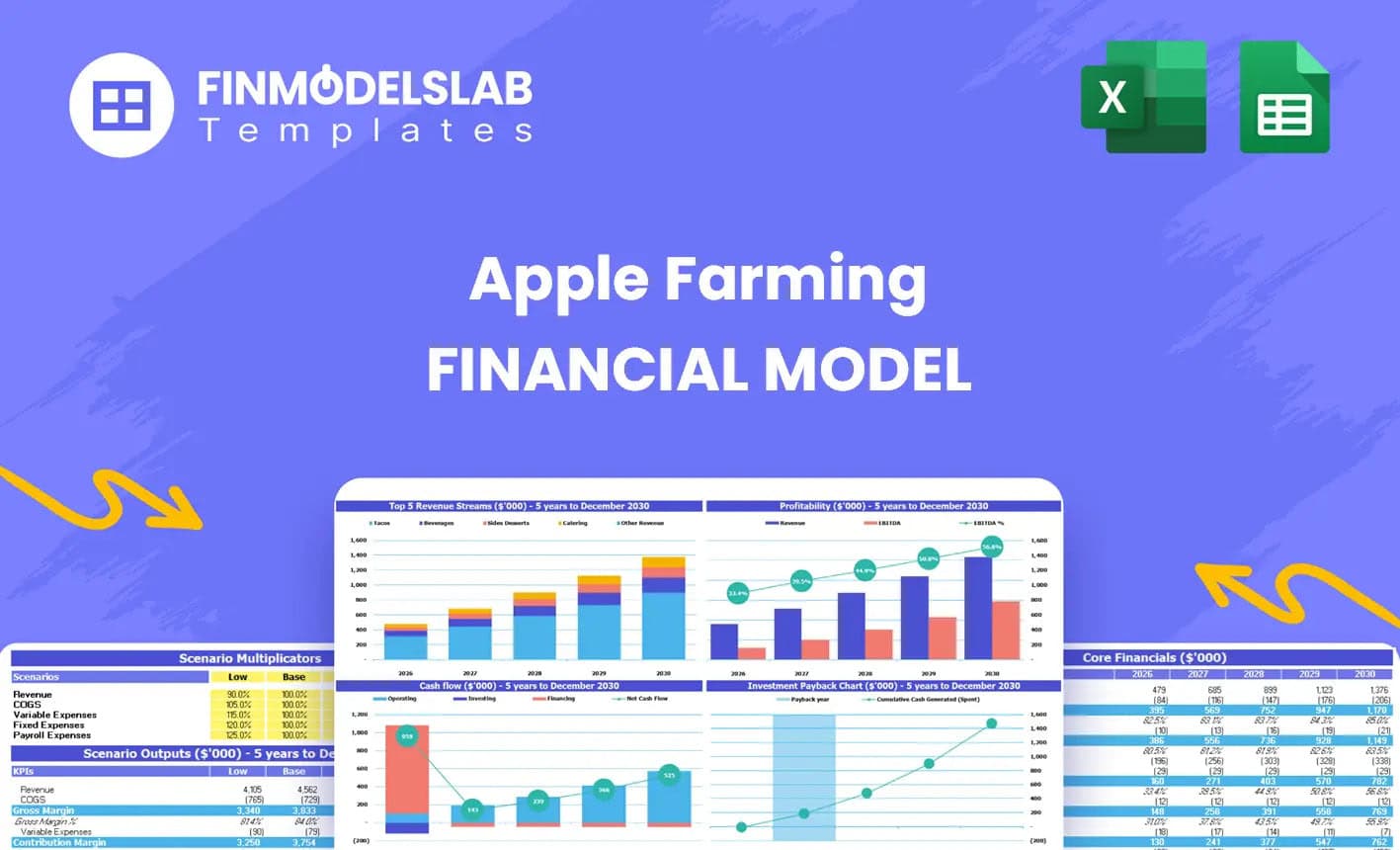
Apple Farming Financial Model Excel Template
The Apple Farming Financial Model helps users turn an orchard business plan into a structured, edita... Read more
 Andreas
Olive Orchard Business – DCF 10-Year Financi...
The Olive Orchard Financial Model is a comprehensive tool tailored to analyze the financial aspects ... Read more
 Luigi R.
Financial Model for AGROINDUSTRY
The financial model I have built contains all the advanced corporate finance concepts referring to a... Read more

 Giorgos
Crop Farm Financial Model – Dynamic 10 Year Fore...
If you want to start a crop farm from scratch or you need a sample crop farm business plan template,... Read more
 eFinancialModels
Avocado Farm Financial Model
Our Excel financial model template for avocado farming is the perfect tool for investors and entrepr... Read more
Fruit Processing Facility – 10 Year Financia...
Financial Model providing a dynamic up to 10-year financial forecast for a startup Fruit Processing ... Read more
You must log in to submit a review.