0 ITEMS

Financial Model Cost: Template vs Managed Service Pricing

A financial model costs anywhere from the price of a ready-made template to a multi-thousand-dollar managed build, and the gap is mostly a trade of cash for time and expertise. A side-by-side comparison of price, build time, expertise and payback shows which option fits a given team.
Key Takeaways
- A template costs the least in cash, but the buyer supplies the adaptation time and the finance judgment.
- A freelance modeler sits in the middle, priced per project or per hour, with quality that depends on the person hired.
- On typical published ranges, which overlap, a managed service costs the most and suits complex, investor-facing models that need an accountable team.
- Total cost is the price plus the hours spent adapting, checking and correcting the model, not the sticker price alone.
- Any inherited or purchased model needs an error check, because a 2024 literature review reported errors in most spreadsheets used for business decisions.
A Template Costs the Least, a Managed Build the Most
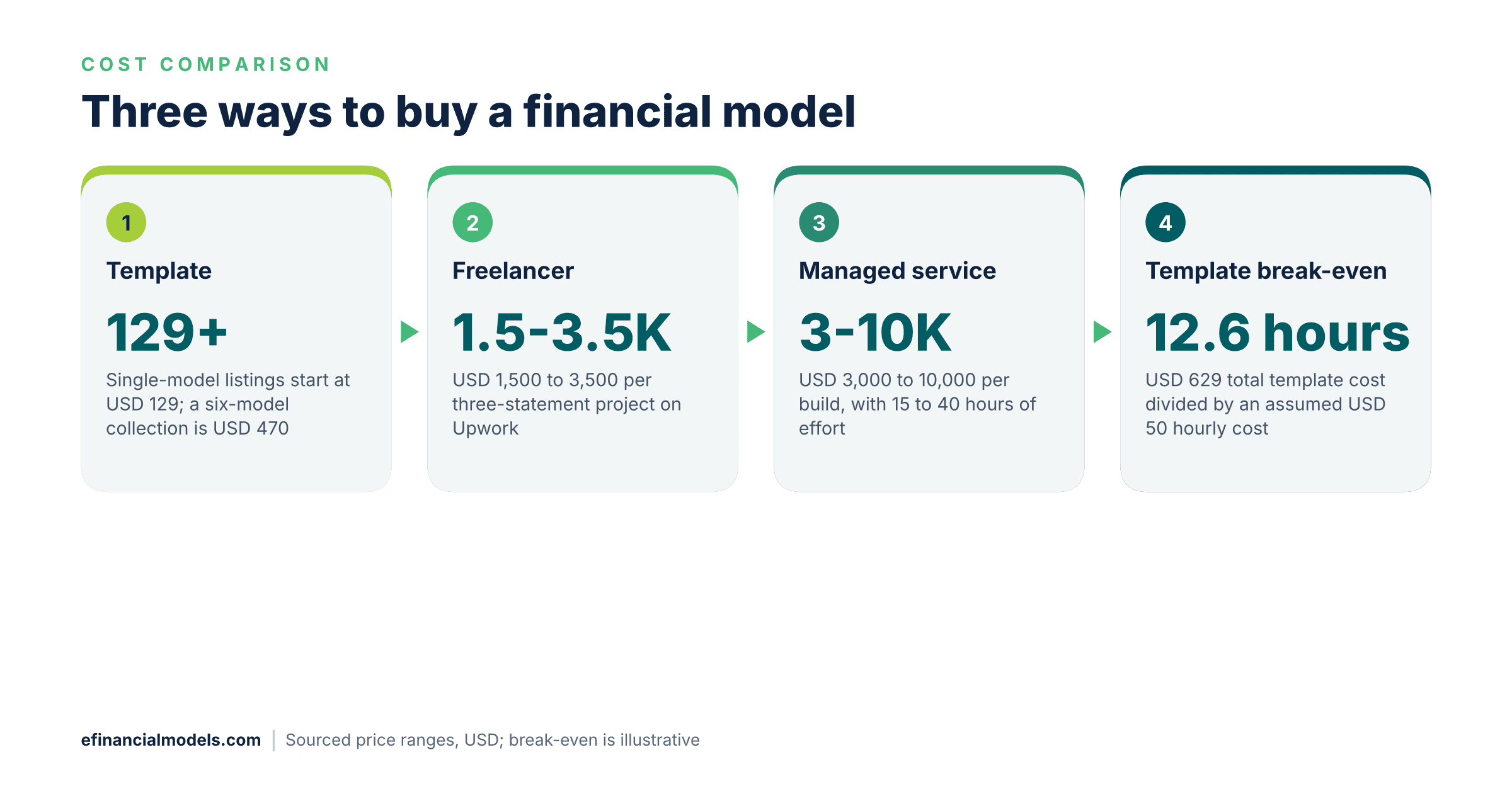
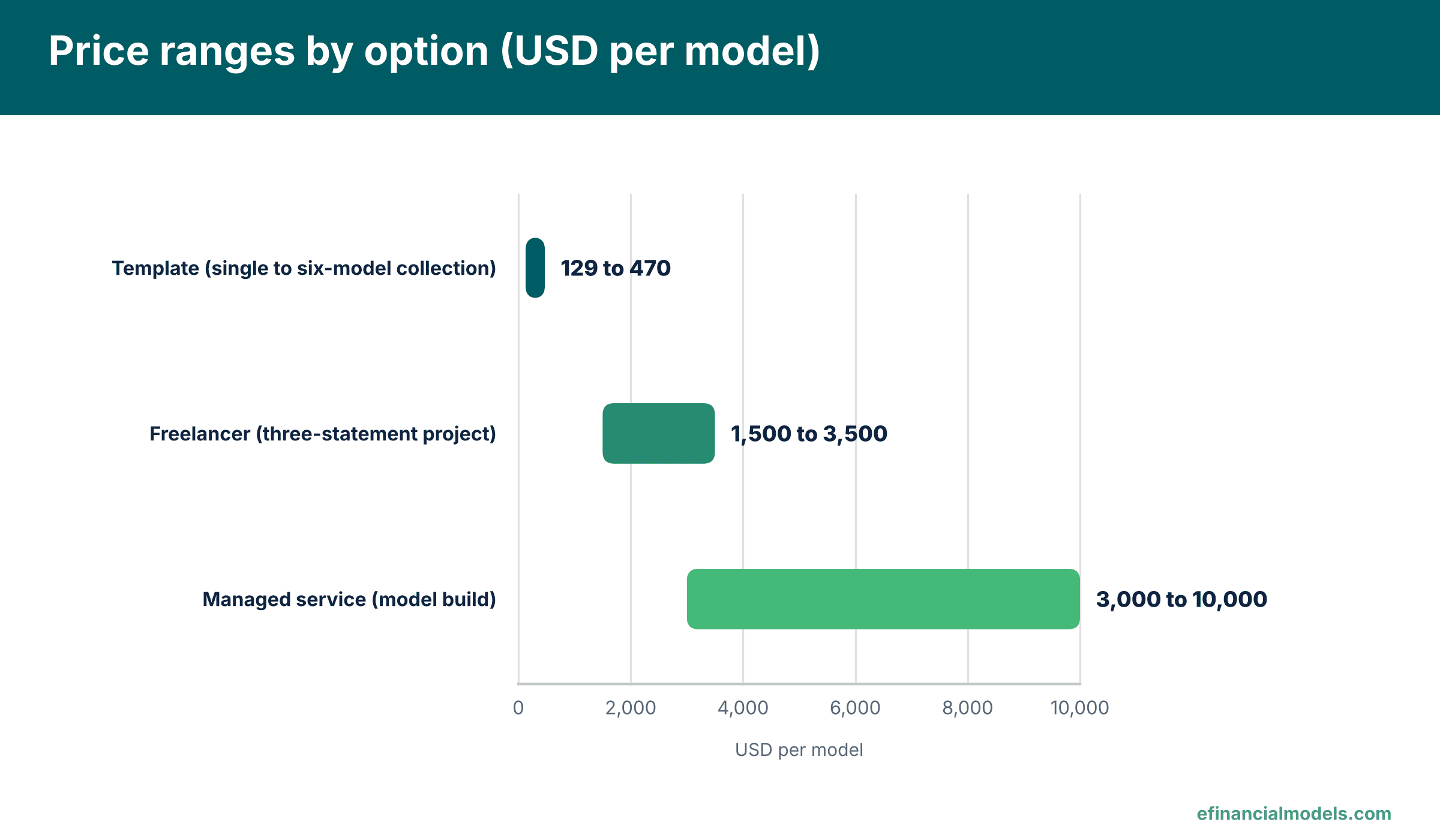
On typical published ranges, which overlap at the edges, a template is the cheapest way to buy a financial model, a freelancer costs more, and a managed service costs the most. All prices are in US dollars, the template prices exclude tax, and the Upwork guide states no geography. Listings in the e-commerce category on eFinancialModels start at USD 129 for a single model, and a collection of six online business models is priced at USD 470.
A freelancer builds a custom model for more. Upwork’s guide to hiring financial modelers lists a three-statement model for startups, which links the income statement, balance sheet and cash flow statement, at USD 1,500 to USD 3,500 per project (Upwork financial modelers guide). The same page says freelance financial modeling consultants on the platform typically charge USD 25 to USD 65 per hour, so a project quote reflects the hours behind it.
A managed service, where a firm owns scoping, build, review and handover, is priced as a one-time project. Planning software maker Jirav lists a one-time model build fee of USD 3,000 to USD 10,000 for accounting firms, covering initial three-statement model setup, data integration and assumption documentation, and says it covers 15 to 40 hours of effort (Jirav, April 2026). A modeling firm’s guide published in November 2026 gives a wider all-provider view: published startup model prices run from about USD 1,000 to USD 15,000, depending on who builds the model and how complex it is (Waveup, November 2026). That range covers freelancers and firms together, so it overlaps the freelancer and managed-service ranges in the table below and does not replace either. The firm sells modeling services itself, so the range reflects a vendor view.
Side-by-Side Comparison of the Three Options
Return on investment (ROI) is the net benefit of a purchase divided by its cost, so the last row compares one quantified ROI across all three options, measured against the cost of building the same model from scratch in house. The table uses the sourced ranges above. The 10-hour adaptation time and the from-scratch cost are assumptions explained in the worked example, and each build-time cell states its own basis because the sources measure time differently. The ranges cover startup and small-business models, so complex transaction or multi-entity models need a direct quote.
| Factor | Template | Freelance modeler | Managed service |
|---|---|---|---|
| Entry price and range | Start at USD 129 for a single model (an e-commerce category starting price, excluding tax) and USD 470 for a six-model collection (eFinancialModels) | USD 1,500 to USD 3,500 per project for a three-statement model for startups (Upwork) | USD 3,000 to USD 10,000 as a one-time fee for initial three-statement model setup, data integration and assumption documentation, for accounting firms (Jirav, 2026) |
| Hourly benchmark | Not applicable, one-time purchase | USD 25 to USD 65 per hour (Upwork) | Quoted per build, not per hour |
| Build time (basis stated) | About 10 hours of buyer effort to adapt (assumed) | Not stated in the cited guide, so it is fixed in the project brief | 15 to 40 hours of provider effort (Jirav, 2026) |
| Expertise required | An in-house analyst who can read and adjust formulas | A buyer who can write a clear brief and review the result | Scoping and sign-off only, with the firm supplying build and review |
| Illustrative ROI against a from-scratch build (worked example) | 138.47% | -11.76% | -51.61% |
Price Reflects Scope and Service, Not Formula Quality
The price gap comes from who carries the work. A template moves build effort to the buyer. A freelancer carries the build but usually not the review. A managed service adds scoping, documentation and a second pair of eyes, which is why its range sits highest.
Worked Example: Payback on a Template
This worked example compares the three options for a startup that needs a three-statement model. Every input below is an assumption for illustration, except the price ranges taken from the sources above.
Assumptions: internal analyst time costs USD 50 per hour. Building the same model from scratch in house would take 30 hours, a figure inside the 15 to 40 hours of effort Jirav cites, so it costs 30 x 50 = USD 1,500; this avoided cost is the benefit each option is measured against. Adapting a template takes 10 hours, reviewing a freelancer’s model takes 4 hours, and signing off a managed build takes 2 hours. All three options enter at the entry price of their range: USD 129 for the template, USD 1,500 for the freelancer and USD 3,000 for the managed service.
| Option | Price used (USD) | Internal hours | Internal cost (USD) | Total cost (USD) |
|---|---|---|---|---|
| Template | 129 | 10 | 500 | 629 |
| Freelance modeler | 1,500 | 4 | 200 | 1,700 |
| Managed service | 3,000 | 2 | 100 | 3,100 |
Calculation: the template total is 129 + (10 x 50) = 629. The freelancer total is 1,500 + (4 x 50) = 1,700, and the managed total is 3,000 + (2 x 50) = 3,100. The template is USD 1,071 cheaper than the freelancer (1,700 – 629) and USD 2,471 cheaper than the managed service (3,100 – 629).
ROI is the net benefit divided by the cost: (benefit – cost) / cost, where the benefit is the USD 1,500 from-scratch cost that each option avoids. Results are rounded to two decimal places. For the template it is (1,500 – 629) / 629 = 871 / 629 = 138.47%. For the freelancer it is (1,500 – 1,700) / 1,700 = -200 / 1,700 = -0.1176, or -11.76%, and for the managed service it is (1,500 – 3,100) / 3,100 = -1,600 / 3,100 = -51.61%. A negative ROI here means the option costs more than the from-scratch build it replaces. It does not value the review, accountability and speed that a freelancer or managed service adds, so it is one lens and not a verdict.
Building the same model from scratch would cost 50 x H, where H is the internal hours needed. Setting that equal to the template’s total cost of 629 gives the break-even hours: H = 629 / 50 = 12.58, or about 12.6 hours. The template therefore pays for itself only if building the same model from scratch would take more than about 12.6 hours, a threshold below the 15 to 40 hours of effort Jirav cites for a model build.
Matching the Option to the Situation
Spreadsheets remain the everyday planning tool: the CFO Connect Top CFO Tools Report 2026 found that 76% of surveyed finance leaders use spreadsheets for financial planning and analysis (Spendesk, October 2026). A template fits teams with an analyst who can adjust formulas and a standard business model, such as a restaurant or a solar project. The three-statement model tag groups models of that kind.
A freelancer fits a one-off custom need with a clear brief.
A managed service fits a model that others will rely on, such as a lender, an investor or a board. The extra cost buys documented assumptions, review and a handover that outlasts one person.
Errors Change the Real Cost of Any Option
An error found late costs more than any price difference above. A 2024 literature review of spreadsheet quality research, led by Pak-Lok Poon and reported by Phys.org, states that 94% of spreadsheets used in business decision-making contain errors (Phys.org, 2024). The report does not explain how the 94% was derived and covers spreadsheets in general, not purchased templates, so the figure signals risk rather than predicting the quality of one model. Every option therefore needs the same checks: a balance sheet that balances, totals that tie back to inputs and an independent read-through.
Conclusion
Template, freelancer and managed service are three prices for three different divisions of labor, and the cheapest sticker price wins only when the buyer has the hours and skill to finish the work. Teams that want to test the template route can start with the General Financial Model Bundle on eFinancialModels, a collection of general financial model templates that includes a valuation model, a payback period calculator and a simple budget planner.
Frequently Asked Questions
Which option is cheaper over a model’s whole life?
Lifetime cost depends on how often assumptions change. A template keeps updates cheap because the owner already understands the structure, while a custom build can require paid changes each time the business adds a product line or funding round. A model nobody can explain becomes expensive once the builder leaves. Buyers should ask who maintains the file, and what a later change would cost, before comparing upfront prices alone.
Can a freelancer customize a purchased template?
Yes, and this hybrid is common. The buyer purchases a template that matches the industry, then hires a modeler for a few hours to add a funding layer, a regional tax rule or a scenario switch. The result is usually cheaper than a full custom build because the revenue logic and layout already exist, so the freelancer only adds the missing pieces. The buyer should agree the scope in writing.
What should a buyer ask for before hiring a modeler?
A buyer should ask for a sample model, a written scope listing inputs and outputs, the number of included revision rounds and delivery of the editable file with unlocked formulas. It also helps to ask how the modeler checks their own work, for example with a cell that confirms the balance sheet balances. Clear answers to these four points reveal more about quality than an hourly rate does.
Does a higher price mean a better model?
No. Price mostly reflects the scope of work and the service wrapped around it, such as review and documentation, not the number of formulas. The published ranges overlap, and a simple model from an expensive provider can serve a buyer worse than a well-structured template. Buyers should compare deliverables, such as scenarios included, documentation and support after handover, rather than treating the quote as a quality score.
How should a team check a purchased or custom model for errors?
Start with the built-in checks: the balance sheet should balance in every period and cash should reconcile to the cash flow statement. Then change one input at a time and confirm the outputs move in the expected direction. Finally, ask a colleague who did not build the file to trace a few key outputs back to their inputs, and keep a short written record of the checks.