
0 ITEMS

Product-Driven vs. Sales-Driven Marketing: Your Best Approach
Table of Content
- What Defines a Truly Product-Oriented Company?
- Understanding the Essence of a Sales-Oriented Company
- Product-Driven vs. Sales-Driven KPIs: Choosing the Right Metrics
- Mastering the Balance: When to Choose Product-Oriented vs. Sales-Oriented Marketing?
- Financial Modeling: The Key to Choosing Product-Driven vs. Sales-Driven Paths
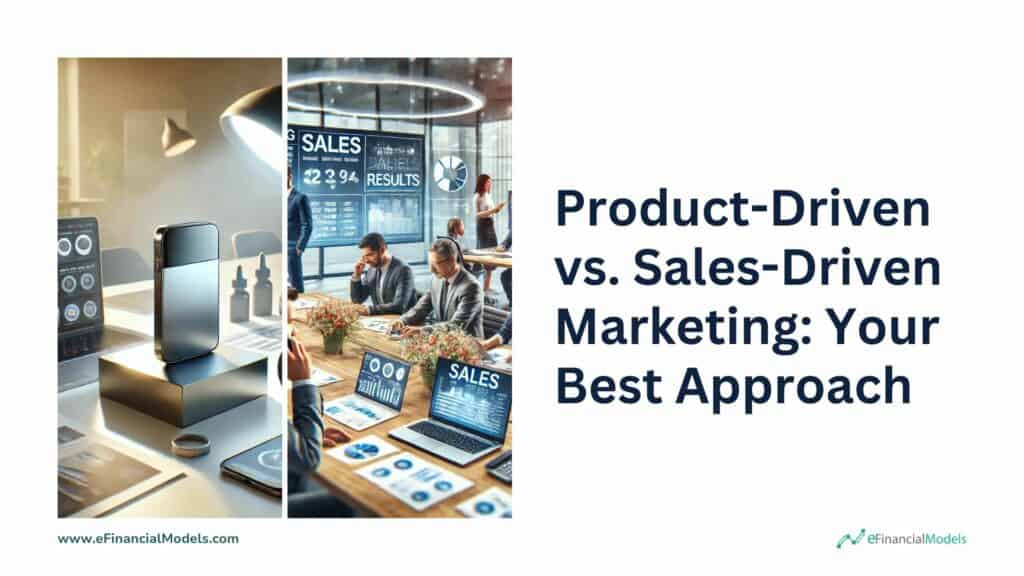
Understanding the difference between product-driven and sales-driven marketing helps clarify strategic priorities for growth.
- Product-oriented marketing emphasizes innovation, quality, and unique features to attract customers naturally.
- Sales-oriented marketing relies on aggressive sales tactics, promotions, and expanding market share quickly.
- Company goals, industry type, and available resources influence whether a product or sales approach is more effective.
- Key metrics like customer retention, churn rate, and customer lifetime value assess the long-term success of each strategy.
- Financial models, including break-even and scenario analysis, guide decisions on which path aligns best with business objectives.
Knowing when to focus on product excellence versus sales tactics can unlock sustained growth and competitive advantage.
What Defines a Truly Product-Oriented Company?
A product-oriented company is a business that prioritizes the development and refinement of its products above all other aspects, including customer preferences and market trends. These companies believe that by focusing on creating superior products, customers will naturally gravitate toward their offerings. In a product-oriented company, the emphasis is on innovation, quality, and technical excellence. This relentless pursuit of innovation, often driven by a strong belief in the product’s ability to meet customer needs, even if the market does not explicitly articulate those needs, can lead to ground breaking products. A product-driven company benefits from scalability, innovation, and enhanced customer satisfaction but may struggle with flexibility in meeting unique customer requirements.
Here are four notable examples of product-oriented companies across different industries:
- Apple is renowned for its product-oriented approach, consistently prioritizing innovation and design excellence in its line of products like the iPhone, Mac, and Apple Watch. Apple has built a loyal customer base and a strong brand identity by creating user-centric products with seamless integration across its ecosystem.
- Nike exemplifies a product-oriented strategy by developing cutting-edge athletic footwear, apparel, and equipment to enhance performance and appeal to athletes and fitness enthusiasts. Through continuous innovation in materials and technology, Nike maintains its position as a leader in the sportswear industry.
- Sony‘s product-oriented approach is evident in its diverse range of high-quality electronics, such as PlayStation consoles, Bravia TVs, and audio equipment. By emphasizing technological advancements and superior craftsmanship, Sony has established itself as a trusted brand in the global consumer electronics market.
- Tesla has always focused on innovation, sustainability, and superior product design. The company prioritizes the development of high-performance electric vehicles that offer a unique blend of luxury, advanced technology, and environmental consciousness. This product-driven marketing strategy disrupted the traditional automotive market and positioned Tesla as a leader in the global shift toward sustainable transportation.
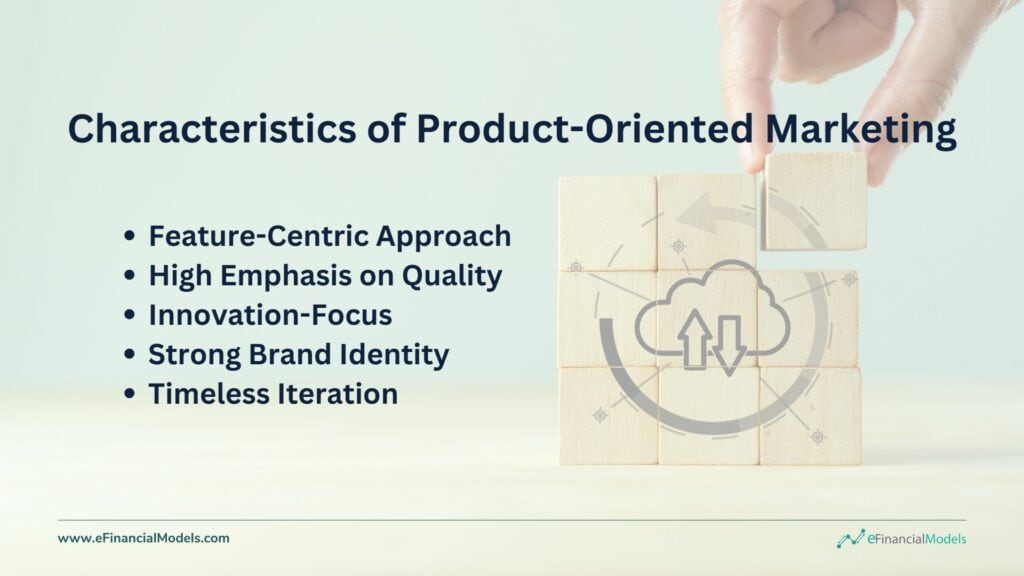
Characteristics of Product-Oriented Marketing
Product-oriented marketing focuses on promoting the product itself as the centerpiece of a company’s strategy. This approach emphasizes the unique qualities and features of the product, positioning it as the primary driver of customer interest and loyalty. Companies that employ product-driven marketing aim to build a strong reputation around their product offerings, often leveraging product excellence and innovation as key selling points. The marketing efforts are designed to highlight how the product stands out in the market, emphasizing the product’s superiority in meeting customer needs.
- Feature-Centric Approach: In a feature-centric approach, the marketing strategy revolves around the specific features and functionalities of the product. This approach appeals to customers looking for particular capabilities or benefits the product offers. Marketers using a feature-centric approach focus on detailing and showcasing the product’s unique aspects that solve a specific problem or meet a particular demand in the market. This strategy is particularly effective in industries where technological advancements or product specifications play a crucial role in consumer decision-making.
- High Emphasis on Quality: A high emphasis on quality is a hallmark of product-oriented marketing, where the focus is on ensuring that the product meets the highest standards of excellence. Companies that prioritize quality in their marketing strategies are committed to delivering products that not only meet but exceed customer expectations. The marketing message often highlights the meticulous attention to detail, rigorous testing, and superior materials used in the production process. This emphasis on quality helps build customer trust and credibility, fostering long-term loyalty and brand advocacy.
- Innovation-Focused Development: Innovation is a critical driver in product-oriented marketing, where the development of new and improved products is central to the company’s success. Companies focusing on innovation aim to stay ahead of the competition by continuously introducing cutting-edge products offering new features, better performance, or enhanced user experiences. The marketing strategy emphasizes the company’s commitment to pushing the boundaries of what is possible, positioning its products as the most advanced and forward-thinking in the market. This approach appeals to customers who value innovation and are looking for the latest and most excellent products.
- Strong Brand Identity: A strong brand identity is crucial in product-oriented marketing, where the product becomes synonymous with the brand. Companies that succeed in this approach create a clear and consistent brand image that reflects their products’ values, quality, and innovation. The brand identity is built around the product’s unique characteristics, and the marketing efforts reinforce this identity across all channels. A strong brand identity helps to differentiate the product in a crowded market, making it easier for customers to recognize and trust the brand.
- Timeless Iteration: Timeless iteration refers to the ongoing process of refining and improving the product over time. In product-oriented marketing, companies are committed to continuously iterating on their products, incorporating feedback, and making incremental improvements to maintain their competitive edge. This approach ensures the product remains relevant and appealing to customers, even as market conditions and consumer preferences change. Timeless iteration allows companies to build a loyal customer base that appreciates the consistent enhancement of the product, leading to sustained success in the market.
Understanding the Essence of a Sales-Oriented Company
A sales-oriented company primarily drives revenue through effective sales strategies and operations. It prioritizes aggressive sales strategies to drive revenue growth, focusing mainly on pushing its products or services into the market. The primary goal of a sales-oriented company is to increase sales volume, often through extensive advertising, promotional campaigns, and direct sales tactics, sometimes with less emphasis on customer needs or market demand. The success of a sales-oriented company is typically measured by the quantity of products sold rather than customer satisfaction or long-term relationships. This approach can lead to short-term gains, but it may risk customer loyalty if the underlying needs and preferences of the market are not adequately addressed.
Here are three notable examples of sales-oriented companies across different industries:
- Adidas focuses heavily on pushing its products through extensive promotional activities, sponsorship deals, and solid branding. The company often uses high-profile endorsements and global campaigns to boost sales and brand visibility.
- Panasonic is a global player in the consumer electronics market. The company employs robust sales strategies, including aggressive marketing and diverse product lines, to maintain its position in the market.
- Samsung, a company known for its diverse range of consumer electronics, attracts customers through its competitive pricing strategy. The company aggressively markets its products and prioritizes market share growth through strategic global distribution.
- Since the days of the Model T, Ford has focused on producing vehicles that appeal to the mass market, ensuring affordability and availability to a broad audience. The company’s strategy has often centered on aggressive marketing, competitive pricing, and a strong dealership network that prioritizes sales efficiency. Ford’s ability to adapt its sales-oriented marketing strategies to meet changing consumer demands and its commitment to maintaining a robust salesforce has been crucial to its enduring presence in the automotive industry.
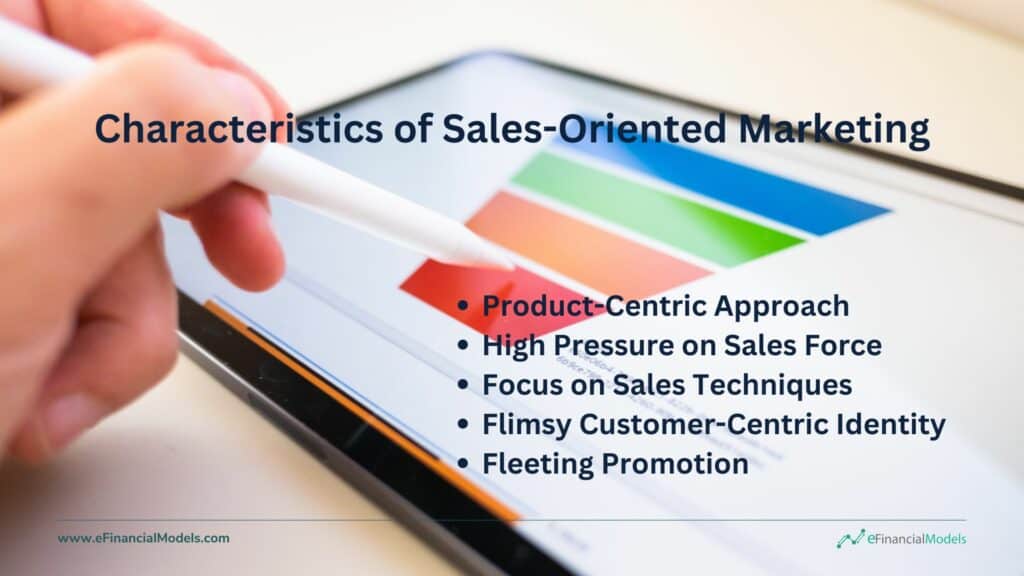
Characteristics of Sales-Oriented Marketing
Sales-oriented marketing prioritizes short-term sales volume and revenue generation over long-term customer relationships or product innovation development. The primary objective is to drive immediate sales through aggressive tactics and strategies to persuade customers to purchase. This approach is typically employed in highly competitive markets or in industries where achieving sales targets is paramount. The marketing efforts are centered around convincing potential customers to buy, rather than focusing on the intrinsic value or quality of the product itself.
- Product-Centric Approach: In a product-centric approach within sales-oriented marketing, the emphasis is placed on selling the product, often without substantial regard for customer needs or preferences. The product is viewed as a commodity that needs to be moved quickly, and the marketing strategy is designed to highlight the product’s features and benefits in a way intended to close sales rapidly. This approach often overlooks the broader context of how the product fits into the customer’s life, focusing instead on pushing the product into the market as efficiently as possible.
- High Pressure on Sales Force: Sales-oriented marketing places significant pressure on the sales force to meet and exceed sales targets. Sales teams are often incentivized through commissions, bonuses, and other rewards to drive as many sales as possible within a given timeframe. This high-pressure environment can lead to aggressive sales tactics, such as upselling, cross-selling, or hard selling, where the primary focus is on closing deals rather than building lasting customer relationships. The effectiveness of this approach is measured by the ability of the sales force to convert leads into sales quickly.
- Focus on Sales Techniques: The focus on sales techniques is a defining characteristic of sales-oriented marketing. Companies invest heavily in training their sales teams on various selling methods, including persuasive communication, negotiation skills, and closing strategies. The marketing strategy is heavily geared toward equipping the sales force with the tools and techniques to overcome objections and persuade customers to purchase. While this approach can lead to high sales volumes in the short term, it often does so at the expense of building deeper customer loyalty or brand equity.
- Flimsy Customer-Centric Identity: In sales-oriented marketing, the customer-centric identity often needs to be more superficial or flimsy. While the outward messaging may claim to prioritize the customer, the underlying strategy is more focused on achieving sales targets than genuinely understanding or addressing customer needs. This approach can lead to a disconnect between the company and its customers, as the focus on selling overshadows the importance of creating value for the customer. Over time, this can result in customer dissatisfaction and reduced loyalty, as customers may feel they are being treated as mere transactions rather than valued partners.
- Fleeting Promotion: Fleeting promotion is a common tactic in sales-oriented marketing, where short-term promotional campaigns are used to drive immediate sales spikes. These promotions, such as discounts, limited-time offers, or flash sales, are designed to create a sense of urgency and prompt quick purchases. While effective in generating short-term revenue, fleeting promotions can sometimes undermine the perceived value of the product or brand, leading customers to wait for the next sale rather than purchasing at the total price. Additionally, this approach can create a cycle of dependency on promotions to sustain sales momentum, making it easier for companies to maintain consistent revenue with constant promotional efforts.










































Product-Driven vs. Sales-Driven KPIs: Choosing the Right Metrics
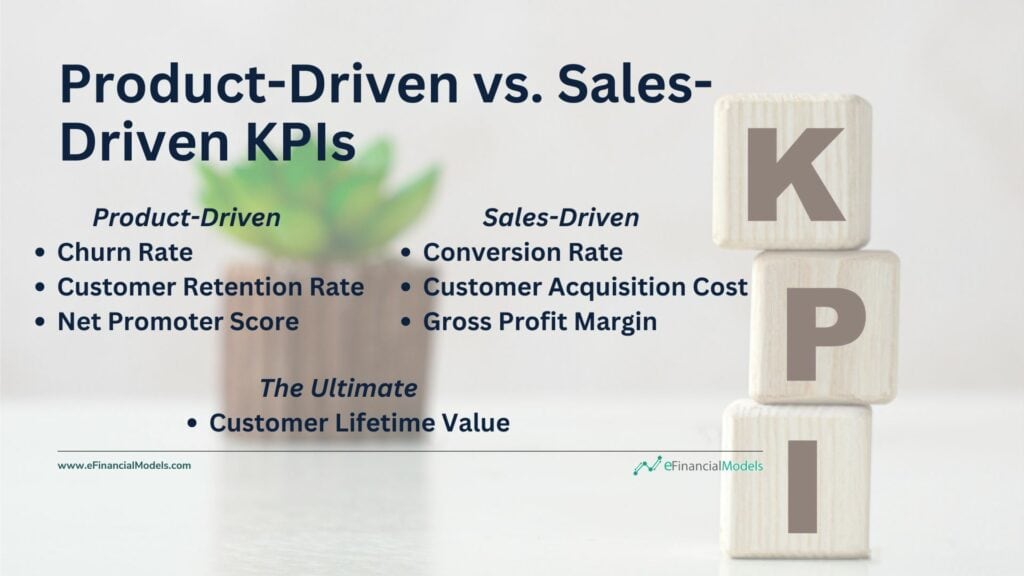
In the dynamic business world, understanding the distinction between product-driven and sales-driven key performance indicators (KPIs) is crucial for aligning a company’s strategy with its long-term objectives. Product-driven KPIs focus on quality, innovation, and customer satisfaction. In contrast, sales-driven KPIs concentrate on revenue generation, sales growth, and market penetration.
Product-Driven KPIs Propel Company Goals
Product-driven KPIs focus on the performance and success of a company’s products. These metrics measure how well a product meets customer needs, market penetration, and overall contribution to the company’s goals. They help companies understand how their products are performing in the market and guide decisions on product development, marketing strategies, and customer support.
- Churn Rate is a critical metric measuring the percentage of customers who stop using a company’s product or service over a period. It is essential for subscription-based businesses, where retaining customers is crucial for long-term success. A high churn rate can indicate dissatisfaction with the product, pricing issues, or better offers from competitors. By tracking churn rate, companies can identify and address why customers leave, improving retention and sustained revenue growth. Churn rate directly influences a company’s ability to achieve long-term goals by highlighting customer retention and satisfaction.
- Customer Retention Rate is a KPI that measures the percentage of customers who continue to use a product or service over a specific period. This metric is vital for understanding customer loyalty and the long-term viability of a business. A high customer retention rate indicates that customers are satisfied with the product and are less likely to switch to a competitor. Improving customer retention is often more cost-effective than acquiring new customers, making this metric a key focus for many businesses. Customer retention rate drives company goals by emphasizing the importance of maintaining a loyal customer base.
- Net Promoter Score (NPS) is a popular KPI that measures customer satisfaction and loyalty by asking customers how likely they are to recommend the product or service to others. The score is calculated by subtracting the percentage of unhappy customers from the rate of happy customers. NPS is widely used because it provides a straightforward indicator of customer sentiment and can strongly predict future growth. Companies use NPS to gauge overall customer satisfaction and identify areas for improvement in their products and services. Net Promoter Score drives company goals by measuring customer loyalty and advocacy, which is essential for sustainable growth.
Sales-Driven KPIs Boost Company Revenues
Sales-driven KPIs measure the effectiveness and efficiency of a company’s sales efforts. They provide insights into sales performance and the overall health of the sales pipeline. By tracking these KPIs, businesses can identify areas of strength and weakness, enabling them to make informed decisions to optimize their sales processes and improve revenue generation.
- The conversion rate, a pivotal sales-driven KPI, measures the percentage of prospects or leads that take a desired action, such as making a purchase or signing up for a service, out of the total number of prospects or leads. This metric is of utmost importance as it serves as a litmus test for the effectiveness of a company’s sales tactics and marketing efforts in turning potential customers into actual customers. A higher conversion rate generally reflects successful sales and marketing strategies, while a lower conversion rate may signal the need for improvements in targeting, messaging, or the sales process. Businesses often focus on optimizing their conversion rate to maximize the return on investment (ROI) from their marketing and sales activities. Optimizing the conversion rate directly boosts company revenues by turning potential leads into paying customers more efficiently.
- Customer Acquisition Cost (CAC) is a sales-driven KPI that represents the total cost a company incurs to acquire a new customer. This metric includes all expenses related to marketing, advertising, sales efforts, and any other costs directly associated with bringing in new customers. Customer acquisition cost is a critical measure of efficiency and profitability, as it helps businesses understand how much they spend to grow their customer base. A lower CAC indicates that the company is acquiring customers more cost-effectively, while a higher CAC might suggest that the current acquisition strategies need to be reevaluated. Lowering customer acquisition cost boosts company revenues by maximizing profitability from each new customer gained.
- The Gross Profit Margin, a key financial metric, and a significant sales-driven KPI, indicates the percentage of revenue that exceeds the cost of goods sold (COGS). It is calculated by subtracting COGS from revenue, divide by revenue, and multiply by 100 for the percentage. As a sales-driven KPI, Gross Profit Margin plays a crucial role in revealing how efficiently a company is producing and selling its goods or services relative to the costs incurred. A higher gross profit margin suggests that the company is generating substantial profit from its sales activities, which can be reinvested in the business to drive further growth. Conversely, a lower margin may indicate rising production costs or pricing pressures, signaling the need for a review of pricing strategies or cost management practices. Improving gross profit margin boosts company revenues by increasing the profitability of each product or service sold.
Customer Lifetime Value: The Ultimate Product-Driven vs. Sales-Driven KPI
Customer Lifetime Value (CLV) is the ultimate KPI when comparing product-driven and sales-driven strategies. In a product-driven approach, CLV delivers long-term value through exceptional product quality, fostering customer loyalty and repeat purchases. Conversely, in a sales-driven strategy, CLV emphasizes optimizing sales tactics to maximize the profitability of each customer over time, often through targeted upselling and cross-selling efforts. By understanding and leveraging customer lifetime value, companies can effectively balance these approaches, ensuring that product innovation and sales effectiveness contribute to sustainable revenue growth.
As a product-driven KPI, CLV is pivotal in propelling company goals by emphasizing the importance of long-term customer relationships. By focusing on enhancing the overall customer experience and delivering superior product quality, businesses can increase the value each customer brings over their lifetime. This approach not only fosters customer loyalty but also drives repeat purchases and word-of-mouth referrals, which are critical for sustainable growth.
As a sales-driven KPI, CLV significantly boosts company revenues by focusing on strategies that maximize the profitability of each customer over time. By prioritizing CLV, businesses can develop targeted retention programs, upselling, and cross-selling opportunities that enhance the overall revenue generated from each customer. This approach increases immediate sales and extends the customer’s relationship with the company, leading to more frequent purchases and higher spending. As a result, companies can achieve a more robust and predictable revenue stream, driving long-term financial success.
Mastering the Balance: When to Choose Product-Oriented vs. Sales-Oriented Marketing?
Finding the right balance between product-oriented and sales-oriented marketing is crucial for sustainable growth. Companies must navigate the delicate intersection where product excellence meets strategic sales efforts, ensuring that neither outshines the other. Mastering this balance allows businesses to attract and retain customers and build a robust brand reputation. Companies can create a cohesive strategy that drives long-term success and market leadership by carefully choosing when to focus on product innovation and when to amplify sales tactics.
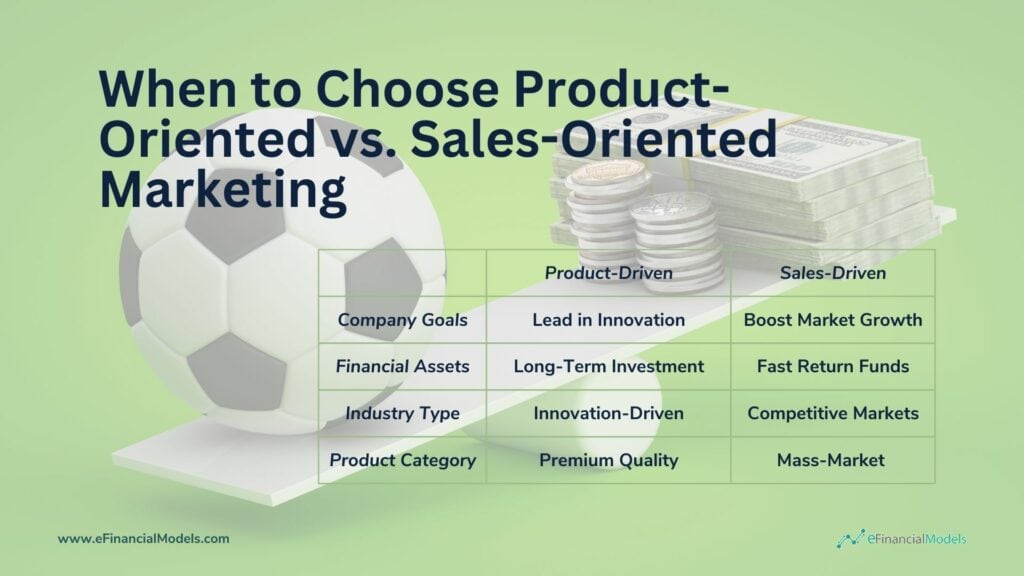
- Company Goals: A company’s goals are crucial when choosing between product-oriented and sales-oriented marketing. A product-oriented approach is more suitable if the company’s primary objective is to establish itself as a leader in innovation and quality. This strategy focuses on creating superior products that naturally attract customers through their inherent value. Conversely, a sales-oriented strategy might be preferred if the company aims to rapidly increase market share, drive revenue growth, or expand into new markets. This approach emphasizes aggressive sales tactics, promotions, and customer acquisition to meet immediate financial targets.
- Financial Assets: Financial assets are a significant factor in the decision-making process between product-oriented and sales-oriented marketing. A product-oriented approach typically demands a substantial investment in research and development, product design, and quality control. Companies with ample financial resources can afford to prioritize this strategy, as it promises a longer-term payoff. Conversely, companies with limited financial assets may find a sales-oriented approach more feasible, as it can yield quicker returns on investment. This strategy might involve allocating funds to sales teams, advertising campaigns, and customer incentives, with a focus on short-term revenue generation.
- Industry Type: The type of industry a company operates in is a major determinant in the choice between product-oriented and sales-oriented marketing. In industries where technological innovation and product differentiation are key drivers of success—such as consumer electronics or automotive—a product-oriented marketing approach is often more effective. Here, customers are willing to pay a premium for cutting-edge products. However, in highly competitive or commoditized industries, like retail or telecommunications, where many similar products exist, a sales-oriented marketing strategy may be more appropriate. In these industries, the focus is on pricing, sales volume, and customer retention, with less emphasis on the product itself.
- Product Category: The category of the product also dictates the marketing strategy. A product-oriented approach is usually preferred for high-end or luxury products, as these products rely on their quality, exclusivity, and brand reputation to attract customers. Marketing efforts highlight the unique features and craftsmanship that justify a higher price point. In contrast, a sales-oriented approach is often more effective for mass-market or fast-moving consumer goods. These products are generally lower priced and rely on high sales volumes to be profitable. The marketing strategy focuses on widespread distribution, competitive pricing, and promotional offers to drive sales.
Financial Modeling: The Key to Choosing Product-Driven vs. Sales-Driven Paths
Choosing between product-driven vs. sales-driven paths hinges on your company’s strengths, long-term goals, and market position. A product-driven strategy is ideal for businesses with innovative, high-quality products that can create demand, often leading to strong brand loyalty and organic growth. Conversely, a sales-driven strategy maximizes revenue through aggressive sales tactics and market penetration, making it suitable for highly competitive industries where market share is vital. Ultimately, the best approach depends on carefully assessing your business model, resources, and the market landscape, ensuring alignment with your overall strategic vision for sustained success.
Several financial models are recommended to assess effectively whether a product-driven or sales-driven path is best for your business. A break-even analysis can help determine the sales volume needed to cover costs under each strategy, highlighting which approach could reach profitability faster. Scenario analysis allows you to model different market conditions, testing how product innovation versus aggressive sales tactics would perform under various circumstances. Discounted cash flow (DCF) models are crucial for understanding long-term profitability from customer retention, especially when comparing the impact of product quality versus sales efforts. A sensitivity analysis can also reveal how changes in key variables, like pricing or sales volume, affect overall financial outcomes. You can make informed, data-driven decisions to guide your strategic direction by leveraging these models.
Financial modeling determines whether a product-driven or sales-driven path is best for your business. By analyzing critical financial metrics, forecasting outcomes, and evaluating various scenarios, financial modeling provides a clear, data-driven foundation for making strategic decisions. It enables you to understand the potential impact of each approach on profitability, growth, and sustainability, ensuring that your choice aligns with your business goals. Ready to unlock the full potential of your business strategy? Start integrating financial modeling into your decision-making process today!











































You might also like:
- 10 Ideas to Increase Average Revenue Per User
- 5 Practical Tips to Help Raise Funds For Startups
- 12 Funding Sources for Businesses and Startups
- How to Make a Startup Financial Plan for Fundraising?
- How to Value a Business Using a Discounted Cash Flow Model
- Financial Model Templates Easy to Use
- Understanding Insurance Policies: A Beginner’s Guide
- Understanding the Debt Service Coverage Ratio: An Essential Metric for Financial Analysis
- Accounting
- Marketing Agencies
- Campaign
- Business Valuation
- How to Prepare a Financial Feasibility Study?
- Cash Flow Analysis
- Airbnb
- Scenario Analysis
- Top 5 Tips For a Good Financial Due Diligence
- Food & Beverages
- What is a business valuation model?
- Financial Ratios Cheat Sheet
Tags: Business Strategy