
0 ITEMS

Solar + BESS Hybrid Project Finance Model Excel – 30-Year Forecast, IRR, DSCR, LCOE & LCOS
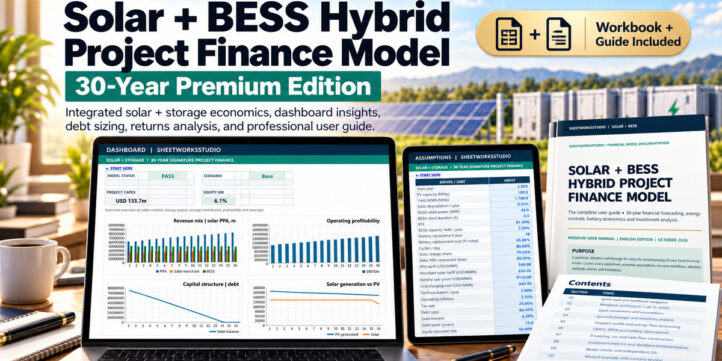
30-year Solar PV + BESS Excel project finance model with annual energy forecasts, PPA and merchant revenue, storage charging economics, CAPEX, debt, DSCR, project/equity IRR, NPV, LCOE, LCOS, four scenarios and eight dashboard charts. Includes a 17-page PDF guide.

30-Year Excel Financial Forecast | Solar PV Production | Battery Storage | Debt & Investment Returns
Evaluate hybrid renewable energy investments through one integrated, fully editable Excel financial model.
The Solar + BESS Hybrid Project Finance Model by SheetworksStudio connects solar generation, battery energy storage, electricity revenues, project costs, financing and investment returns within a structured 30-year financial forecast.
Designed for renewable energy developers, independent power producers, infrastructure investors and project finance professionals, the model supports preliminary investment feasibility, financing analysis, commercial scenario evaluation and long-term project planning.
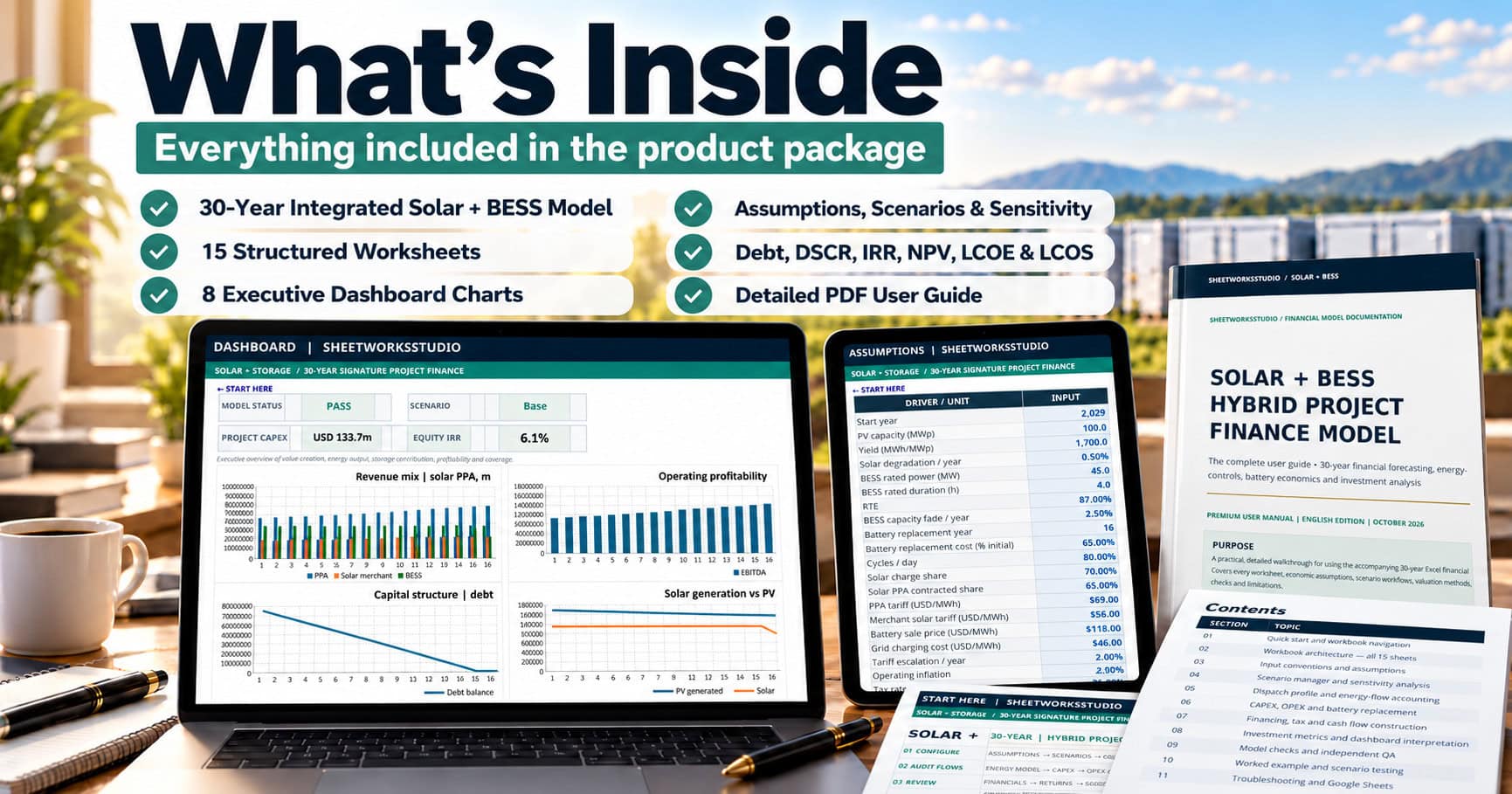
The complete package includes 15 integrated Excel worksheets, eight native executive dashboard charts, four financial scenarios and a professional 17-page PDF user guide.
📊 EXECUTIVE DASHBOARD & INVESTMENT PERFORMANCE
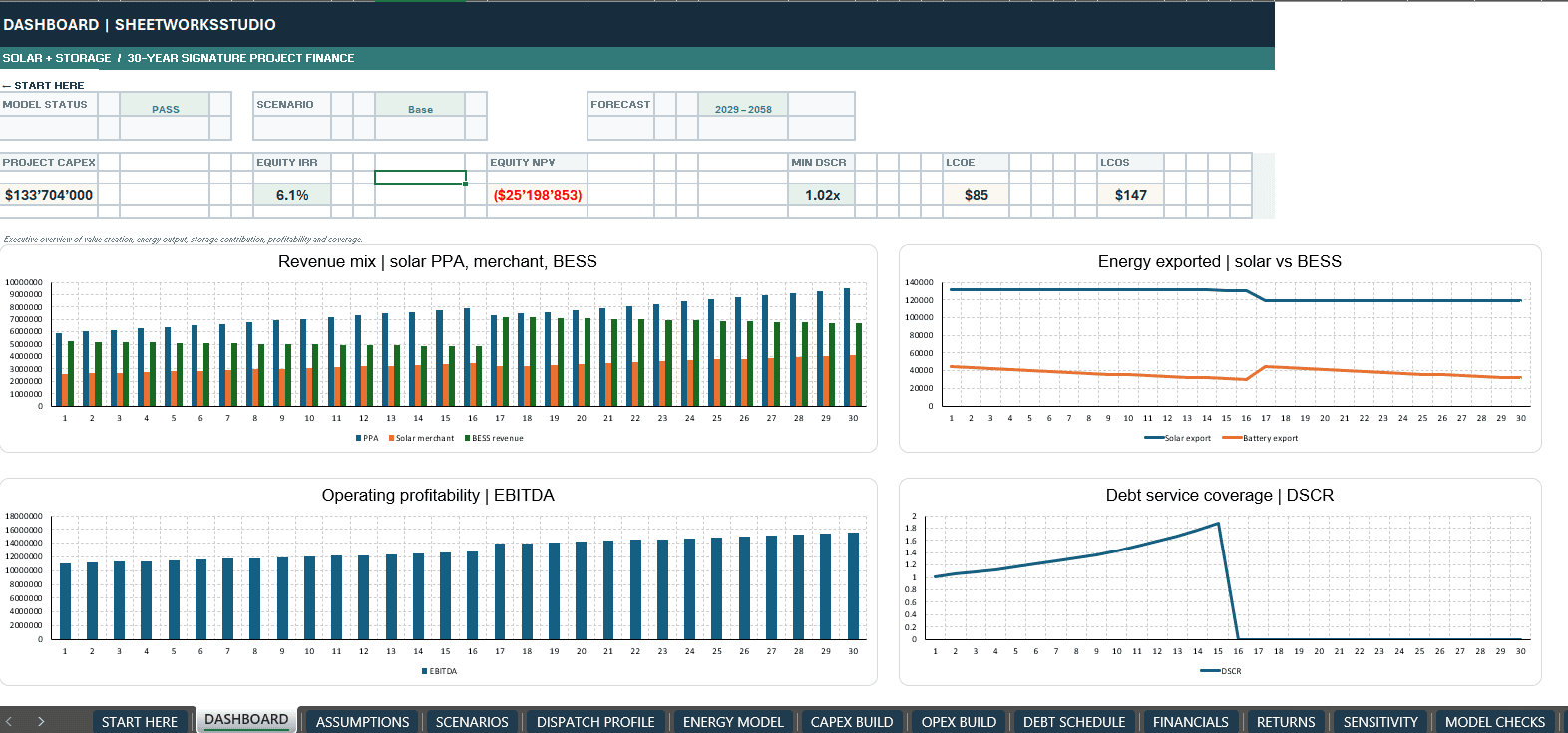
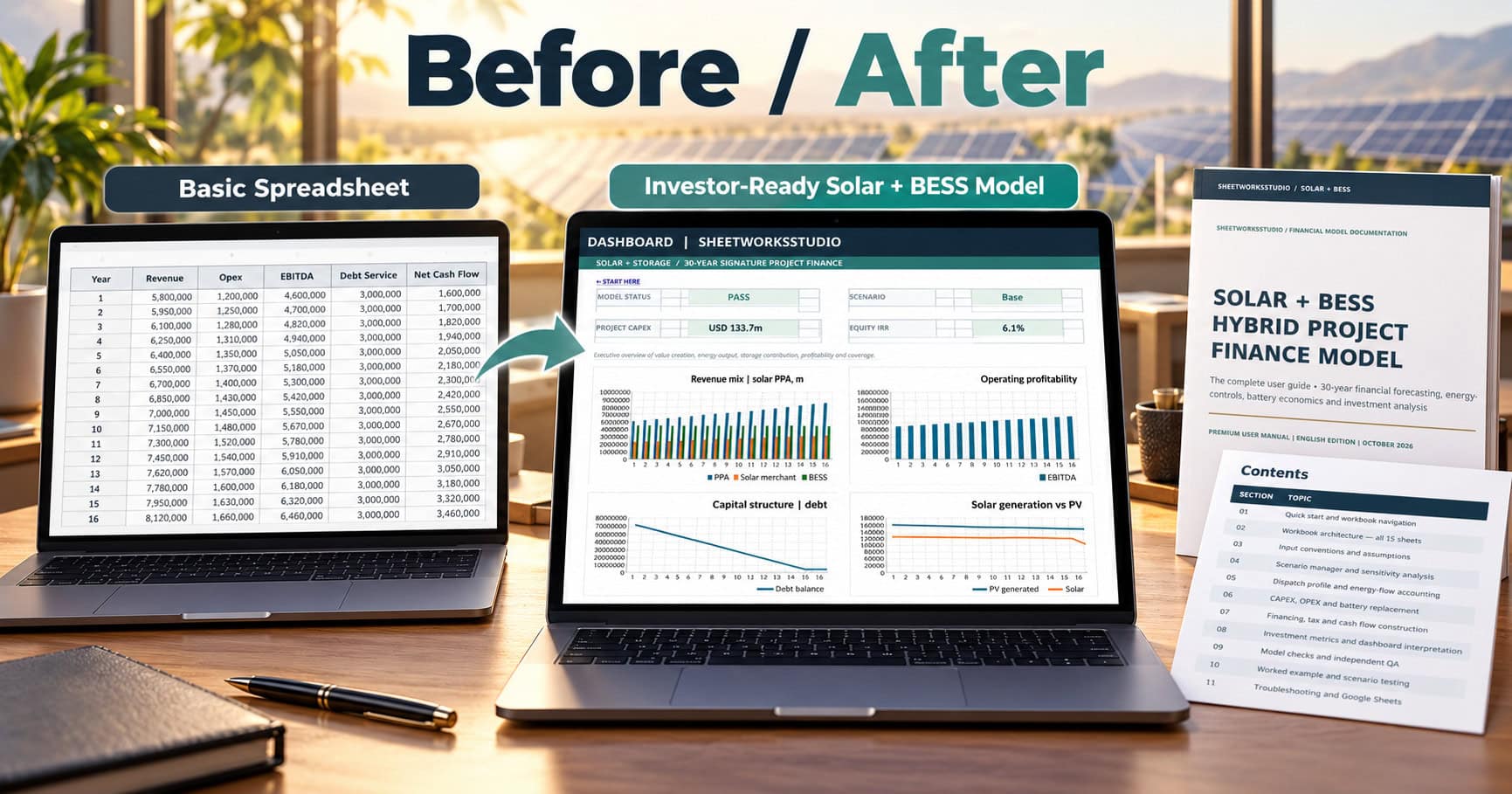
The Executive Dashboard provides a consolidated view of hybrid energy project economics.
Key investment indicators include:
- Initial Project CAPEX
- Project Internal Rate of Return (IRR)
- Equity Internal Rate of Return (IRR)
- Equity Net Present Value (NPV)
- Minimum Active-Year Debt Service Coverage Ratio (DSCR)
- Levelized Cost of Energy (LCOE)
- Levelized Cost of Storage (LCOS)
- Selected Financial Scenario and Model Status
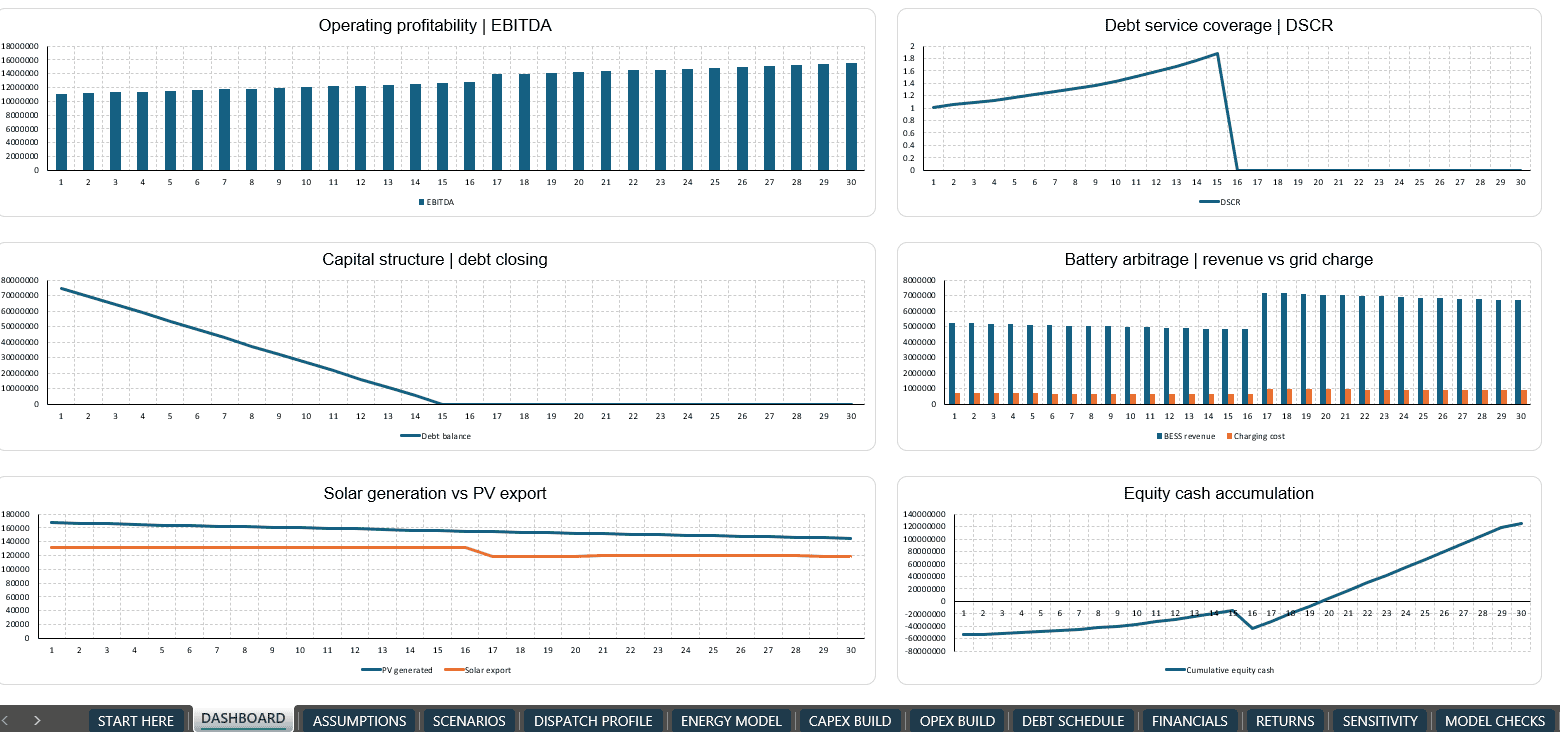
Eight dynamically linked Excel charts visualize project revenue, electricity exports, operating profitability, debt balances and other relevant financial and technical trends.
Dashboard outputs are linked to the underlying model and respond to changes in assumptions.
⚡ SOLAR PV & BATTERY ENERGY MODELING
Solar PV Operations
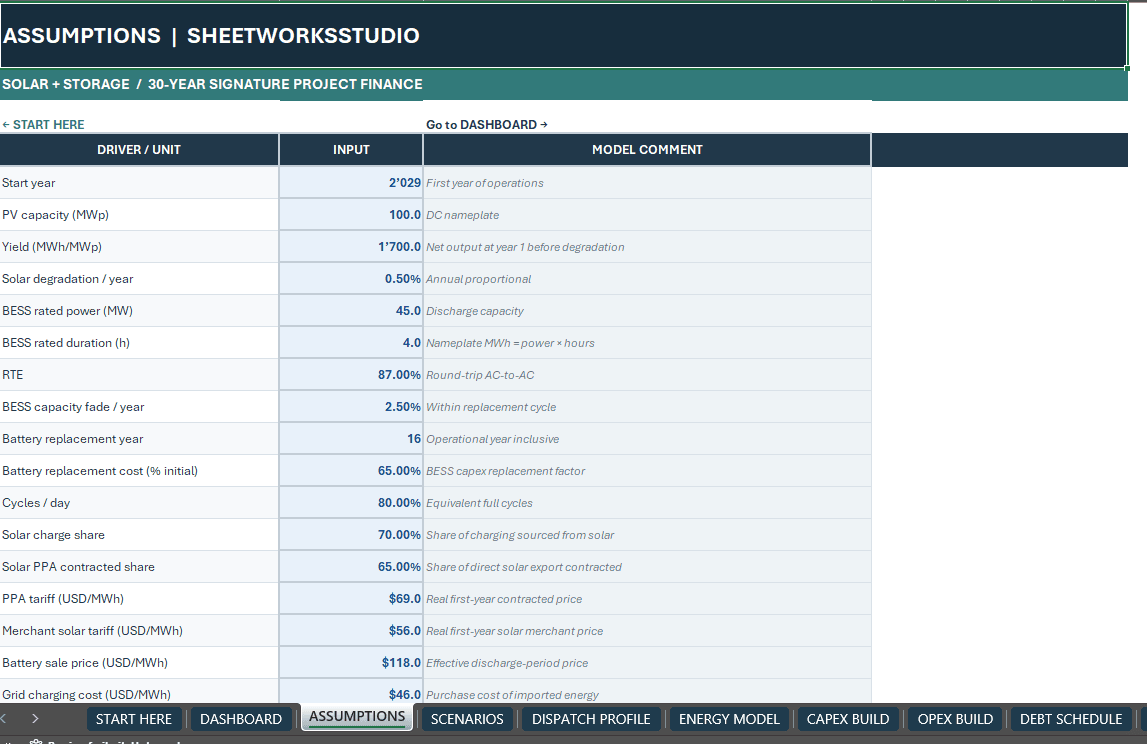
Forecast annual electricity generation using configurable assumptions for:
- Installed PV Capacity (MWp)
- Annual Energy Yield
- Technical Output Adjustment
- Solar Panel Degradation
- Direct Solar Electricity Exports
- Solar Energy Allocated to Battery Charging
- Grid Export Constraints
- Energy Curtailment and Electricity Allocation
Battery Energy Storage System
Analyze battery storage performance using:
- Rated BESS Power (MW)
- Storage Duration (Hours)
- Battery Energy Capacity (MWh)
- Round-Trip Efficiency
- Equivalent Daily Cycling
- Solar and Grid Charging
- Battery Capacity Degradation
- Battery Replacement Timing
- Replacement Investment Costs
- Annual Battery Discharge
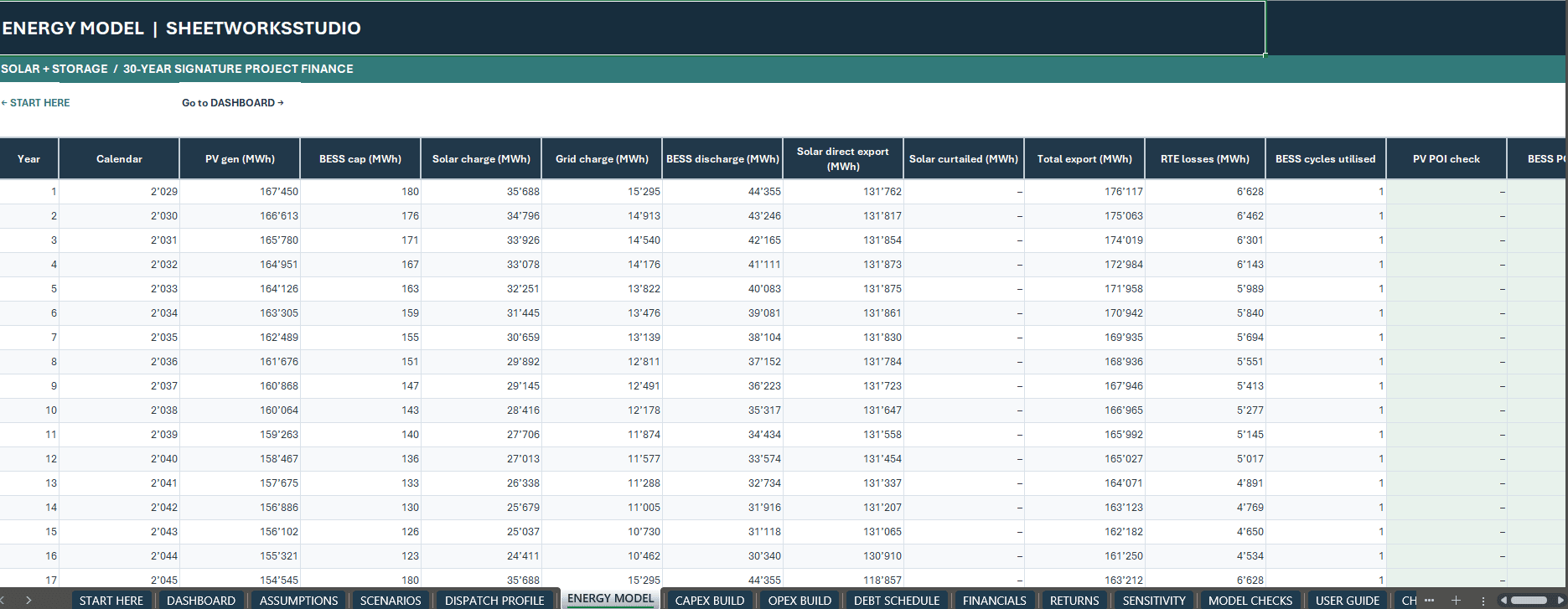
The ENERGY MODEL connects solar generation, battery charging, grid electricity purchases, battery discharge, conversion losses and total electricity exports.
The separate DISPATCH PROFILE illustrates a representative 24-hour operating concept.
Modeling convention: The financial forecast uses annual energy calculations. It does not perform chronological hourly battery dispatch optimization.
💰 THREE ELECTRICITY REVENUE COMPONENTS
1. Solar PPA Revenue
Forecast contracted electricity sales using an editable PPA allocation percentage and contracted electricity tariff.
2. Merchant Solar Revenue
Model non-contracted solar electricity exports using an editable merchant electricity price.
3. Battery Energy Sales
Estimate BESS discharge revenue using annual discharge volumes and electricity selling-price assumptions.
Grid electricity charging purchases are modeled separately as an operating cost.
Electricity price escalation and scenario assumptions allow users to examine how changes in commercial conditions affect long-term project performance.
🏗️ PROJECT CAPEX, OPEX & BATTERY REPLACEMENT
Capital Expenditure
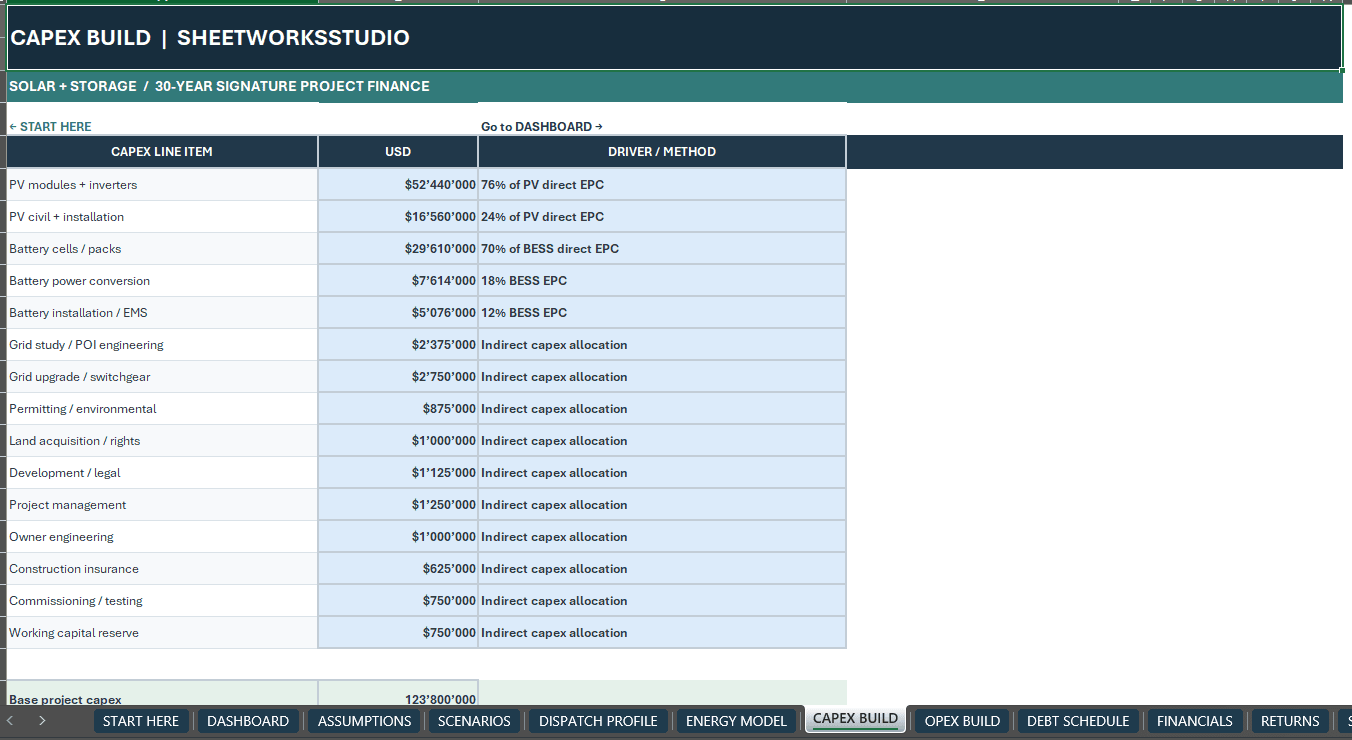
The CAPEX BUILD worksheet includes 15 illustrative cost categories covering:
- Solar Modules and Inverters
- Solar Installation and Civil Works
- Battery Equipment
- Power Conversion Systems
- Battery Installation and Energy Management
- Grid Connection and Electrical Infrastructure
- Permitting and Project Development
- Construction-Related Professional Services
- Contingencies and Other Project Costs
The workbook calculates initial project CAPEX and the corresponding initial debt and equity financing requirements.
Battery replacement expenditure is incorporated into the long-term investment forecast.
Operating Expenditure
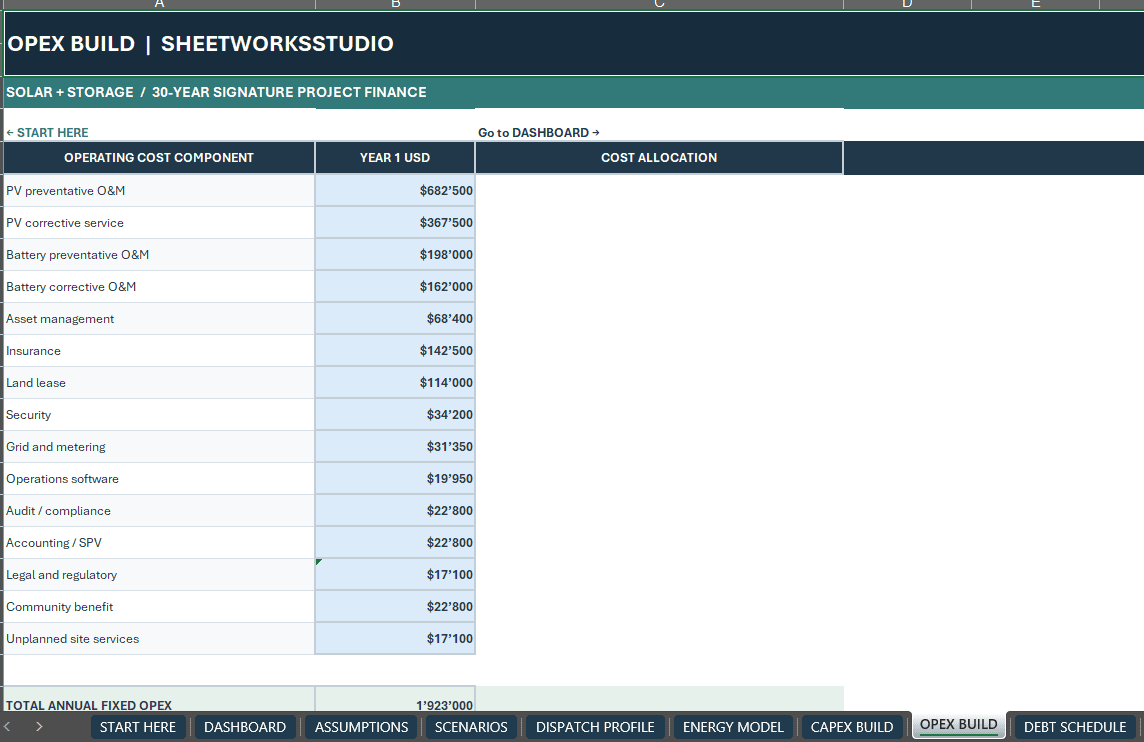
The OPEX BUILD worksheet contains 15 illustrative operating cost categories.
The model connects fixed operating expenses, escalation assumptions, grid charging costs, depreciation and simplified taxation to annual project cash flows.
All cost assumptions should be replaced with independently validated project-specific information.
🏦 PROJECT DEBT, CASH FLOW & DSCR
The integrated financing schedule models the relationship between project investment, debt financing and investor cash flows.
Key capabilities include:
- Editable Initial Debt Ratio
- Loan Interest Rate
- Financing Tenor
- Annual Principal Repayment
- Opening and Closing Debt Balances
- Scheduled Debt Service
- Cash Flow Available for Debt Service
- Debt Service Coverage Ratio (DSCR)
- Project and Equity Cash Flows
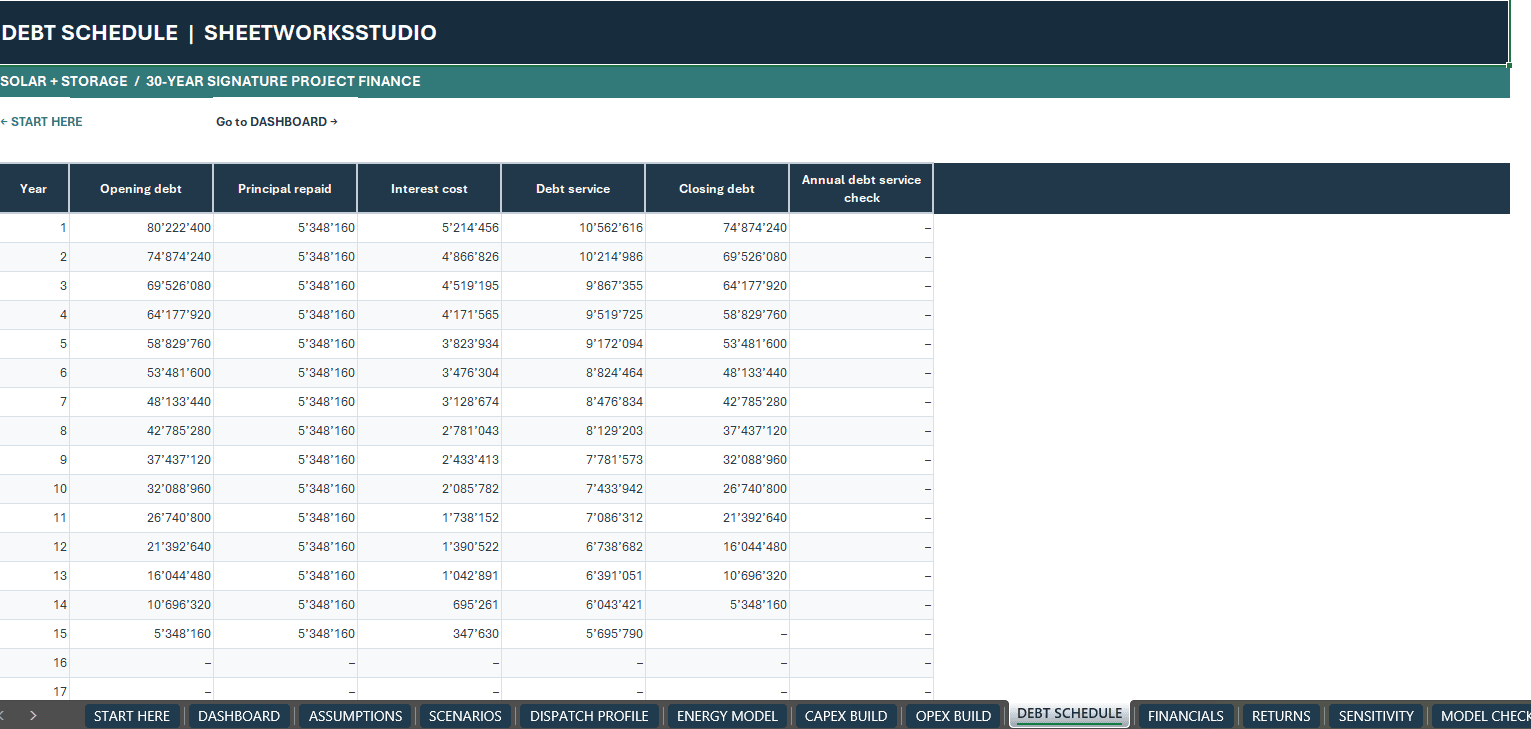
The model uses simplified straight-line principal amortization of initial project debt.
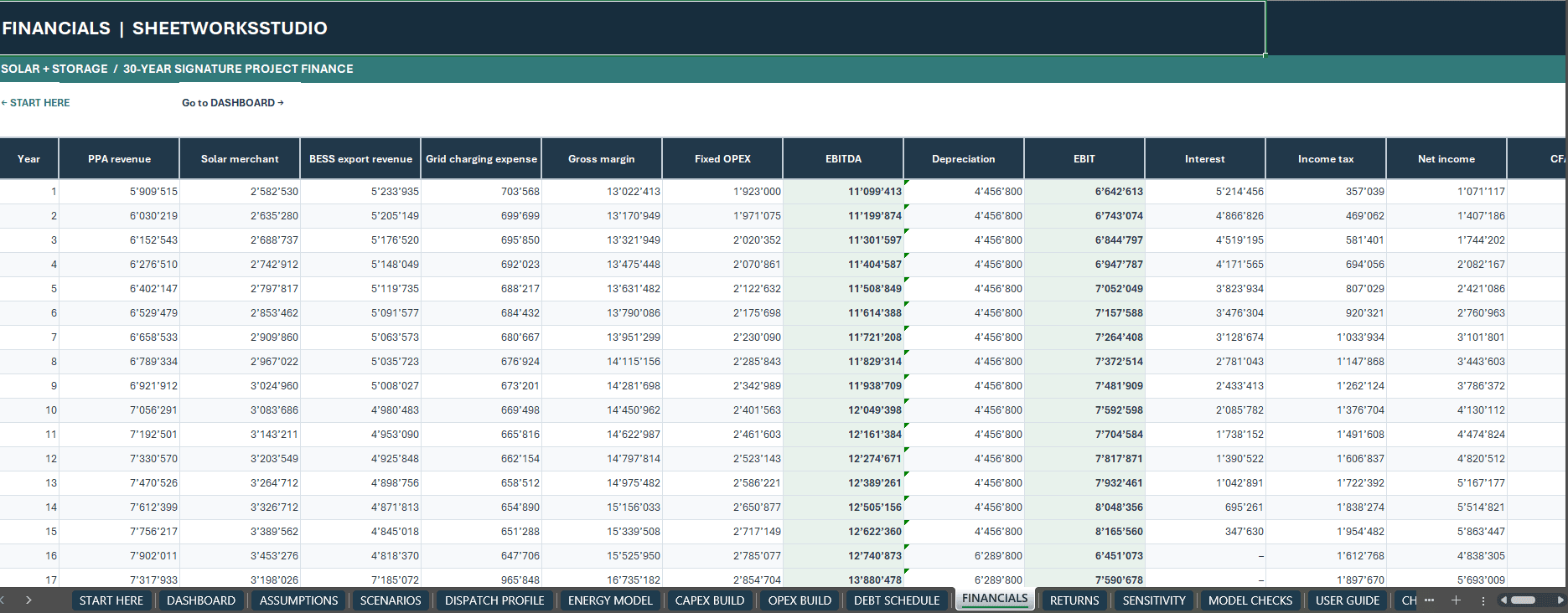
The FINANCIALS worksheet links operating revenues, electricity charging costs, OPEX, EBITDA, depreciation, financing expenses and simplified taxes with the cash flow calculations.
📈 INVESTMENT RETURNS, NPV, LCOE & LCOS
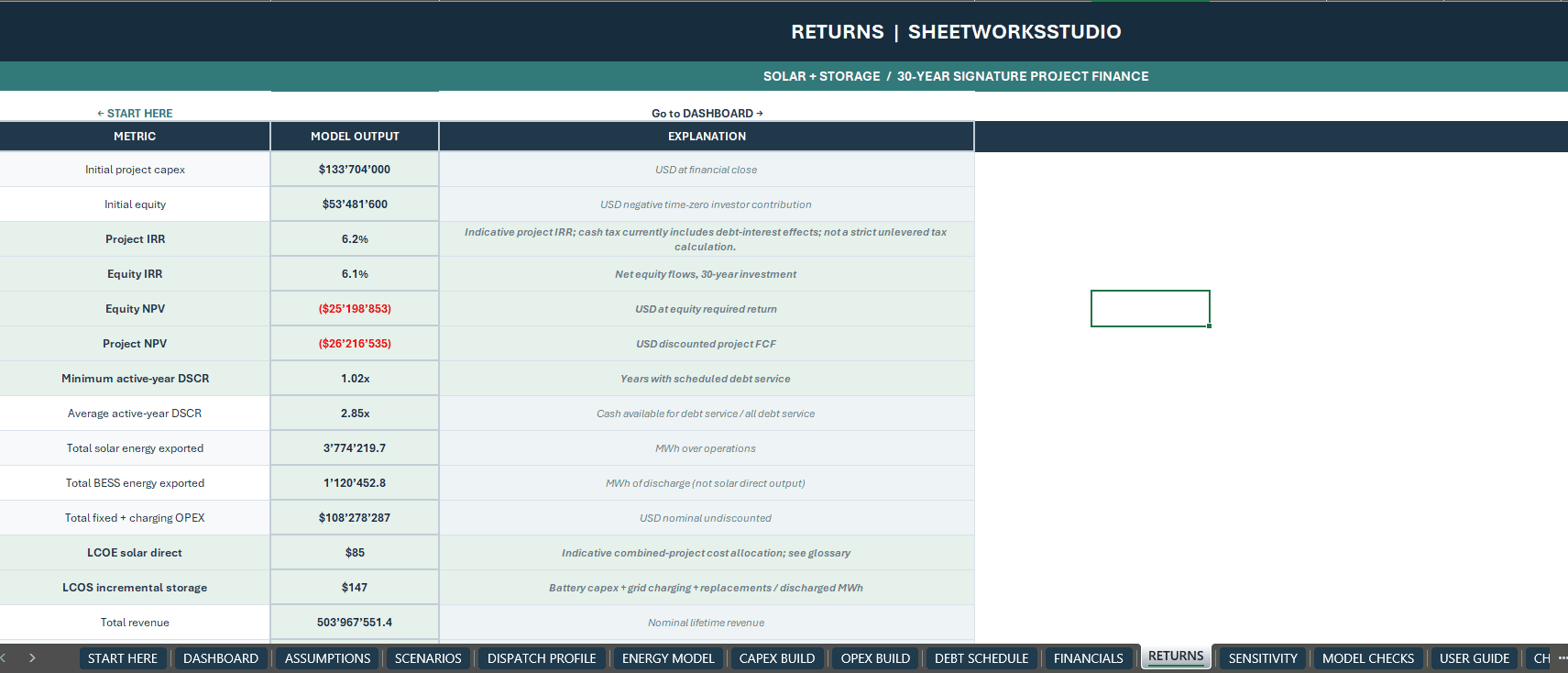
The RETURNS worksheet provides essential project finance indicators:
- Project IRR
- Equity IRR
- Project NPV
- Equity NPV
- Minimum and Average Active-Year DSCR
- Initial Project CAPEX
- Initial Debt and Equity Funding
- Lifetime Solar Electricity Exports
- Lifetime Battery Electricity Exports
- Total Project Revenue
- Indicative Solar LCOE
- Indicative Battery LCOS
The model evaluates discounted project and equity cash flows using configurable return and discount-rate assumptions.
LCOE and LCOS are calculated through documented simplified cost-allocation methods. They are intended for financial screening rather than independently certified energy cost benchmarking.
🔄 FOUR SCENARIOS & SENSITIVITY ANALYSIS
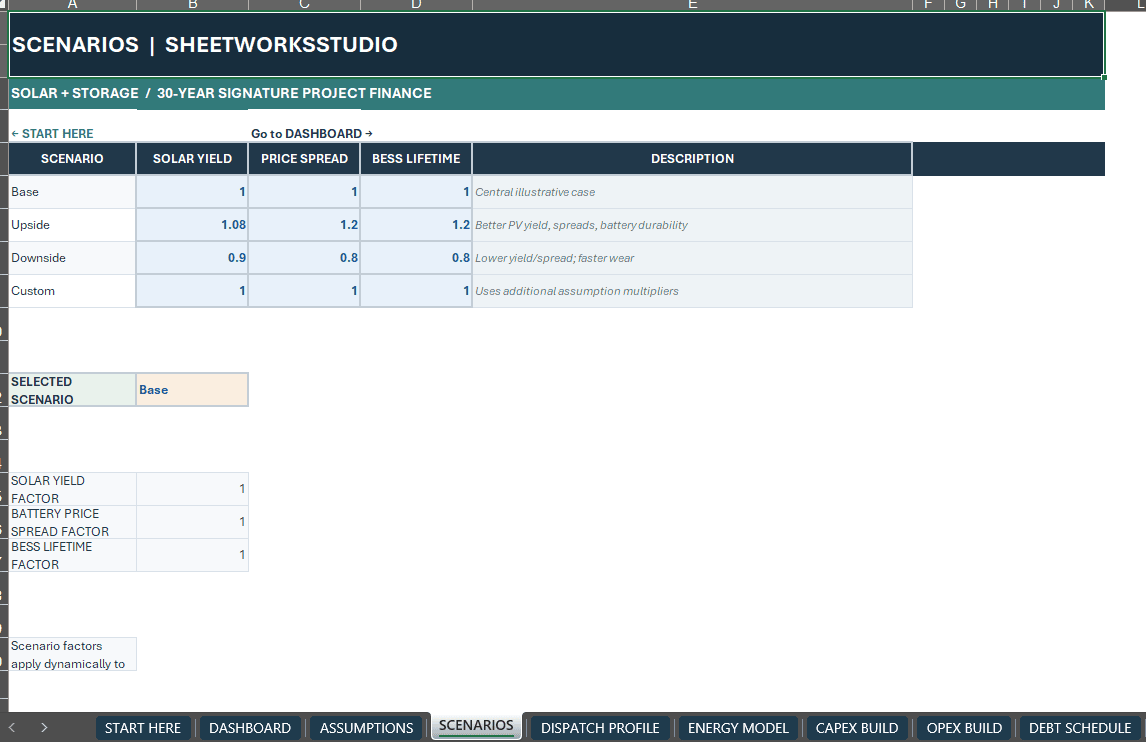
Evaluate alternative technical and commercial conditions through four selectable scenarios.
BASE CASE
Illustrative central project assumptions.
UPSIDE CASE
Higher solar yield, improved battery electricity-price spreads and more favorable battery durability.
DOWNSIDE CASE
Lower solar generation, weaker battery economics and less favorable storage performance.
CUSTOM CASE
User-defined scenario multipliers for project-specific analysis.
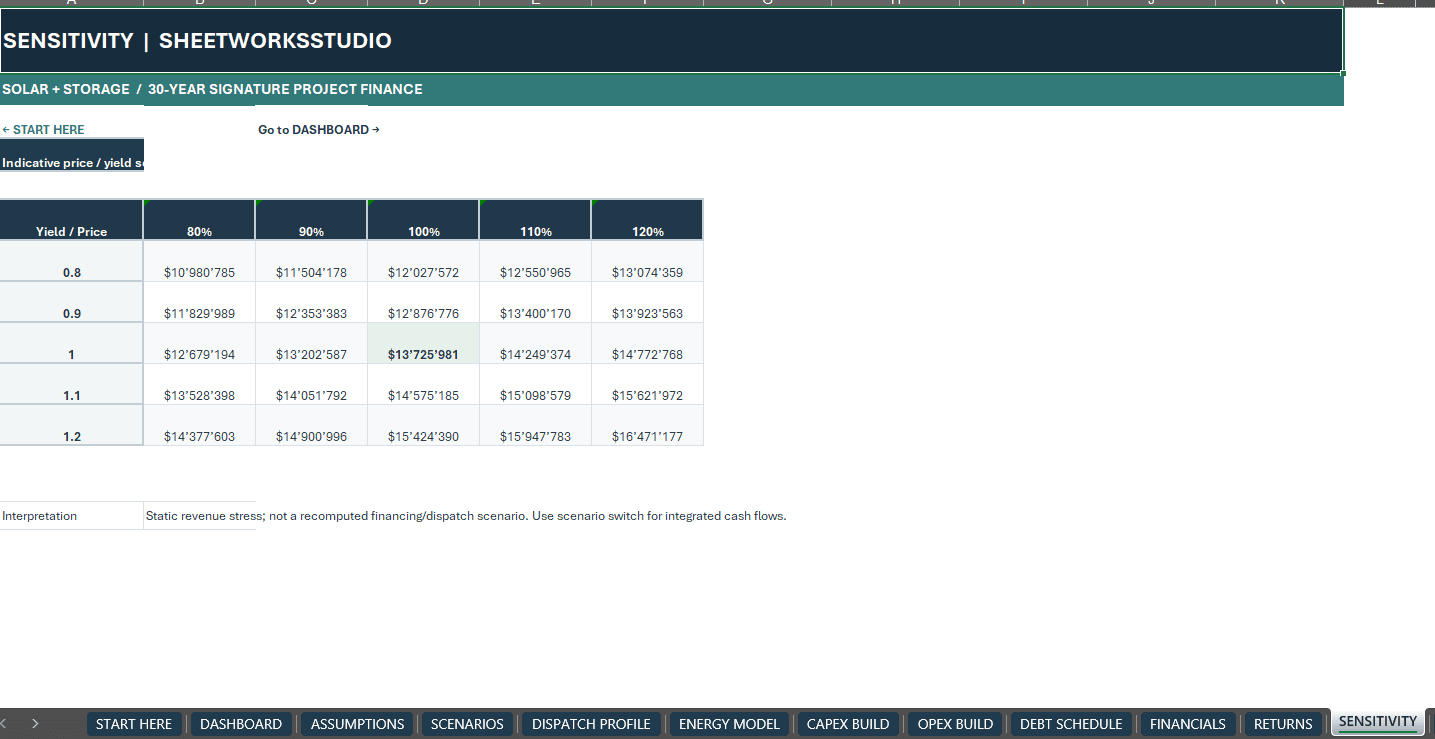
The SENSITIVITY worksheet provides a 5 × 5 revenue sensitivity table examining alternative solar-yield and battery-price factors.
This table is an illustrative first-year revenue stress test. For the integrated effect on project cash flows, debt coverage and investment returns, use the live scenario selector.
⚙️ PREMIUM WORKBOOK STRUCTURE
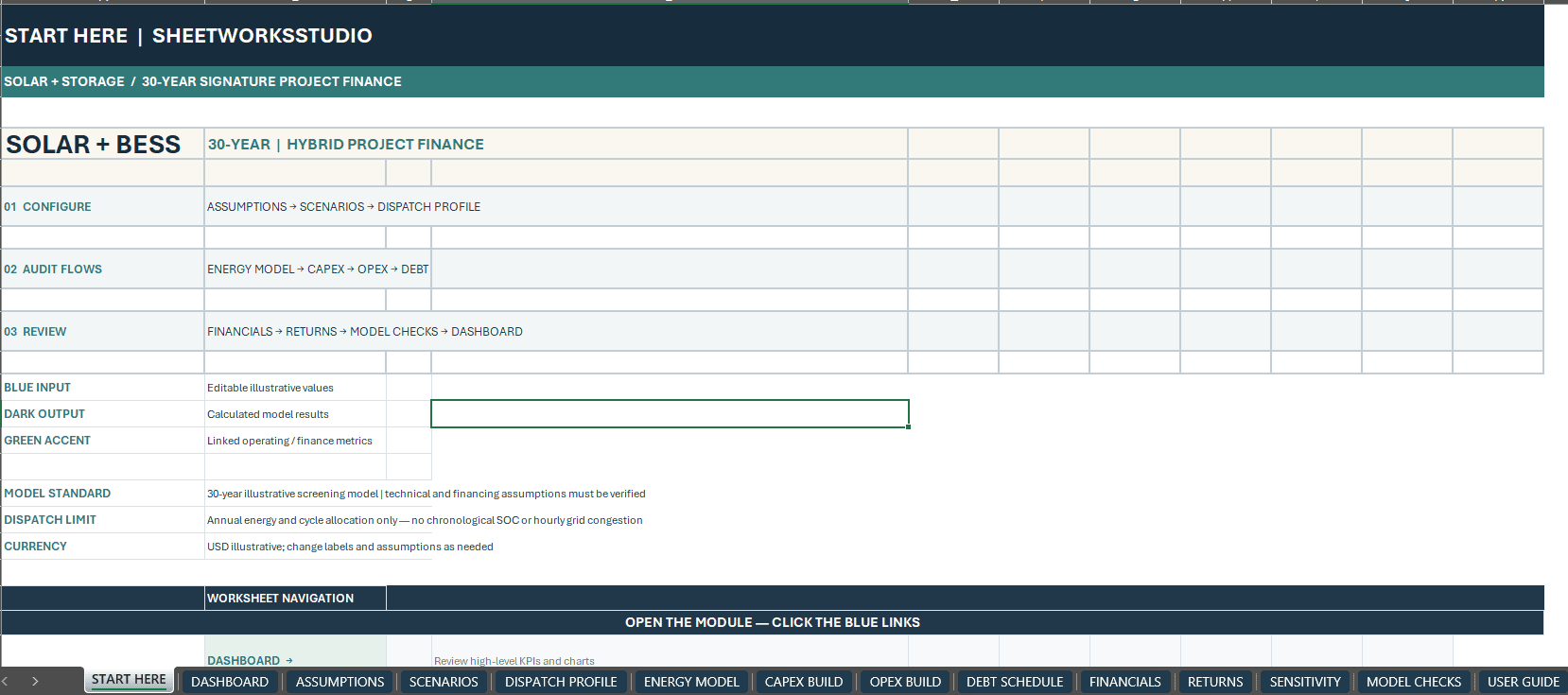
The Excel financial model includes 15 interconnected worksheets:
- START HERE – Introduction and navigation
- DASHBOARD – Investment KPIs and eight charts
- ASSUMPTIONS – Technical, commercial and financing inputs
- SCENARIOS – Base, Upside, Downside and Custom
- DISPATCH PROFILE – Representative daily energy operation
- ENERGY MODEL – Annual electricity generation and allocation
- CAPEX BUILD – Project investment costs
- OPEX BUILD – Operating cost categories
- DEBT SCHEDULE – Borrowing, interest and repayments
- FINANCIALS – Operating results and cash flows
- RETURNS – IRR, NPV, DSCR, LCOE and LCOS
- SENSITIVITY – Revenue sensitivity analysis
- MODEL CHECKS – Financial and energy calculation controls
- USER GUIDE – Workbook instructions
- CHART DATA – Linked dashboard chart data
The workbook uses editable formulas, clearly marked input areas, structured financial calculations and internal navigation.
No macros, external data connections or paid add-ins are required.
📦 WHAT YOU RECEIVE
1. Solar + BESS Hybrid Project Finance Model (.xlsx)
A complete Excel financial model featuring:
- 30 Annual Financial Forecast Periods
- 15 Integrated Worksheets
- 8 Native Excel Dashboard Charts
- Solar Generation and BESS Energy Calculations
- PPA, Merchant and Battery Electricity Revenues
- CAPEX, OPEX and Debt Financing Schedules
- Project and Equity Investment Returns
- IRR, NPV, DSCR, LCOE and LCOS
- Four Financial Scenarios
- Sensitivity Analysis and Model Checks
- Editable Formulas and Illustrative Example Data
2. Professional How-to-Use Guide – 17-Page PDF
A detailed English user guide covering setup, assumptions, solar and battery operations, project expenses, financing, investment metrics, scenarios, model validation, troubleshooting and financial model limitations.
IDEAL FOR
- Solar PV Project Developers
- Battery Energy Storage Developers
- Renewable Energy Investors
- Independent Power Producers
- Infrastructure Investment Professionals
- Project Finance Analysts
- Financial Modeling Consultants
- Energy Investment Advisors
- Professionals Preparing Feasibility Reviews
HOW TO GET STARTED
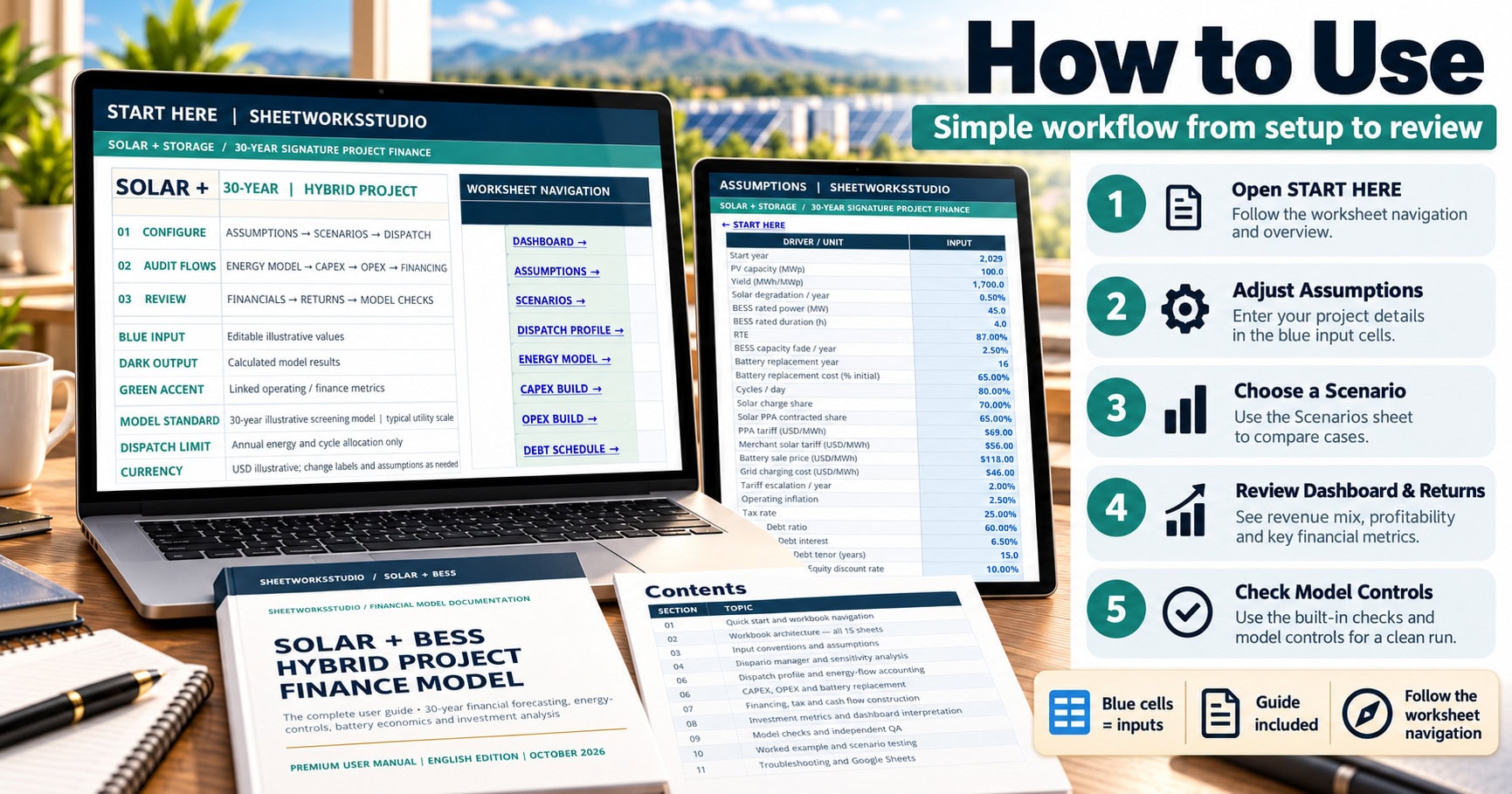
Step 1 – Configure Your Project
Open START HERE and update the technical, commercial and financial inputs in ASSUMPTIONS.
Step 2 – Select a Financial Scenario
Choose Base, Upside, Downside or Custom in SCENARIOS.
Step 3 – Review Energy and Costs
Analyze DISPATCH PROFILE, ENERGY MODEL, CAPEX BUILD and OPEX BUILD.
Step 4 – Evaluate Financing and Returns
Review DEBT SCHEDULE, FINANCIALS and RETURNS.
Step 5 – Analyze Sensitivities and Model Integrity
Use the Executive Dashboard, SENSITIVITY and MODEL CHECKS worksheets to evaluate results and investigate potential risks.
TECHNICAL SPECIFICATIONS
- File Format: Microsoft Excel (.xlsx)
- Forecast Horizon: 30 Years
- Forecast Frequency: Annual
- Example Forecast: 2029–2058
- Workbook: 15 Worksheets
- Dashboard: 8 Native Charts
- Scenarios: Base, Upside, Downside and Custom
- Sensitivity: 5 × 5 Revenue Analysis
- Macros: None
- External Data Connections: None
- Formula Editing: Supported
- User Guide: 17-Page English PDF
Microsoft Excel Desktop is recommended.
Google Sheets import and functional compatibility have not been independently verified. Equivalent formula behavior, charts, navigation and formatting are therefore not guaranteed.
IMPORTANT LIMITATIONS & DISCLAIMER
This is an illustrative annual Solar PV and BESS financial screening model, not an hourly dispatch optimizer, certified technical engineering simulation, statutory three-statement accounting model or lender-approved financing model.
Project financing uses simplified straight-line amortization. Tax calculations, battery performance, solar dispatch allocation, LCOE and LCOS involve documented simplifying assumptions.
Financial results may indicate negative NPV, insufficient debt service coverage or other unfavorable investment outcomes. Passing internal model checks does not establish bankability or guarantee project profitability.
All project data, prices, financial assumptions and illustrative outputs are fictional.
Users are responsible for independently verifying project-specific technical inputs, electricity market assumptions, construction costs, financing terms, regulatory requirements and all financial calculations before making investment decisions.
This product does not constitute financial, investment, engineering, accounting, legal or tax advice.
This is a digital download. No physical product will be shipped.
Developed by SheetworksStudio – Professional Financial Models & Business Decision Tools.
Similar ProductsOther customers were also interested in...


 eFinancialModels
Electric Vehicle (EV) Charging Station Financial M...
With this comprehensive 5- or 10-year monthly tool, investors can assess the viability of setting up... Read more

Financial Model for Mobile App | Mobile App Busine...
The Mobile App Financial Plan Template in Excel allows you to develop financial projections when lau... Read more

 HenrySheykin
Food Truck Financial Model Excel Template
The Food Truck Financial Model helps entrepreneurs, founders, business owners, consultants, and anal... Read more

Green Hydrogen Production from Wind Energy Financi...
The Green Hydrogen from Wind Financial Model aims to comprehensively forecast a horizon of 40 years ... Read more

Simple Mutual Non-Disclosure Agreement Template
Protect your business secrets with ease using our Simple Mutual Non-Disclosure Agreement Template. S... Read more

Solar Energy Financial Model
The Solar Energy Financial Model Spreadsheet Template in Excel assists you in preparing a sophistica... Read more

 Peter Graf
The Customer-Centric Financial Model for Restauran...
Starting a restaurant without a financial plan is like driving a car blindfolded. You wouldn´t do i... Read more
You must log in to submit a review.