

0 ITEMS

Second-Life EV Battery Economics Model – Excel Repurposing, Refurbishment, Resale, Recycling & Profitability Tracker
Premium 24-month Excel financial model for second-life EV battery economics. Compare direct resale, refurbishment, stationary storage integration, recycling and disposal. Analyze battery SOH, usable capacity, recovery yield, acquisition costs, refurbishment expenses, profit margins, break-even pricing and four financial scenarios. Includes 13 worksheets, 10 executive KPIs, six native charts, 15 fictional battery examples and a comprehensive 19-page PDF guide.
🔋 SECOND-LIFE EV BATTERY REPURPOSING ECONOMICS
24-Month Financial Intelligence for Battery Reuse, Refurbishment, Resale, Recycling & Recovery Value
🏆 SIGNATURE LUXURY EDITION
Evaluate battery value. Compare commercial recovery routes. Understand financial performance.
Used electric vehicle batteries present an important economic decision: should a battery be resold, refurbished, repurposed for stationary energy storage, recycled or disposed of?
Each option involves different acquisition costs, State of Health assumptions, processing requirements, recovery yields, commercial values and financial risks.
The Second-Life EV Battery Repurposing Economics model by SheetworksStudio is a premium, formula-driven Excel financial planning system designed to help businesses compare these alternatives through transparent battery-level unit economics and a structured 24-month financial forecast.
Developed for battery repurposing companies, circular-economy operators, recycling businesses, energy storage developers and financial analysts, the model connects battery characteristics with cost, recovery value, expected profitability and cash realization.
✨ SIGNATURE LUXURY EDITION — KEY FEATURES
✅ 13 interconnected Excel worksheets
✅ 24-month financial planning horizon
✅ 15 fictional example battery records
✅ 45 prepared battery input rows
✅ Five alternative commercial recovery strategies
✅ Battery State of Health and usable capacity analysis
✅ Acquisition, inspection and refurbishment cost calculations
✅ Recovery yield and rejection rate analysis
✅ Financial cost per usable kWh
✅ Break-even battery acquisition economics
✅ 10 executive financial KPIs
✅ Six native Excel dashboard charts
✅ Four configurable financial scenarios
✅ 24 integrated model consistency checks
✅ Professional 19-page English How-to-Use Guide
All demonstration information is fictional. Financial assumptions and designated input fields are editable.
🔋 1. BATTERY-LEVEL FINANCIAL INTELLIGENCE
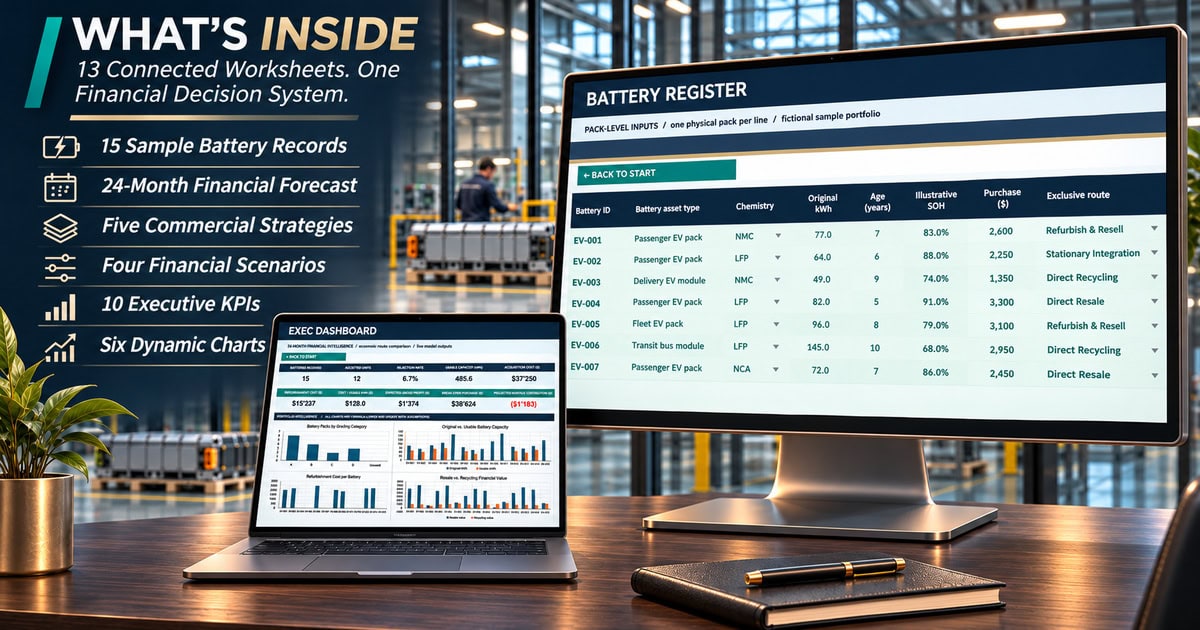
The BATTERY REGISTER provides a structured foundation for evaluating individual used EV battery packs or batches.
Track:
- Battery type and chemistry
- Original nominal capacity
- Battery age
- Illustrative State of Health (SOH)
- Estimated remaining usable capacity
- Acquisition price
- Transport and handling expenses
- Battery condition and grading
- Selected commercial recovery route
The model includes 15 fictional battery examples, with prepared capacity for up to 45 battery records.
Battery condition inputs are financial assumptions, not independently verified technical measurements.
🔬 2. INSPECTION, GRADING & RECOVERY YIELD
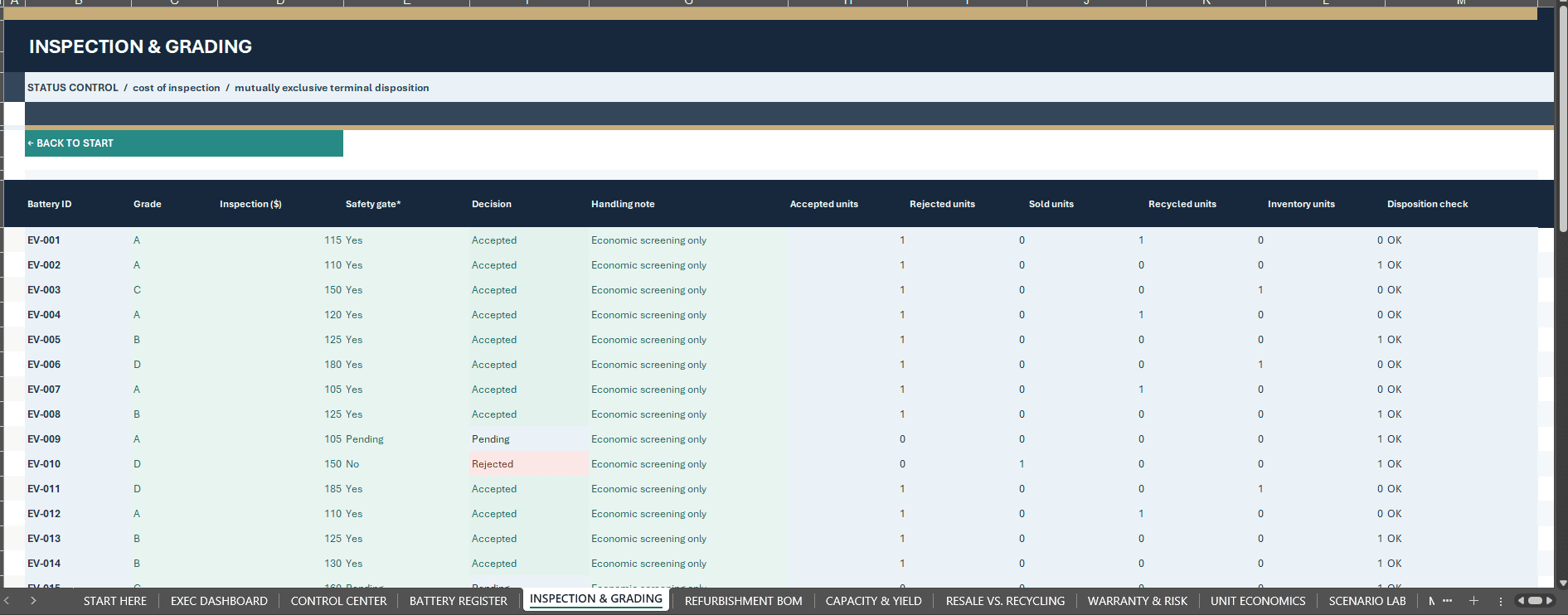
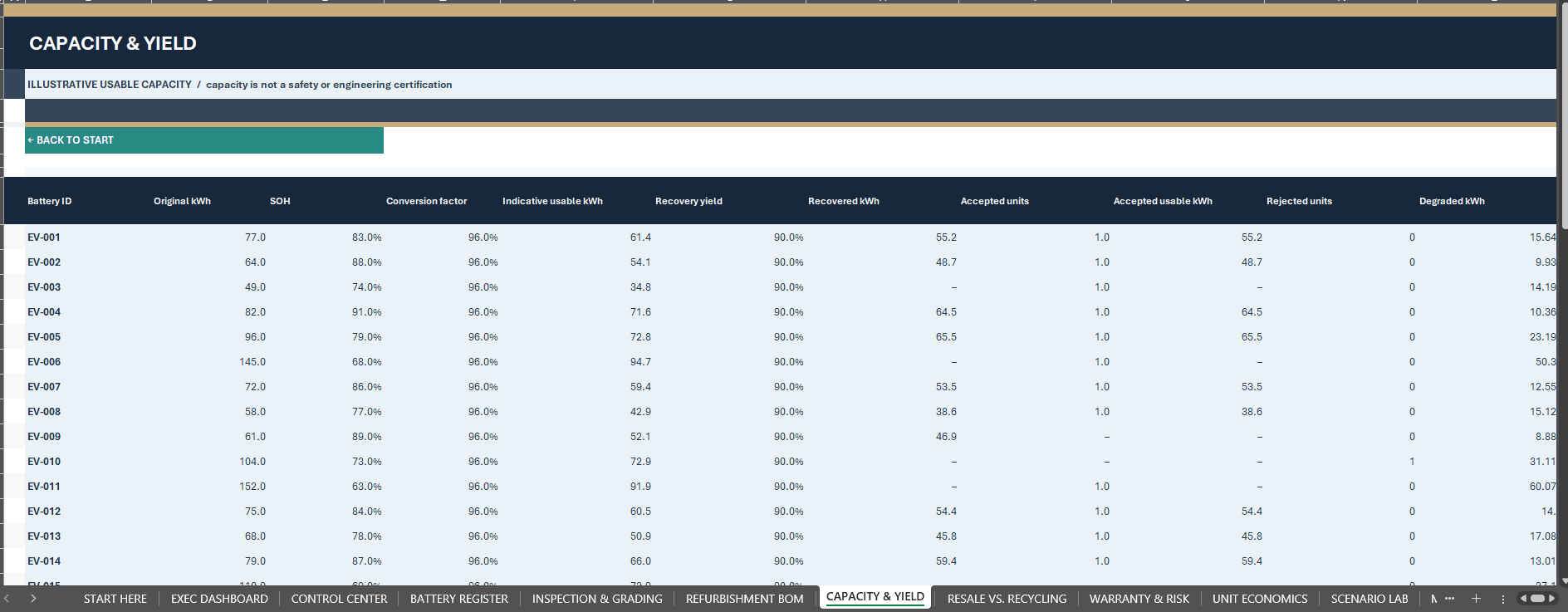
The INSPECTION & GRADING and CAPACITY & YIELD worksheets translate battery characteristics into estimated commercial recovery potential.
Analyze:
✅ Inspection and testing costs
✅ Battery grading assumptions
✅ Original versus usable battery capacity
✅ State of Health
✅ Refurbishment recovery yield
✅ Accepted and rejected units
✅ Financially usable kWh
✅ Recovery efficiency
The calculations help identify how changes in battery quality and recovery yield influence unit economics.
Important: SOH and grading assumptions do not establish electrical safety, technical suitability or remaining battery service life.
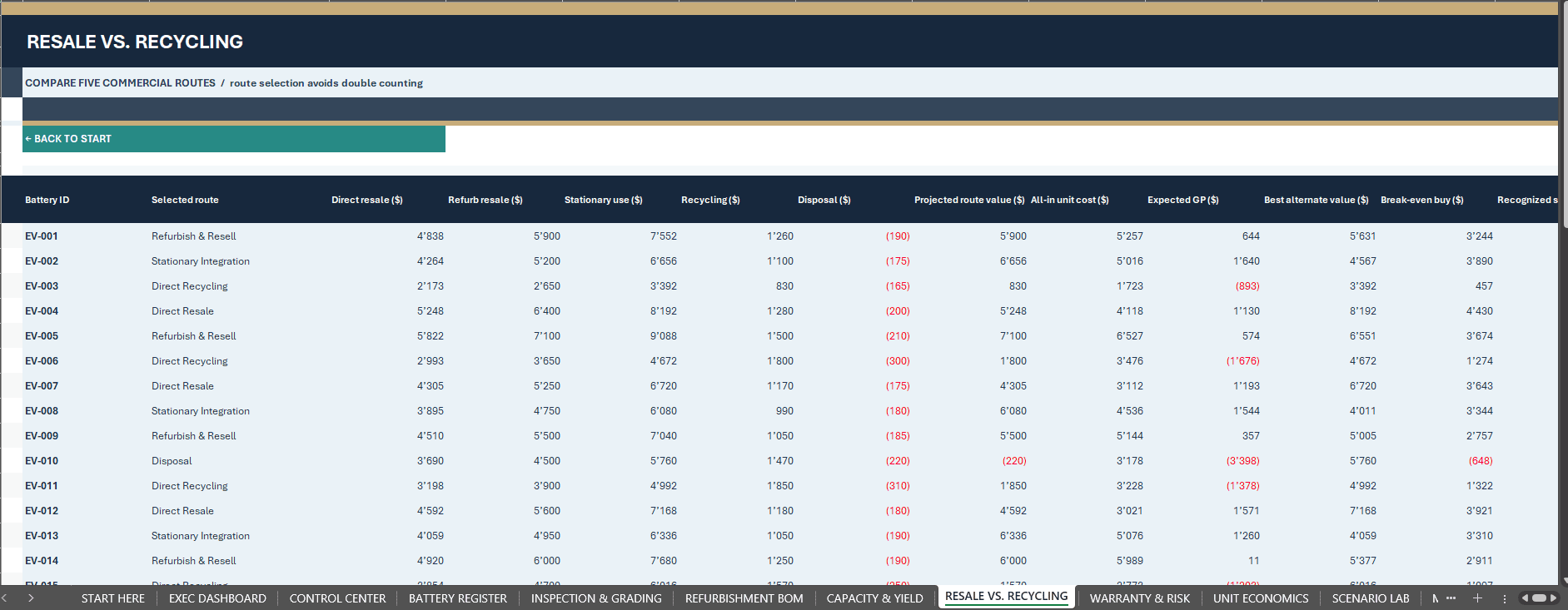
⚙️ 3. FIVE COMMERCIAL RECOVERY STRATEGIES
Compare five alternative financial routes for used EV batteries.
01 — 🔄 DIRECT RESALE
Evaluate estimated proceeds from selling suitable battery packs without extensive refurbishment.
02 — 🛠️ REFURBISHMENT & RESALE
Analyze additional parts, labor, inspection and processing expenditure against expected resale value.
03 — ⚡ STATIONARY STORAGE INTEGRATION
Assess the financial implications of preparing suitable batteries for potential stationary energy storage applications.
04 — ♻️ DIRECT RECYCLING
Compare expected recycling recovery value against acquisition, handling and processing costs.
05 — 📦 DISPOSAL
Estimate financial consequences where reuse or recycling is not economically justified under the selected assumptions.
Each battery is assigned to one exclusive commercial route to avoid counting the same unit simultaneously in multiple recovery strategies.
The model evaluates financial attractiveness, not engineering feasibility or regulatory approval.
💰 4. ACQUISITION & REFURBISHMENT COST ANALYSIS
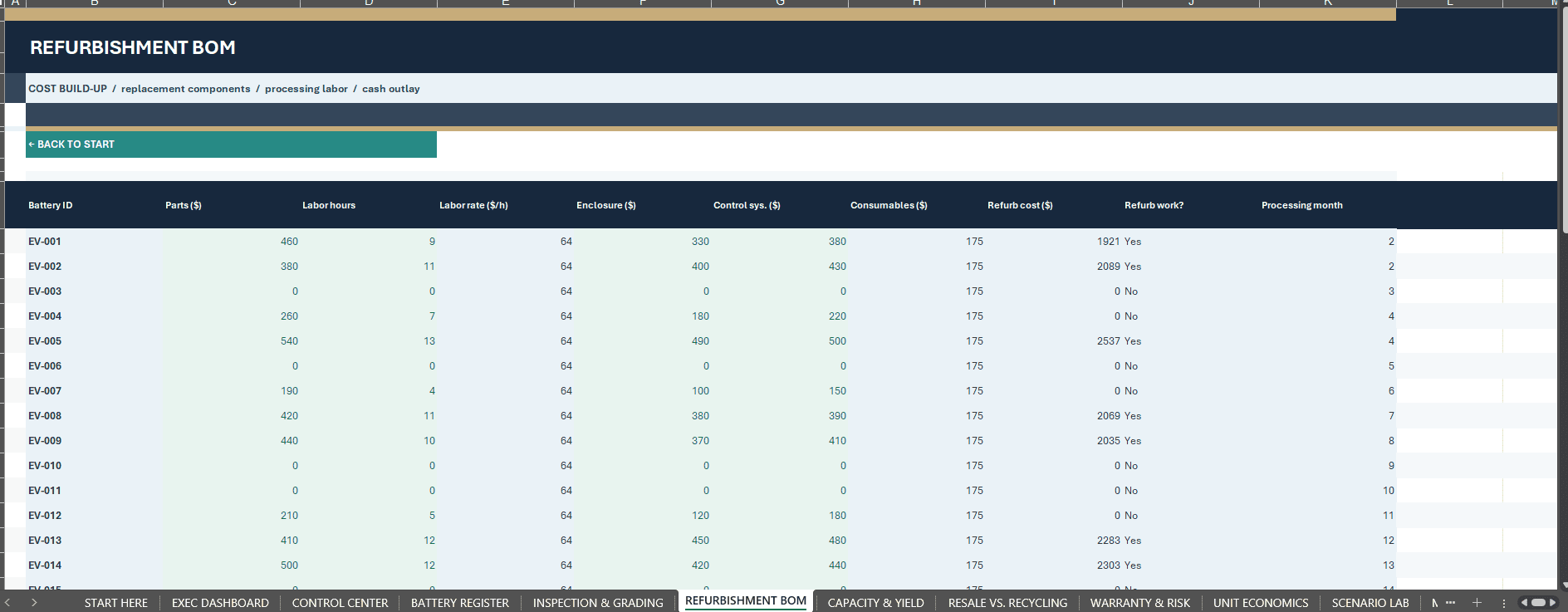
The REFURBISHMENT BOM and related financial calculations capture important cost drivers.
Included assumptions:
- Battery acquisition expenditure
- Transportation and handling
- Inspection and grading
- Replacement components
- Refurbishment labor
- Enclosure and control systems
- Storage and holding costs
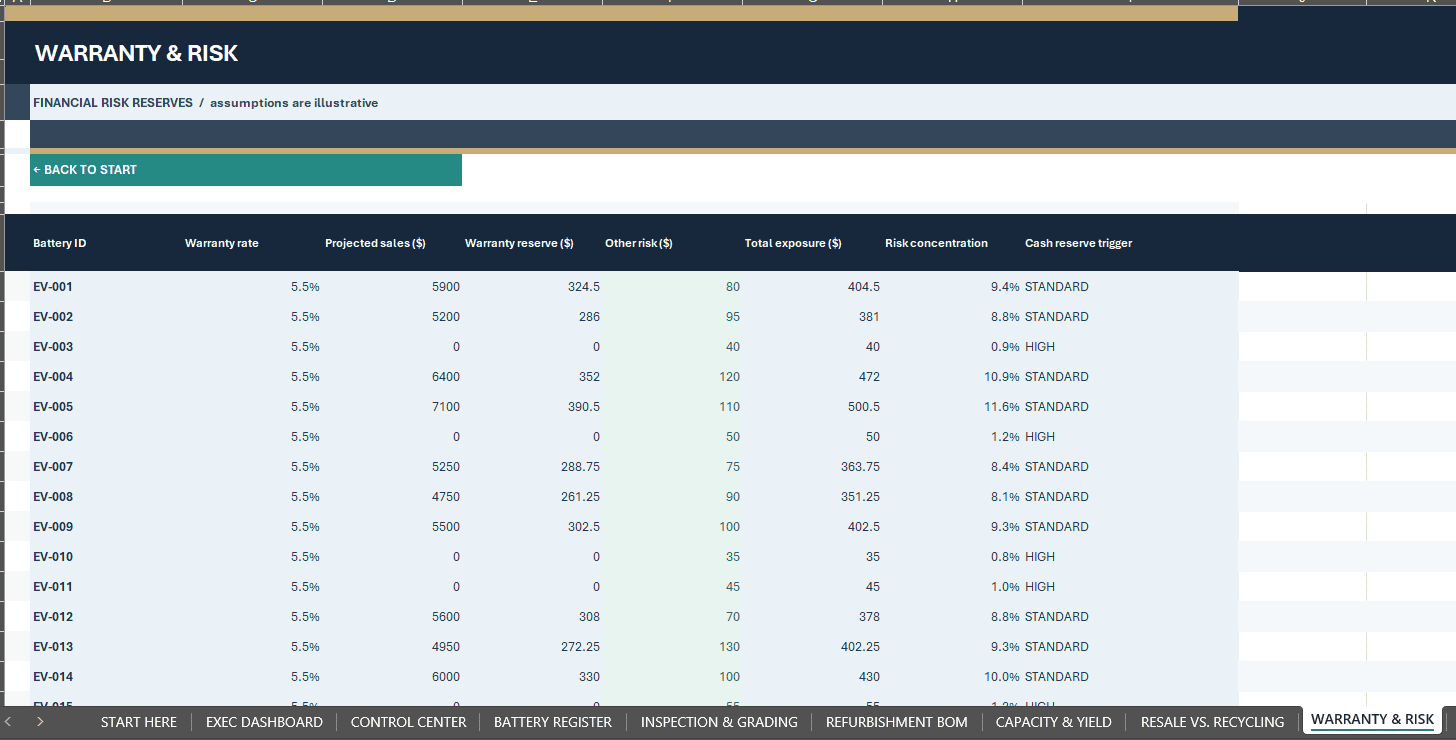
- Warranty reserve assumptions
- Recycling and disposal expenses
Understand how additional processing requirements influence the total cost and financial contribution of a battery.
The workbook separates acquisition cost, refurbishment expenditure and expected commercial recovery value.
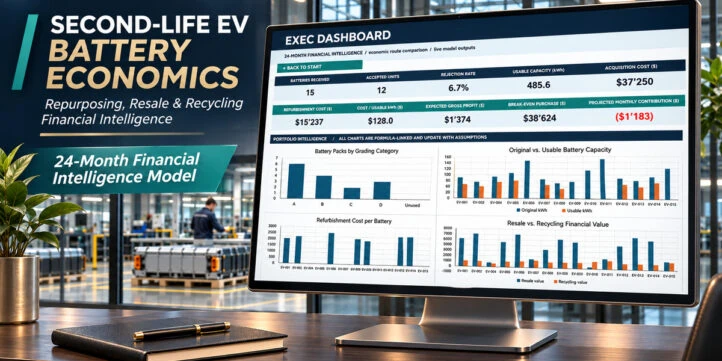
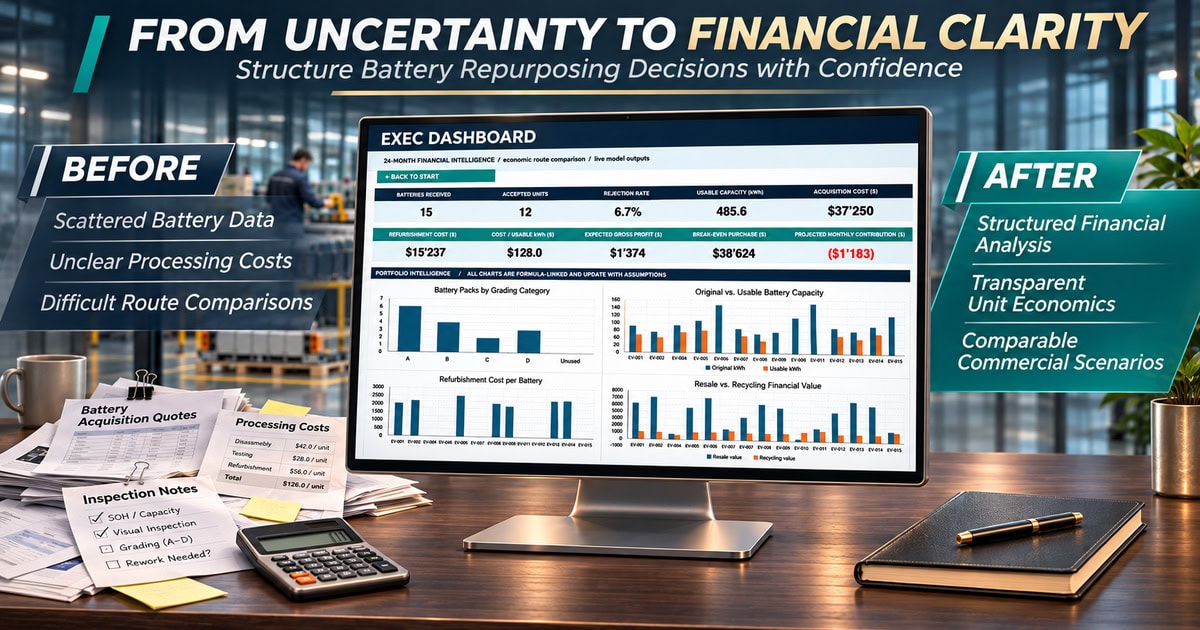
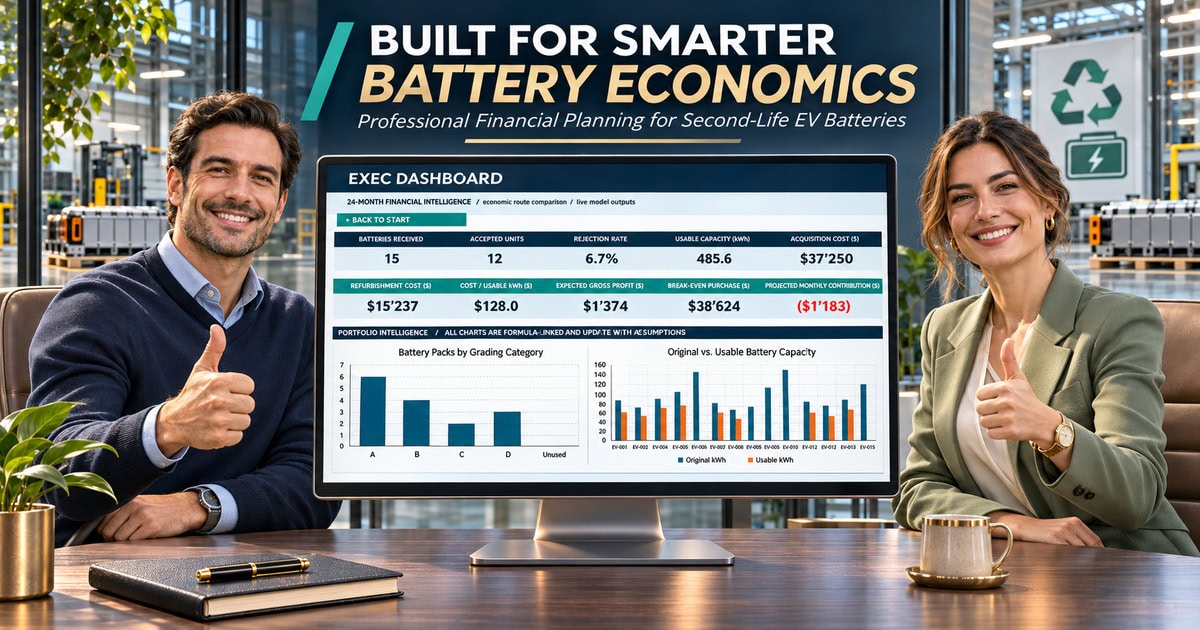
📊 5. EXECUTIVE DASHBOARD — 10 KPIs
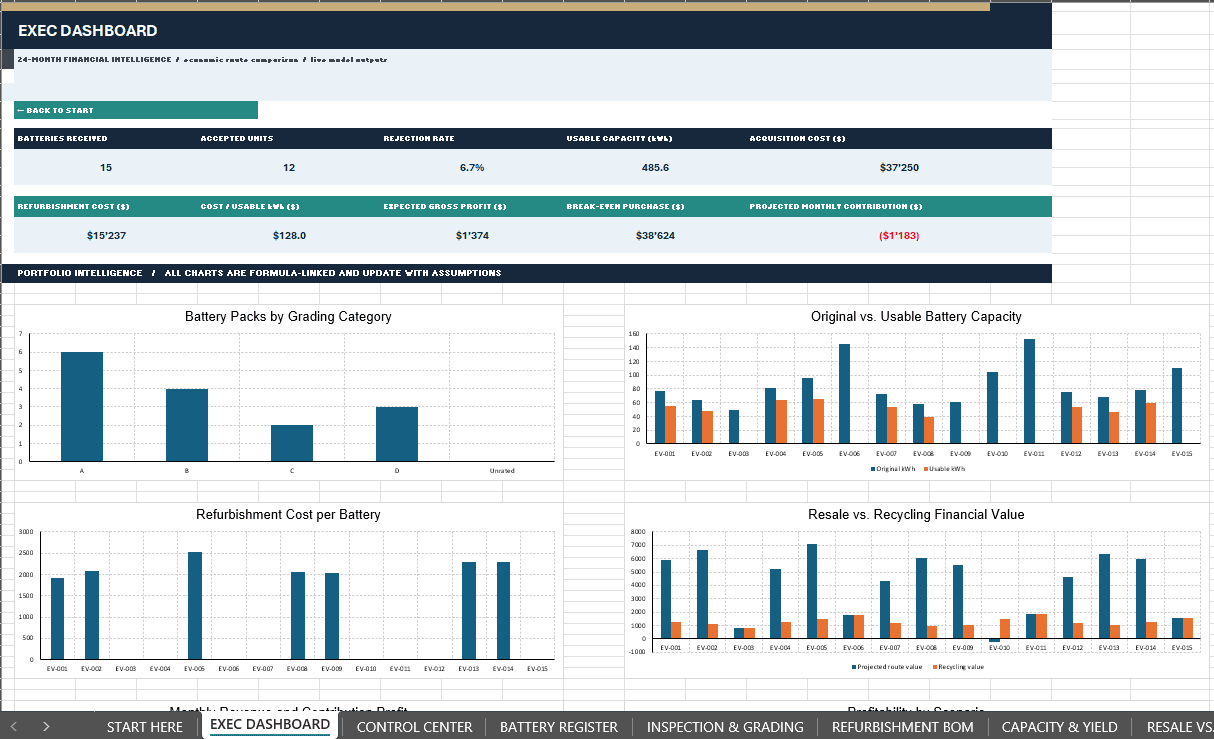
The premium EXEC DASHBOARD consolidates ten operational and financial indicators:
- 🔋 Batteries Received
- ✅ Accepted Units
- ⚠️ Rejection Rate
- ⚡ Usable Battery Capacity
- 💰 Acquisition Cost
- 🛠️ Refurbishment Cost
- 📏 Cost per Usable kWh
- 📈 Expected Gross Profit
- 🎯 Break-even Purchase Price
- 💵 Projected Monthly Contribution
This executive view helps users identify key drivers of battery recovery economics across the modeled portfolio.
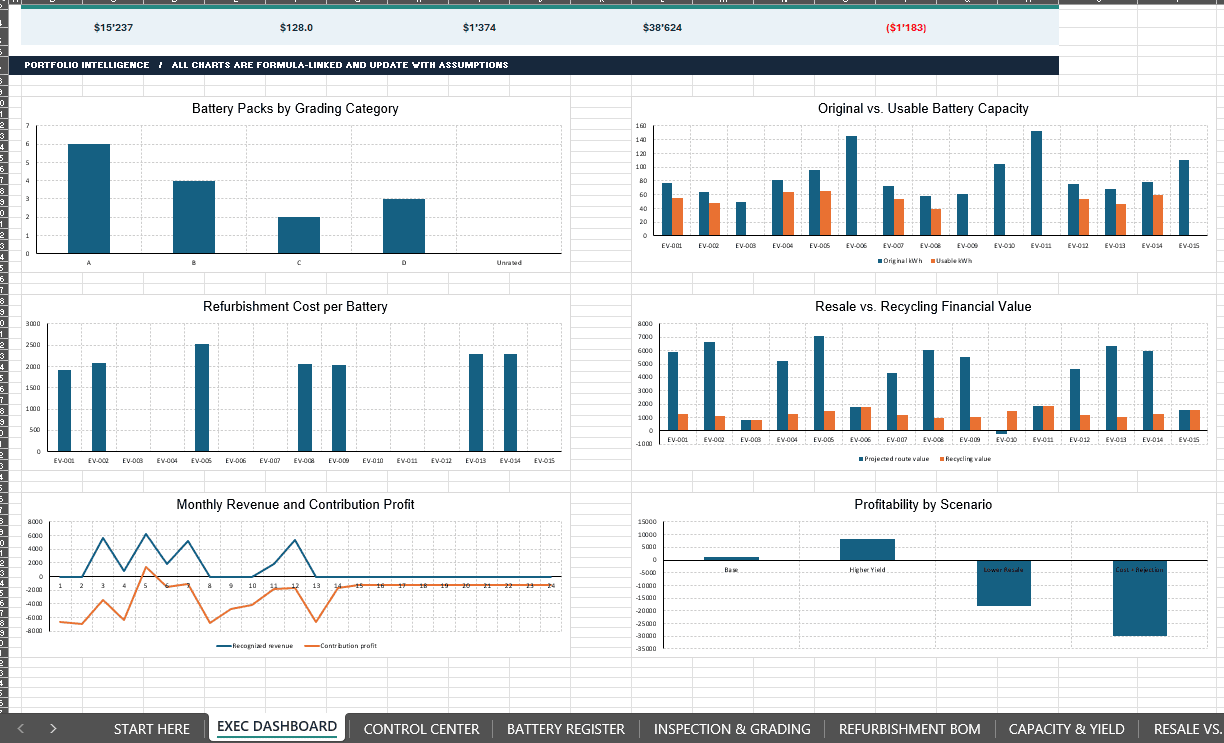
📈 6. SIX NATIVE EXCEL DASHBOARD CHARTS
Six formula-linked visualizations support financial interpretation:
01 — Battery Packs by Grading Category
Review the distribution of batteries across condition grades.
02 — Original vs. Usable Battery Capacity
Compare nominal capacity with estimated financially usable capacity.
03 — Refurbishment Cost per Battery
Identify battery records with higher processing requirements.
04 — Resale vs. Recycling Financial Value
Compare alternative commercial recovery values.
05 — Monthly Revenue & Contribution Profit
Review projected financial performance over the planning horizon.
06 — Profitability by Scenario
Compare expected portfolio contribution across four financial cases.
All six charts are native Excel objects connected to workbook calculations rather than static promotional illustrations.
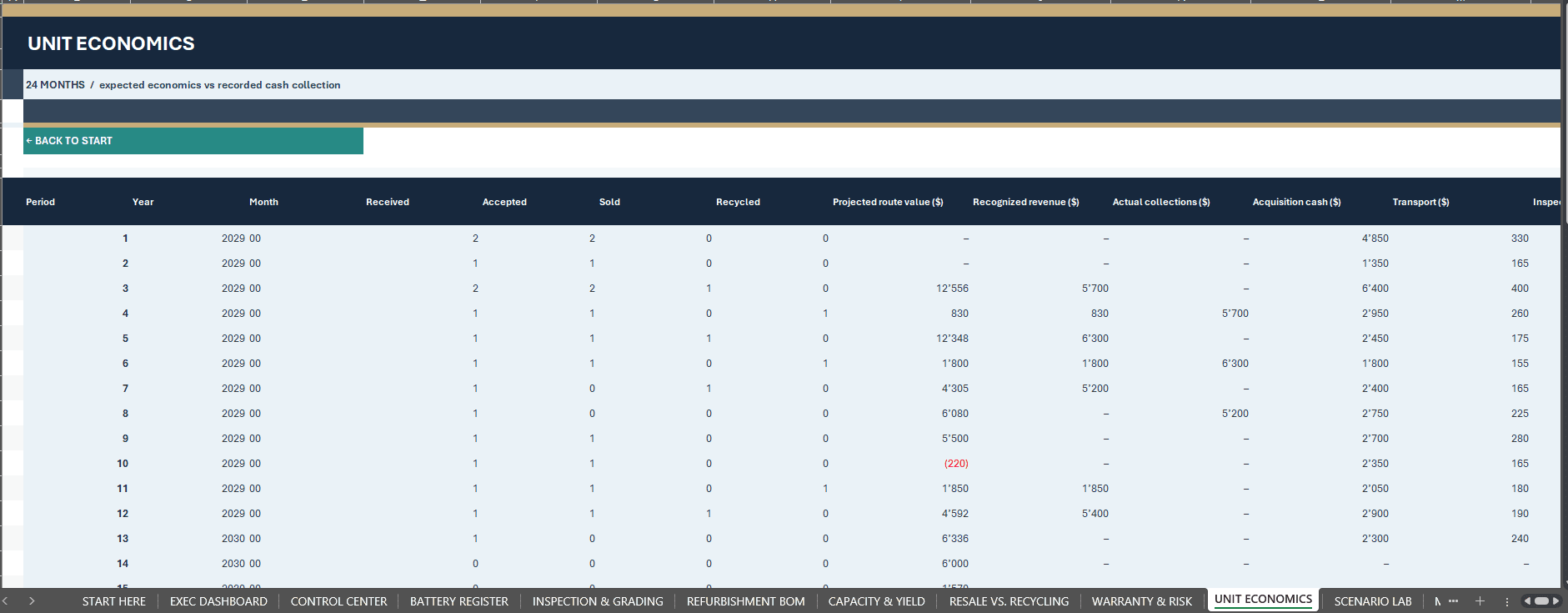
🏦 7. UNIT ECONOMICS & BREAK-EVEN ANALYSIS
The UNIT ECONOMICS worksheet converts battery-specific assumptions into financial performance indicators.
Core outputs include:
✅ Estimated commercial recovery value
✅ Total acquisition and processing cost
✅ Expected gross profit
✅ Contribution margin
✅ Financial cost per usable kWh
✅ Break-even acquisition price
✅ Portfolio profitability assumptions
✅ Monthly revenue and contribution estimates
These calculations help users compare commercial recovery opportunities and identify unfavorable acquisition or processing economics.
Negative financial outcomes remain visible. The model does not automatically assume that battery reuse or refurbishment is profitable.
📅 8. 24-MONTH FINANCIAL FORECAST & CASH COLLECTIONS
Evaluate financial activity over 24 monthly periods, beginning in 2029 by default.
The forecast includes:
- Battery acquisition expenditure
- Processing and refurbishment costs
- Expected commercial recovery value
- Revenue assumptions
- Monthly contribution profitability
- Cash collection timing
- Financial exposure
- Operating cash flow
The model distinguishes expected commercial value from recorded financial transactions and collected cash.
This distinction is essential when evaluating second-life battery business economics.
Expected portfolio contribution is not identical to cumulative cash flow. Cash results reflect the model’s timing and expenditure assumptions.
🔀 9. FOUR FINANCIAL SCENARIOS
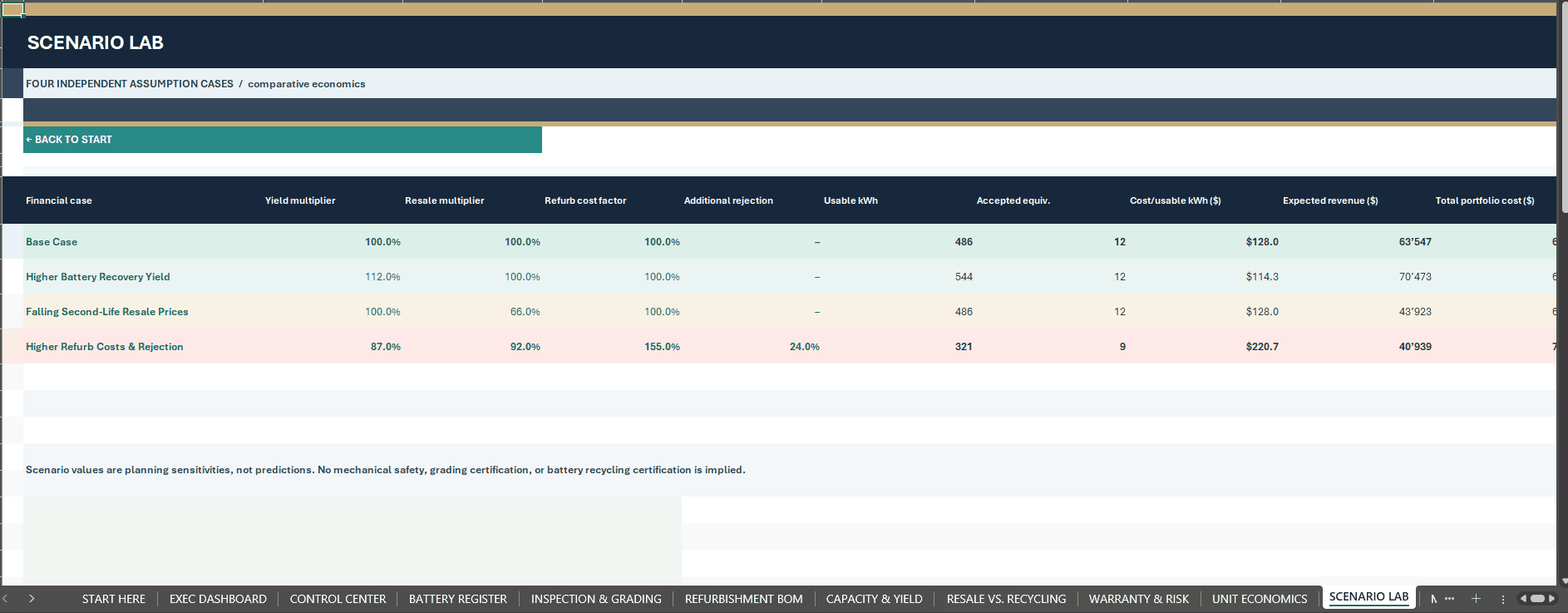
The SCENARIO LAB evaluates four illustrative commercial cases.
🟢 01 — BASE CASE
Reference acquisition costs, battery condition, recovery yield, resale values and refurbishment assumptions.
🔵 02 — HIGHER BATTERY RECOVERY YIELD
Evaluate the economic impact of improved usable capacity and recovery performance.
🟠 03 — FALLING SECOND-LIFE RESALE PRICES
Assess profitability exposure to weaker resale markets and reduced commercial recovery value.
🔴 04 — HIGHER REFURBISHMENT COSTS & REJECTION RATE
Examine combined pressure from increased processing expenses and fewer accepted battery units.
Scenario outputs include:
✅ Accepted battery units
✅ Usable battery capacity
✅ Acquisition and processing costs
✅ Expected revenue
✅ Unit economics
✅ Financial contribution
✅ Changes against the Base Case
The scenarios provide assumption-based financial sensitivities. Scenario contribution estimates are not four independent, fully reconciled monthly cash flow forecasts.
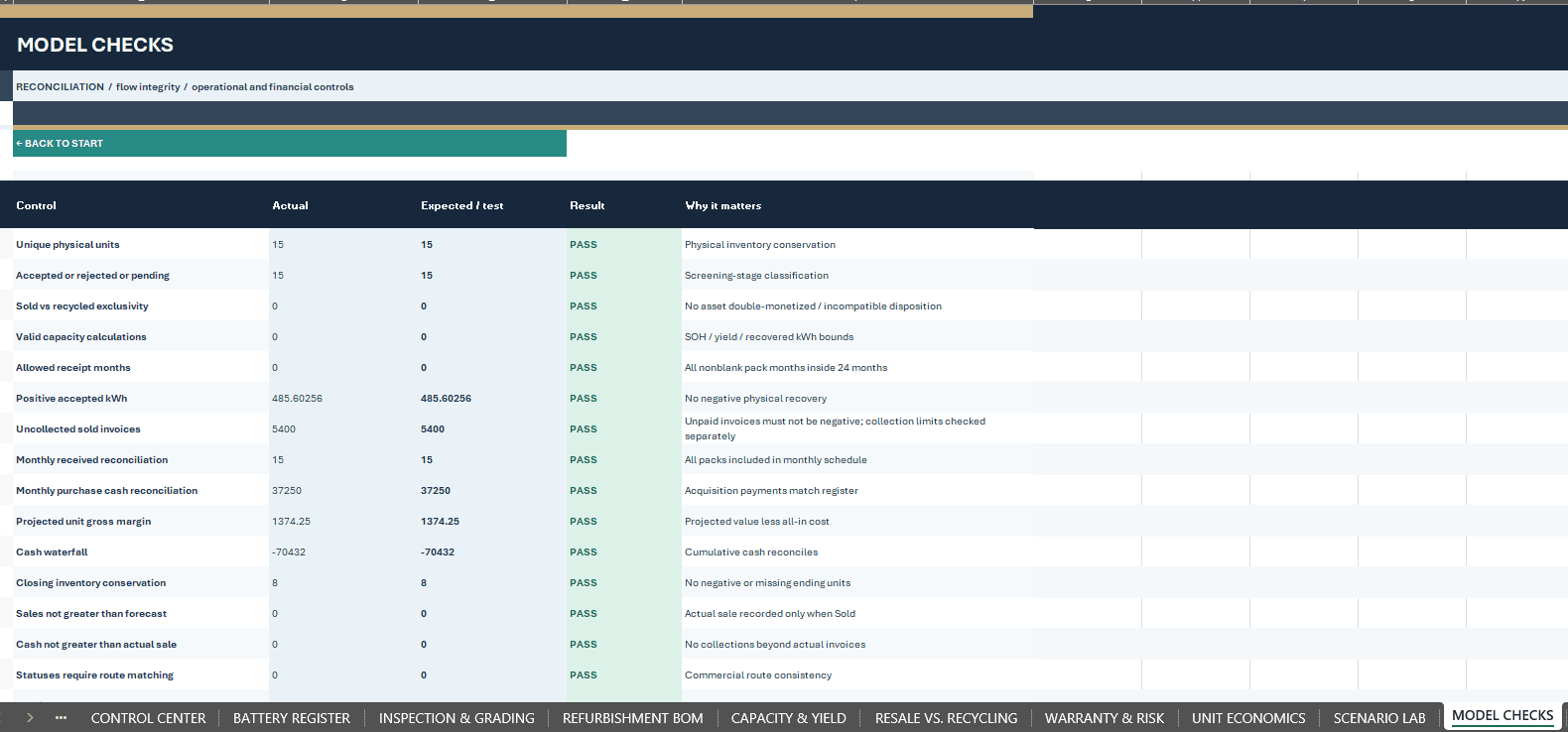
🛡️ 10. MODEL CHECKS & FINANCIAL VALIDATION
The MODEL CHECKS worksheet provides 24 internal consistency controls.
Review areas include:
- Battery inventory allocation
- Commercial route consistency
- Inspection and recovery assumptions
- SOH input validity
- Cost calculations
- Financial outputs
- Receivables checks
- Scenario calculation integrity
The updated model checks are designed to distinguish numerical validity from an assumed positive or negative financial outcome.
A model control marked PASS supports internal formula consistency; it does not certify battery performance, technical safety or commercial forecasts.
📦 WHAT’S INCLUDED
📗 1. PREMIUM EDITABLE EXCEL FINANCIAL MODEL (.XLSX)
✅ 13 Interconnected Worksheets
✅ 24-Month Financial Forecast
✅ 15 Fictional Battery Examples
✅ 45 Prepared Battery Input Rows
✅ Five Commercial Recovery Routes
✅ Battery Register & Grading
✅ SOH & Usable Capacity Analysis
✅ Refurbishment Bill of Materials
✅ Recovery Yield & Rejection Analysis
✅ Resale vs. Recycling Economics
✅ Warranty Reserve & Financial Risk
✅ Battery-Level Unit Economics
✅ Break-even Acquisition Analysis
✅ Monthly Revenue & Contribution Forecast
✅ Four Financial Scenarios
✅ 10 Executive KPIs
✅ Six Native Excel Dashboard Charts
✅ 24 Model Consistency Checks
✅ Premium Navigation & Instructions
📘 2. COMPLETE HOW-TO-USE GUIDE (.PDF)
✅ 19 Professionally Formatted English Pages
✅ Workbook Setup & Navigation
✅ Battery Register Instructions
✅ Inspection, Grading & SOH Methodology
✅ Refurbishment Cost Analysis
✅ Five Commercial Route Explanations
✅ Capacity & Recovery Yield Calculations
✅ Financial Forecast Interpretation
✅ Scenario Analysis
✅ Model Controls & Troubleshooting
✅ Technical and Financial Limitations
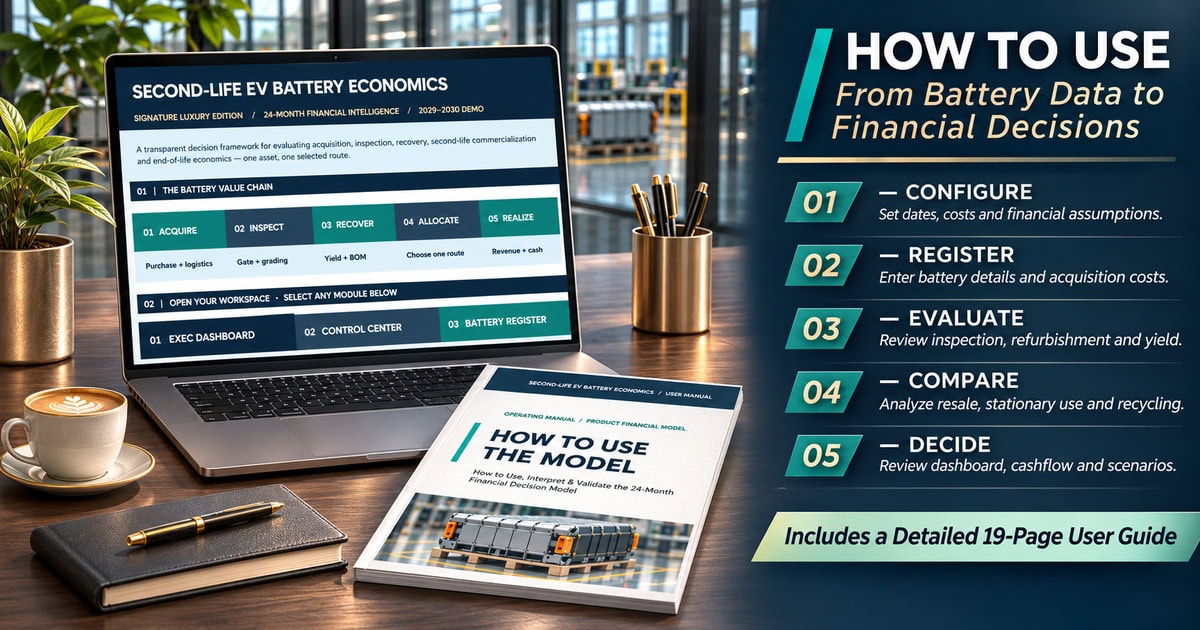
🧭 HOW TO GET STARTED
01 — ⚙️ CONFIGURE THE MODEL
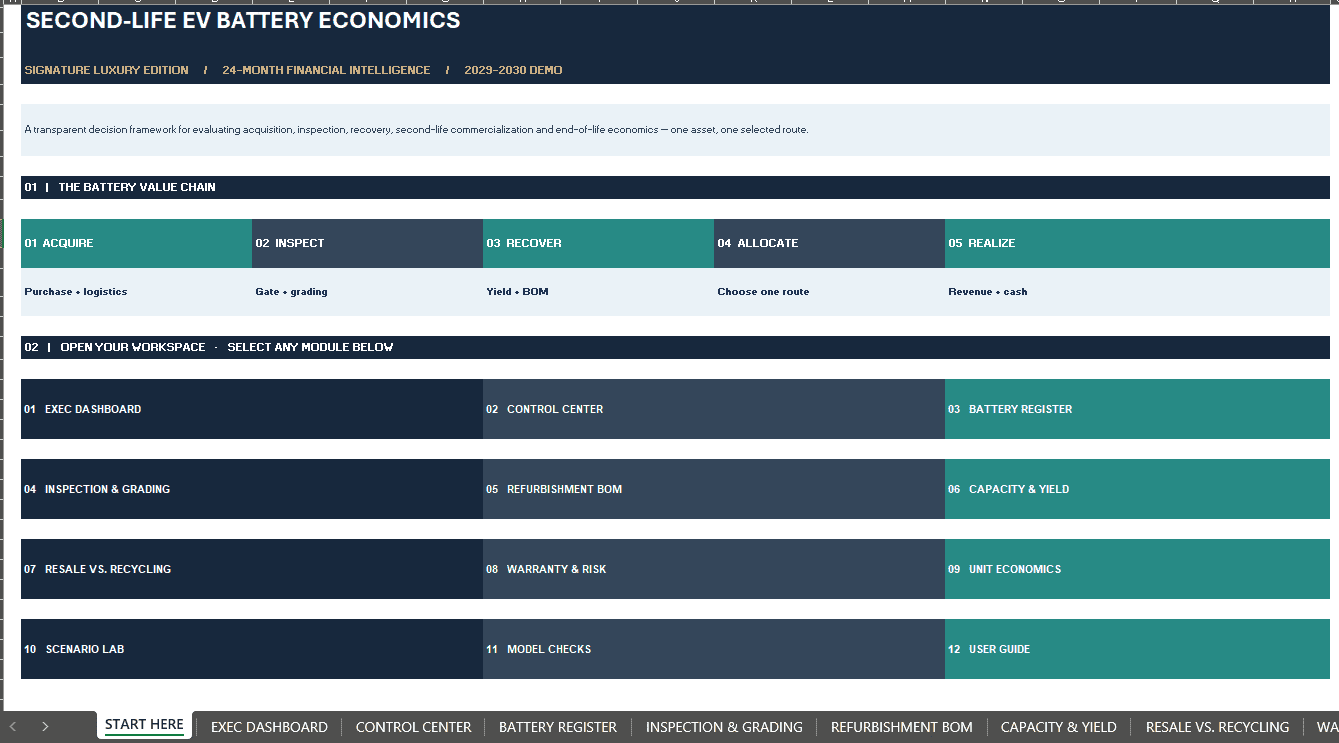
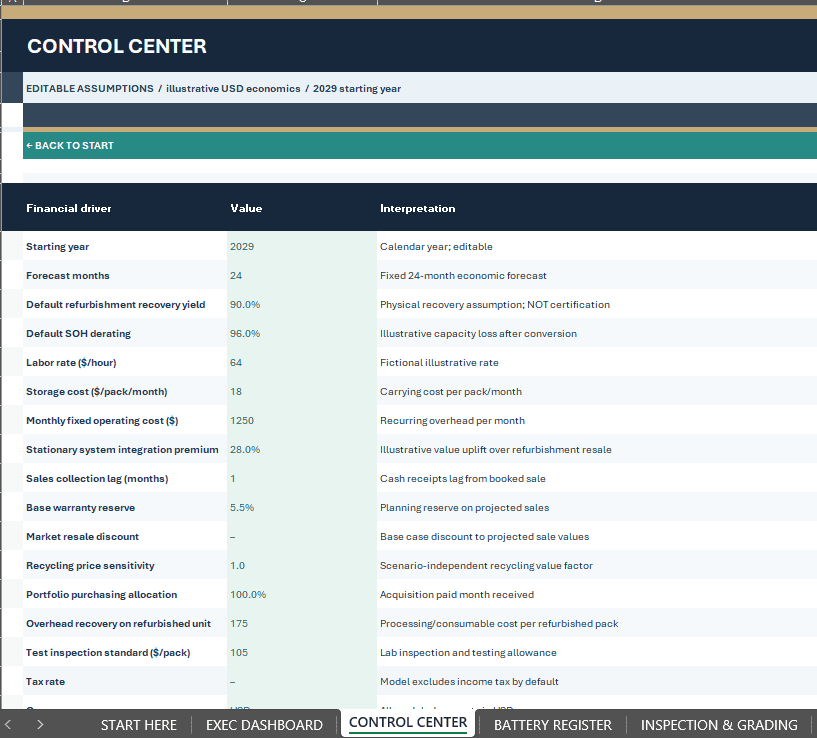
Open START HERE and CONTROL CENTER. Review the planning period and financial assumptions.
02 — 🔋 ENTER BATTERY INFORMATION
Replace the fictional records in BATTERY REGISTER with authorized battery-specific data and assumptions.
03 — 🔬 REVIEW INSPECTION & GRADING
Examine battery condition, SOH, accepted units and estimated usable capacity.
04 — 🛠️ ANALYZE PROCESSING COSTS
Update REFURBISHMENT BOM, CAPACITY & YIELD and WARRANTY & RISK.
05 — ♻️ COMPARE COMMERCIAL ROUTES
Review RESALE VS. RECYCLING and the associated unit economics.
06 — 📊 EVALUATE FINANCIAL RESULTS
Use UNIT ECONOMICS and EXEC DASHBOARD to review cost, profitability and monthly forecasts.
07 — 🔀 STRESS-TEST & VALIDATE
Compare the four financial scenarios and review MODEL CHECKS before relying on outputs.
The included 19-page English PDF guide provides further instructions and methodology explanations.
👥 IDEAL FOR
🔋 Battery Repurposing Companies
♻️ Circular-Economy Businesses
🏭 Battery Recycling Operators
⚡ Stationary Energy Storage Developers
💼 Financial Controllers & FP&A Teams
📊 Financial Analysts & Investors
🔬 Battery Recovery Strategy Teams
🛠️ Industrial & Energy Consultants
Typical applications: Battery acquisition evaluation, refurbishment economics, second-life battery resale analysis, recycling value comparison, recovery yield planning, cost-per-kWh analysis, break-even pricing and financial scenario assessment.
💻 TECHNICAL SPECIFICATIONS
Specification
Details
File Format
Microsoft Excel (.xlsx)
Forecast Horizon
24 Months
Default Years
2029–2030
Worksheets
13
Example Battery Records
15
Prepared Input Rows
45
Commercial Routes
5
Executive KPIs
10
Native Excel Charts
6
Financial Scenarios
4
Model Checks
24
PDF Guide
19 English Pages
Macros / VBA
None
External Data Connections
None Required
Power Query
None
Worksheet Protection
None
Recommended Software
Microsoft Excel Desktop
Language
English
Editable Demonstration Inputs: All battery examples, acquisition prices, technical characteristics, resale values, recovery assumptions and financial figures are fictional.
Google Sheets import may require adjustments to formulas, formatting, native charts and input validation. Full compatibility has not been independently verified.
Digital download only — no physical product is supplied.
⚠️ IMPORTANT TECHNICAL & FINANCIAL LIMITATIONS
This workbook is an illustrative financial planning tool, not a battery diagnostic platform, engineering model, safety assessment, certified testing system or regulatory compliance solution.
SOH, usable capacity, inspection grades and recovery yields are financial assumptions. They do not establish electrical safety, actual remaining battery life, technical fitness or suitability for stationary energy storage.
The model does not verify transportation requirements, recycling certification, fire safety, electrical safety or engineering approval.
Actual resale proceeds, refurbishment costs, recovery values and investment outcomes depend on market conditions, battery condition, contractual terms and other factors.
No battery performance, financial return, recovery value or commercial profitability is guaranteed.
🛡️ INDEPENDENT TEMPLATE & LEGAL NOTICE
The Second-Life EV Battery Repurposing Economics model is an independent, unofficial financial planning template developed by SheetworksStudio.
It is not affiliated with, certified by, sponsored by or endorsed by battery manufacturers, EV manufacturers, recycling companies, regulators, industry standards organizations or spreadsheet software providers.
The model is not independently audited, engineering-approved or regulator-certified and does not constitute financial, accounting, investment, tax, legal, technical safety or environmental compliance advice.
All demonstration data is fictional. Users must independently verify inputs, battery condition, contractual arrangements, financial assumptions and applicable regulations.
SHEETWORKSSTUDIO
Calm design. Clear logic.
Premium Financial Models • Circular Economy Intelligence • Professional Excel Templates
Similar ProductsOther customers were also interested in...


 eFinancialModels
Electric Vehicle (EV) Charging Station Financial M...
With this comprehensive 5- or 10-year monthly tool, investors can assess the viability of setting up... Read more

Financial Model for Mobile App | Mobile App Busine...
The Mobile App Financial Plan Template in Excel allows you to develop financial projections when lau... Read more

 HenrySheykin
Food Truck Financial Model Excel Template
The Food Truck Financial Model helps entrepreneurs, founders, business owners, consultants, and anal... Read more

Green Hydrogen Production from Wind Energy Financi...
The Green Hydrogen from Wind Financial Model aims to comprehensively forecast a horizon of 40 years ... Read more

Simple Mutual Non-Disclosure Agreement Template
Protect your business secrets with ease using our Simple Mutual Non-Disclosure Agreement Template. S... Read more

Solar Energy Financial Model
The Solar Energy Financial Model Spreadsheet Template in Excel assists you in preparing a sophistica... Read more

 Peter Graf
The Customer-Centric Financial Model for Restauran...
Starting a restaurant without a financial plan is like driving a car blindfolded. You wouldn´t do i... Read more
You must log in to submit a review.