
0 ITEMS

Project Finance Model: 500 MW Offshore Wind with Debt Sizing, DSCR, Equity IRR and 3 Statements (Free Excel)
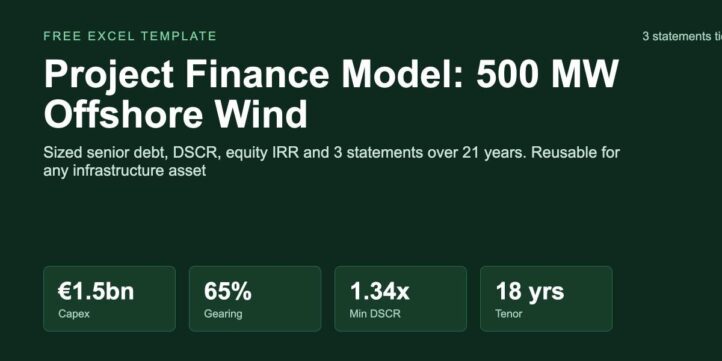
A reusable project finance template for a capex-heavy asset on a long-term contract, worked on a 500 MW offshore wind farm with a 20-year PPA. Generation build, P&L, senior debt at 65% gearing amortised over 18 years, DSCR per year and minimum DSCR, project equity IRR, and three statements that tie out over 21 years (balance check monitored at zero). Swap the asset drivers to reuse it for solar, storage, towers, data centres or toll roads. Free, fully unlocked, no macros, no external links.
What this project finance template is for
This model shows how a large infrastructure asset is financed and repaid: a big upfront capex, funded by senior debt plus sponsor equity, repaid from long-term contracted revenue and tested on debt service coverage and equity return. It is built for project finance analysts, infrastructure and energy investors, lenders reviewing a base case, and students learning the mechanics. The worked example is a 500 MW offshore wind farm: 1.5bn of capex at 3,000k per MW, 65% gearing at 5.0% over 18 years, 525m of sponsor equity, construction in 2026 and 20 operating years to 2046.
What is inside
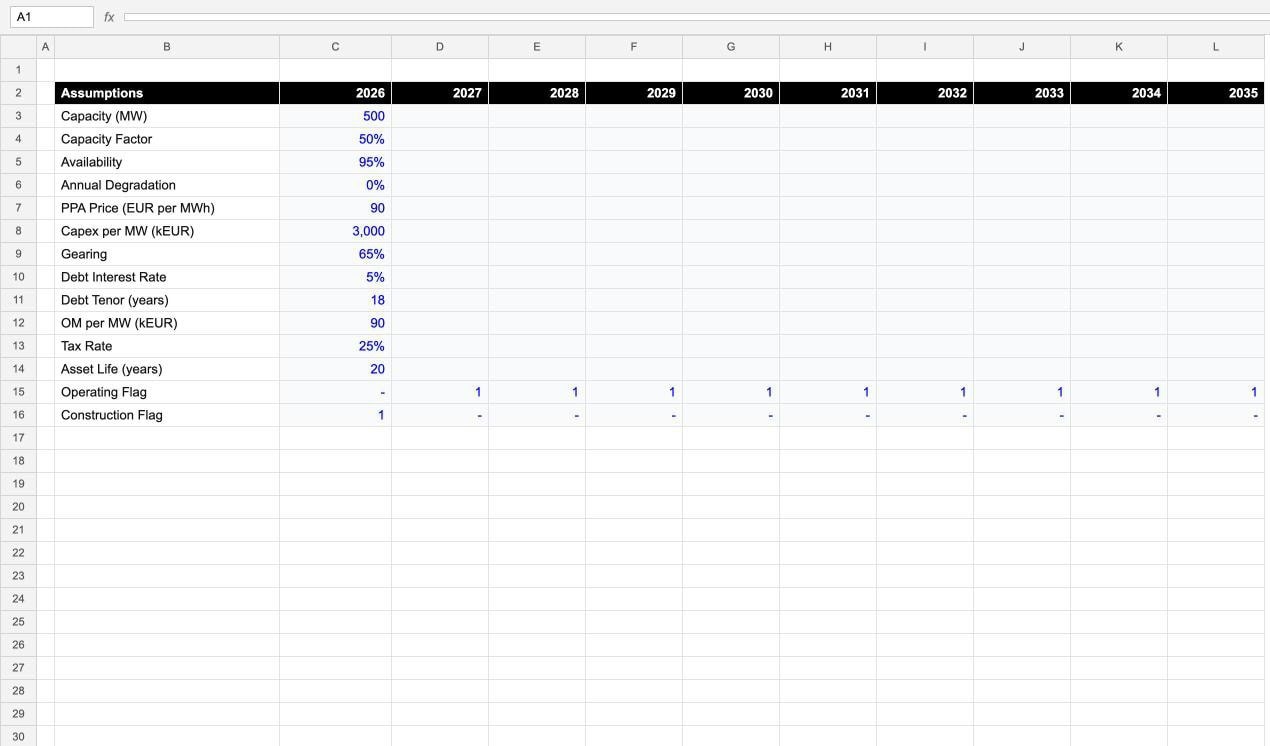
Assumptions: every driver on one sheet, inputs in blue (capacity, capacity factor, availability, degradation, PPA price, capex per MW, gearing, interest rate, tenor, O&M per MW, tax rate, asset life, construction and operating flags).
Generation: gross and net annual generation in MWh, with degradation over the life of the asset.
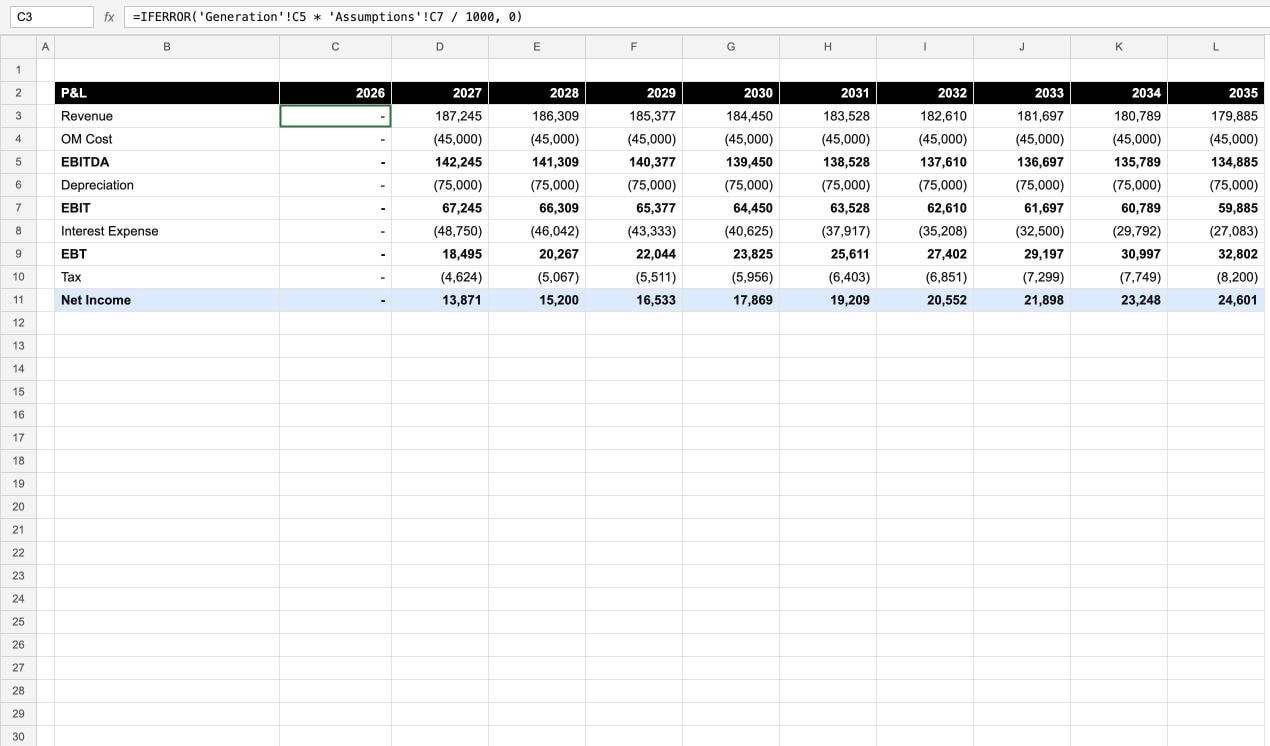
P&L: revenue, O&M, EBITDA, depreciation, interest, tax and net income for every year.
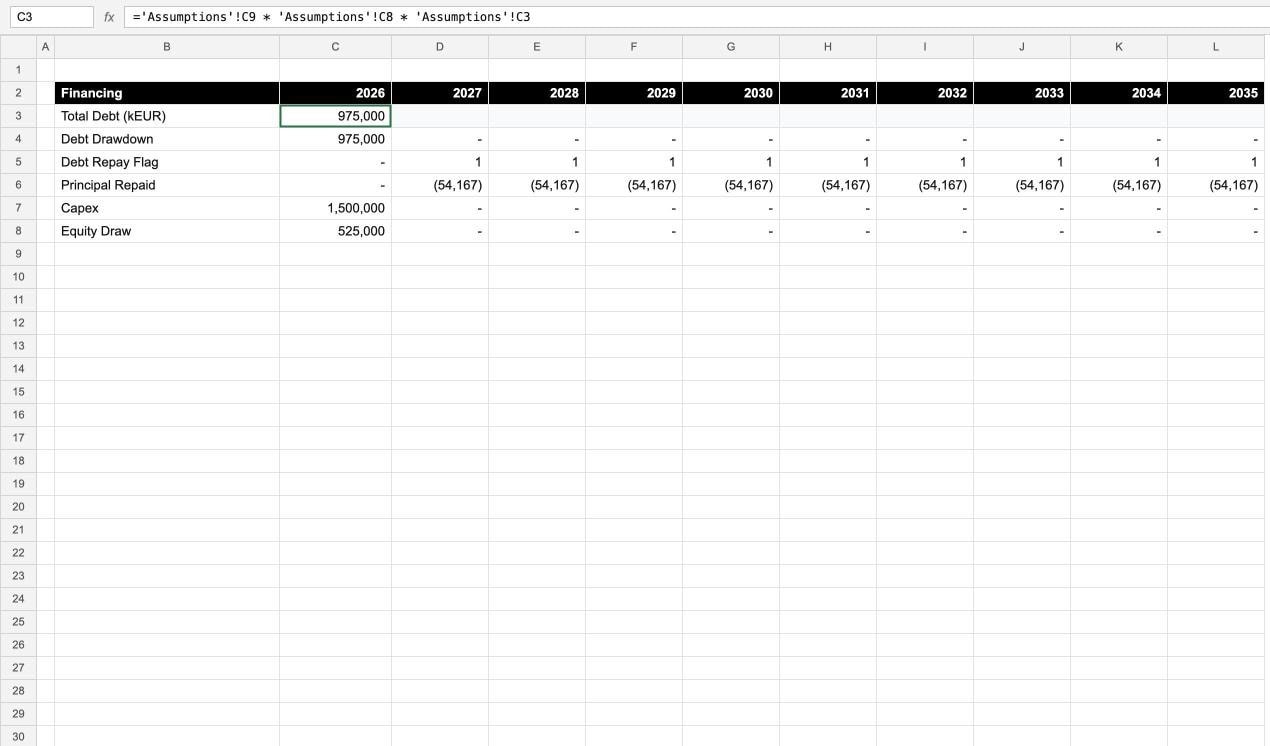
Financing: debt drawdown at financial close, straight-line principal repayment over the tenor, capex and equity draw.
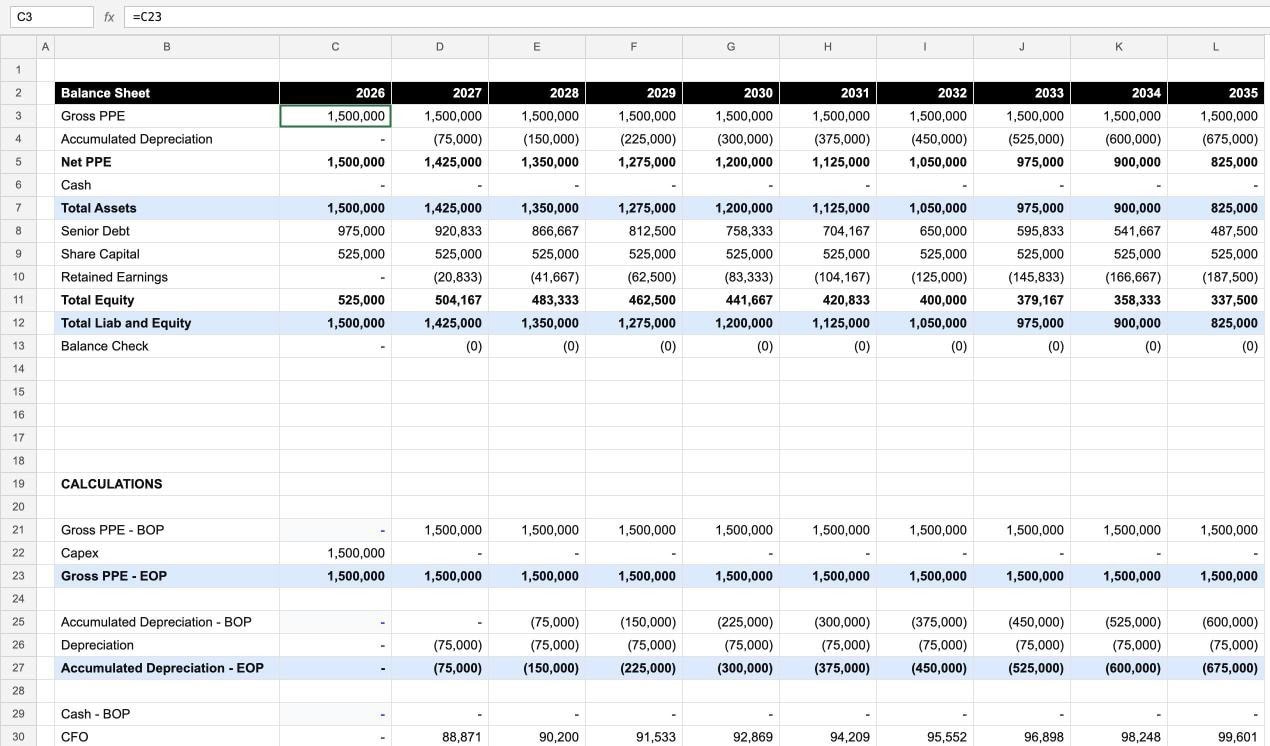
Cash Flow and Balance Sheet: wired, not pasted. The cash flow rolls into the balance sheet and a Balance Check line stays at zero in all 21 years; the senior debt amortises to zero at maturity.
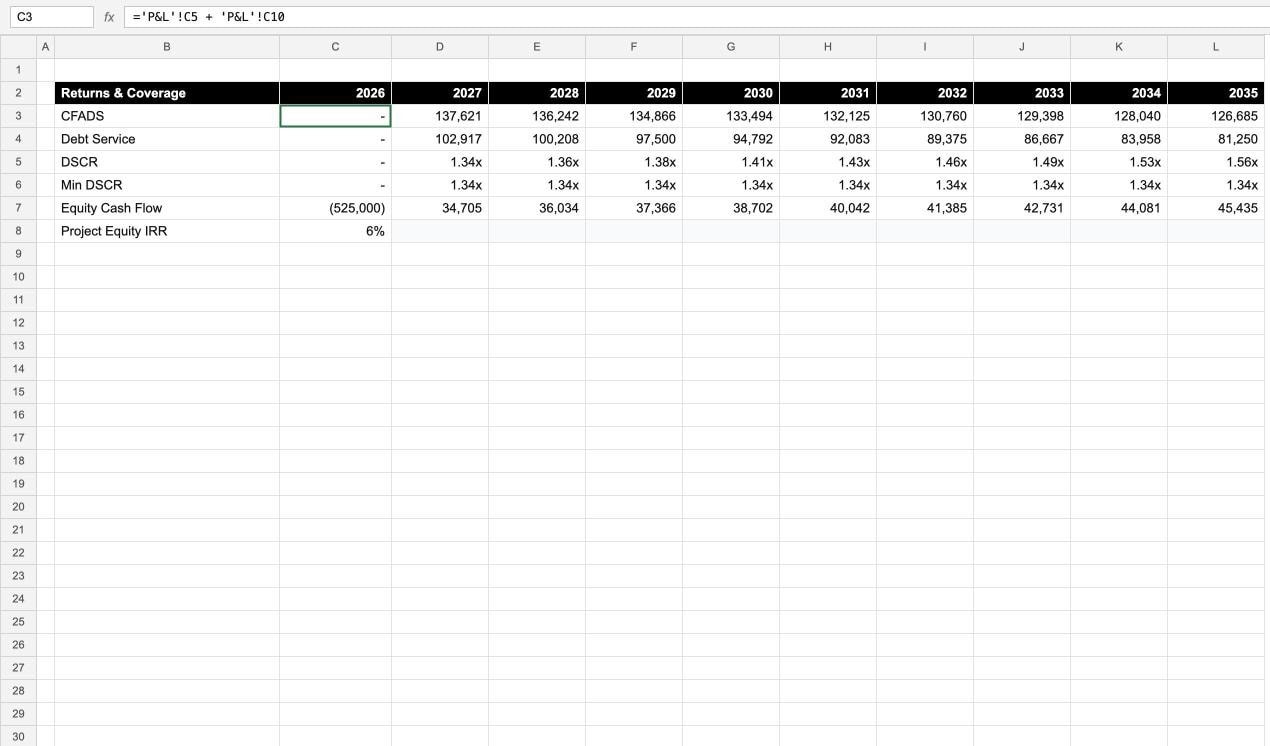
Returns and Coverage: CFADS, debt service, DSCR per year, minimum DSCR (1.34x) and project equity IRR.
Investor Dashboard: the key outputs at a glance.
How to use it
Open the Assumptions sheet and change the blue inputs. Everything else is a formula: generation, the three statements, the debt schedule, the DSCR and the IRR recompute at once. Test a lower PPA price, a higher gearing or a shorter tenor and watch the minimum DSCR. To reuse the model for another asset, keep the structure and swap the asset drivers: capacity factor and degradation for solar or storage, sites and lease rates for towers or data centres, traffic and tariff for a toll road.
Why this template
Project finance models are often too heavy to audit. This one keeps the skeleton that every infrastructure deal shares (sized debt, coverage ratios, equity return, balancing statements) in a structure you can read in a few minutes. Formulas are visible, nothing is locked, no macros and no hard-coded values inside the statements. Note: distributions follow a full cash sweep to equity, so cumulative distributions can exceed accounting profit; add a distribution lock-up or shareholder loans if your jurisdiction requires distributable reserves.
About the author
Built by Anthony Barbey, former Director in financial modelling and project finance at Deloitte Finance, now a fractional CFO. The model was built in Layerz, a structured spreadsheet ready for AI, and exported to Excel. A documented version of the model, with its structure explained, is available on GitHub (anthomakr/finance-models).
Similar ProductsOther customers were also interested in...


 eFinancialModels
Electric Vehicle (EV) Charging Station Financial M...
With this comprehensive 5- or 10-year monthly tool, investors can assess the viability of setting up... Read more

Financial Model for Mobile App | Mobile App Busine...
The Mobile App Financial Plan Template in Excel allows you to develop financial projections when lau... Read more

 HenrySheykin
Food Truck Financial Model Excel Template
The Food Truck Financial Model helps entrepreneurs, founders, business owners, consultants, and anal... Read more

Green Hydrogen Production from Wind Energy Financi...
The Green Hydrogen from Wind Financial Model aims to comprehensively forecast a horizon of 40 years ... Read more

Simple Mutual Non-Disclosure Agreement Template
Protect your business secrets with ease using our Simple Mutual Non-Disclosure Agreement Template. S... Read more

Solar Energy Financial Model
The Solar Energy Financial Model Spreadsheet Template in Excel assists you in preparing a sophistica... Read more

 Peter Graf
The Customer-Centric Financial Model for Restauran...
Starting a restaurant without a financial plan is like driving a car blindfolded. You wouldn´t do i... Read more
You must log in to submit a review.