
0 ITEMS

Photography Studio Financial Model Excel Template
The Photography Studio Financial Model helps users turn a studio concept into a structured, editable financial forecast for launch, funding, or expansion planning. Instead of building a complex spreadsheet from scratch, entrepreneurs and business owners can work from a ready-to-use template designed around the economics of a photography studio, including customer acquisition, service pricing, package mix, print and album sales, equipment investment, staffing, and recurring operating expenses. It gives users a practical way to estimate how revenue may grow, how much capital may be required, and when the business can move toward sustainable profitability. This financial model template is built for photography studio founders, existing studio owners, consultants, analysts, and anyone preparing a business plan, lender package, or investor presentation. It supports financial planning by organizing the assumptions that matter most, such as session volume, hourly rates, memberships, marketing spend, customer acquisition cost, direct costs, payroll, rent, software, outsourcing, and fixed overhead. By connecting these assumptions to projected income statements, cash flow, and investment metrics, the model helps users understand the financial consequences of their decisions before committing money or resources. The template is especially useful for evaluating different business strategies. Users can test pricing changes, adjust revenue assumptions, model low, base, and high scenarios, review startup costs, forecast operating expenses, and analyze how changes in customer volume or service mix affect cash flow and profitability. The model also supports break-even analysis, helping users estimate when the studio may cover its costs and begin generating positive returns. This makes it easier to set realistic expectations, prepare funding requests, and decide whether the business plan is financially achievable. Designed to be fully customizable, the Photography Studio Financial Model can be adapted for boutique portrait studios, brand photography businesses, commercial studios, family photography studios, or hybrid models with packages, memberships, single sessions, and print products. It includes investor-ready formatting, dashboard views, professional charts, KPI tracking, and lender-friendly reports so users can present their financial story clearly. Whether you are launching a new studio, expanding an existing one, or advising a client, this template helps simplify decision-making and provides a more disciplined approach to budgeting, forecasting, and long-term business planning.
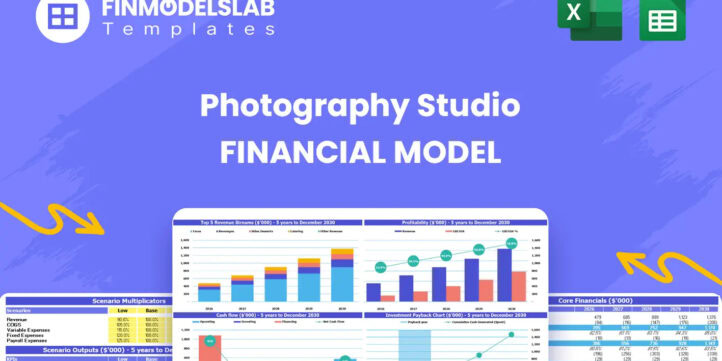


Financial Model Overview
The Photography Studio Financial Model is a ready-to-use financial model template created to help entrepreneurs, studio owners, consultants, and analysts forecast the financial performance of a photography business. It brings together the main planning drivers of a studio, including revenue streams, customer acquisition, pricing, memberships, session packages, print and album sales, startup investment, operating expenses, payroll, cash flow, profitability, and investor returns. For a photography studio, the financial picture can change quickly depending on booking volume, service mix, equipment needs, outsourcing costs, and marketing efficiency. This template gives users a structured way to organize those assumptions and translate them into a five-year financial forecast. It is useful for preparing a business plan, applying for funding, presenting to investors, testing expansion plans, or simply understanding whether a studio concept can become profitable under realistic assumptions.
All-in-One Dashboard
The all-in-one dashboard gives users a central view of the most important inputs and outputs in the Photography Studio Financial Model. Instead of searching through separate tabs to understand the business, users can review key assumptions, projected revenue, expenses, cash flow, profitability, and performance indicators in one place. Inputs may include customer acquisition cost, marketing budget, number of new customers, service pricing, package mix, direct costs, staffing assumptions, rent, and other operating expenses. Outputs may include projected sales, EBITDA, net profit, ending cash balance, payback period, and other financial metrics that matter to owners, lenders, and investors. This component is useful because it turns a detailed spreadsheet into a practical decision-making tool. A founder can quickly see whether the studio has enough revenue to support its cost structure, whether cash reserves are adequate during the ramp-up period, and whether changes in pricing or customer volume improve the overall business case.
Low, Base, and High Scenario Analysis
The low, base, and high scenario analysis component helps users model different possible outcomes for the photography studio rather than relying on a single forecast. The base case may represent the expected plan, while the low case can reflect a slower launch, higher customer acquisition cost, weaker booking volume, or lower package conversion. The high case can show the upside from stronger marketing performance, better pricing, higher membership adoption, or a more profitable service mix. Key inputs can include new customer volume, average session price, hourly rates, conversion to premium packages, print and album sales, marketing spend, direct costs, payroll, and fixed overhead. The model then shows how each scenario affects revenue, cash flow, EBITDA, profitability, and funding needs. This is valuable for planning because a photography studio often faces uncertainty in its first years. Scenario analysis helps users stress-test the business, prepare for downside risk, evaluate upside opportunities, and present a more credible plan to investors or lenders.
Professional Charts
The professional charts component converts the financial model’s calculations into clear visual outputs that are suitable for internal reviews, business plans, investor discussions, and stakeholder presentations. These charts may display revenue growth, profitability trends, cash flow movement, cost structure, margin development, service mix, and key performance metrics over time. Inputs come from the underlying assumptions and forecast sheets, such as sales by revenue stream, monthly expenses, staffing costs, direct production costs, and projected financial statements. Outputs are visual summaries that make the model easier to understand and communicate. This is particularly useful for a photography studio because many strategic decisions involve comparing trends, such as whether revenue growth is keeping pace with marketing spend, whether fixed studio costs are being absorbed as bookings increase, or whether cash flow is improving after the initial investment period. Professional charts help users explain the financial story without forcing stakeholders to interpret rows of spreadsheet data.
ROE Components and DuPont Analysis
The ROE components and DuPont analysis section helps users understand the drivers behind return on equity rather than viewing profitability as a single isolated number. This component breaks down return performance into underlying factors such as profitability, asset efficiency, and leverage. Inputs may include net income, revenue, assets, equity, and balance sheet assumptions from the forecast. Outputs can include return on equity, profit margin, asset turnover, equity multiplier, and related indicators that show how effectively the studio converts investment into financial returns. For a photography studio, this is useful because investment is often concentrated in equipment, editing workstations, studio setup, and working capital. DuPont analysis helps users evaluate whether returns are coming from strong margins, efficient use of assets, or financing structure. It also supports investor discussions by showing the economics behind the return profile, helping users assess whether the business is generating enough value from the capital invested.
Revenue Inputs
The revenue inputs component is where users define the commercial assumptions that drive the studio’s forecast. This section may include service pricing, hourly rates, number of new customers, customer acquisition cost, marketing budget, expected booking volume, conversion rates, package allocation, membership adoption, and add-on sales such as prints and albums. For example, a studio may model revenue from single sessions, multi-session packages, brand builder memberships, and physical products. The model uses these assumptions to calculate projected sales by month and year, allowing users to see how changes in demand, pricing, or service mix affect the overall forecast. This component is important because revenue is not just a single top-line number. In a photography studio, revenue depends on how many customers are acquired, which services they choose, how much they spend, and how often they return. By making these assumptions editable and transparent, the template helps users build a forecast that reflects their specific business model rather than relying on generic estimates.
Bank-Ready Reports
The bank-ready reports component provides lender-friendly financial outputs that can support loan applications, funding discussions, and formal business planning. These reports may include projected profit and loss statements, cash flow forecasts, balance sheets, financing assumptions, debt repayment schedules, and summaries of key financial metrics. Inputs are drawn from the model’s revenue assumptions, startup costs, operating expenses, payroll, direct costs, capital investment, and funding structure. Outputs help show whether the photography studio can generate enough revenue and cash flow to cover expenses, repay debt, maintain liquidity, and grow over time. This component is useful because banks and lenders typically want to see more than an idea. They need structured projections, clear assumptions, and evidence that the borrower understands the financial requirements of the business. Bank-ready reports help users present the studio in a professional format, demonstrate repayment capacity, and answer common lender questions about profitability, cash balance, and funding needs.
Revenue Breakdown
The revenue breakdown component gives users a detailed view of how the studio earns money across different products and services. Instead of treating sales as one general line item, the model separates revenue streams such as brand builder memberships, multi-session packages, single sessions, prints, albums, and other studio offerings. Inputs may include unit volume, pricing, average order value, customer allocation by service type, upsell rates, and recurring membership assumptions. Outputs show revenue by stream, contribution to total sales, growth over time, and the effect of changing the service mix. This is useful because not all photography revenue has the same margin, effort level, or cash flow profile. A high-priced membership may create more predictable income, while prints and albums may generate strong margins as add-ons. A detailed revenue breakdown helps users identify which offerings are most important to the business model, where to focus marketing, and how to refine pricing or packages for better profitability.
KPI Dashboard
The KPI dashboard component helps users monitor the operating and financial metrics that matter most for a photography studio. These may include revenue growth, gross margin, EBITDA, net profit, customer acquisition cost, cash balance, payback period, return on equity, booking volume, average revenue per customer, and other performance indicators. Inputs come from the model’s revenue, expense, payroll, capital expenditure, and cash flow sections, while outputs are summarized in an easy-to-read format for quick review. This component is useful because a photography studio owner needs to track both creative business activity and financial performance. A studio may appear busy but still struggle if customer acquisition costs are too high, packages are underpriced, payroll is increasing too quickly, or fixed expenses are not covered by recurring revenue. The KPI dashboard helps users identify these issues earlier, compare actual or projected performance against targets, and make more informed decisions about pricing, marketing, staffing, and expansion.
Startup Cost and Capital Investment Planning
The startup cost and capital investment planning component organizes the initial funding required to prepare the photography studio for launch or expansion. Inputs may include professional camera bodies, lenses, lighting equipment, backdrops, props, editing workstations, studio furniture, deposits, leasehold improvements, insurance, licenses, website development, software setup, initial marketing, and working capital reserves. The model can separate one-time launch costs from ongoing operating expenses, helping users avoid mixing setup investment with monthly overhead. Outputs may include total initial capital required, funding gap, investment schedule, depreciation assumptions, and the effect of capital purchases on cash flow. This is especially important for a photography studio because equipment quality and studio setup can require meaningful upfront spending before revenue begins. By clearly mapping these costs, the template helps founders estimate how much money is needed before opening, decide whether to buy or delay certain assets, and present a realistic funding request to banks, investors, or partners.
Break-Even Analysis
The break-even analysis component helps users estimate when the photography studio can cover its costs and begin generating sustainable profit. Inputs may include projected revenue, direct costs, marketing spend, rent, payroll, software subscriptions, insurance, utilities, outsourcing, and other fixed and variable expenses. The model uses these assumptions to calculate when cumulative profit or cash flow reaches the break-even point, as well as how changes in price, customer volume, cost structure, or package mix can move that date forward or backward. Outputs may include the break-even month, required sales level, required number of sessions or customers, and profitability timeline. This component is useful for planning because many studios experience a ramp-up period while building their client base and brand recognition. Break-even analysis helps users set realistic expectations, determine whether starting cash is sufficient, evaluate how quickly the business must grow, and identify practical actions that can accelerate profitability, such as increasing prices, improving conversion rates, reducing customer acquisition cost, or focusing on higher-margin offerings.
File types:
Excel – Single-User: .xlsx
Excel – Multi-User: .xlsx
Similar ProductsOther customers were also interested in...



 HenrySheykin
Traditional Advertising Agency Financial Model Exc...
The Advertising Agency Financial Model helps founders, agency owners, consultants, analysts, and bus... Read more

Direct Marketing Agency Financial Model Excel Temp...
The Direct Marketing Agency Financial Model helps turn an agency concept into a structured financial... Read more

Content Marketing Agency Financial Model Excel Tem...
The Marketing Agency Financial Model is a ready-to-use financial model template built to help agency... Read more
 City Finance
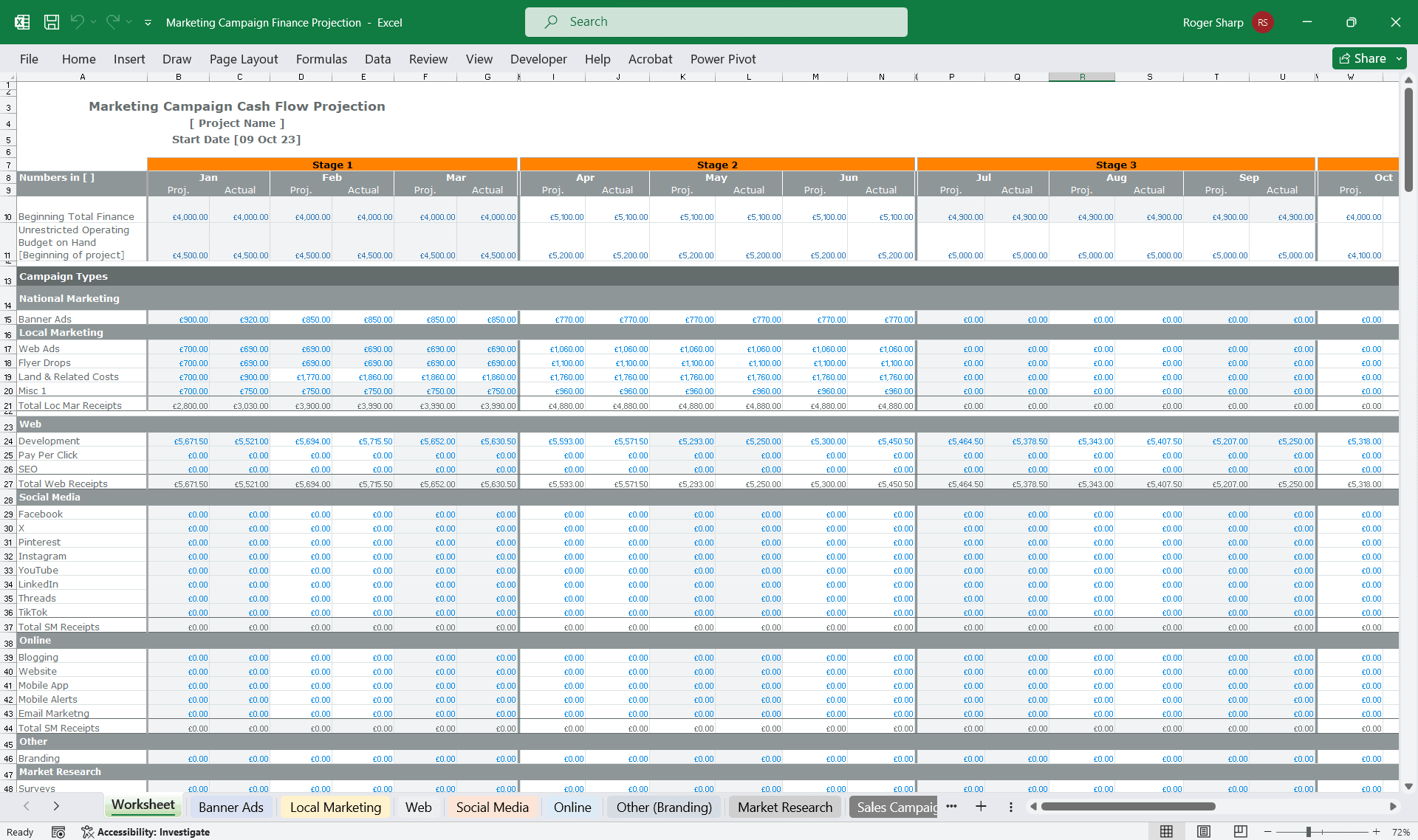
Marketing Campaign Financial Projection Model
Comprehensive editable, Excel spreadsheet for tracking marketing campaign financials in months or st... Read more

Social Network Financial Model Excel Template
The Social Networking Platform Financial Model helps founders, entrepreneurs, consultants, analysts,... Read more
Office Development REFM Financial Model Excel Temp...
The Office Development Financial Model Financial Model Template helps users evaluate a commercial of... Read more
Social Media Agency Financial Model Excel Template
The Social Media Agency Financial Model helps users turn an agency concept, launch plan, or growth s... Read more

Digital Marketing Agency Financial Model Excel Tem...
The Digital Marketing Agency Financial Model helps agency founders, business owners, consultants, an... Read more

Email Marketing Agency Financial Model Excel Templ...
The Email Marketing Agency Financial Model helps founders, agency owners, consultants, analysts, and... Read more

Office Acquisition REFM Financial Model Excel Temp...
The Real Estate Acquisition Financial Model Financial Model Template helps investors, developers, an... Read more
Reviews
 Studio Model
Thank you for the free demo to give an idea of whether this is the right model for me!
573 of 1161 people found this review helpful.
Help other customers find the most helpful reviews
Did you find this review helpful?
You must log in to submit a review.