
0 ITEMS

Email Marketing Agency Financial Model Excel Template
The Email Marketing Agency Financial Model helps founders, agency owners, consultants, analysts, and business plan writers turn an email marketing service concept into a structured five-year financial forecast. Instead of starting with a blank spreadsheet, users can work from a ready-to-use model built around the way email marketing agencies typically earn revenue, manage retainers, deliver client services, and scale operations. It supports financial planning by connecting revenue assumptions, customer acquisition costs, service package pricing, startup costs, operating expenses, payroll, cash flow, and profitability into one editable framework. This template is designed for entrepreneurs launching a new agency, established digital marketing businesses adding email marketing services, and advisors preparing funding documents or investor presentations. Users can customize assumptions for client growth, monthly retainers, automation setup fees, list management services, marketing spend, staffing plans, direct service costs, and recurring overhead. The model helps estimate how quickly the agency may become profitable, how much capital may be needed at launch, and how changes in pricing, acquisition cost, churn, or service mix can affect long-term performance. The model is useful for both strategic decision-making and formal financial reporting. It includes core forecast outputs such as profit and loss, cash flow, balance sheet views, scenario analysis, KPI tracking, and investor-ready summaries. This makes it easier to explain the financial logic behind the agency, compare different growth paths, review operating margins, evaluate cash runway, and prepare answers to common lender or investor questions. It also supports break-even analysis so users can understand the revenue level and timeline required to cover fixed and variable costs. Because the Email Marketing Agency Financial Model is fully editable and compatible with Excel and Google Sheets, users can adapt it to their own market, pricing strategy, staffing model, and funding plan. It is suitable for business planning, pitch decks, loan applications, internal budgeting, monthly reviews, and growth planning. By organizing the key financial drivers of an email marketing agency in one place, the template helps users make more confident decisions before launch, during expansion, or while preparing professional financial projections for stakeholders.
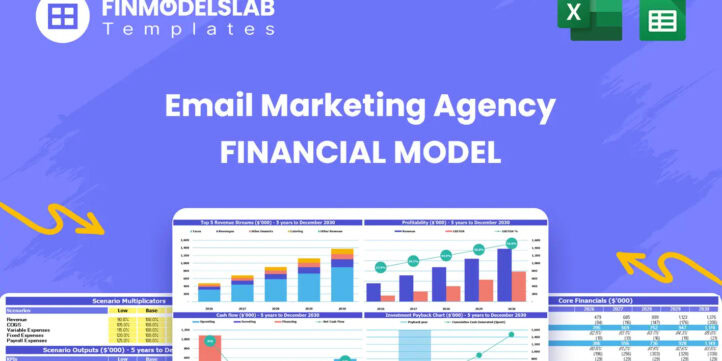


Financial Model Overview
The Email Marketing Agency Financial Model is a ready-to-use financial model template designed to help founders, agency owners, consultants, analysts, and business planners forecast the financial performance of an email marketing agency. It brings together the core drivers of an agency business, including client acquisition, service package pricing, monthly retainers, automation setup work, list management services, staffing, delivery costs, operating expenses, cash flow, profitability, and funding needs. For an email marketing agency, a strong financial model is especially useful because the business often depends on recurring client revenue, service capacity, marketing efficiency, and margin control. This template gives users a structured way to test assumptions, prepare five-year projections, review financial statements, compare scenarios, and present a more credible plan to investors, lenders, partners, or internal decision-makers. Instead of building formulas and reports from scratch, users can update editable inputs and use the model to evaluate whether the agency can launch, grow, and reach sustainable profitability.
All-in-One Dashboard
The all-in-one dashboard component gives users a centralized view of the most important inputs and outputs in the Email Marketing Agency Financial Model. It is designed to bring together the major assumptions that drive the forecast, such as service pricing, customer acquisition cost, client growth, direct service costs, operating expenses, and staffing requirements, then connect those assumptions to key outputs such as revenue, gross profit, EBITDA, net income, cash balance, and return metrics. For an email marketing agency, this dashboard is useful because owners and stakeholders need to see how recurring retainers, one-time setup work, list management services, and growth assumptions translate into financial results. Rather than moving through multiple worksheets to understand performance, users can review high-level outcomes in one place and quickly identify whether the plan is commercially viable. This component is particularly valuable for management reviews, investor discussions, and funding preparation because it summarizes the model’s core financial story in a clear and organized format.
Low, Base, and High Scenario Analysis
The low, base, and high scenario analysis component helps users evaluate how the agency may perform under different business conditions. The model can be used to compare conservative, expected, and optimistic cases by adjusting major assumptions such as customer acquisition cost, marketing budget, new client volume, churn, pricing growth, service mix, payroll expansion, and operating costs. In a low scenario, users can stress-test the business against slower client acquisition, higher churn, or weaker pricing power. In a base scenario, they can model a realistic operating plan based on the agency’s intended strategy. In a high scenario, they can review the upside potential of stronger demand, better retention, higher average contract value, or improved operating efficiency. This component is useful for decision-making because it shows how sensitive revenue, margins, cash runway, and profitability may be to changes in key business drivers. It also helps entrepreneurs and investors understand risk, prepare contingency plans, and make more informed strategic choices before committing capital or expanding the team.
Professional Charts
The professional charts component turns the financial forecast into visual reports that are easier to review, explain, and present. The model can display trends such as revenue growth, profitability, cash movement, cost structure, client growth, margins, and other financial metrics over time. For an email marketing agency, charts are useful because they make it easier to communicate how recurring monthly retainers, service package mix, customer acquisition, and operating leverage affect the financial trajectory of the business. Instead of relying only on rows of spreadsheet data, users can show stakeholders a clear visual progression of sales, expenses, EBITDA, cash flow, and other key indicators. This component is valuable for pitch decks, lender submissions, internal reporting, board updates, and monthly business reviews. It helps simplify complex financial information and supports more confident communication with investors, co-founders, advisors, or team members who need to understand the plan quickly.
ROE Components and DuPont Analysis
The ROE components and DuPont analysis component helps users examine return on equity by breaking it into underlying financial drivers. Rather than viewing return on equity as a single percentage, this section helps connect profitability, asset efficiency, and financial leverage to the agency’s overall return profile. For an email marketing agency, this is useful because strong revenue growth alone does not guarantee attractive returns if margins are weak, costs are too high, or capital is being used inefficiently. Inputs and outputs may include net profit margin, asset turnover, equity levels, leverage assumptions, net income, total assets, and shareholder equity. By reviewing these components, users can better understand whether returns are being driven by efficient operations, strong margins, scale, or capital structure. This component is especially helpful for investors and financial analysts because it adds a deeper layer of performance evaluation beyond the basic profit and loss statement. It supports more disciplined planning and helps users identify which levers may improve investor returns over time.
Revenue Inputs
The revenue inputs component is where users define the commercial assumptions that drive the Email Marketing Agency Financial Model. This section may include assumptions for marketing budget, customer acquisition cost, new client acquisition, client allocation across service packages, monthly retainer pricing, annual price increases, automation setup fees, list management revenue, and any other revenue streams relevant to the agency. For example, an email marketing agency may offer a growth package for foundational services, a scale package for expanding clients, an enterprise package for larger accounts, automation setup projects, and ongoing list management. The revenue inputs section connects these assumptions to the forecast so users can understand how many clients may be acquired, what they may pay, how revenue may grow, and how pricing decisions affect profitability. This component is critical for planning because revenue is not entered as a static number. It is built from the real drivers of the business, giving users a more realistic and editable way to forecast sales performance and test different go-to-market strategies.
Bank-Ready Reports
The bank-ready reports component provides lender-friendly financial outputs that can support loan applications, funding conversations, and formal business plan submissions. These reports may include projected profit and loss statements, cash flow forecasts, balance sheet summaries, profitability measures, debt capacity indicators, and other financial views that lenders commonly review when assessing a business. For an email marketing agency, bank-ready reporting is useful because external financing may be needed for startup investment, hiring, marketing spend, software systems, office setup, working capital, or expansion. This component helps users present the agency’s financial position in a professional and organized way, showing projected income, expenses, cash availability, and repayment capacity. It also helps demonstrate that the business plan is supported by structured assumptions rather than informal estimates. For founders, consultants, and business owners, this makes it easier to communicate funding needs, explain the use of capital, and provide stakeholders with clear financial documentation.
Revenue Breakdown
The revenue breakdown component gives users a detailed view of how total revenue is generated across the agency’s different service lines and customer segments. Instead of showing only total sales, this section can separate revenue from monthly retainers, growth packages, scale packages, enterprise packages, automation setup, list management, and other recurring or project-based services. This is especially important for an email marketing agency because different services may have different pricing, margins, delivery requirements, sales cycles, and scalability. A detailed revenue breakdown helps users understand which offerings contribute most to revenue, which services may be driving growth, and whether the agency is overly dependent on one type of client or package. It also supports strategic decision-making around pricing, upsells, service positioning, marketing focus, and team capacity. By reviewing revenue by stream, users can better plan the service mix, identify high-value opportunities, and build a more credible forecast that reflects how the agency actually earns money.
KPI Dashboard
The KPI dashboard component tracks key performance indicators that help users evaluate the health and efficiency of the email marketing agency. Relevant KPIs may include customer acquisition cost, client growth, churn, average revenue per client, revenue per service package, gross margin, EBITDA margin, cash balance, payback period, return metrics, and other operational or financial benchmarks. For an email marketing agency, KPI tracking is essential because performance depends on more than total revenue. The agency must acquire clients efficiently, retain them long enough to recover acquisition costs, manage service delivery costs, and maintain profitable recurring relationships. This component helps users monitor whether the business is moving in the right direction and compare projected results against internal targets or industry benchmarks. It is useful for monthly reviews, investor updates, management meetings, and performance improvement planning. By consolidating key metrics into one dashboard, the model helps users move from raw financial data to actionable business insights.
Startup and Operating Cost Planning
The startup and operating cost planning component helps users estimate the capital required to launch the agency and the recurring expenses required to keep it running. Startup cost inputs may include computer equipment, hardware, office setup, furnishings, software development, CRM setup, website development, branding, legal fees, licenses, initial marketing, deposits, and working capital. Operating expense inputs may include salaries, contractor costs, rent, software subscriptions, email marketing tools, analytics platforms, advertising, professional services, insurance, administrative expenses, and other recurring overhead. This component is useful because many agency owners underestimate the cash required before revenue becomes stable. By organizing both one-time and ongoing expenses, the model helps users calculate funding needs, plan budgets, phase spending, and avoid unnecessary cash pressure. For business planning and funding documents, this section also explains how capital will be used and whether the cost structure is realistic for the agency’s expected growth path.
Break-Even and Cash Flow Forecast
The break-even and cash flow forecast component helps users understand when the agency may become profitable and whether it can maintain enough liquidity while growing. Break-even analysis compares projected revenue against fixed and variable costs to identify the point where the business begins covering its total expenses. Cash flow forecasting then shows how money moves through the business over time, including revenue collections, payroll, operating expenses, startup investment, working capital needs, taxes, financing, and ending cash balances. For an email marketing agency, this component is especially important because recurring retainers can create attractive revenue stability, but payroll, marketing spend, software costs, and client acquisition expenses may create cash pressure during early growth. The model helps users evaluate cash runway, identify months where additional funding may be needed, and test how faster growth or slower collections affect liquidity. It supports better decision-making around hiring, pricing, sales targets, payment terms, and capital planning, giving users a clearer view of when the agency can reach sustainable profitability.
File types:
Excel – Single-User: .xlsx
Excel – Multi-User: .xlsx
Similar ProductsOther customers were also interested in...


 HenrySheykin
Digital Marketing Agency Financial Model Excel Tem...
The Digital Marketing Agency Financial Model helps agency founders, business owners, consultants, an... Read more
Direct Marketing Agency Financial Model Excel Temp...
The Direct Marketing Agency Financial Model helps turn an agency concept into a structured financial... Read more

Content Marketing Agency Financial Model Excel Tem...
The Marketing Agency Financial Model is a ready-to-use financial model template built to help agency... Read more
Traditional Advertising Agency Financial Model Exc...
The Advertising Agency Financial Model helps founders, agency owners, consultants, analysts, and bus... Read more
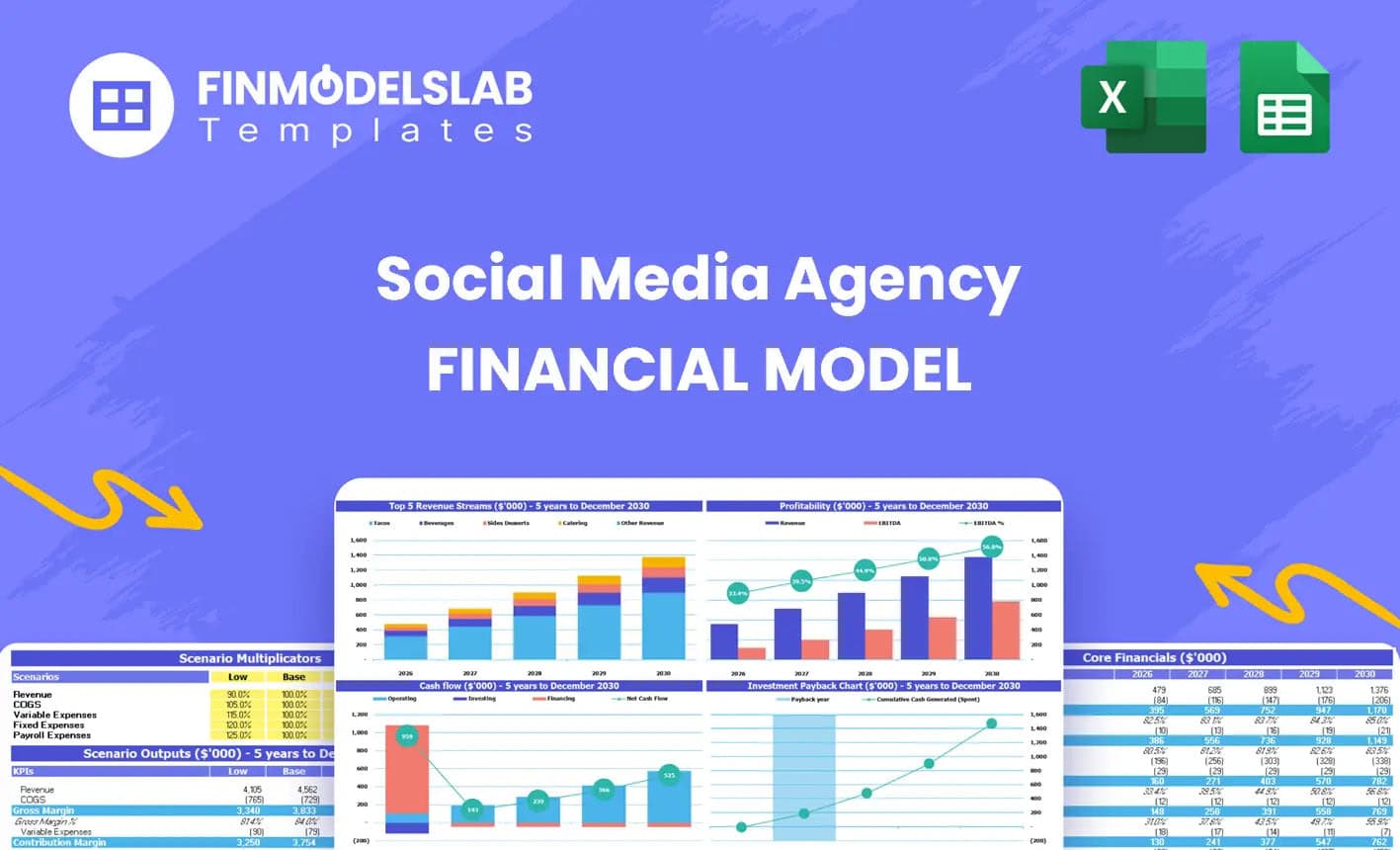
Social Media Agency Financial Model Excel Template
The Social Media Agency Financial Model helps users turn an agency concept, launch plan, or growth s... Read more

 City Finance
Bookkeeping Agency Finance Model Excel Template
A comprehensive editable, MS Excel spreadsheet for tracking Bookkeeping services finances, including... Read more

Social Media Marketing Agency Finance Model 5 Year...
Comprehensive editable, 5-year 3 statement MS Excel spreadsheets for tracking Social Media Service f... Read more

Digital Advertising Agency Finance Model Excel Tem...
A comprehensive editable 5 Year 3 Statement, MS Excel spreadsheet for tracking Digital Advertising A... Read more

Affiliate Marketing Agency Finance Model 5 Year 3 ...
A comprehensive editable, MS Excel spreadsheet for tracking Affiliate Marketing Agency finances, int... Read more

 UPtick
Youtube Content Creator Financial Model Excel Temp...
The UPtick Youtube Content Creator Template is a simple yet robust financial model that allows you t... Read more
You must log in to submit a review.