
0 ITEMS

Multi-Entity Treasury Liquidity & 13-Week Rolling Cash Flow Control Tower
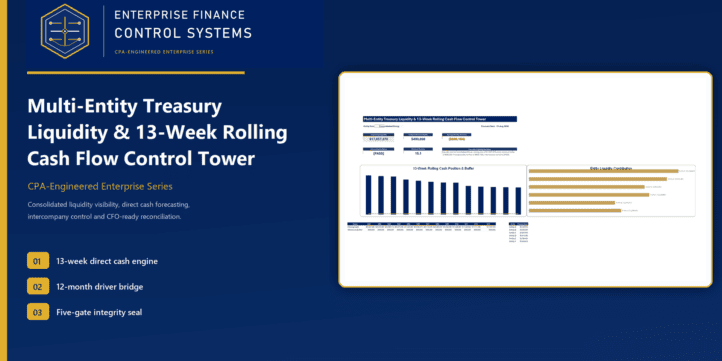
The Multi-Entity Treasury Liquidity & 13-Week Rolling Cash Flow Control Tower provides CFOs and Financial Controllers with unified cash visibility across operating entities. It integrates 13-week weekly receipts/disbursements forecasting with a 12-month macro driver model, intercompany loan settlement net-offs, and a 5-gate integrity audit. Quarantined Xero data ingestion feeds formula-driven liquidity waterfall charts and minimum-cash buffer views, helping teams identify cash blindness, liquidity pressure, and current solvency concerns. Reviewed exports remain separated from calculations, while entity selectors support consolidated analysis without claiming live Xero connectivity.
| Distribution, Financial Model, General Excel Financial Models, Service Businesses |
| Accounting, Cash Flow Projections, CFO, Consolidation, Excel, Financial Modeling |


The Multi-Entity Treasury Liquidity and 13-Week Rolling Cash Flow Control Tower is a Microsoft Excel model for CFOs, Financial Controllers, and treasury teams that need a view of cash across operating and shared-service entities. It combines direct weekly forecasting, longer-range driver analysis, intercompany settlement controls, and integrity testing within one formula-driven workbook.
The 13-week engine begins with reviewed opening bank balances and schedules receipts and disbursements according to expected settlement timing. Lines capture customer collections, supplier payments, payroll, tax, financing, and other operating movements. Users can evaluate consolidated results or select an entity, compare closing cash with its minimum buffer, identify runway pressure, and investigate the weeks driving a liquidity exception.
A 12-month macro engine extends the weekly horizon through assumptions for revenue, collection timing, payment timing, payroll, tax, and working capital. The monthly view is not a substitute for the direct weekly forecast. Instead, a reconciliation gate compares the two horizons so finance teams can identify divergence and refine assumptions without overwriting source history.
The bilateral intercompany bridge records both counterparties for each transfer or settlement. Due-to and due-from positions are assembled into a counterparty matrix, entity net positions remain visible, and the consolidated elimination delta is expected to equal zero. This structure makes missing, duplicated, or one-sided intercompany entries easier to isolate before group reporting.
Xero-oriented ingestion tables map reviewed exports for bank balances, accounts receivable aging, accounts payable aging, payroll and tax schedules, and intercompany activity. The package does not claim a live Xero connection. Sample data are illustrative and must be replaced with reviewed organisational records before operational use.
Five integrity gates test opening-cash continuity, intercompany elimination, weekly-versus-monthly convergence, minimum-buffer exceptions, and K1-to-K2-to-K3 formula lineage. Native executive charts display the weekly liquidity waterfall and monthly driver outlook using local workbook data.
The five-file suite contains the production workbook, Enterprise User Manual, Quick-Start Guide, Treasury Governance Sign-Off Template, and clean sample dataset. The documentation covers onboarding, role ownership, forecast refresh, exception handling, reconciliation, and sign-off. Published by Enterprise Finance Control Systems and engineered by Luke A., CPA. The model supports analysis and governance but does not replace professional judgment, source verification, covenant interpretation, or entity-specific treasury policy.
Similar ProductsOther customers were also interested in...



 eFinancialModels
Electric Vehicle (EV) Charging Station Financial M...
With this comprehensive 5- or 10-year monthly tool, investors can assess the viability of setting up... Read more

Financial Model for Mobile App | Mobile App Busine...
The Mobile App Financial Plan Template in Excel allows you to develop financial projections when lau... Read more

 HenrySheykin
Food Truck Financial Model Excel Template
The Food Truck Financial Model helps entrepreneurs, founders, business owners, consultants, and anal... Read more

Green Hydrogen Production from Wind Energy Financi...
The Green Hydrogen from Wind Financial Model aims to comprehensively forecast a horizon of 40 years ... Read more

Simple Mutual Non-Disclosure Agreement Template
Protect your business secrets with ease using our Simple Mutual Non-Disclosure Agreement Template. S... Read more

Solar Energy Financial Model
The Solar Energy Financial Model Spreadsheet Template in Excel assists you in preparing a sophistica... Read more

 Peter Graf
The Customer-Centric Financial Model for Restauran...
Starting a restaurant without a financial plan is like driving a car blindfolded. You wouldn´t do i... Read more
You must log in to submit a review.