
0 ITEMS

LBO Model: Mid-Market Buyout with Cash Sweep, 3 Statements, IRR and MOIC (Free Excel)
A clean, fully unlocked leveraged buyout model of a mid-market business with €25m of entry EBITDA. Sources and uses, senior debt sized off EBITDA with mandatory amortisation and a cash sweep, three statements that tie out every year (balance check monitored at zero), and sponsor returns (IRR and MOIC) with a value bridge. Change one assumption and the whole deal reprices. Free to download, no macros, no hidden sheets, no external links.
What this LBO template is for
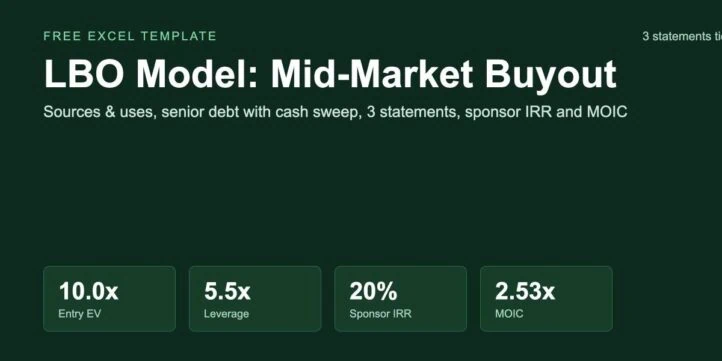
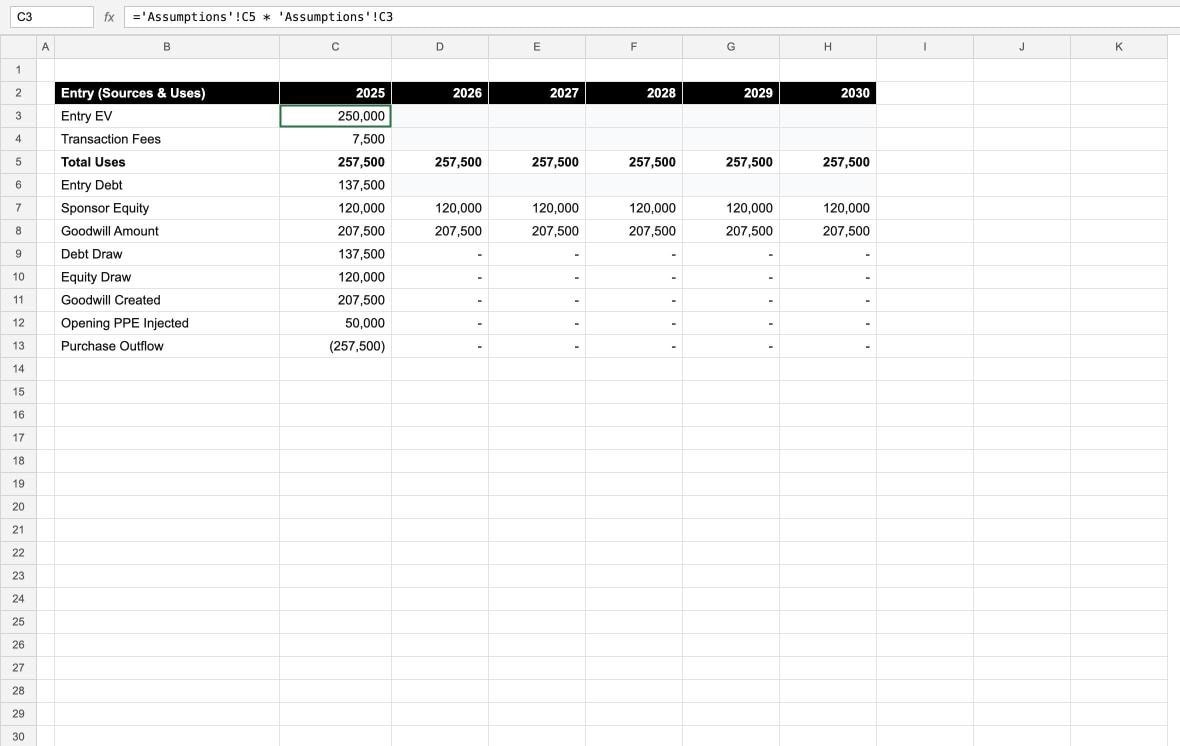
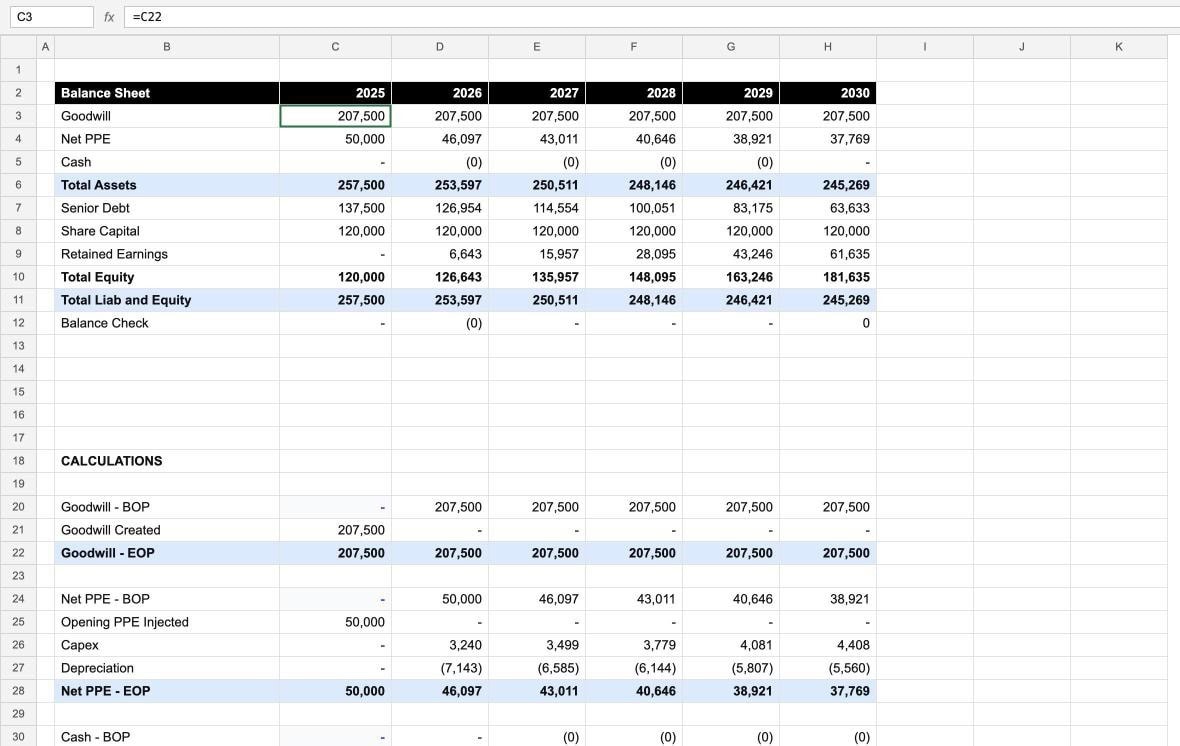
This model shows how a private equity sponsor buys a mid-market company with debt, pays the debt down from operating cash flow, and earns its return at exit. It is built for analysts and associates who want to understand or present an LBO quickly, for CFOs of PE-backed companies who need to follow the sponsor’s logic, and for students preparing for buyout case studies. The worked example acquires a business with €25m of EBITDA at 10.0x, financed with 5.5x senior debt and €120m of sponsor equity, held for five years (2025 entry, 2030 exit).
What is inside
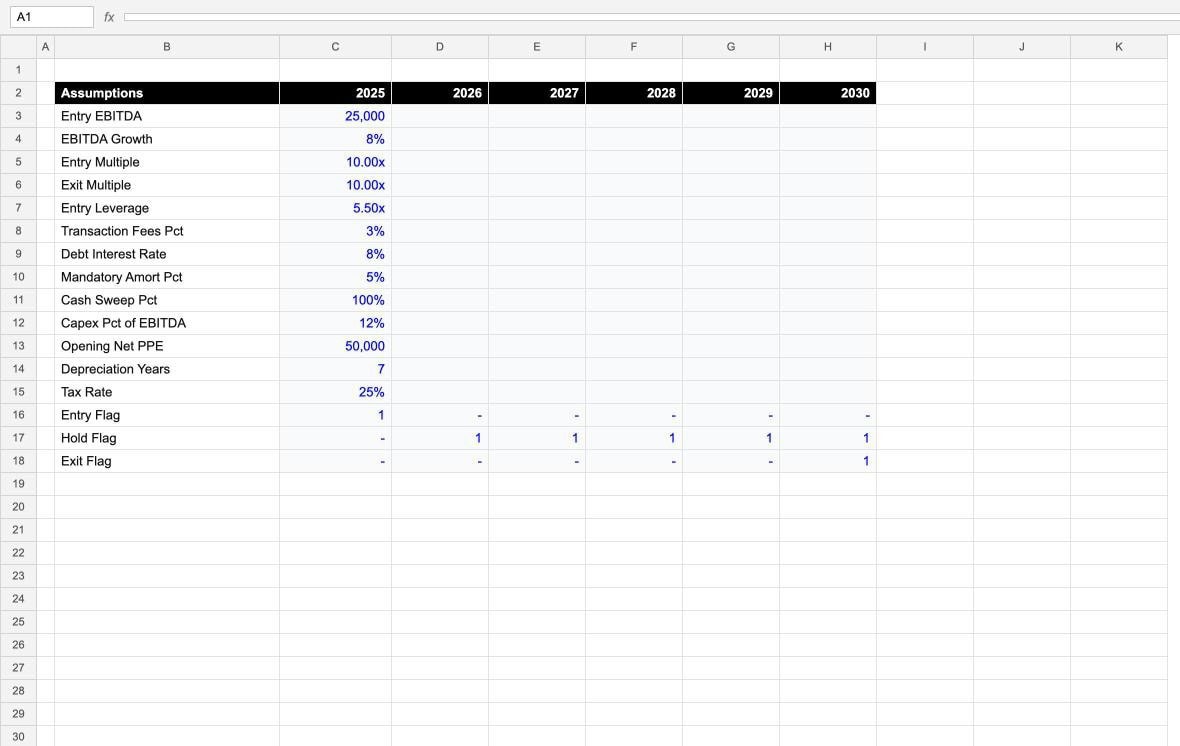
Assumptions: every driver on one sheet, inputs in blue (entry and exit multiples, leverage, fees, interest rate, mandatory amortisation, cash sweep, capex, depreciation, tax, timing flags).
Entry (Sources & Uses): enterprise value, transaction fees, debt and equity funding, goodwill created.
Operations and P&L: EBITDA growth, depreciation, interest, tax, net income.
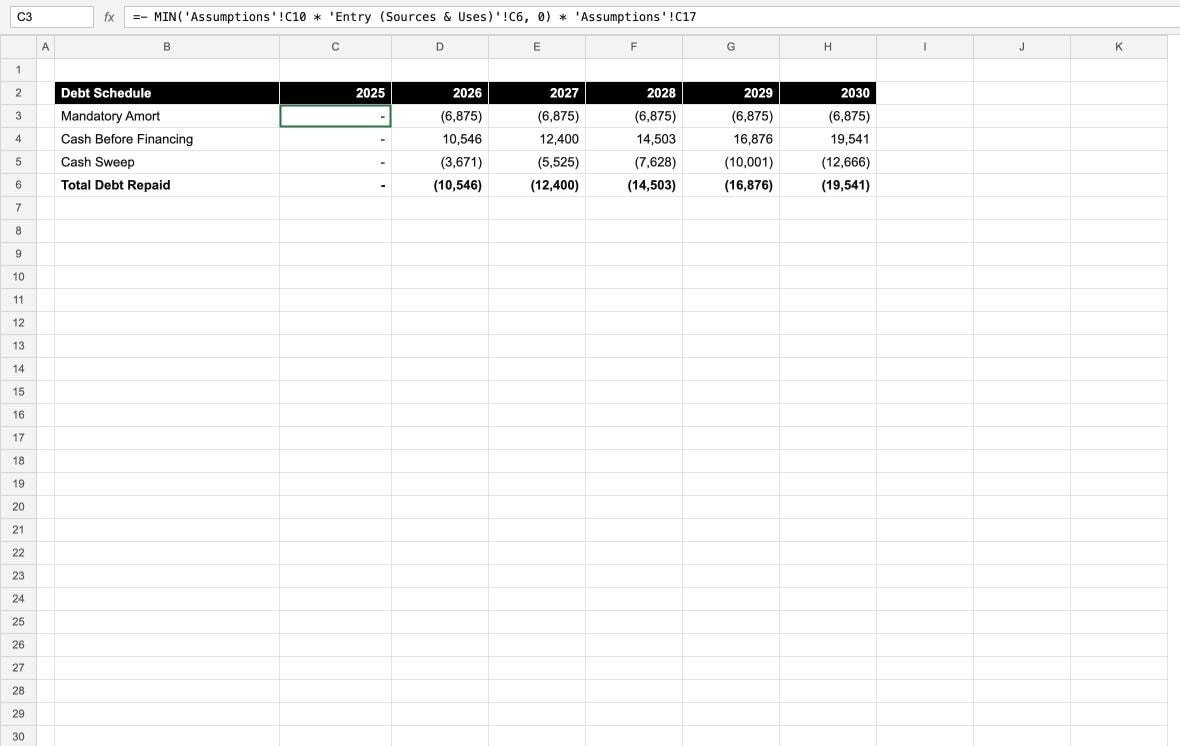
Debt Schedule: mandatory amortisation plus a capped cash sweep, so the senior debt never goes negative.
Cash Flow and Balance Sheet: wired, not pasted. Net income flows to retained earnings, debt repayments reduce the debt, and a Balance Check line stays at zero in every year.
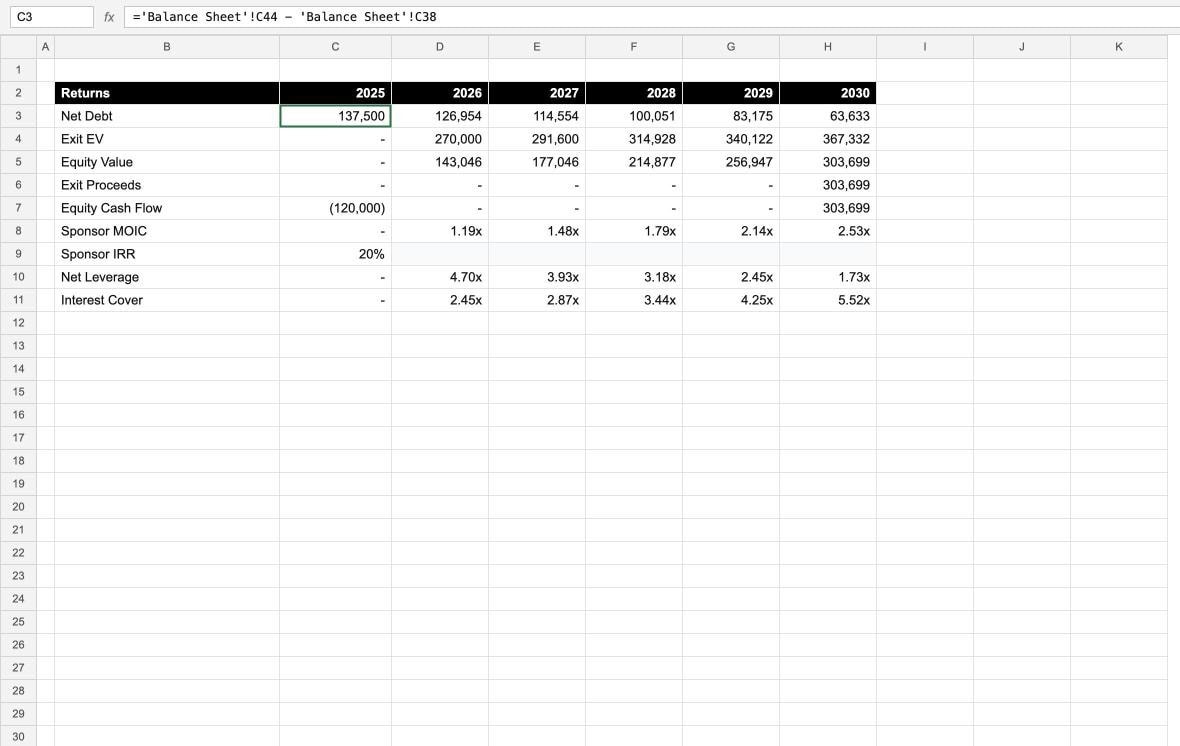
Returns: net debt, exit enterprise value, equity value, sponsor MOIC (2.53x) and IRR (20%), net leverage (5.5x down to 1.7x) and interest cover.
Sponsor Dashboard: the key outputs at a glance.
How to use it
Open the Assumptions sheet and change the blue inputs. Everything else is a formula and recalculates: the debt schedule, the three statements and the returns. Try a higher entry multiple, a lower growth rate or a shorter hold and watch the IRR move. The return in the base case comes from EBITDA growth and deleveraging only (exit multiple equal to entry), which makes it a sound starting point for a conservative case.
Why this template
Most LBO templates are either too heavy to read or too thin to trust. This one stays small enough to audit in a few minutes while keeping the mechanics that matter: a real cash sweep, a balancing balance sheet and a clean returns calculation. Formulas are visible, nothing is locked, there are no macros and no hard-coded values inside the statements.
About the author
Built by Anthony Barbey, former Director in financial modelling and project finance at Deloitte Finance, now a fractional CFO. The model was built in Layerz, a structured spreadsheet ready for AI, and exported to Excel. A documented version of the model, with its structure explained, is available on GitHub (anthomakr/finance-models).
Similar ProductsOther customers were also interested in...



 eFinancialModels
Electric Vehicle (EV) Charging Station Financial M...
With this comprehensive 5- or 10-year monthly tool, investors can assess the viability of setting up... Read more

Financial Model for Mobile App | Mobile App Busine...
The Mobile App Financial Plan Template in Excel allows you to develop financial projections when lau... Read more

 HenrySheykin
Food Truck Financial Model Excel Template
The Food Truck Financial Model helps entrepreneurs, founders, business owners, consultants, and anal... Read more

Green Hydrogen Production from Wind Energy Financi...
The Green Hydrogen from Wind Financial Model aims to comprehensively forecast a horizon of 40 years ... Read more

Simple Mutual Non-Disclosure Agreement Template
Protect your business secrets with ease using our Simple Mutual Non-Disclosure Agreement Template. S... Read more

Solar Energy Financial Model
The Solar Energy Financial Model Spreadsheet Template in Excel assists you in preparing a sophistica... Read more

 Peter Graf
The Customer-Centric Financial Model for Restauran...
Starting a restaurant without a financial plan is like driving a car blindfolded. You wouldn´t do i... Read more
You must log in to submit a review.