
0 ITEMS

GloBE Pillar Two Global Minimum Tax Model – ETR, QDMTT, IIR, UTPR & Cash Tax Forecast
A 30-module editable Excel model for multinational Pillar Two analysis, covering jurisdictional GloBE income and covered taxes, ETR and top-up tax, transitional CbCR safe harbour, QDMTT, IIR, UTPR, deferred tax, restructuring scenarios, cash tax, EPS/FCF impact, dashboards, GIR working-paper mapping, and model integrity controls.
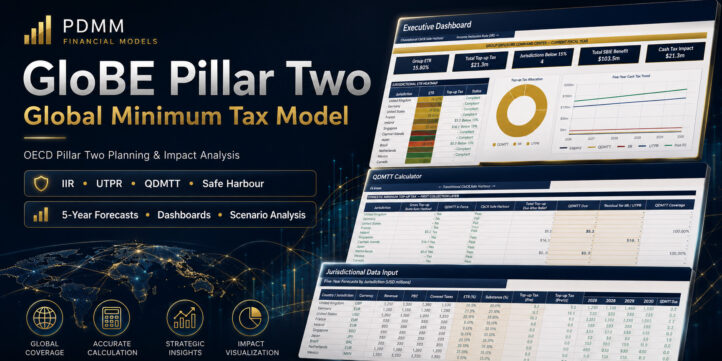


GloBE Pillar Two Global Minimum Tax Model
Purpose
The GloBE Pillar Two Global Minimum Tax Model is a structured 30-module Excel workbook designed to support multinational groups, tax teams, finance teams, advisers, and reviewers in analyzing the OECD Pillar Two framework across multiple jurisdictions. The workbook is built around an illustrative multinational group and is intended to be updated with the user’s own entity, financial, tax, ownership, and jurisdictional data.
The model follows a clear workflow from central assumptions and entity-level inputs through GloBE income, covered taxes, jurisdictional effective tax rates, top-up tax and allocation mechanisms. It also connects the tax calculation to management-focused outputs such as cash tax, diluted EPS, free cash flow, executive reporting, jurisdictional review, and integrity checks.
Verified Model Features
- 30 worksheet modules with a Cover & Navigator and operating instructions.
- Central assumptions for the 15% minimum GloBE rate, de minimis thresholds, SBIE transition rates, FX rates, forecast drivers, scenario toggles, and QDMTT/IIR/UTPR sequencing.
- Group structure and entity master data, including ownership, jurisdiction and rule-status fields.
- Three-year jurisdictional financial and tax data input.
- Book-to-GloBE income or loss computation.
- Covered tax reconciliation and GloBE-specific adjusted covered tax calculations.
- Substance-Based Income Exclusion calculations using payroll and tangible-asset components.
- De minimis jurisdictional threshold testing.
- Jurisdictional ETR, top-up percentage, excess-profit and top-up tax calculations.
- Transitional CbCR Safe Harbour testing using three independent tests.
- QDMTT calculation as the first domestic collection layer.
- Income Inclusion Rule allocation at UPE level, net of QDMTT.
- UTPR residual allocation using employee and tangible-asset substance weights.
- Top-up tax allocation reconciliation designed to prevent double counting.
- Deferred tax adjustment and five-year recapture schedule.
- Permanent and temporary book-tax-GloBE difference bridge.
- Functional-currency translation and FX shock analysis.
- Implementation timeline and SBIE phase-in through 2033.
- Mid-year acquisition/disposal scenario with days-based proration.
- Legal-entity restructuring scenario for ownership and domicile changes.
- Five-year cash tax forecast comparing legacy tax with post-Pillar Two cash tax.
- Diluted EPS and free cash flow impact schedule.
- GIR Information Return working-paper mapping to model source sheets and ranges.
- Executive Dashboard with group ETR, top-up tax, jurisdictions below 15%, SBIE benefit, cash tax impact, jurisdictional heatmap and charts.
- Jurisdictional Dashboard with a selected-jurisdiction profile and prior/current/forecast metrics.
- Audit & Integrity Control with 21 model checks and tie-outs.
- Sources & Version Control based on official OECD Pillar Two materials and a documented policy basis.
Workflow
Users begin by reviewing the Global Assumptions sheet, checking the reporting year, rates, thresholds, FX assumptions and scenario drivers. The entity master is then updated for the group’s legal entities, ownership and jurisdictions. Illustrative sample data in the Jurisdictional Data Input sheet should be replaced with the user’s three-year financial and tax data.
The calculation modules then bridge accounting income to GloBE income, reconcile covered taxes, compute adjusted covered taxes, calculate the substance-based exclusion and de minimis tests, and determine jurisdictional ETR and top-up tax exposure. The allocation sequence then applies QDMTT, IIR and UTPR logic. Downstream modules translate the results into cash tax, EPS and free cash flow impacts and management dashboards.
Who It Is For
The workbook is suited to multinational tax teams, CFO and finance functions, tax advisers, accounting firms, consultants, transaction teams, internal reviewers, and analysts who need a transparent Excel-based Pillar Two working model for planning, review, scenario analysis and management reporting.
Practical Benefits
The model brings the major calculation layers into one connected workbook so users can trace inputs through to jurisdictional exposure and group-level consequences. Navigation links, standardized cell identities, central assumptions, dashboards and integrity checks make it easier to review the model, identify low-tax jurisdictions, understand where top-up tax is collected, and assess the financial impact of Pillar Two over the forecast period.
Important Limitations
This workbook uses an illustrative sample group and should be customized before professional use. Its policy basis is OECD material consolidated through May 2026, while local enactment, qualified-rule status, filing requirements and administrative guidance can change and must be confirmed for the relevant jurisdiction and period. The GIR sheet is a working-paper source map rather than an XML or electronic filing engine. The model is a professional analytical template and does not replace jurisdiction-specific legal or tax advice.
Similar ProductsOther customers were also interested in...



 eFinancialModels
Electric Vehicle (EV) Charging Station Financial M...
With this comprehensive 5- or 10-year monthly tool, investors can assess the viability of setting up... Read more

Financial Model for Mobile App | Mobile App Busine...
The Mobile App Financial Plan Template in Excel allows you to develop financial projections when lau... Read more

 HenrySheykin
Food Truck Financial Model Excel Template
The Food Truck Financial Model helps entrepreneurs, founders, business owners, consultants, and anal... Read more

Green Hydrogen Production from Wind Energy Financi...
The Green Hydrogen from Wind Financial Model aims to comprehensively forecast a horizon of 40 years ... Read more

Simple Mutual Non-Disclosure Agreement Template
Protect your business secrets with ease using our Simple Mutual Non-Disclosure Agreement Template. S... Read more

Solar Energy Financial Model
The Solar Energy Financial Model Spreadsheet Template in Excel assists you in preparing a sophistica... Read more

 Peter Graf
The Customer-Centric Financial Model for Restauran...
Starting a restaurant without a financial plan is like driving a car blindfolded. You wouldn´t do i... Read more
You must log in to submit a review.