
0 ITEMS

Debt Fund Model Companion: Facility, Covenant & LP Reporting Pack (Excel)
An Excel companion for private credit and real estate debt fund managers who already run a monthly fund cash-flow model and need the reporting layers around it. Paste 120 months of fund-level figures and the workbook builds a warehouse-style credit facility with an eligibility-adjusted borrowing base, draws to a target utilisation, SOFR-plus-spread interest and an unused fee. It then tests seven covenants every month with headroom, PASS / BREACH flags and a first-breach summary, and produces a quarterly LP pack: NAV roll-forward, distributions by type, DPI / RVPI / TVPI, and IRR and MOIC by investor vintage using XIRR. Twenty-two built-in checks, an Input Map tab and a fully populated fictional sample fund are included in the file. No macros.
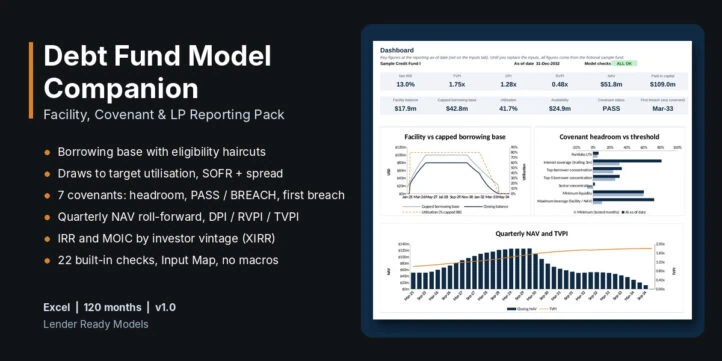
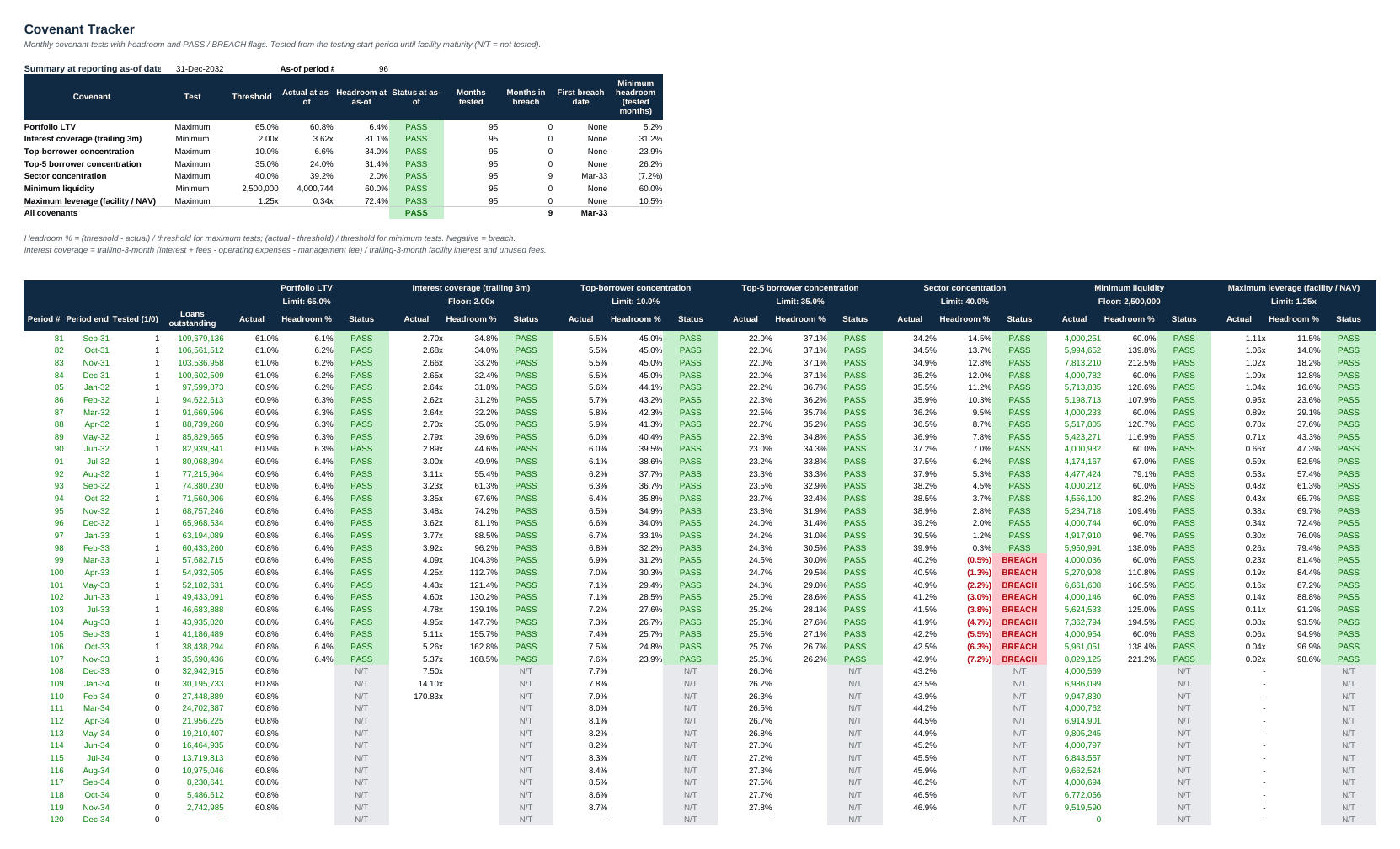
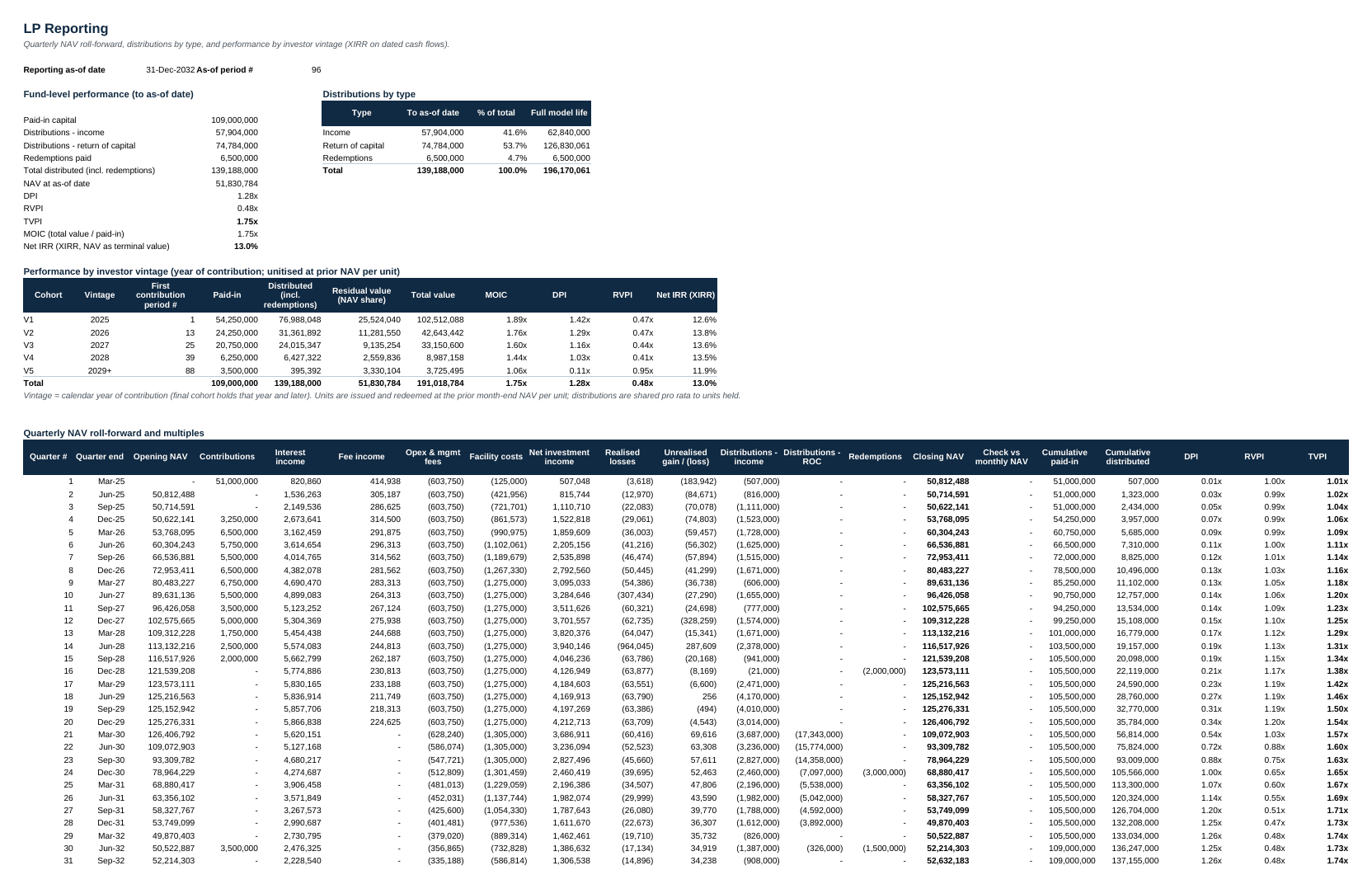
The Debt Fund Model Companion adds facility, covenant and investor reporting to a monthly debt-fund cash-flow model. It works standalone with your own inputs, and an Input Map tab describes where each figure typically sits in a monthly debt-fund model.
The workbook has nine tabs:
- Start Here: purpose, how to use the file, the colour convention (blue inputs, black formulas, green links) and the version.
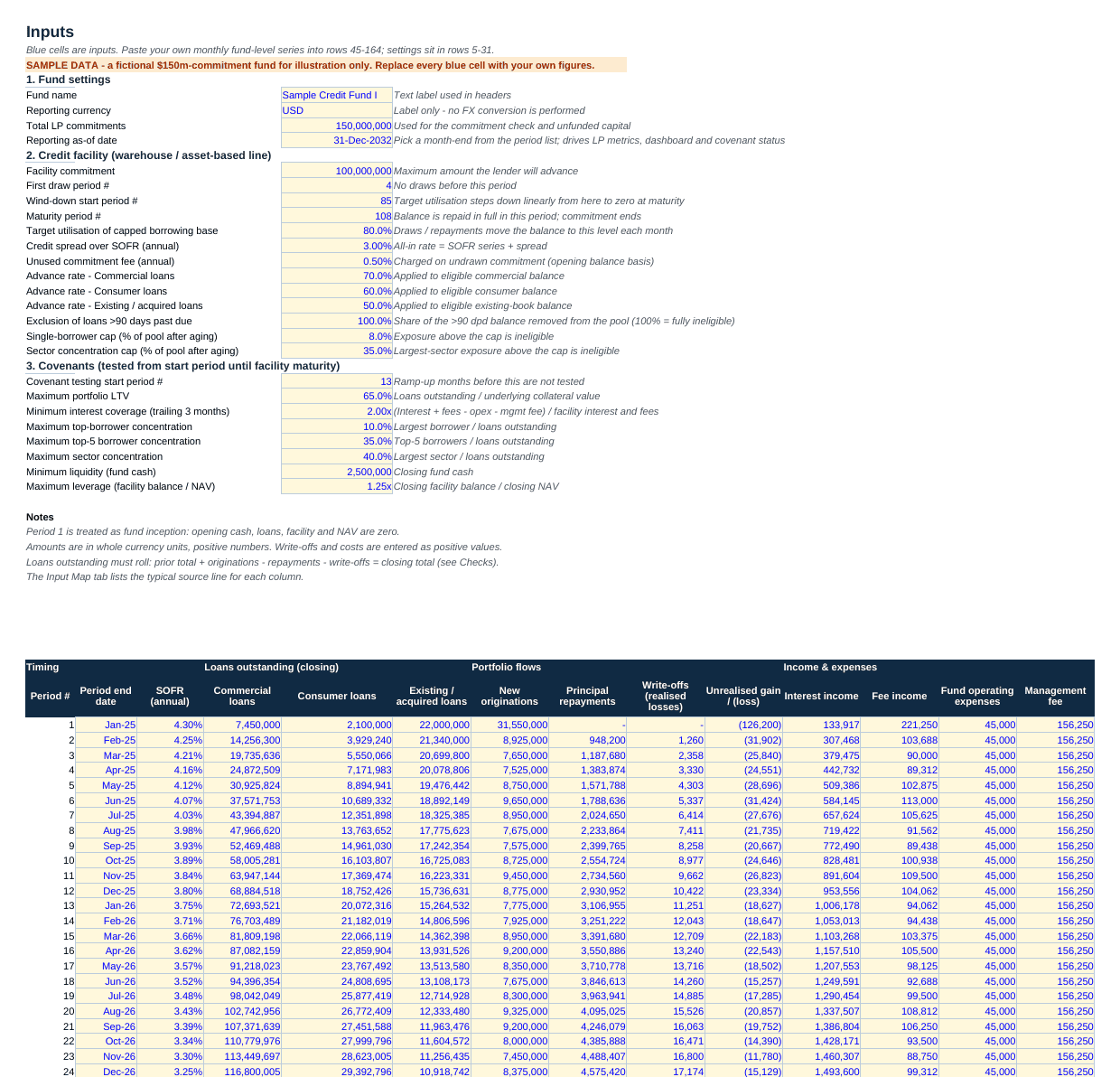
- Inputs: fund, facility and covenant settings, plus a 120-month series covering loans outstanding for commercial, consumer and existing books, originations, repayments, write-offs, fair-value marks, interest and fee income, operating expenses, management fees, capital called, income and return-of-capital distributions, redemptions, past-due balances, concentration data and collateral value.
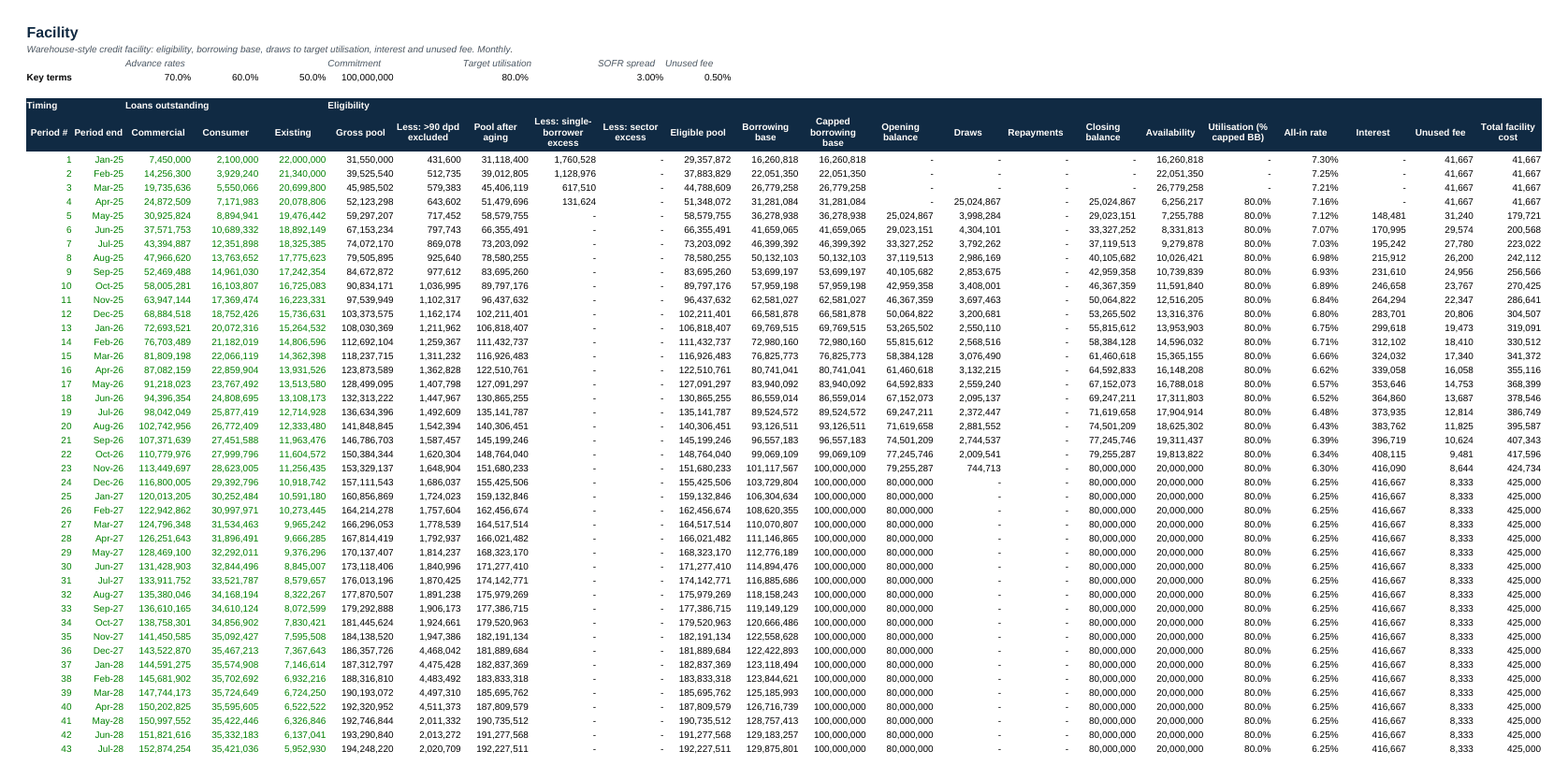
- Facility: removes loans more than 90 days past due, single-borrower excess and sector excess from the pool, applies advance rates by bucket, caps the borrowing base at the commitment and moves the balance to a target utilisation. A wind-down setting steps utilisation to zero at maturity. Interest is SOFR plus spread on the opening balance, with an unused fee on the undrawn commitment.
- Fund Calc: monthly fund cash, balance-sheet NAV, an independent NAV roll-forward, unitisation at prior NAV per unit and five investor-vintage cohorts.
- Covenant Tracker: portfolio LTV, trailing three-month interest coverage, top-borrower, top-five and sector concentration, minimum liquidity and maximum leverage. Each test shows its threshold, actual, headroom and a PASS / BREACH / not-tested flag with conditional formatting, plus months in breach and the first breach date.
- LP Reporting: quarterly NAV roll-forward (opening, contributions, income, fees, facility costs, losses, marks, distributions, redemptions, closing), distributions by type, DPI / RVPI / TVPI by quarter, and paid-in, distributed, residual value, MOIC and XIRR by vintage at a chosen as-of date.
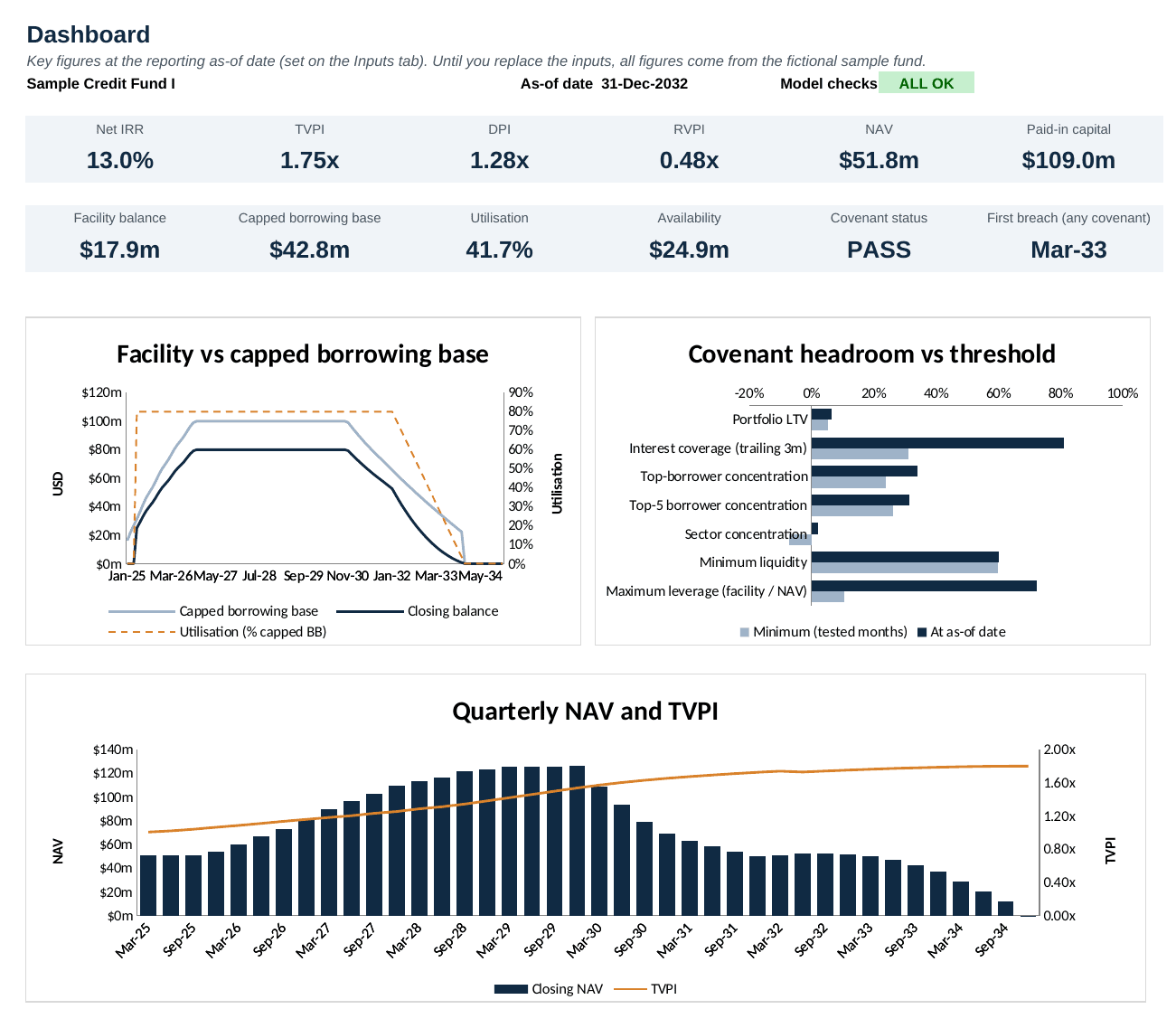
- Dashboard: twelve KPIs and three charts showing facility balance against the borrowing base, covenant headroom, and quarterly NAV with TVPI.
- Input Map: source line, sign convention and notes for every input.
- Checks: 22 roll-forward and reconciliation checks with an overall status that also shows on the Dashboard.
The file ships with a fictional sample fund of $150m commitments so every tab is populated on opening. The sample figures are illustrative only and do not describe any real fund, borrower or lender. The workbook is formula-driven, contains no macros, no external links and no hyperlinks, and is built for desktop Excel (2010 or later).
The workbook was built with AI assistance and its results were verified against an independent recalculation of the sample fund.
The file is sold as-is under eFinancialModels terms. It is a calculation tool, not investment, legal or tax advice, and its outputs depend entirely on the inputs entered.
Similar ProductsOther customers were also interested in...



 eFinancialModels
Electric Vehicle (EV) Charging Station Financial M...
With this comprehensive 5- or 10-year monthly tool, investors can assess the viability of setting up... Read more

Financial Model for Mobile App | Mobile App Busine...
The Mobile App Financial Plan Template in Excel allows you to develop financial projections when lau... Read more

 HenrySheykin
Food Truck Financial Model Excel Template
The Food Truck Financial Model helps entrepreneurs, founders, business owners, consultants, and anal... Read more

Green Hydrogen Production from Wind Energy Financi...
The Green Hydrogen from Wind Financial Model aims to comprehensively forecast a horizon of 40 years ... Read more

Simple Mutual Non-Disclosure Agreement Template
Protect your business secrets with ease using our Simple Mutual Non-Disclosure Agreement Template. S... Read more

Solar Energy Financial Model
The Solar Energy Financial Model Spreadsheet Template in Excel assists you in preparing a sophistica... Read more

 Peter Graf
The Customer-Centric Financial Model for Restauran...
Starting a restaurant without a financial plan is like driving a car blindfolded. You wouldn´t do i... Read more
You must log in to submit a review.