
0 ITEMS

Biogas & Waste-to-Energy Financial Model Excel | 20-Year CHP Project Finance, IRR, NPV, DSCR & LCOE
Evaluate anaerobic-digestion and CHP project economics with a 20-year Excel model: 15 linked worksheets, 500 feedstock entry rows, 8 native dashboard charts, 4 scenarios, integrated financial statements, IRR, NPV, DSCR and LCOE. Includes a detailed 38-page PDF guide.
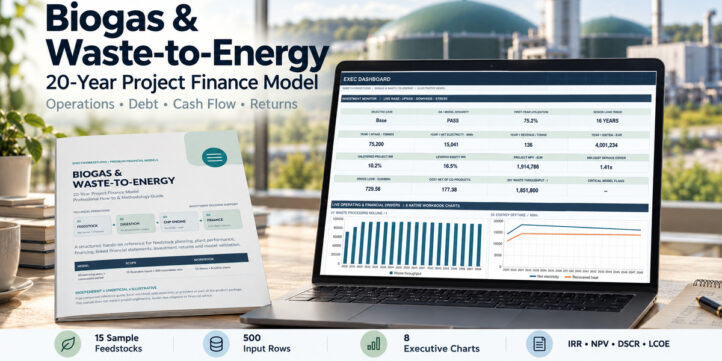
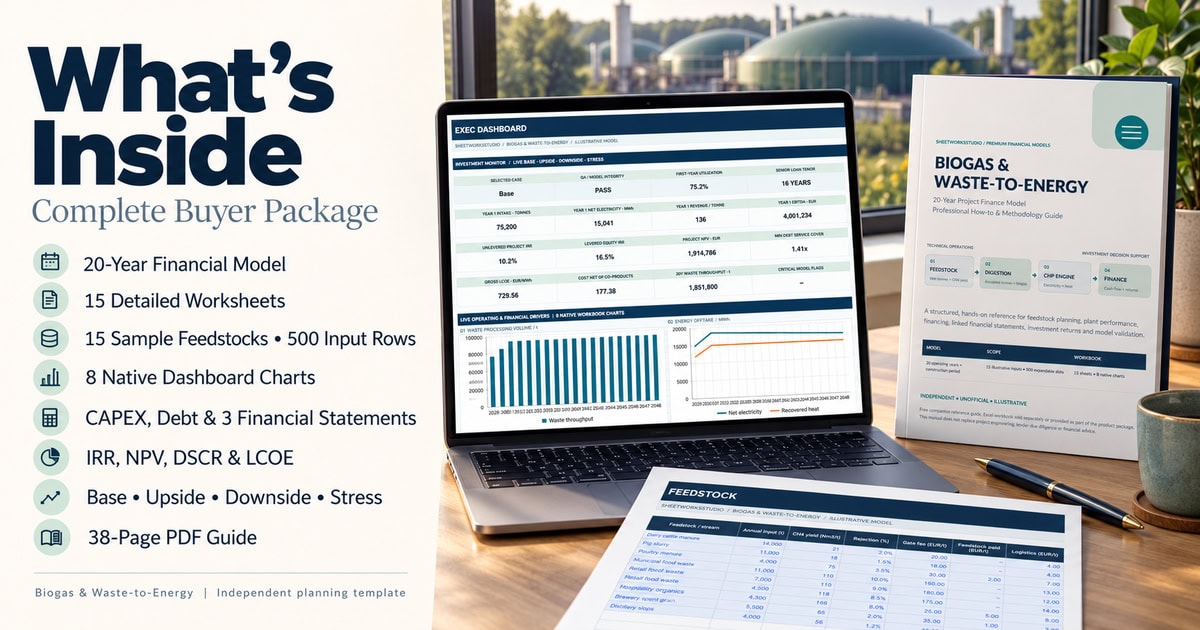
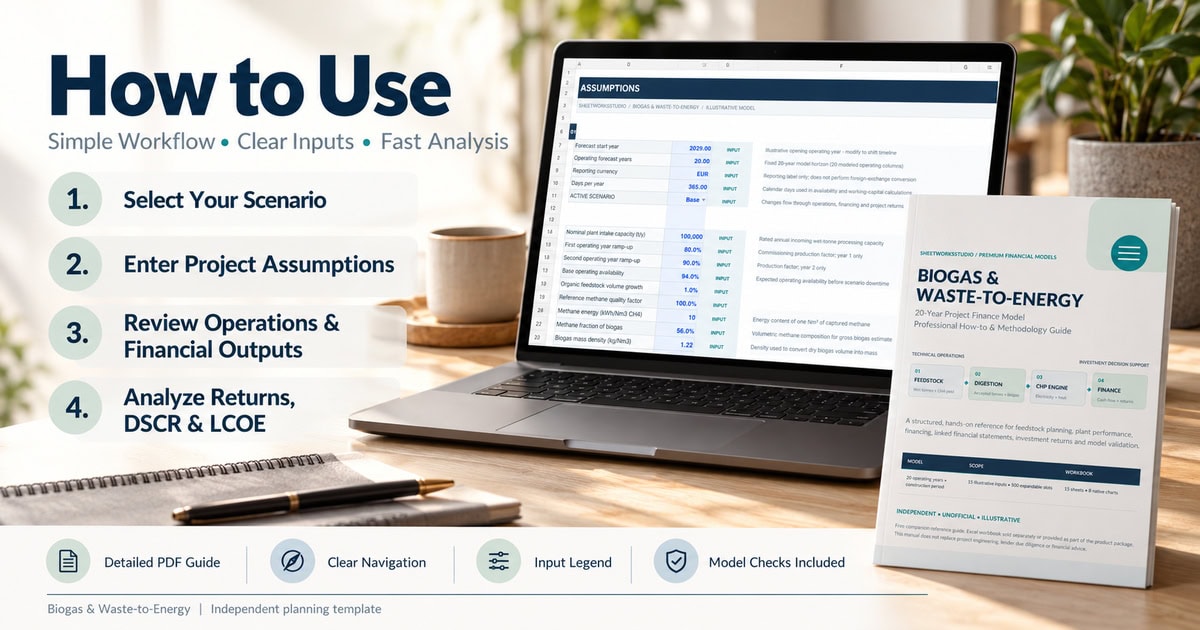
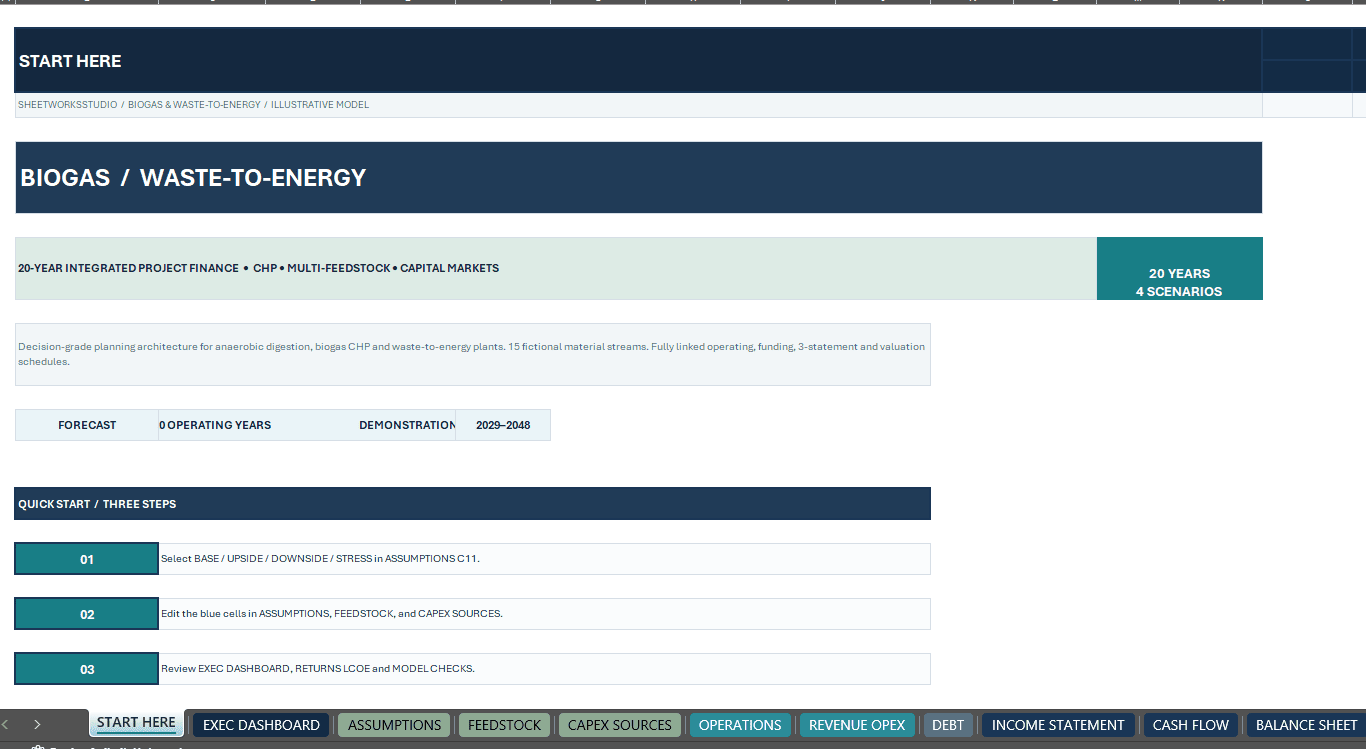
Biogas & Waste-to-Energy | 20-Year Project Finance Model
Transform feedstock contracts, anaerobic-digestion performance and financing assumptions into a transparent view of long-term project economics. This editable Excel financial model connects the physical operation of a single biogas combined heat and power (CHP) plant with 20-year annual financial projections, investment returns, lender coverage and operating risks.
Designed for renewable-energy developers, plant operators, financial modelers, feasibility consultants and investment analysts, the workbook helps evaluate illustrative plant concepts and replace assumptions with site-specific project information.
📊 EXECUTIVE DASHBOARD
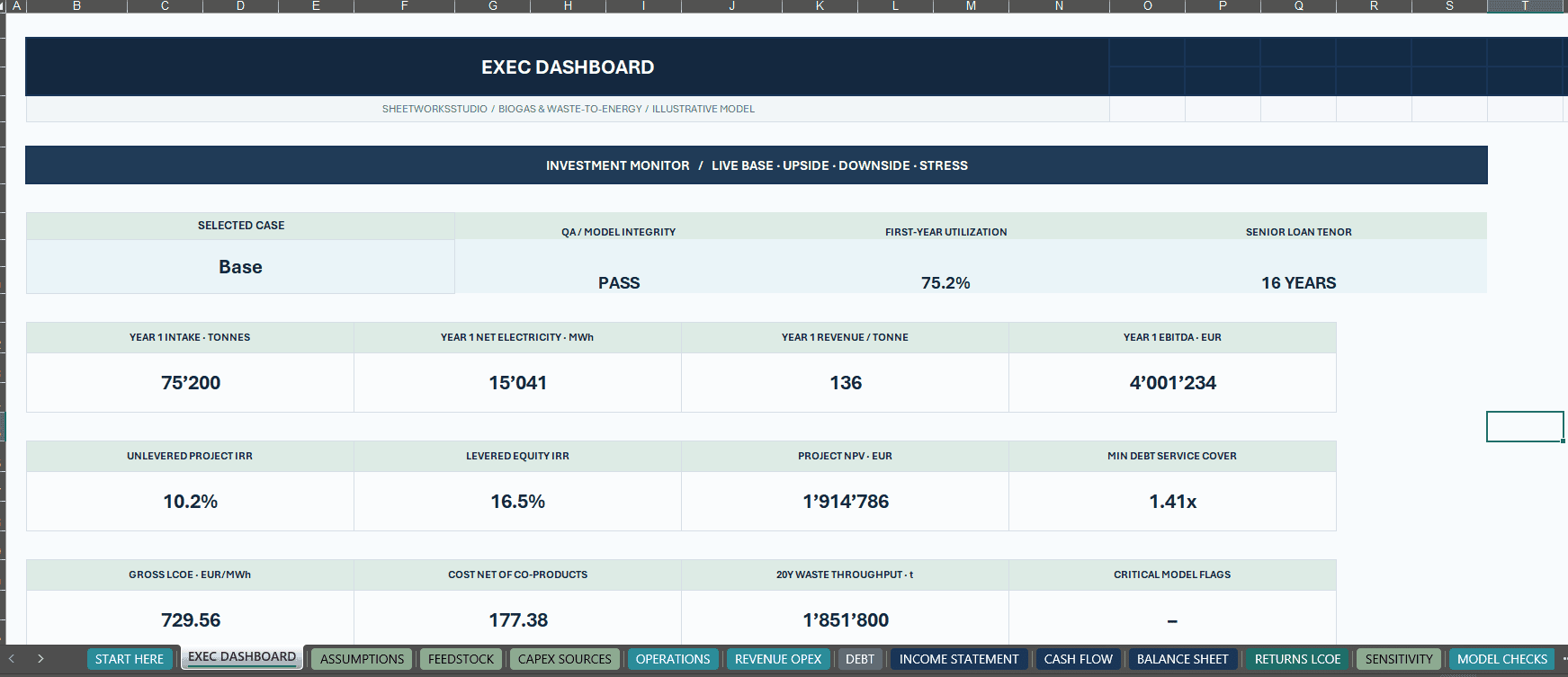
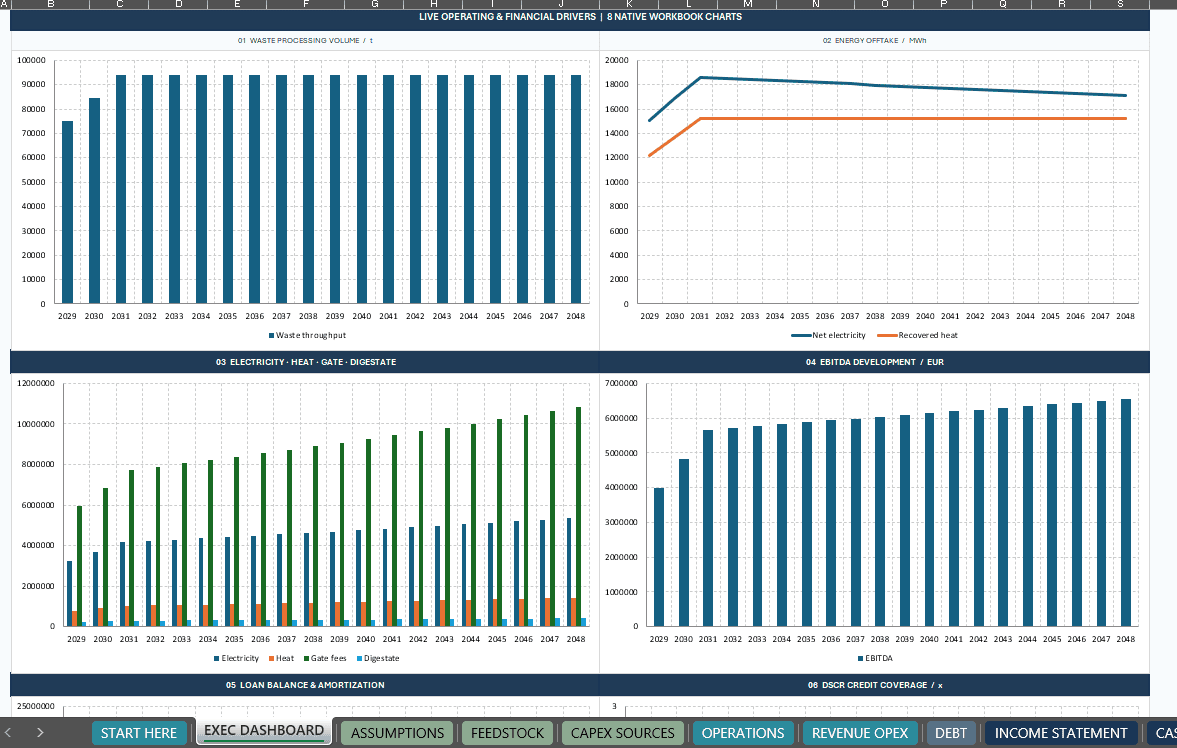
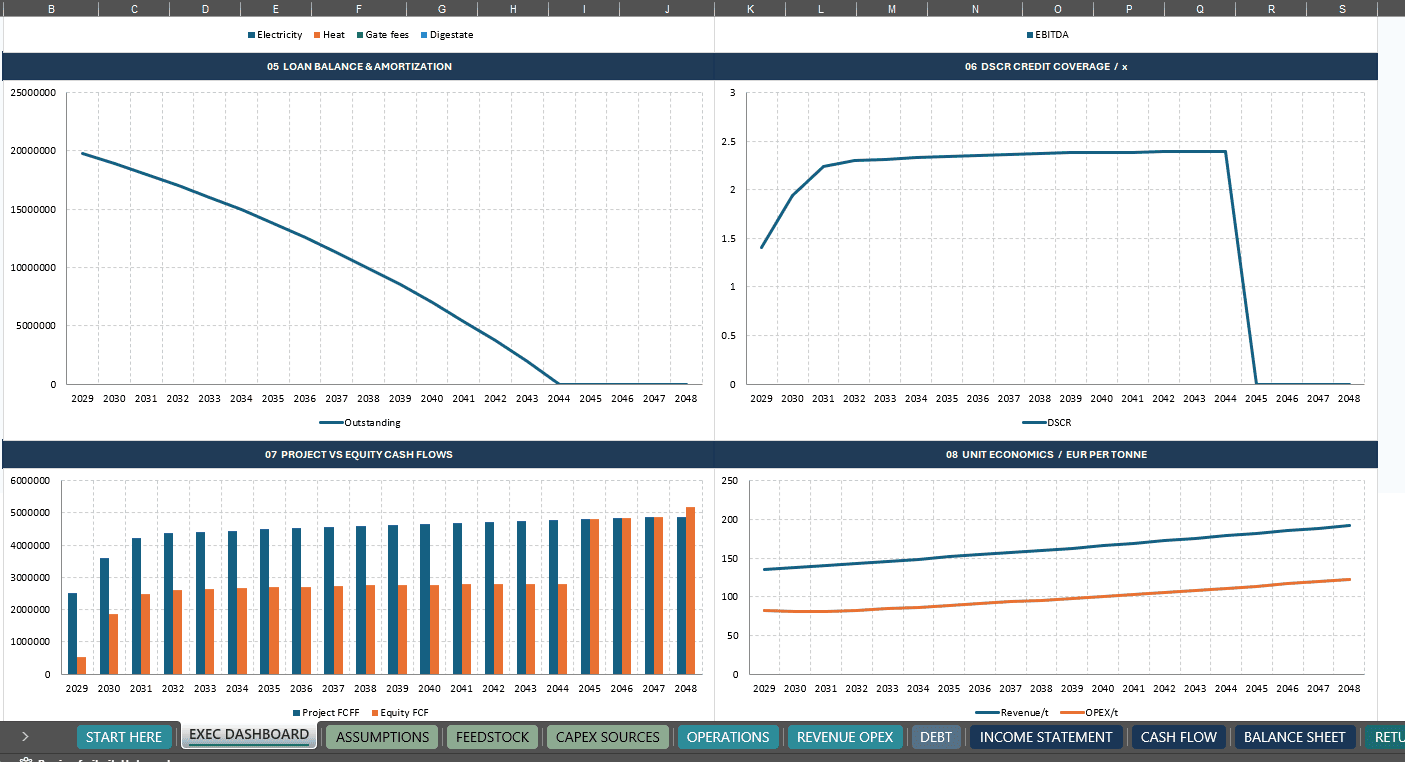
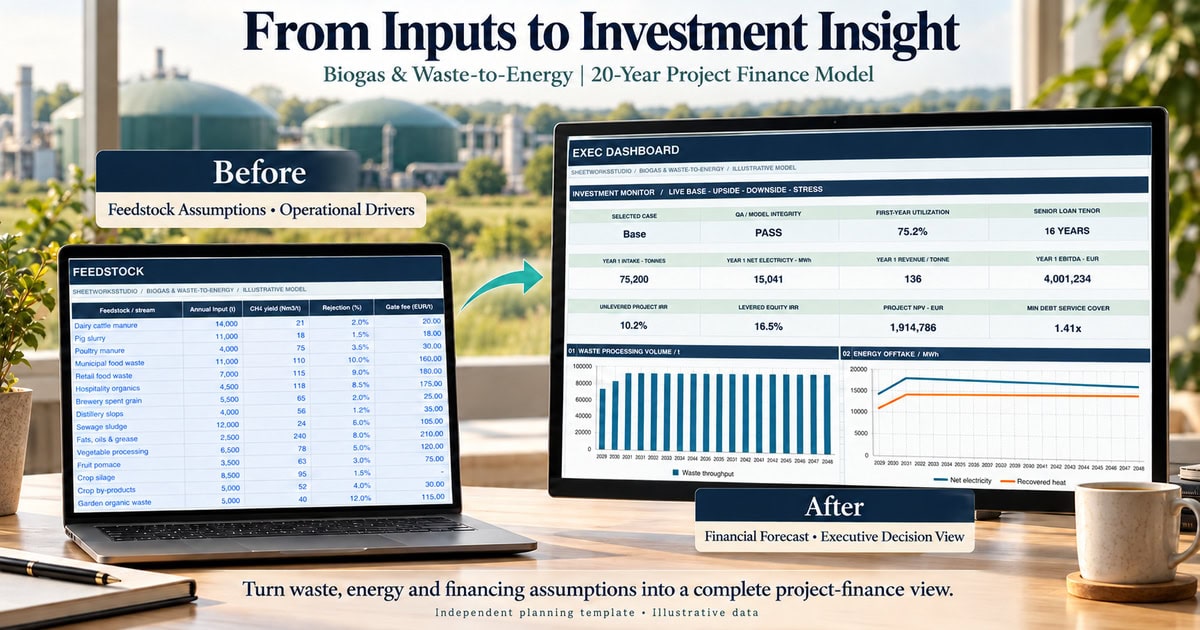
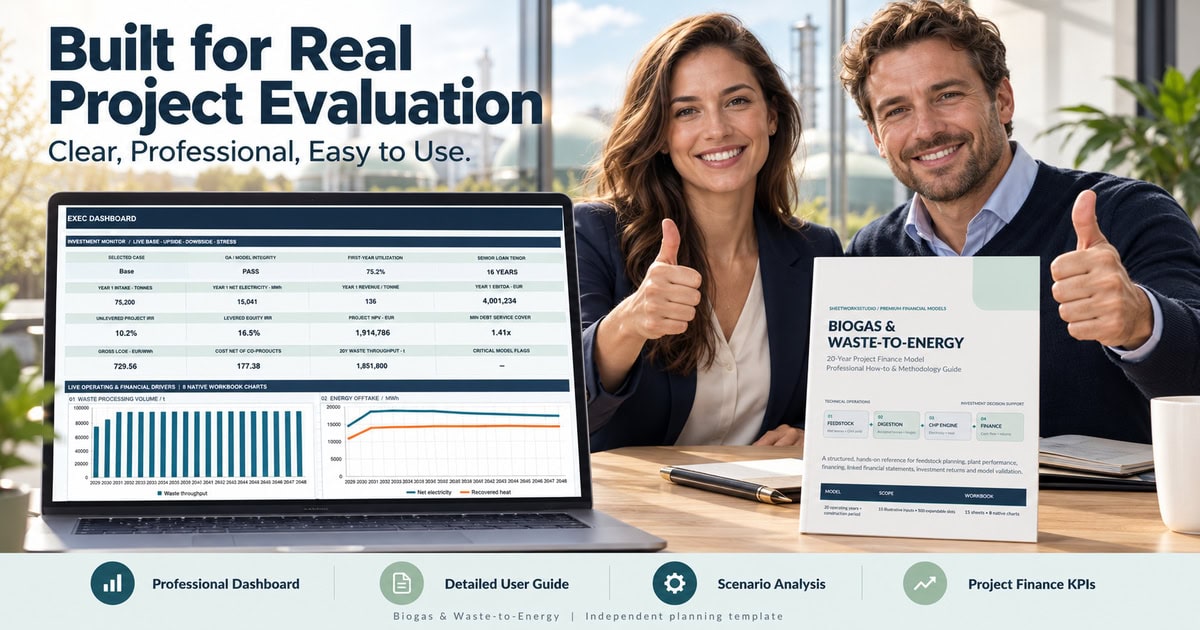
A dedicated investment dashboard presents 8 linked native Excel charts and essential project indicators: first-year waste throughput, net electricity output, revenue per tonne, EBITDA, unlevered Project IRR, levered Equity IRR, Project NPV, minimum loan-year DSCR, gross LCOE and electricity cost after coproduct credits. The active scenario and model-check status remain visible alongside the metrics.
⚙️ FEEDSTOCK & PLANT OPERATIONS
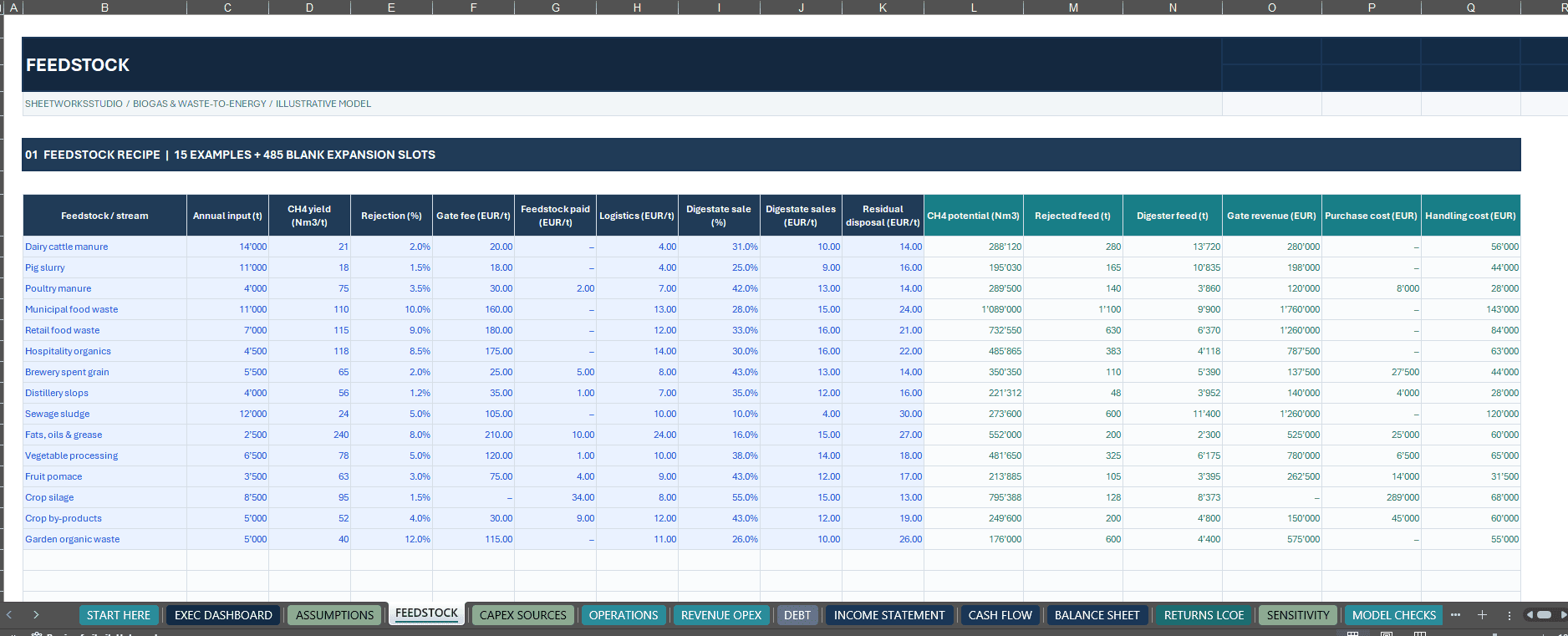
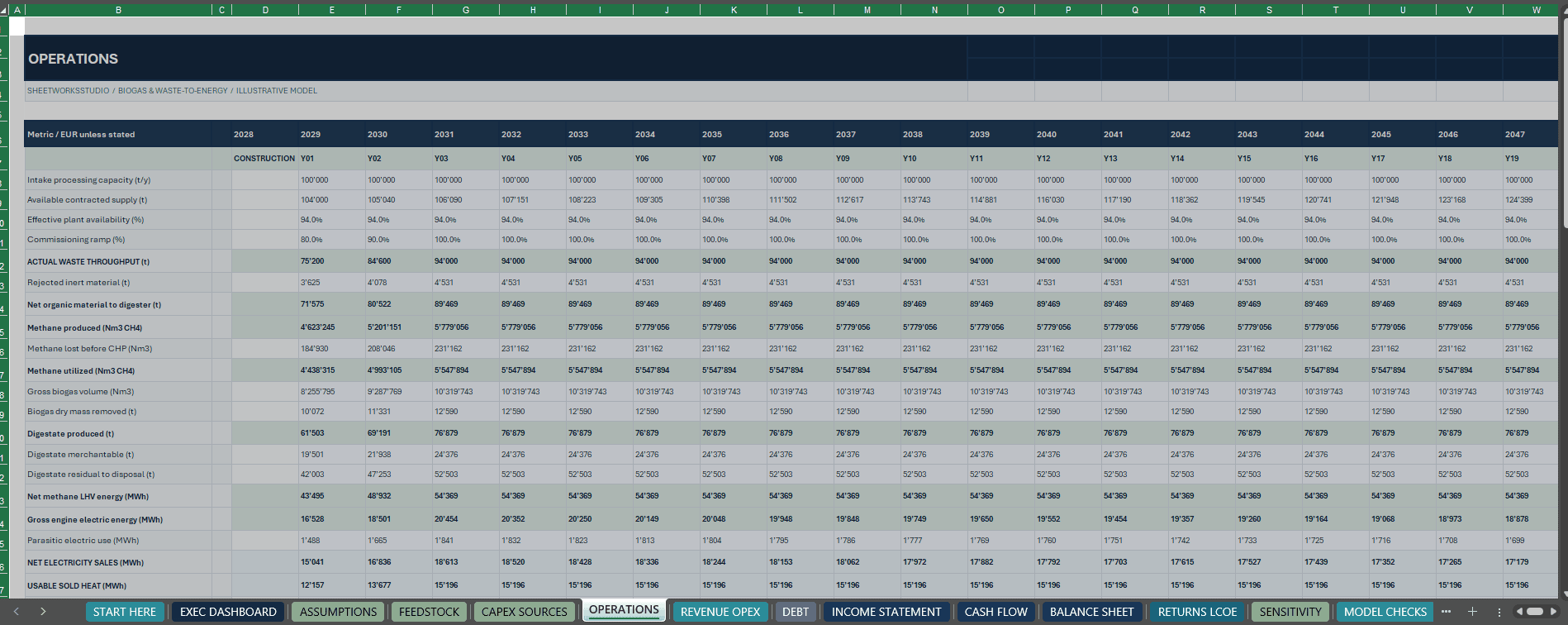
Use 500 prepared feedstock entry rows, including 15 illustrative organic-waste examples, to enter wet tonnes, methane yield, rejection rates, gate fees, procurement costs, logistics, digestate sales and disposal assumptions. The operating schedules link feedstock selection to effective plant availability, commissioning ramp-up, methane losses, gas production, electricity and recoverable heat.
Annual modeled outputs include accepted feedstock, methane and biogas volumes, CHP electricity, auxiliary power consumption, net electricity for sale, recovered heat, digestate and disposal volumes. Adjustable constraints include processing capacity, CHP electrical nameplate and electricity-yield degradation.
◈ REVENUE & OPERATING ECONOMICS
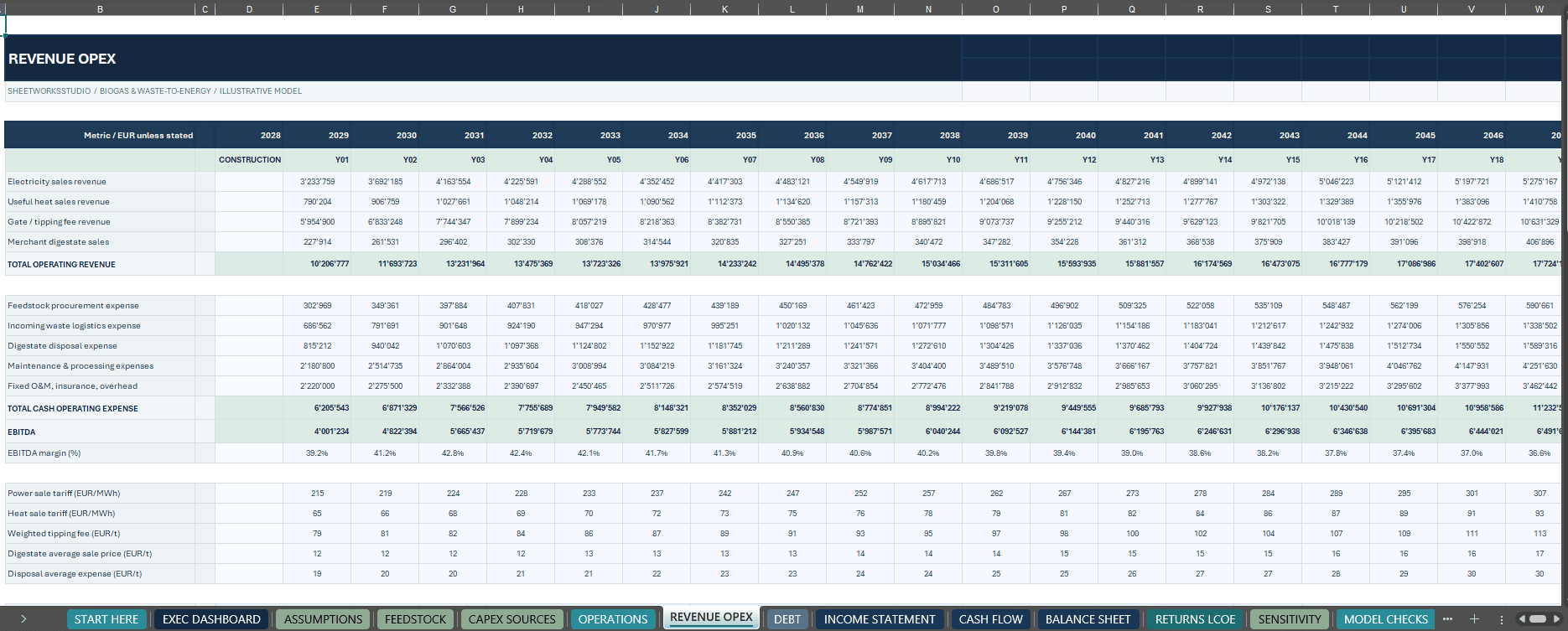
Forecast electricity sales, recovered-heat sales, tipping fees and digestate revenue as four separately modeled income streams. Review feedstock and logistics charges, residual disposal, fixed plant costs, variable processing and maintenance expense, cost escalation, operating revenue, EBITDA and revenue per tonne.
🏦 CAPITAL STRUCTURE & FINANCIAL STATEMENTS
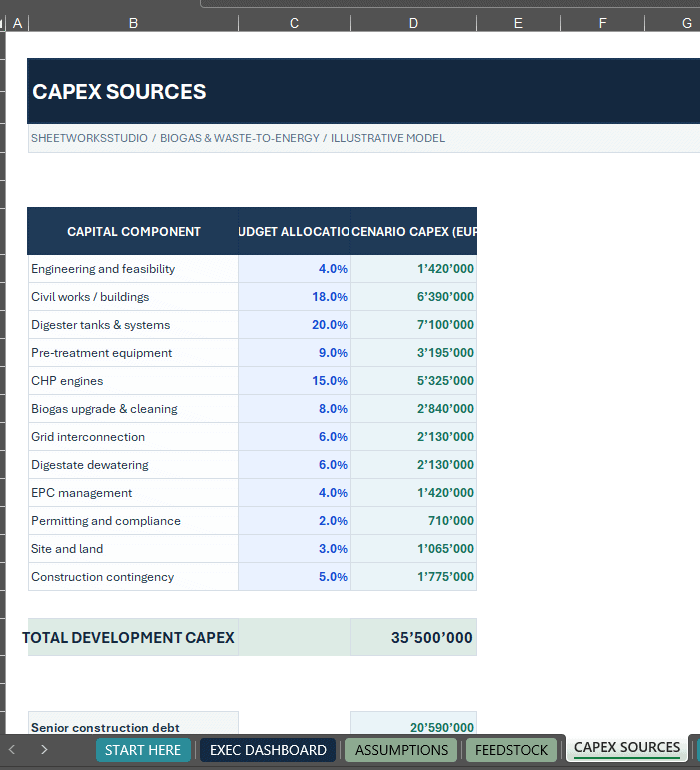
Allocate initial investment among 12 editable CAPEX categories and link construction funding to senior debt, capital grants and sponsor equity. The debt schedule includes annual interest, scheduled principal repayment, debt service and closing balances.
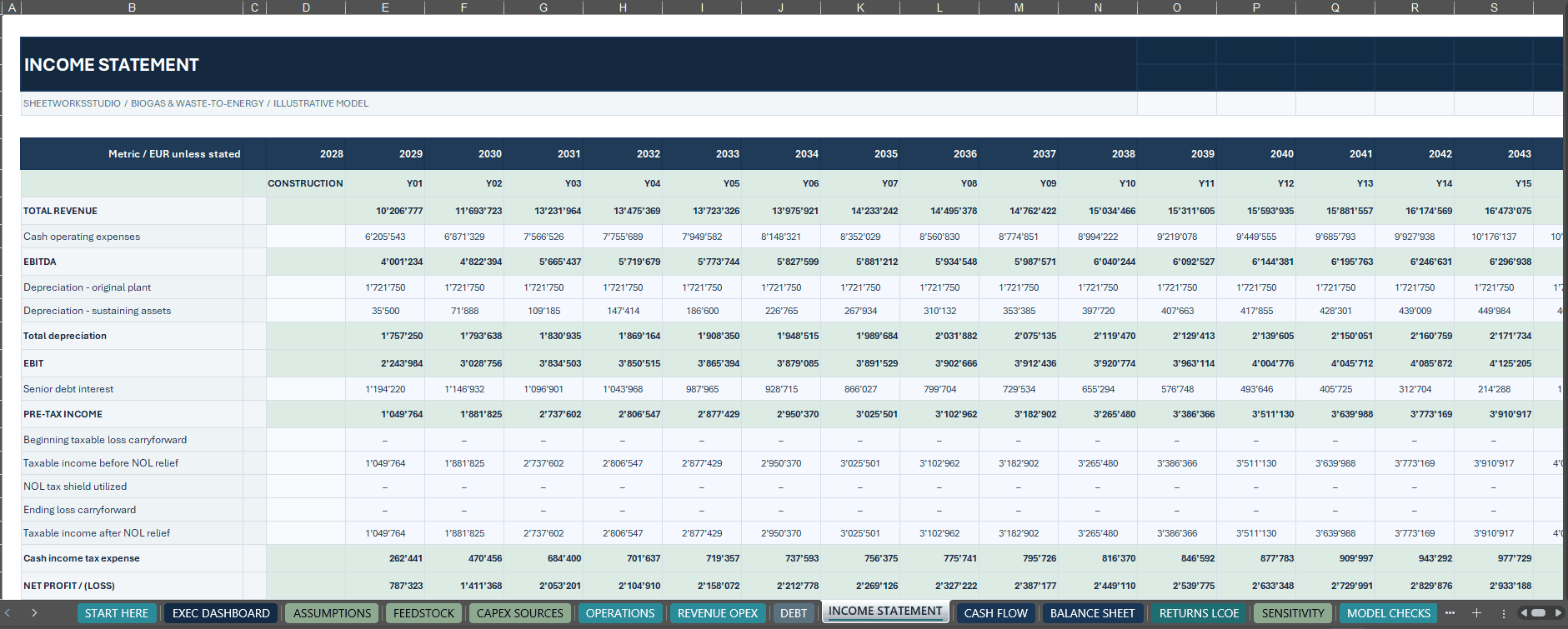
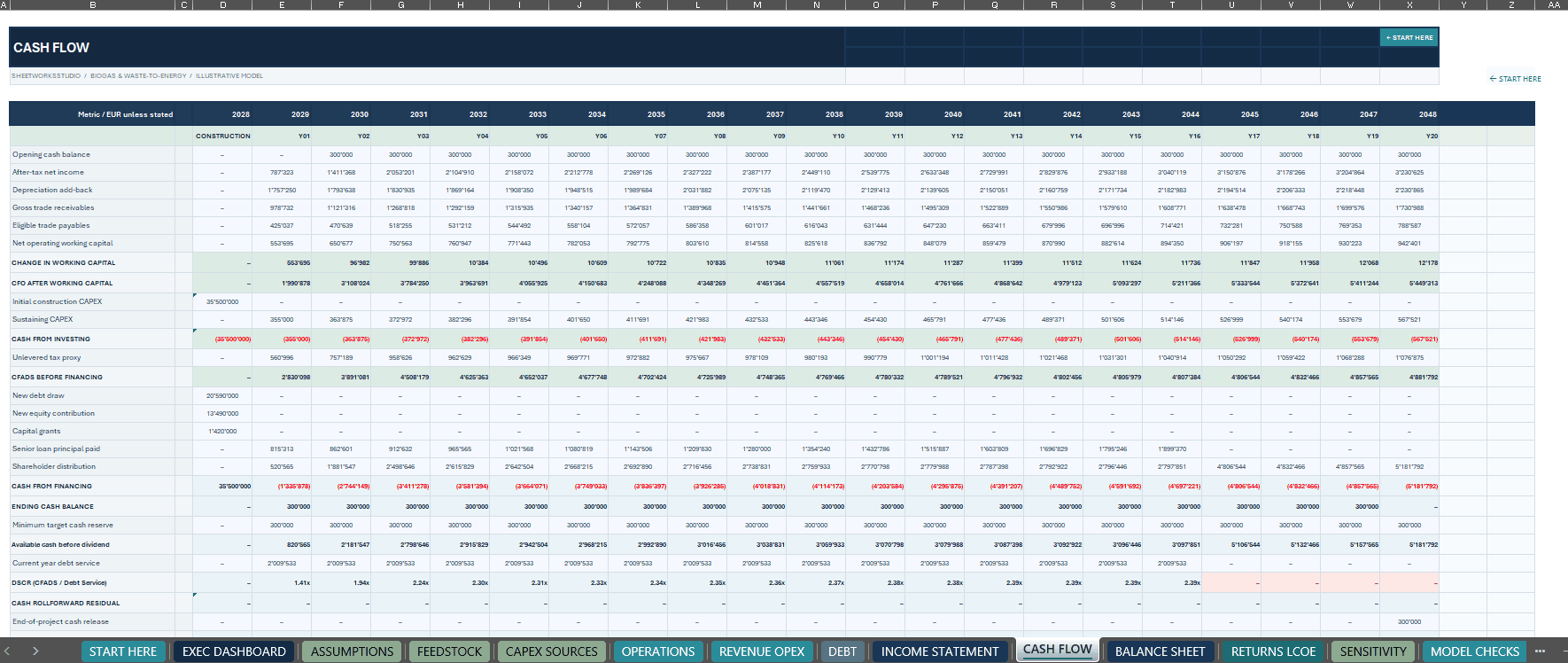
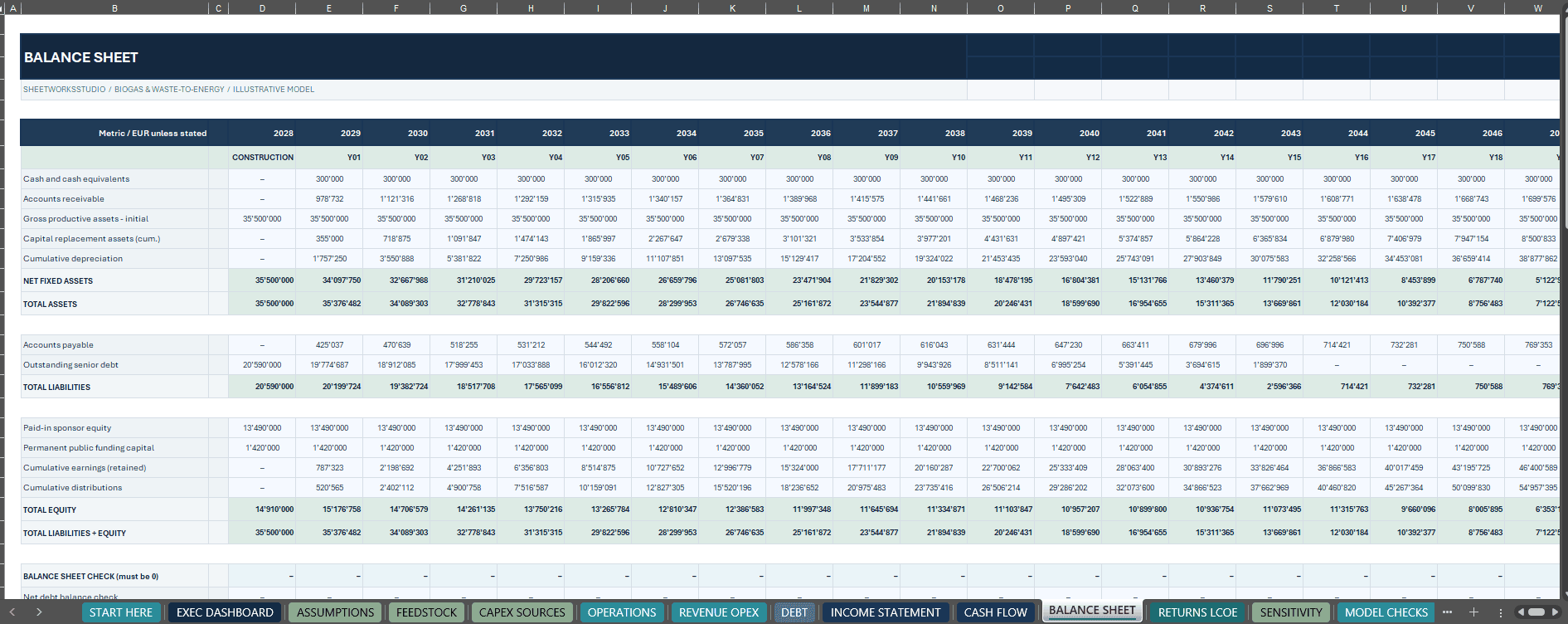
Income Statement, Cash Flow Statement and Balance Sheet worksheets link operating performance, depreciation, tax assumptions, loss carryforwards, receivables, payables, maintenance CAPEX and distributions.
The forecast comprises one initial construction period and 20 annual operating periods; it is not a monthly construction-financing model.
📈 INVESTMENT RETURNS & ELECTRICITY COST
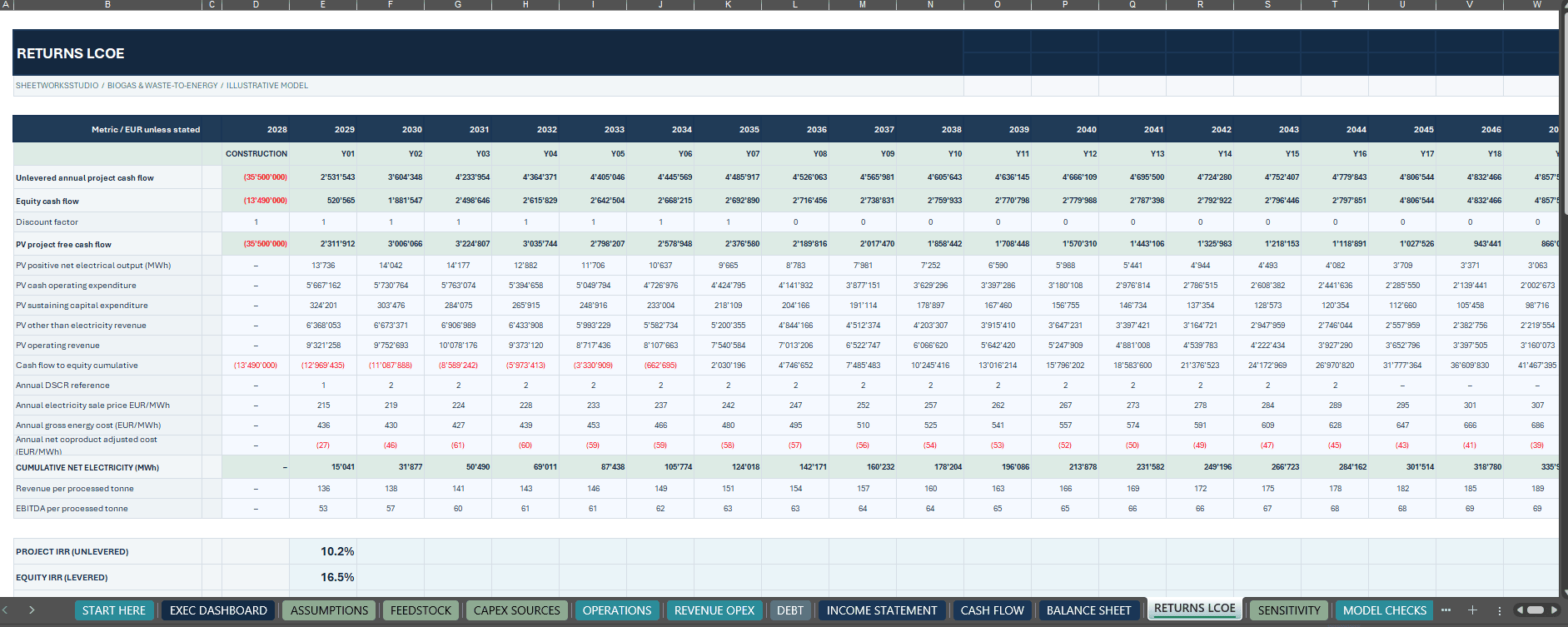
Analyze Project IRR, Equity IRR, Project NPV, Equity NPV, equity multiple, annual DSCR, total electricity, cumulative waste processing, gross discounted LCOE and coproduct-credit-adjusted electricity cost.
The returns worksheet makes project-level and investor-level results distinguishable.
🔀 SCENARIOS & SENSITIVITY
Select Base, Upside, Downside or Stress using the editable scenario selector. The four cases adjust modeled drivers including methane yield, energy pricing, feedstock availability, downtime, launch timing, CAPEX and operating costs. They recalculate the connected financial schedules and investment outputs.
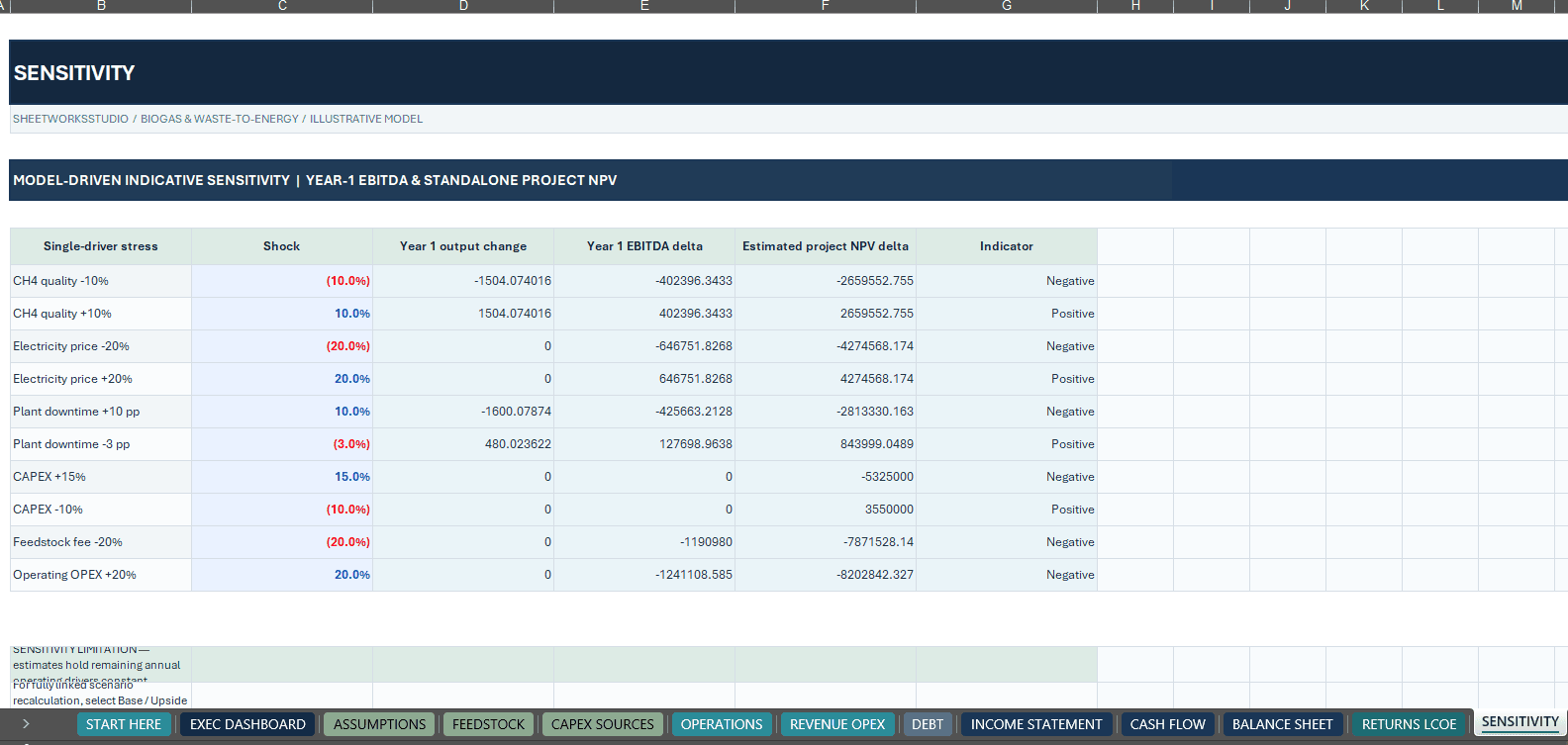
The separate Sensitivity worksheet provides indicative single-driver estimates of first-year EBITDA and directional NPV effects. It is not a complete multi-variable, full-forecast sensitivity engine.
Important: Downside and Stress assumptions can produce negative cash balances, funding gaps, negative NPV or returns that are not mathematically meaningful. These outcomes are intentional warnings to evaluate, not evidence of a funded or viable project.
✅ MODEL CHECKS & TRANSPARENT WORKFLOW
Built-in checks address feedstock input constraints, methane and mass accounting, CHP capacity, digestate allocation, sources and uses, debt movements, cash reconciliation, financial-statement consistency and negative cash balances.
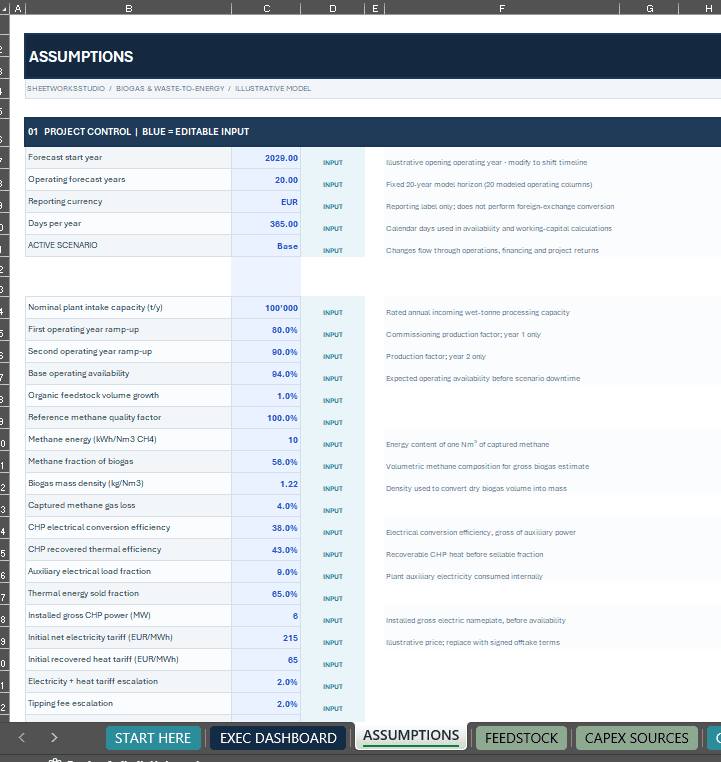
Blue INPUT and calculated AUTO fields are identified within the model. START HERE navigation and the embedded USER GUIDE support workbook orientation.
📦 WHAT YOU RECEIVE
1 editable .xlsx workbook with 15 worksheets:
START HERE, EXEC DASHBOARD, ASSUMPTIONS, FEEDSTOCK, CAPEX SOURCES, OPERATIONS, REVENUE OPEX, DEBT, INCOME STATEMENT, CASH FLOW, BALANCE SHEET, RETURNS LCOE, SENSITIVITY, MODEL CHECKS and USER GUIDE.
1 Professional How-to-Use PDF guide, 38 pages, covering model setup, feedstock methodology, operations, funding, statements, cash flow, scenarios, return metrics, model checks and troubleshooting.
The guide may also be downloaded separately as an informational free resource; the paid editable Excel workbook is not included in the free guide.
🧭 HOW TO USE
Download and save a working copy. Select the scenario in ASSUMPTIONS, then replace the illustrated inputs with actual feedstock contracts, plant specifications, pricing, CAPEX and funding terms.
Review the operating schedules and financial statements before interpreting headline investment metrics, and investigate any model warnings or cash shortfalls.
⚙️ TECHNICAL SPECIFICATIONS & COMPATIBILITY
Forecast: 20 annual operating periods (illustrative 2029–2048) plus one construction period.
15 Excel worksheets. 8 native workbook charts. 4 linked scenarios. 500 feedstock rows with 15 examples. 12 CAPEX allocation categories.
Macro-free .xlsx; no live connections or automatic external data feeds.
The currency label can be edited, but changing the text does not perform FX conversion. Enter all project figures in a consistent monetary unit.
Microsoft Excel is the reference spreadsheet environment; Google Sheets import and spreadsheet-program cross-compatibility have not been independently verified.
🛡️ IMPORTANT LIMITATIONS & INDEPENDENT TEMPLATE DISCLAIMER
This model covers anaerobic digestion with combined heat and power. It is not an incineration, biomethane-upgrading, gas-grid-injection, certified engineering or lender-approved financial model.
Simplified plant performance, taxes and financing conventions must be adapted and verified for each project. Model-check PASS values indicate internal relationships only and do not confirm financial viability or lender readiness.
This is an independent, unofficial financial-planning template by SheetworksStudio. Sample assumptions and outputs are illustrative and do not constitute certified engineering results, assured financial projections or individualized financial, tax, legal or investment advice.
Independent technical due diligence and professional review are required for real projects.
Build a clearer picture of feedstock, energy yield and project-financing trade-offs before advancing a biogas investment decision.
Similar ProductsOther customers were also interested in...



 eFinancialModels
Electric Vehicle (EV) Charging Station Financial M...
With this comprehensive 5- or 10-year monthly tool, investors can assess the viability of setting up... Read more

Financial Model for Mobile App | Mobile App Busine...
The Mobile App Financial Plan Template in Excel allows you to develop financial projections when lau... Read more

 HenrySheykin
Food Truck Financial Model Excel Template
The Food Truck Financial Model helps entrepreneurs, founders, business owners, consultants, and anal... Read more

Green Hydrogen Production from Wind Energy Financi...
The Green Hydrogen from Wind Financial Model aims to comprehensively forecast a horizon of 40 years ... Read more

Simple Mutual Non-Disclosure Agreement Template
Protect your business secrets with ease using our Simple Mutual Non-Disclosure Agreement Template. S... Read more

Solar Energy Financial Model
The Solar Energy Financial Model Spreadsheet Template in Excel assists you in preparing a sophistica... Read more

 Peter Graf
The Customer-Centric Financial Model for Restauran...
Starting a restaurant without a financial plan is like driving a car blindfolded. You wouldn´t do i... Read more
You must log in to submit a review.