
0 ITEMS

Battery Energy Storage System (BESS) Financial Model Excel – 20-Year Project Finance, IRR, NPV & DSCR
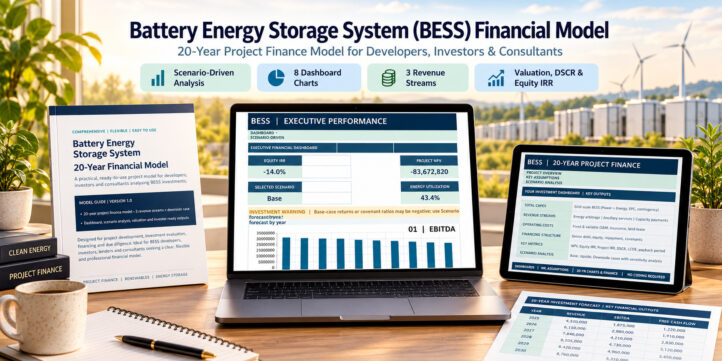
Standalone BESS Excel project finance model with 240 monthly forecasts, 20-year three-statement reporting, 24-hour representative dispatch, arbitrage/capacity/ancillary revenue, debt, IRR, NPV, DSCR and 8 dashboard charts. Includes a 10-page PDF guide.
20-Year Excel Project Finance | 240-Month Forecast | Battery Dispatch, Revenue & Equity Returns
Understand standalone battery storage project economics using a transparent, fully editable Excel financial model.
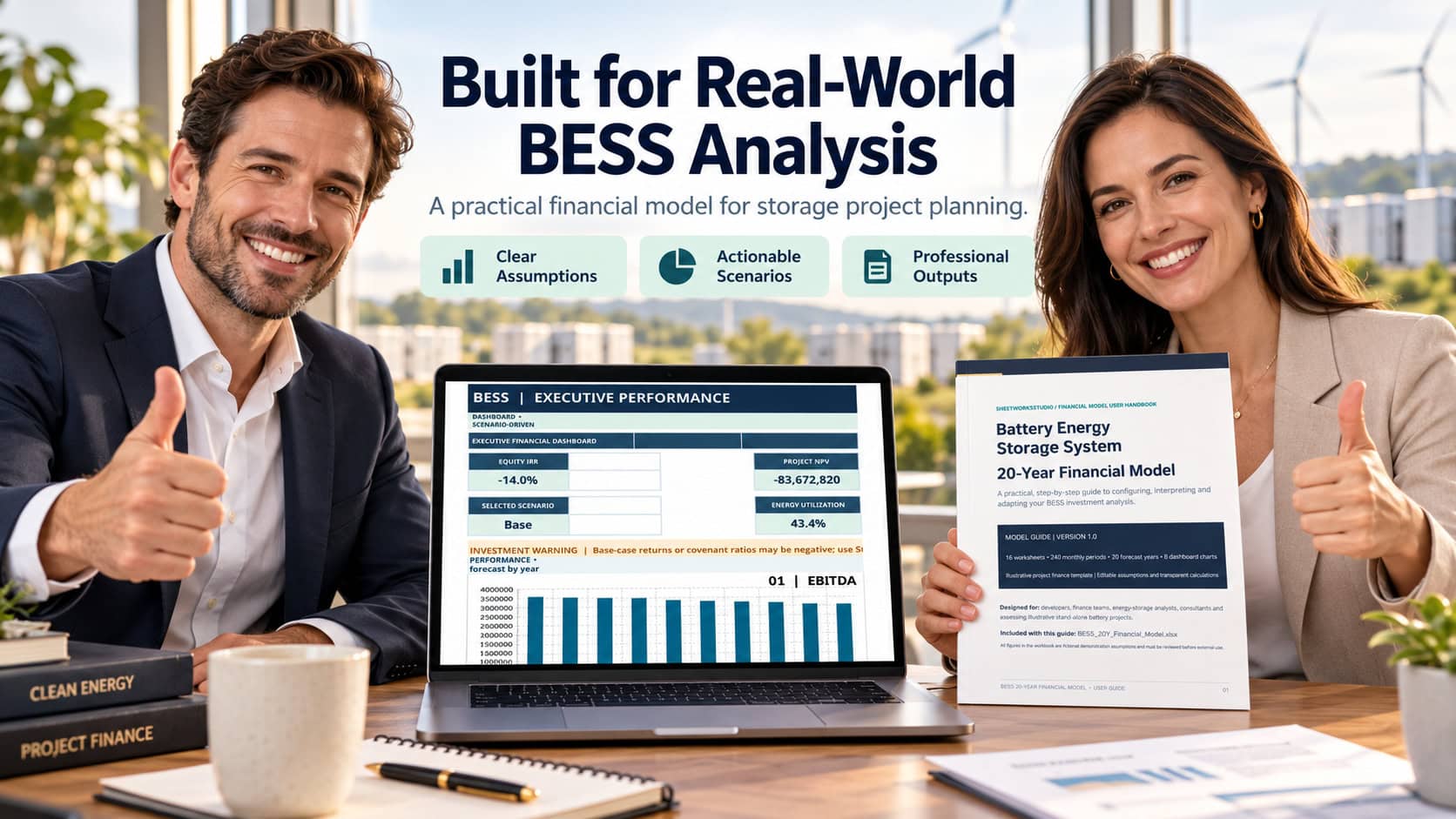
The BESS 20-Year Financial Model by SheetworksStudio combines technical battery assumptions, representative daily dispatch, energy-market revenue, capacity payments, ancillary services, operating costs, financing, integrated financial statements and investment returns within one connected Excel workbook.
Designed for project developers, infrastructure investors and financial analysts, the model supports long-term project feasibility assessments, investment evaluation, financing reviews and scenario comparisons.
📊 EXECUTIVE INVESTMENT DASHBOARD
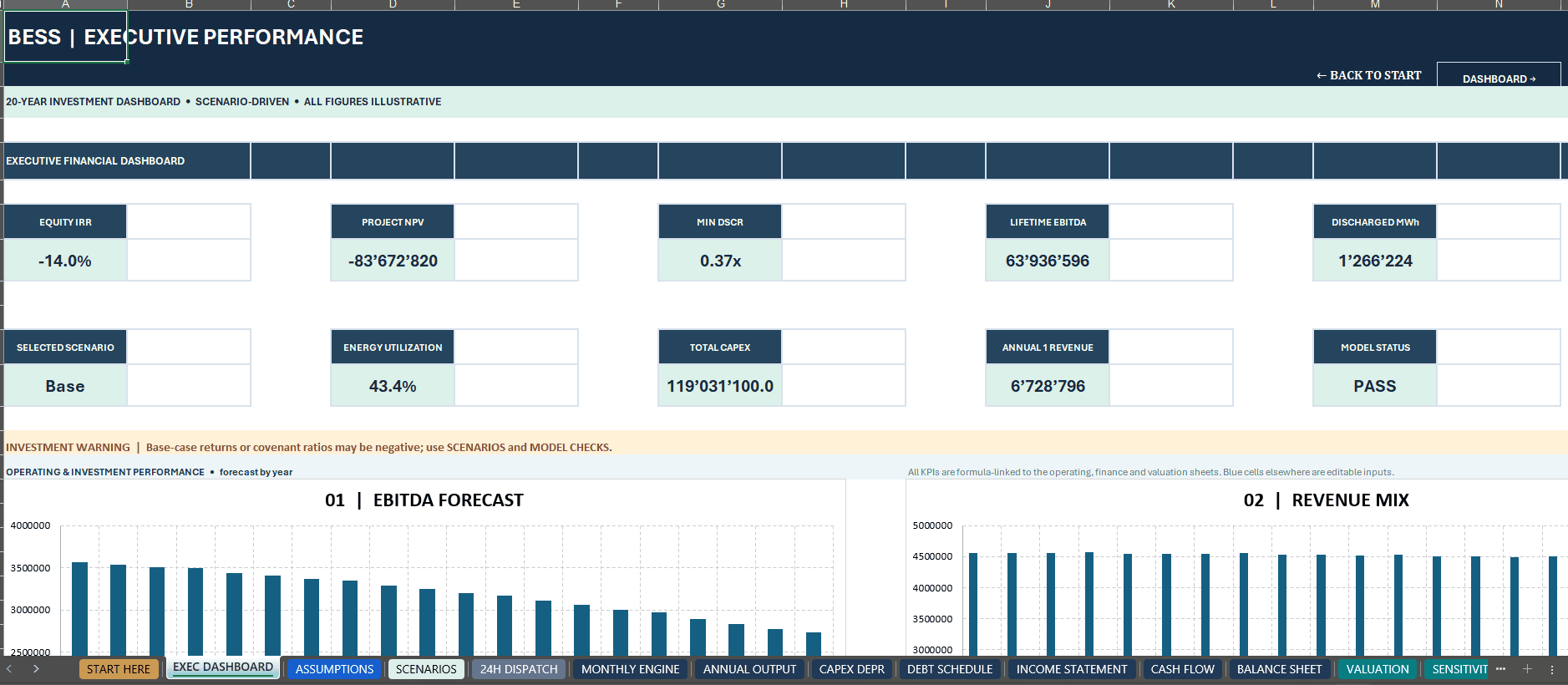
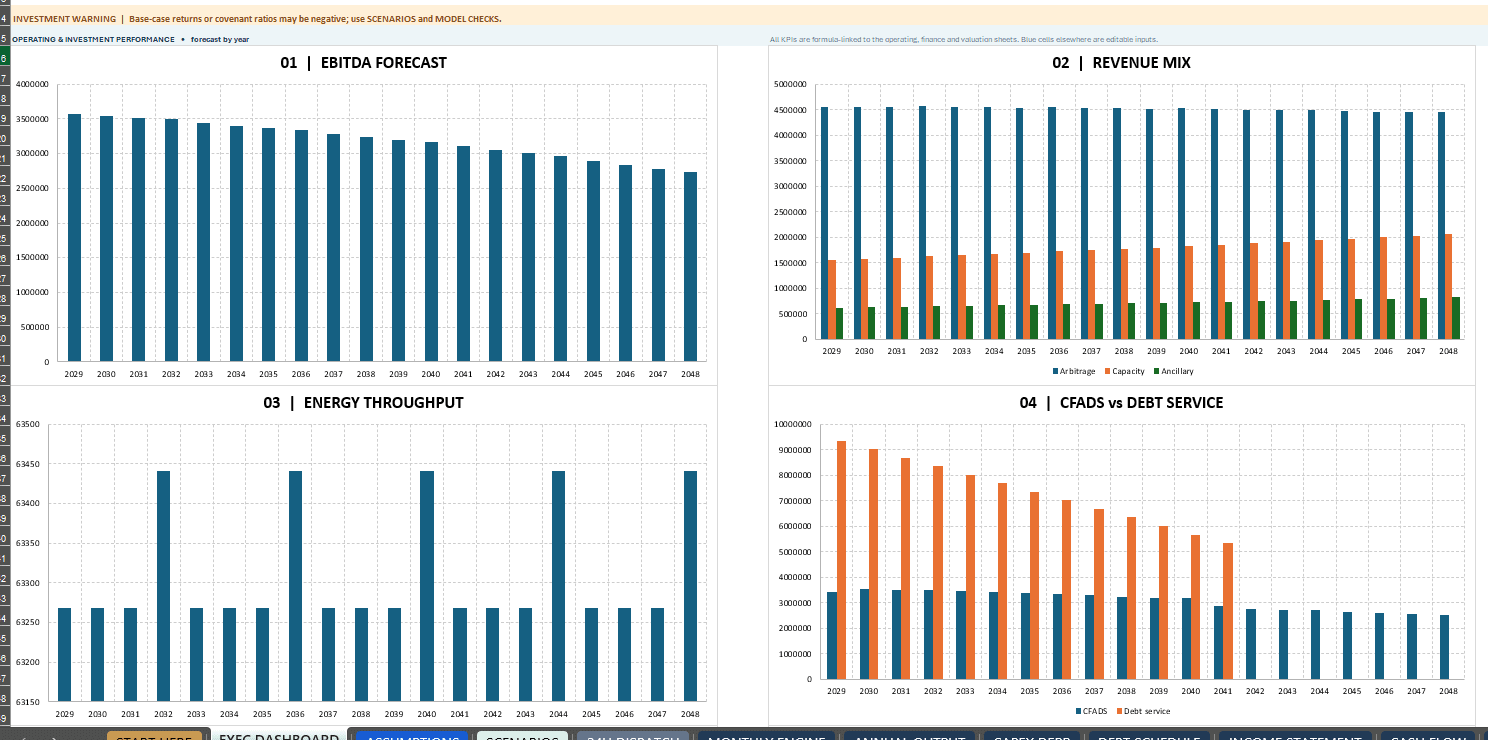
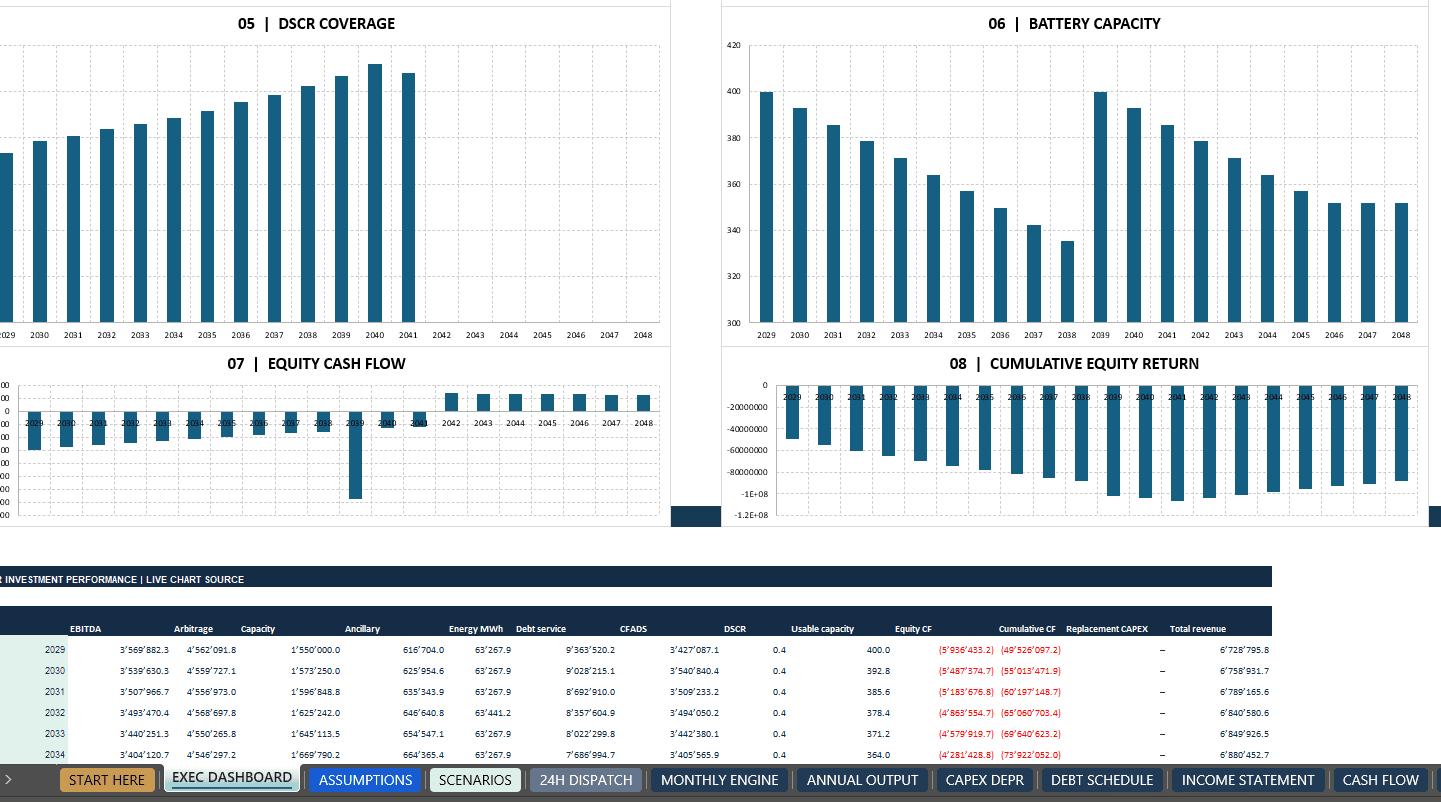
Monitor investment performance through eight native, data-linked Excel charts covering:
- Annual EBITDA Performance
- Revenue Composition
- Discharged Energy Throughput
- CFADS vs Debt Service
- DSCR Coverage
- Usable Battery Capacity
- Annual Equity Cash Flow
- Cumulative Equity Cash Flow
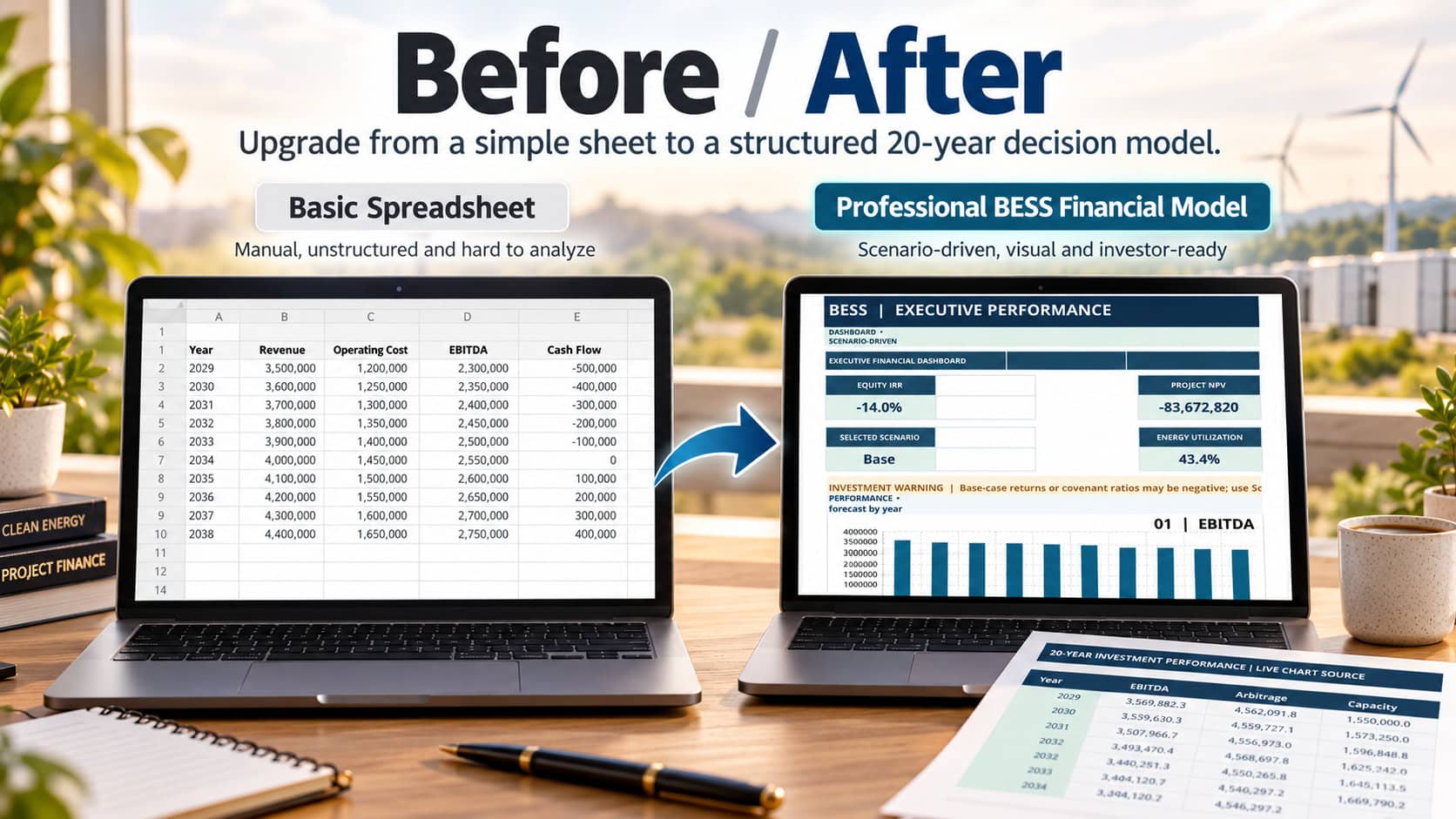
Executive indicators include Equity IRR, Project NPV, Minimum DSCR, Energy Utilization, Total CAPEX, Year 1 Revenue, Lifetime EBITDA and Total Discharged MWh.
The dashboard distinguishes technical model integrity from financial investment attractiveness.
⚡ 20-YEAR BATTERY PERFORMANCE & DISPATCH
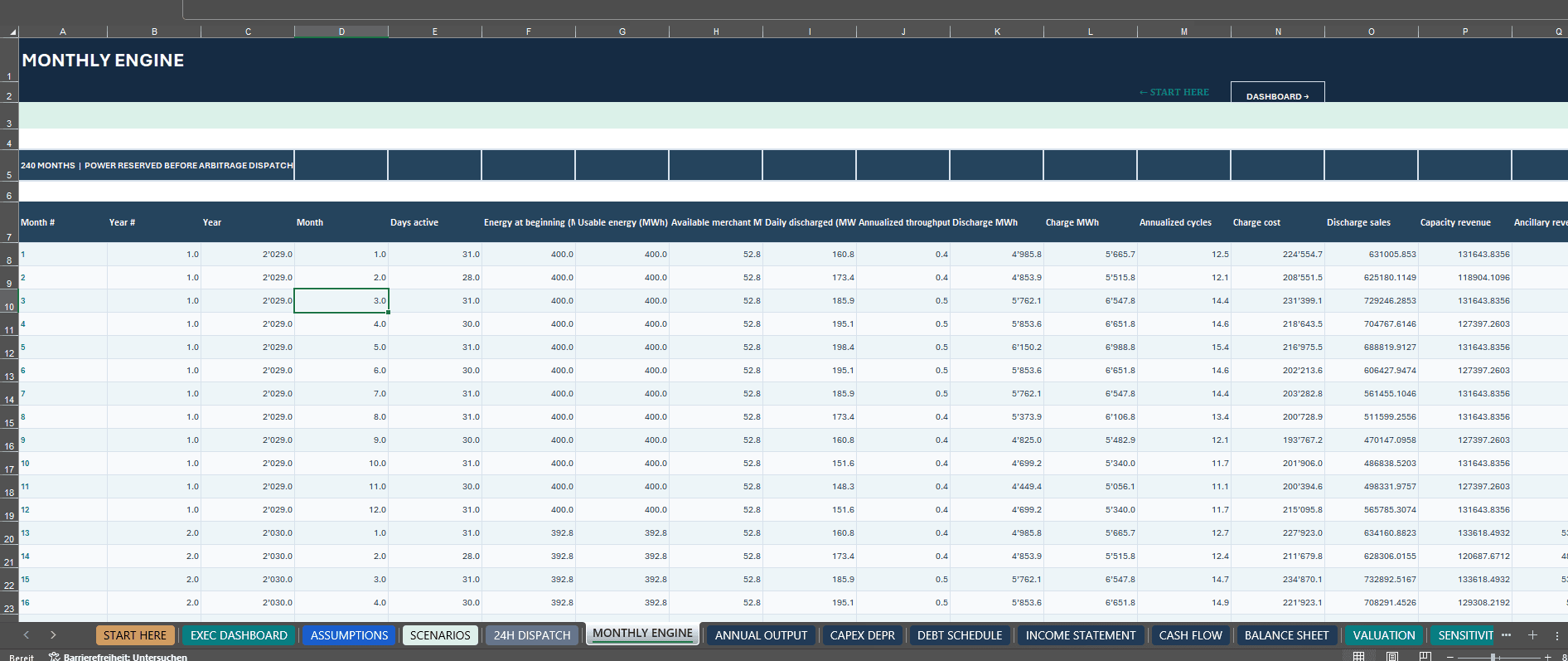
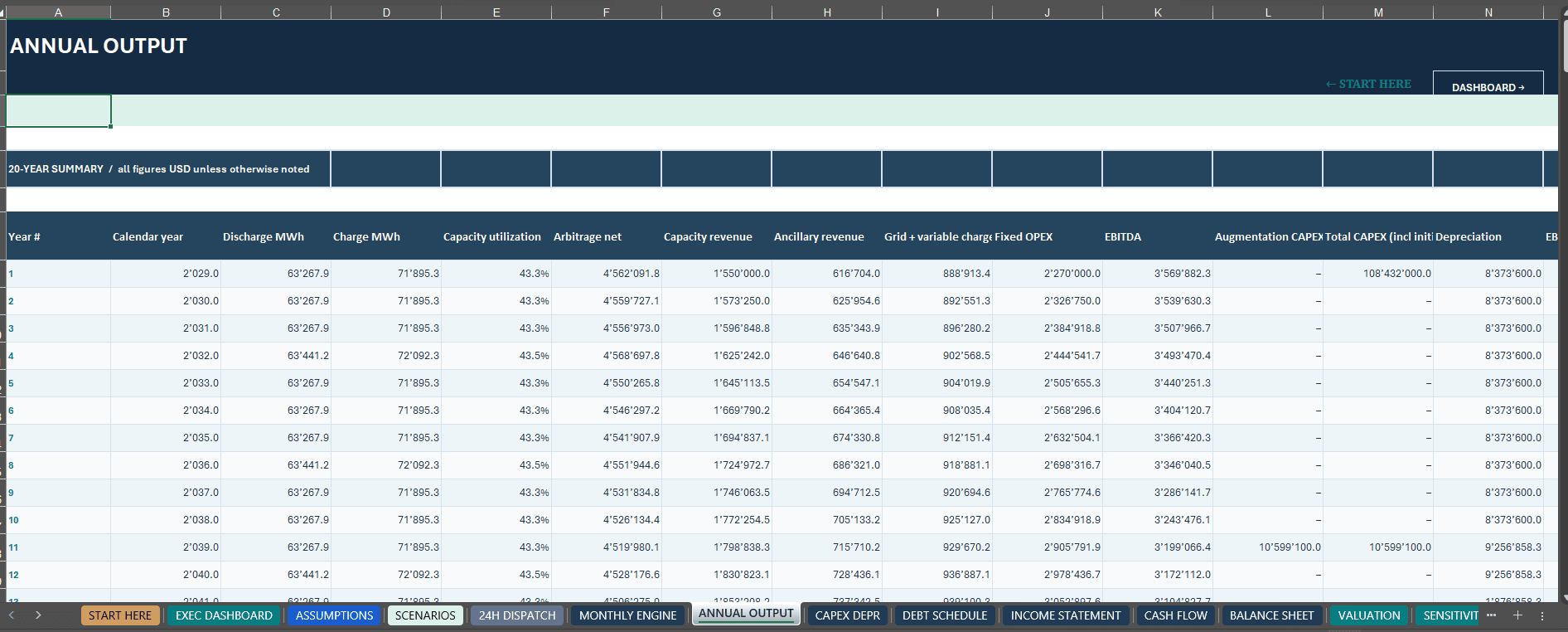
Build a detailed 240-month operating forecast with 20 annual financial summaries.
Configure key technical assumptions, including:
- Battery Power Capacity (MW)
- Nameplate Energy Capacity (MWh)
- Round-Trip Efficiency
- Daily Cycling Limits
- Technical Availability
- Annual Battery Degradation
- Minimum Remaining Capacity
- Battery Augmentation Timing and Costs
- Operating Commencement Year
The 24H DISPATCH worksheet provides editable representative hourly charge/discharge profiles and 12 monthly seasonality factors.
Monthly energy throughput and revenue are calculated using these representative operating assumptions.
The workbook does not perform a chronological hour-by-hour simulation of the entire project lifetime or optimize real-time battery state of charge.
💰 THREE INTEGRATED BESS REVENUE STREAMS
1. Energy Arbitrage
Model the relationship between electricity charging costs and discharge sales revenue using configurable purchase prices, selling prices, round-trip efficiency, grid fees and variable operating costs.
2. Capacity Payments
Forecast contracted capacity revenues based on an assumed share of available MW capacity and user-defined capacity rates.
3. Ancillary Services
Estimate additional revenues based on reserved capacity, service availability hours and configurable compensation assumptions.
Power reservation assumptions reduce merchant arbitrage capacity within the model’s simplified operating envelope.
🏗️ CAPEX, OPEX & BATTERY AUGMENTATION
Evaluate project investment and operating costs using editable financial assumptions.
Key cost components include:
- Battery Equipment and EPC Costs
- Power Conversion System Costs
- Interconnection and Development Costs
- Project Contingency
- Fixed Operations and Maintenance
- Variable Discharge Costs
- Insurance and Site Expenses
- Operating Cost Escalation
- Battery Augmentation Expenditure
- Depreciation
The model connects capital spending and battery augmentation to the financial schedules and long-term investment results.
No live market pricing, supplier quotations or external data feeds are included.
🏦 PROJECT DEBT & FINANCIAL STATEMENTS
Review how project financing affects operating cash flow, debt service and investor returns.
The financing module includes:
- Initial Debt Funding
- Debt Leverage Assumptions
- Annual Interest Calculations
- Scheduled Principal Repayments
- Opening and Closing Loan Balances
- Debt Service
- Cash Flow Available for Debt Service (CFADS)
- Debt Service Coverage Ratio (DSCR)
The workbook includes linked financial reporting modules:
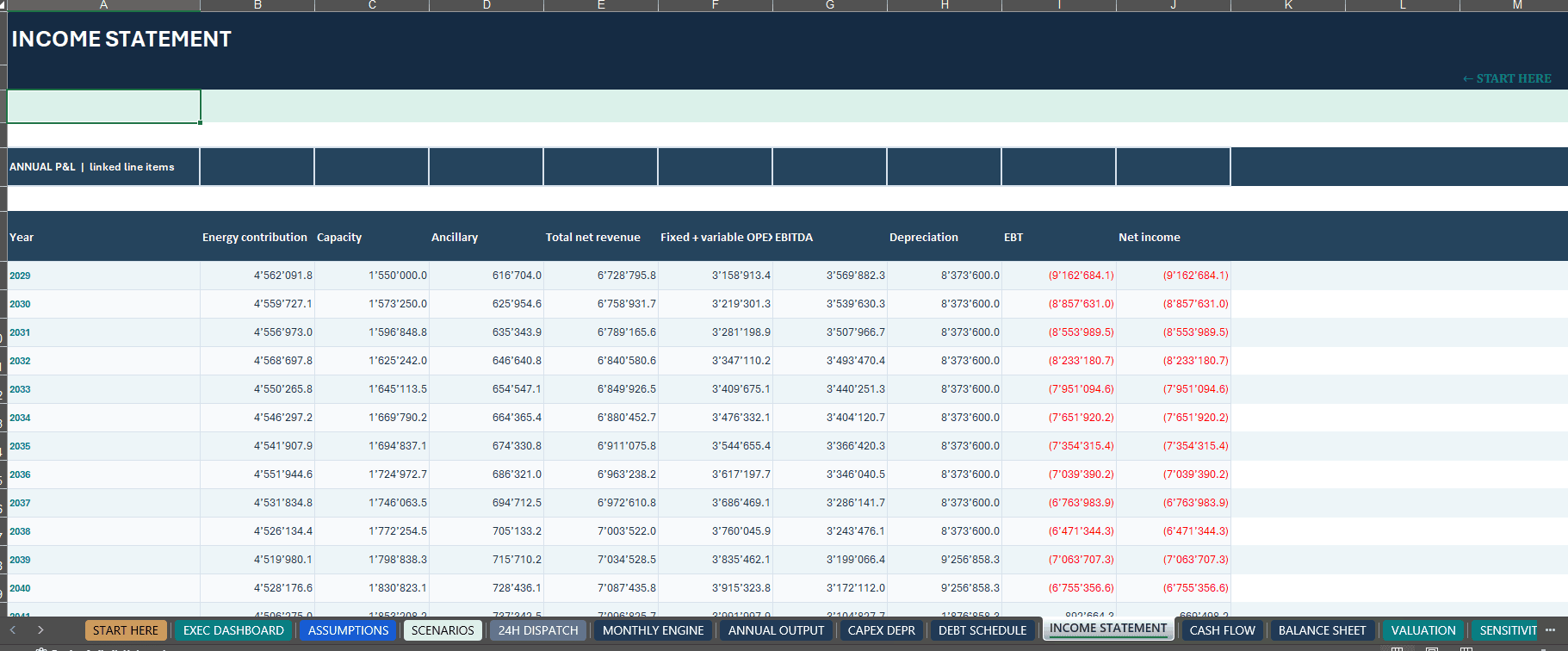
Income Statement – Revenue, operating expenses, EBITDA, depreciation, interest, tax and earnings.
Cash Flow Statement – Operating cash flows, capital investment, financing and equity-related cash movements.
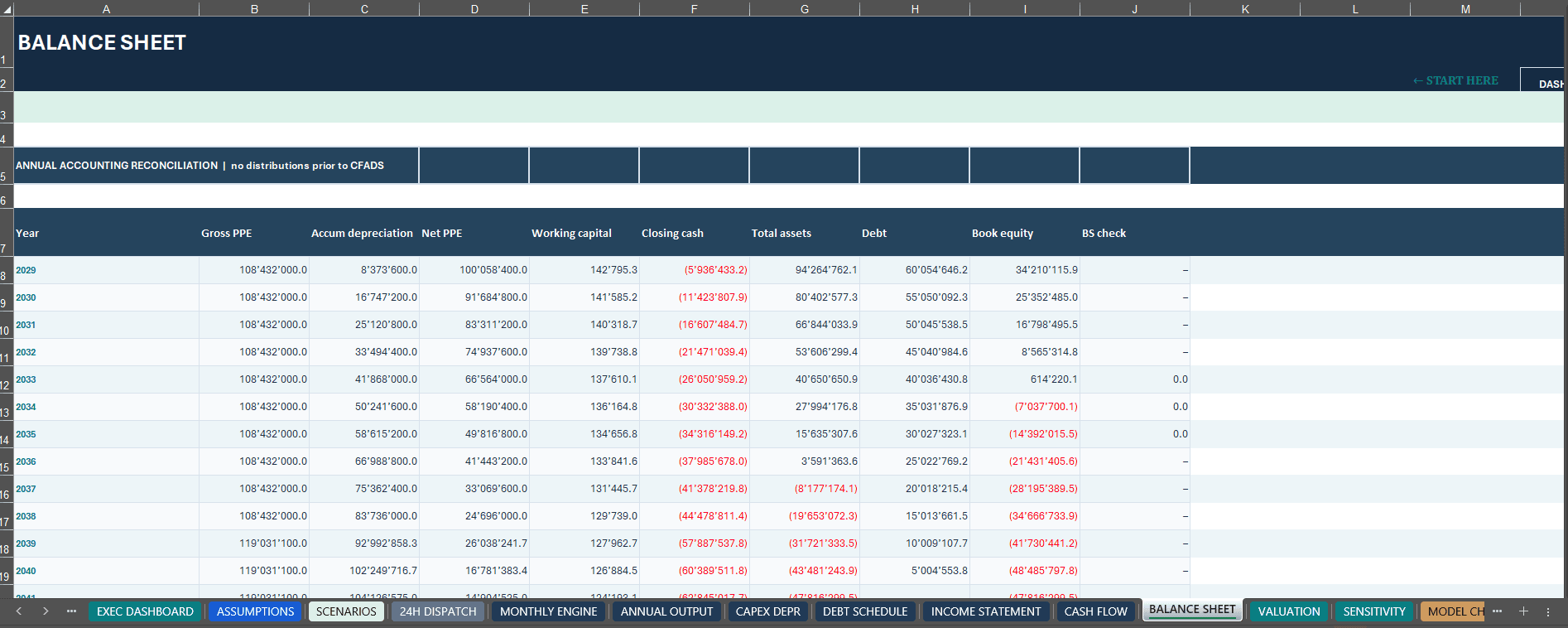
Balance Sheet – Project assets, cash, liabilities, debt and equity balances.
The financing methodology uses simplified annual level-principal amortization rather than a fully negotiated, sculpted project-finance debt structure.
📈 INVESTMENT RETURNS & SENSITIVITY
Evaluate long-term project performance using:
- Equity Internal Rate of Return (IRR)
- Unlevered Project Net Present Value (NPV)
- Equity Net Present Value (NPV)
- Minimum and Average DSCR
- Project Cash Flow
- Equity Cash Flow
- EBITDA and Financial Performance
- Price and CAPEX Sensitivity Analysis
The sensitivity worksheet compares relative energy-price realization and capital-cost changes.
Its sensitivity outputs are analytical approximations, not independent complete operating and financing forecasts for every scenario combination.
🔄 FOUR FINANCIAL SCENARIOS
Switch between four operating cases using the SCENARIOS worksheet.
BASE – Central illustrative assumptions.
UPSIDE – Improved electricity pricing, throughput and costs.
DOWNSIDE – Reduced commercial performance and less favorable expenditure.
STRESS – More adverse revenue, operating and investment conditions.
Scenario selection influences electricity price realization, energy throughput, CAPEX and operating expenses across the integrated financial calculations.
⚙️ MODEL CONTROLS & WORKBOOK STRUCTURE
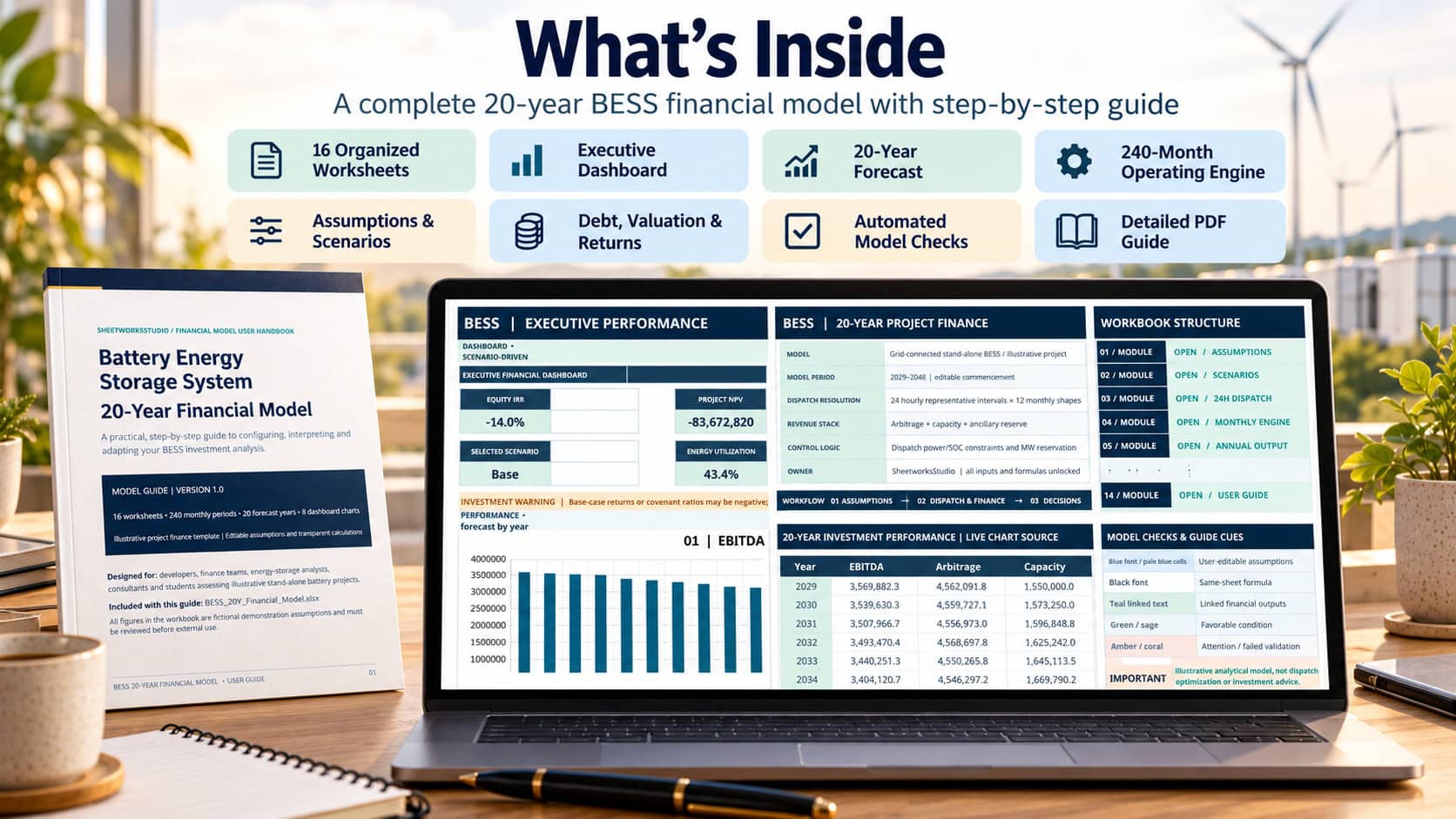
The workbook includes 16 organized worksheets:
Worksheet Purpose START HERE Introduction, instructions and navigation EXEC DASHBOARD Investment KPIs and eight charts ASSUMPTIONS Editable operating and financial inputs SCENARIOS Base, Upside, Downside and Stress 24H DISPATCH Representative hourly battery operation MONTHLY ENGINE 240-month operating and revenue forecast ANNUAL OUTPUT 20 annual financial summaries CAPEX DEPR Investment costs and depreciation DEBT SCHEDULE Financing and debt service INCOME STATEMENT Annual profitability CASH FLOW Project and equity cash movements BALANCE SHEET Financial position and reconciliation VALUATION IRR, NPV and coverage metrics SENSITIVITY Price and CAPEX sensitivity MODEL CHECKS Automated accounting and operating checks USER GUIDE In-workbook instructions
MODEL CHECKS tests selected operational constraints, energy conservation, debt calculations and financial statement consistency.
Additional indicators highlight cash deficits, weak coverage ratios and negative investment returns.
A model integrity PASS does not mean the investment is profitable, financeable or bankable.
📦 WHAT YOU RECEIVE
1. BESS 20-Year Financial Model (.xlsx)
- 16 Integrated Excel Worksheets
- 240 Monthly Forecast Periods
- 20 Annual Financial Forecasts
- Three Battery Storage Revenue Streams
- Representative 24-Hour Dispatch Profiles
- Battery Degradation and Augmentation
- CAPEX, OPEX and Debt Schedules
- Integrated Financial Statements
- IRR, NPV and DSCR Analysis
- Four Scenario Options
- Eight Dynamic Dashboard Charts
- Editable Formulas and Illustrative Sample Data
- No Macros or External Workbook Connections
2. Professional How-to-Use Guide (10-Page PDF)
A detailed English-language guide covering setup, dispatch assumptions, battery performance, revenue calculations, project costs, financing, financial statements, valuation, scenario testing, troubleshooting and model limitations.
IDEAL FOR
- Standalone BESS Project Developers
- Renewable Energy and Infrastructure Investors
- Independent Power Producers (IPPs)
- Project Finance Analysts
- Energy Storage Consultants
- Financial Modeling Professionals
- Infrastructure Project Sponsors
- Investment and Corporate Finance Teams
HOW TO GET STARTED
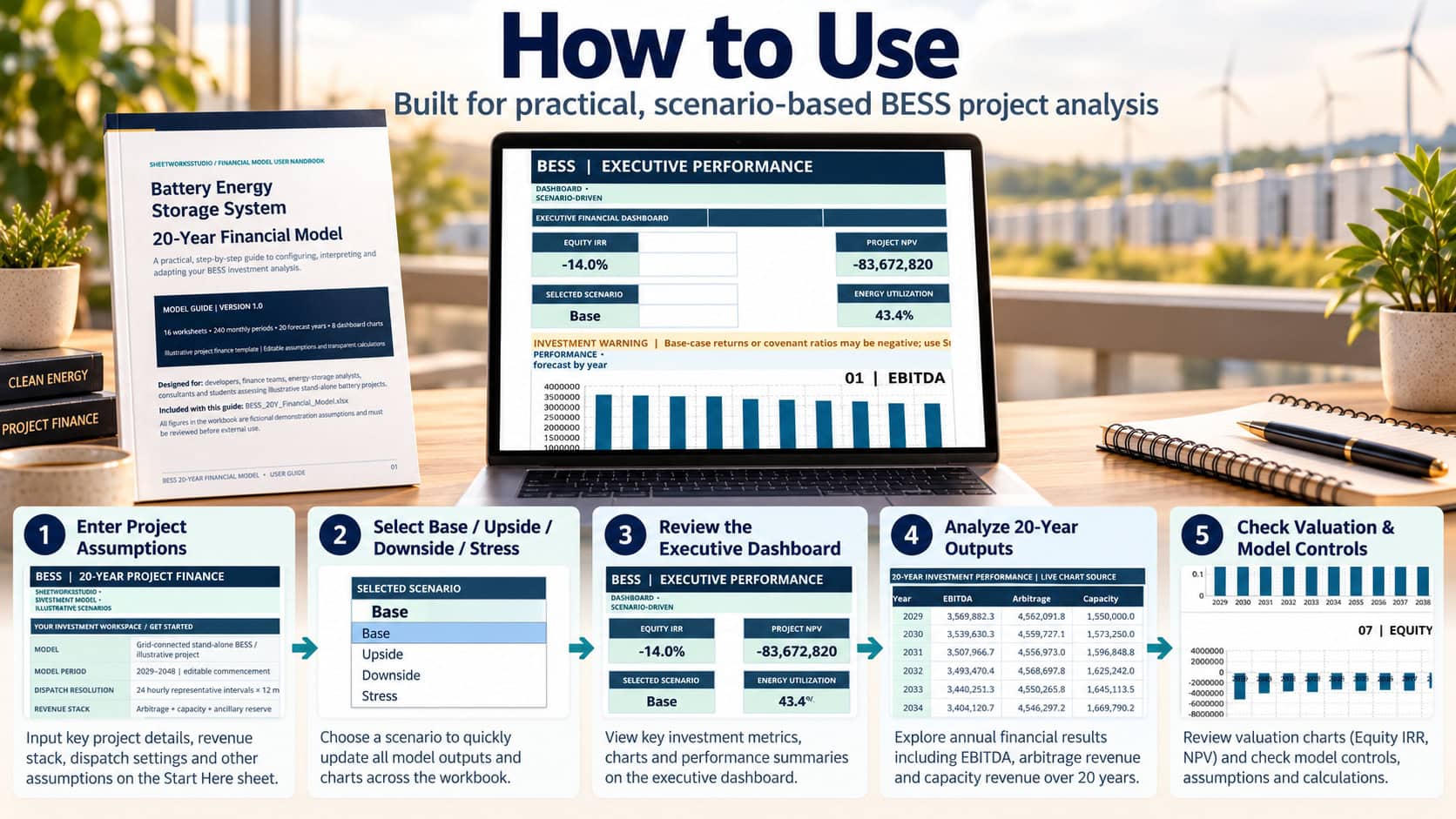
- Open START HERE and review the model workflow.
- Configure battery, electricity price, CAPEX, OPEX, financing and calendar assumptions.
- Select Base, Upside, Downside or Stress.
- Review the representative dispatch profile and monthly operating calculations.
- Analyze annual revenue, debt service and financial statements.
- Evaluate the Dashboard, Valuation, Sensitivity and Model Checks.
- Refine your assumptions and repeat the analysis.
TECHNICAL SPECIFICATIONS
- File Format: Microsoft Excel (.xlsx)
- Model Horizon: 20 Years
- Forecast Granularity: 240 Monthly Periods
- Financial Statements: Annual
- Workbook: 16 Worksheets
- Dashboard: 8 Native Excel Charts
- Scenarios: 4
- Formulas: Editable
- Sample Period: 2029–2048
- Macros: None
- External Data Connections: None
- User Documentation: 10-Page PDF
Microsoft Excel Desktop is recommended. Google Sheets compatibility has not been independently validated and is not guaranteed.
IMPORTANT MODEL LIMITATIONS & DISCLAIMER
This is an illustrative, standalone BESS financial planning model, not a certified engineering model, 8,760-hour dispatch optimizer, live electricity trading system, lender-approved financing model or audited financial forecast.
Battery operation, electricity pricing, depreciation, taxation, working capital and financing use simplified assumptions.
The included Base Case demonstrates that financially unfavorable outcomes are possible. Negative IRR, negative NPV, low DSCR and cash deficits reflect the example assumptions and are not automatically spreadsheet errors.
Users are responsible for independently verifying project inputs, technical parameters, financing terms, calculations and investment decisions.
This product does not constitute financial, investment, legal, tax, accounting or engineering advice.
No physical product will be shipped.
Developed by SheetworksStudio – Professional Financial Models & Business Decision Tools.
Similar ProductsOther customers were also interested in...


 eFinancialModels
Electric Vehicle (EV) Charging Station Financial M...
With this comprehensive 5- or 10-year monthly tool, investors can assess the viability of setting up... Read more

Financial Model for Mobile App | Mobile App Busine...
The Mobile App Financial Plan Template in Excel allows you to develop financial projections when lau... Read more

 HenrySheykin
Food Truck Financial Model Excel Template
The Food Truck Financial Model helps entrepreneurs, founders, business owners, consultants, and anal... Read more

Green Hydrogen Production from Wind Energy Financi...
The Green Hydrogen from Wind Financial Model aims to comprehensively forecast a horizon of 40 years ... Read more

Simple Mutual Non-Disclosure Agreement Template
Protect your business secrets with ease using our Simple Mutual Non-Disclosure Agreement Template. S... Read more

Solar Energy Financial Model
The Solar Energy Financial Model Spreadsheet Template in Excel assists you in preparing a sophistica... Read more

 Peter Graf
The Customer-Centric Financial Model for Restauran...
Starting a restaurant without a financial plan is like driving a car blindfolded. You wouldn´t do i... Read more
You must log in to submit a review.