
0 ITEMS

Ayurveda Center Financial Model Excel Template
The Ayurvedic Consultation Service Financial Model helps entrepreneurs, practitioners, wellness founders, consultants, and analysts turn an Ayurvedic clinic or consultation concept into a structured financial forecast. Instead of starting with a blank spreadsheet, users get a ready-to-use planning tool designed around the economics of a holistic health practice, including practitioner capacity, consultation pricing, client utilization, service mix, startup costs, operating expenses, payroll, cash flow, and profitability. It is built to support practical decision-making before launch, during expansion, or while preparing investor, lender, or business plan materials. This financial model template is especially useful for anyone planning an Ayurvedic consultation service that may include senior practitioner consultations, junior wellness consultant sessions, dietary health coaching, stress management appointments, corporate wellness workshops, and related wellness offerings. Users can adjust assumptions for pricing, staffing, client volume, utilization, direct costs, marketing, overhead, and growth to see how those decisions affect revenue, margins, cash balances, and long-term profitability. The model supports financial planning by connecting operating assumptions to clear five-year projections, helping users understand whether the practice can support its cost structure and scale sustainably. The template also helps buyers evaluate funding needs and launch readiness. It includes a structured view of startup costs, ongoing operating expenses, payroll planning, profitability forecasts, break-even analysis, scenario planning, and investor-friendly outputs. This makes it suitable for founders preparing a business plan, advisors helping clients evaluate a wellness practice, business owners considering a new location, or analysts who need a credible framework for reviewing an Ayurvedic service business. By organizing assumptions and outputs in one model, it helps users identify the key financial drivers that matter most. With editable inputs and professional outputs, the Ayurvedic Consultation Service Financial Model allows users to test low, base, and high cases, review cash flow dynamics, assess expected returns, and prepare clear financial reports for stakeholders. It saves time compared with building a model from scratch while still giving users flexibility to customize the forecast around their actual business strategy. The result is a more disciplined approach to planning, budgeting, funding discussions, and operational decision-making.


Financial Model Overview
The Ayurvedic Consultation Service Financial Model is a ready-to-use financial model template designed to help founders, Ayurvedic practitioners, wellness entrepreneurs, consultants, and analysts evaluate the financial viability of an Ayurvedic consultation practice. It brings together the key assumptions needed to forecast service revenue, practitioner capacity, operating expenses, startup investment, payroll, cash flow, profitability, investor returns, and funding needs over a multi-year planning period. For an Ayurvedic consultation service, accurate financial planning depends on more than estimating client demand. The model needs to connect practitioner availability, session pricing, client utilization, service mix, corporate wellness opportunities, supplement-related costs, marketing spend, facility overhead, and staffing growth into one structured forecast. This template gives users a practical framework for making those connections and translating business assumptions into investor-ready financial outputs. It is useful for launching a new wellness practice, expanding an existing clinic, preparing a business plan, applying for funding, or presenting projections to investors and lenders. Because the template is editable, users can replace the built-in assumptions with their own pricing, hiring plan, cost structure, launch budget, and growth expectations while still benefiting from a professional model layout and automated calculations.
All-in-One Dashboard
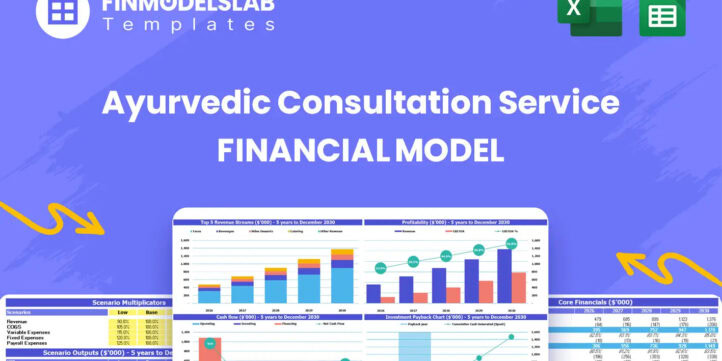
The all-in-one dashboard gives users a centralized view of the most important inputs and outputs in the Ayurvedic Consultation Service Financial Model. Instead of searching through separate worksheets to understand performance, users can review the core financial picture in one place, including revenue projections, profitability, cash flow, investment requirements, margins, and selected return metrics. This component is especially useful for Ayurvedic consultation services because founders often need to monitor several drivers at once, such as the number of practitioners, monthly treatment capacity, pricing by service type, utilization levels, direct costs, and operating expenses. The dashboard may pull from revenue assumptions, startup costs, payroll schedules, operating expense budgets, financing assumptions, and forecasted financial statements to present a clear overview of expected performance. The outputs help users quickly understand whether the business plan is financially balanced, whether cash balances remain healthy, and whether profitability improves as the practice scales. For business planning and stakeholder communication, the dashboard provides a concise summary that can support meetings with investors, lenders, partners, or internal decision-makers. It also helps non-financial users interpret the model more easily because key metrics are summarized visually and logically rather than buried in detailed calculations.
Low Base High Scenario Analysis
The low, base, and high scenario analysis component helps users test how the Ayurvedic consultation service may perform under different business conditions. A wellness practice can be affected by changes in client acquisition, practitioner utilization, service pricing, staffing pace, marketing effectiveness, corporate wellness demand, and cost inflation, so relying on a single forecast can create a false sense of certainty. This section allows users to compare conservative, expected, and optimistic cases by adjusting the major business drivers that influence revenue, expenses, cash flow, and profitability. Inputs may include client utilization rates, monthly appointments per practitioner, prices for consultations and wellness sessions, the timing of hiring additional practitioners, direct cost percentages, fixed overhead, marketing spend, and growth assumptions. The outputs show how different assumptions affect sales, EBITDA, net profit, cash runway, funding requirements, and investor returns. This is useful for risk management because it helps users understand the minimum performance needed to remain financially stable and the upside potential if demand grows faster than expected. For funding preparation, scenario analysis strengthens the business case by showing stakeholders that the plan has been stress-tested rather than built around only one ideal outcome. It also supports practical decision-making, such as whether to lease a larger facility, add specialists sooner, expand corporate wellness programs, or delay certain expenses until demand is proven.
Professional Charts
The professional charts component transforms the financial forecast into clear visual outputs that are easier to interpret and present. For an Ayurvedic Consultation Service Financial Model, charts can show revenue growth, service line contribution, expense trends, profitability, cash balances, margins, and other key financial movements over time. The inputs come from the underlying forecast, including service revenue assumptions, direct costs, payroll, operating expenses, startup costs, capital expenditures, cash flow, and financial statement summaries. The outputs may include line charts, bar charts, trend visuals, and comparative graphics that make complex financial information easier to communicate. This is especially valuable when preparing an investor presentation, lender discussion, business plan appendix, or internal strategy review, because stakeholders often need to understand the direction of the business quickly. Charts can highlight whether revenue is scaling as practitioner capacity expands, whether margins improve as fixed costs are absorbed, and whether cash balances remain sufficient through the early months of operation. They also help users identify potential issues, such as expenses growing faster than revenue or a decline in cash flow during expansion. By presenting financial information in a polished and structured format, the professional charts component helps users move beyond raw spreadsheet numbers and communicate the business case with greater clarity.
ROE Components and DuPont Analysis
The ROE components and DuPont analysis section helps users understand what drives return on equity in the Ayurvedic consultation service. Return on equity is an important investor metric because it shows how effectively the business generates profit from the owners’ invested capital. DuPont analysis breaks ROE into underlying components, typically including profitability, asset efficiency, and financial leverage, so users can see whether returns are being driven by strong margins, efficient use of assets, financing structure, or a combination of factors. Inputs may include net profit, revenue, total assets, equity, debt assumptions, retained earnings, and balance sheet projections from the financial model. The outputs help explain why ROE changes over time as the practice grows, hires more practitioners, invests in facilities, expands service offerings, or changes its funding mix. For an Ayurvedic consultation service, this analysis can be particularly useful because the business may have relatively high service margins but still require upfront investment in buildout, furniture, website development, herbal inventory, marketing, and working capital. Understanding the relationship between profit generation and invested equity helps founders and investors evaluate whether the business is producing an attractive return. It also supports strategic decisions about whether to finance expansion through owner equity, debt, or reinvested earnings, and whether operational improvements should focus on pricing, utilization, cost control, or asset productivity.
Revenue Inputs
The revenue inputs component is one of the most important sections of the Ayurvedic Consultation Service Financial Model because it defines how the business generates income from its services. Revenue in an Ayurvedic consultation practice is typically driven by practitioner count, monthly appointment capacity, client utilization, pricing per session, service mix, package sales, and corporate wellness opportunities. This section allows users to input assumptions for senior Ayurvedic practitioner consultations, junior wellness consultant sessions, dietary health coaching, stress management appointments, corporate workshops, and other relevant service categories. It may also include ramp-up assumptions as the practice builds awareness, adds staff, increases appointment volume, or expands into new customer segments. The model uses these inputs to calculate monthly and annual revenue projections, service-level contribution, total client volume, and growth over time. This is useful because it forces users to build the forecast from operational reality rather than relying on a top-down sales estimate. By connecting pricing and capacity to actual practitioner availability and expected utilization, the revenue inputs section helps users test whether the business can realistically achieve its sales targets. It also supports pricing decisions, hiring plans, marketing budgets, and funding discussions by showing how each revenue assumption affects the broader financial forecast.
Bank-Ready Reports
The bank-ready reports component organizes the financial outputs in a format suitable for lenders, investors, and professional stakeholders. When applying for a business loan, seeking startup funding, or presenting a business plan, users need more than internal assumptions. They need clear financial statements, transparent forecasts, and lender-friendly summaries that show the business can generate revenue, manage expenses, maintain liquidity, and repay obligations. This section may include projected profit and loss statements, cash flow forecasts, balance sheet summaries, debt service assumptions, funding needs, margins, and key financial indicators. Inputs flow from the broader model, including revenue drivers, startup costs, operating expenses, payroll, working capital, financing assumptions, and capital expenditures. The outputs help present a complete financial picture for the Ayurvedic consultation service, showing how the business is expected to perform month by month and year by year. For lenders, this helps assess repayment capacity and cash flow stability. For investors, it helps evaluate profitability, scalability, and return potential. For founders, it creates a structured set of reports that can be attached to a business plan or used in meetings with banks, grant providers, partners, or advisors. The professional formatting also helps users communicate credibility by showing that the numbers are organized, connected, and based on documented assumptions.
Revenue Breakdown
The revenue breakdown component provides a detailed view of how different services contribute to total income. An Ayurvedic consultation service may earn revenue from multiple sources, including one-on-one consultations, follow-up visits, junior consultant sessions, dietary health coaching, stress management programs, corporate wellness workshops, membership packages, and potentially related wellness product sales. This section separates those revenue streams so users can see which offerings generate the most income, which services are growing fastest, and how changes in pricing or utilization affect the overall forecast. Inputs may include the number of appointments by service type, price per session, practitioner capacity, utilization rates, package assumptions, workshop frequency, and growth rates for each revenue category. The outputs may show monthly and annual revenue by stream, percentage contribution to total sales, year-over-year growth, and service-level trends. This is useful for operational planning because not all services have the same capacity requirements, margin profile, or marketing strategy. For example, corporate workshops may generate larger single transactions but require different sales efforts than individual consultations. Dietary coaching may support recurring engagement, while senior practitioner sessions may command premium pricing. By breaking revenue into detailed streams, users can make better decisions about where to focus marketing, how to allocate practitioner time, which services to expand, and which pricing adjustments may improve profitability.
KPI Dashboard
The KPI dashboard component tracks performance metrics that help users evaluate whether the Ayurvedic consultation service is meeting its financial and operational goals. While the all-in-one dashboard summarizes the broader model, the KPI dashboard focuses on key performance indicators that can be used for benchmarking, monitoring, and management. Relevant KPIs may include revenue per practitioner, average revenue per client, utilization rate, EBITDA margin, net profit margin, cash balance, payback period, IRR, ROE, revenue growth, direct cost percentage, payroll as a percentage of revenue, and break-even timing. Inputs are drawn from the forecast assumptions and financial statements, including service volumes, pricing, staffing, expenses, investment, and financing structure. The outputs give users a measurable way to assess business performance over time and compare actual results against the plan once the practice is operating. This is useful for decision-making because KPIs reveal whether the business is improving for the right reasons. Revenue growth alone may not be enough if margins are declining, cash flow is tightening, or practitioner utilization is below target. The KPI dashboard helps owners and managers identify issues early, set realistic goals for the team, and communicate progress to stakeholders. It also supports industry benchmarking by allowing users to compare important metrics against expected standards for wellness, consultation, and holistic health service businesses.
Startup Cost Breakdown
The startup cost breakdown component helps users estimate the initial capital required to launch an Ayurvedic consultation service before revenue begins. Opening a professional wellness practice often requires spending on facility preparation, interior design, consultation rooms, furniture, website development, search engine optimization, booking systems, initial marketing, licensing, insurance, deposits, professional equipment, initial herbal apothecary inventory, and working capital reserves. This section organizes those costs into a clear launch budget so users can see how much funding may be needed and where the money will be spent. Inputs may include one-time setup expenses, capital expenditures, pre-opening payroll, technology costs, branding, legal and professional fees, lease deposits, inventory purchases, and contingency reserves. The outputs may include total startup investment, funding requirement, timing of cash outflows, and the impact of initial spending on cash balances and balance sheet projections.
File types:
Excel – Single-User: .xlsx
Excel – Multi-User: .xlsx
Similar ProductsOther customers were also interested in...


 HenrySheykin
Drug Rehab Clinic Financial Model Excel Template
The Drug and Alcohol Rehab Center Financial Model helps users turn a treatment facility concept into... Read more

Health Clinic Financial Model Excel Template
The Health Clinic Financial Model helps users build a structured financial forecast for a medical cl... Read more

Alcohol Treatment Center Financial Model Excel Tem...
The Drug and Alcohol Rehab Center Financial Model helps users turn a treatment facility concept into... Read more

Acupuncture Center Financial Model Excel Template
The Acupuncture Clinic Financial Model helps users turn an acupuncture practice concept into a struc... Read more

Occupational Therapy Financial Model Excel Templat...
The Occupational Therapy Financial Model helps users build a structured forecast for an OT clinic or... Read more

 Giorgos
Speech Therapy Center – 5 Year Financial Model
Financial Model providing an advanced 5-year financial plan for a startup or operating Speech Therap... Read more
Medical Practice Financial Model Excel Template
The Medical Practice Financial Model helps users turn a clinic concept, expansion plan, or healthcar... Read more
Dental Practice Financial Model Excel Template
The Dental Clinic Financial Model helps users turn a dental practice concept, launch plan, or expans... Read more

Ambulatory Surgical Center Financial Model Excel T...
The Ambulatory Surgery Center Financial Model helps founders, healthcare operators, consultants, ana... Read more
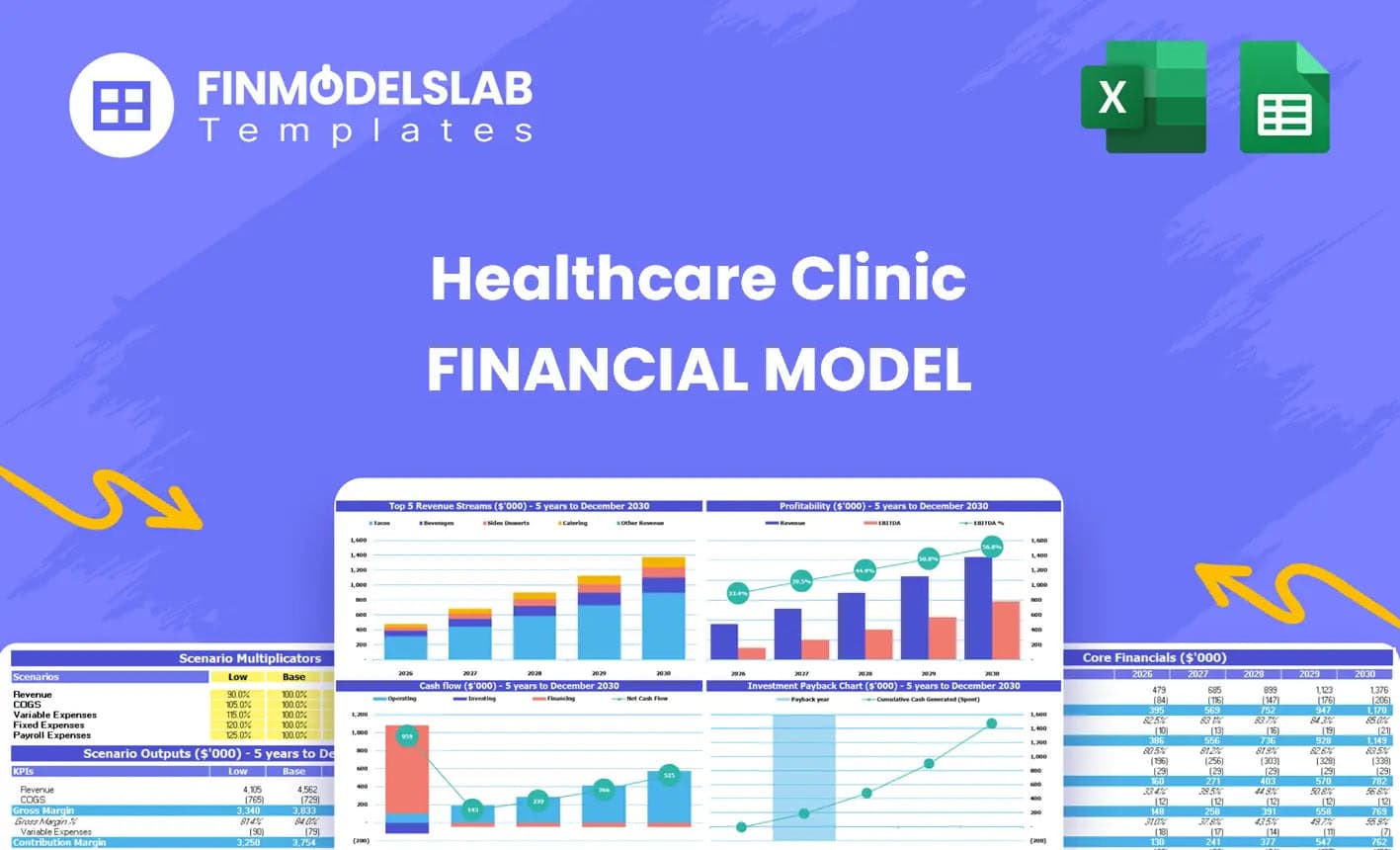
Clinic Financial Model Excel Template
The Healthcare Clinic Financial Model helps founders, clinic owners, consultants, analysts, and busi... Read more
You must log in to submit a review.