
0 ITEMS

AI Startup Financial Model – Excel Template for Generative AI, LLM & AI SaaS Companies
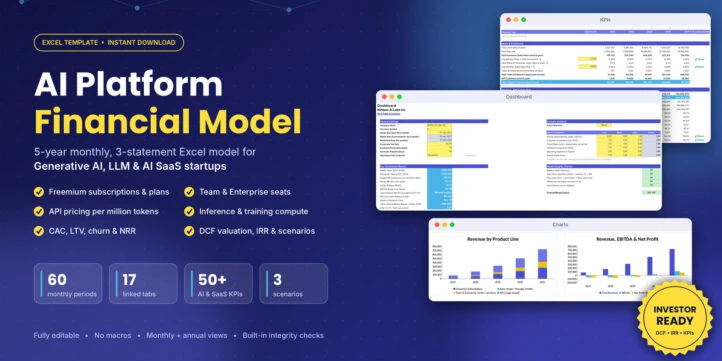
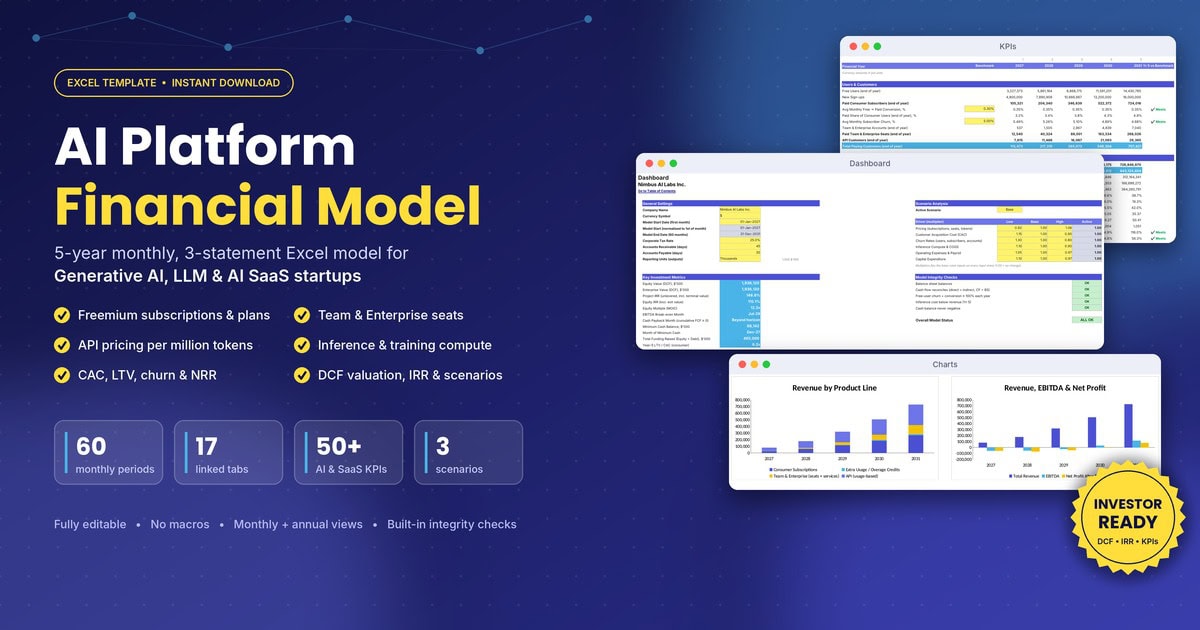
AI Startup Financial Model – Excel Template for Generative AI, LLM & AI SaaS Companies Plan, pitch and fundraise with a 5-year monthly AI startup financial model built for how generative AI products really make money. This investor-ready Excel template models three revenue engines – freemium consumer subscriptions, Team & Enterprise seats and usage-based API pricing per million tokens – and links them to the cost that matters most in AI: inference compute. Ideal for AI startups preparing pitch decks, budgets and investor data rooms. WHY AN AI-SPECIFIC FINANCIAL MODEL? Generic SaaS templates assume near-zero cost per user. Generative AI doesn’t work that way: every prompt, free user and API call consumes GPU compute. This model ties revenue and costs to tokens processed, so your gross margin, unit economics and cash runway reflect real usage – exactly what investors look for in an AI business plan. REVENUE MODELLING Freemium funnel: marketing budget, CAC per sign-up, organic growth, free-to-paid conversion and churn Up to 5 subscription plans with price, churn, token usage and app-store share Team & Enterprise seats with seat expansion and account churn API segments with tokens per customer, usage growth and declining price per million tokens AI COSTS & OPERATIONS Inference cost per million tokens, including free-user serving cost Model training compute, data licensing, cloud hosting and app-store fees Payroll plan by department, GPU cluster CAPEX and depreciation Equity rounds, venture debt and loan schedules INVESTOR-READY OUTPUTS Fully linked monthly income statement, cash flow and balance sheet 50+ AI & SaaS KPIs: ARR, MRR, NRR, churn, ARPU, CAC, LTV, LTV/CAC, payback, magic number, burn multiple, Rule of 40 DCF valuation with revenue multiple, EBITDA multiple or perpetual growth, plus IRR and MOIC Break-even analysis, Low/Base/High scenarios, integrity checks and charts WHO IT’S FOR AI founders raising seed to Series B, CFOs at AI SaaS and LLM companies, investors doing due diligence, and consultants modelling AI chatbots, AI assistants, AI copilots and AI agent platforms. WHAT YOU GET 17 linked Excel tabs, clear colour-coded inputs, no macros and a fictional example company to guide you. Works in Microsoft Excel with monthly and annual views, a selectable currency and reporting units in units, thousands or millions. Fully editable – replace the sample assumptions with your own and build a credible AI business plan in hours, not weeks. FLEXIBLE FOR ANY AI BUSINESS MODEL Use all three revenue engines or switch any of them off – the model works for subscription-only AI apps, seat-based AI SaaS, pay-as-you-go API platforms or any mix. Download the AI Platform Financial Model and turn your AI product into a clear, defensible financial plan.
AI Platform Financial Model – Excel Template for Generative AI, LLM & AI SaaS Startups
Building an AI company? Investors no longer accept a generic SaaS spreadsheet for a generative AI business. Your revenue comes from freemium consumer subscriptions, sales-led team and enterprise seats, and usage-based API pricing per million tokens, and your largest cost is inference compute. This AI startup financial model captures all of it in one professional, fully linked Excel template.
The AI Platform Financial Model is a 5-year, monthly, three-statement financial model built for AI assistants, AI chatbots, large language model (LLM) applications, AI copilots, AI developer platforms and any generative AI product that monetises through subscriptions, seats and API usage. It turns your assumptions about users, conversion, churn, pricing, tokens and compute into an investor-ready income statement, cash flow statement, balance sheet, KPI dashboard and DCF valuation, all in minutes.
Why AI Companies Need a Different Financial Model
Traditional SaaS financial models assume near-zero marginal cost per user. Generative AI breaks that assumption. Every prompt, every free user and every API call consumes GPU compute. A credible AI business plan financial model must therefore link revenue and cost to usage:
- Tokens processed drive inference cost, so gross margin depends on how much your users actually use the product.
- Free users are not free: serving a large freemium base costs money every month.
- API revenue is usage-based: it grows with customer adoption and falls as price per million tokens declines.
- Training compute is a major fixed investment that sits alongside payroll in operating expenses.
- Unit economics (CAC, LTV, LTV/CAC, payback, NRR) decide whether growth creates or destroys value.
This template was designed around exactly these drivers, so your forecast reflects how AI products really make and spend money.
Three Revenue Engines Modelled Separately
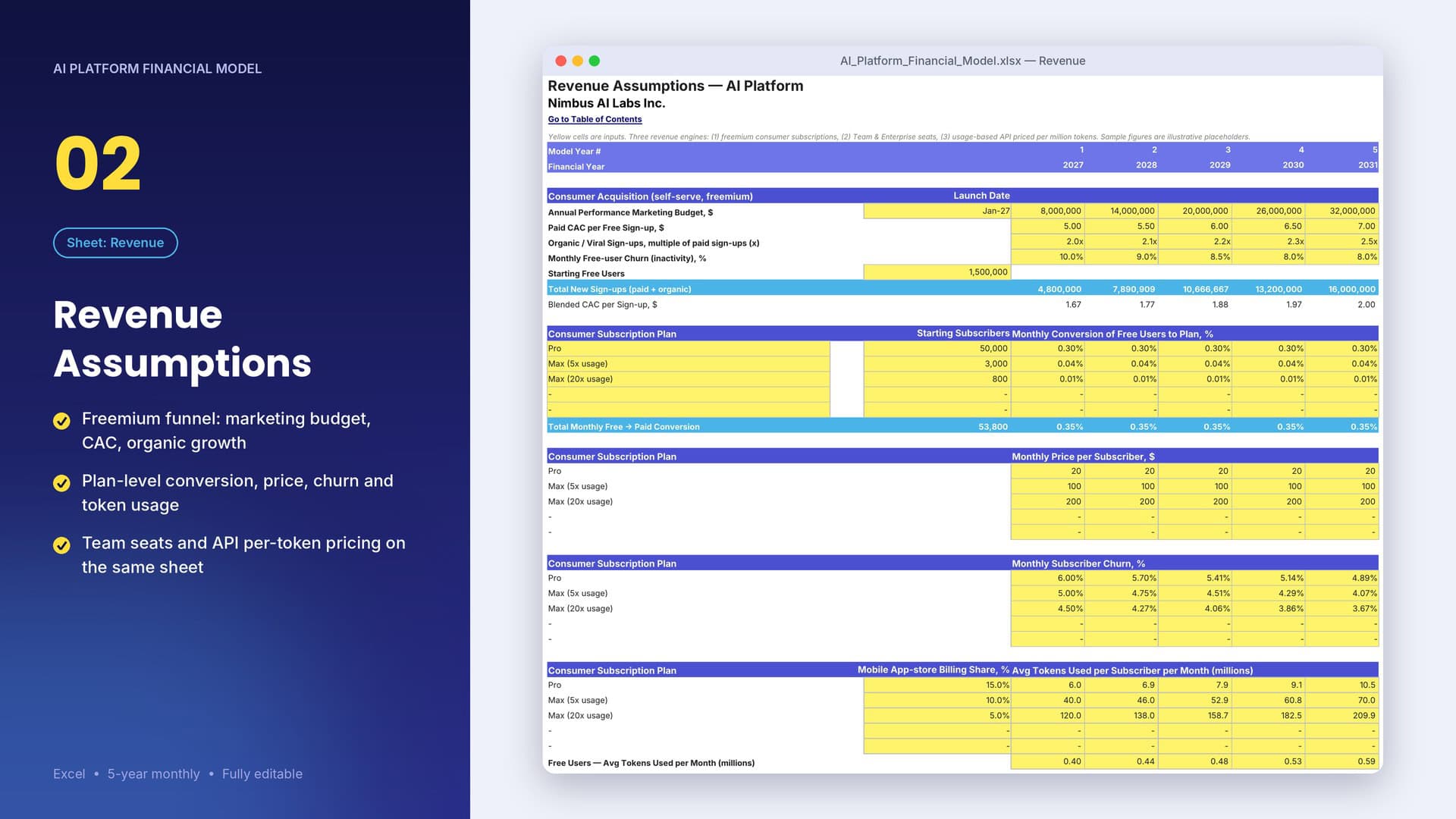
1. Consumer Freemium Subscriptions (Self-Serve)
Model a consumer AI app or AI assistant with a free tier and multiple paid plans, such as Pro and Max-style usage tiers.
- Annual performance marketing budget with monthly seasonality
- Paid CAC per free sign-up and an organic or viral sign-up multiple
- Free-user pool with monthly inactivity churn
- Monthly free-to-paid conversion rate for each plan (up to five plans)
- Monthly price per subscriber by plan and by year
- Monthly subscriber churn rate by plan
- Average tokens used per subscriber and per free user
- Share of billings through mobile app stores, with app-store commission
- Extra usage and overage credits as a percentage of subscription revenue
2. Team & Enterprise Seats (Sales-Led)
Forecast B2B revenue from team workspaces and enterprise contracts.
- New accounts won per year for up to five seat plans (e.g. Team Standard, Team Premium, Enterprise)
- Seats per new account and starting accounts
- Price per seat per month by year
- Monthly net seat expansion inside existing accounts
- Monthly account (logo) churn
- Average tokens per seat for compute costing
- Professional services and custom deployment revenue
3. Usage-Based API Platform (Pay-As-You-Go)
Model developer and enterprise API revenue on a price per million tokens basis.
- Up to five API customer segments (e.g. self-serve developers, start-ups and scale-ups, enterprise platform)
- New API customers per year and starting customers
- Tokens per new customer per month
- Monthly usage growth per customer
- Monthly customer churn
- Blended price per million tokens (input and output) with an annual price-decline path
All three engines roll forward every month in a dedicated calculation sheet, producing revenue, MRR, ARR, customer counts and total tokens processed.
AI-Specific Cost Modelling
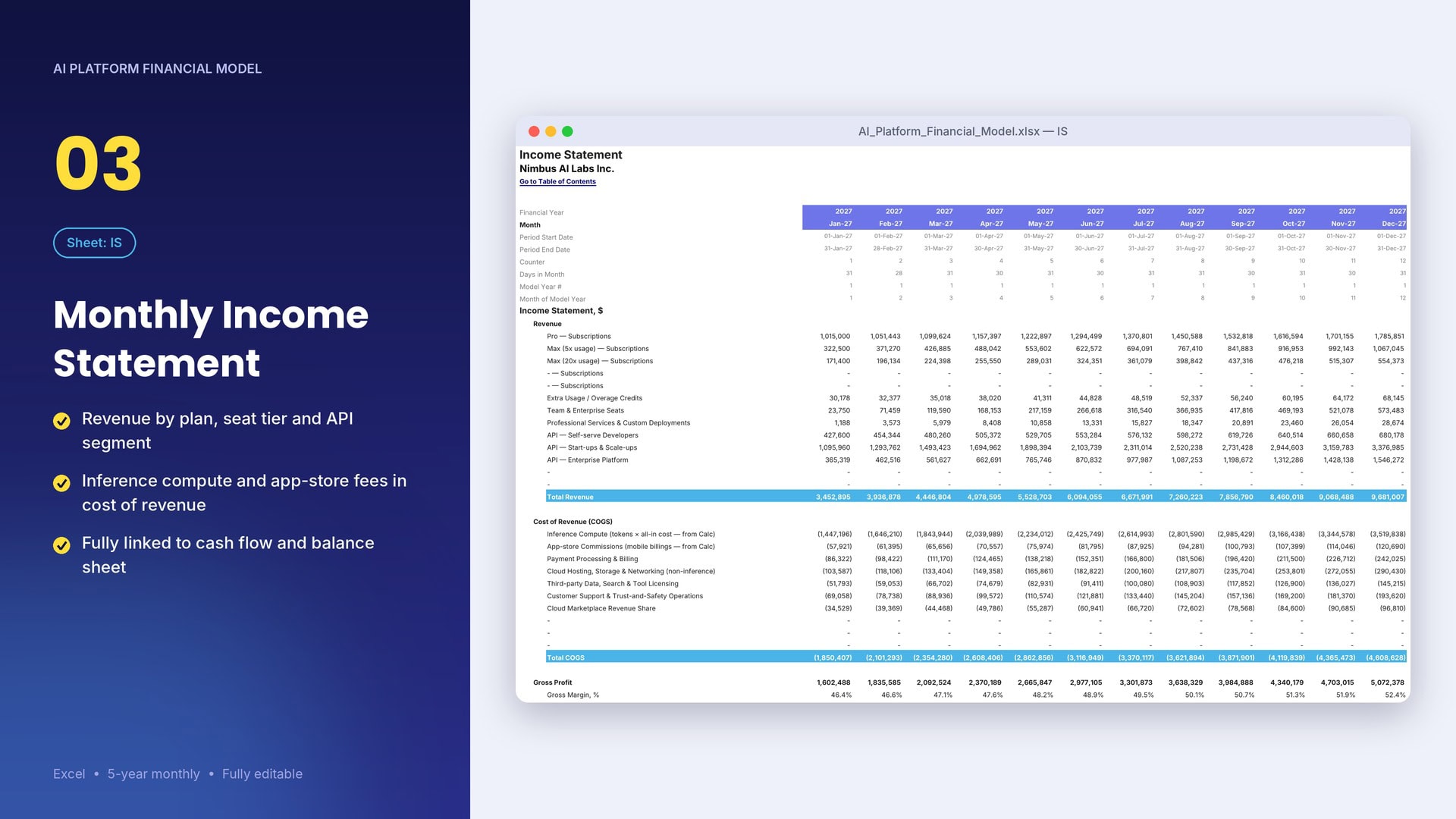
- Inference compute cost = total tokens processed × all-in cost per million tokens
- Separate tracking of free-user serving cost, one of the most important metrics for a freemium AI product
- Reserved or idle GPU capacity overhead and safety, moderation and evaluation compute
- App-store commissions on mobile billings
- Cost-of-revenue lines for payment processing, cloud hosting and storage, third-party data and tool licensing, customer support and trust-and-safety operations, and cloud marketplace revenue share
- Variable expenses: performance marketing, sales commissions, reseller fees, bad debt
- Fixed expenses with monthly, quarterly or annual timing: model training compute, research compute, training data licensing and human feedback (RLHF) vendors, brand marketing, office, software, security and compliance (SOC 2, ISO 27001, ISO 42001), legal and IP, insurance, recruiting, audit and more
Payroll, CAPEX and Funding
- Payroll plan for up to 20 roles across R&D, Sales & Marketing, G&A and Customer Operations, with hire dates, salaries, annual raises, bonuses, payroll taxes and headcount by year (research scientists, ML engineers, inference engineers, product, safety, sales, solutions engineers, developer relations, support and more)
- CAPEX schedule for GPU inference clusters, high-speed networking and storage, offices and employee hardware, with asset-level useful lives, straight-line depreciation and net book value
- Capital structure: up to five equity rounds, three debt facilities (venture debt, GPU equipment financing, term loans) with annuity, linear or bullet repayment and grace periods, plus an optional dividend policy
Integrated Three-Statement Financial Model
Every input flows automatically into fully linked monthly financial statements:
- Income statement (P&L): revenue by plan, seat and API segment, COGS, gross profit, operating expenses, EBITDA, depreciation, interest, tax with loss carry-forward and net profit
- Cash flow statement: both indirect and direct method, with automatic reconciliation
- Balance sheet: cash, receivables, fixed assets, payables, debt and equity, with a built-in balance check
- Annual summary of the P&L, cash flow and balance sheet, with revenue by product line
50+ AI & SaaS KPIs, Benchmarked
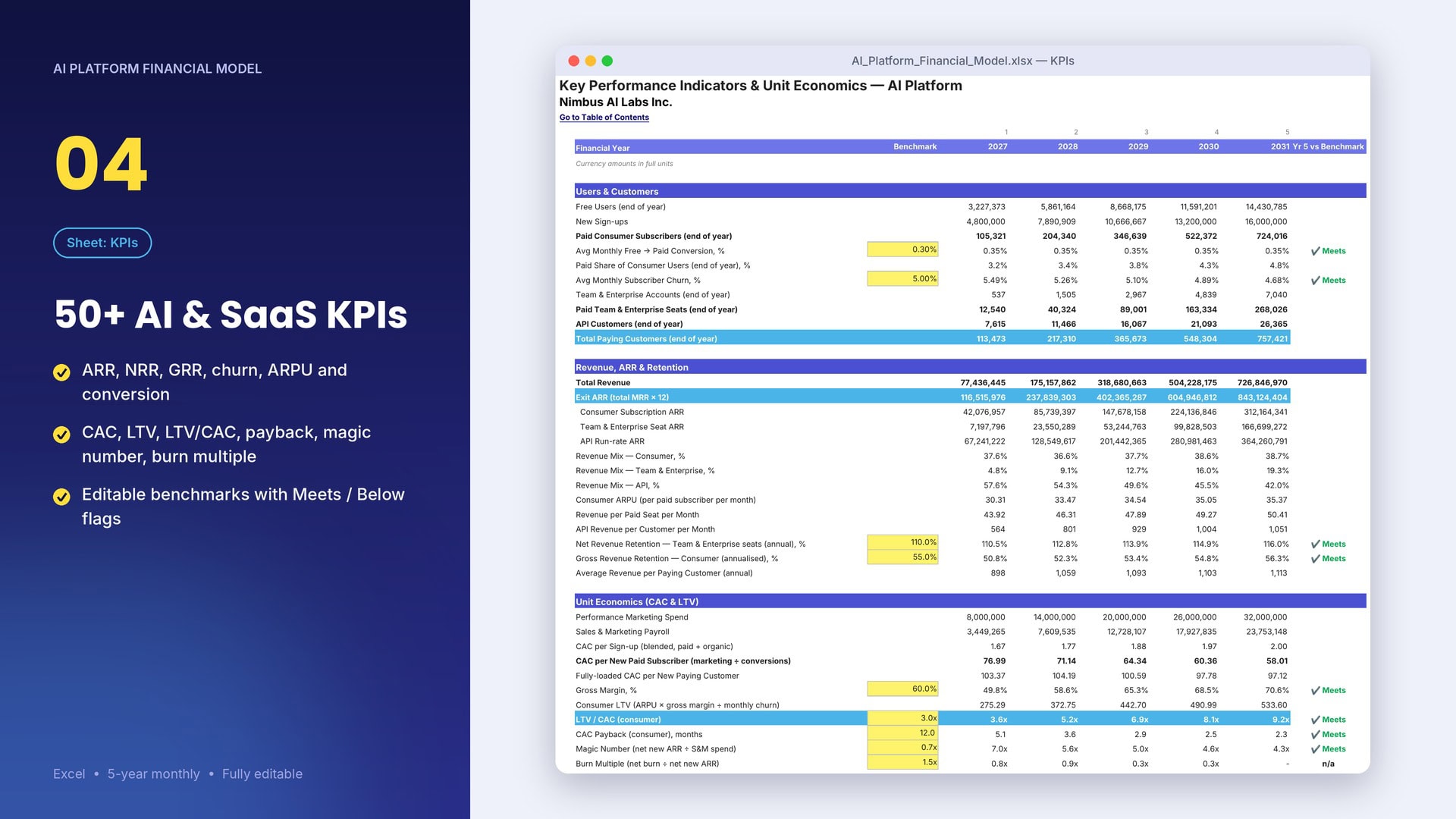
The KPI sheet calculates the metrics investors and boards ask for, and scores key ones against editable industry benchmarks:
Users & customers: free users, new sign-ups, paid subscribers, paid share of users, team accounts, paid seats, API customers, total paying customers
Revenue & retention: total revenue, exit ARR, ARR by product line (consumer, seats, API), revenue mix, consumer ARPU, revenue per seat, API revenue per customer, net revenue retention (NRR), gross revenue retention (GRR), average revenue per paying customer
Unit economics: marketing spend, sales and marketing payroll, CAC per sign-up, CAC per paid subscriber, fully loaded CAC, gross margin, customer lifetime value (LTV), LTV/CAC ratio, CAC payback period, SaaS magic number, burn multiple
Compute & AI unit costs: tokens processed, revenue per million tokens, inference cost per million tokens, inference cost as a percentage of revenue, free-user serving cost per user, training compute, total compute as a percentage of revenue
Efficiency & growth: headcount, revenue per employee, R&D intensity, EBITDA margin, revenue growth, Rule of 40
Valuation, Returns & Break-Even
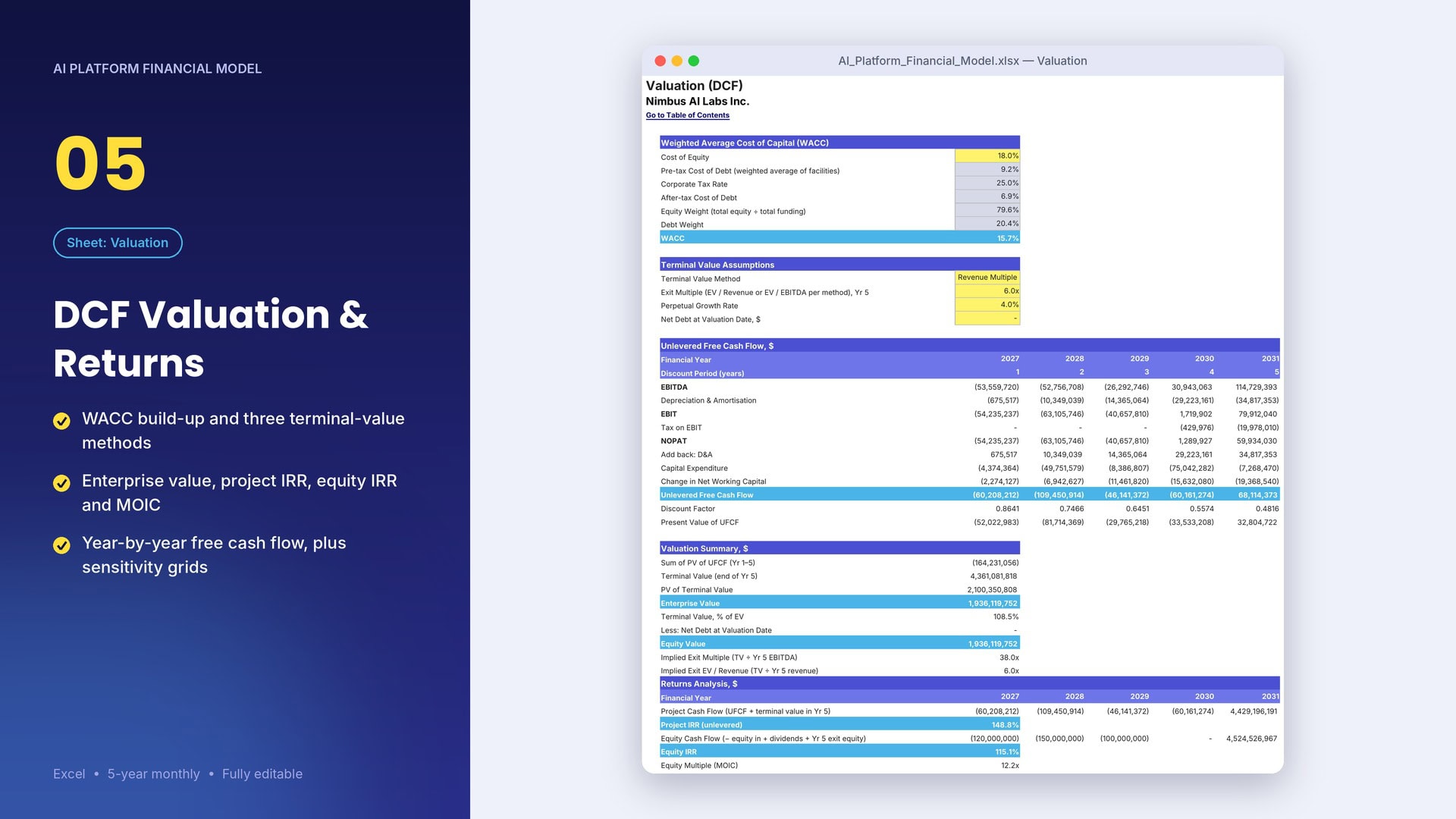
- Discounted cash flow (DCF) valuation with WACC built from cost of equity, cost of debt and capital structure
- Three terminal value methods: EV/Revenue multiple (ideal for high-growth AI companies), EV/EBITDA multiple or perpetual growth
- Enterprise value, equity value and implied exit multiples
- Project IRR, equity IRR and equity multiple (MOIC)
- Two sensitivity tables: WACC vs exit multiple and WACC vs terminal growth
- Break-even analysis: contribution margin, break-even revenue, break-even paying customers, first EBITDA-positive month, first net-profit month, cash-flow break-even and payback month
Dashboard, Scenarios & Charts
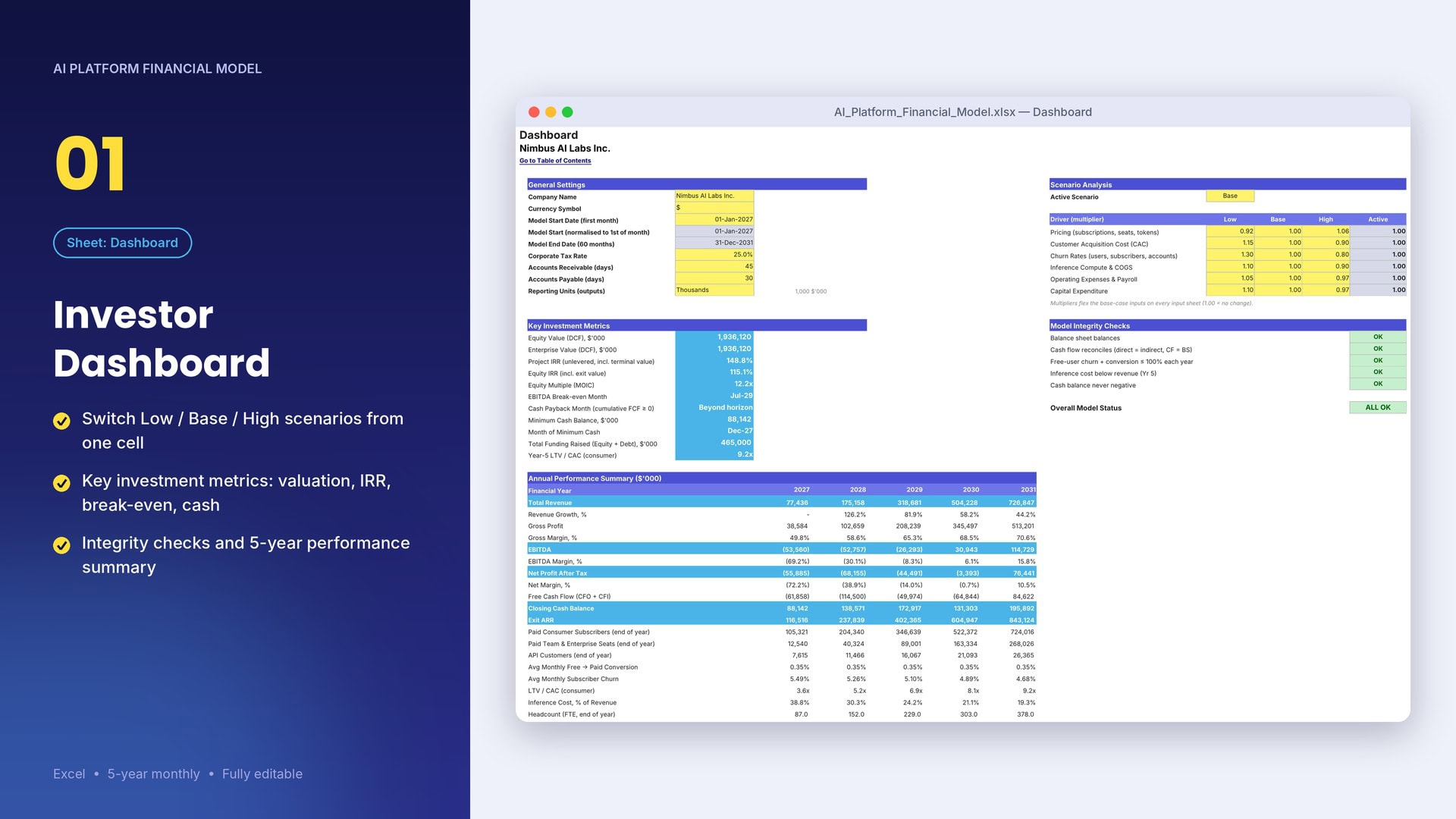
- One-page investor dashboard with key investment metrics, an annual performance summary and charts
- Scenario analysis (Low / Base / High) switched from a single cell, flexing pricing, CAC, churn, inference compute costs, operating expenses and CAPEX
- Model integrity checks: balance sheet balances, cash flow reconciles, free-user flows stay valid, inference cost below revenue, no negative cash, plus an overall status indicator
- Ready-made charts: revenue by product line, revenue vs EBITDA vs net profit, ARR growth, paid subscribers, free users, tokens processed, LTV vs CAC and monthly cash balance
- Selectable reporting units (units, thousands or millions) and currency symbol
What’s Inside the Excel Workbook (17 Linked Tabs)
- Contents – table of contents with hyperlinks, colour legend and step-by-step instructions
- Dashboard – settings, scenario selector, investment metrics, checks and annual summary
- Summary – annual P&L, cash flow, balance sheet and revenue by plan or segment
- KPIs – 50+ AI and SaaS metrics with benchmarks
- Valuation – WACC, DCF, terminal value, IRR, MOIC and sensitivities
- BE – break-even analysis
- Charts – visual summary of growth, profitability and cash
- Revenue – freemium funnel, consumer plans, seats and API assumptions
- COGS & OPEX – compute assumptions, cost of revenue, variable and fixed expenses
- Payroll – staffing plan and payroll costs
- CAPEX – capital expenditure, depreciation and net book value
- Capital – equity, debt schedules and dividends
- Calc – monthly calculation engine
- IS – monthly income statement
- CF – monthly cash flow statement
- BS – monthly balance sheet
- LU – lookup lists that drive the drop-down menus
Key Features at a Glance
- 60-month (5-year) monthly forecast with annual roll-ups
- Clear colour coding: yellow input cells, grey calculated cells, consistent headers and totals
- No macros, no hidden hard-codes, every figure traceable through live formulas
- Works in Microsoft Excel (desktop recommended); compatible with most spreadsheet tools that support standard Excel functions
- Pre-filled with an illustrative, fictional example company so you can see how every input works before replacing it with your own data
- Flexible start date and fully editable labels for plans, seats, segments, roles and cost lines
- Professional formatting ready for investor presentations, pitch decks, board packs and data rooms
Who Is This AI Financial Model For?
- AI startup founders raising pre-seed, seed, Series A, Series B or later rounds
- CFOs and finance teams at generative AI, LLM, AI agent and AI SaaS companies
- Venture capital and private equity investors evaluating AI startups
- Corporate innovation and strategy teams launching an AI product
- Consultants, accelerators and incubators supporting AI companies
Typical use cases include an AI chatbot or AI assistant app, an AI writing or coding assistant, an AI copilot for a vertical industry, an LLM API or model-as-a-service platform, an AI agent platform, an AI productivity SaaS and any product combining subscriptions with usage-based AI pricing.
How to Use the Template in Five Steps
- Set up: enter company name, currency, start date, tax rate and working-capital days on the Dashboard.
- Revenue: set your marketing budget, CAC and organic multiple; define consumer plans (conversion, price, churn, token usage), team and enterprise seat plans, and API segments with token volumes and price per million tokens.
- Costs: enter inference cost per million tokens, overheads, app-store fees, cost-of-revenue percentages and fixed costs such as training compute.
- Team, CAPEX & funding: build your hiring plan, GPU and office investments, equity rounds and debt facilities.
- Review: switch scenarios, check that the dashboard shows all checks OK, and review KPIs, valuation, break-even and charts.
Frequently Asked Questions
Can I use this model for an AI product that only has subscriptions, or only an API? Yes. Set the inputs for any revenue engine you don’t need to zero. The model works for subscription-only, seat-only, API-only or any combination.
How is inference cost calculated? The model estimates the tokens consumed by free users, paid subscribers, team seats and API customers each month, then multiplies total tokens by your all-in cost per million tokens, including idle-capacity and safety overheads.
Can I change the number of plans, segments or roles? The template provides up to five consumer plans, five seat plans, five API segments, twenty payroll roles and nineteen CAPEX items. Unused rows can be left blank.
Does it include a DCF valuation and IRR? Yes. It includes an unlevered DCF with three terminal value methods, project and equity IRR, MOIC and two sensitivity tables.
Is the sample data real? No. The example company and all figures are fictional placeholders to illustrate the mechanics. Replace them with your own assumptions.
Why Choose This AI Startup Financial Model?
Most financial model templates were designed for traditional SaaS, e-commerce or service businesses. This one was built from the ground up for the economics of generative AI: freemium funnels, seat expansion, token-based API pricing, inference compute, training spend and the unit economics that determine whether an AI company can scale profitably. You get a detailed, transparent and investor-ready Excel model that saves weeks of spreadsheet work and helps you tell a credible story about growth, margins, cash runway and valuation.
Download the AI Platform Financial Model today and turn your AI product vision into a clear, defensible financial plan.
Disclaimer: This template is provided for planning and educational purposes. It does not constitute financial, investment, tax or legal advice. All sample figures are illustrative; validate assumptions with qualified advisers before making decisions.
AI startup financial model, generative AI financial model, AI SaaS financial model, LLM business plan template, AI financial projections Excel, AI chatbot business plan, AI subscription model, freemium financial model, usage-based pricing model, API pricing per token, token-based pricing, inference cost model, GPU compute cost model, SaaS financial model Excel, startup financial model template, three statement financial model, 5 year financial projections, monthly financial model, CAC LTV model, churn model, ARR MRR model, net revenue retention, DCF valuation template, startup valuation model, investor ready financial model, AI company valuation, seed round financial model, Series A financial model, AI agent business model, AI copilot financial model
Similar ProductsOther customers were also interested in...



 eFinancialModels
Electric Vehicle (EV) Charging Station Financial M...
With this comprehensive 5- or 10-year monthly tool, investors can assess the viability of setting up... Read more

Financial Model for Mobile App | Mobile App Busine...
The Mobile App Financial Plan Template in Excel allows you to develop financial projections when lau... Read more

 HenrySheykin
Food Truck Financial Model Excel Template
The Food Truck Financial Model helps entrepreneurs, founders, business owners, consultants, and anal... Read more

Green Hydrogen Production from Wind Energy Financi...
The Green Hydrogen from Wind Financial Model aims to comprehensively forecast a horizon of 40 years ... Read more

Simple Mutual Non-Disclosure Agreement Template
Protect your business secrets with ease using our Simple Mutual Non-Disclosure Agreement Template. S... Read more

Solar Energy Financial Model
The Solar Energy Financial Model Spreadsheet Template in Excel assists you in preparing a sophistica... Read more

 Peter Graf
The Customer-Centric Financial Model for Restauran...
Starting a restaurant without a financial plan is like driving a car blindfolded. You wouldn´t do i... Read more
You must log in to submit a review.