
0 ITEMS

AI Data Center Development Financial Model Excel – 15-Year Colocation, Power, Debt & Investment Returns
15-year AI data center project finance model with power-constrained IT capacity, 500 tenant slots, colocation revenue, development CAPEX, debt refinancing, three-statement forecasts, IRR, NPV, DSCR and eight dashboard charts. Includes a 34-page PDF guide.
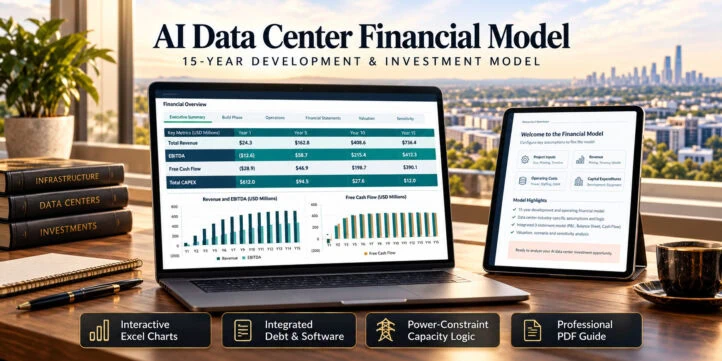
AI DATA CENTER DEVELOPMENT & INVESTMENT FINANCIAL MODEL
15-Year Excel Project Finance | Colocation Revenue | Power Capacity | Debt & Investment Returns
Evaluate AI-focused data center investments with a fully editable Excel financial model connecting physical infrastructure, tenant contracts, energy consumption, project financing and long-term financial performance.
The AI Data Center Development & Investment Financial Model by SheetworksStudio provides an integrated 15-year financial planning framework for developers, colocation operators, infrastructure investors, financial analysts and project finance professionals.
Unlike a generic revenue forecast, this model incorporates physical infrastructure constraints that influence commercial performance. Available IT capacity is determined by commissioned infrastructure, grid power adjusted for Power Usage Effectiveness (PUE), and energized white-space capacity.
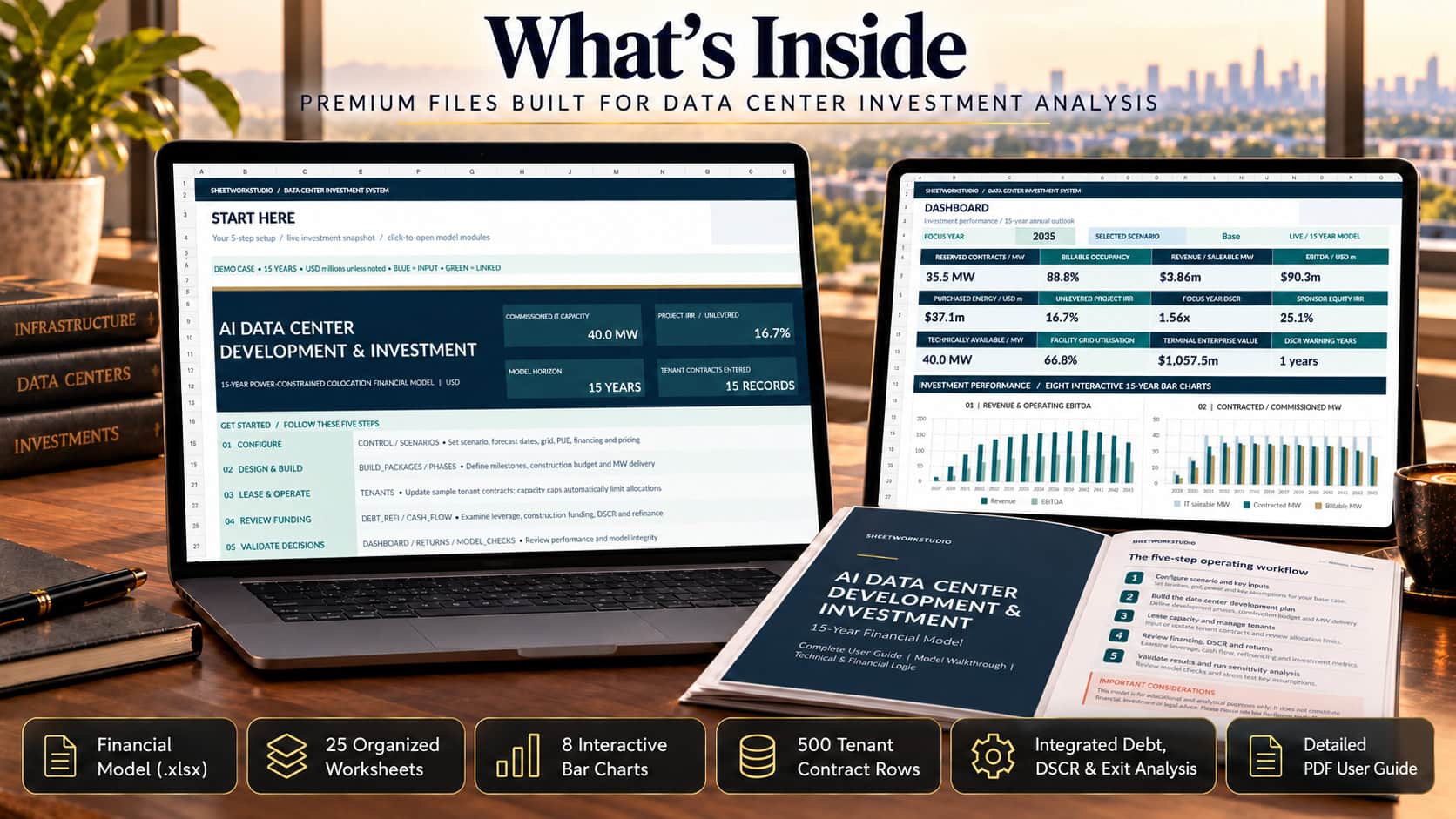
The workbook includes 25 integrated worksheets, 500 tenant contract slots, four investment scenarios, eight dynamic dashboard charts and a comprehensive 34-page PDF user guide.
📊 EXECUTIVE DASHBOARD & INVESTMENT PERFORMANCE
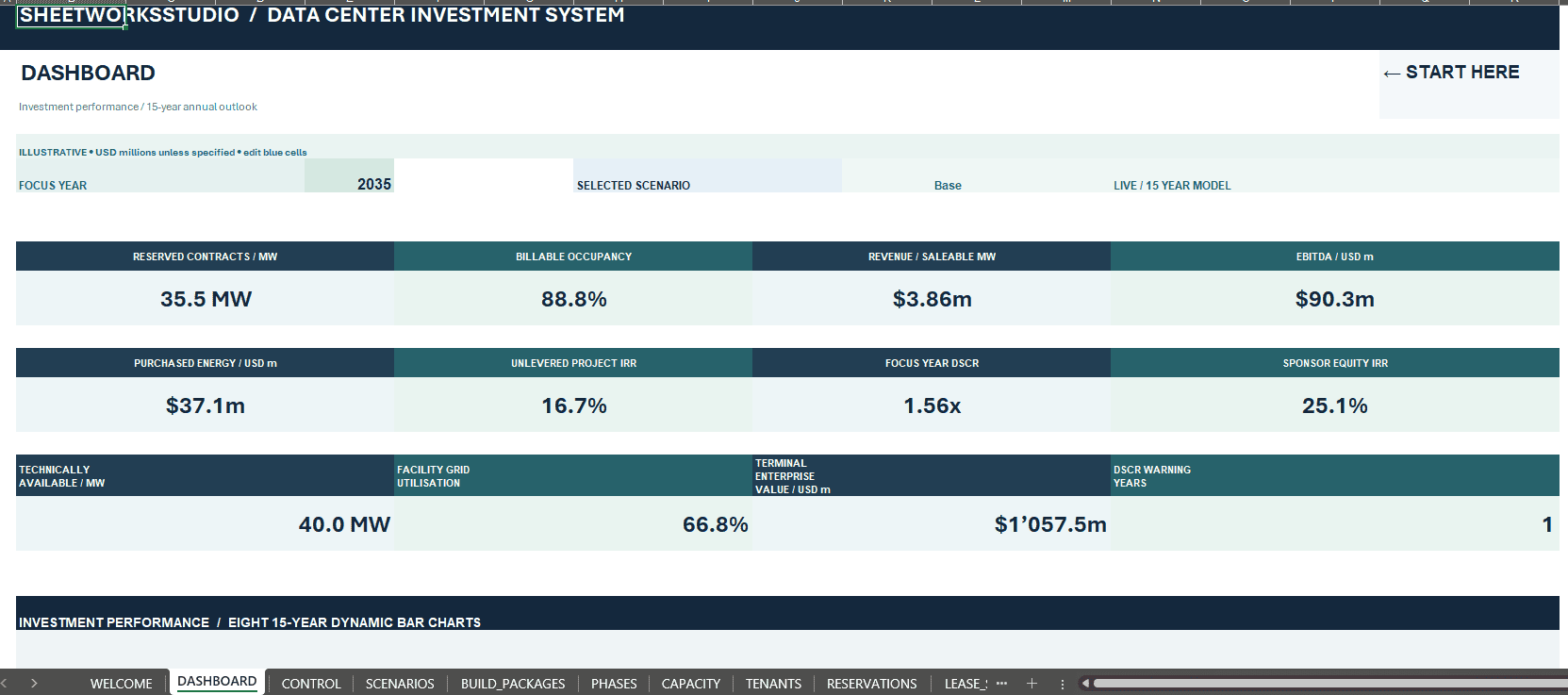
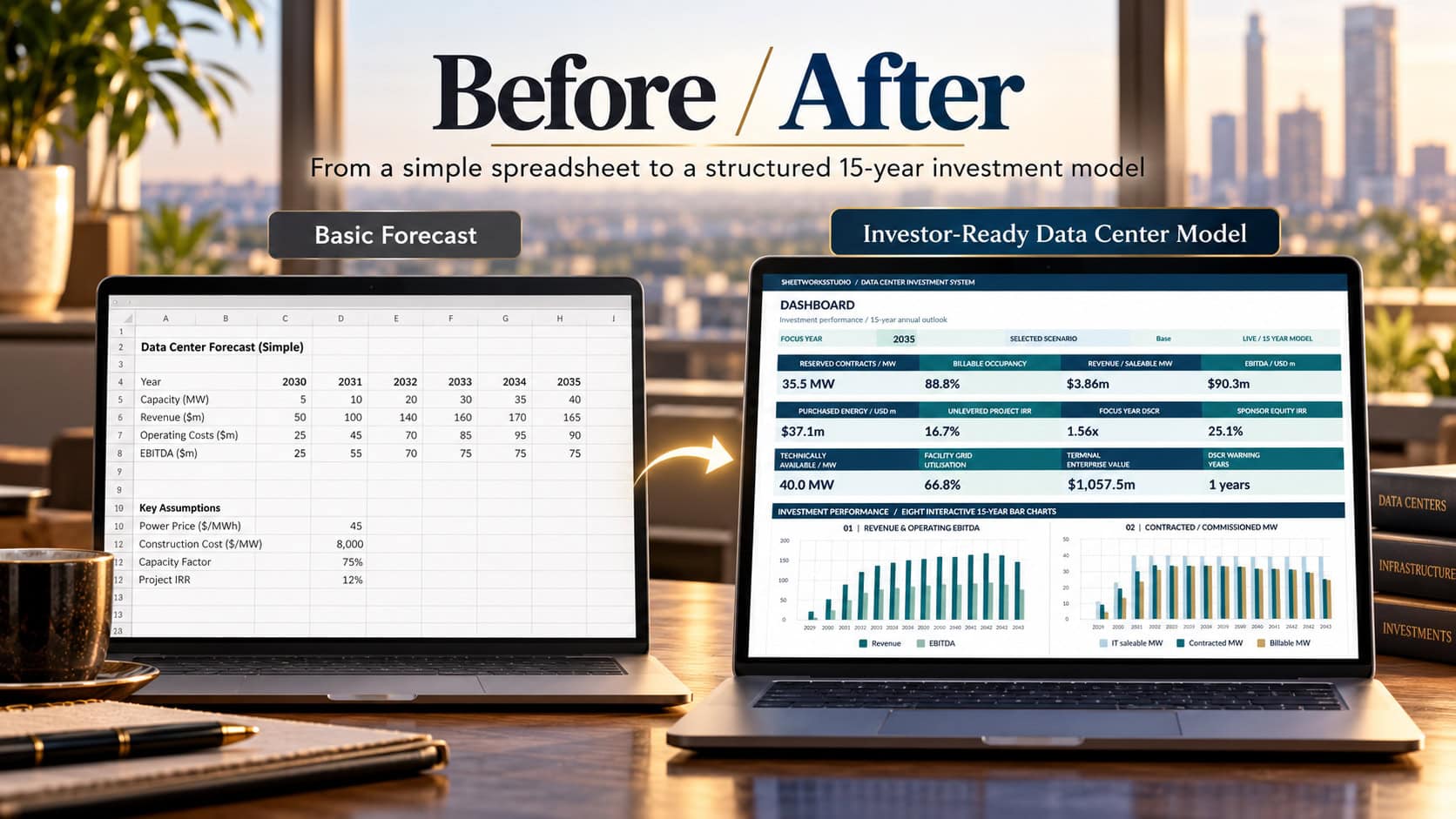
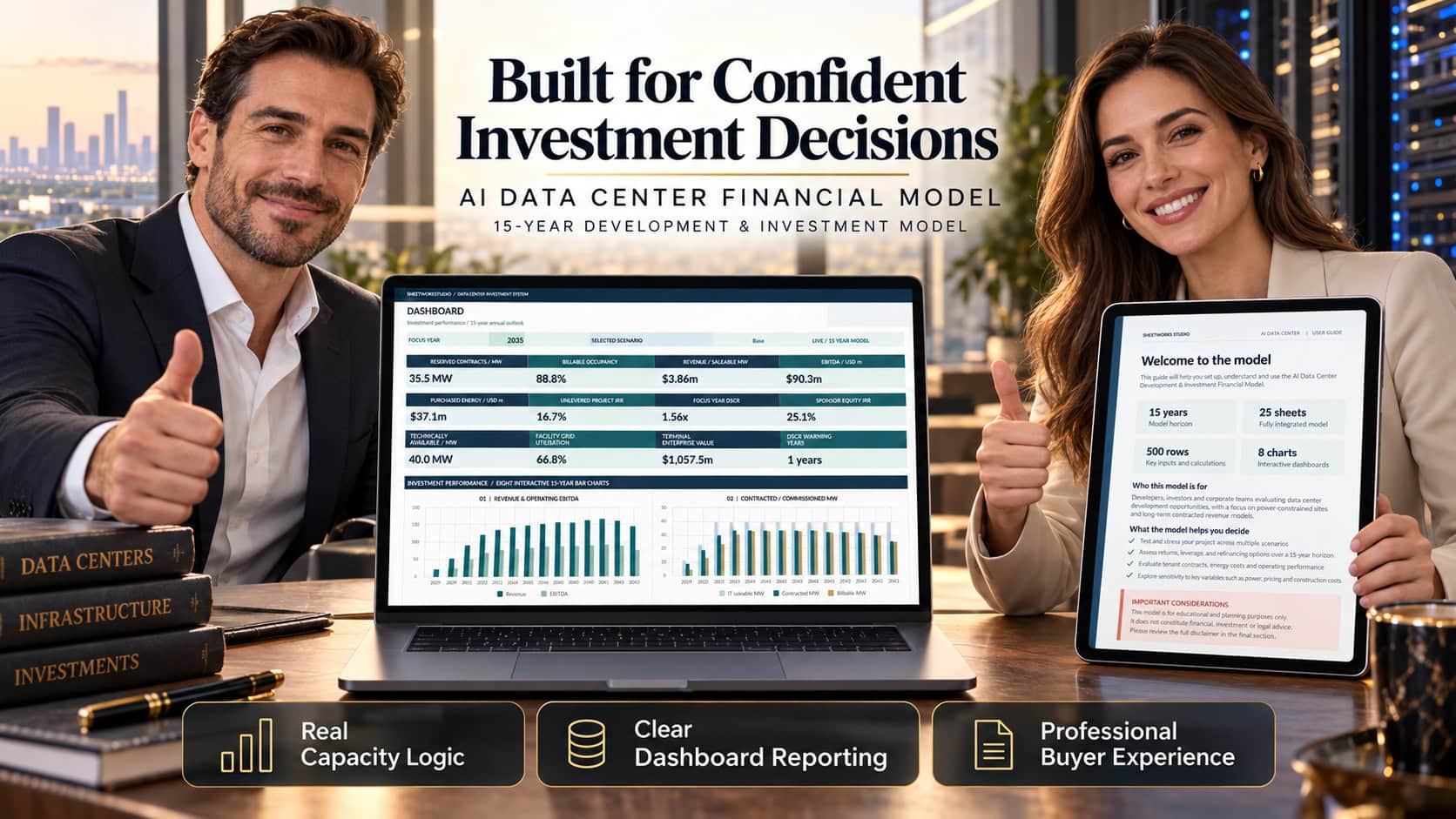
The Executive Dashboard consolidates operating and financial performance through 12 linked KPI indicators and eight native Excel charts.
Key performance indicators include:
- Reserved Contracted IT Capacity (MW)
- Billable Occupancy
- Revenue per Saleable MW
- Operating EBITDA
- Purchased Electricity Costs
- Unlevered Project IRR
- Sponsor Equity IRR
- Focus-Year DSCR
- Technically Available IT Capacity
- Facility Grid Utilization
- Terminal Enterprise Value
- DSCR Warning Years
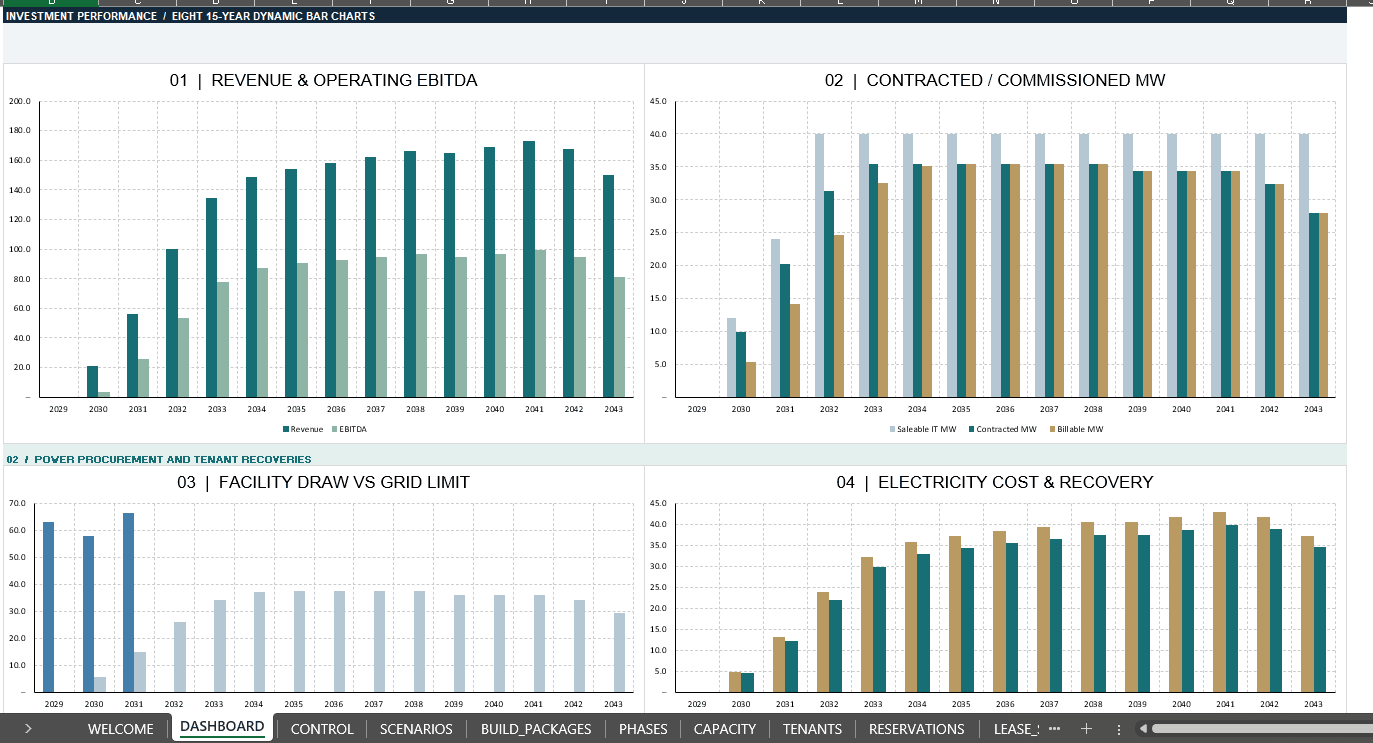
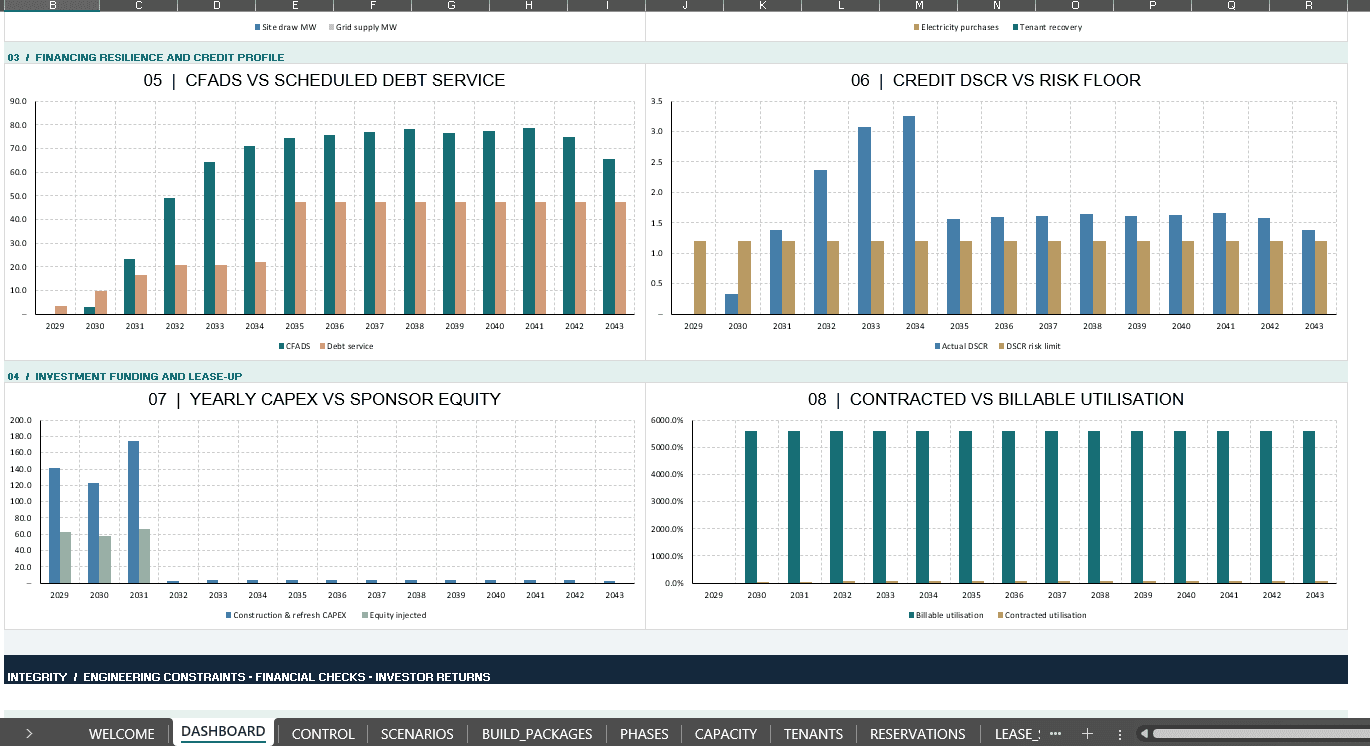
Eight charts visualize:
- Revenue and EBITDA Development
- Saleable, Contracted and Billable IT Capacity
- Facility Electricity Demand versus Grid Power
- Purchased Electricity versus Tenant Recoveries
- CFADS versus Scheduled Debt Service
- DSCR versus Warning Threshold
- Construction CAPEX versus Sponsor Equity Funding
- Contracted versus Billable Utilization
The dashboard responds to changes in the operating assumptions and selected investment scenario.
⚡ DATA CENTER CAPACITY, POWER & COLOCATION REVENUE
Physical Infrastructure and Capacity Planning
Develop an infrastructure forecast using:
- Installed Critical IT Capacity (MW)
- Grid Connection Capacity and Energization Year
- Power Usage Effectiveness (PUE)
- White-Space Area and Power Density
- Three Configurable Construction and Commissioning Phases
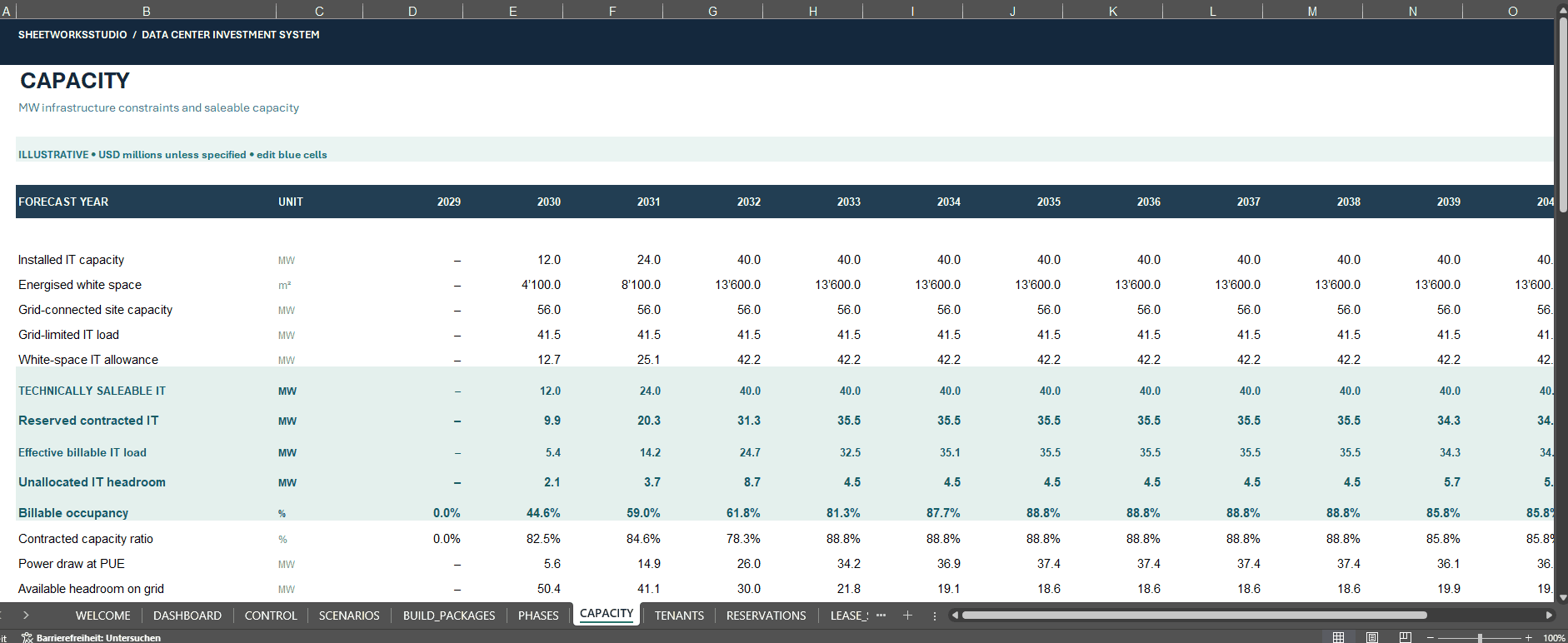
- Technically Saleable IT Capacity
- Contracted and Billable MW
- Available Grid Headroom
- Annual Occupancy and Utilization
The model calculates available commercial IT capacity using the minimum of installed capacity, grid-limited capacity and available white-space capacity.
Tenant reservations are allocated sequentially within available technical capacity, helping prevent commercial capacity from exceeding the modeled physical limits.
Tenant Contracts and Colocation Revenue
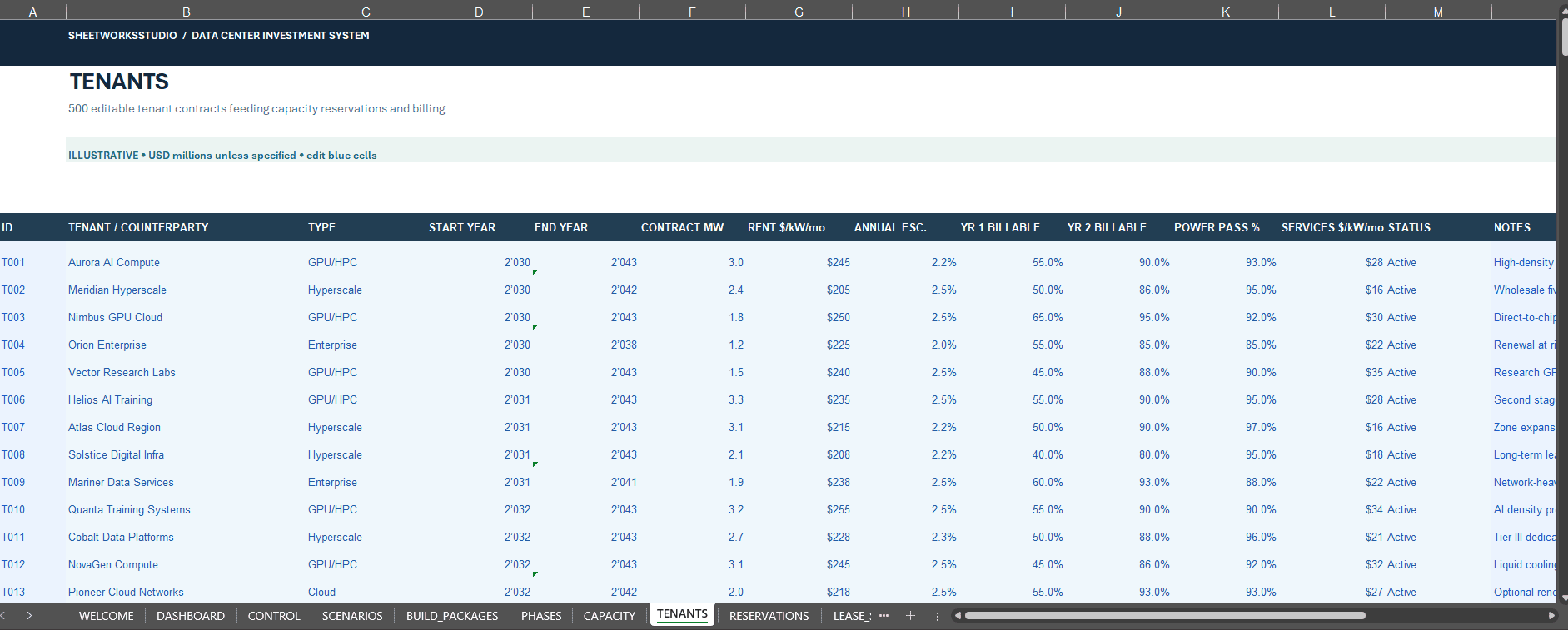
The TENANTS register provides 500 prepared contract rows, with 15 fictional example contracts covering AI/GPU, hyperscale, cloud and enterprise customers.
Model:
- Customer and Contract Information
- Contracted IT Capacity (MW)
- Lease Start and Expiration Years
- Colocation Pricing in USD/kW/month
- Annual Contract Price Escalation
- Initial Occupancy and Ramp-Up Assumptions
- Electricity Cost Recovery
- Ancillary Service Revenue
- Reserved and Billable Capacity
- Annual Rental Revenue
Dedicated schedules link tenant reservations, occupied IT capacity and contract-specific revenue to the operating forecast.
Electricity Consumption and Cooling Costs
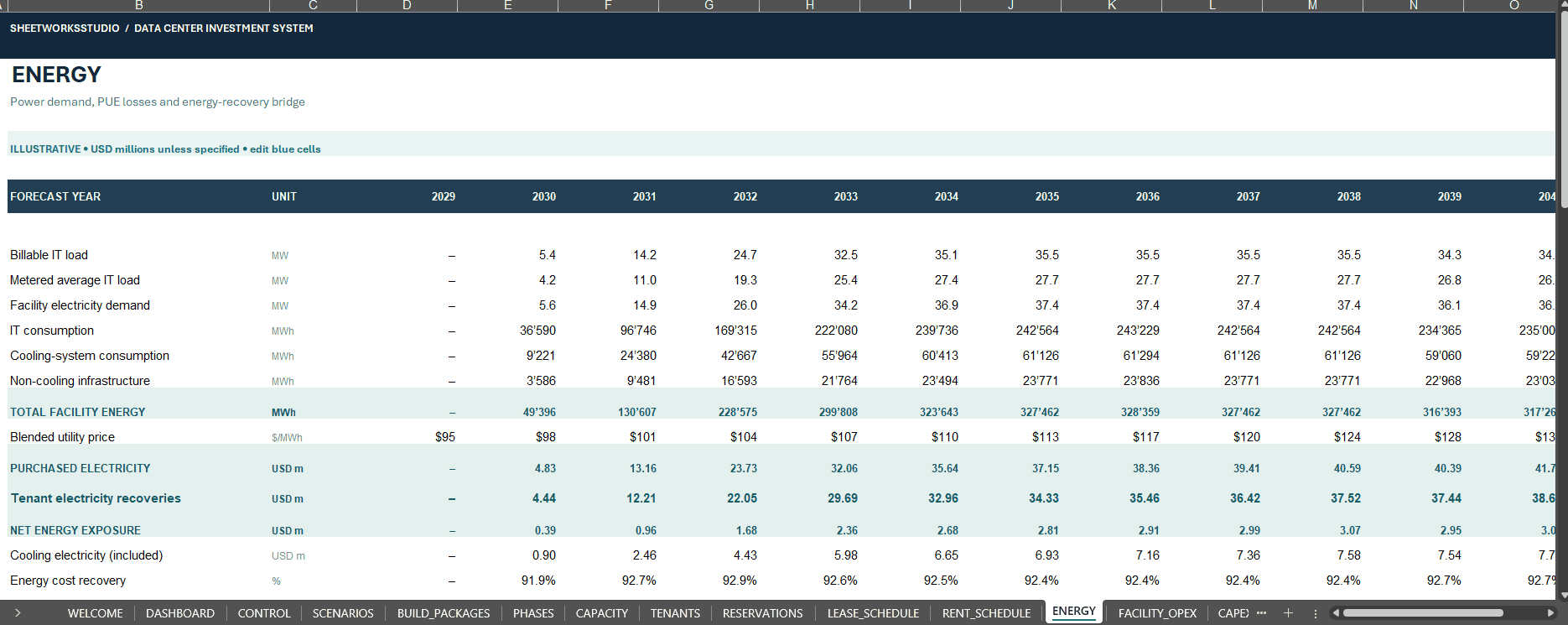
The ENERGY module calculates power consumption using modeled IT utilization, PUE, electricity prices and calendar hours.
Review IT energy consumption, total facility electricity demand, cooling-related consumption, purchased electricity costs, tenant energy recoveries and net energy exposure.
The model allows users to explore how higher electricity prices, changes in PUE and customer occupancy influence project profitability.
🏗️ CONSTRUCTION CAPEX, DEVELOPMENT & FINANCING
The workbook supports development planning across three configurable construction phases.
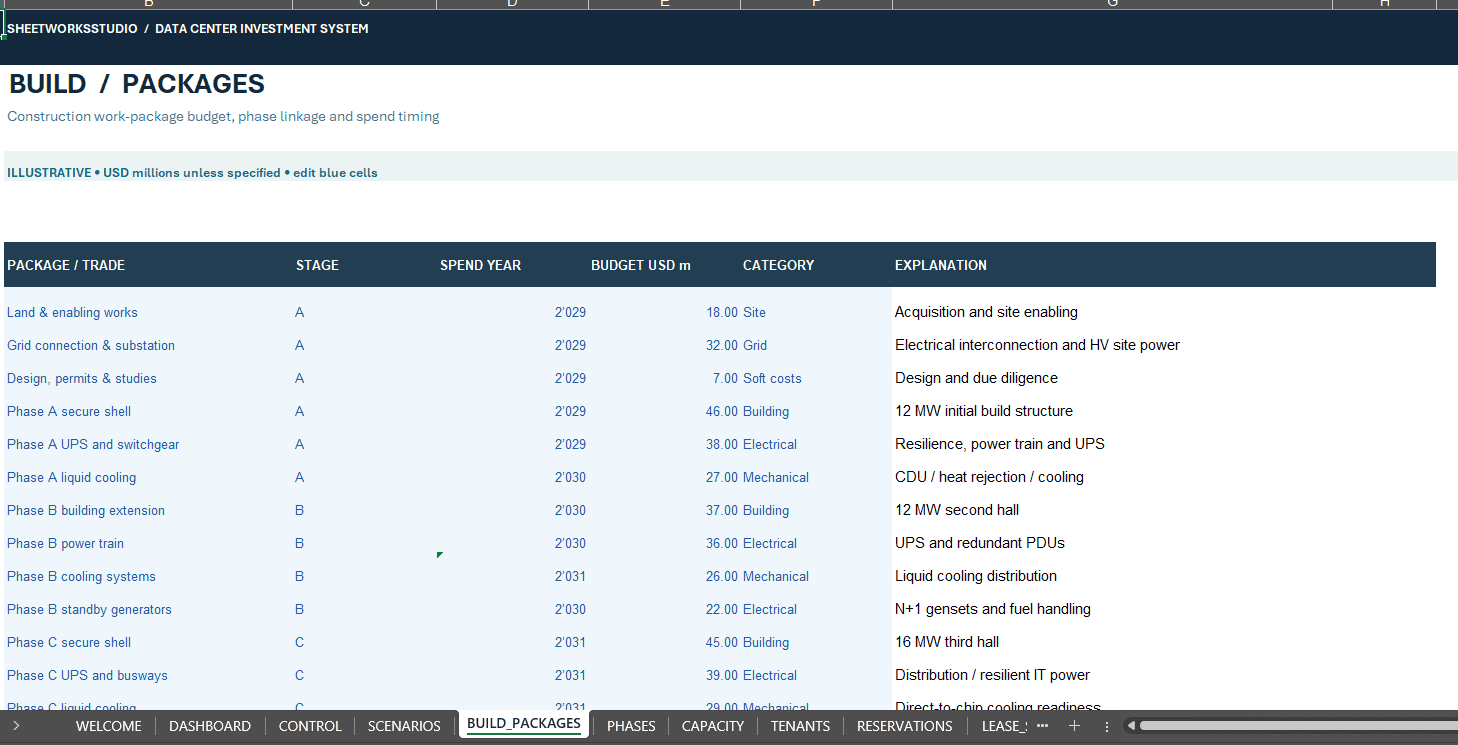
A dedicated construction package register covers site preparation, grid connection, electrical infrastructure, building shells, UPS and switchgear, cooling systems, generators, security and commissioning.
The illustrative project includes 15 construction cost packages.
Construction and CAPEX functionality includes:
- Construction Budget and Project Work Packages
- Development Spending by Year
- Phased Commissioning
- Grid and Electrical Infrastructure Costs
- Cooling and Facility Investment
- Annual Maintenance and Replacement CAPEX
- Capital Asset Depreciation
- Construction Cost Scenario Adjustments
Construction Debt and Refinancing
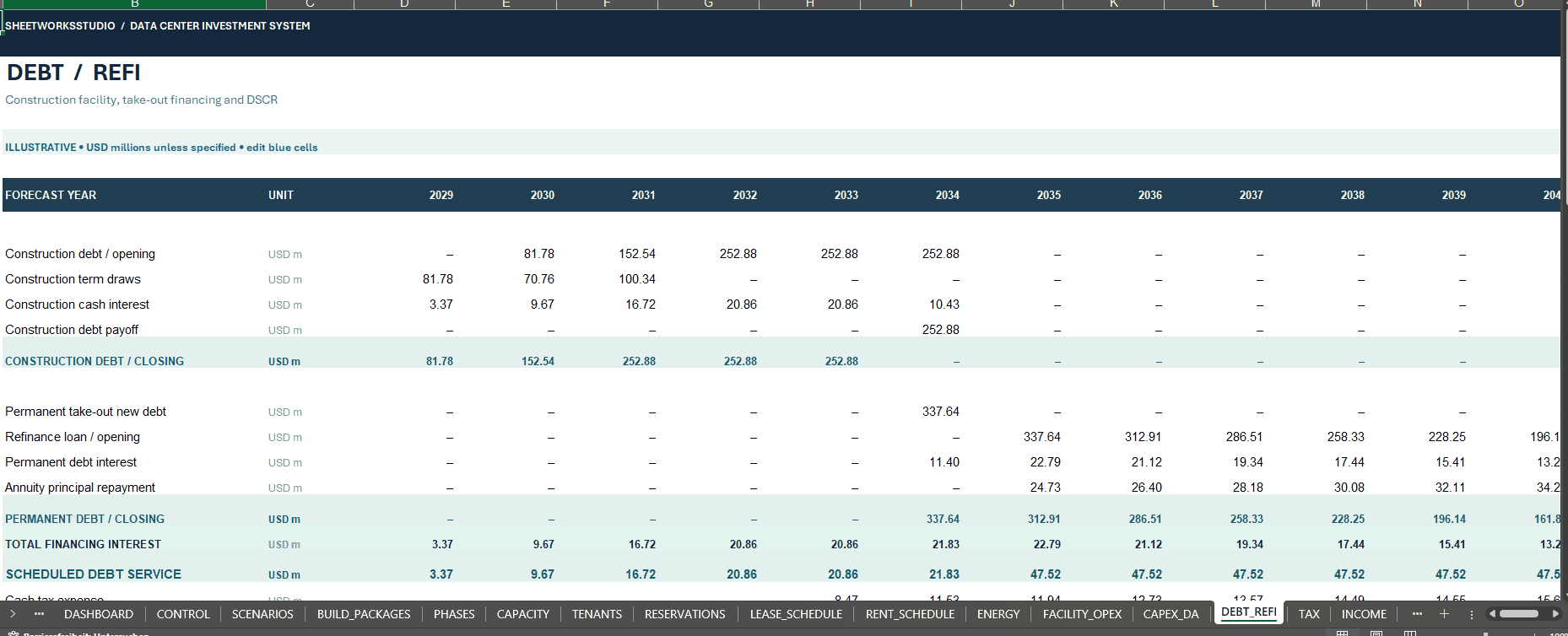
The financing model connects development expenditure to debt and equity funding requirements.
Analyze:
- Construction Debt Drawdowns
- Construction Loan Interest
- Loan Balance Roll-Forwards
- Permanent Financing and Refinancing
- DSCR-Based Debt Sizing Constraints
- Loan-to-Value Limits
- Permanent Loan Amortization
- Scheduled Debt Service
- Cash Flow Available for Debt Service (CFADS)
- Shareholder Equity Contributions
- Shareholder Distributions
- Operating Cash Requirements
Debt refinancing is constrained by the modeled underwriting assumptions rather than automatically assuming unlimited borrowing capacity.
📈 INTEGRATED THREE-STATEMENT MODEL & INVESTMENT RETURNS
The model contains interconnected annual financial forecasts covering the complete 15-year investment period.
Income Statement
Review colocation rental revenue, ancillary services, power cost recovery, operating costs, EBITDA, depreciation, financing costs, tax and net income.
Balance Sheet
Analyze cash, receivables, capital assets, payables, construction debt, permanent loans and shareholders’ equity.
Cash Flow Statement
Track operating cash movements, capital expenditure, financing proceeds, loan repayments, shareholder contributions and distributions.
Investment Valuation
The RETURNS module provides:
- Unlevered Project IRR
- Sponsor Levered Equity IRR
- Project NPV
- Sponsor Equity NPV
- Sponsor Investment Multiple
- Construction CAPEX per MW
- EBITDA-Based Terminal Enterprise Value
- Exit Transaction Costs
- Net Exit Equity Proceeds
- Annual Sponsor Cash Flow
Investment valuation uses the modeled project cash flows, discount assumptions and terminal enterprise value methodology.
🔄 FOUR INVESTMENT SCENARIOS
Compare alternative project conditions using four configurable scenarios.
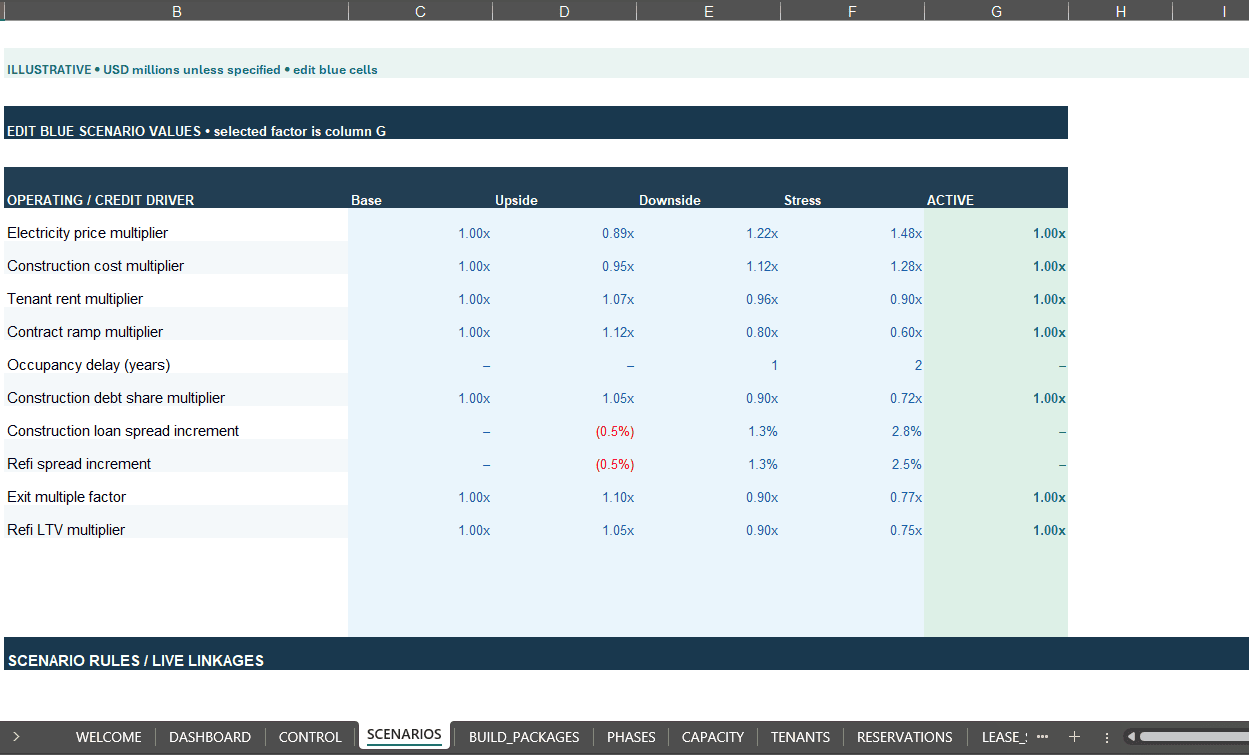
Base Case – Central illustrative development and operating assumptions.
Upside Case – More favorable electricity costs, tenant economics, financing and exit assumptions.
Downside Case – More conservative occupancy, construction and financial conditions.
Stress Case – More adverse combinations of operating, commercial and financing assumptions.
The scenarios affect electricity pricing, construction expenditure, customer rent, occupancy ramp, tenant commencement delays, financing spreads, refinancing constraints and exit multiples.
Scenario selection updates the connected financial model and investment returns.
Model Validation and Risk Monitoring
The MODEL_CHECKS worksheet provides annual financial and technical consistency checks alongside additional input-quality controls.
These include financial statement reconciliation, capacity limits, loan roll-forwards, electricity calculations, tax-loss continuity, tenant records and financing assumptions.
The model reports potential DSCR concerns separately from technical calculation errors.
A successful model-integrity check does not establish project bankability or guarantee investment profitability.
📦 WHAT YOU RECEIVE
1. AI Data Center 15Y Financial Model (.xlsx)
- 25 Integrated Excel Worksheets
- 15 Annual Forecast Periods
- 8 Dynamic Dashboard Charts
- Approximately 29,400 Formula Cells
- 500 Prepared Tenant Contract Rows
- 15 Illustrative Tenant Contracts
- 3 Development and Commissioning Phases
- Construction CAPEX and Operating Cost Schedules
- Power and Capacity Constraints
- Construction Debt and Permanent Refinancing
- Integrated Income Statement, Balance Sheet and Cash Flow
- IRR, NPV, DSCR and Investment Valuation
- Four Investment Scenarios
- Model Integrity and Input-Quality Controls
- Editable Assumptions and Visible Formulas
- No Macros or External Data Connections
2. Professional How-to-Use Guide (34-Page PDF)
A comprehensive English-language guide covering model navigation, technical assumptions, power and PUE logic, construction planning, tenant contracts, rental revenue, electricity costs, operating expenses, debt financing, financial statements, returns, scenarios, validation and troubleshooting.
3. Illustrative Project Data
The workbook contains a fictional AI-focused colocation development featuring 40 MW of installed IT capacity, three development stages and an illustrative USD 436 million construction budget.
The example produces approximately 16.7% Project IRR and 25.1% Sponsor Equity IRR under its Base Case assumptions.
These figures are demonstration outputs and do not represent market quotations or guaranteed investment returns.
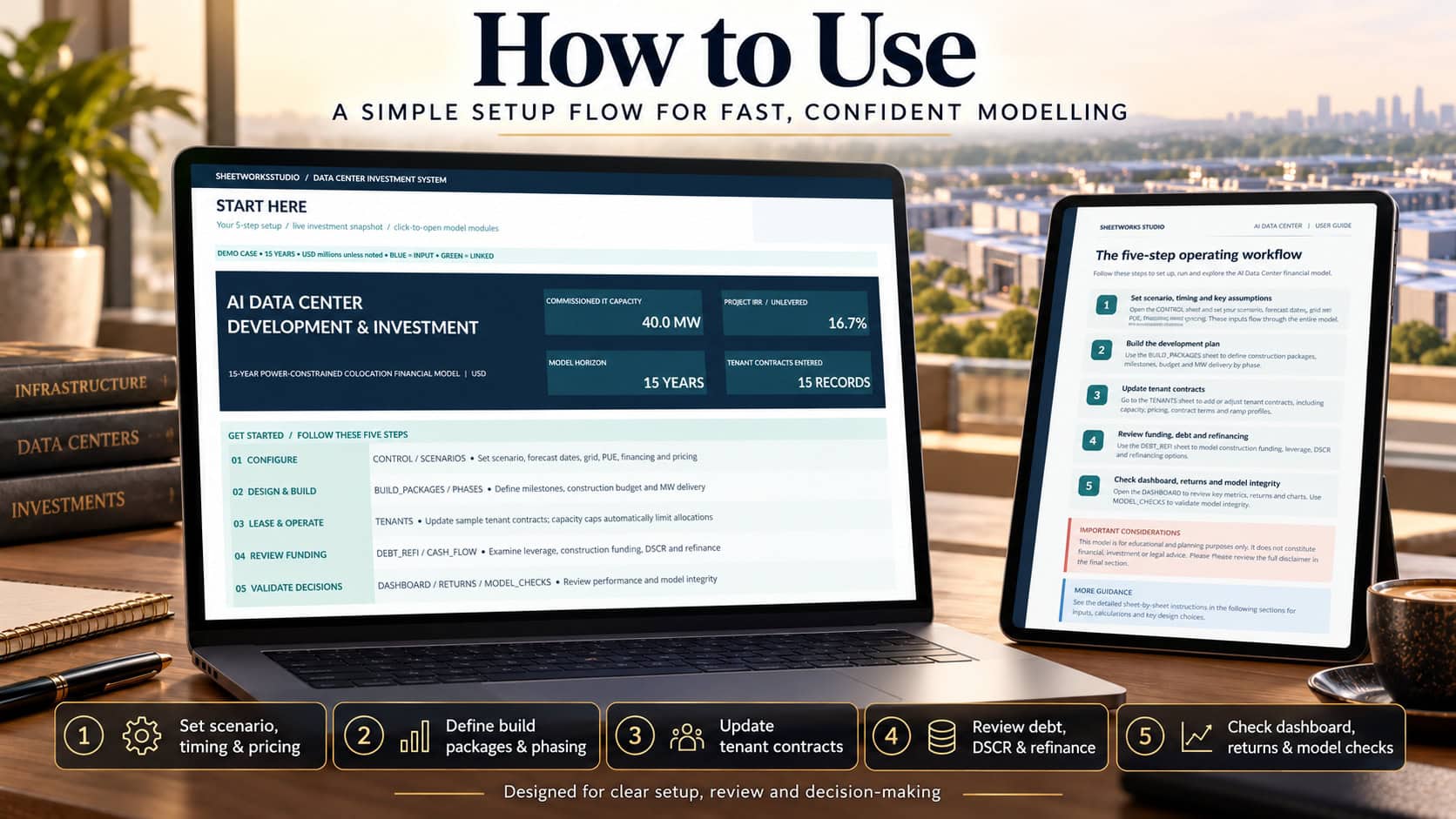
⚙️ HOW TO USE
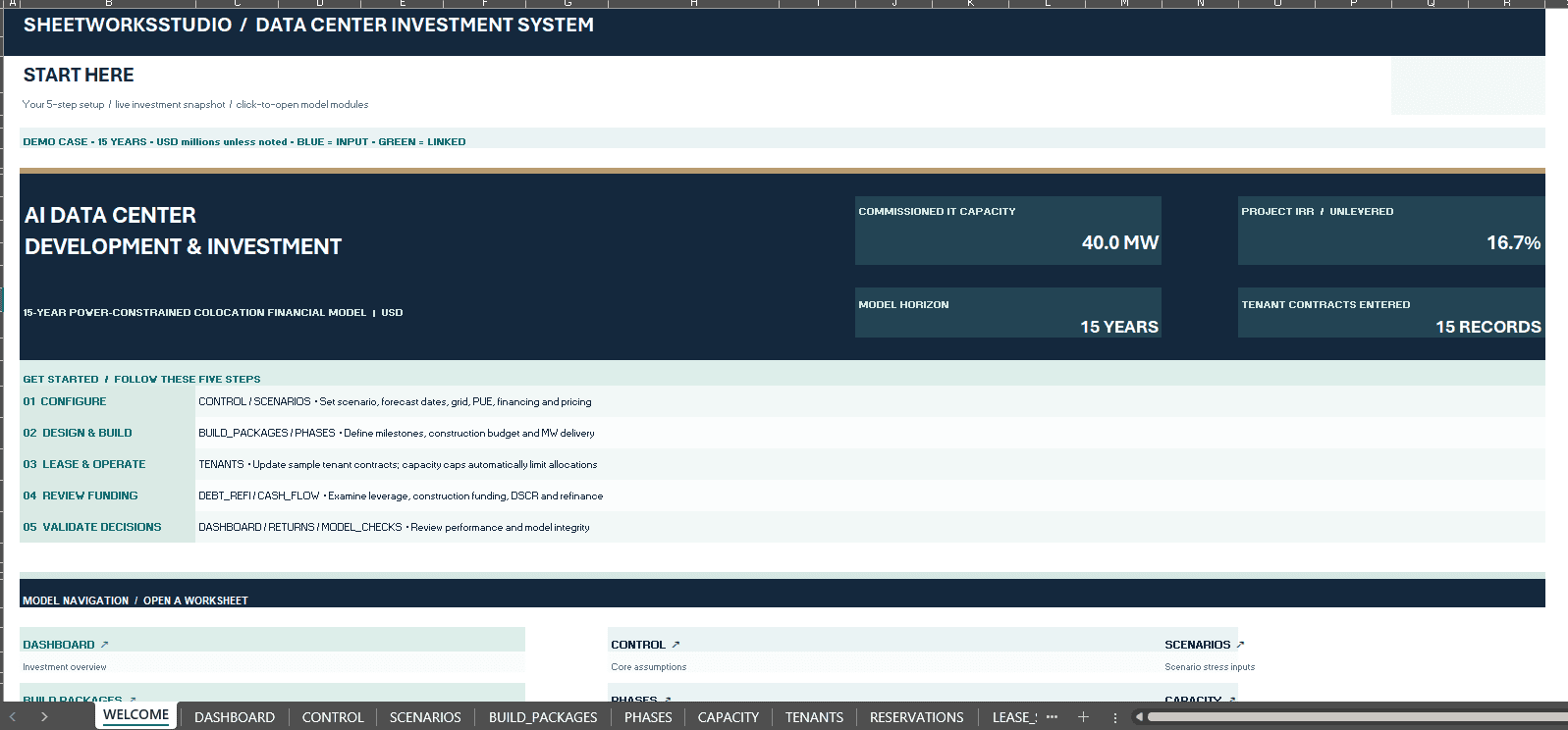
Step 1 – Configure the Project
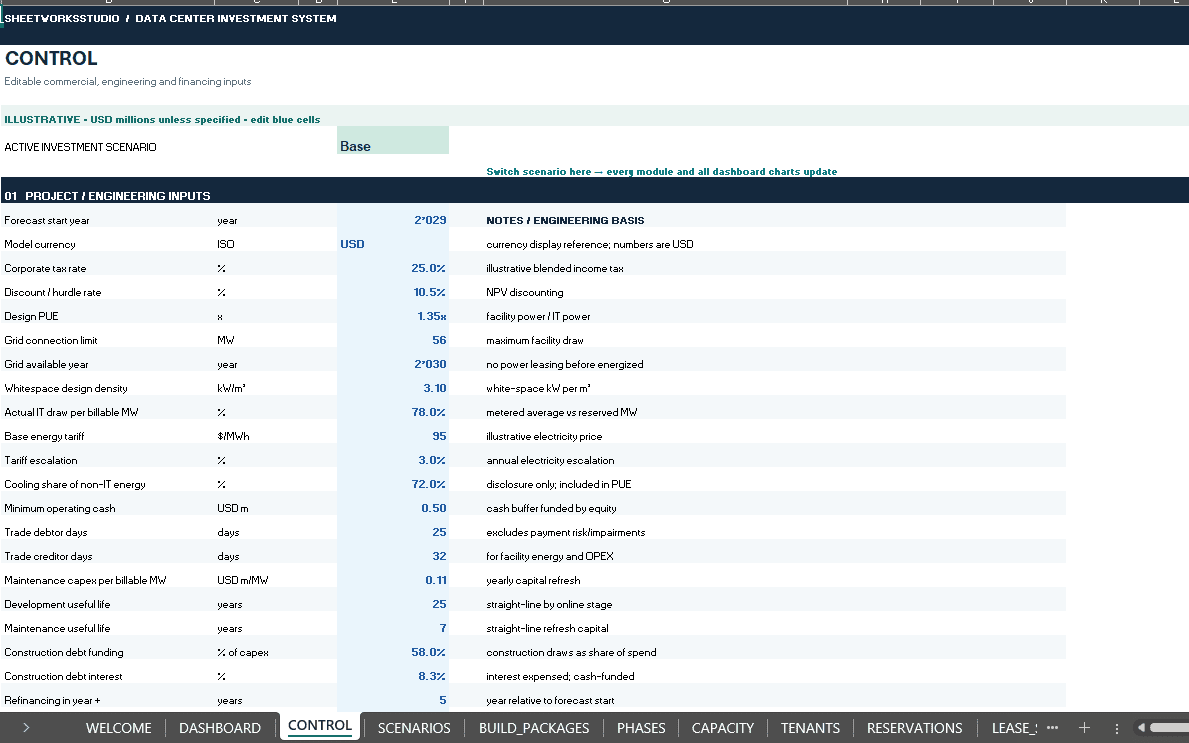
Begin with WELCOME and CONTROL. Set your forecast year, technical capacity, electricity prices, PUE, financing assumptions and investment scenario.
Step 2 – Build the Development Plan
Adjust BUILD_PACKAGES and PHASES to reflect construction expenditure, installed IT capacity and commissioning timing.
Step 3 – Configure Tenant Contracts
Enter customer-specific MW, lease dates, rental prices, escalation, occupancy ramp and energy recovery assumptions.
Step 4 – Review Operations and Financing
Analyze CAPACITY, LEASE_SCHEDULE, RENT_SCHEDULE, ENERGY, FACILITY_OPEX, CAPEX_DA and DEBT_REFI.
Step 5 – Evaluate Investment Returns
Review INCOME, CASH_FLOW, BALANCE, RETURNS and SENSITIVITY.
Step 6 – Validate Results
Use the Executive Dashboard and MODEL_CHECKS to examine financial performance, investment returns, liquidity requirements and potential financing risks.
IDEAL FOR
- AI and GPU Data Center Developers
- Colocation and Hyperscale Infrastructure Operators
- Digital Infrastructure Investors
- Infrastructure Private Equity Funds
- Project Finance Analysts
- Commercial Real Estate Investment Teams
- Lenders and Credit Analysts
- Investment Consultants
- Financial Modeling Professionals
- Corporate Finance and Strategic Planning Teams
TECHNICAL SPECIFICATIONS
- File Format: Microsoft Excel (.xlsx)
- Forecast Horizon: 15 Years
- Forecast Frequency: Annual
- Sample Years: 2029–2043
- Worksheets: 25
- Dashboard Charts: 8
- Tenant Contract Capacity: 500 Rows
- Development Phases: 3
- Investment Scenarios: 4
- Financial Statements: Integrated
- Formulas: Editable and Visible
- Macros: None Required
- External Data Feeds: None
- PDF User Guide: 34 Pages
Microsoft Excel Desktop is recommended.
Google Sheets import and functional compatibility have not been independently verified. Equivalent formula behavior, charts, navigation and formatting are therefore not guaranteed.
IMPORTANT MODEL LIMITATIONS & DISCLAIMER
This is an annual investment planning and financial analysis model. It does not provide a detailed monthly construction financing simulation, hourly data center engineering simulation or comprehensive GPU hardware replacement model.
Taxation, depreciation, financing, energy procurement and exit valuation use simplified assumptions. Location-specific engineering studies, power purchase agreements, advanced GPU economics, customer default scenarios and jurisdiction-specific regulatory requirements may require additional analysis.
The model is not audited, bank-certified or approved by any lending institution.
All sample financial figures, tenants, development assumptions and investment returns are fictional and provided solely for illustrative, educational and internal planning purposes.
This product does not constitute investment, financial, accounting, legal, tax, engineering or lending advice. Buyers must independently verify all assumptions and calculations before using the model for actual investment decisions.
This is a digital product. No physical item will be shipped.
Developed by SheetworksStudio – Professional Financial Models & Business Decision Tools.
Similar ProductsOther customers were also interested in...


 eFinancialModels
Electric Vehicle (EV) Charging Station Financial M...
With this comprehensive 5- or 10-year monthly tool, investors can assess the viability of setting up... Read more

Financial Model for Mobile App | Mobile App Busine...
The Mobile App Financial Plan Template in Excel allows you to develop financial projections when lau... Read more

 HenrySheykin
Food Truck Financial Model Excel Template
The Food Truck Financial Model helps entrepreneurs, founders, business owners, consultants, and anal... Read more

Green Hydrogen Production from Wind Energy Financi...
The Green Hydrogen from Wind Financial Model aims to comprehensively forecast a horizon of 40 years ... Read more

Simple Mutual Non-Disclosure Agreement Template
Protect your business secrets with ease using our Simple Mutual Non-Disclosure Agreement Template. S... Read more

Solar Energy Financial Model
The Solar Energy Financial Model Spreadsheet Template in Excel assists you in preparing a sophistica... Read more

 Peter Graf
The Customer-Centric Financial Model for Restauran...
Starting a restaurant without a financial plan is like driving a car blindfolded. You wouldn´t do i... Read more
You must log in to submit a review.