
0 ITEMS

Real Estate Fund Cash Flow and Returns Model (Capital Calls, Distributions, NAV, DPI, TVPI, Net IRR, J-Curve)
A fully formula-driven cash flow and returns model for a closed-end real estate fund over a 10-year life. Enter commitments, the deployment schedule, income yield, value growth, holding period, management fees and fund expenses: the model builds every vintage, capital calls, distributions and NAV year by year, and returns net IRR, DPI, RVPI, TVPI, the J-curve and the break-even year, with five built-in checks. No macros, no hidden sheets.
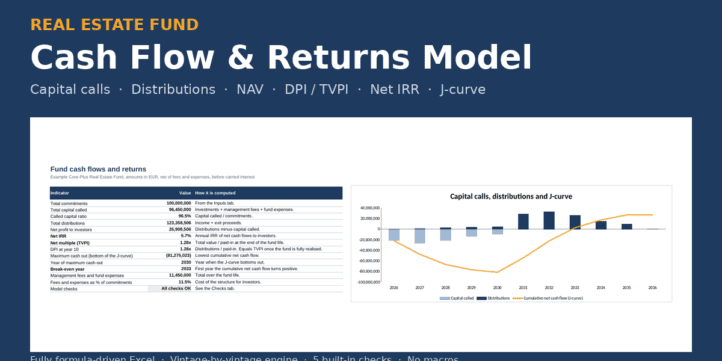
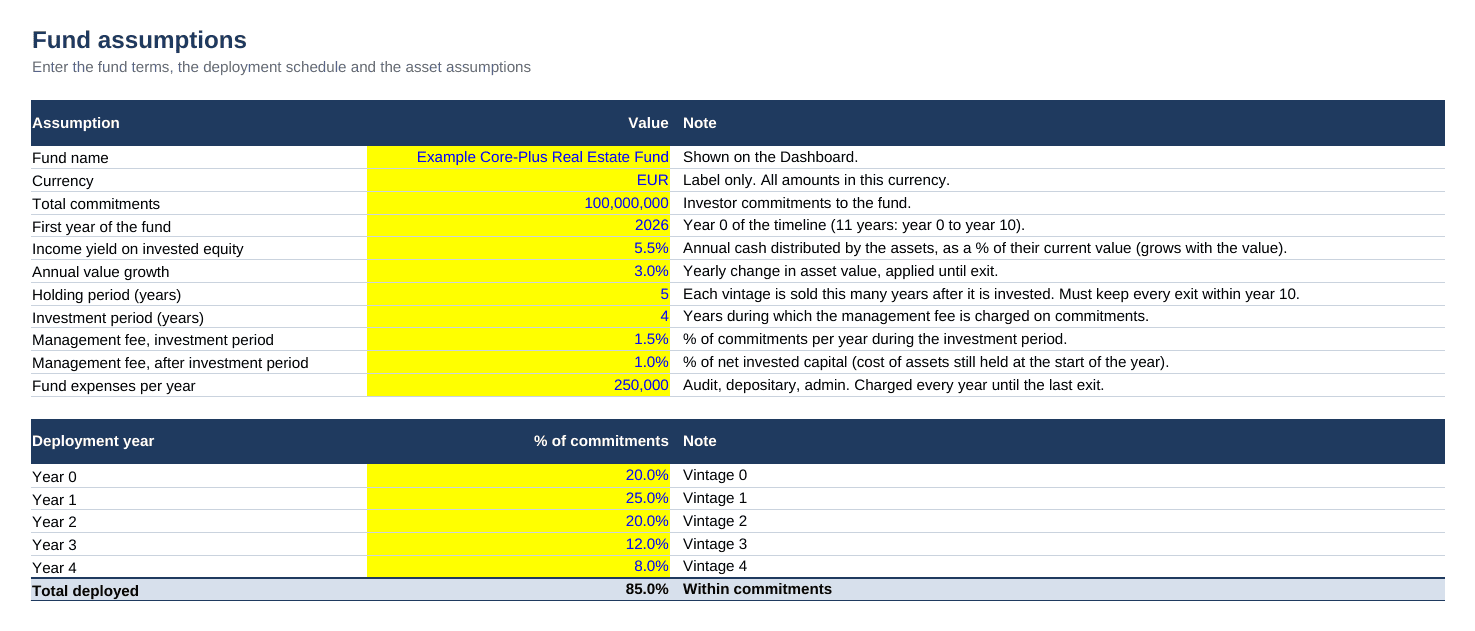
How much will investors have to put in, when will they get it back, and what will the fund return? This template answers those questions for a closed-end real estate fund (core-plus, value-add or any income-producing strategy) over a 10-year life, from the first capital call to the last exit.
What the model does
You enter the fund terms and a few asset assumptions. The model then builds the fund vintage by vintage:
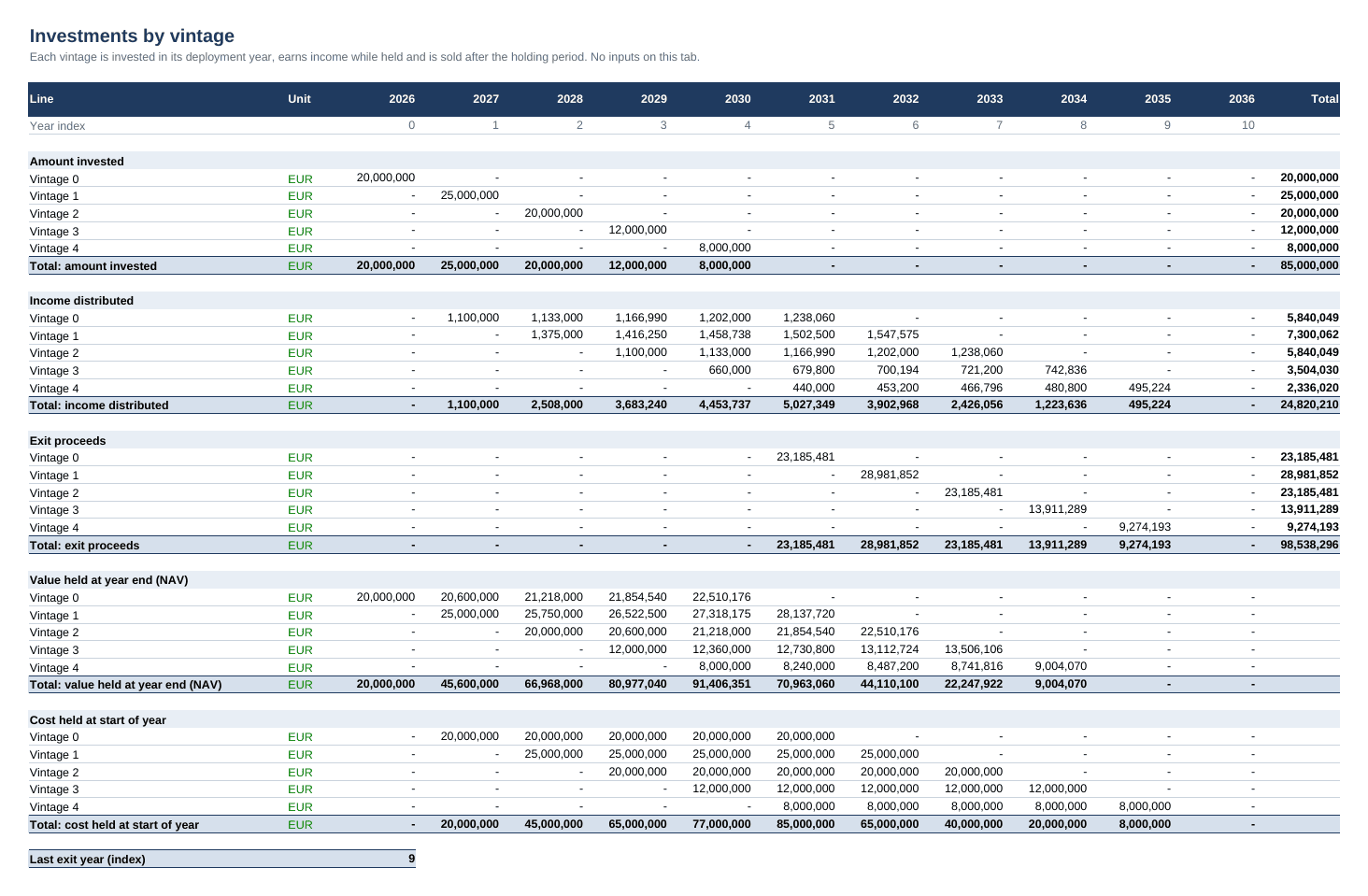
- Deployment: the share of commitments invested in each of the first five years (five vintages).
- Income: each vintage distributes a cash yield every year it is held, growing with the asset value.
- Value growth and exits: each vintage grows in value and is sold after the holding period you choose.
- Management fees: a rate on commitments during the investment period, then a rate on net invested capital (cost of the assets still held).
- Fund expenses: a yearly amount, charged until the last exit.
Outputs
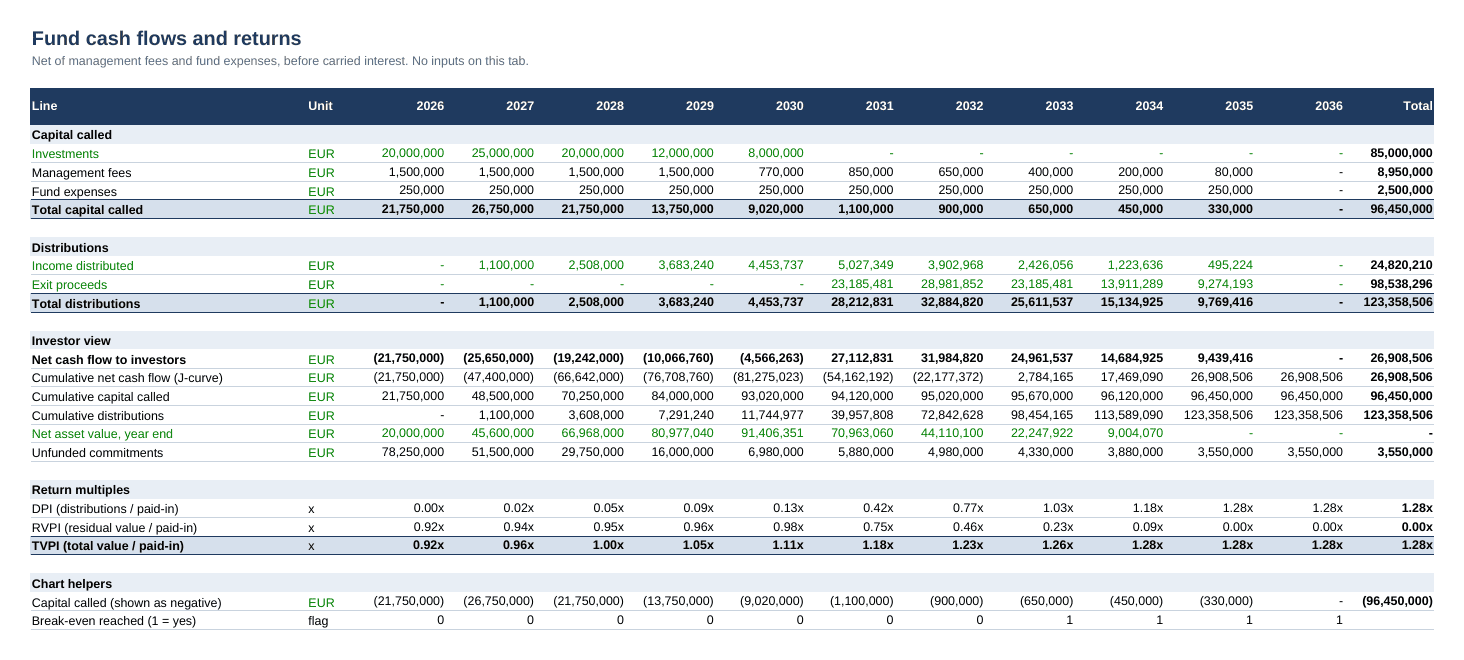
- Capital calls (investments, fees, expenses) and distributions (income, exit proceeds), year by year
- Net asset value (NAV) at each year end and unfunded commitments
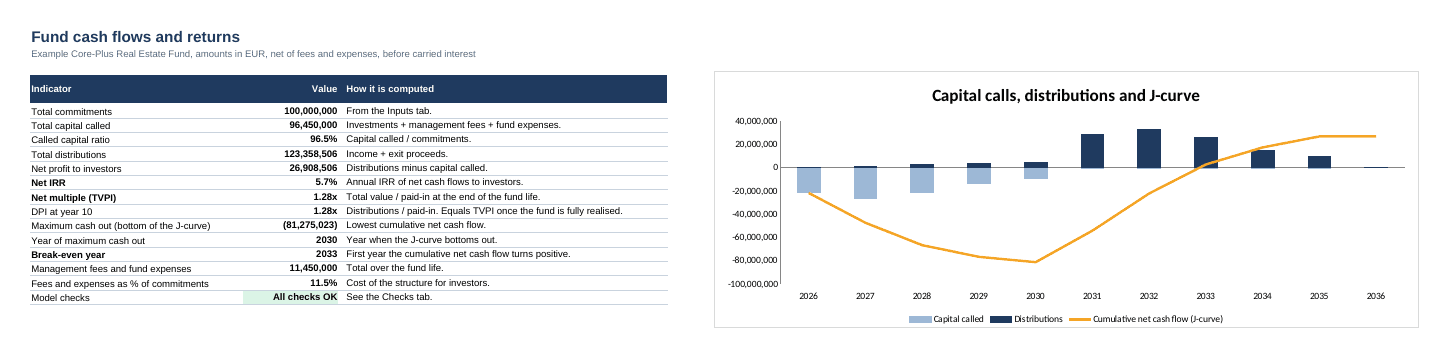
- DPI, RVPI and TVPI every year, and the net IRR to investors
- The J-curve: maximum cash out, the year it bottoms out and the break-even year
- Total fees and expenses, and their weight as a % of commitments
- A chart combining capital calls, distributions and the cumulative net cash flow
Built to be trusted
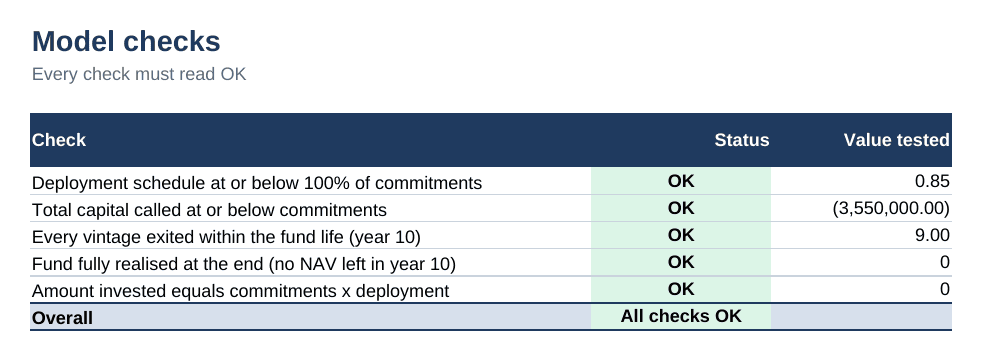
- Five automatic checks: deployment within 100%, capital called within commitments, every vintage exited within the fund life, fund fully realised at the end, invested amounts tying out. The Dashboard shows “All checks OK”.
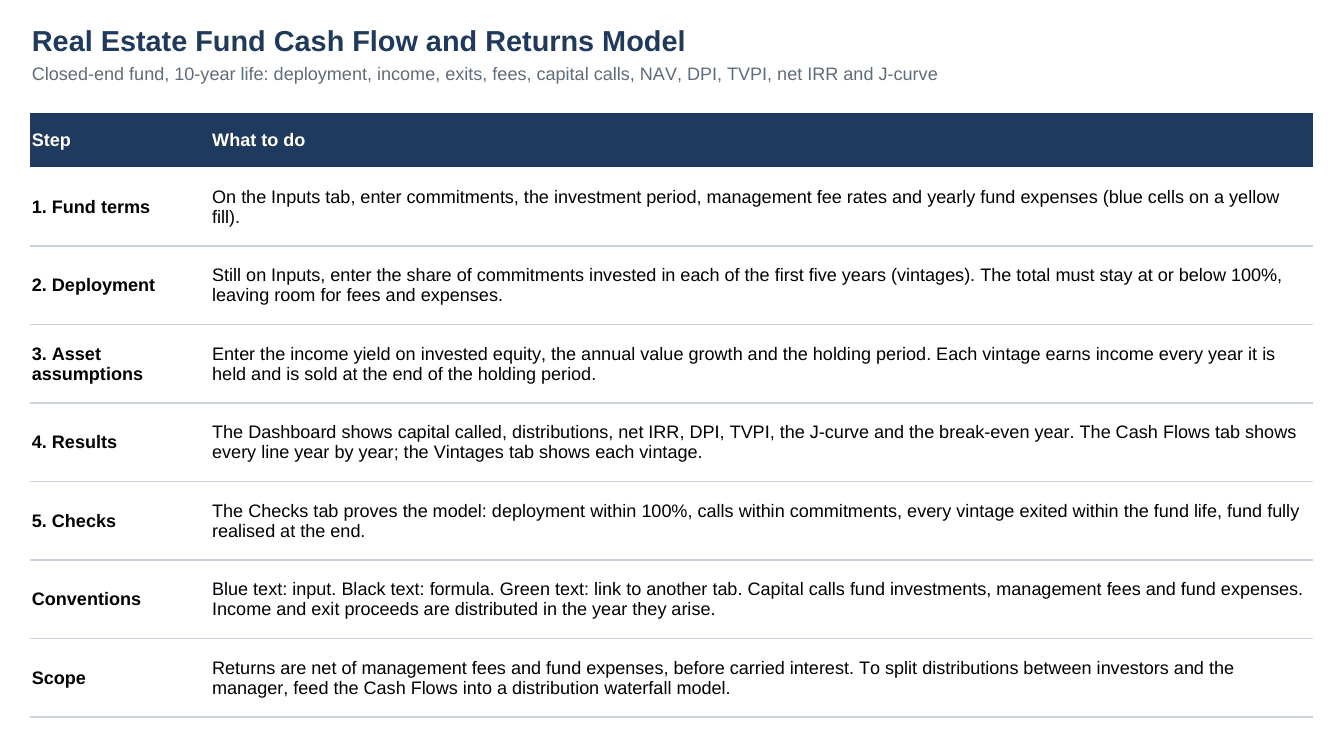
- Transparent formulas: blue inputs, black formulas, green links between tabs, no hard-coded numbers inside formulas, no macros, no hidden or protected sheets.
- Vintage-by-vintage engine on its own tab, so every number can be traced and explained.
How to use it
The workbook has six tabs: Instructions, Dashboard, Inputs, Vintages, Cash Flows and Checks. Change the yellow cells on the Inputs tab and read the results on the Dashboard. Use it to size a fund, test a deployment pace, show investors the J-curve, compare fee structures, or prepare the cash flow profile of a fundraising presentation.
Who it is for
Real estate fund managers and sponsors, investor relations and fundraising teams, family offices and institutional investors assessing a fund, and analysts or students learning how fund cash flows and return multiples work.
Returns are net of management fees and fund expenses, before carried interest. To split distributions between investors and the manager, pair it with our Real Estate Fund Distribution Waterfall model. The example data is fictional: a 100 million core-plus fund with 85% deployed over five years, a 5.5% income yield, 3% annual value growth and five-year holds, giving a 5.7% net IRR and a 1.28x net multiple. A PDF preview of every tab is available as a free download.
Similar ProductsOther customers were also interested in...



 eFinancialModels
Electric Vehicle (EV) Charging Station Financial M...
With this comprehensive 5- or 10-year monthly tool, investors can assess the viability of setting up... Read more

Financial Model for Mobile App | Mobile App Busine...
The Mobile App Financial Plan Template in Excel allows you to develop financial projections when lau... Read more

 HenrySheykin
Food Truck Financial Model Excel Template
The Food Truck Financial Model helps entrepreneurs, founders, business owners, consultants, and anal... Read more

Green Hydrogen Production from Wind Energy Financi...
The Green Hydrogen from Wind Financial Model aims to comprehensively forecast a horizon of 40 years ... Read more

Simple Mutual Non-Disclosure Agreement Template
Protect your business secrets with ease using our Simple Mutual Non-Disclosure Agreement Template. S... Read more

Solar Energy Financial Model
The Solar Energy Financial Model Spreadsheet Template in Excel assists you in preparing a sophistica... Read more

 Peter Graf
The Customer-Centric Financial Model for Restauran...
Starting a restaurant without a financial plan is like driving a car blindfolded. You wouldn´t do i... Read more
You must log in to submit a review.