
0 ITEMS

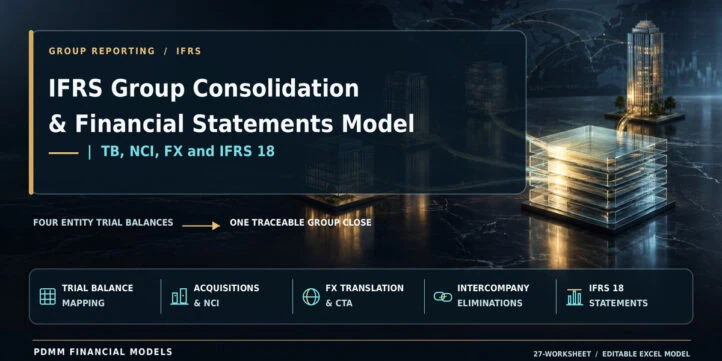
IFRS Group Consolidation & Financial Statements Model | TB, NCI, FX and IFRS 18
IFRS Group Consolidation & Consolidated Financial Statements Model 🧾 Turn separate legal-entity trial balances into a traceable group close. This editable Excel workbook connects ownership judgements, group-account mapping, local-currency balances, acquisition accounting, non-controlling interests, intercompany eliminations and consolidation journals to consolidated financial statements. Its fictional Meridian Group example shows a parent, two controlled subsidiaries and one equity-accounted associate, with FY2025 comparative and FY2026 current-year periods. Amounts are presented in USD thousands.
| All Industries, E-Commerce & Web Shops, Financial Model, General Excel Financial Models |

IFRS Group Consolidation & Consolidated Financial Statements Model
🧾 Turn separate legal-entity trial balances into a traceable group close. This editable Excel workbook connects ownership judgements, group-account mapping, local-currency balances, acquisition accounting, non-controlling interests, intercompany eliminations and consolidation journals to consolidated financial statements. Its fictional Meridian Group example shows a parent, two controlled subsidiaries and one equity-accounted associate, with FY2025 comparative and FY2026 current-year periods. Amounts are presented in USD thousands.
When a group has multiple ledgers, a consolidated statement cannot simply add every company together. The reporting team must decide which entities are controlled, translate a foreign subsidiary, remove internal balances and trades, recognise relevant purchase-accounting entries, allocate income and equity to NCI, and make the final totals explainable. The workbook provides one connected workpaper for that sequence, with visible inputs and formula-driven output rather than disconnected summary tables.
🎯 Decisions the workbook supports
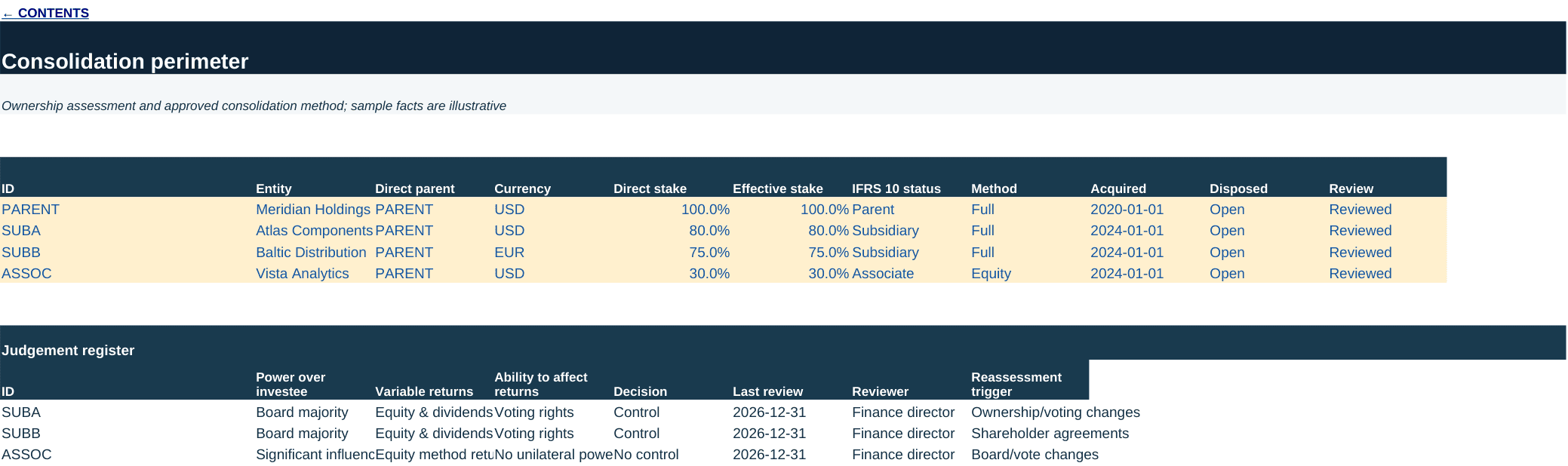
- What belongs inside full consolidation, and which investment is accounted for using the equity method?
- Which local accounts map to each group line, and are any TB rows missing a usable map or exchange rate?
- How do the recorded PPA inputs, historical exchange rate and subsidiary ownership translate into goodwill and NCI?
- Which intercompany receivables and payables match, and which revenue/purchase pairs can be eliminated?
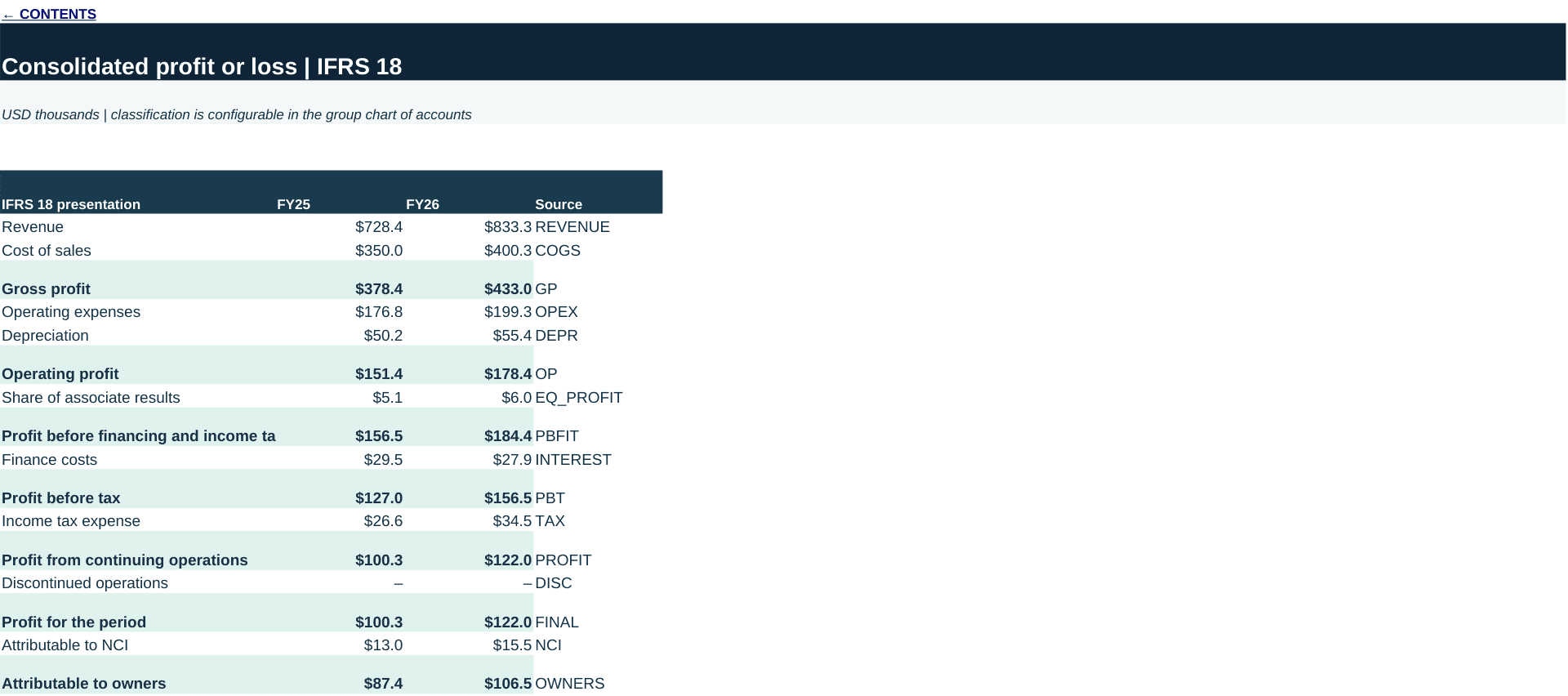
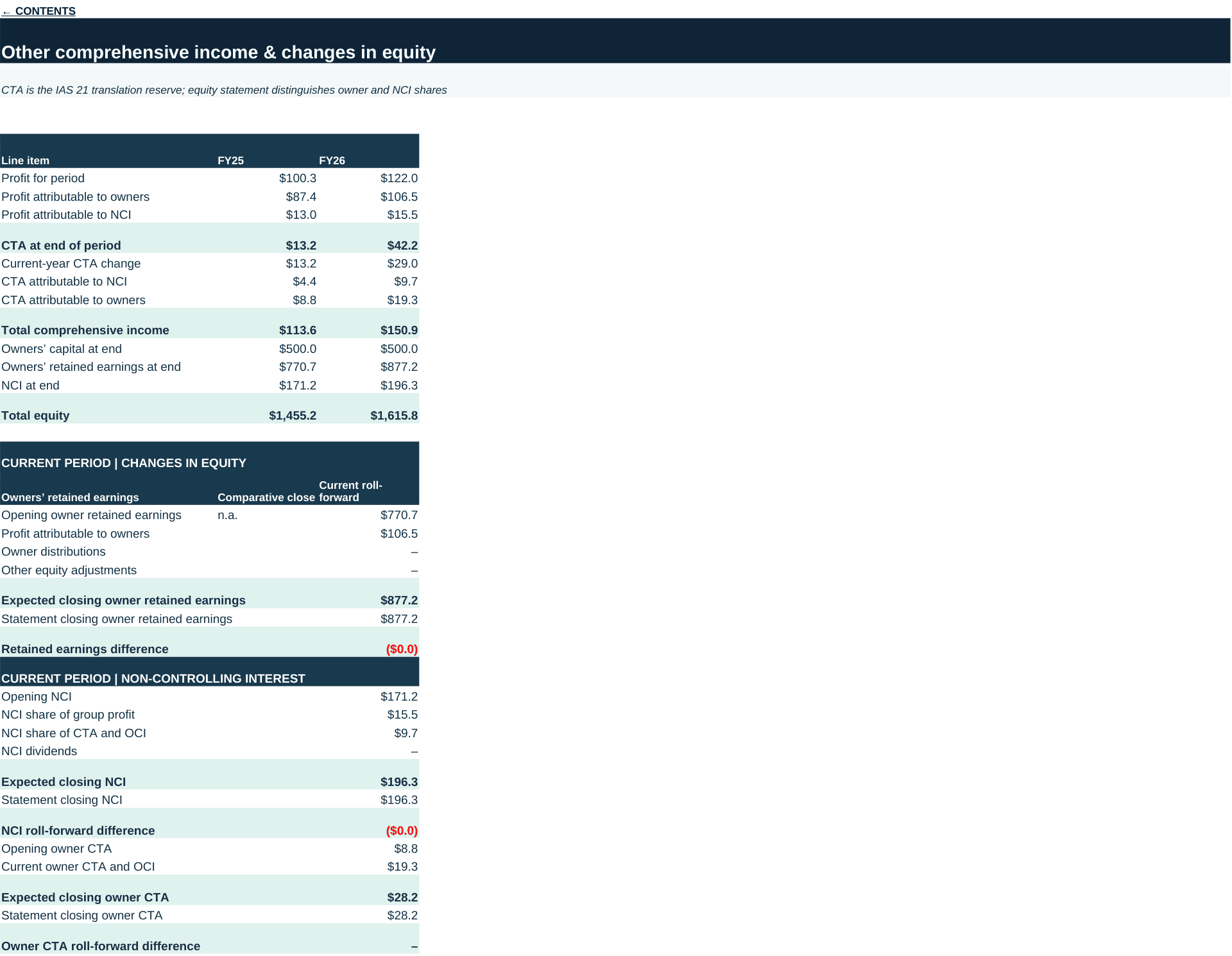
- How much group profit belongs to owners versus NCI, and how does translation affect the CTA reserve?
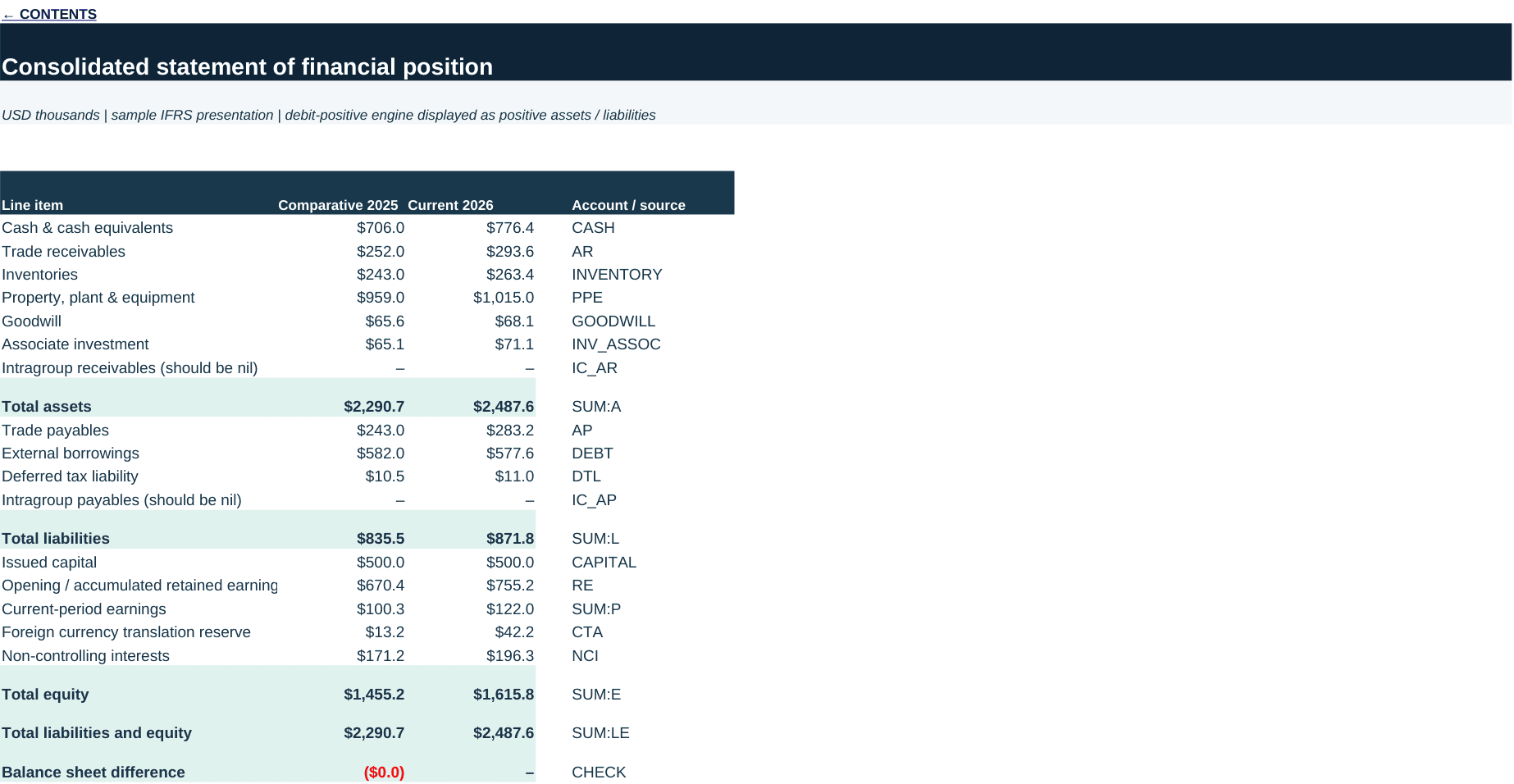
- Do the statements of financial position and cash flows tie to the signed consolidation ledger?
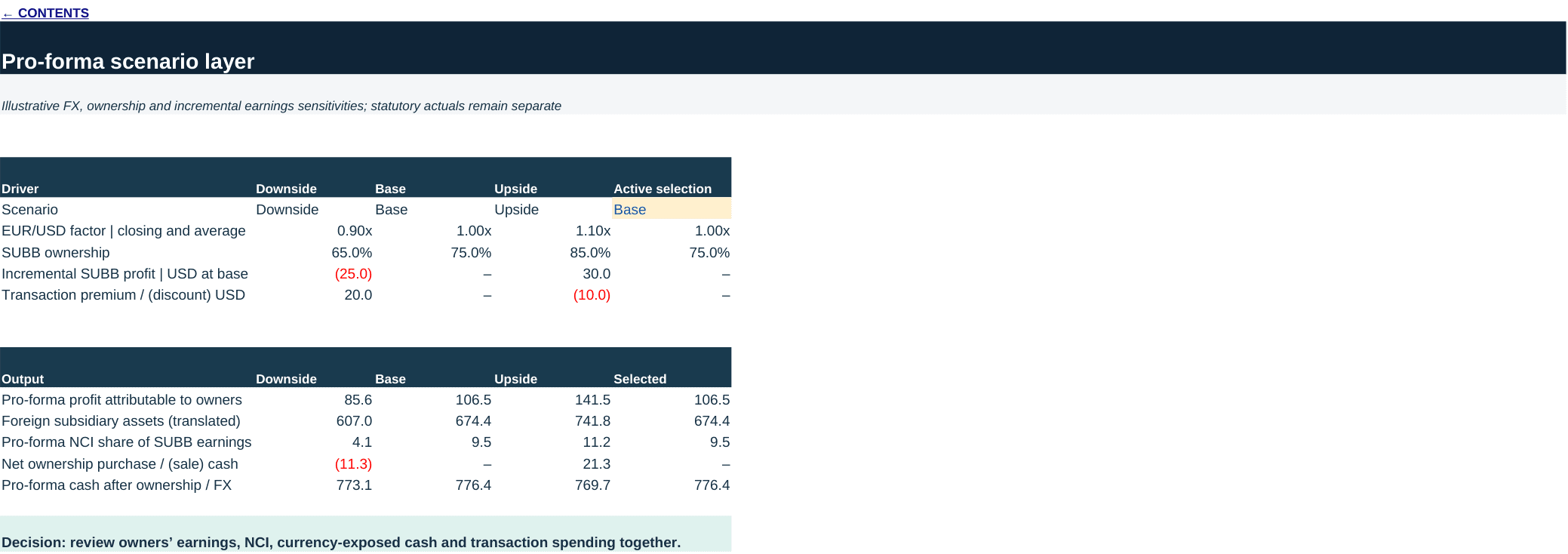
- How would a separate hypothetical change in ownership, EUR/USD rates or a subsidiary’s earnings affect owners’ profit, NCI, assets and cash?
🔗 From source TB to consolidated statements
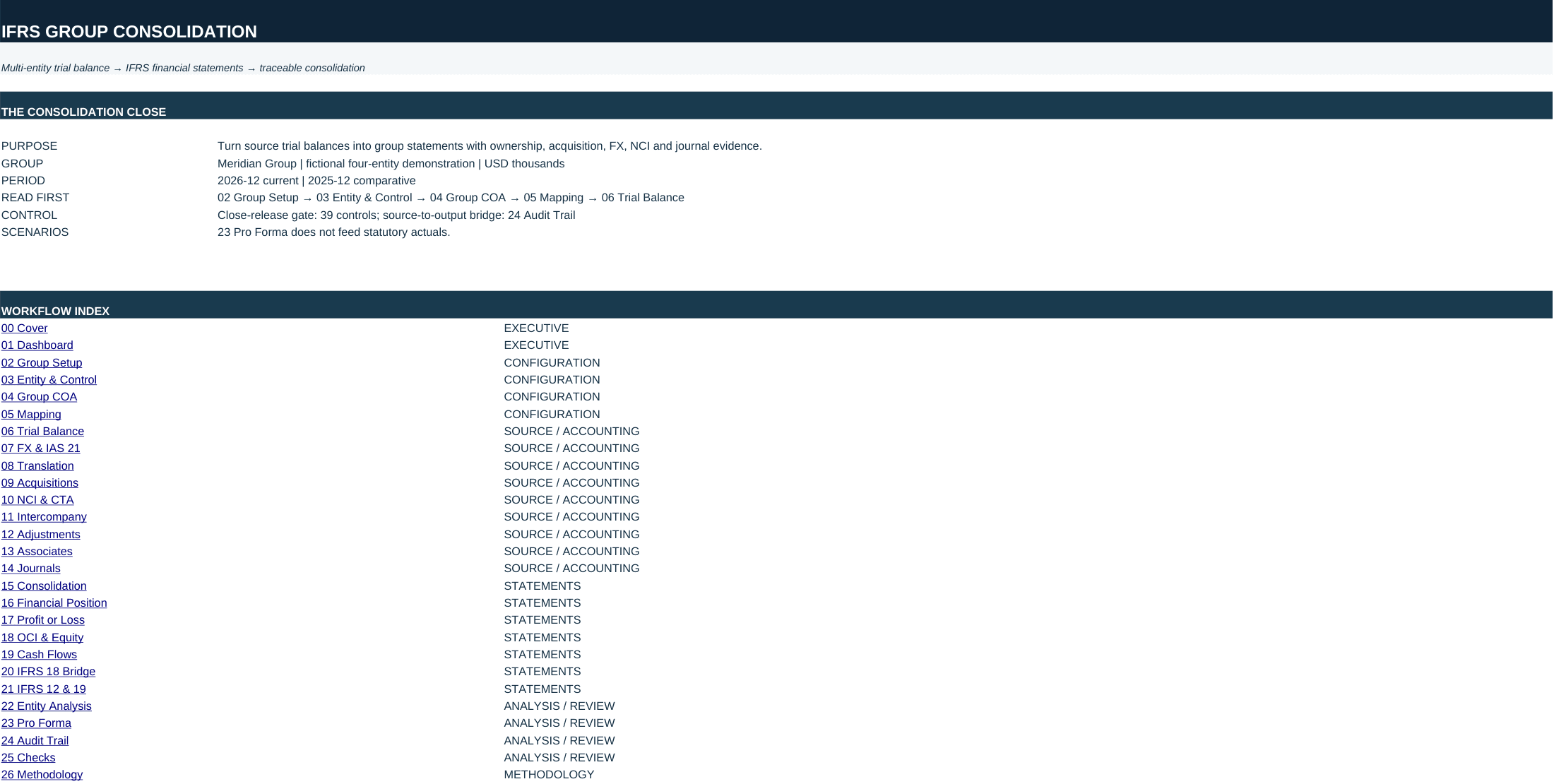
Set the reporting case. Start with `00 Cover` for clickable navigation, `02 Group Setup` for period keys, presentation currency and check tolerance, and `03 Entity & Control` for entity IDs, currencies, direct/effective stakes and documented control conclusions. `04 Group COA` defines group accounts and presentation classifications; `05 Mapping` links local account keys to those accounts.
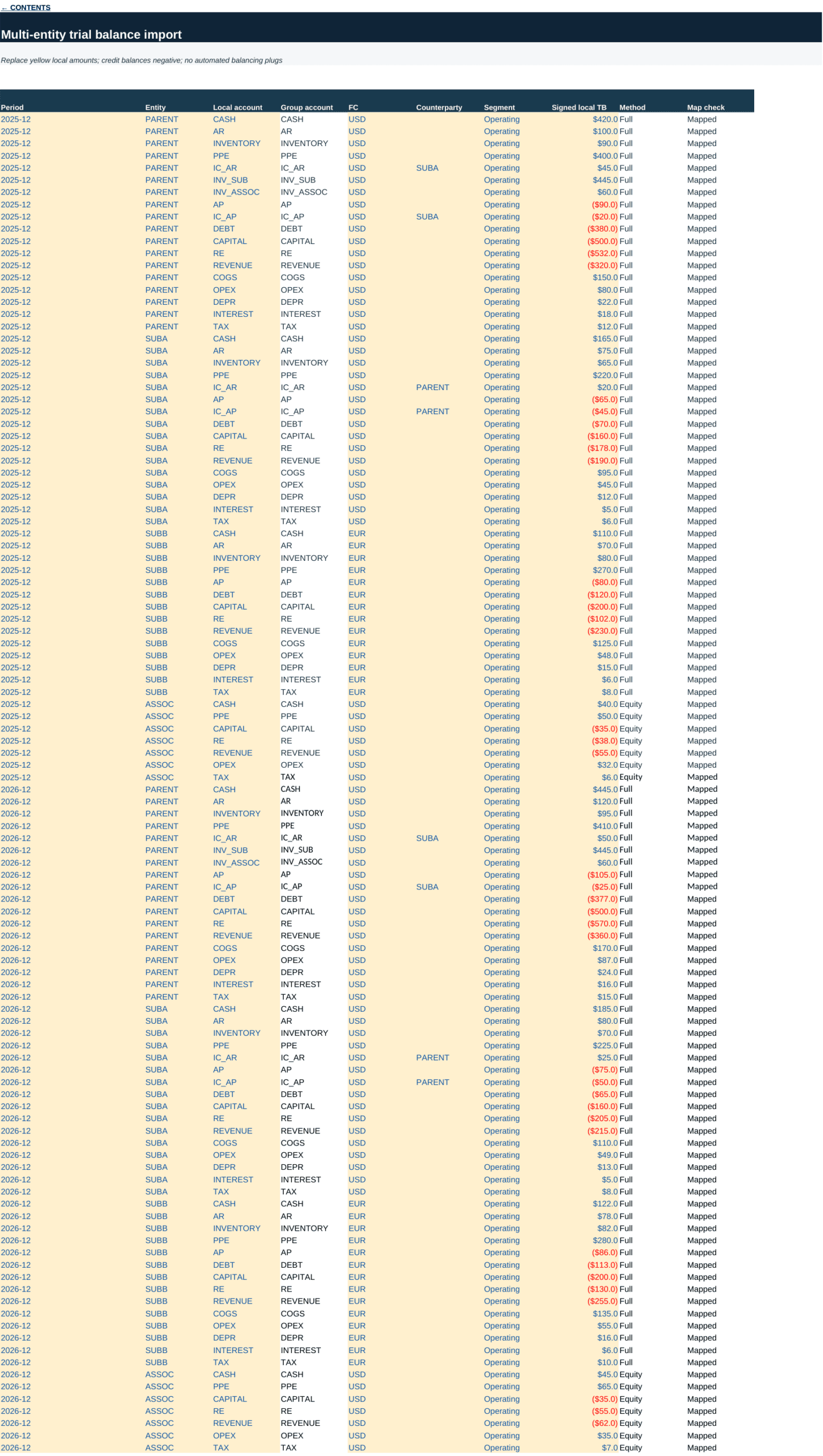
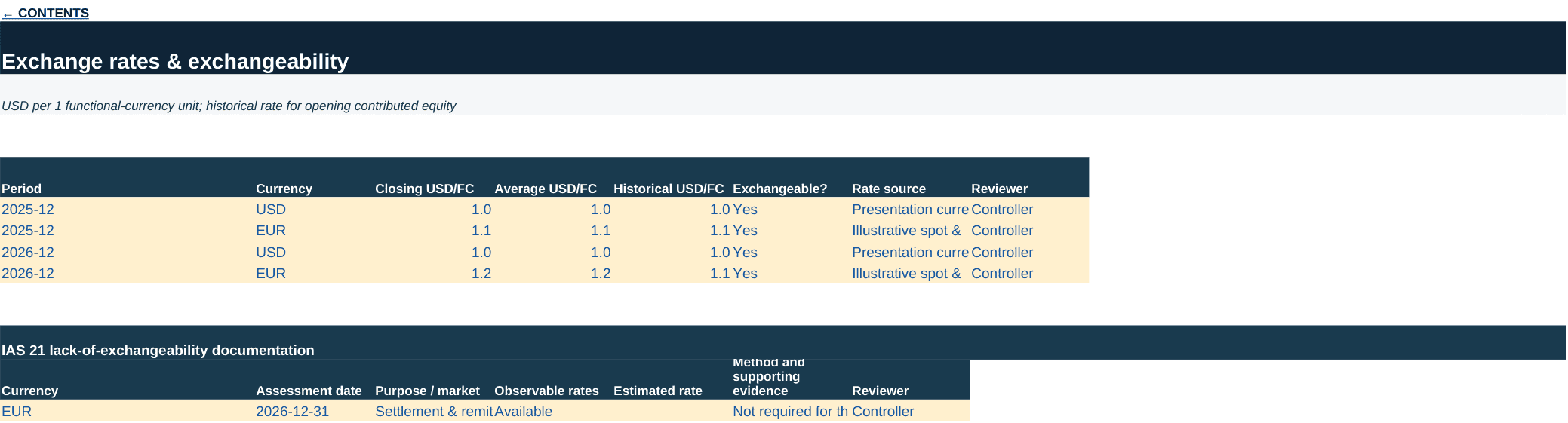
Load and translate. `06 Trial Balance` is a row-based, editable import with periods, entities, local accounts, group accounts, currencies, counterparty and segment dimensions. Sample credit balances are negative and debits positive. `07 FX & IAS 21` holds closing, average and historical USD-per-functional-currency rates and an exchangeability documentation area. `08 Translation` converts the included entities’ balances under the workbook’s account treatment and rate inputs. Replace the fictional amounts and review the entity and period keys when adapting the case.
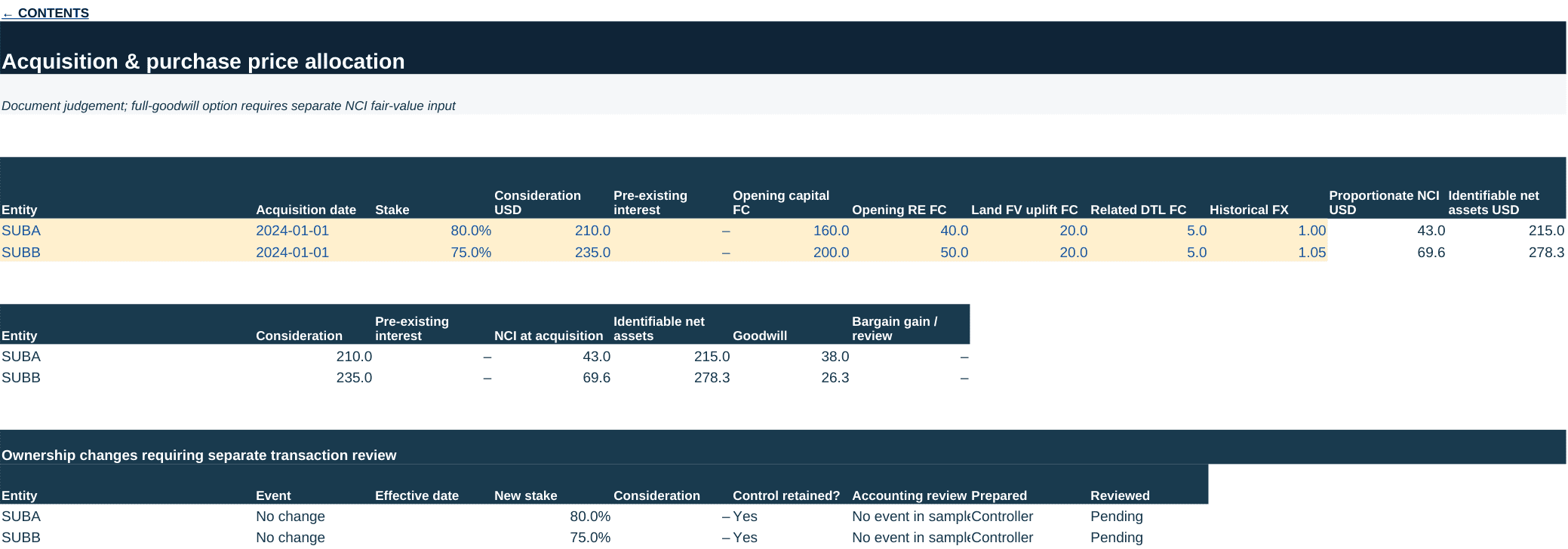
Recognise ownership economics. `09 Acquisitions` links consideration, acquired interests, acquisition equity, a sample land fair-value uplift and related deferred tax to identifiable net assets, proportionate NCI and goodwill. It also provides an ownership-change review register. `10 NCI & CTA` attributes subsidiary outcomes and foreign-operation translation to owners and NCI; `13 Associates` rolls the associate investment from cost through its share of results, OCI, dividends and impairment inputs. The demonstration covers the accounting patterns built into those schedules; new transaction facts require their own review and appropriate journal inputs.
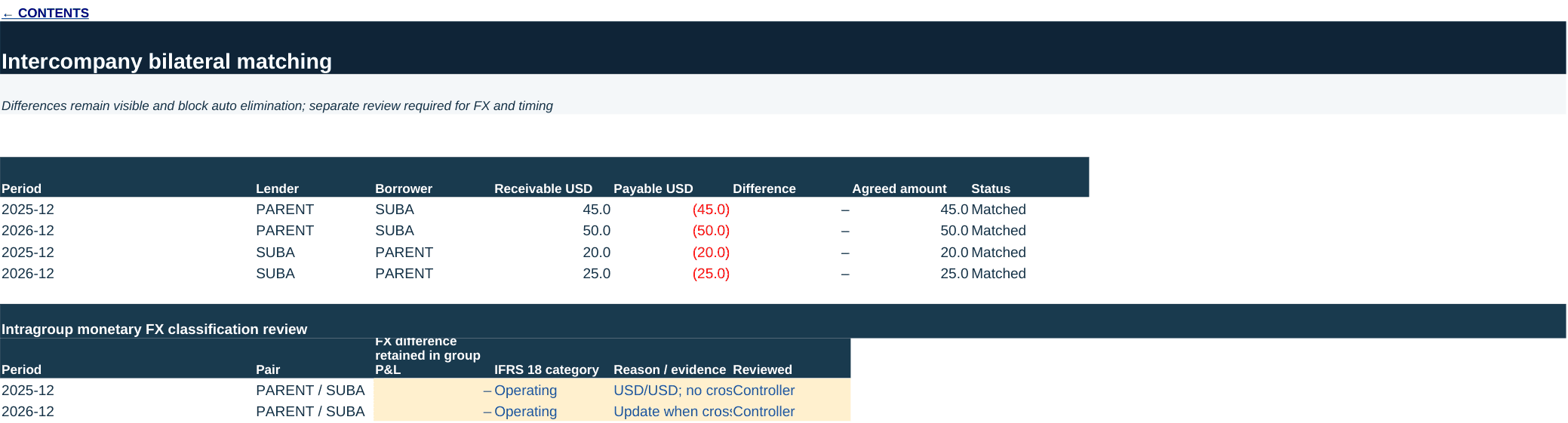
Eliminate internal activity. `11 Intercompany` presents bilateral receivable/payable differences alongside an intragroup monetary-FX classification review. `12 Adjustments` provides editable sales/purchase pairs and documented unrealised-profit adjustments for inventory and fixed assets. `14 Journals` assembles formula-driven acquisition, translation, NCI and elimination postings alongside editable manual consolidation journals. `15 Consolidation` ties the translated group-account balances to journal adjustments, yielding the consolidated signed balances.
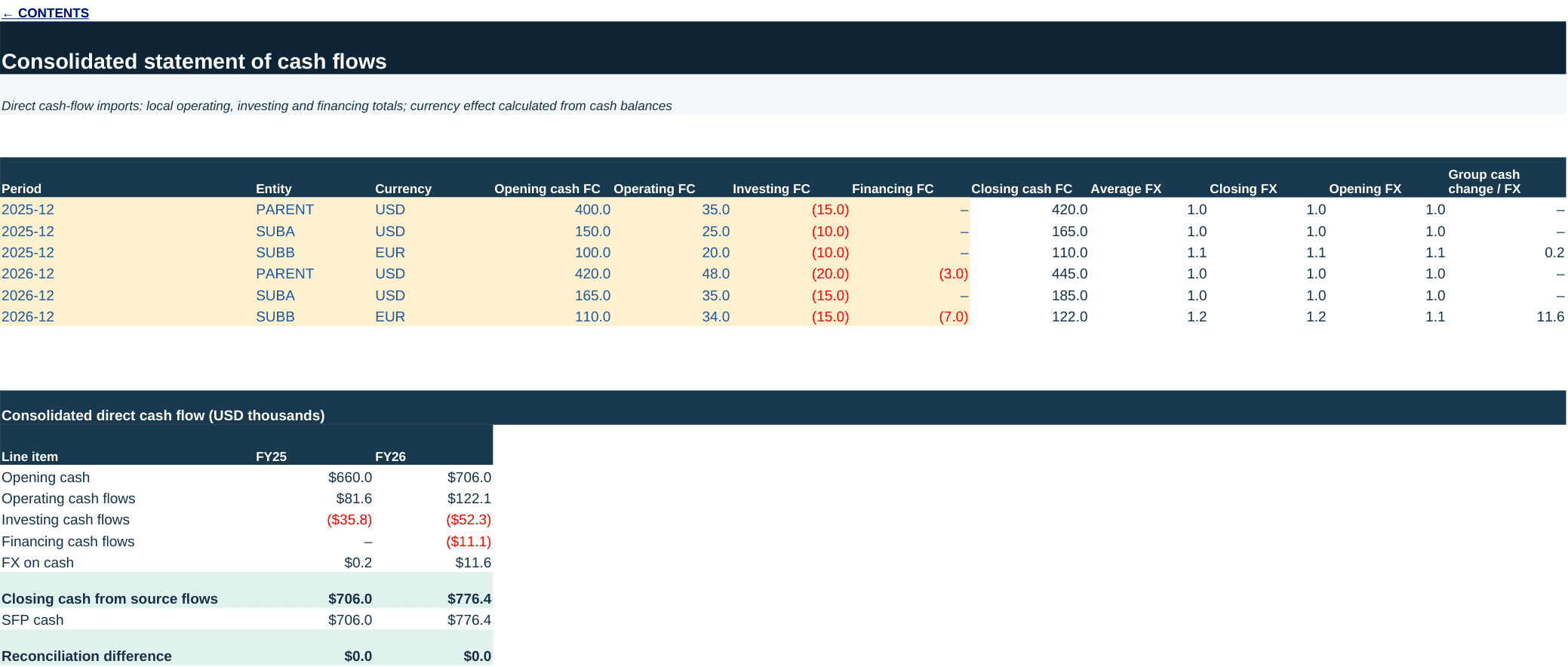
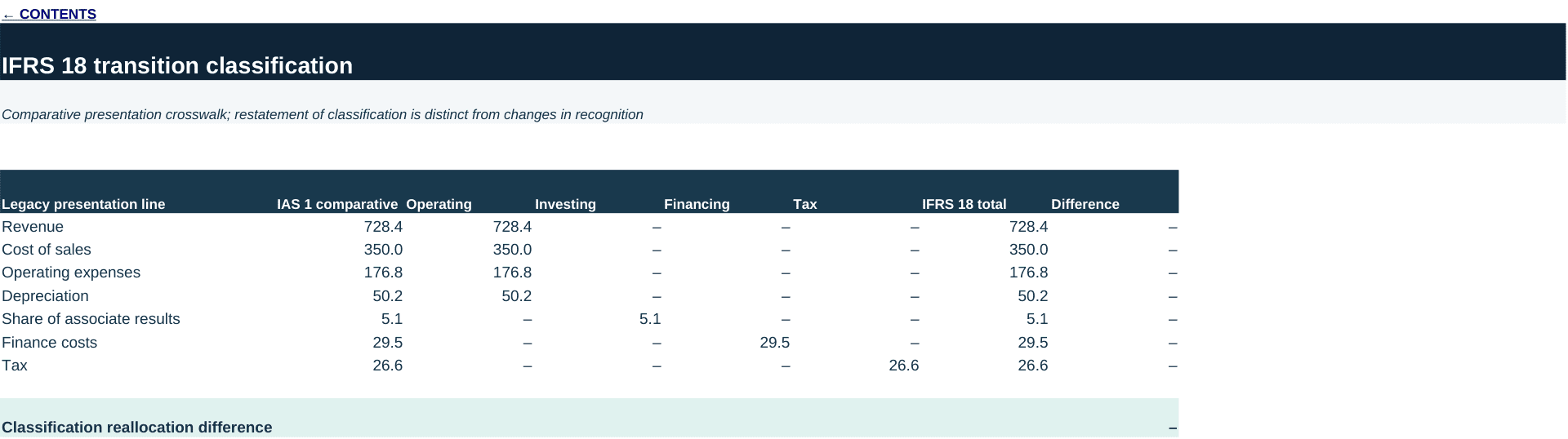
Read the results. `16 Financial Position` shows comparative/current assets, liabilities and equity. `17 Profit or Loss` displays IFRS 18-ready operating, investing, financing and income-tax presentation and profit attribution. `18 OCI & Equity` presents total comprehensive income, owners’ reserves and NCI movements. `19 Cash Flows` uses editable local direct-cash-flow imports, average/closing rates and an FX-on-cash calculation to reconcile group closing cash. `20 IFRS 18 Bridge` maps comparative legacy income-statement lines into presentation categories; `21 IFRS 12 & 19` helps plan interest-in-other-entities disclosures and screen subsidiary-level reduced-disclosure eligibility.
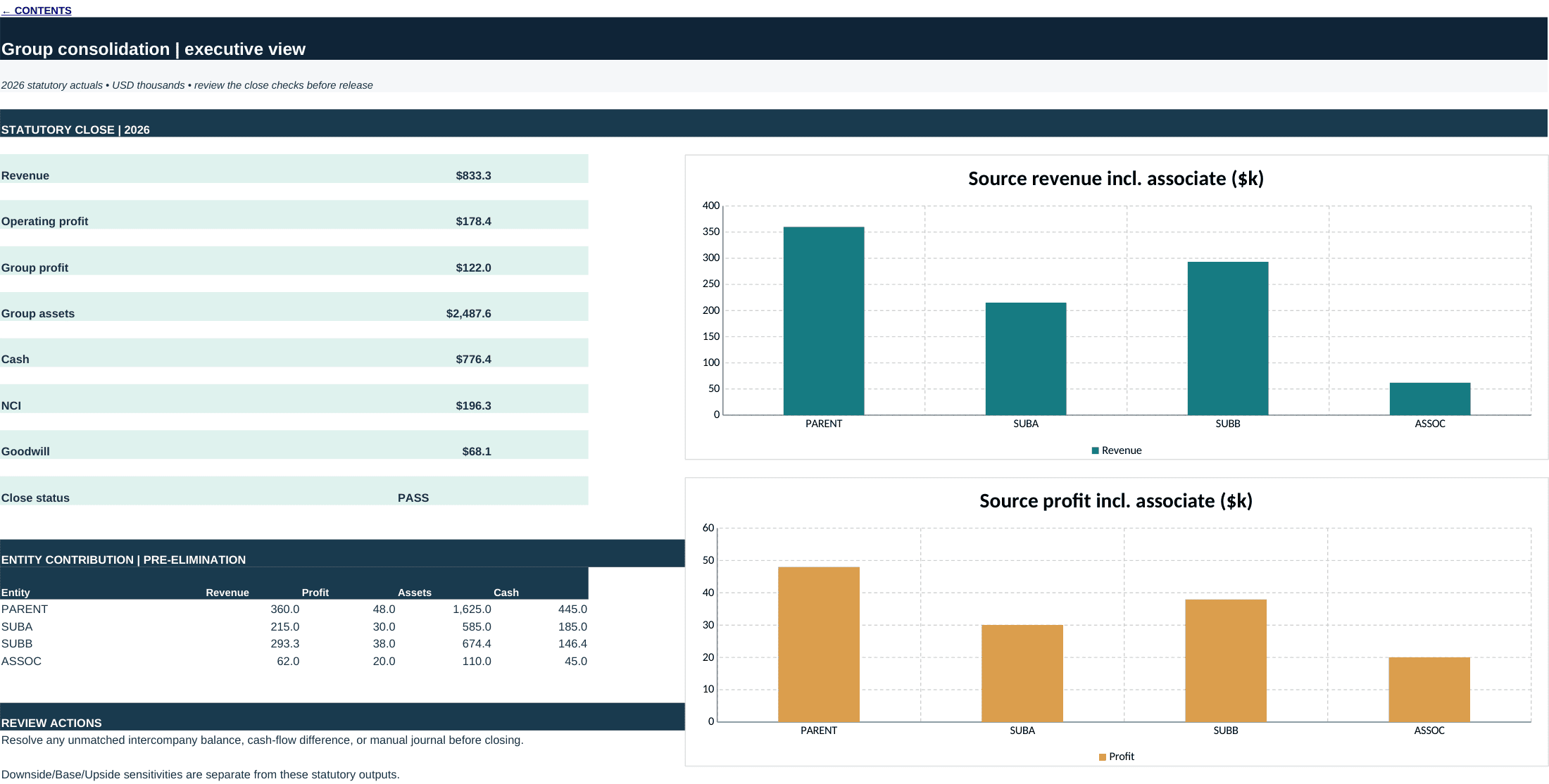
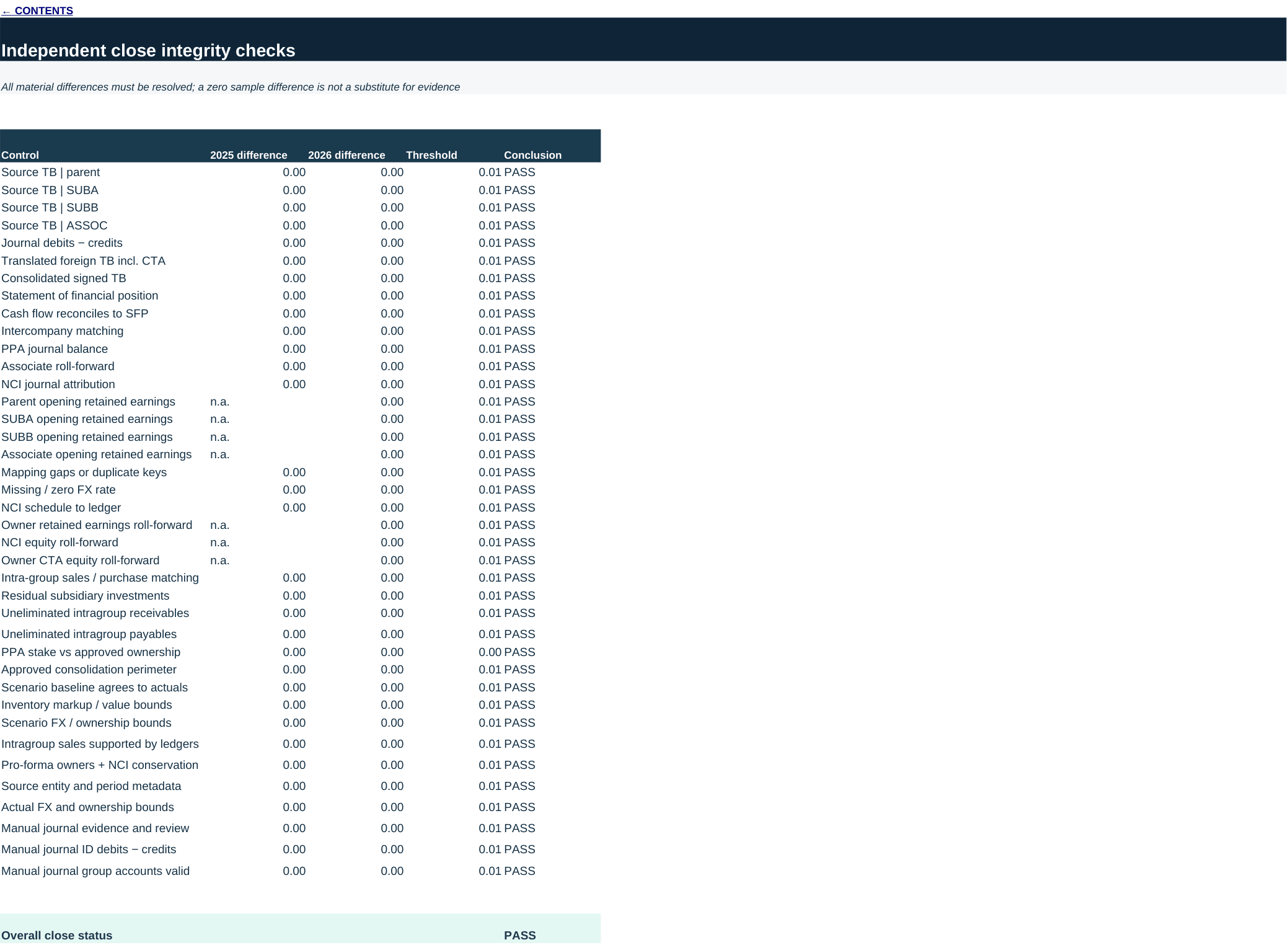
Review and explain. `22 Entity Analysis` separates each entity’s translated contribution before eliminations. `24 Audit Trail` reconciles each group-account code through translated TB, journal changes and consolidated balance. `25 Checks` contains a 39-control close gate covering source TB balance, journal balance, translated balances, mapping/rates, intercompany matching, ownership accounting, statement balance and cash reconciliation. `26 Methodology` documents calculation conventions and source references. `01 Dashboard` brings the principal figures, entity contribution and close status into one executive view with native charts.
📊 Scenarios, sensitivity and management questions
`23 Pro Forma` provides Downside, Base and Upside columns, plus an active selection. Its editable assumptions cover a EUR/USD multiplier, a subsidiary ownership stake, incremental subsidiary earnings and a transaction premium or discount. The linked outputs show pro-forma profit attributable to owners, foreign-subsidiary assets, NCI earnings, cash spent or raised through ownership movement and resulting cash after the stated FX/ownership effects. This is a sensitivity of the illustrated ownership and FX decisions; it does not change statutory actuals or turn the workbook into a long-range forecast.
You can use the workbook to:
- Plan the group reporting close around a controlled perimeter, approved account mapping and outstanding integrity checks.
- Prepare comparative consolidated statements from separately keyed local FY2025 and FY2026 trial balances.
- Investigate group profitability by tracing revenue, operating profit, NCI and the pre-elimination entity contributions.
- Reconcile cash flows from direct local operating, investing and financing inputs through exchange-rate effects to cash on the balance sheet.
- Quantify acquisition accounting with consideration, sampled fair-value and deferred-tax adjustments, goodwill and acquisition-date NCI.
- Resolve intercompany differences before eliminating receivables, payables and matched sales/purchases.
- Test foreign-exchange sensitivity by changing the EUR/USD pro-forma factor and observing assets, owners’ profit and closing cash.
- Test ownership and earnings cases separately under Downside/Base/Upside and review the associated NCI and transaction-cash effect.
- Document reporting judgements using the control register, exchangeability notes and IFRS 18 comparative classification bridge.
- Trace a statement line back to inputs through the account-level TB-to-adjustments-to-consolidated audit view.
✍️ Editable inputs, outputs and delivered files
Input areas cover the group settings and tolerance, entity master and control conclusions, group chart, local account mapping, signed TB values, exchange rates and exchangeability assessment, acquisition data, dividends, intercompany pairs, inventory/fixed-asset profit adjustments, associate movements, manual journals, direct local cash flows and separate scenario drivers. The integrated fictional case makes formulas, charts, checks and statement outputs visible immediately; substitute your own controlled data for a live group.
The download includes one macro-free editable XLSX workbook, a full-sheet searchable PDF preview containing exactly one page for each of the 27 worksheets. The workbook’s cover links to the workflow, its dashboard exposes key group metrics, and the methodology page states the example’s accounting conventions and review points. It suits group financial controllers, consolidation accountants, CFO or finance-director teams, reporting consultants and advisers who want an adaptable Excel workpaper for a defined multi-entity IFRS close.
Similar ProductsOther customers were also interested in...



 eFinancialModels
Electric Vehicle (EV) Charging Station Financial M...
With this comprehensive 5- or 10-year monthly tool, investors can assess the viability of setting up... Read more

Financial Model for Mobile App | Mobile App Busine...
The Mobile App Financial Plan Template in Excel allows you to develop financial projections when lau... Read more

 HenrySheykin
Food Truck Financial Model Excel Template
The Food Truck Financial Model helps entrepreneurs, founders, business owners, consultants, and anal... Read more

Green Hydrogen Production from Wind Energy Financi...
The Green Hydrogen from Wind Financial Model aims to comprehensively forecast a horizon of 40 years ... Read more

Simple Mutual Non-Disclosure Agreement Template
Protect your business secrets with ease using our Simple Mutual Non-Disclosure Agreement Template. S... Read more

Solar Energy Financial Model
The Solar Energy Financial Model Spreadsheet Template in Excel assists you in preparing a sophistica... Read more

 Peter Graf
The Customer-Centric Financial Model for Restauran...
Starting a restaurant without a financial plan is like driving a car blindfolded. You wouldn´t do i... Read more
You must log in to submit a review.