
0 ITEMS

How Do You Select Your Business Model?
Table of Content
- Business Model Definition: Understanding the Core Concept
- Exploring the Different Types of Business Models
- How to Choose a Profitable Business Model?
- Maximize Profits: The Power of a Solid Business Model Plan
- Frequently Asked Questions (FAQs)
Choosing the right business model is crucial for sustainable growth and profitability.
- Different models rely on diverse revenue streams like product sales, subscriptions, or marketplace commissions.
- Understanding your target customers helps tailor offerings and pricing strategies effectively.
- Analyzing costs and expenses ensures your model remains profitable as your business scales.
- Testing and iterating your approach allows adaptation to market changes and customer needs.
- Comparing industry examples reveals which models best fit your goals and operational strengths.
Continuing can help you identify the most profitable structure for your business.
Business Model Definition: Understanding the Core Concept
Oxford Dictionary’s business model definition labeled it as a design for effectively running a business, outlining revenue streams, target customers, offering products, and financial structure. Wikipedia’s business model definition outlines how an organization generates, delivers, and sustains value across economic, social, cultural, or other domains. It details the company’s approach to operations, revenue generation, and expenditures to ensure profitability.
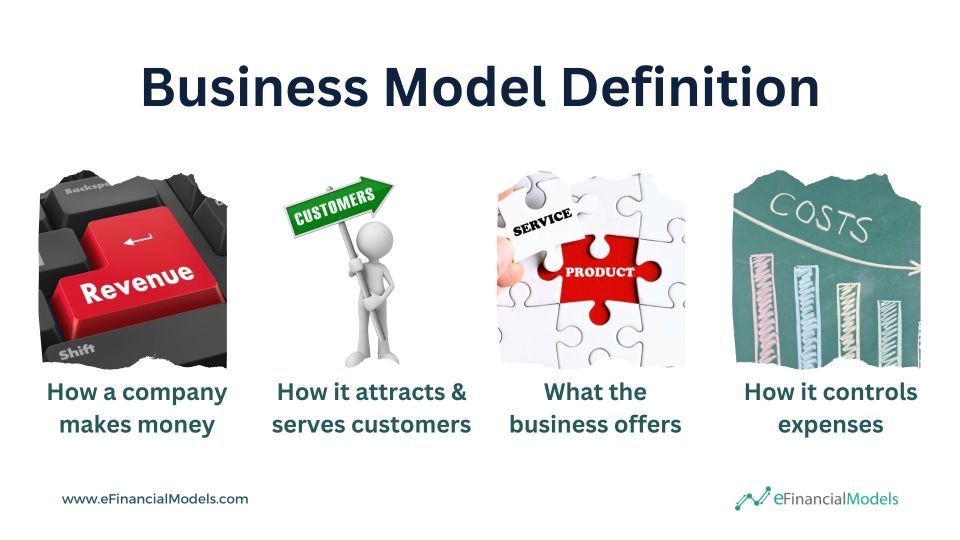
In simple terms, a business model explains how a company makes money by delivering value to customers while managing costs and revenue. It outlines how it generates revenue, how it attracts and serves customers, what the business offers, and how it controls expenses. Strong business models balance pricing, costs, and market demand to stay profitable. They also adapt to changes in competition, technology, and customer needs. A well-structured model helps businesses grow and sustain success over time.
Key Components of a Business Model
A business model is the foundation of any company’s success. It explains how a business creates, delivers, and captures value. It shapes the company’s competitive edge and long-term sustainability. Every decision, from pricing to operations, depends on it. A business risks confusion, inefficiency, and failure without a clear model. Understanding the key components of a business model helps entrepreneurs refine strategies and maximize growth potential.
- Revenue Streams: Revenue streams show how a business makes money. They come from product sales, service fees, subscriptions, or licensing. Each stream should align with customer demand and business strategy. A strong business model includes multiple revenue streams to ensure consistent cash flow and long-term growth. Diversifying revenue sources reduces risk and increases stability. Tracking these streams helps businesses understand profitability and growth potential.
- Target Customers: Target customers are the specific group a business serves. They share common traits like age, location, income, or interests. A clear customer focus improves sales and brand loyalty. A business must define its ideal customers based on demographics, behavior, and needs. Understanding the target market helps in tailoring products, pricing, and marketing strategies. A well-defined audience improves customer engagement and boosts sales. Businesses that focus on the right customers gain a competitive edge and build loyalty.
- Value Proposition: A value proposition explains why customers should choose a business over competitors. It highlights the key benefits and solutions the product or service offers. These may include lower costs, better quality, or innovative features. A strong value proposition sets a business apart from competitors. It must be clear, compelling, and customer-focused.
- Cost Structure: Cost structure outlines a business’s expenses. These include fixed costs like rent and salaries and variable costs like materials and marketing. Keeping costs under control ensures profitability. To stay profitable, a business must track fixed and variable costs. Controlling costs without sacrificing quality boosts efficiency and margins. A lean cost structure improves financial health and supports long-term success. A well-planned cost structure supports sustainable growth.

A clear and adaptable business model drives profitability and ensures long-term stability in an ever-evolving market. By defining the key components of a business model, companies can build a sustainable and competitive edge.
Exploring the Different Types of Business Models
A business model defines how a company makes money and serves its customers. It shapes pricing, sales strategy, and overall operations. Some businesses rely on direct sales, while others earn through subscriptions, licensing, or advertising. The target customer also plays a key role in influencing product design, marketing, and distribution. Whether catering to individuals or businesses, companies must align their revenue streams with customer needs to stay competitive. Understanding the different types of business models helps businesses refine their approach and maximize profitability.
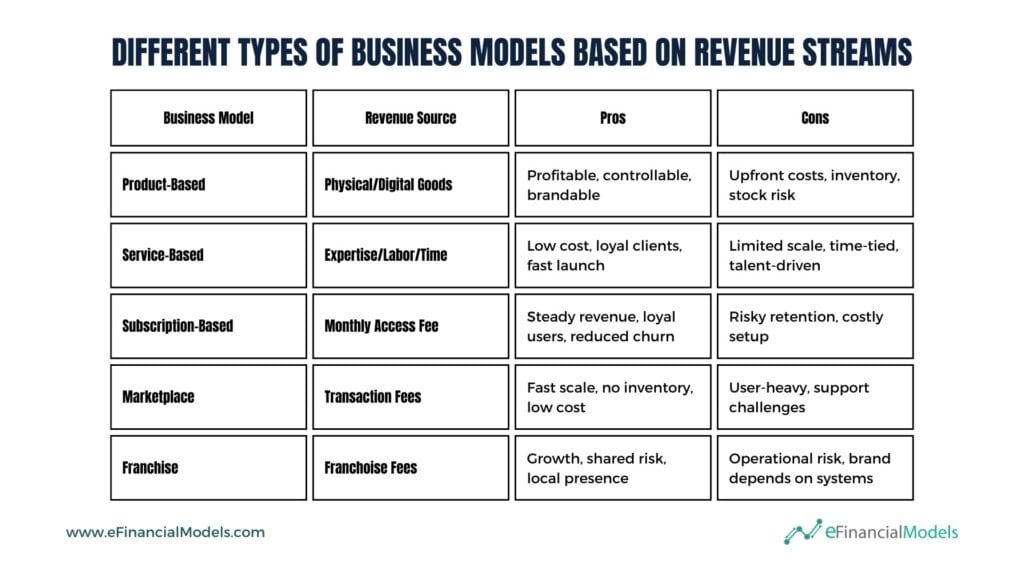
Different Types of Business Models Based on Revenue Streams
Every business needs a way to make money, and that’s where revenue models come in. These models shape how a company earns income through selling products, charging subscriptions, or offering services. Each approach reflects a unique strategy tailored to the market and customer needs.
Product-Based Business Model
A product-based business makes money by selling physical or digital goods. Companies manufacture, distribute, or resell products to customers. Revenue comes from one-time purchases, bulk sales, or direct-to-consumer transactions. Profit depends on pricing, cost of production, and sales volume. Examples include retail stores, e-commerce brands, and software providers.
A product-based business model can bring high profits when demand is strong and offers control over pricing and quality. It also helps build a solid brand identity. But it comes with challenges. You need upfront investment for production, storage, and inventory. Market shifts or slow sales can lead to losses. Plus, scaling often requires more capital and complex logistics. A product-based business model is best suited for markets with consistent demand and room for brand differentiation.
Service-Based Business Model
A service-based business earns revenue by offering expertise or labor. Customers pay for professional skills, consultation, or hands-on work. Income depends on time, skill level, and demand for the service. Examples include law firms, marketing agencies, and personal trainers. Scaling often requires hiring more people or increasing service prices.
A service-based business model needs less upfront cost and allows fast entry into the market. It builds strong customer relationships and offers flexibility. But it depends heavily on time and expertise. Scaling is harder since you trade time for money. Quality can also vary if your team grows too fast. A service-based business model best suits industries where personal skills, expertise, and client relationships drive value.
Subscription-Based Business Model
A subscription business charges customers a recurring fee for continuous access to products or services. Revenue comes from monthly or yearly payments, ensuring steady cash flow. The focus is on retaining customers rather than one-time sales. Examples include streaming platforms, SaaS companies, and membership clubs.
A subscription-based model creates steady income and builds long-term customer loyalty. It makes forecasting easier and helps lower customer acquisition costs over time. However, it needs constant value to keep users engaged. Churn can hurt profits, and early growth often demands high marketing and tech costs. A subscription-based business model best suits markets where customers need ongoing access to products or services.
Marketplace Business Model
A marketplace connects buyers and sellers, earning revenue through commissions, listing fees, or transaction fees. It does not own the products or services listed. Instead, it provides a platform for transactions. Success depends on attracting both buyers and sellers. Examples include Amazon, eBay, and Airbnb.
A marketplace model connects buyers and sellers, scaling fast without holding inventory. It earns from fees or commissions, with low upfront costs. However, success depends on reaching a critical mass of users. Trust, security, and platform management are constant challenges. Competition is tough, and growth needs strong tech and customer support. A marketplace business model best suits industries with fragmented supply and demand, where connecting many buyers and sellers adds value.
Franchise Business Model
A franchise allows individuals to operate a business under an established brand. The franchisor earns money through franchise fees and royalties. Franchisees benefit from brand recognition and proven business processes. This model helps businesses expand quickly while reducing risk. Examples include McDonald’s, Subway, and 7-Eleven.
A franchise model helps businesses grow fast with less capital by letting others run new locations. It spreads brand reach and earns from fees and royalties. However, strong systems are needed to keep quality consistent. Poor franchisees can hurt the brand. Managing many partners also takes time and clear rules. A franchise business model is best suited for proven concepts that are ready to expand quickly through local ownership.
Different Types of Business Models Based on Target Customers
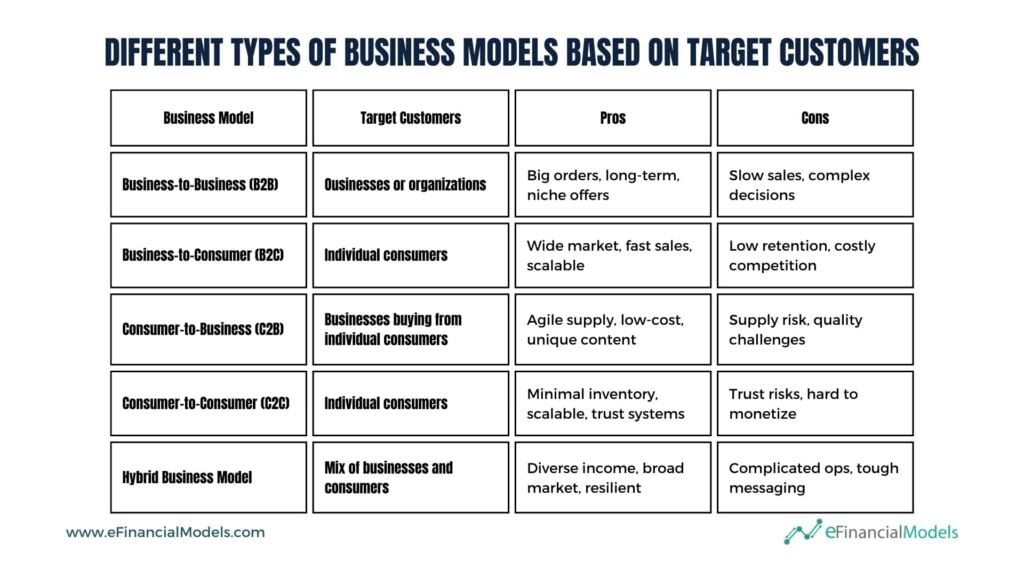
Every business begins with one critical question—who are we serving? The answer shapes the entire business model. Whether individuals, small businesses, or large corporations, each target customer demands a different approach. This difference influences how products are created, priced, and delivered.
Business-to-Business (B2B)
A B2B business model sells products or services to other businesses. These companies focus on meeting the needs of enterprises, not individual consumers. They often provide software, raw materials, or professional services. B2B transactions usually involve bulk orders, long sales cycles, and strong customer relationships. Examples include cloud software providers, wholesale suppliers, and consulting firms.
B2B offers big deals and steady income but comes with longer sales cycles. Businesses often spend more, making each customer valuable. However, winning their trust takes time and effort. Relationships matter more than quick wins. You’ll need tailored solutions, detailed contracts, and strong support. The upside? Fewer clients can bring more revenue. The downside? Losing one may hurt more than expected. A Business-to-Business (B2B) model is best suited for companies offering specialized products or services that help other businesses operate, grow, or solve complex problems.
Business-to-Consumer (B2C)
A B2C business model sells directly to individual consumers. These businesses focus on convenience, affordability, and customer experience. They sell products or services through physical stores, e-commerce, or subscriptions. Marketing plays a key role in attracting and retaining customers. Examples include online retailers, restaurants, and streaming services.
B2C moves fast and reaches many, but it’s also highly competitive. You can sell in volume and build strong brand loyalty. But keeping attention is tough. Trends shift quickly, and customers expect instant service. Marketing costs can rise as you fight for visibility. Still, when done right, B2C offers quick wins, repeat sales, and wide market reach. A Business-to-Consumer (B2C) model is best suited for companies selling everyday products or services directly to individual customers at scale.
Consumer-to-Business (C2B)
A C2B business model lets individuals sell goods or services to businesses. Consumers create value, and companies pay for their input. This model is common in influencer marketing, freelance work, and user-generated content. Businesses benefit from cost-effective, high-quality contributions. Examples include freelance platforms, stock photography sites, and customer reviews.
C2B flips the script—consumers offer value, and businesses buy it. This model gives people more power and income, like freelancers or influencers. It’s flexible and taps into unique talent. But it’s also hard to scale and manage. Quality can vary, and trust takes time. For businesses, it brings fresh ideas; for consumers, it opens new doors. Still, both sides must stay aligned for it to work. A Consumer-to-Business (C2B) model is best suited for platforms that connect freelancers, creators, or everyday users with businesses seeking content, services, or insights.
Consumer-to-Consumer (C2C)
A C2C business model connects consumers who buy and sell from each other. Online marketplaces and peer-to-peer platforms enable these transactions. Businesses act as intermediaries, providing security and payment processing. Trust and user reviews drive success in this model. Examples include eBay, Airbnb, and Facebook Marketplace.
C2C lets people trade directly, often through online marketplaces. It’s low-cost, easy to start, and grows through user trust. Sellers reach buyers fast, and buyers find unique deals. But it’s hard to control quality, safety, and disputes. The platform must manage risks and keep users engaged. When trust is high, C2C thrives. When it’s lost, users leave. A Consumer-to-Consumer (C2C) model is best suited for online marketplaces that enable individuals to buy, sell, or exchange goods and services directly.
Hybrid Business Model
A hybrid business model combines elements of multiple models to serve different customer segments. Companies using this approach target businesses and consumers or mix traditional and digital strategies. This model increases revenue streams and market reach. Many modern companies adopt hybrid models to stay competitive. Examples include Amazon (B2B and B2C), Uber (C2C and B2B), and Apple (direct sales and third-party resellers).
A hybrid model blends customer types, offering more ways to earn. It boosts reach and spreads risk across markets. You can sell to businesses and consumers or mix products and services. However, managing both sides adds complexity. Each audience needs different messages, support, and pricing. Growth can be strong but focus can slip if not handled well. Success depends on a clear strategy and smooth execution. A Hybrid Business Model is best suited for companies aiming to serve multiple customer segments or combine product and service offerings for greater flexibility and growth.
The different types of business models mentioned above have strengths and weaknesses. So, choosing the right model is critical to success. It depends on market demand, growth potential, and cost structure. A smart approach is to analyze customer needs, operational efficiency, and revenue streams. Planning ahead helps avoid pitfalls and maximize profits. The right business model fuels long-term success, so take the time to evaluate your options carefully.













































How to Choose a Profitable Business Model?
Choosing a profitable business model starts with understanding how your company will make money and sustain growth. The right model aligns with your market, customers, and cost structure, ensuring long-term success. Strong revenue streams, manageable expenses, and scalability are key factors. A well-chosen model gives you a competitive edge, improves cash flow, and attracts investors. You can refine your approach and maximize profitability by testing assumptions and adapting to market shifts.
Step 1 – Define Your Value Proposition
Start by defining what makes your product or service valuable. Focus on the problem it solves and why customers will pay for it. A strong value proposition sets you apart from competitors and drives demand. Keep it clear, simple, and customer-focused. If people don’t see the value, they won’t buy. Test your idea, gather feedback, and refine your offering to ensure it meets real needs.
A strong value proposition sets you apart, but sales volume determines success. To build a profitable business model, you must predict how much you can sell. Estimate demand based on market research, customer needs, and competitor sales. Look at pricing, production capacity, and seasonal trends. Test your assumptions with surveys or pilot launches. Without a clear forecast, you risk overproducing or missing revenue opportunities. A solid sales projection helps you plan costs, pricing, and growth strategies for long-term profitability.
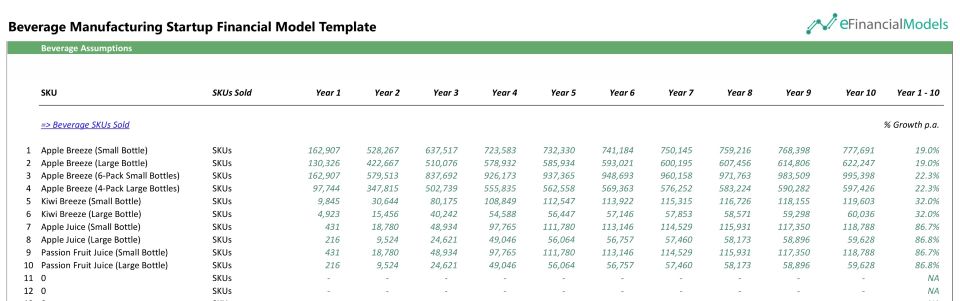
Beverage Manufacturing Startup Financial Model Template
The attached chart showcases SKU sales projections, annual growth rates, and trends, offering a clear picture of demand patterns for a beverage manufacturer. By analyzing SKU-specific growth, businesses can identify high-performing products and optimize production to meet market demand. This data-driven insight helps refine pricing, distribution, and product expansion strategies, aligning the business model with profitability and scalability. High-growth products like Passion Fruit Juice and Apple Juice suggest strong market traction, guiding investment decisions. Ultimately, the chart helps manufacturers focus on the most profitable product mix and establish a competitive, sustainable business model.
Step 2 – Analyze the Target Market
Know your customers before you build your business model. Identify who they are, what they need, and how they make buying decisions. Look at demographics, behaviors, and spending habits. Research their pain points and what solutions they value. Analyze competitors to see how they attract similar customers. A clear target audience helps you design products, pricing, and marketing that match demand. Without this step, you risk offering something no one wants or pricing it wrong. A profitable business model starts with understanding who will pay for your product or service.

The chart above helps analyze the target market by breaking down subscriber growth, traffic sources, and payment preferences. It reveals where users come from, how they engage, and which pricing tiers drive revenue. Businesses can spot trends and adjust strategies to boost retention by tracking renewal rates and churn. Detailed segmentation by traffic source and payment plan shows the most valuable customer segments. With these insights, companies can refine marketing, pricing, and product strategies to maximize profitability and long-term growth.
Step 3 – Assess Revenue Streams
Assess revenue streams by identifying how your business will attract customers and generate sales. Focus on marketing channels, customer acquisition strategies, and pricing models that drive interest in your products. Analyze which revenue sources—subscriptions, one-time purchases, or upsells—align with customer demand—and track which marketing efforts bring in the most engaged buyers. Optimize pricing and promotions to maximize conversions. A strong revenue strategy ensures steady growth and long-term profitability.
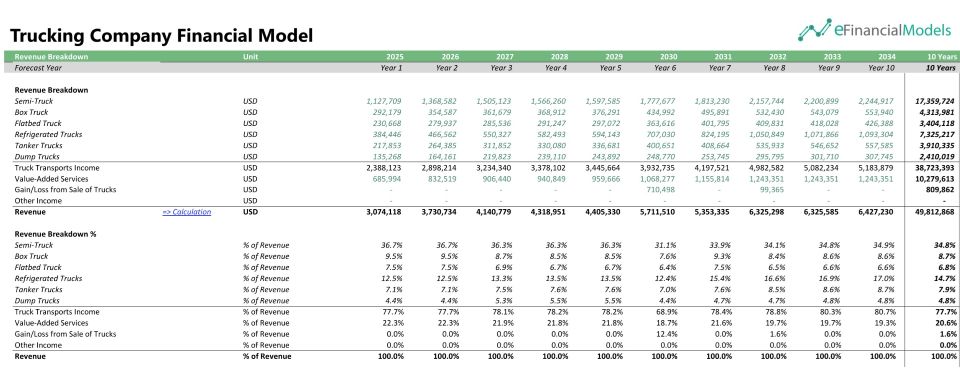
Trucking Company Financial Model
The chart above helps assess revenue streams by breaking down income from truck types, transport services, and value-added offerings. It shows which trucks generate the most revenue and how income sources evolve. Businesses can spot profitable segments and adjust fleet investments or pricing strategies by analyzing revenue percentages. It also highlights additional income opportunities, such as selling trucks or offering premium services. These insights help refine the business model for maximum profitability and long-term growth.
Step 4 – Determine Cost Structure
Before making a profit, you need to understand your costs. List all expenses, including production, marketing, salaries, and overhead. Identify fixed costs (like rent) and variable costs (like raw materials). Analyze how these costs change as your business grows. Compare them to your expected revenue to ensure profitability. Keep costs lean to maximize margins. A clear cost structure helps you set the right pricing and avoid financial surprises.
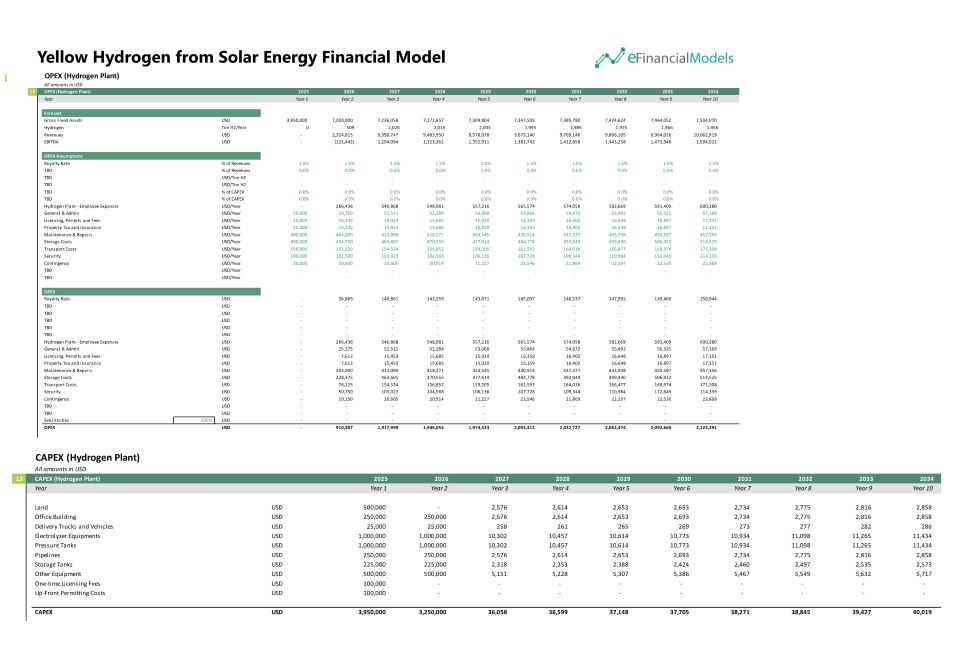
Yellow Hydrogen from Solar Energy Financial Model
The chart above breaks down the operating (OPEX) and capital (CAPEX) expenses for a yellow hydrogen plant, helping to determine the cost structure. It lists key costs like equipment, storage, maintenance, salaries, and royalties. By analyzing these expenses, businesses can compare costs to expected revenue and adjust spending to improve profitability. Understanding fixed and variable costs ensures accurate pricing and better financial planning. A clear cost structure helps identify risks, control expenses, and build a sustainable, profitable business model.
Step 5 – Research Available Options
Study your competitors to see which business models work best in your industry. Look at their pricing, revenue streams, and customer engagement. Identify what makes them successful and where they struggle. Compare different models to find their strengths and weaknesses. A franchise may offer stability, but it limits flexibility. A subscription model provides recurring revenue but requires high customer retention. Weigh the pros and cons to see what fits your goals. Learning from others saves time and helps you avoid costly mistakes.
Here’s a simple comparison of the different types of business models:

Step 6 – Test & Iterate
Test your business model by launching a small version of your product or service. Gather real customer feedback to see what works and what doesn’t. Adjust pricing, features, or delivery based on demand. Focus on scalability—can you serve more customers without a big cost increase? Streamline operations and automate tasks to improve efficiency. Keep refining your model to maximize value and long-term growth.
Maximize Profits: The Power of a Solid Business Model Plan
Choosing the right business model requires a strategic approach. Start by defining your value proposition to ensure your offering stands out. Analyze your target market to understand customer needs and behaviors. Identify and assess revenue streams to determine how your business will generate income. Consider the cost structure to maintain profitability. Research available options to compare different models. Finally, test and iterate your approach to refine your strategy. A well-chosen business model sets the foundation for long-term success.
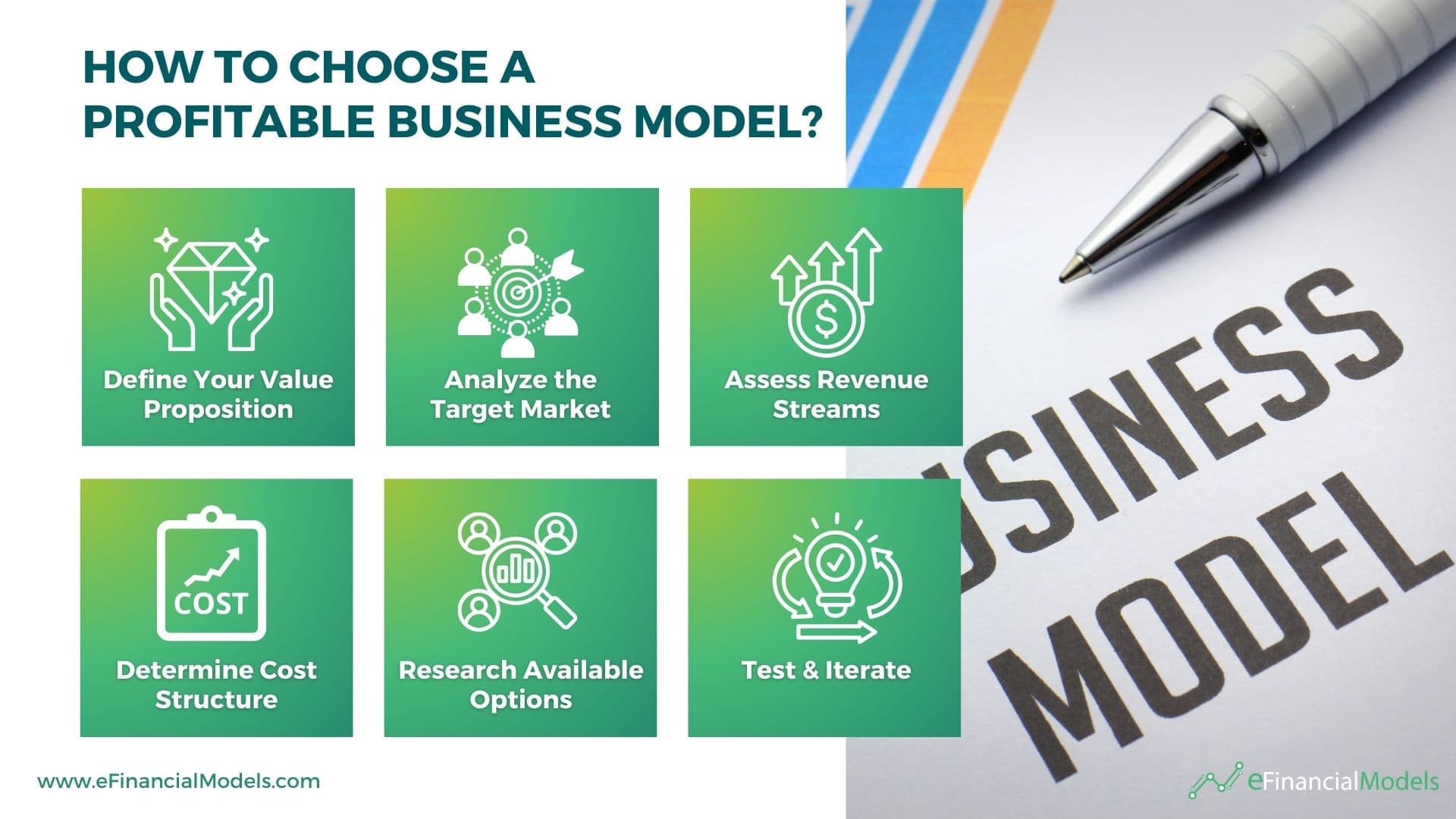
A solid business model plan is the key to maximizing profits. By carefully structuring your value proposition, revenue streams, and cost management, you create a framework for sustainable growth. Understanding your market and continuously refining your strategy through testing and iteration ensures adaptability and long-term success. The right business model plan doesn’t just focus on generating revenue—it optimizes profitability, minimizes risks, and positions your business for lasting competitive advantage.
Discover how a real-world business model plan can guide your planning and maximize profitability. Explore Business Plan Models – Using Business Models as Examples to build a solid strategy for success!
Frequently Asked Questions (FAQs)
We have listed below some of the frequently asked questions and their answers related to this topic:
What is a business model?
A business model shows how your business runs and earns money. It explains what you sell, who buys it, how you reach them, and how you keep your operations profitable. It’s your clear plan for creating value and turning it into income.
Why is choosing the right business model important?
Picking the right business model helps you succeed faster. It guides your strategy, controls costs, and aligns your product with customer needs. A poor choice can waste time and money, while the right one builds a solid path to growth.
What are the key components of a business model?
The main parts include your value proposition, target customer segments, revenue streams, cost structure, delivery channels, key activities, and partnerships. Each part works together to help you deliver value, stay efficient, and make money.
- Value proposition: Why customers choose the business.
- Target customer segments: Who the business serves.
- Revenue streams: How the business earns money.
- Cost structure: The business’s main expenses.
- Delivery channels are the various means through which a business delivers its value proposition to its customer segments.
- Key activities are the essential tasks and operations a business must perform to deliver its value proposition, reach customers, maintain customer relationships, and generate revenue.
- Key partnerships refer to external companies, suppliers, or collaborators that help the business operate effectively by providing resources, reducing risk, or expanding reach.
How do revenue streams work?
Revenue streams are the ways your business makes money. They can come from product sales, services, subscriptions, ads, or licensing. Each stream adds to your total income, so the more stable and diverse they are, the better.
How do I assess my target market?
To assess your market, study your ideal customers—what they need, how they buy, where they live, and how much they can spend. Use surveys, market data, and competitor research to see if your product fits and if demand is strong enough.
What is a value proposition?
It’s why customers choose your product—what makes it useful and different. A value proposition tells people why they should choose you. It clearly states the benefit they get, the problem you solve, and what makes your offer different. It’s the main reason customers say “yes.”
What is a cost structure?
It lists your business expenses—rent, salaries, and production costs. A cost structure shows all the expenses your business must cover to run and make money. It includes fixed costs like rent and salaries and variable costs like materials and shipping. Knowing your cost structure helps you price your products right, control spending, and boost profits.
How do I define my business model?
Define your revenue sources, target customers, value proposition, and cost structure. Start by naming your product or service, your customers, how you reach them, and how you earn money. Make sure each part fits together smoothly. Keep it short, simple, and focused on real customer needs.
What are the different types of business models?
Business models vary by who you serve and how you deliver value. B2B sells to other businesses, while B2C targets individual consumers. C2B lets individuals offer services to businesses, like freelancers. C2C connects people directly to buy or sell, like on eBay. A hybrid model mixes two or more types to create more income streams and flexibility.
How do I compare different business models?
Look at costs, revenue potential, customer type, and scalability. Compare models based on cost, risk, revenue potential, scalability, and customer reach. Look at how fast each one can grow, how hard it is to manage, and how well it matches your product and resources.
What is a product-based business model?
A product-based business model sells physical or digital goods to customers for a one-time or recurring fee. This model sells goods—physical or digital—directly to customers. Revenue comes from each sale. It works well to control costs, manage inventory, and market your products effectively.
What is a service-based business model?
A service-based business model offers skills, expertise, or labor in exchange for payment. You sell your skills, time, or expertise. Customers pay per hour, project, or package. It’s great for consultants, agencies, and freelancers who build trust and results over time.
What is a subscription-based business model?
A subscription-based business model charges customers a recurring fee for continued access to a product or service. Customers pay on a regular schedule—monthly or yearly—for continued access to your product or service. This model creates predictable income and keeps customer relationships going longer.
What is a marketplace?
A marketplace connects buyers and sellers in one place. You don’t own the products—you just make the platform work. You earn through commissions, fees, or ads, like Amazon or Fiverr.
What is a franchise?
A franchise is a business model where individuals operate a branded business using a company’s established system and trademarks. A franchise lets others open a business using your brand, systems, and support. You earn money from franchise fees and royalties. It helps you grow quickly without running every location yourself.
What’s the difference between B2B and B2C models?
B2B sells to businesses; B2C sells directly to individual consumers. B2B sells to businesses, focusing on efficiency and long-term value. B2C sells to consumers, focusing on emotions and fast decisions. B2B deals are bigger but take longer; B2C is faster but more competitive.
What’s the difference between C2B and C2C models?
C2B involves individuals offering products or services to companies, while C2C involves selling directly to others. C2B lets individuals offer value to businesses—like freelancers or influencers. C2C connects people to sell or trade with each other—like Facebook Marketplace. In both, users drive the value, not companies.
What is a hybrid business model?
It combines elements from multiple models to serve various customer types. A hybrid business model blends two or more types. For example, you might sell products and services, or use both direct sales and subscriptions. It adds flexibility and opens more revenue options.
How to select a business model?
To select the right business model, start by clearly defining your value proposition—what makes your offer unique and valuable. Next, analyze your target market to understand who your customers are, what they need, and how they behave. Assess potential revenue streams to see how your business can earn money and identify your cost structure to ensure long-term sustainability. Research different business model options that suit your product or service, and finally, test your chosen approach in real conditions, then adjust based on results to find the most effective and profitable path.
How do I describe my business model in one sentence?
Say how your business creates and delivers value to make money. Keep it simple: say what you offer, who it helps, and how you earn money. Example: “We offer online fitness coaching to busy professionals through a monthly subscription.”
You might also like:
- 10 Ideas to Increase Average Revenue Per User
- How to Make a Startup Financial Plan for Fundraising?
- 5 Best Practices for Managing Days Receivables
- 10 Main Elements of a Business Plan
- Financial Planning for Small Business Owners – Taking an SBA Loan
- Financial Ratios Analysis and Its Importance
- Finding a Valuation Model for Your Business
- Best in Class Property Appraisal Methods and What to Look Out for
- Achieve Financial Success By Knowing Your Business Plan Model
- Are EV Charging Stations Profitable?
- Startup Model Templates in Excel that can help your Business Grow
- 12 Funding Sources for Businesses and Startups
- Understanding the Debt Service Coverage Ratio: An Essential Metric for Financial Analysis
- Financial Planning Retirement Tips
- How to Build a Capitalization Table
- Financial Model Templates Easy to Use
- Financial Model – Valuation of Tax Loss Carryforwards
- Retail Chain Rollout Strategy Model
- Financial Modeling for Startups and Small Businesses
- Bootstrapping vs. Venture Capital Funding: Which is Better?
Tags: financial planning