
0 ITEMS

How to Calculate SaaS Monthly Recurring Revenue?

Salesforce, a global customer relationship management (CRM) software leader, has achieved remarkable success by calculating and optimizing its SaaS monthly recurring revenue (MRR). By implementing a robust MRR calculation model, Salesforce gained precise insights into its subscription-based revenue streams, enabling accurate forecasting and strategic planning. This approach allowed the company to identify growth opportunities, enhance customer retention, and drive innovation. As a result, Salesforce has delivered impressive financial performance consistently, solidifying its position as a dominant force in the SaaS industry and a model for other tech companies aiming for sustainable growth through recurring revenue.
- MRR is based on the total active customers multiplied by their average revenue per user (ARPU).
- Accurate MRR includes new customer subscriptions, expansion revenue from upgrades, and subtracts churned or downgraded customers.
- Common mistakes involve mixing one-time payments with recurring revenue and ignoring churn or discounts.
- Using a detailed financial model helps track trends, forecast accurately, and refine growth strategies.
- Mastering MRR calculation supports better financial planning and sustainable long-term growth.
Join us to learn the essential steps and best practices for accurately calculating SaaS Monthly Recurring Revenue (MRR) and optimizing your subscription-based business.
Understanding Software As A Service (SaaS) Business
A software-as-a-service (SaaS) business delivers software applications over the Internet as a service. Instead of purchasing and installing software on individual computers or servers, users access the software through a web browser, often on a subscription basis. The provider manages and maintains the infrastructure, ensuring regular updates, security, and support. This approach simplifies software deployment and accessibility, making it an attractive option for businesses and individuals seeking flexible, scalable, and cost-effective solutions. This model offers significant advantages, including lower upfront costs, scalability, and accessibility from any device with an internet connection. Popular SaaS services today include Salesforce for CRM, Slack for team collaboration, Zoom for video conferencing, and Google Workspace for productivity tools.
The concept of SaaS dates back to the 1960s with the advent of time-sharing systems and utility computing. However, it wasn’t until the late 1990s and early 2000s, with advancements in internet technology, that SaaS began to gain traction. Salesforce, founded in 1999, is often credited with pioneering the modern SaaS model. Its success demonstrated the viability and potential of delivering software over the Internet, paving the way for countless other SaaS companies.
The SaaS business landscape is highly competitive and dynamic, requiring strategic financial planning to ensure growth and stability. SaaS companies must carefully manage recurring revenue streams, customer acquisition costs, and churn rates. Accurate forecasting and effective budgeting are crucial to sustaining operations and scaling the business. Moreover, the subscription-based model demands continuous innovation and excellent customer service to retain clients and reduce churn. As the industry evolves, successful SaaS businesses can adapt to market changes, leverage data-driven insights, and maintain a clear focus on long-term financial health.
Monthly Recurring Revenue (MRR) vs. Annual Recurring Revenue (ARR)
Monthly Recurring Revenue (MRR) and Annual Recurring Revenue (ARR) are essential metrics for subscription-based businesses, each serving distinct purposes. MRR measures the predictable revenue generated from all active subscriptions in a given month, providing a snapshot of short-term financial performance. It is calculated by summing the monthly subscription price of all active customers, making it ideal for tracking monthly growth, identifying trends, and making operational decisions. However, MRR can be volatile, reflecting monthly fluctuations due to new customer acquisitions, churn, and changes in subscription plans.
In contrast, ARR annualizes MRR to give a long-term perspective on a company’s recurring revenue stream. It is calculated by multiplying MRR by 12, offering a more stable and comprehensive view of the business’s financial health over a year. ARR is beneficial for strategic planning, forecasting, and valuation, as it smooths out the monthly variations seen in MRR. While ARR provides valuable insights for long-term decision-making and investment evaluation, it is less effective for capturing immediate trends and short-term performance changes.
SaaS Subscription Business Model Advantages
Investing in a SaaS subscription business model offers a compelling opportunity. The business model capitalizes on the growing demand for accessible, cloud-based solutions, allowing providers to reach a broad audience with minimal infrastructure costs. The consistent SaaS monthly recurring revenue provides a predictable income, which enhances financial stability and enables strategic long-term planning. Furthermore, the ongoing customer relationship fosters continuous engagement and improvement, positioning SaaS businesses for sustained growth and innovation in an increasingly digital world. Below are some SaaS subscription business model advantages:
Better Forecasting
One of the primary SaaS subscription business model advantages is better forecasting. Since customers pay a SaaS monthly recurring revenue, it becomes easier for businesses to predict their future profits. This predictability allows for more accurate financial planning and budgeting. Companies can better anticipate their cash flow needs, allocate resources more efficiently, and confidently plan for growth. The regularity of subscription payments reduces the uncertainty often associated with one-time sales models.
Lower Customer Retention Cost
In a SaaS subscription model, the cost of retaining a customer is generally lower than the cost of acquiring a new one. It is because once customers are onboarded and start using the service, their continued use often requires less effort and fewer resources compared to continuously marketing to and acquiring new customers. Companies can achieve high retention rates by focusing on customer satisfaction and providing excellent service, reducing marketing and sales expenses over time. Loyal customers are also more likely to become brand advocates, lowering the cost of acquiring new customers through word-of-mouth referrals.
Predictable Revenue
Predictable revenues are another significant SaaS subscription business model advantages. Because customers pay regularly, usually monthly or annually, businesses can count on a steady income stream. This predictability is crucial for financial stability and planning. Companies can invest in growth initiatives, research and development, and other strategic areas with the confidence that they have a reliable revenue base. It also makes it easier to meet financial obligations and can improve a company’s creditworthiness.
Stable Cash Flow
The SaaS subscription model provides stable cash flow, which is vital for any business. With regular, recurring customer payments, companies can avoid the peaks and valleys of revenue familiar in traditional sales models. This stability allows businesses to manage their expenses more effectively, invest in new opportunities, and ensure they have the funds to cover operational costs. Stable cash flow is significant for startups and small businesses, as it can make the difference between survival and failure in the early stages of growth.
Upselling Opportunities
SaaS subscription business model advantages inherently includes numerous upselling opportunities. Once a customer uses a platform or service, businesses can offer additional features, higher service tiers, or complementary products to enhance the customer’s experience. These upselling opportunities can significantly increase the lifetime value of a customer. Since the customer is already familiar with the service, they are more likely to consider upgrades or add-ons, which can drive additional revenue without extensive marketing efforts. It creates a mutually beneficial scenario where the customer gains more value, and the business increases its revenue.

Mastering the SaaS Monthly Recurring Revenue Formula
Mastering the SaaS Monthly Recurring Revenue formula is crucial for driving predictable and sustainable growth in the competitive world of Software as a Service. By understanding and optimizing your MRR, you can gain valuable insights into your business’s financial health, forecast future revenues more accurately, and make data-driven decisions that propel your company forward. Whether you’re a startup looking to scale or an established enterprise aiming to fine-tune your financial strategies, mastering the SaaS monthly recurring revenue formula is the key to unlocking consistent revenue streams and long-term success.
The SaaS Monthly Recurring Revenue formula is a key metric used to measure the predictable and repeating revenue generated by a SaaS (Software as a Service) business every month. Here’s the SaaS Monthly Recurring Revenue formula:

Where:
- The Number of Customers represents the total number of active subscribers or users paying for the service monthly.
- The Average Revenue Per User (ARPU) is the average revenue generated from each customer. It can be calculated by dividing the total revenue by the number of customers.
Sample SaaS Monthly Recurring Revenue Formula Calculation
Suppose a SaaS company has 100 customers, and each customer pays $50 per month. Using the Saas Monthly Recurring Revenue formula:

Another example using the SaaS Monthly Recurring Revenue formula is a live streaming company with 1000 subscribers. Of these, 50% pay $100 monthly, and the other half pay $50 monthly.

This simple yet powerful formula helps SaaS businesses track their monthly revenue trends, assess the effectiveness of their growth strategies, and make informed decisions to drive sustainable growth.
The SaaS Monthly Recurring Revenue formula can be further broken down to reflect more detailed aspects of revenue, including:
- New MRR: Revenue from new customers acquired during the month. It equals the number of new customers multiplied by the average revenue per new customer.
- Expansion MRR: Additional revenue from existing customers who have upgraded their subscriptions or purchased additional services. The monthly recurring revenue formula for expansion MRR equals the number of upgrades multiplied by the average revenue per customer upgrade.
- Churned MRR: Revenue lost from customers who have canceled their subscriptions. It equals the number of churned customers multiplied by the average revenue per churned customer.
- Downgrade MRR: Revenue lost from customers who have downgraded their subscriptions to a lower plan. The monthly recurring revenue formula for downgrade MRR equals the number of downgrades multiplied by the average revenue per customer downgrade.
- End MRR: Monthly Recurring Revenue at the end of the month, calculated as the sum of Start MRR, New MRR, and Expansion MRR, minus Churned MRR and Downgrade MRR.
Sample SaaS Monthly Recurring Revenue Spreadsheet
Here’s a sample spreadsheet for calculating the end MRR:

The spreadsheet above outlines the MRR metrics from January 2023 to June 2023. It starts with summing up the start MRR, new MRR, and expansion MRR for each month. From there, we subtract the sum of the churned MRR and downgrade MRR. The ending MRR for each month shows the total MRR after accounting for these changes. This spreadsheet helps visualize the growth and fluctuations in revenue over the six months.
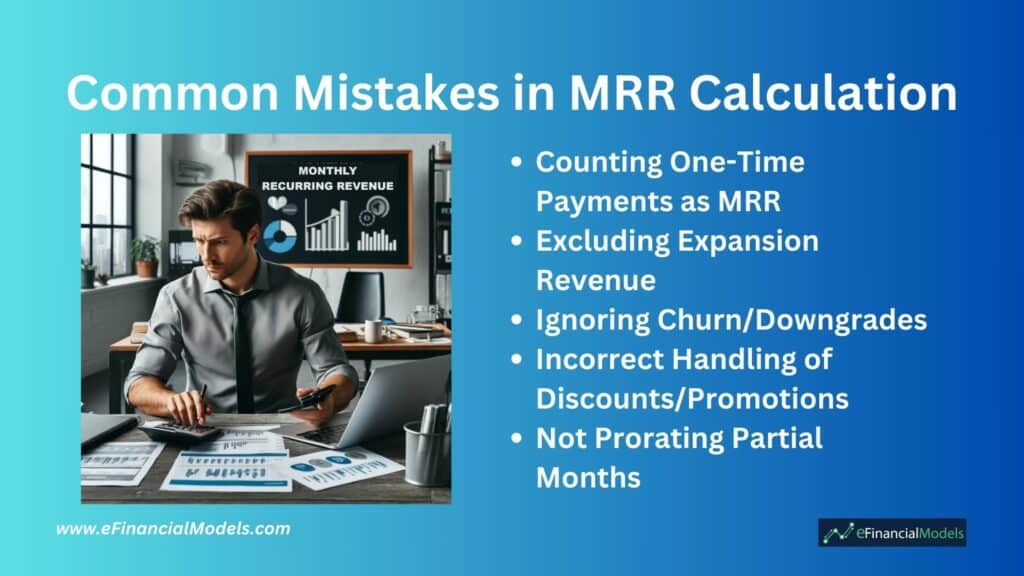
Common Mistakes in MRR Calculation
When calculating Monthly Recurring Revenue (MRR), businesses must correct several common mistakes that can lead to inaccurate figures.
Counting One-Time Payments as MRR
One of the frequent mistakes in calculating Monthly Recurring Revenue (MRR) is including one-time payments. MRR should only encompass recurring revenue that a company expects to receive monthly based on subscriptions or long-term contracts. One-time payments, such as setup fees or consulting services, are not predictable or repeatable every month and should not be included in MRR. Including them can inflate the perceived stability and predictability of the revenue, leading to misleading financial analysis and projections.
Excluding Expansion Revenue
Another standard error is excluding expansion revenue. Expansion revenue comes from existing customers who upgrade their subscriptions or purchase additional features. This revenue is crucial for understanding the true growth potential of a SaaS business. By omitting it, companies may underestimate their growth rates and miss out on recognizing the total value generated from customer relationships. Accurately including expansion revenue provides a clearer picture of customer satisfaction and the effectiveness of upselling strategies.
Ignoring Churn and Downgrades
Ignoring churn (customers canceling their subscriptions) and downgrades (customers moving to a less expensive plan) can lead to overestimating MRR. Churns and downgrades directly reduce the recurring revenue, and not accounting for them presents an overly optimistic view of the business’s financial health. To have a precise calculation, it’s essential to subtract the revenue lost from churned customers and downgraded plans. It ensures a realistic and actionable understanding of the company’s recurring revenue trends.
Incorrect Handling of Discounts and Promotions
Improperly accounting for discounts and promotions can distort MRR calculations. If customers pay reduced rates due to discounts or promotional offers, these lower payments should be accurately reflected in the MRR. Ignoring discounts can result in an inflated MRR, giving a false sense of revenue stability. Correctly incorporating these adjustments ensures that MRR reflects the monthly revenue generated, providing a more reliable financial planning and analysis basis.
Not Prorating Partial Months
Failing to prorate revenue for partial months can also lead to inaccuracies in MRR. When customers sign up or cancel their subscriptions partway through a month, the revenue for that month should be prorated to reflect only the portion of the month they were active. Not prorating can cause spikes or dips in MRR that do not accurately represent the recurring nature of the revenue. Prorating ensures a smooth and accurate calculation, reflecting monthly recurring revenue.
Precision in Your SaaS Monthly Recurring Revenue Calculations
Monthly Recurring Revenue (MRR) is a crucial metric for SaaS (Software as a Service) businesses, representing the monthly predictable revenue expected. It clearly shows the company’s financial health and growth potential. The basic formula for MRR is the total number of customers multiplied by the average revenue per customer (ARPU). A more detailed calculation incorporates new MRR (revenue from new customers), expansion MRR (additional revenue from existing customers through upselling or cross-selling), churn MRR (revenue lost from customers who cancel subscriptions), and downgrade MRR (reduction in revenue from customers who switch to a lower-priced plan). Accurate MRR calculation is vital for effective financial planning, budgeting, and strategic decision-making.
Financial modeling is not just a tool but a powerful instrument that plays a pivotal role in refining MRR calculations. It does this by simulating various scenarios, accounting for different revenue streams, and forecasting future performance with higher accuracy. A SaaS financial model supports precision in Monthly Recurring Revenue (MRR) calculations by incorporating detailed inputs and assumptions that reflect the subscription business’s unique characteristics. By modeling revenue on a granular, month-by-month basis, the financial model provides clear visibility into how changes in customer behavior and market conditions affect MRR. Additionally, it can include scenarios and sensitivity analyses to project how different strategies and external factors might influence future MRR, allowing for data-driven decision-making and precise financial forecasting.

























































You might also like:
- 10 Ideas to Increase Average Revenue Per User
- How to Calculate Annual Recurring (ARR) Revenue for Sustainable Growth
- 5 Best Practices for Managing Days Receivables
- Monthly Recurring Revenue (MRR)
- How to Build a SaaS Financial Model
- SaaS
- Calculating Revenue Growth Rate: A Key Metric for Business Success
- Financial Modeling for Startups and Small Businesses
- Mastering Mobile App Success: A Comprehensive Financial Model for Sustainable Growth and Profitability
- 10 Main Elements of a Business Plan
- Understanding the Levelized Cost of Energy Formula
- Financial Planning Retirement Tips
- How to Request for Custom Financial Models
- Tips for Measuring Monthly Recurring Revenue for SaaS Business
- How to Write a Killer Mobile App Business Plan
- Unlocking The Full Potential of Meal Prep Business Plan PDF
- How to Optimize the Average Selling Price: Strategies for Higher Profits
- How to Effectively Read a Company’s Annual Report
- Financial Model Templates Easy to Use
Tags: financial metrics