
0 ITEMS

Herbal Medicine Center Financial Model Excel Template
The Herbal Remedies Financial Model helps entrepreneurs, founders, business owners, consultants, and analysts turn a herbal products concept into a structured five-year financial forecast. Instead of starting with a blank spreadsheet, users can work from a ready-to-use model designed around the economics of a wellness, botanical, herbal supplement, or natural health product business. The template supports financial planning by connecting revenue assumptions, customer acquisition, repeat purchasing, product costs, startup costs, operating expenses, payroll, profitability, and cash flow in one organized workbook. This financial model template is useful for people preparing a business plan, investor pitch, lender package, internal budget, or expansion strategy. It allows users to estimate how marketing spend may convert into new customers, how retained customers may generate recurring revenue, and how product pricing, cost of goods sold, fulfillment, payroll, and overhead affect margins over time. By editing the built-in assumptions, users can create a more realistic view of how their herbal remedies business may perform under different growth and cost conditions. The template also helps users understand the funding needed to launch and sustain the business. It includes structured areas for initial investment planning, ongoing expense forecasting, cash flow management, profitability analysis, and break-even analysis, helping users identify when the business may become self-sustaining. These outputs are especially valuable for decision-making because they show not only projected revenue, but also the timing of cash requirements, the impact of growth spending, and the path toward positive earnings. Built for Excel and Google Sheets, the Herbal Remedies Financial Model is editable, practical, and presentation-ready. It helps users test assumptions, review financial statements, compare scenarios, and communicate key metrics to partners, lenders, investors, or internal teams. Whether you are launching an online herbal product store, building a botanical wellness brand, or planning a scalable natural remedies business, this model gives you a clear financial planning framework for evaluating the opportunity before committing major time, money, and resources.
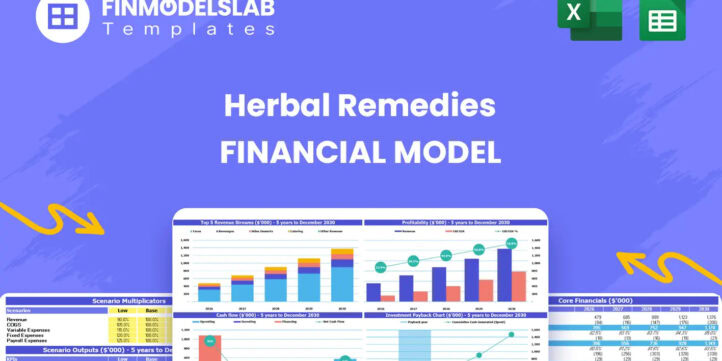


Financial Model Overview
The Herbal Remedies Financial Model is a ready-to-use financial model template built for planning, funding, and managing a herbal remedies, botanical wellness, herbal supplement, or natural health product business. It gives entrepreneurs, business owners, consultants, analysts, and founders a structured way to translate business assumptions into a five-year financial forecast. The model is designed to help users estimate revenue, startup investment, product costs, marketing spend, payroll, operating expenses, cash flow, profitability, and funding needs without building a spreadsheet from scratch. Because herbal remedies businesses often depend on customer acquisition, repeat purchasing, product margins, fulfillment efficiency, and regulatory or production setup costs, this template brings those drivers into one organized planning tool. Users can edit the assumptions, test different strategies, review financial statements, and prepare clearer projections for investors, lenders, internal planning, or business plan documentation.
All-in-One Dashboard
The all-in-one dashboard brings the most important inputs and outputs of the Herbal Remedies Financial Model into a single, easy-to-review area. It is designed to help users quickly understand the overall financial direction of the business without searching through multiple sheets. Key assumptions may include revenue drivers, customer acquisition metrics, pricing, cost of goods sold, operating expenses, payroll, capital requirements, and scenario settings, while key outputs may include revenue, gross profit, EBITDA, net income, cash balance, funding needs, and other summary metrics. For a herbal remedies business, this is especially useful because many decisions are connected, such as how marketing spend affects customer acquisition, how repeat purchase behavior affects revenue stability, and how product margins influence the path to profitability. The dashboard helps users monitor whether the business plan is financially realistic, identify areas that need adjustment, and communicate the model’s main conclusions to investors, lenders, partners, or internal stakeholders in a concise format.
Low Base High Scenario Analysis
The low, base, and high scenario analysis component helps users evaluate how the herbal remedies business may perform under different market conditions and strategic assumptions. Instead of relying on a single forecast, the model allows users to compare a conservative case, a realistic base case, and a more optimistic upside case. Inputs may include customer acquisition cost, marketing budget, conversion rate, average order value, repeat purchase rate, product pricing, gross margin, payroll growth, fulfillment costs, and overhead levels. The outputs help show how changes in these assumptions affect revenue, profitability, cash flow, and funding requirements over the five-year projection period. This is valuable for planning because a herbal remedies business may face uncertainty around demand, customer retention, advertising efficiency, supplier costs, and scale-up timing. Scenario analysis gives founders and decision-makers a practical way to stress-test the business model, prepare for downside risk, set achievable performance targets, and explain the financial impact of different growth strategies to investors or lenders.
Professional Charts
The professional charts section turns financial projections into clear visual reports that are easier to interpret and present. Instead of relying only on rows of numbers, users can review charts that may display revenue growth, expense trends, gross margin, EBITDA, net profit, cash balance, funding needs, or other financial performance indicators. For a herbal remedies business, these visuals are helpful because they show the relationship between product sales, marketing investment, operating costs, and profitability over time. A chart can quickly reveal whether revenue is scaling fast enough to support payroll, whether cash reserves are tightening, or whether margins are improving as the business grows. This component is especially useful for investor presentations, lender discussions, board updates, and internal strategy meetings, where stakeholders need to understand the business outlook quickly. The chart-driven format also helps non-financial users make better decisions by translating detailed calculations into practical insights that support planning, budgeting, fundraising, and performance tracking.
ROE Components and DuPont Analysis
The ROE components and DuPont analysis section helps users understand the drivers behind return on equity rather than viewing profitability as a single isolated number. This component may break return on equity into factors such as profit margin, asset efficiency, and financial leverage, helping users see whether returns are being driven by operating profitability, use of assets, or capital structure. For a herbal remedies business, this can be useful when evaluating how inventory, production equipment, working capital, marketing investment, and retained earnings influence overall returns. Inputs may come from the income statement and balance sheet, including net income, revenue, assets, liabilities, and equity. Outputs help show how efficiently the business converts sales into profit and how effectively it uses invested capital. This section is valuable for investor readiness because it provides a more analytical view of performance and helps founders identify whether they should focus on improving margins, increasing revenue productivity, managing inventory, reducing costs, or adjusting financing assumptions.
Revenue Inputs
The revenue inputs section is one of the most important parts of the Herbal Remedies Financial Model because it defines how the business generates sales. It helps users build a bottom-up forecast based on practical commercial assumptions rather than broad guesses. Inputs may include marketing spend, customer acquisition cost, number of new customers, conversion rates, average order value, product mix, repeat purchase percentage, purchase frequency, pricing changes, and sales channel assumptions. For a herbal remedies business, this can reflect direct-to-consumer online sales, returning customers who buy regularly, product bundles, seasonal promotions, subscription-like purchasing behavior, or expansion into additional product categories. The model uses these inputs to estimate monthly and annual revenue over the forecast period. This component is useful because it connects sales projections to the real drivers of demand, helping users test whether the business can acquire enough customers, retain them profitably, and generate sufficient revenue to cover product costs, payroll, overhead, marketing, and future growth investments.
Bank-Ready Reports
The bank-ready reports section provides structured financial outputs that can support lender conversations, funding applications, and professional business planning. These reports may include projected profit and loss statements, cash flow forecasts, balance sheet summaries, funding requirements, debt repayment assumptions, and financial performance metrics that lenders typically review. For a herbal remedies business seeking startup capital, working capital, inventory financing, equipment funding, or expansion financing, clear reporting is essential because lenders want to understand revenue potential, cost structure, cash generation, and repayment capacity. The model helps organize assumptions into standardized financial statements so users can present a more complete and credible picture of the business. Outputs may show whether the business can maintain liquidity, cover operating expenses, support loan payments, and move toward sustainable profitability. This component saves time during funding preparation and gives business owners a more disciplined view of their financial position before approaching banks, credit providers, or other financing partners.
Revenue Breakdown
The revenue breakdown section gives users a more detailed view of how different revenue streams contribute to total sales. For a herbal remedies business, this may include direct-to-consumer online product sales, repeat customer purchases, bundles, product categories, retained customer revenue, new customer revenue, or future wholesale and retail opportunities if the user chooses to customize the model. Inputs may include unit pricing, order volume, repeat buying behavior, product mix, channel mix, and assumptions about how customer demand changes over time. Outputs help show which streams produce the most revenue, which may carry stronger margins, and which require more marketing or operational support. This is useful for planning because not all revenue is equally attractive. A product line with high sales but low margins may be less valuable than a smaller recurring customer segment with better profitability. By reviewing revenue at a more granular level, users can make better decisions about pricing, promotions, inventory planning, marketing allocation, and long-term growth strategy.
KPI Dashboard
The KPI dashboard helps users track the operating and financial metrics that matter most for a herbal remedies business. It may include customer acquisition cost, customer lifetime value, repeat purchase rate, average order value, revenue growth, gross margin, EBITDA margin, net profit margin, cash runway, return on equity, payback period, and other performance indicators. These metrics help users move beyond total revenue and understand the quality of growth. For example, a herbal remedies brand may increase sales through paid marketing, but if acquisition costs are too high or repeat purchases are too low, the business may struggle to become profitable. The KPI dashboard makes these relationships easier to monitor by presenting performance indicators in a clear, benchmark-oriented format. This component is useful for decision-making because it helps founders and managers identify where the model is strong, where assumptions may be too aggressive, and which levers need attention before presenting the plan to investors, lenders, advisors, or internal teams.
Startup Costs and Initial Investment Planning
The startup costs and initial investment planning section helps users estimate the funding required before the herbal remedies business can operate effectively. This may include initial inventory, product formulation, packaging, small-scale production equipment, website development, e-commerce setup, branding, licenses, compliance costs, deposits, launch marketing, professional services, and working capital reserves. For a herbal remedies business, startup costs can vary significantly depending on whether the company manufactures products internally, works with suppliers, sells online only, or plans to build a larger wellness brand. This component helps users separate one-time launch expenses from recurring operating expenses, making the funding plan easier to understand and defend. Outputs may show total startup investment required, timing of cash needs, and how much capital should be available before revenue begins to scale. This section is useful for budgeting, fundraising, and risk management because it helps users avoid undercapitalization, plan for pre-launch spending, and communicate funding requirements clearly to investors, lenders, or partners.
Break-Even Analysis
The break-even analysis section helps users identify when the herbal remedies business may generate enough revenue to cover its cost structure and move toward profitability. It connects revenue assumptions, gross margin, fixed operating expenses, payroll, marketing spend, and other recurring costs to determine the point at which the business stops operating at a loss. Outputs may include the projected break-even month, break-even revenue level, and the operating conditions required to reach that milestone. For a herbal remedies business, break-even analysis is especially useful because early-stage companies often invest heavily in customer acquisition, inventory, branding, fulfillment systems, and team building before profitability appears. This component helps users understand how changes in customer acquisition cost, average order value, repeat purchase rate, product margin, or overhead expenses can accelerate or delay break-even. It supports better decision-making by giving founders a clear financial milestone, helping investors understand the path to sustainability, and showing which operational levers have the greatest impact on profitability.
File types:
Excel – Single-User: .xlsx
Excel – Multi-User: .xlsx
Similar ProductsOther customers were also interested in...

 HenrySheykin
Mental Health Center Financial Model Excel Templat...
The Mental Health Clinic Financial Model helps users build a structured financial forecast for a the... Read more

Orthopedic Center Financial Model Excel Template
The Orthopedic Clinic Financial Model helps users build a structured five-year forecast for a capita... Read more
Drug Treatment Center Financial Model Excel Templa...
The Residential Treatment Center Financial Model helps users turn a live-in behavioral health, menta... Read more

Hypnotherapy Center Financial Model Excel Template
The Hypnotherapy Practice Financial Model helps users turn a wellness practice concept into a struct... Read more
Yoga Studio Financial Model Excel Template
The Yoga Studio Financial Model helps entrepreneurs, founders, studio owners, consultants, and finan... Read more
Weight Loss Center Financial Model Excel Template
The Weight Loss Center Financial Model helps entrepreneurs, clinic owners, consultants, and analysts... Read more

Sports Therapy Financial Model Excel Template
The Sports Medicine Clinic Financial Model helps users turn a clinic concept, launch plan, or expans... Read more

Tai Chi Center Financial Model Excel Template
The Martial Arts School Financial Model helps founders, school owners, consultants, and business pla... Read more
Osteopathic Center Financial Model Excel Template
The Holistic Health Center Financial Model helps entrepreneurs, founders, consultants, analysts, and... Read more

Oriental Medicine Center Financial Model Excel Tem...
The Traditional Chinese Medicine Clinic Financial Model helps entrepreneurs, clinic owners, consulta... Read more
You must log in to submit a review.