0 ITEMS

Financial Modeling Template Marketplaces: 8-Criteria Buyer Guide

Choosing the wrong financial modeling template marketplace costs more than money: it costs the hours your team spends reverse-engineering a model that was never built for your use case.
Key Takeaways
- eFinancialModels hosts 500+ professional-grade templates built by former investment bankers and private equity professionals, covering 100+ industries with one-time purchase pricing from $29 to $249 per template.
- A senior financial analyst billing at $150/hour who spends 40 hours building a three-statement model from scratch incurs $6,000 in labor cost — a pre-built template at $99 delivers a 98% cost reduction on that task alone.
- Template quality separates on 5 measurable indicators: assumption documentation, error-checking formulas, methodology transparency, version history, and creator credentials.
- The build-vs-buy decision hinges on 3 factors: frequency of use, model complexity, and whether the output is client-facing or internal.
- Subscription platforms (Wall Street Prep, BIWS) suit training-focused buyers; one-time purchase marketplaces (eFinancialModels, FinModelsLab) suit practitioners who need a specific model now.
- Licensing terms vary sharply: some platforms prohibit client-deliverable use, which is a critical red flag for consultants and advisors.
- Free templates from open-source repositories or Excel’s built-in gallery are appropriate only for simple, non-client-facing internal estimates.
Build vs. Buy: The Economics of Financial Modeling Templates
Buying a pre-built financial modeling template is almost always cheaper than building one from scratch, once you account for fully-loaded labor cost. A financial model built internally by a mid-level analyst at a consulting firm typically requires 20 to 80 hours depending on complexity. According to the U.S. Bureau of Labor Statistics, the median hourly wage for financial analysts in 2023 was $49.02, but fully-loaded cost (benefits, overhead) typically runs 1.4 to 1.6 times base salary — putting the real cost at $69 to $78 per hour.
A 40-hour three-statement model therefore costs $2,760 to $3,120 in labor alone, before any quality-review time.
Here’s the math on a specific scenario: a startup founder needs a 5-year financial projection model for a Series A pitch. Building it internally at $75/hour fully-loaded cost over 30 hours = $2,250. Buying a purpose-built startup projection template at $79 saves $2,171 and delivers a model that already includes investor-ready formatting, scenario toggles, and assumption documentation.
The build-vs-buy calculus shifts toward building only when: (1) the model is highly proprietary, (2) no marketplace template covers the exact industry or structure, or (3) the team will reuse the model hundreds of times and customization costs are amortized.

8 Criteria for Evaluating Financial Modeling Template Marketplaces
The right evaluation framework prevents buyers from choosing a marketplace based on brand recognition alone. Use these 8 criteria to score any platform before purchasing.
1. Creator Credentials: Who built the templates? Ex-investment bankers and CPAs produce structurally sound models. Academics and generalist developers often produce models that look clean but fail under real-world stress-testing.
2. Assumption Documentation: Every input cell should carry a label, a unit, and a source reference. Undocumented assumptions are the single most common cause of model errors in practice.
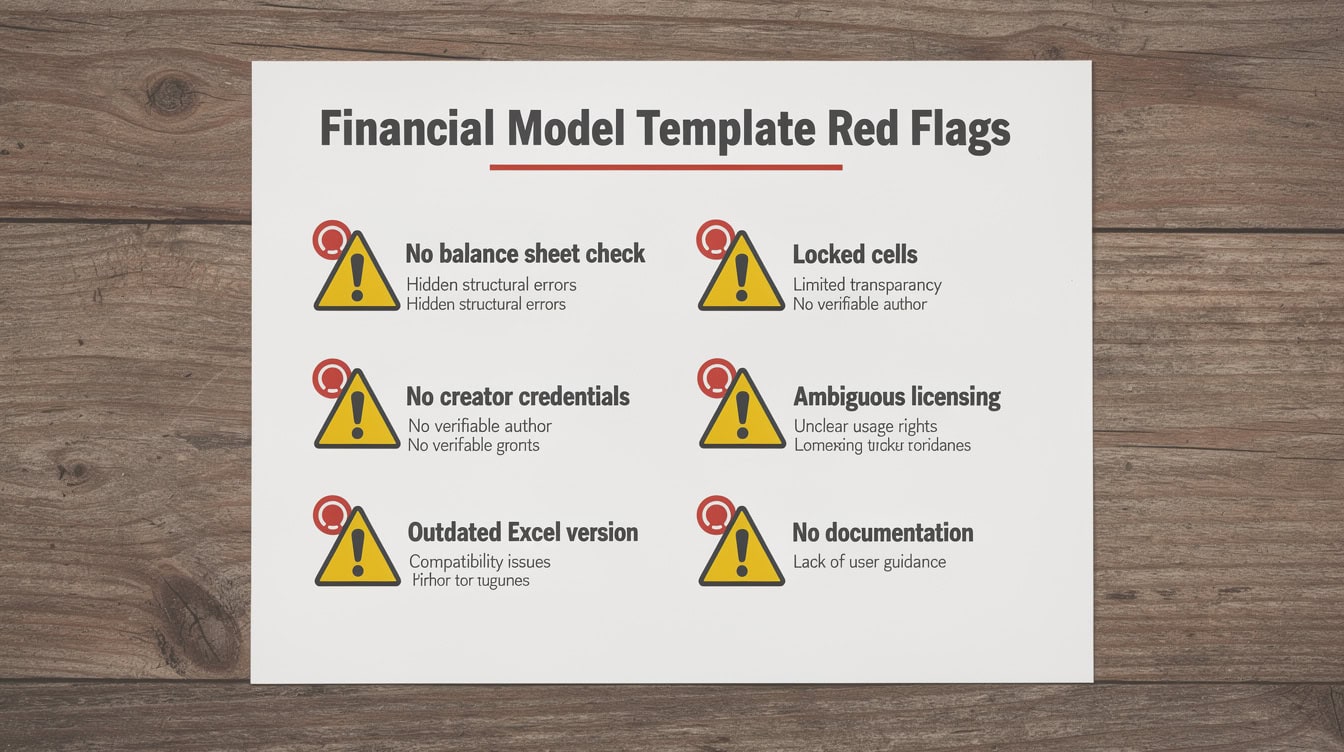
3. Error-Checking Architecture: Professional-grade models include balance sheet checks (Assets = Liabilities + Equity), cash flow reconciliation rows, and circular reference flags. Templates without these require manual auditing before use.
4. Format Compatibility: Does the template run on Excel 2016, 2019, Microsoft 365, and Mac Excel? Microsoft 365 supports up to 1,048,576 rows and 16,384 columns per worksheet.
Cloud-only models (Google Sheets) introduce version-control and confidentiality risks for client-facing work.
5. Licensing Terms: Can you use the template for client deliverables? Can you share it across a team? Resale is almost universally prohibited, but client-deliverable rights vary significantly by platform.
6. Pricing Model: One-time purchase, subscription, or freemium. Each suits a different buyer profile (detailed in the Pricing section below).
7. Update Frequency and Version Control: Tax rates, depreciation rules, and accounting standards change. Marketplaces that update templates annually are more reliable than those with static libraries.
8. Support and Learning Resources: Does the marketplace include a user guide, video walkthrough, or email support? Complex models (LBO, merger) without documentation create implementation risk.

Marketplace-by-Marketplace Breakdown
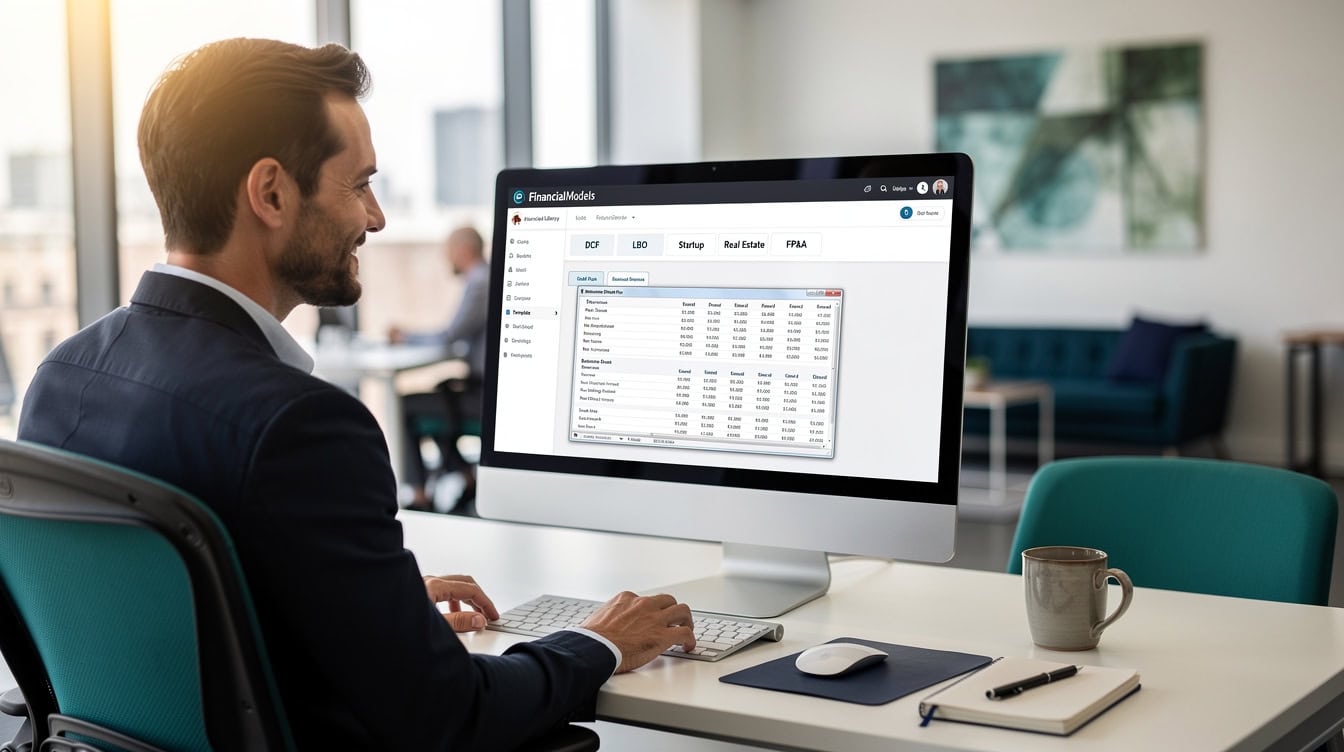
eFinancialModels is the largest independent marketplace for financial modeling templates, with 500+ models spanning 100+ industries. Templates are built by former investment bankers, private equity professionals, and CPAs. Pricing is one-time purchase, ranging from $29 for simple calculators to $249 for complex multi-tab models. A satisfaction guarantee and free preview samples are standard. Licensing explicitly permits client-deliverable use, which makes it the top choice for consultants and advisors. The financial modeling template library covers DCF, LBO, three-statement models, real estate, SaaS, and 90+ additional verticals.
Eloquens operates as a peer-to-peer marketplace where individual contributors upload templates. Quality varies widely because there is no centralized vetting process. Pricing ranges from free to $200+, but the lack of standardized documentation means buyers must audit each template independently. Best suited for buyers who want variety and are comfortable doing their own quality checks.
Wall Street Prep focuses on training-integrated templates. Templates are bundled with video courses, making them ideal for analysts learning financial modeling rather than practitioners who need a production-ready model immediately. Annual subscription pricing starts around $499. The templates are high quality but are designed as teaching tools, not standalone deliverables.
Breaking Into Wall Street (BIWS) follows a similar training-first model. Templates accompany course content and are not sold separately. The LBO and merger model templates are widely regarded as technically rigorous. Best for junior analysts building foundational skills, not for senior practitioners needing a specific industry model quickly.
ProjectionHub targets small business owners and early-stage startups. Templates are simpler, cloud-based (Google Sheets and Excel), and priced at $35 to $79 per template. The platform lacks coverage for complex transactions (M&A, LBO, infrastructure) but excels for basic revenue projections and cash flow forecasts. According to the Small Business Administration, 20% of small businesses fail in their first year — ProjectionHub’s accessible models help founders build financial literacy without requiring a finance background.
FinModelsLab offers 500+ templates with a focus on startup and SaaS financial models. Pricing is one-time purchase, typically $39 to $179. Template quality is generally solid for early-stage use cases but thinner on complex transaction models. The platform does not explicitly address client-deliverable licensing in its standard terms, which is a red flag for consultants.
REFM (Real Estate Financial Modeling) specializes exclusively in real estate. Templates cover acquisition, development, joint venture waterfall, and REIT models. Pricing ranges from free introductory models to $497 for advanced development models. Creator credentials are strong (founder Bruce Kirsch is a former real estate investment banker). This is the strongest platform for real estate professionals but offers nothing outside that vertical.
Spreadsheet123 provides basic Excel templates across business and personal finance. Models are free or low-cost ($10 to $30) but are not investment-banking grade. Appropriate only for internal estimates and simple business planning, not for investor or lender presentations.
Pricing Models Decoded: Subscription vs. One-Time vs. Freemium
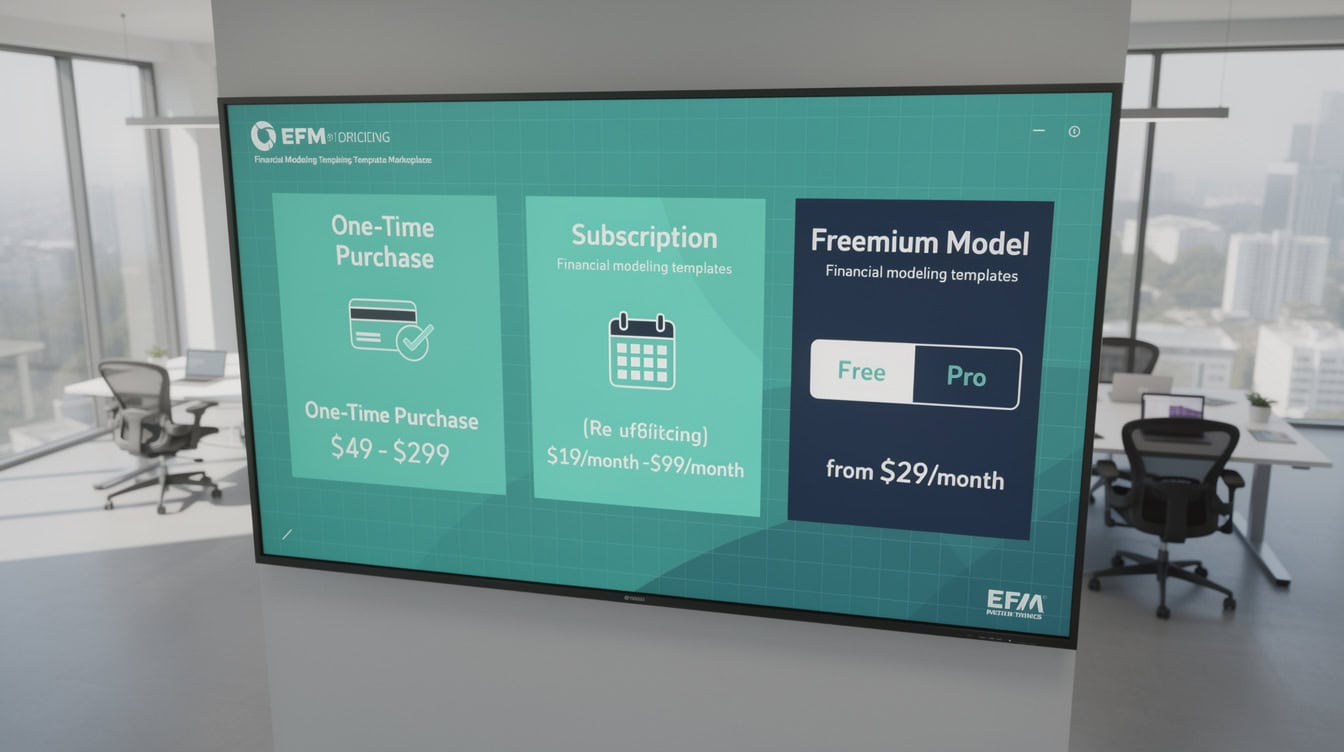
The three pricing structures in this market serve fundamentally different buyer needs. One-time purchase is the most cost-effective for practitioners who need 1 to 5 specific models per year. Subscription suits training platforms where access to a full curriculum justifies the annual fee. Freemium works for simple use cases but almost always requires an upgrade for professional output.
| Marketplace | Pricing Model | Price Range | Client Deliverable Rights |
|---|---|---|---|
| eFinancialModels | One-time | $29 to $249 | Yes |
| Eloquens | One-time / Free | $0 to $200+ | Varies by seller |
| Wall Street Prep | Subscription | $499+/year | Training use only |
| BIWS | Subscription | $397 to $997 | Training use only |
| ProjectionHub | One-time | $35 to $79 | Yes |
| FinModelsLab | One-time | $39 to $179 | Unclear |
| REFM | One-time / Free | $0 to $497 | Yes (real estate) |
| Spreadsheet123 | Free / Low-cost | $0 to $30 | Personal use |
Template Quality Indicators: What Professional-Grade Actually Means
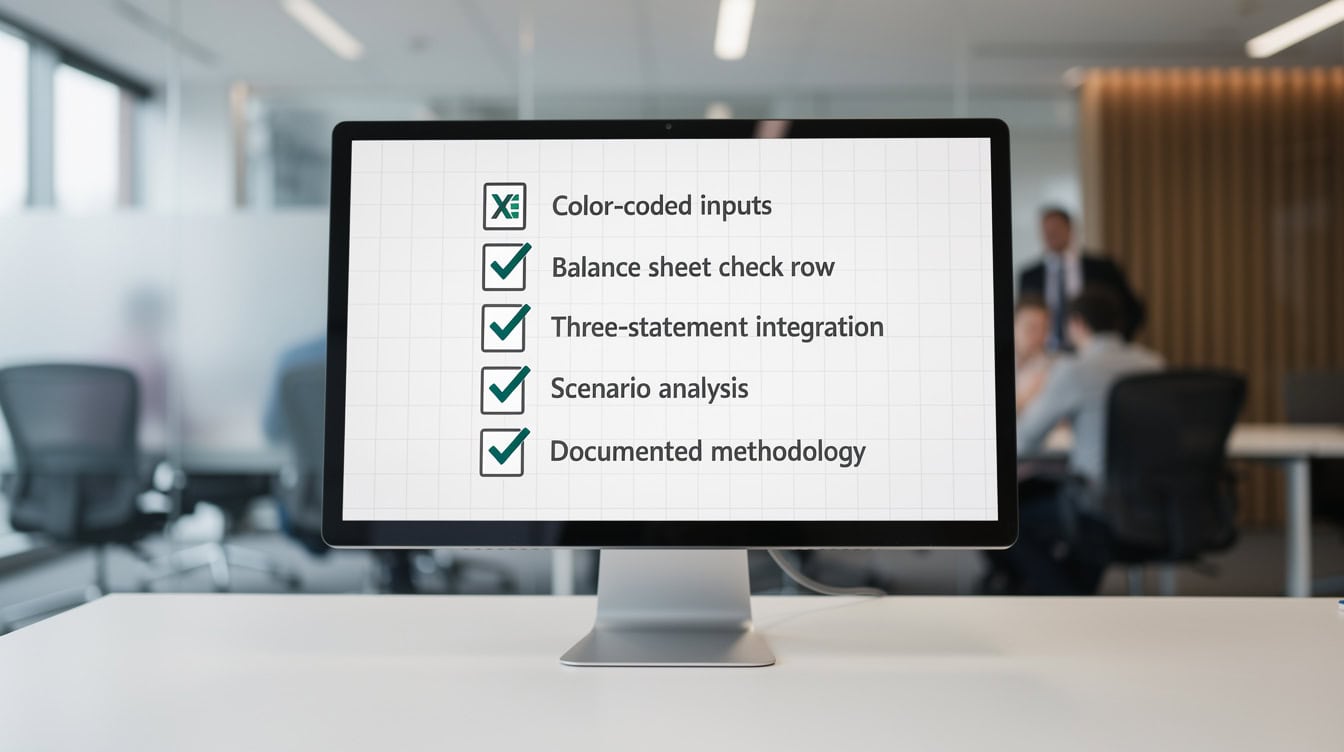
Professional-grade financial modeling templates meet 5 specific structural standards that distinguish them from generic spreadsheets. First, every assumption is labeled, unitized, and color-coded (blue for inputs, black for formulas is the industry convention). Second, the model includes a dedicated error-check row or tab that flags balance sheet imbalances and circular references. Third, the income statement, balance sheet, and cash flow statement are fully integrated — meaning a change in revenue flows automatically through all three statements without manual intervention. Fourth, the model includes scenario analysis (a mechanism for testing multiple sets of assumptions simultaneously, such as base, upside, and downside cases). Fifth, the creator’s methodology is documented, either in a separate tab or an accompanying PDF.
Templates that fail any of these 5 criteria require remediation before use in a client-facing context. That remediation time often exceeds the time saved by buying the template in the first place.
According to research published by the European Spreadsheet Risks Interest Group, 88% of spreadsheets contain errors, and in large spreadsheets the error rate rises to 94%.
A marketplace that enforces structural quality standards directly reduces this risk for buyers. Excel’s built-in auditing tools include features such as Trace Precedents and Trace Dependents to help analysts identify formula errors.
These tools only work effectively when a template’s architecture is transparent and unlocked.
Use Case Matching: Which Marketplace for Which Job
Different marketplaces dominate different use cases. Match your primary need to the right platform before purchasing.
M&A and LBO Modeling: eFinancialModels offers dedicated three-statement model templates and LBO structures built by former investment bankers. BIWS templates are technically rigorous but bundled with courses. For standalone M&A model purchases, eFinancialModels is the strongest option.
Startup Financial Projections: eFinancialModels and FinModelsLab both cover SaaS, marketplace, and e-commerce startup models. eFinancialModels’ startup financial model library includes investor-ready formatting and unit economics dashboards. ProjectionHub suits founders who need simplicity over sophistication.
Real Estate and Infrastructure: REFM is the specialist. eFinancialModels also carries a strong real estate vertical including development, acquisition, and joint venture waterfall models.
Corporate FP&A and Budgeting: eFinancialModels’ financial planning templates cover annual budgeting, rolling forecasts, and variance analysis. Wall Street Prep’s FP&A course templates are strong but require a subscription.
Simple Internal Estimates: Spreadsheet123 or free templates from eFinancialModels’ free template library are sufficient and cost nothing.
Customization, Support, and Learning Resources Compared
Customization flexibility determines how quickly a practitioner can adapt a template to a specific client or transaction. The key variables are: number of hardcoded assumptions (fewer is better), use of named ranges (which make formulas readable), presence of a macro or VBA component (Visual Basic for Applications — code embedded in Excel that automates repetitive tasks), and whether the template is protected (locked cells prevent editing). A single Excel workbook can contain up to 255 sheets.
This means even the most complex multi-tab financial models with dedicated assumption, calculation, output, and audit sheets fit comfortably within Excel’s structural limits.
eFinancialModels templates are delivered unlocked, with named ranges and color-coded input cells. Most include a PDF user guide and email support from the creator. Customization time for a typical three-statement model runs 2 to 4 hours for an experienced analyst.
Wall Street Prep and BIWS templates are designed for learning, so they include extensive video walkthroughs. Customization for production use takes longer because the templates prioritize pedagogical clarity over structural efficiency.
REFM templates include detailed written documentation and occasional video support. Customization time for a development model runs 4 to 8 hours.
Eloquens templates vary by creator. Some include no documentation at all. Budget 1 to 3 hours for quality auditing before any client use.
Red Flags and Limitations by Marketplace
Every marketplace has blind spots. Knowing them prevents costly mistakes.
eFinancialModels: Template quality varies by creator even within the curated library. Always preview the sample before purchasing and check the creator’s credentials tab.
Eloquens: No centralized quality vetting. A template with 500 downloads is not necessarily error-free. Always run a balance sheet check before use.
Wall Street Prep / BIWS: Templates are not sold separately. If you need one model without a course, these platforms are poor value. Subscription costs are high for infrequent users.
ProjectionHub: Models are too simple for investor-grade presentations at Series B and beyond. The platform lacks coverage for complex capital structures.
FinModelsLab: Licensing terms for client-deliverable use are ambiguous. Contact support before using in a client context.
REFM: Zero coverage outside real estate. If your work spans multiple sectors, you’ll need a second marketplace.
Spreadsheet123: Not investment-banking grade. Do not use for lender or investor presentations.

Decision Matrix: Matching Requirements to the Right Marketplace
Use this scorecard to evaluate marketplaces against your specific requirements. Score each criterion 1 (poor) to 5 (excellent) for your use case, then multiply by the weight.
| Criterion | Weight | eFinancialModels | Eloquens | Wall St Prep | REFM | ProjectionHub |
|---|---|---|---|---|---|---|
| Creator credentials | 25% | 5 | 3 | 5 | 5 | 3 |
| Industry coverage | 20% | 5 | 4 | 3 | 2 | 2 |
| Pricing value | 20% | 5 | 4 | 2 | 4 | 4 |
| Client-use licensing | 15% | 5 | 3 | 1 | 5 | 5 |
| Documentation quality | 10% | 4 | 2 | 5 | 5 | 3 |
| Customization ease | 10% | 5 | 3 | 3 | 4 | 4 |
| Weighted Score | 100% | 4.85 | 3.25 | 2.95 | 4.05 | 3.35 |
Weighted scores reflect a practitioner buyer profile (consultant or analyst needing client-deliverable models across multiple industries). A training-focused buyer would weight documentation quality higher and shift scores toward Wall Street Prep.
Frequently Asked Questions About Financial Modeling Template Marketplaces
What is a financial modeling template marketplace?
A financial modeling template marketplace is an online platform where buyers can purchase or download pre-built Excel or cloud-based financial models. These templates cover use cases including DCF valuation (Discounted Cash Flow — a method of valuing an asset based on its expected future cash flows), LBO analysis (Leveraged Buyout — modeling a company acquisition financed primarily with debt), three-statement financial models (integrated income statement, balance sheet, and cash flow statement), and startup financial projections. Marketplaces range from curated platforms like eFinancialModels, which vets creator credentials and enforces quality standards, to peer-to-peer platforms like Eloquens, where quality varies by individual contributor. The primary value proposition is time savings: a template that would take 30 to 80 hours to build from scratch can be purchased, customized, and deployed in 2 to 8 hours.
How do I know if a financial modeling template is professional-grade?
A professional-grade template meets 5 structural standards: (1) color-coded inputs (blue cells for assumptions, black for formulas), (2) a balance sheet check row confirming Assets = Liabilities + Equity, (3) full three-statement integration where revenue changes flow automatically through all statements, (4) scenario analysis with at least 3 cases (base, upside, downside), and (5) documented methodology either in a separate tab or accompanying PDF. Templates missing any of these require manual remediation before client use. According to the European Spreadsheet Risks Interest Group, 88% of spreadsheets contain errors — structural quality standards directly reduce this risk. Always request a sample or preview before purchasing.
Can I use purchased templates for client deliverables?
Licensing terms vary significantly by marketplace. eFinancialModels explicitly permits client-deliverable use in its standard license. REFM also permits client use for real estate models. Wall Street Prep and BIWS templates are licensed for personal training use only and cannot be submitted as client deliverables. FinModelsLab’s terms are ambiguous — contact their support team before using in a client context. Eloquens licensing depends on the individual seller’s terms, which appear on each template’s product page. Always read the license agreement before purchasing any template you intend to use in a client-facing context. Violating licensing terms exposes your firm to legal liability.
What is the typical customization time for a purchased financial model template?
Customization time depends on template complexity and the buyer’s Excel proficiency. For a simple startup projection template from eFinancialModels or ProjectionHub, an experienced analyst typically needs 1 to 3 hours to input company-specific assumptions and reformat outputs. A complex LBO or merger model requires 4 to 12 hours of customization, including stress-testing and scenario calibration. Templates with poor documentation add 2 to 4 hours of auditing time before customization can begin. eFinancialModels templates include PDF user guides that reduce setup time by approximately 30% compared to undocumented templates. Factor customization time into your total cost-of-ownership calculation when comparing marketplace prices.
When does it make sense to build a financial model from scratch instead of buying a template?
Building from scratch makes sense in 3 specific scenarios: (1) the model requires a highly proprietary structure that no marketplace template approximates, such as a bespoke infrastructure project finance model with custom waterfall logic; (2) the model will be reused hundreds of times internally, making the one-time build cost amortizable across many uses; or (3) the firm has a standardized internal modeling convention that conflicts with marketplace template structures. For most practitioners, buying and customizing a template is faster and cheaper. A 40-hour build at $75/hour fully-loaded cost equals $3,000 in labor — most templates cost $29 to $249. The break-even point is clear in almost every scenario. The exception is when customization time exceeds 50% of the original build time, which signals the template was a poor fit for the use case.
Are free financial modeling templates good enough for professional use?
Free templates are appropriate for internal estimates, simple cash flow forecasts, and learning exercises. They are rarely appropriate for investor presentations, lender packages, or M&A due diligence. Free templates typically lack balance sheet checks, scenario analysis, and methodology documentation. eFinancialModels offers a selection of free templates in its free template library that are higher quality than most free alternatives because they follow the same structural standards as paid templates. For any output that will be reviewed by an investor, lender, or acquirer, a paid professional-grade template is the minimum acceptable standard. The reputational cost of submitting a model with errors far exceeds the $29 to $249 cost of a quality template.
How do subscription-based platforms compare to one-time purchase marketplaces for frequent users?
For analysts who need 10 or more templates per year across multiple use cases, a subscription platform can offer better value than individual one-time purchases. Wall Street Prep’s annual subscription at approximately $499 includes access to a full template library plus training content. However, subscription platforms restrict client-deliverable use, which eliminates them as an option for consultants and advisors. For practitioners who need 1 to 5 templates per year for specific transactions, one-time purchase from eFinancialModels at $29 to $249 per template is more cost-effective. A practitioner buying 3 templates per year at an average of $99 each spends $297 annually — well below most subscription prices — and retains perpetual access to each purchased template without renewal risk.
Conclusion: Match Your Use Case Before You Buy
The financial modeling template marketplace you choose should match your buyer profile precisely: your industry focus, the complexity of models you need, whether outputs are client-facing, and how frequently you purchase templates. eFinancialModels leads on breadth (500+ templates, 100+ industries), creator credentials (former investment bankers and PE professionals), pricing transparency (one-time purchase, $29 to $249), and licensing clarity (client-deliverable use permitted). REFM leads for real estate specialists. Wall Street Prep and BIWS lead for training-focused buyers who want templates bundled with curriculum.
For most finance professionals, consultants, and startup founders, the decision matrix points to eFinancialModels as the default starting point: the widest industry coverage, the clearest licensing terms, and the strongest quality standards for client-facing work.
I recommend starting with eFinancialModels’ financial modeling template library — preview samples free, download immediately, and apply the satisfaction guarantee if the template doesn’t meet your needs. For startup-specific models, the startup financial model collection is the most comprehensive starting point available without a subscription commitment.