
0 ITEMS

SaaS Financial Model Excel – 5-Year Three-Statement Forecast, MRR, ARR, Cash Flow & Unit Economics
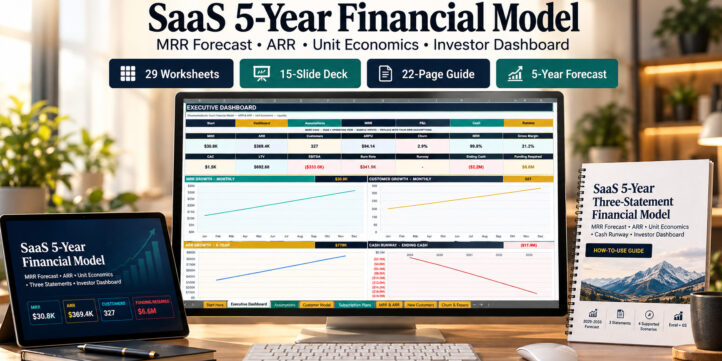
Professional 5-year SaaS financial model in Excel for subscription-based businesses, founders, financial analysts, and consultants. The 29-worksheet workbook integrates customer growth, subscription pricing, MRR and ARR, churn, expansion revenue, operating expenses, staffing, profitability, cash flow, and funding requirements. Includes three-statement financial projections (Income Statement, Balance Sheet, and Cash Flow Statement), SaaS unit economics (CAC, LTV, ARPU, NRR), break-even analysis, scenario and sensitivity analysis, and an executive dashboard. The complete package includes: – 29-worksheet Excel financial model (.xlsx) – 15-slide Investor / Management PowerPoint (.pptx) – 22-page How-to-Use PDF Guide (.pdf) All files are in English. The Excel workbook is macro-free, contains editable assumptions and transparent formulas, and includes illustrative financial data for 2029–2033. An independently developed financial planning template by SheetworksStudio, designed for internal forecasting, financial analysis, business planning, and management reporting.
| Financial Model, Online Businesses, SaaS |
| 5-year Financial Projections, Annual Recurring Revenue (ARR), Average Order Value (AOV), Break-Even, Budget, Budgeting, Churn, Excel |
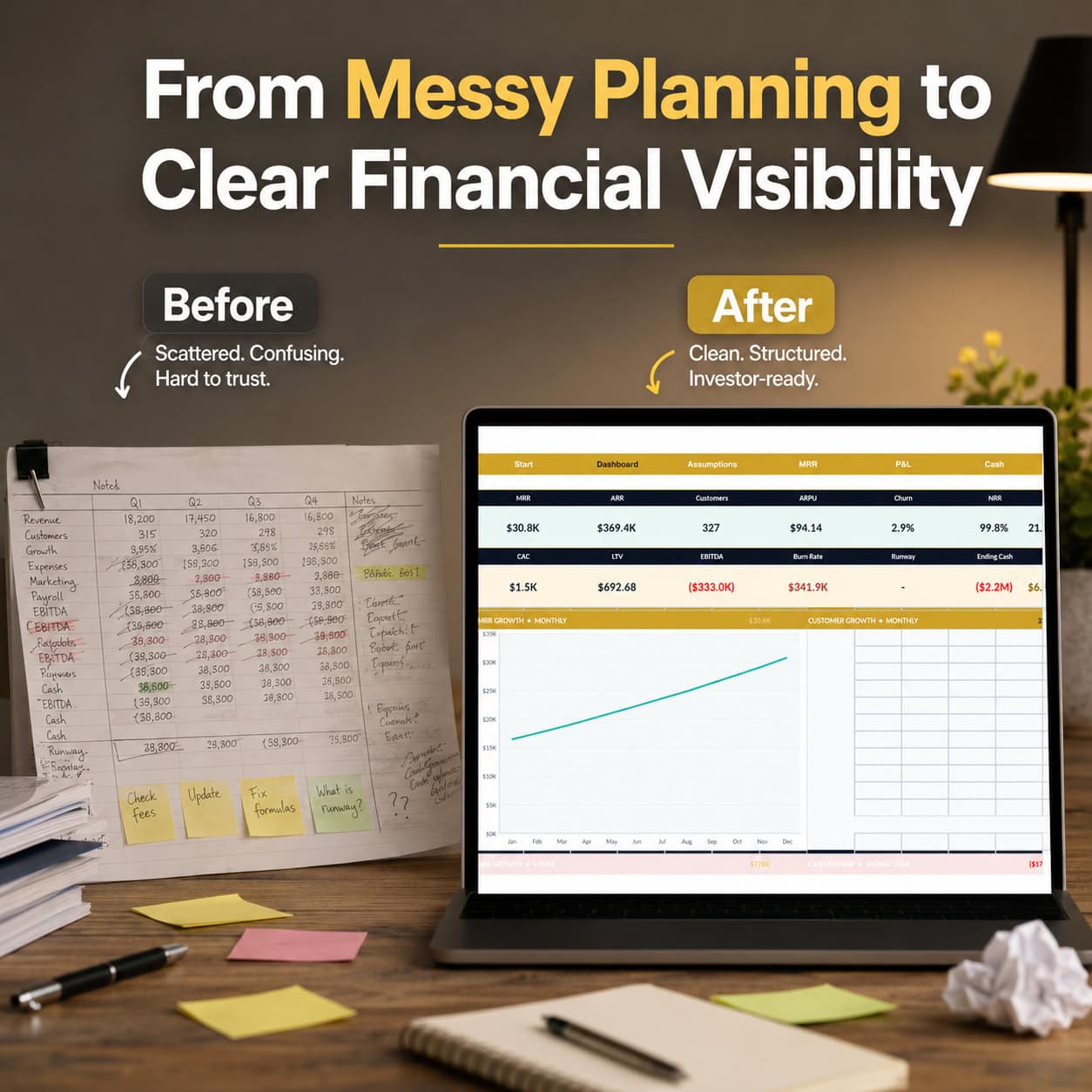

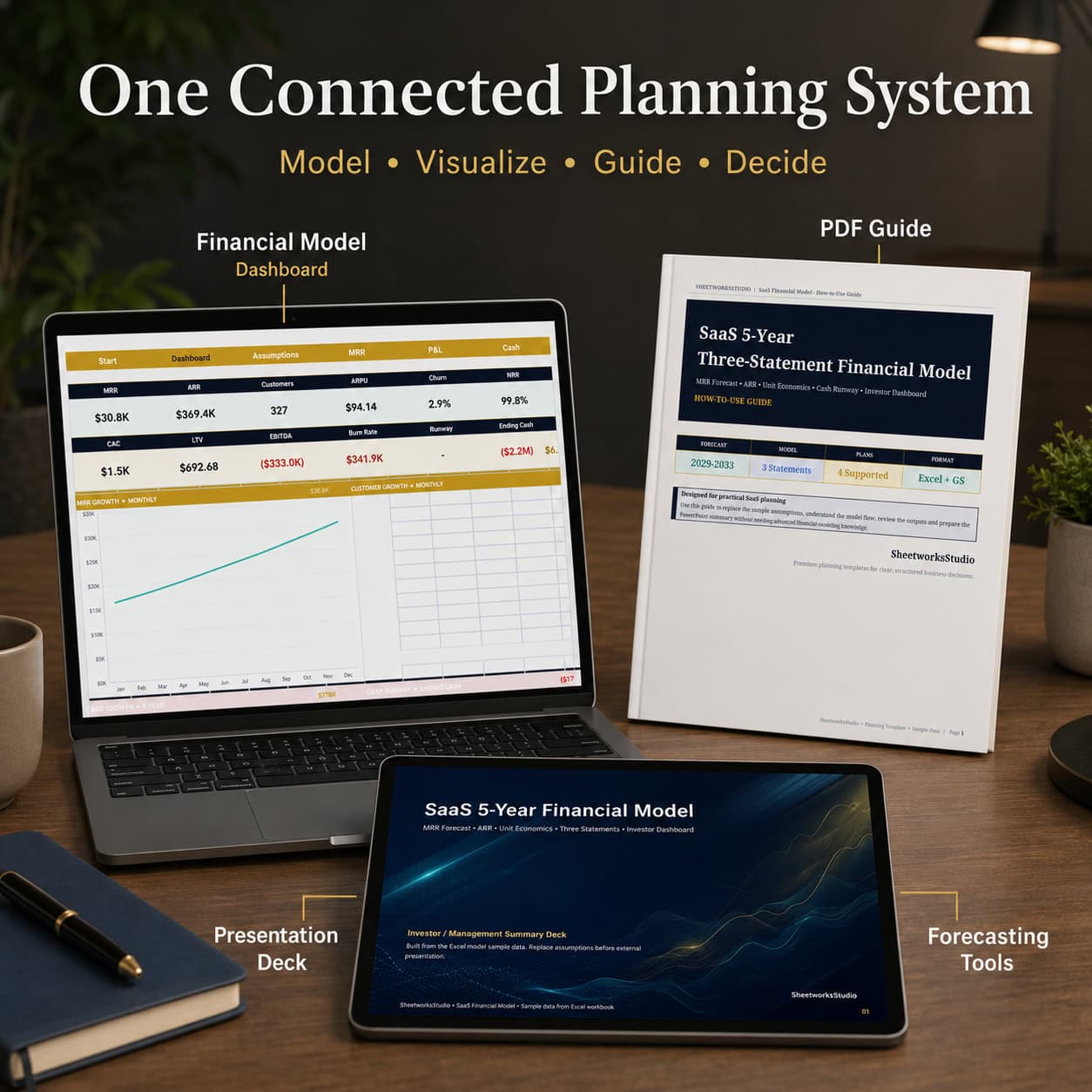
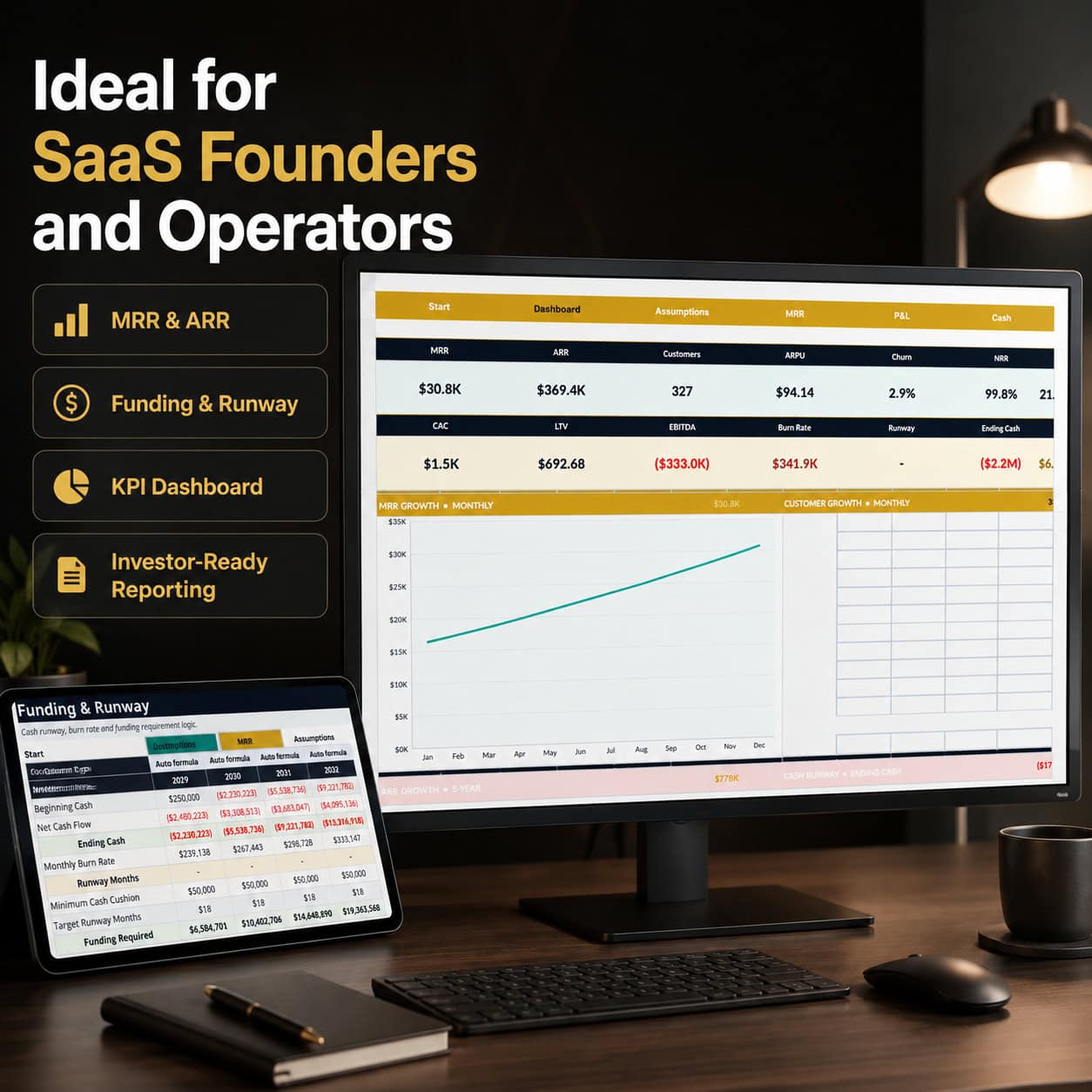
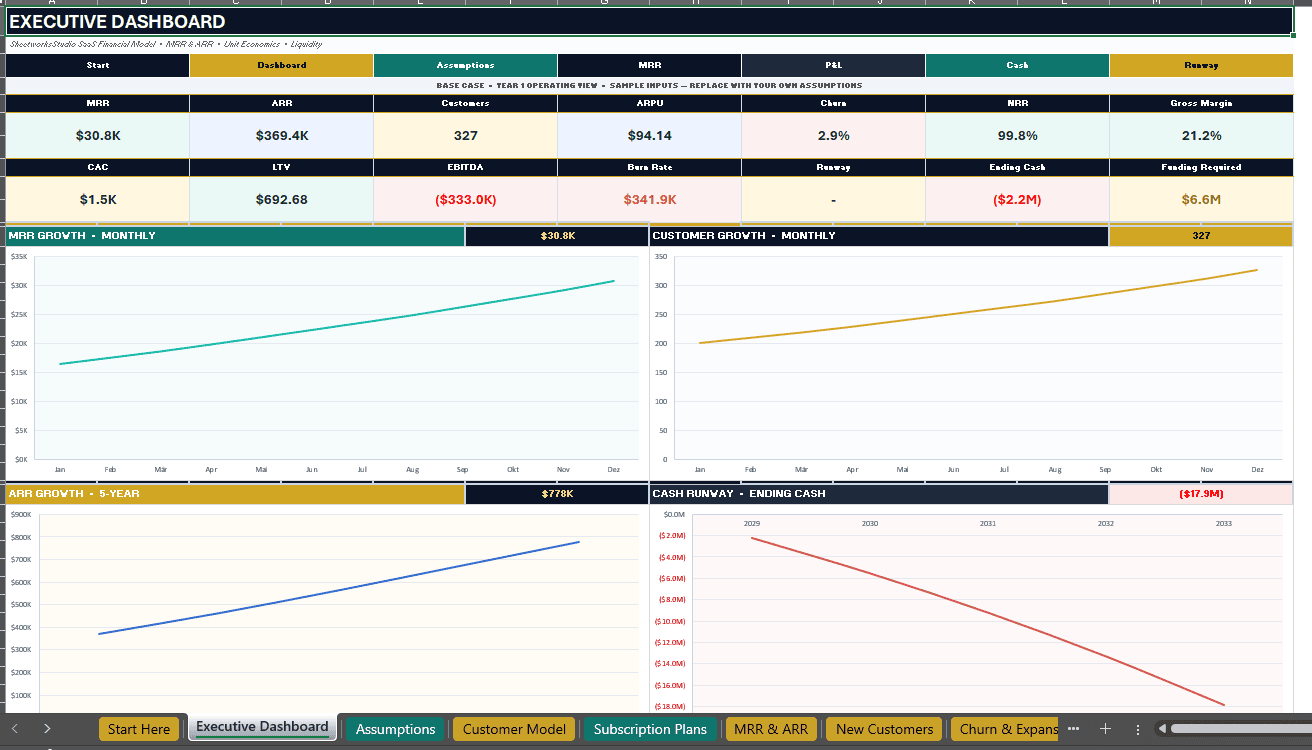
PRODUCT OVERVIEW
The SaaS 5-Year Three-Statement Financial Model by SheetworksStudio is a comprehensive Excel-based financial planning template developed for subscription-based software businesses, entrepreneurs, financial analysts, consultants, and management teams.
The model connects SaaS operating assumptions with revenue forecasting, customer development, operating expenses, profitability, cash flow, and financing requirements over a five-year planning period.
It provides a structured framework for analyzing recurring revenue, customer acquisition, churn, staffing, unit economics, and financial performance.
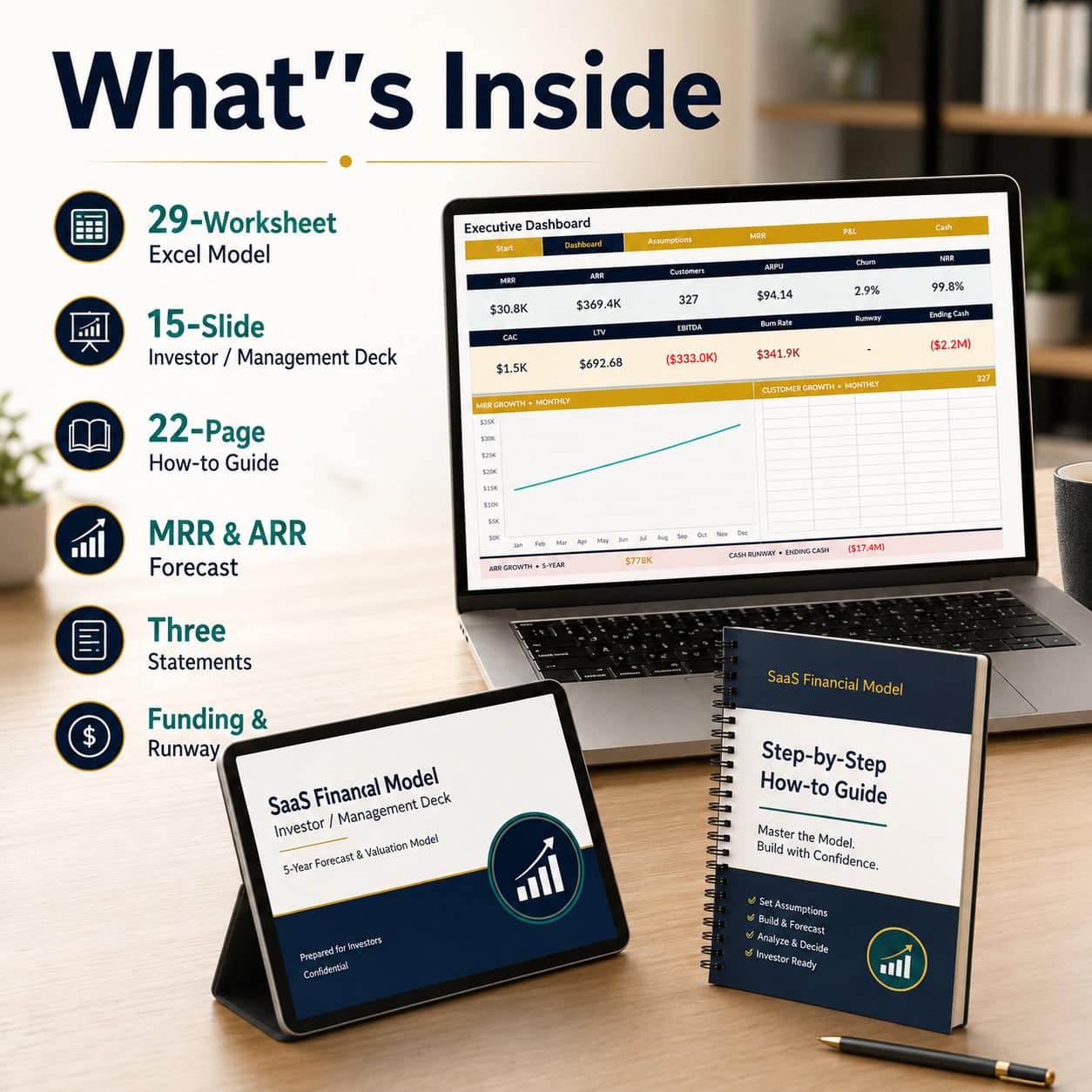
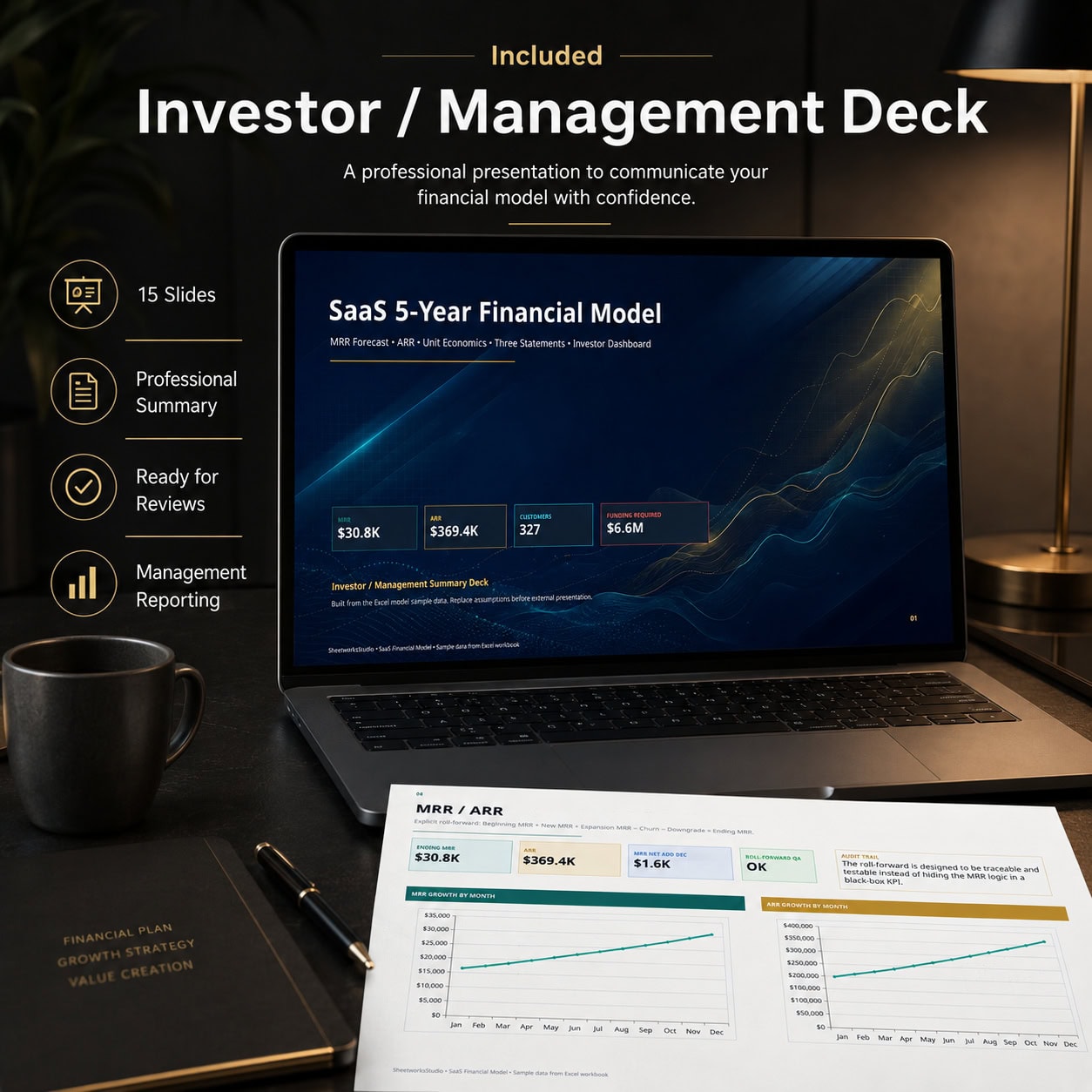
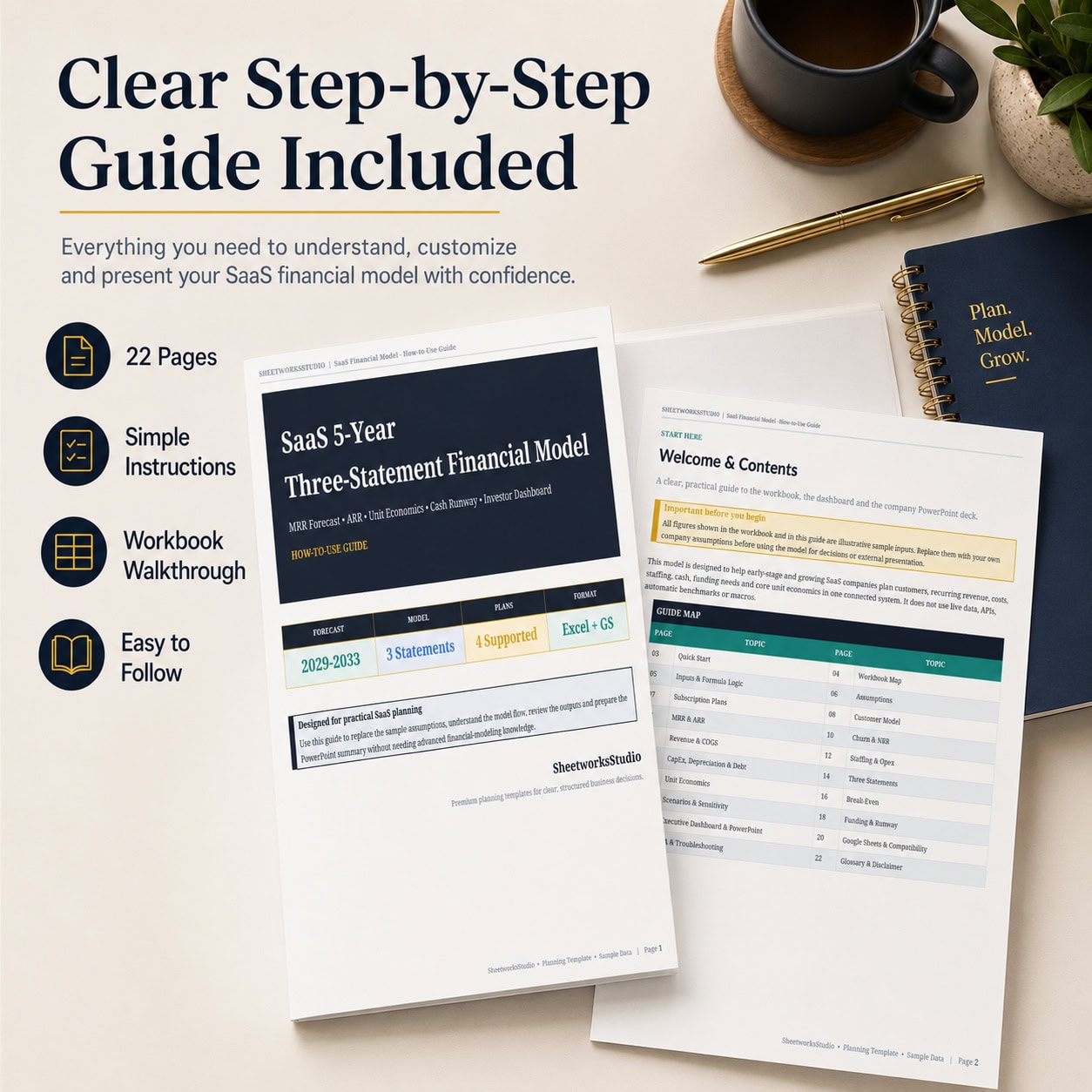
The complete package includes a 29-worksheet Excel financial model, a 15-slide Investor / Management PowerPoint presentation, and a 22-page user guide.
KEY FEATURES
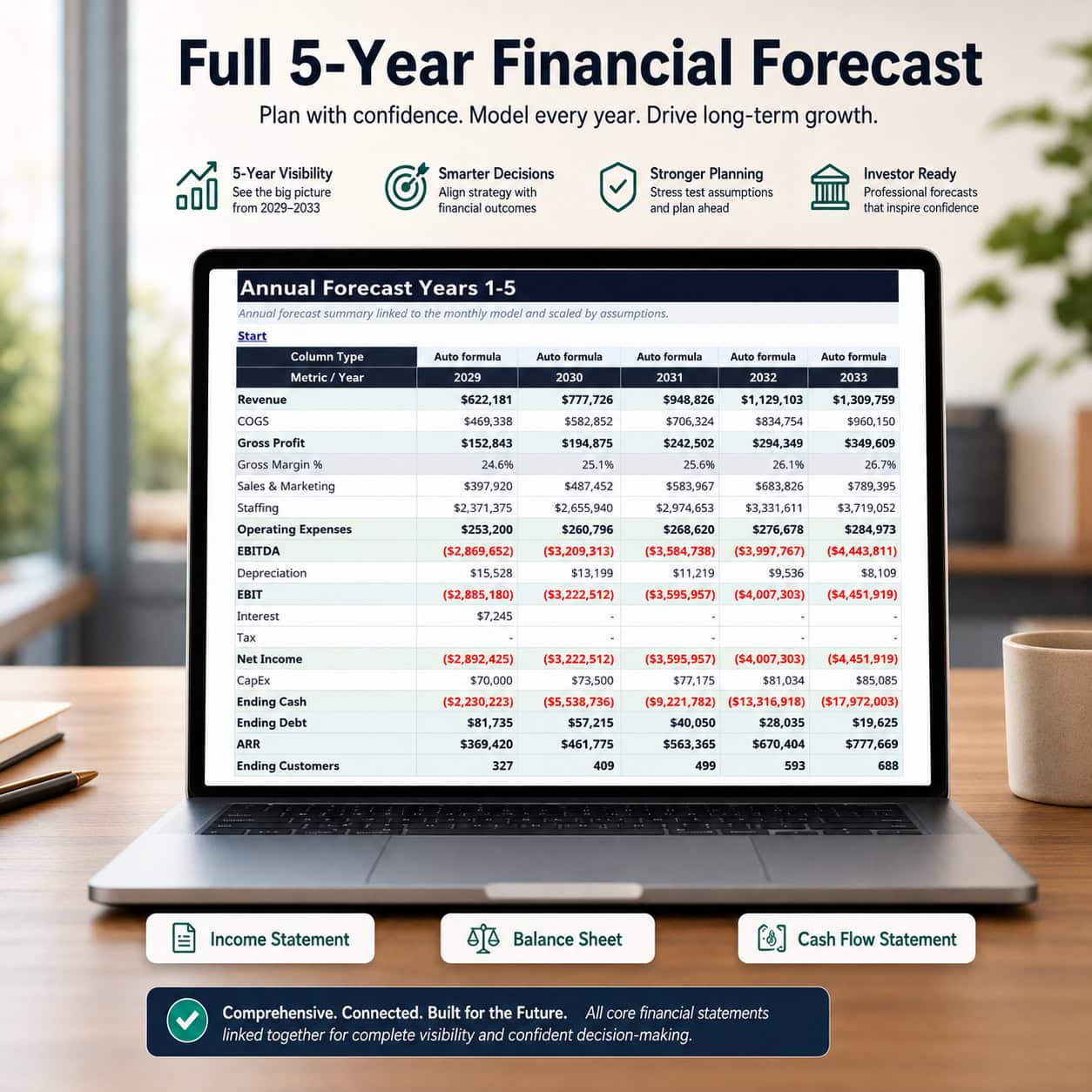
1. Integrated Five-Year Financial Forecast
The model provides structured projections for the three principal financial statements:
- Income Statement
- Balance Sheet
- Cash Flow Statement
Supporting schedules cover operating expenses, staffing, capital expenditure, depreciation, and debt financing.
A balance check is included to help users review financial statement consistency.
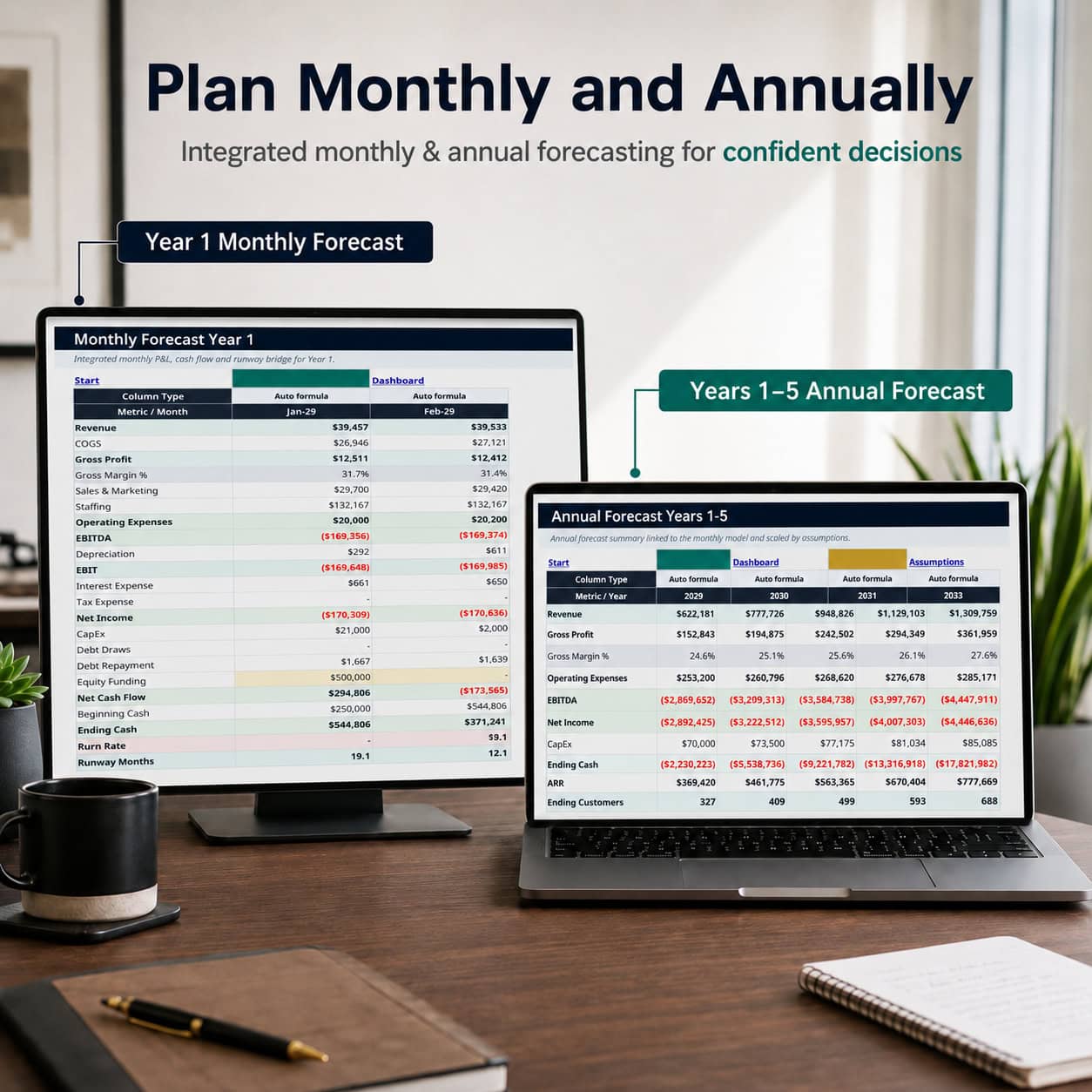
The forecast includes monthly planning for Year 1 and annual projections for Years 1–5.
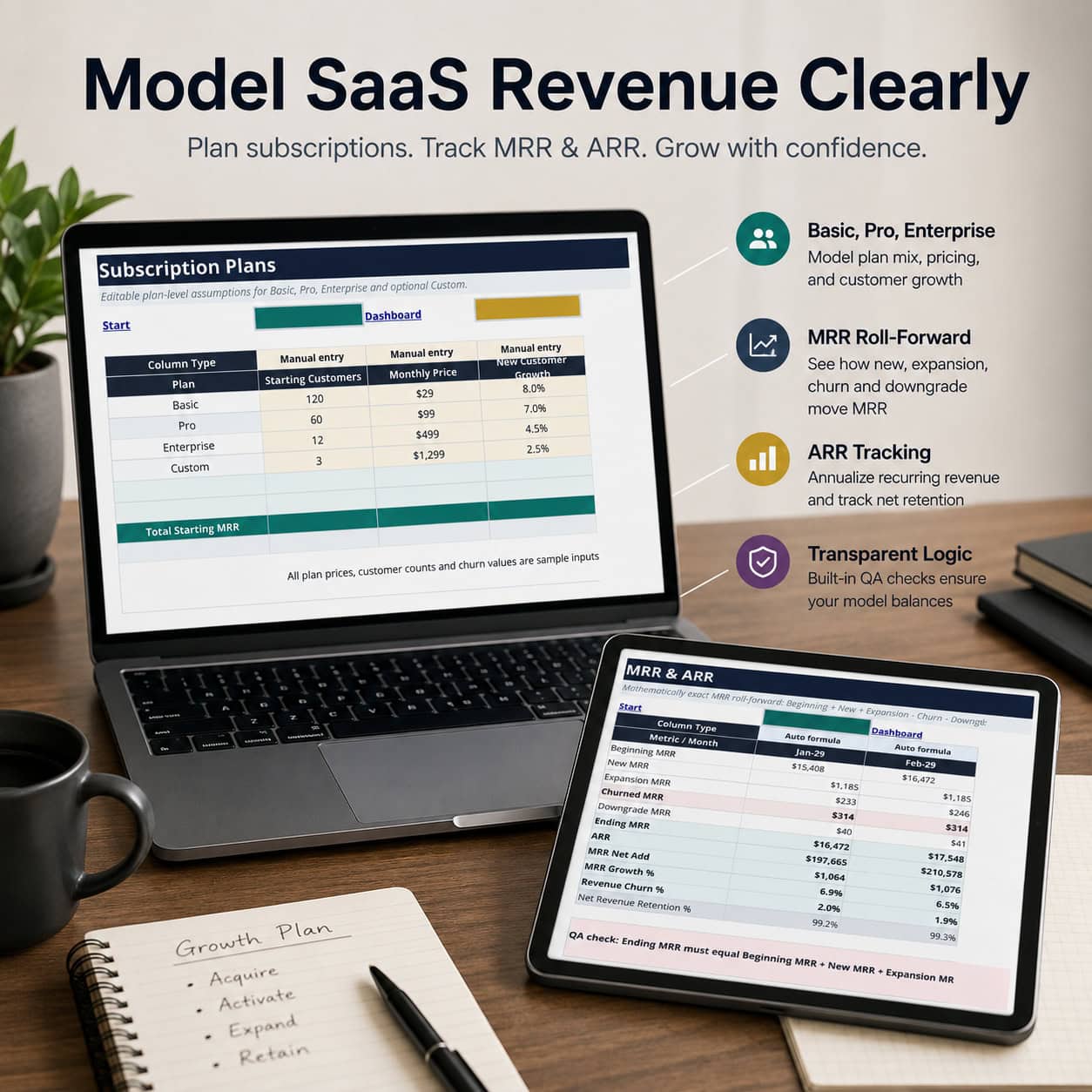
2. SaaS Revenue, MRR and ARR Forecasting
Plan subscription-based revenue using customizable operating assumptions.
Key components include:
- Subscription plans and monthly pricing
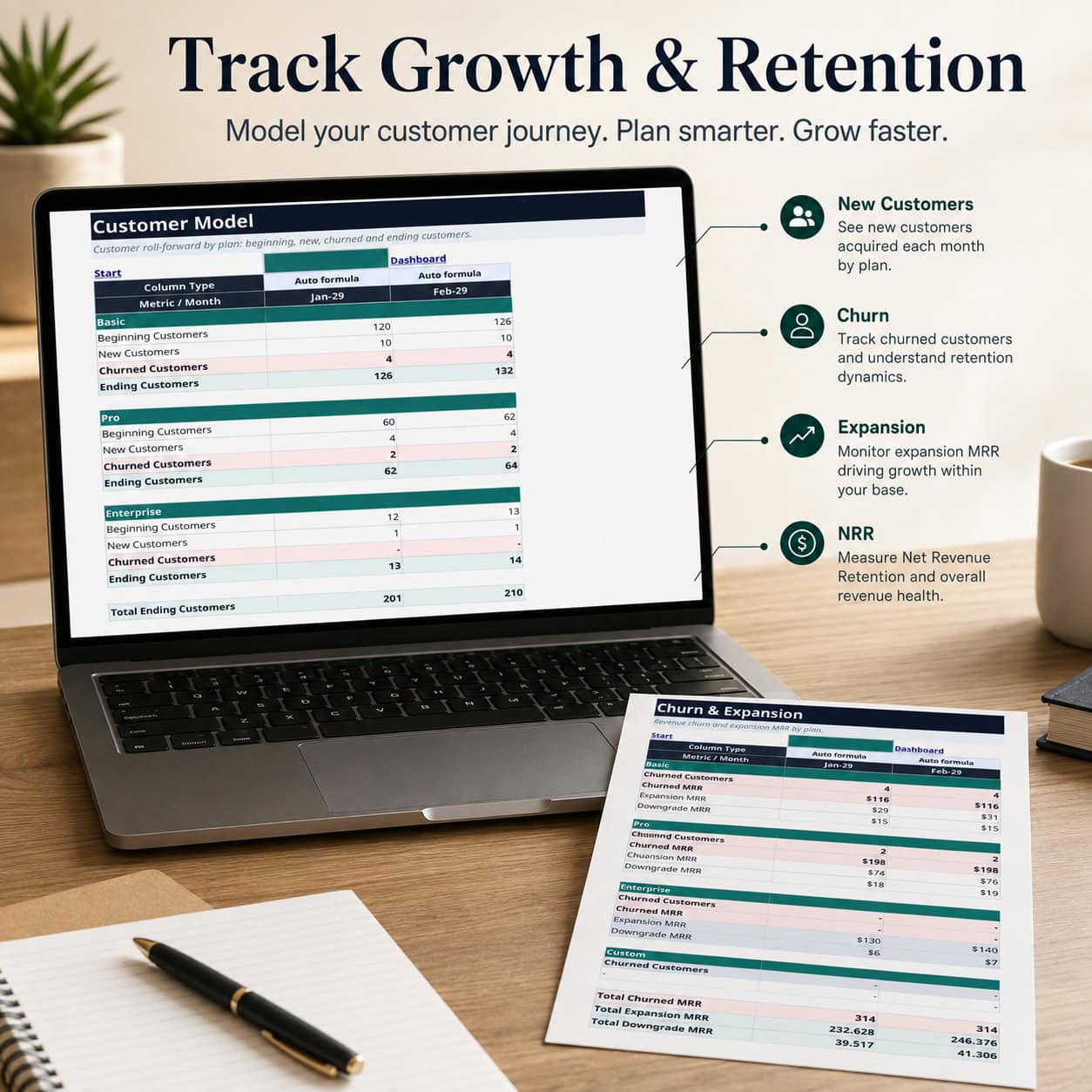
- Starting customers and new customer acquisition
- Customer growth assumptions
- Monthly customer churn
- Expansion and contraction
- Beginning and ending MRR
- New and expansion MRR
- Churned MRR
- Annual Recurring Revenue (ARR)
The recurring revenue schedules provide visibility into how customer activity and subscription assumptions influence revenue development.
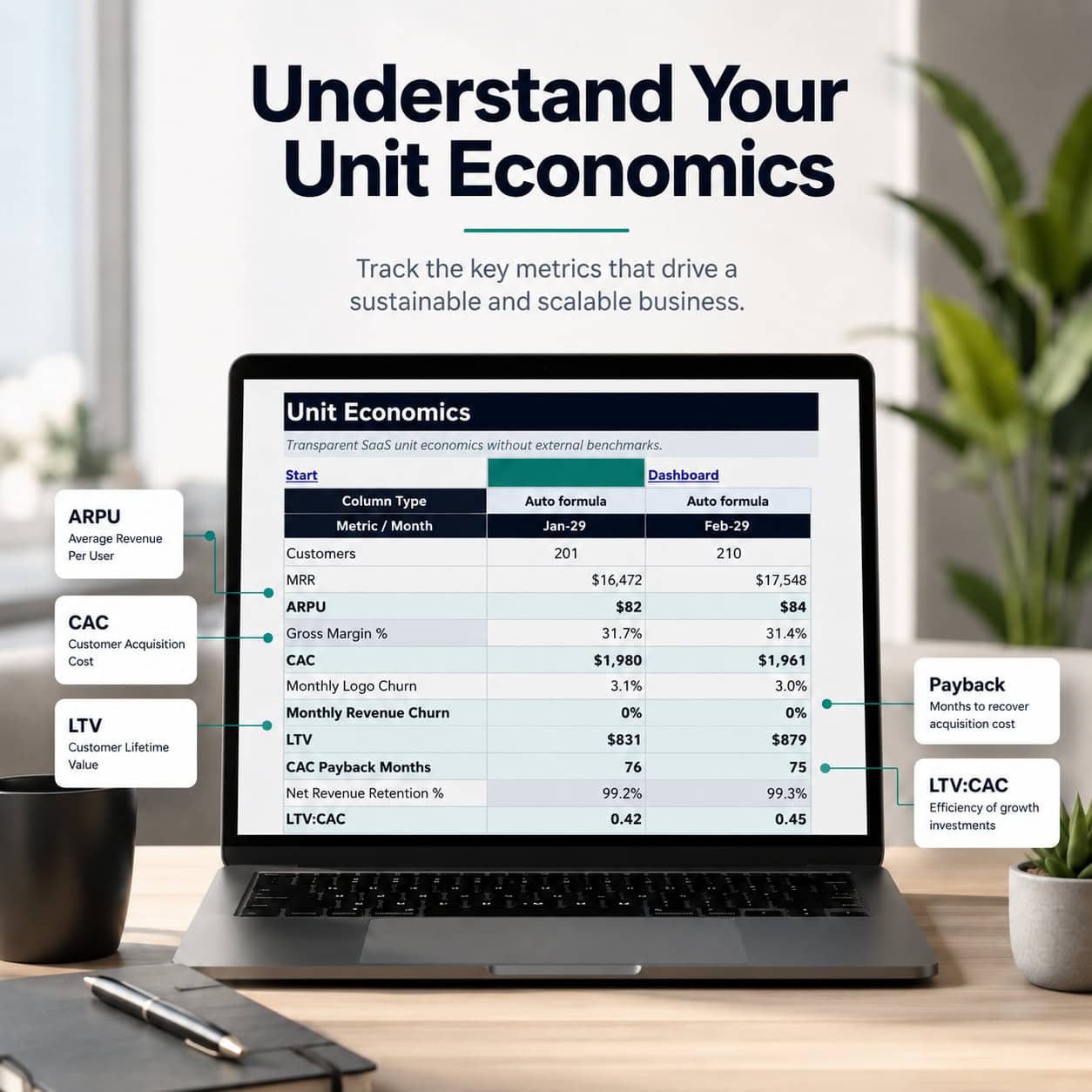
3. SaaS Unit Economics and KPI Analysis
The workbook includes dedicated financial and operating performance indicators:
- Average Revenue per User (ARPU)
- Customer Acquisition Cost (CAC)
- Customer Lifetime Value (LTV)
- CAC Payback Period
- Gross Margin
- Logo Churn
- Revenue Churn
- Net Revenue Retention (NRR)
- EBITDA
- Burn Rate
- Cash Runway
- Ending Cash
These indicators support the analysis of customer acquisition efficiency, retention, profitability, and financial sustainability.
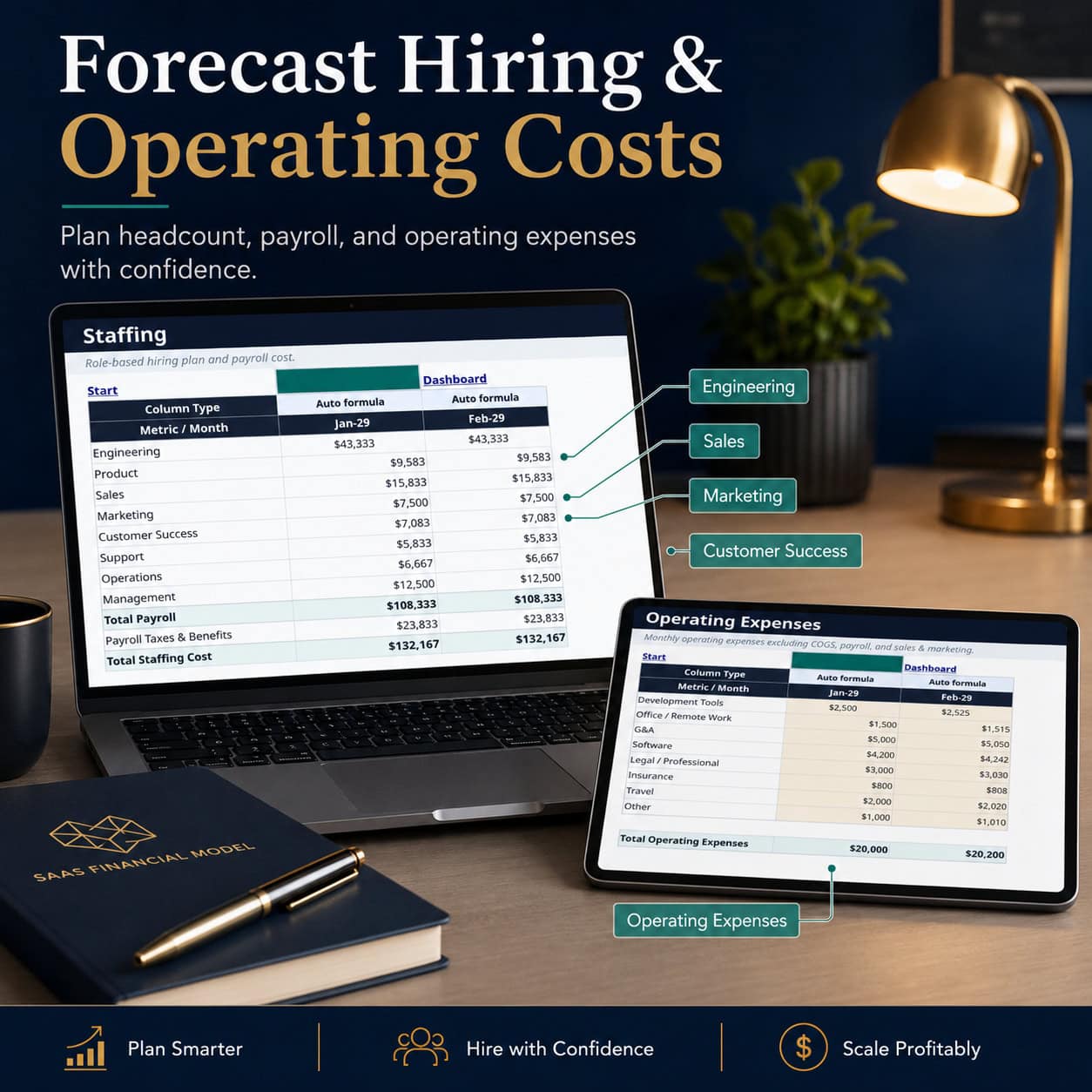
4. Operating Costs, Staffing and Financing
The model incorporates operational and financial planning schedules covering:
- Hosting and Cost of Goods Sold
- Sales and Marketing
- Staffing and Personnel Costs
- Operating Expenses
- Capital Expenditure
- Depreciation
- Debt Financing
These schedules connect operational assumptions with the financial statements and overall business forecast.
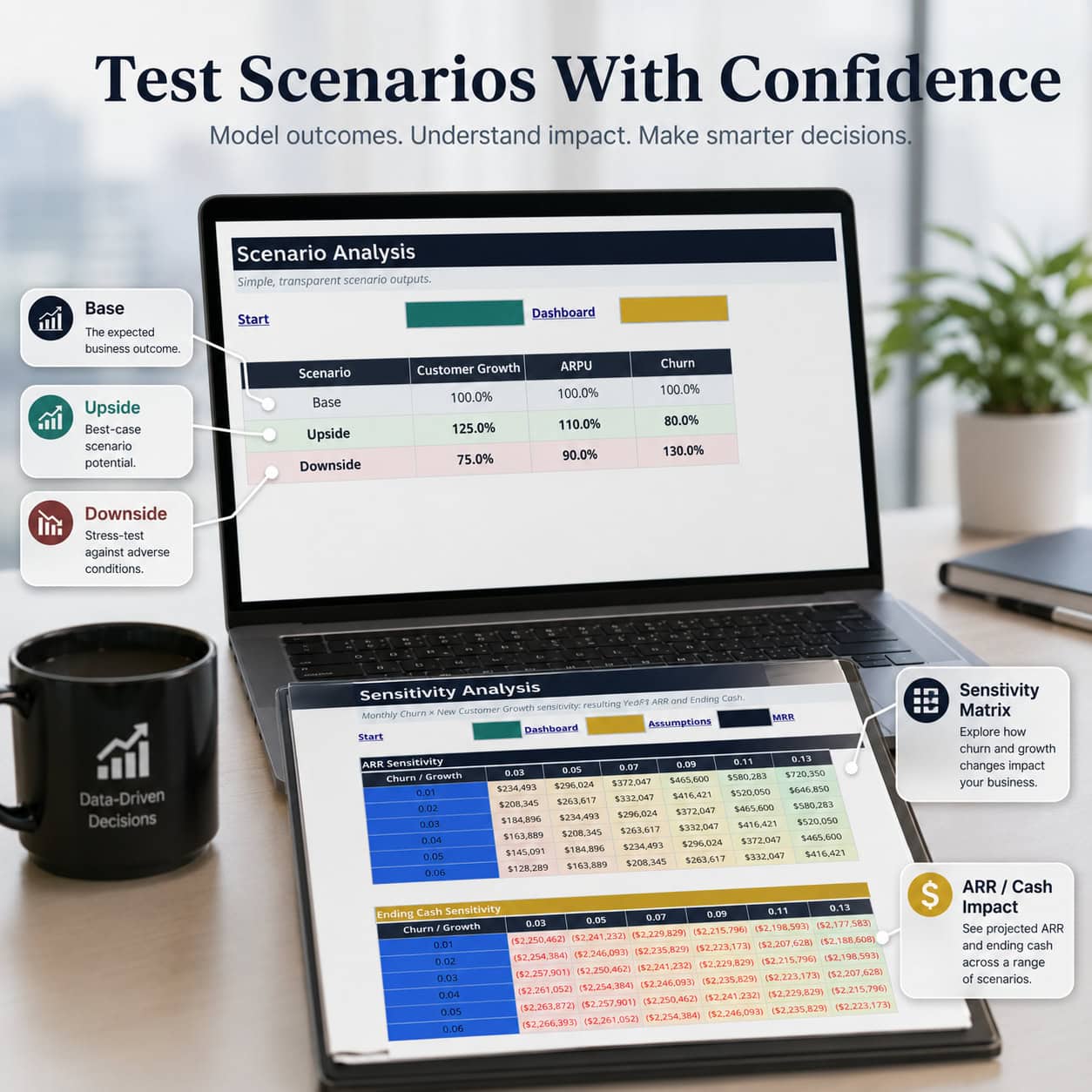
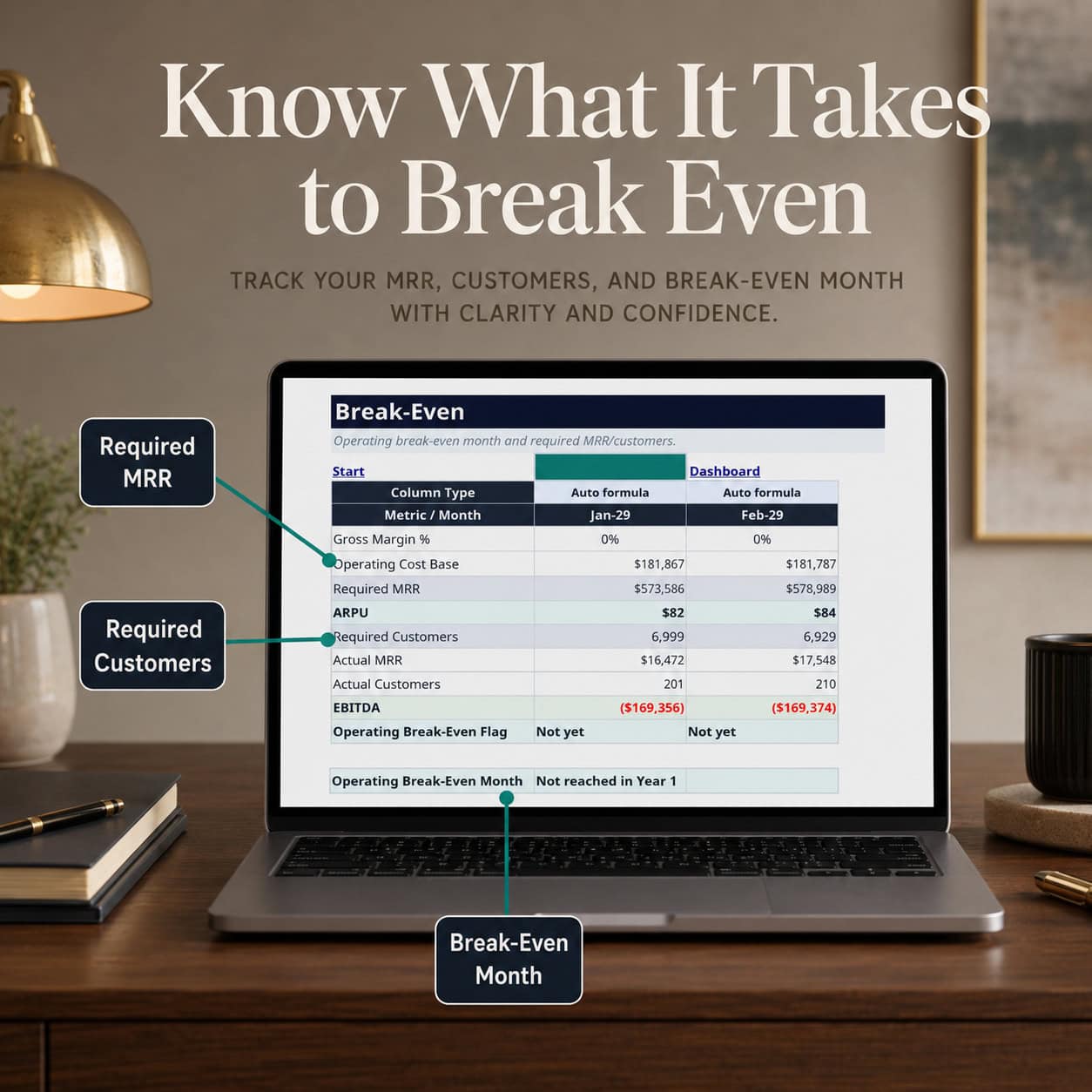
5. Break-Even, Scenario and Sensitivity Analysis
Dedicated analytical worksheets support evaluation of alternative financial assumptions.
The model includes:
- Operating break-even analysis
- Required MRR and customer levels
- Base, Upside and Downside scenarios
- Customer growth assumptions
- Churn sensitivity
- ARR and cash impact analysis
These tools allow users to explore how changes in selected operating assumptions may influence projected financial outcomes.
6. Executive Dashboard and Management Reporting
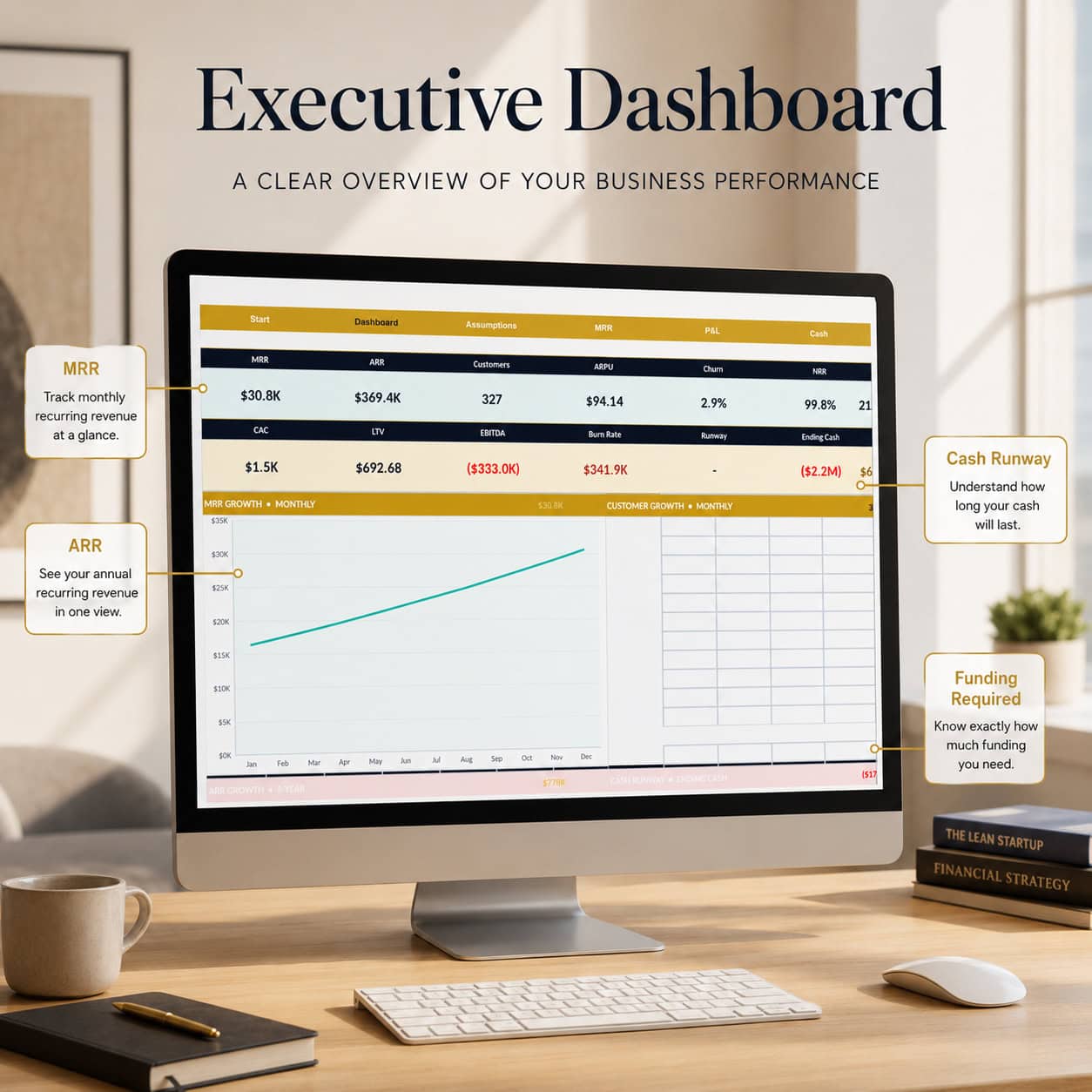
The Executive Dashboard consolidates selected financial and operational indicators into a structured management overview.
Reporting areas include:
- Recurring Revenue
- Customer Development
- Financial Performance
- Cash Position
- Funding and Runway
- SaaS KPIs
Additional forecasting and KPI worksheets provide supporting information for financial analysis and internal management reviews.
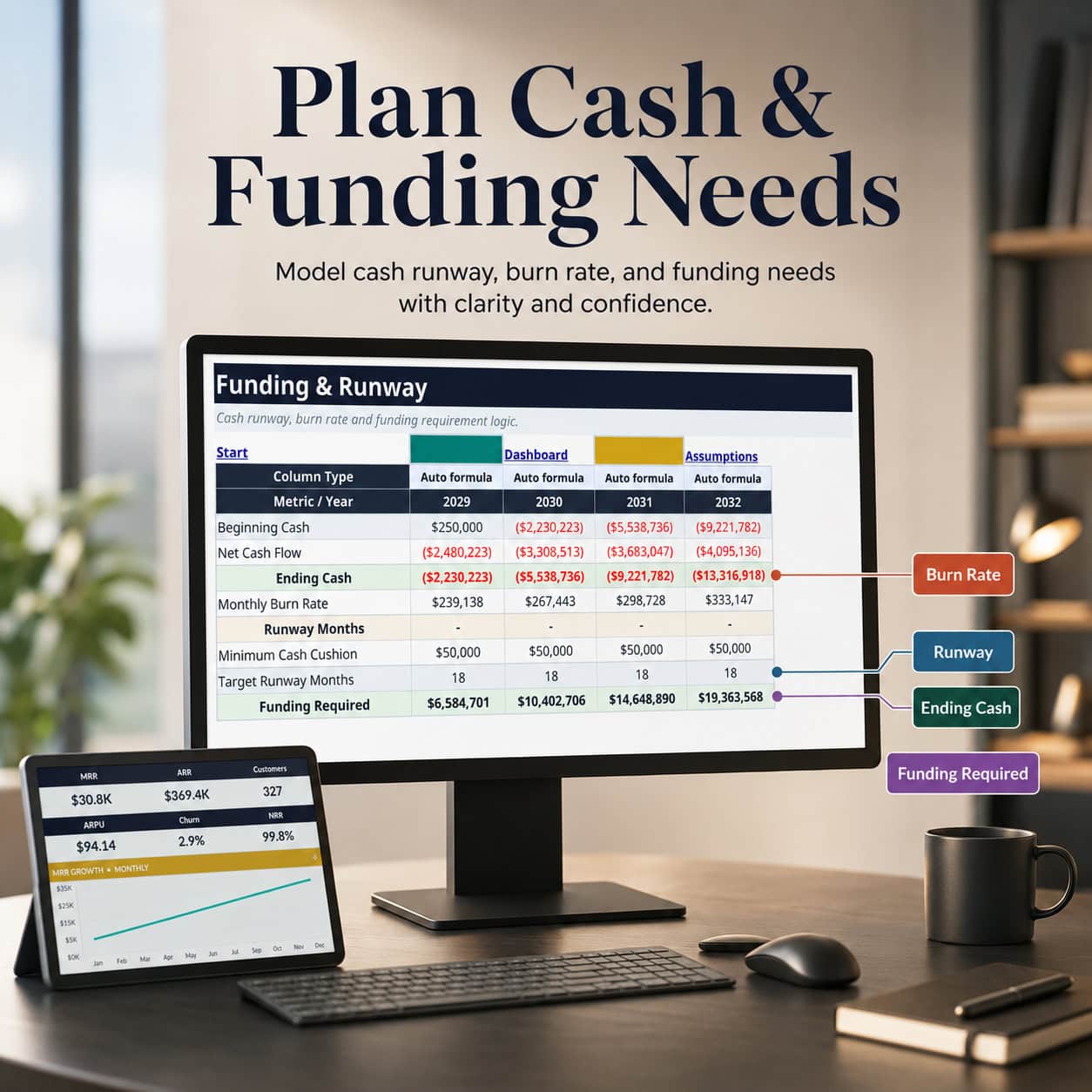
7. Funding Requirements and Cash Runway
The model includes a dedicated Funding & Runway section to support liquidity and financing analysis.
Users can review:
- Operating Burn Rate
- Ending Cash
- Cash Cushion
- Target Runway
- Potential Funding Requirements
These calculations provide a structured basis for assessing projected liquidity under the selected assumptions.
INCLUDED FILES
Excel Financial Model (.xlsx)
The primary financial planning workbook contains 29 worksheets covering operating assumptions, subscription revenue, customer development, costs, financial statements, forecasting, analytical tools, and management reporting.
The workbook includes illustrative financial information for 2029–2033.
Investor / Management PowerPoint (.pptx)
A 15-slide presentation covering selected SaaS operating and financial topics, including customer growth, subscription plans, recurring revenue, unit economics, financial projections, scenarios, funding, and management conclusions.
The presentation contains illustrative information and can be customized for individual reporting requirements.
How-to-Use PDF Guide (.pdf)
A 22-page user guide explaining the workbook structure, navigation, input assumptions, subscription revenue logic, financial statements, SaaS KPIs, analytical worksheets, and general usage.
All three files are provided in English.
HOW TO USE THE MODEL
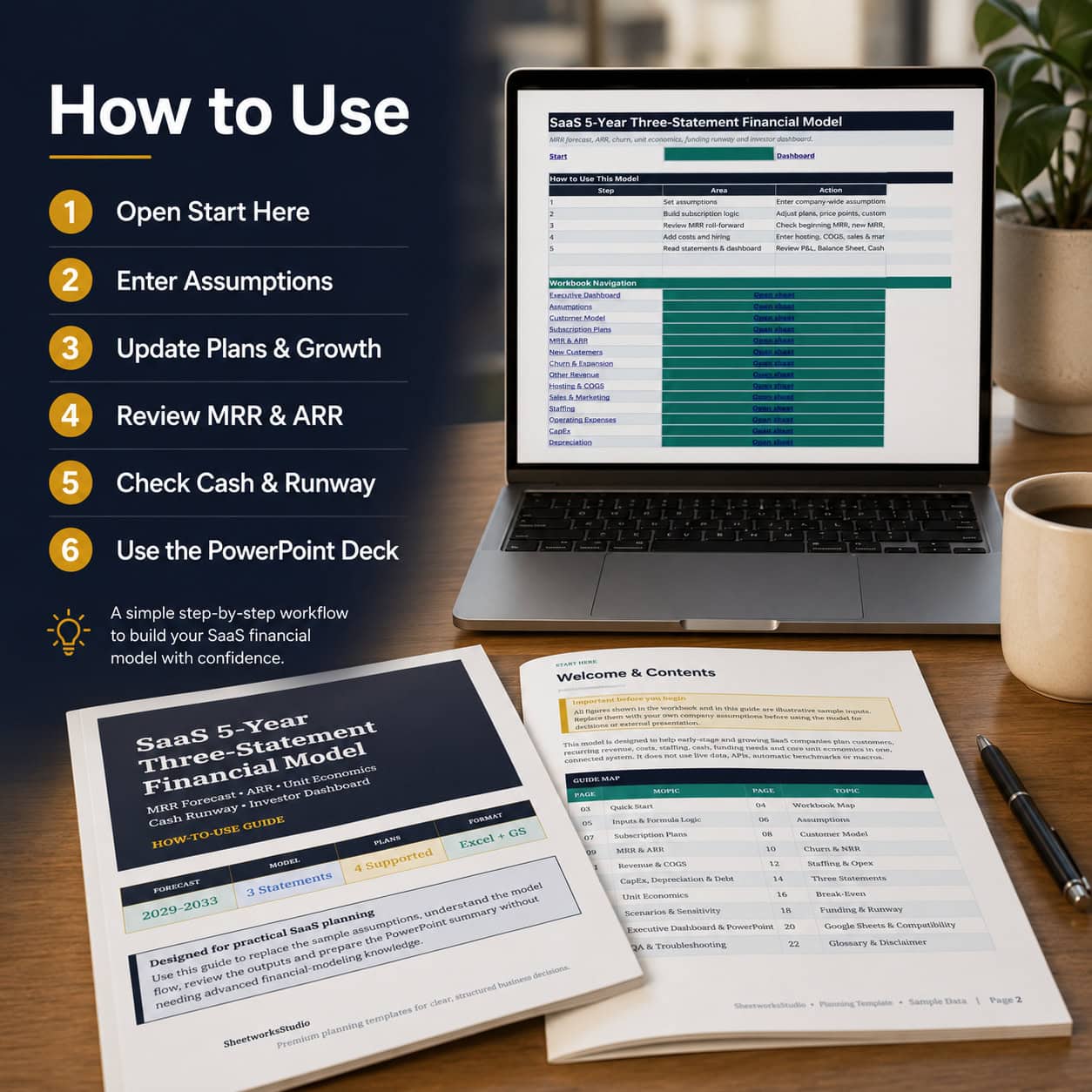
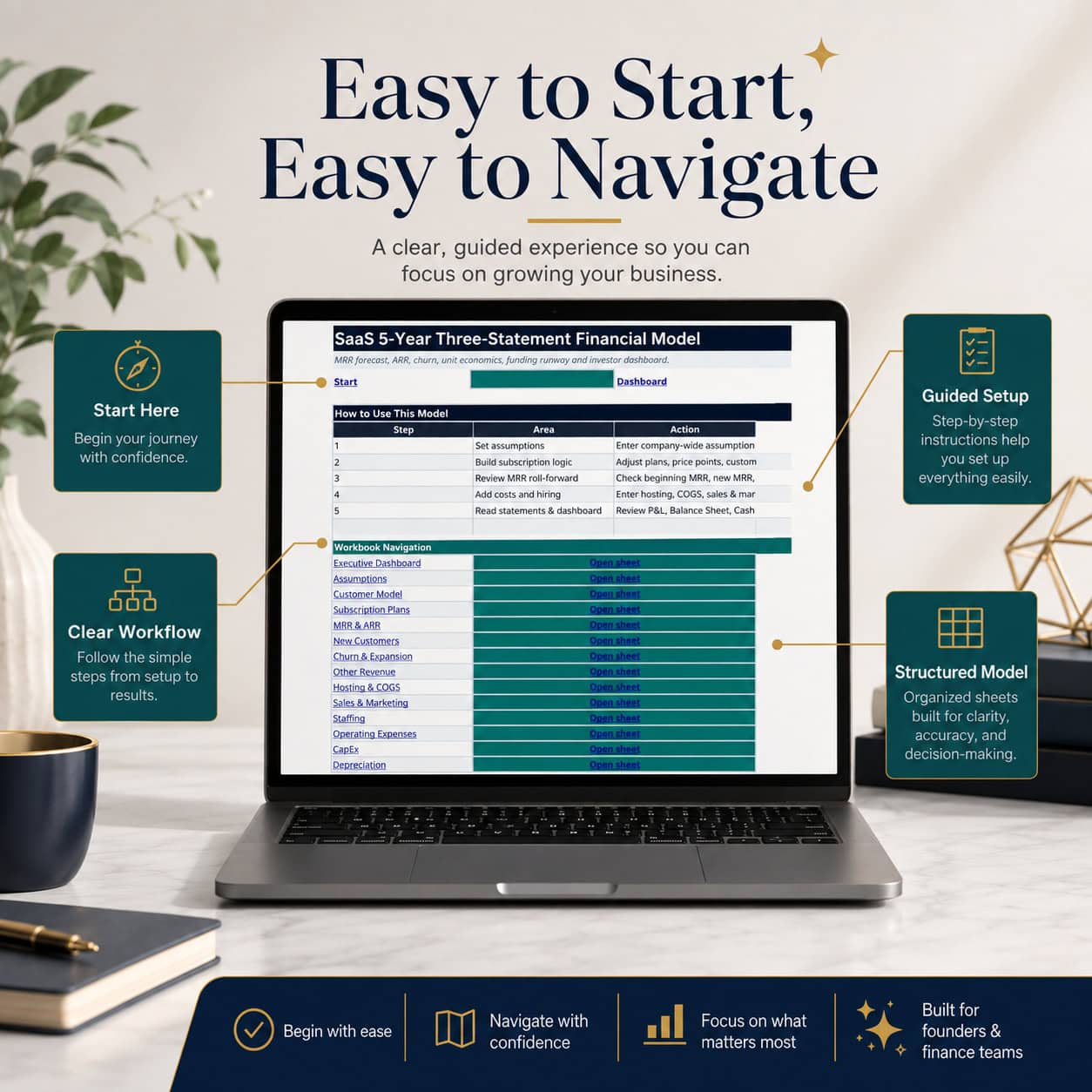
- Open the Excel workbook and begin with the Start Here worksheet.
- Review the illustrative sample data and planning assumptions.
- Replace the example inputs with your own business information.
- Configure subscription plans, pricing, customer growth, and churn.
- Enter operating costs, staffing, capital expenditure, and financing assumptions.
- Review the resulting financial statements and SaaS performance indicators.
- Explore break-even, scenario, sensitivity, and funding analyses.
- Use the Executive Dashboard and supporting PowerPoint presentation for internal reporting and planning discussions.
The included planning years and sample data are illustrative and can be adapted to individual requirements.
WHO IS THIS MODEL FOR?
This financial model is intended for:
- SaaS Founders and Startup Teams
- Subscription-Based Software Companies
- Entrepreneurs and Business Owners
- Financial Analysts
- Business and Financial Consultants
- Management and Finance Teams
- Professionals Preparing Business Plans and Financial Forecasts
TECHNICAL INFORMATION
- Microsoft Excel (.xlsx)
- Microsoft PowerPoint (.pptx)
- PDF User Guide (.pdf)
- 29 Excel Worksheets
- 15 PowerPoint Slides
- 22-Page Documentation
- Five-Year Financial Planning Horizon
- Editable Assumptions and Transparent Excel Formulas
- No VBA Macros
- No API Connections or Live Data
- Illustrative Sample Data for 2029–2033
- English-Language Files
Microsoft Excel is recommended for working with the financial model.
IMPORTANT DISCLAIMER
SheetworksStudio is an independent provider of unofficial digital business planning, financial modeling, and documentation templates.
This product is intended for financial planning, analysis, internal reporting, and informational purposes only. It does not constitute financial, investment, accounting, legal, tax, or other professional advice.
All sample data, assumptions, financial projections, and calculated outcomes are illustrative and should not be interpreted as verified industry benchmarks, investment recommendations, or guarantees of future performance.
Users are responsible for reviewing the model, validating the calculations and assumptions for their individual circumstances, and obtaining professional advice where appropriate.
SheetworksStudio — Professional Templates for Planning, Analysis & Documentation.
Similar ProductsOther customers were also interested in...



 eFinancialModels
Electric Vehicle (EV) Charging Station Financial M...
With this comprehensive 5- or 10-year monthly tool, investors can assess the viability of setting up... Read more

Financial Model for Mobile App | Mobile App Busine...
The Mobile App Financial Plan Template in Excel allows you to develop financial projections when lau... Read more

 HenrySheykin
Food Truck Financial Model Excel Template
The Food Truck Financial Model helps entrepreneurs, founders, business owners, consultants, and anal... Read more

Green Hydrogen Production from Wind Energy Financi...
The Green Hydrogen from Wind Financial Model aims to comprehensively forecast a horizon of 40 years ... Read more

Simple Mutual Non-Disclosure Agreement Template
Protect your business secrets with ease using our Simple Mutual Non-Disclosure Agreement Template. S... Read more

Solar Energy Financial Model
The Solar Energy Financial Model Spreadsheet Template in Excel assists you in preparing a sophistica... Read more

 Peter Graf
The Customer-Centric Financial Model for Restauran...
Starting a restaurant without a financial plan is like driving a car blindfolded. You wouldn´t do i... Read more
You must log in to submit a review.