
0 ITEMS

Office Lease Options Appraisal Model – Renew, Regear, Relocate or Consolidate
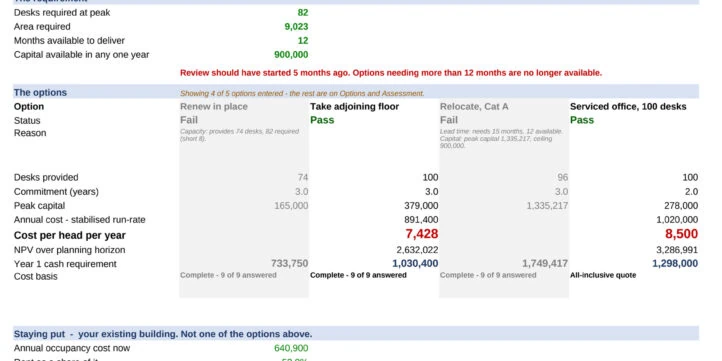
When a lease expires, most comparisons rank options by rent per square foot. That metric divides by the one variable you are deciding, ignores a third to a half of true occupancy cost, and ranks options that cannot physically seat your people or be delivered in the time you have left. This model reverses the order. It establishes your requirement first – desks, area, months available, capital ceiling – then tests every option against it. Options that fail capacity, lead time, capital or commitment are flagged with the margin stated and what would have to change for them to pass. Only the survivors are priced, on total occupancy cost per head. It carries the full cost pool rather than the lease document alone: rent, service charge, property taxes and rates, utilities, out-of-hours air conditioning, FM contracts, insurance, dilapidations, dual running and technical migration. It levels an all-inclusive serviced office price against a traditional lease. It converts gross floor area to net using the building’s efficiency ratio. It separates the stabilised run-rate from the Year 1 cash requirement, because a rent-free period distorts one and not the other. And one switch re-runs every gate and every cost at minus twenty per cent headcount. Built for the UK, Hong Kong, Singapore and New York, with each market’s measurement and cost conventions set out in the guide. Supplied with a fully populated London worked example and a 25-page user guide in English and Traditional Chinese.


What this model is for
Your office lease has an end date. Somewhere between now and then you have to choose between renewing, resizing in place, relocating, consolidating sites, or moving to serviced space. These options are not comparable on the number your agent will quote.
Renewing, regearing, relocating and consolidating carry different capital profiles, different one-off costs and different exit liabilities. Rent is typically only half to two-thirds of what a building actually costs to occupy. A rent-free period and a landlord contribution are designed to make an expensive option look cheap on the one metric agents use. And an option that cannot be delivered in the time you have left is not an option at all, whatever it costs.
This model produces a one-page appraisal you can put in front of a board, with the assumptions behind every figure recorded next to it.
Main features
Gates before cost. Four tests — capacity, lead time, capital, commitment — each returning Pass, Conditional or Fail against a threshold you set, with the margin stated in words. Options that fail are not ranked on cost. For every failed gate the model states what would have to change: the headcount at which the option becomes adequate, the ratio that would make it fit, the capital ceiling that would accommodate it, the date by which it would have needed to start.
The full occupancy cost pool. Ten recurring lines including out-of-hours air conditioning, which is a real cost in Asian markets and appears in no lease. One-off costs include dual running, professional fees, transaction tax, deposits, dilapidations and technical migration — the comms room rebuild that is often larger than the removal invoice.
Flexible and traditional on one comparison. An all-inclusive monthly desk rate and a leased floor are levelled onto the same cost pool, with the implied area per desk of each reported against your own space standard.
Gross-to-net conversion. Enter the area as the lease states it and the building’s efficiency ratio beside it. The model derives the net area for every comparison against your space standard and carries the ratio to the summary, so the assumption is on the record rather than in someone’s calculator.
Run-rate against Year 1 cash. The stabilised annual cost and the first-year funding requirement are reported separately. A long rent-free period can make an expensive option the easiest one to start; a board needs both numbers.
A minus twenty per cent stress test. One switch re-runs every gate and every cost at reduced headcount. In the supplied worked example the answer reverses: the renewal that failed on capacity becomes the cheapest option by a wide margin.
Blank cost lines are estimated, not zeroed. An unanswered cost is scaled from your current building rather than treated as nil, so an option nobody has fully quoted looks dearer rather than cheaper. Every option carries a Complete, Estimated or Incomplete label through to the summary.
How to work with it
Complete the Requirement sheet before you look at a single option. It returns how many desks you need, how much area, how long you actually have after approval time and contingency, and whether the review should already have started. That output alone is worth taking to a board.
Then the current position, on the same cost pool every option is measured on. Then the options, from your own agents’ proposals and your own quotes.
The first pass takes two to three hours, most of it spent finding numbers about your own building that nobody has had reason to assemble before. Waiting for agents to supply the rest takes one to two weeks — that is the market, not the workbook.
Why you need it
Because the alternative is a comparison built by the party selling you the space, on a metric designed for negotiation.
What is included
A fully populated London worked example, so you can see every output before you fill anything in. A blank template with 1,056 formulas, explicit blank-input handling and no hidden error suppression. A 25-page user guide in English, and the same guide in Traditional Chinese — localised rather than translated, with a short VAT chapter and a considerably longer Hong Kong section.
What is not included
No market rents, construction rates or benchmark costs are supplied. Every figure is your own lease terms and your own quotes. The model does not produce lease accounting balances, does not calculate tax, and does not natively handle North American base-year operating expense escalations — the guide explains the workaround for that one market. Every other supported market is handled natively.
Built for the UK, Hong Kong, Singapore and New York, with each market’s measurement and cost conventions set out in the guide.
Similar ProductsOther customers were also interested in...



 eFinancialModels
Electric Vehicle (EV) Charging Station Financial M...
With this comprehensive 5- or 10-year monthly tool, investors can assess the viability of setting up... Read more

Financial Model for Mobile App | Mobile App Busine...
The Mobile App Financial Plan Template in Excel allows you to develop financial projections when lau... Read more

 HenrySheykin
Food Truck Financial Model Excel Template
The Food Truck Financial Model helps entrepreneurs, founders, business owners, consultants, and anal... Read more

Green Hydrogen Production from Wind Energy Financi...
The Green Hydrogen from Wind Financial Model aims to comprehensively forecast a horizon of 40 years ... Read more

Simple Mutual Non-Disclosure Agreement Template
Protect your business secrets with ease using our Simple Mutual Non-Disclosure Agreement Template. S... Read more

Solar Energy Financial Model
The Solar Energy Financial Model Spreadsheet Template in Excel assists you in preparing a sophistica... Read more

 Peter Graf
The Customer-Centric Financial Model for Restauran...
Starting a restaurant without a financial plan is like driving a car blindfolded. You wouldn´t do i... Read more
You must log in to submit a review.