
0 ITEMS

Carbon Capture & Storage (CCS) Financial Model Excel | 25-Year Project Finance, DSCR, NPV & IRR
Evaluate carbon capture and geological storage project economics with a macro-free Excel model: 11 worksheets, 300 monthly periods, 15 sample emitter contracts, 8 native charts, 3 scenarios, linked debt and returns, physical CO₂ accounting and an 18-page professional guide.
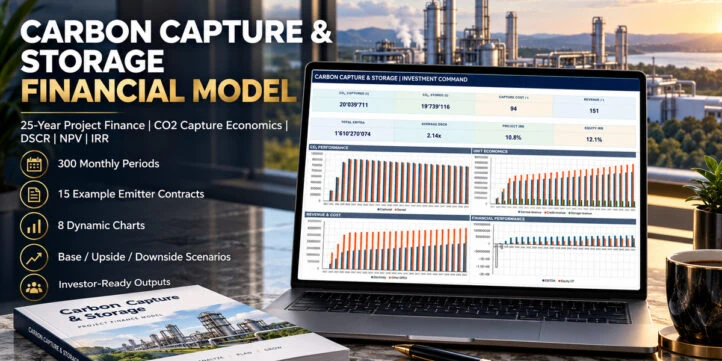
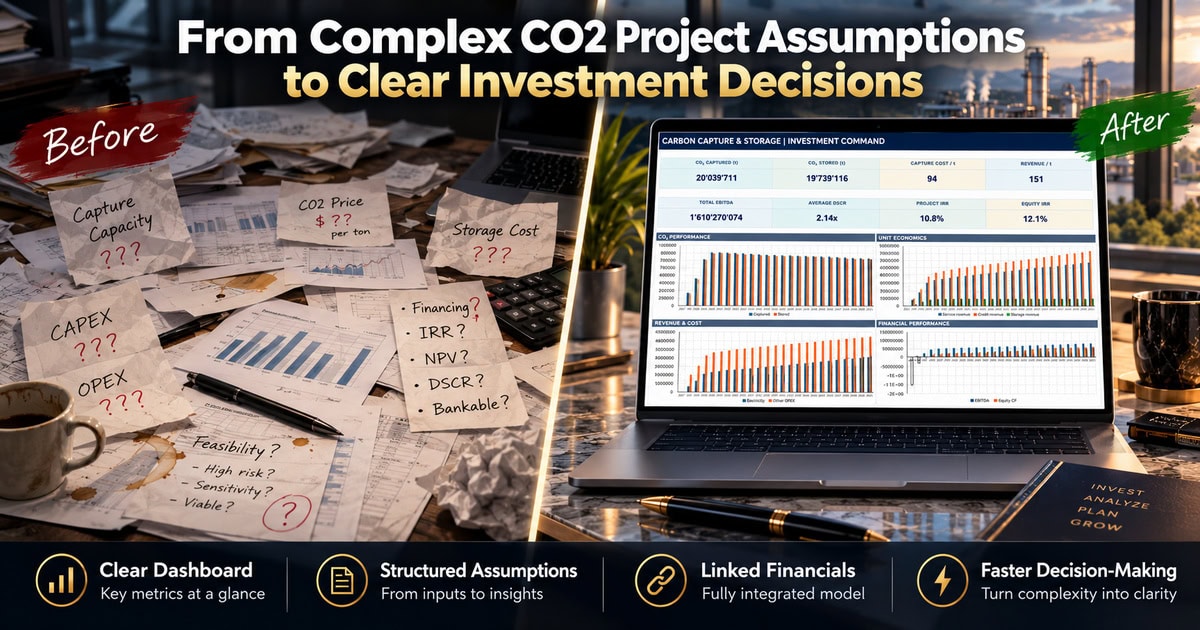

Evaluate the financial and operating drivers of a fictional carbon capture and geological storage (CCS) project through a transparent, independently branded Excel financial-planning template. Connect contracted emitter volumes, capture and transport efficiency, available storage capacity, carbon-credit assumptions, commercial service tariffs, recurring project costs, annual debt movements and investor cash flows within one connected workbook.
The model is designed for climate-tech analysts, energy transition teams, infrastructure developers, project finance professionals, consultants and students exploring carbon capture project economics. Every sample figure is illustrative and must be replaced and independently verified for a real investment case.
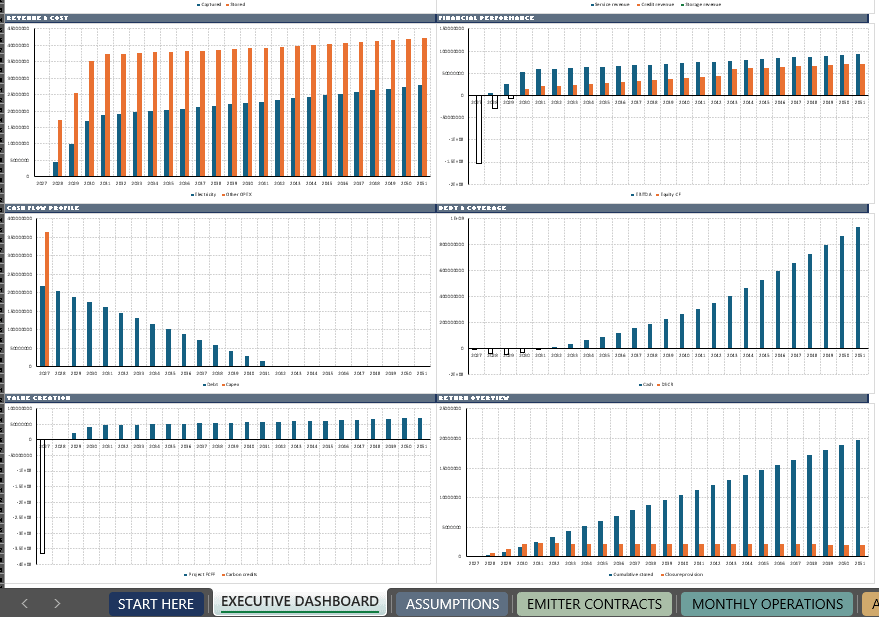
📊 EXECUTIVE DASHBOARD
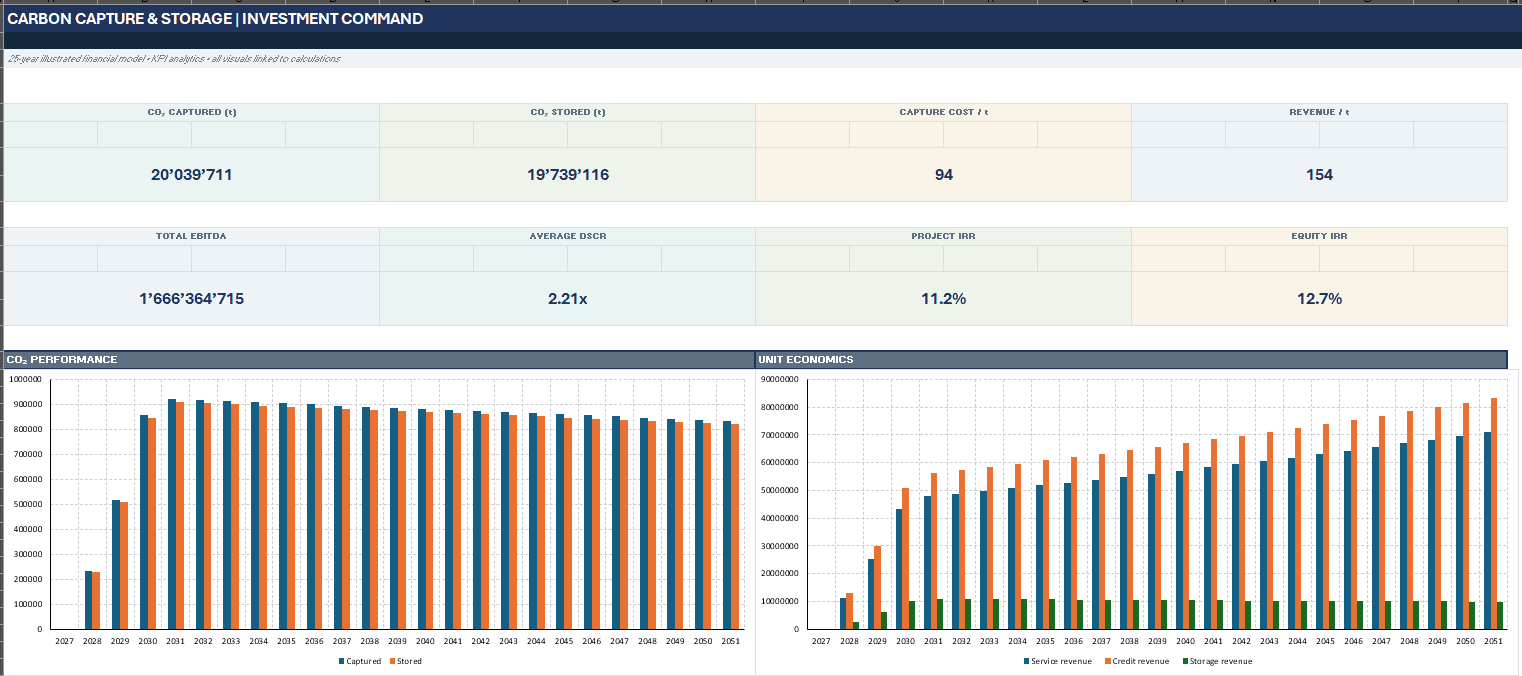
Review eight native, Excel-linked financial charts covering captured and stored CO₂, commercial income streams, operating expenses, EBITDA, project cash flows, debt trends, storage headroom and other tracked drivers.
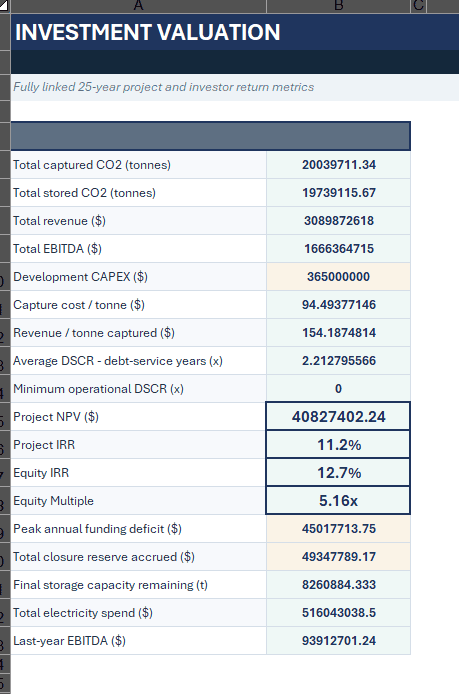
Dedicated KPI fields summarize total capture, total storage, capture cost per tonne, revenue per captured tonne, cumulative EBITDA, average modeled DSCR, Project IRR and Equity IRR.
The native chart series contain saved numerical data to improve workbook previews; the final XLSX requests a full spreadsheet recalculation on opening.
⚙️ EMITTER CONTRACTS & CAPTURE PERFORMANCE
Start with 15 illustrative emitter records representing sectors including cement, steel, refining, chemicals and power generation. Modify annual CO₂ supply, eligibility, contract dates, delivery reliability, portfolio allocation and individual service fees.
Capture-related service revenue reflects a volume-weighted active emitter fee profile relative to an editable reference fee and base project tariff. Update both ASSUMPTIONS and EMITTER CONTRACTS to test commercial contract economics.
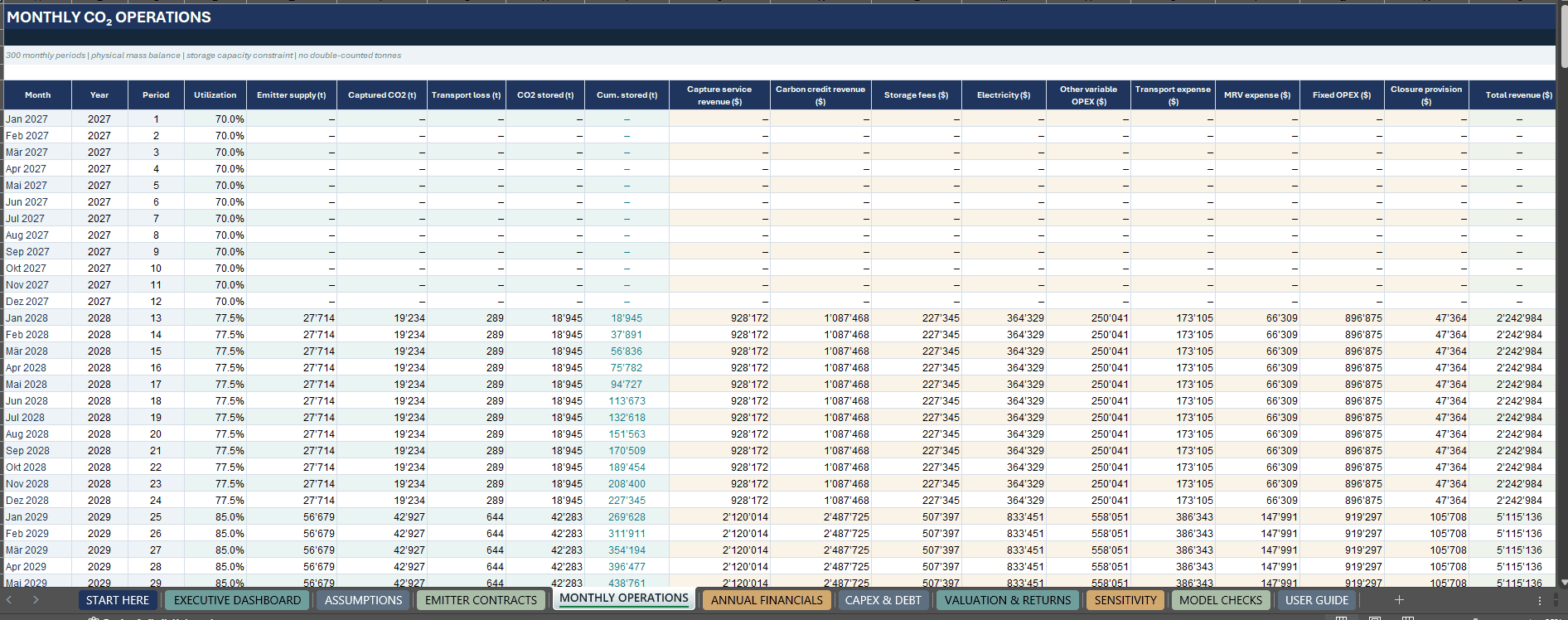
The 300-month operating schedule connects contracted eligible supply with plant nameplate capacity, capture efficiency, commissioning ramp-up, degradation, transport loss, injection availability and cumulative stored volumes.
The model distinguishes captured CO₂ from modeled stored volumes and explicitly identifies captured volumes not stored.
◈ REVENUE & OPERATING ECONOMICS
Model capture service fees, illustrative carbon-credit realization and storage-service income.
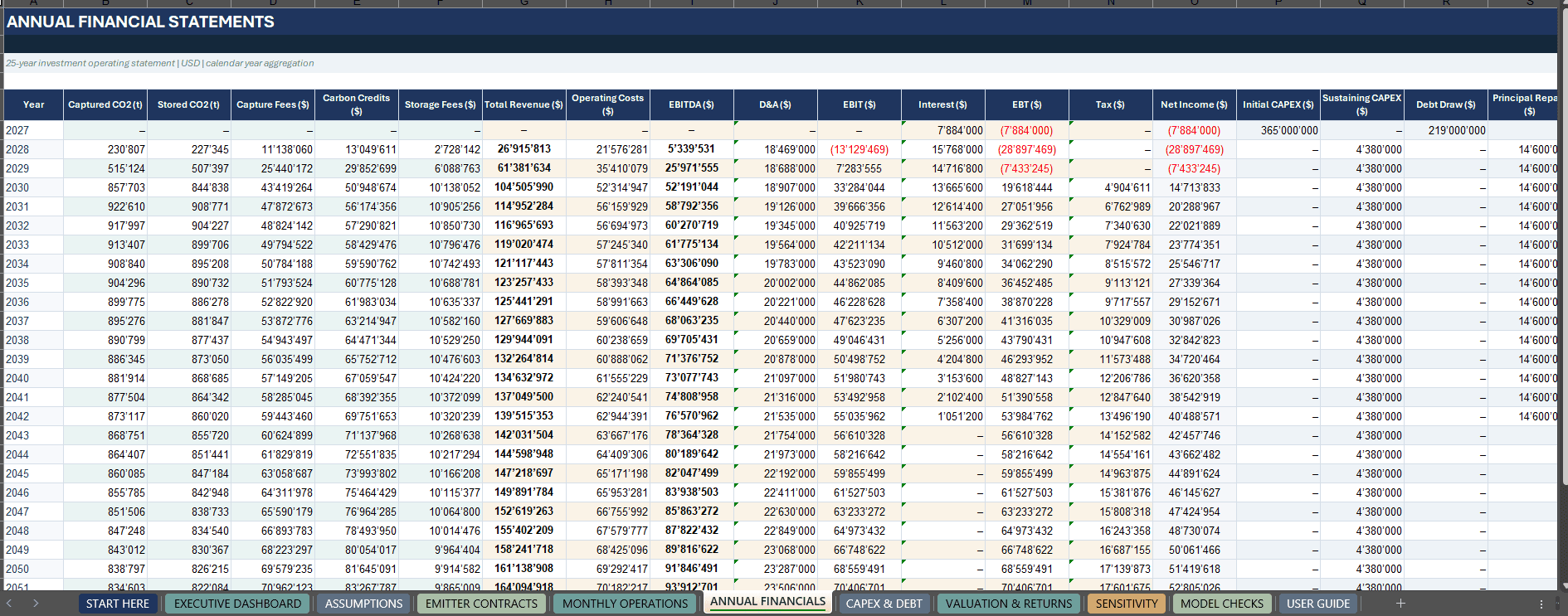
Operating costs include electricity consumption, chemicals and consumables, transport, monitoring/reporting/verification (MRV), fixed OPEX, modeled closure charges and sustaining CAPEX.
The unit economics view reports an aggregate lifetime capture cost per captured tonne and revenue per captured tonne. These are illustrative financial ratios, not certified engineering-cost benchmarks.
🏦 CAPITAL STRUCTURE & DEBT SERVICE
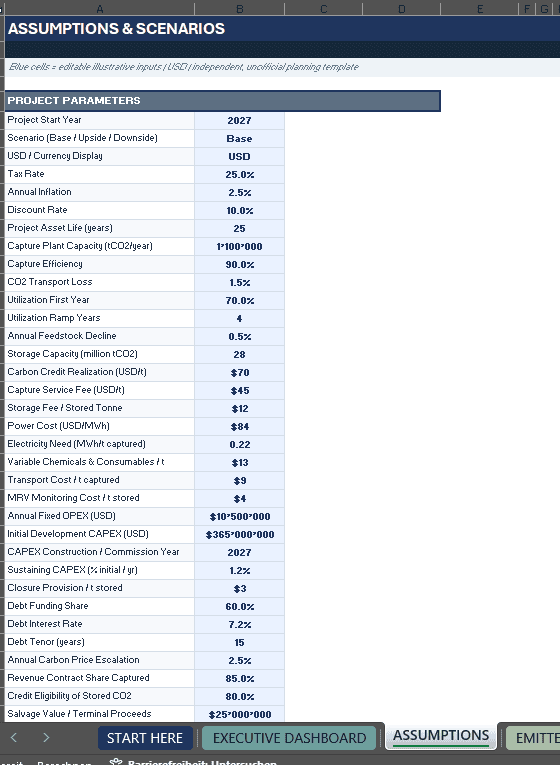
Edit initial development CAPEX, construction timing, sustaining investment, debt-funding share, interest, annual amortization tenor, assumed tax, inflation and discounting.
The annual financing schedule links CAPEX, loan drawdown, debt service, closing debt balances and sponsor equity funding.
Debt finance, tax and accounting are intentionally simplified at the annual level. This is not a granular, lender-approved monthly debt-sculpting model, full debt waterfall or certified three-statement underwriting package.
📈 VALUATION, RETURNS & COVERAGE
Review modeled Project NPV, annual-frequency Project IRR, annual-frequency Equity IRR, equity multiple, DSCR, peak annual funding gap, project free cash flow, captured and stored CO₂, total EBITDA and lifetime electricity expenses.
Project NPV uses the initial project cash flow at time zero followed by the remaining annual project cash flows discounted at the selected rate. IRR outputs are based on the annual cash-flow vectors, not a monthly investor XIRR.
The entered illustrative salvage/terminal assumption is not automatically included in the current Project IRR or NPV vectors. The modeled closure charge is not a segregated funded reserve account.
🔀 THREE LIVE SCENARIOS & INDICATIVE SENSITIVITY
Switch between Base, Upside and Downside using the scenario selector in ASSUMPTIONS.
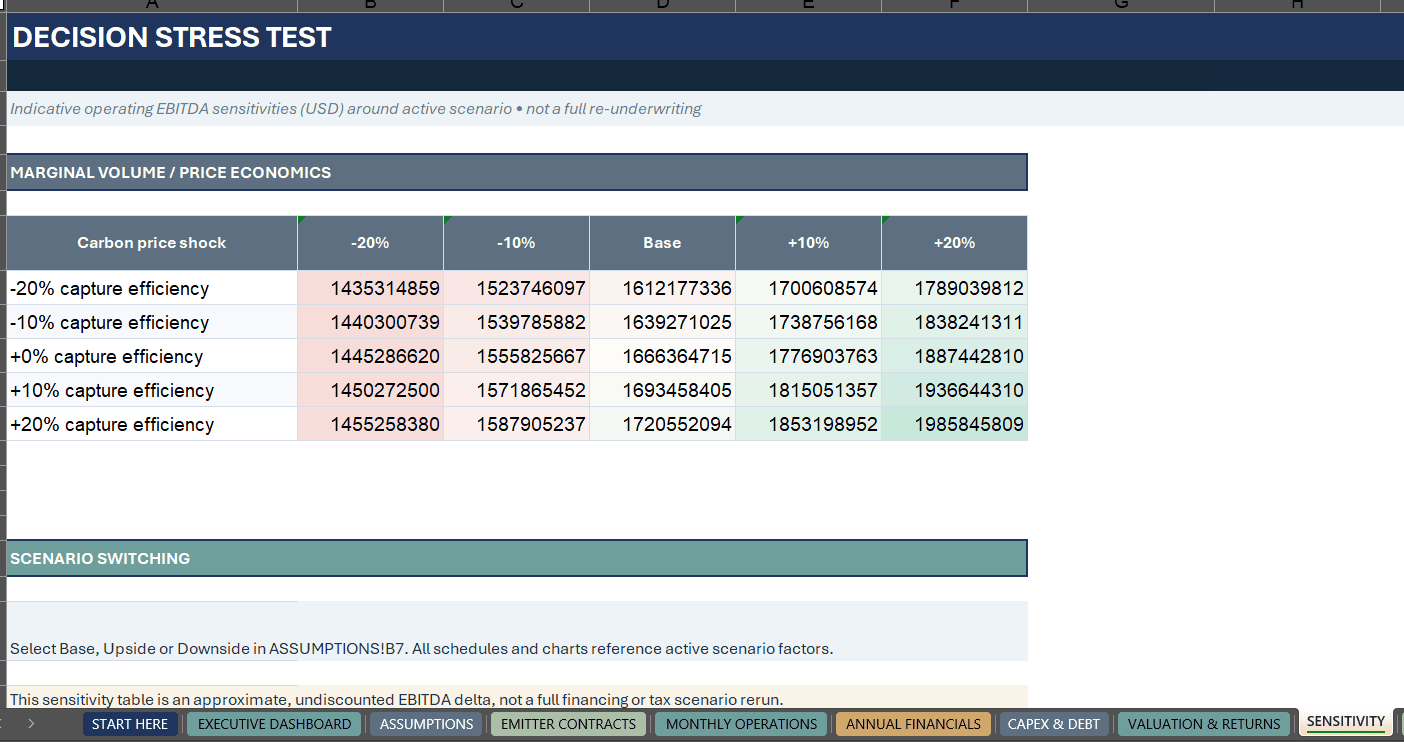
The selected case changes modeled service/carbon pricing, electricity costs, capture efficiency, initial CAPEX, commissioning delays, other OPEX and transport/storage availability, recalculating the linked operating and finance schedules.
The separate SENSITIVITY worksheet provides directional estimates for carbon-price and capture-efficiency changes to illustrative lifetime EBITDA.
This is not a fully rerun, multi-variable DSCR or DCF sensitivity matrix.
✅ MODEL CHECKS & ECONOMIC WARNINGS
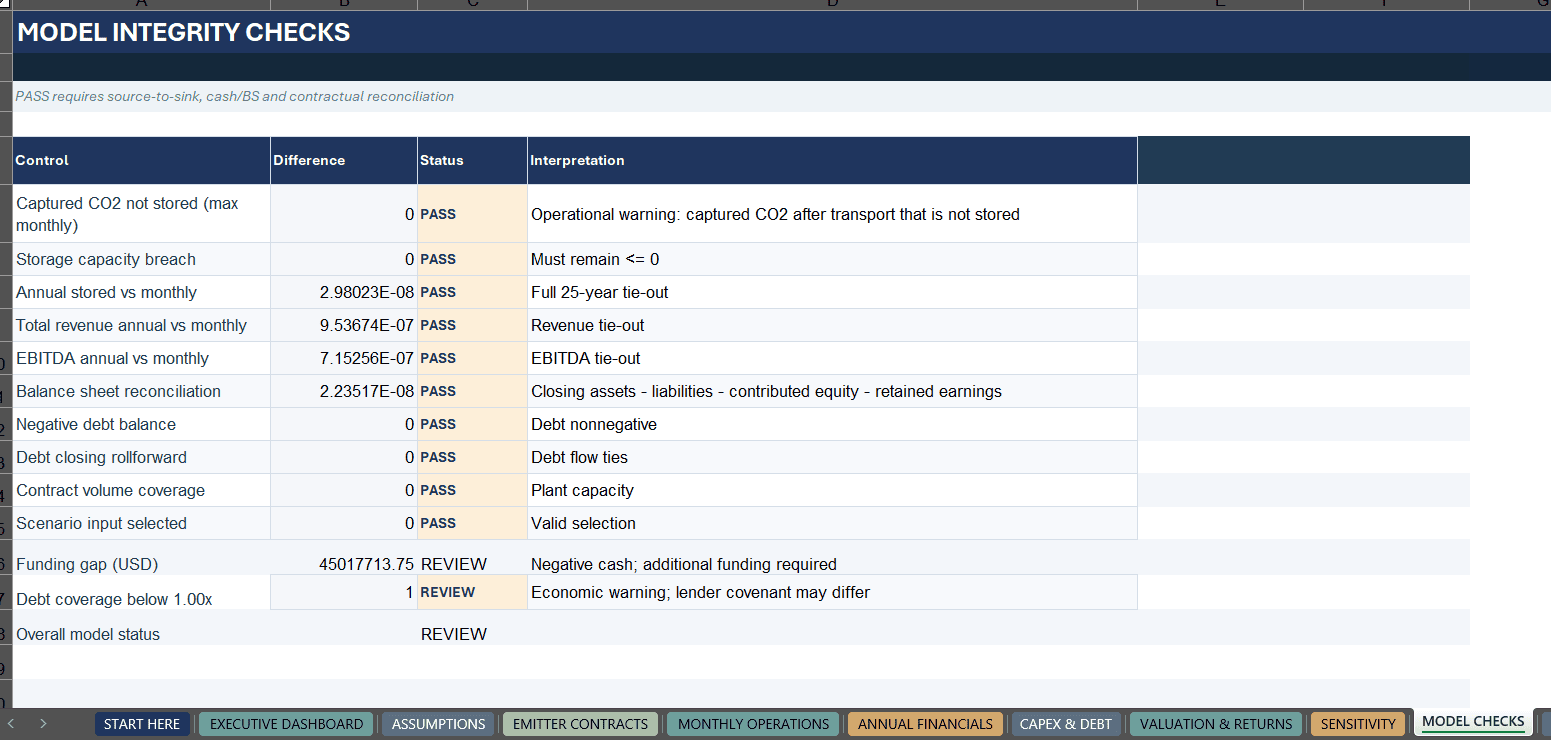
Built-in controls test physical storage consistency, storage-capacity limitations, annual/monthly revenue and EBITDA reconciliation, balance-sheet relationships, debt movements, project throughput and valid scenario selection.
Additional economic checks identify captured volumes not stored, negative annual cash and operating debt-service coverage below an indicative 1.00x threshold.
Important: With the supplied fictional assumptions, Base, Upside and Downside all show negative annual cash balances and minimum modeled operating DSCR below 1.00x.
These cases represent unresolved illustrative funding and debt-service risk; passing accounting identities does not mean the project is fully financed or commercially viable.
📦 WHAT YOU RECEIVE
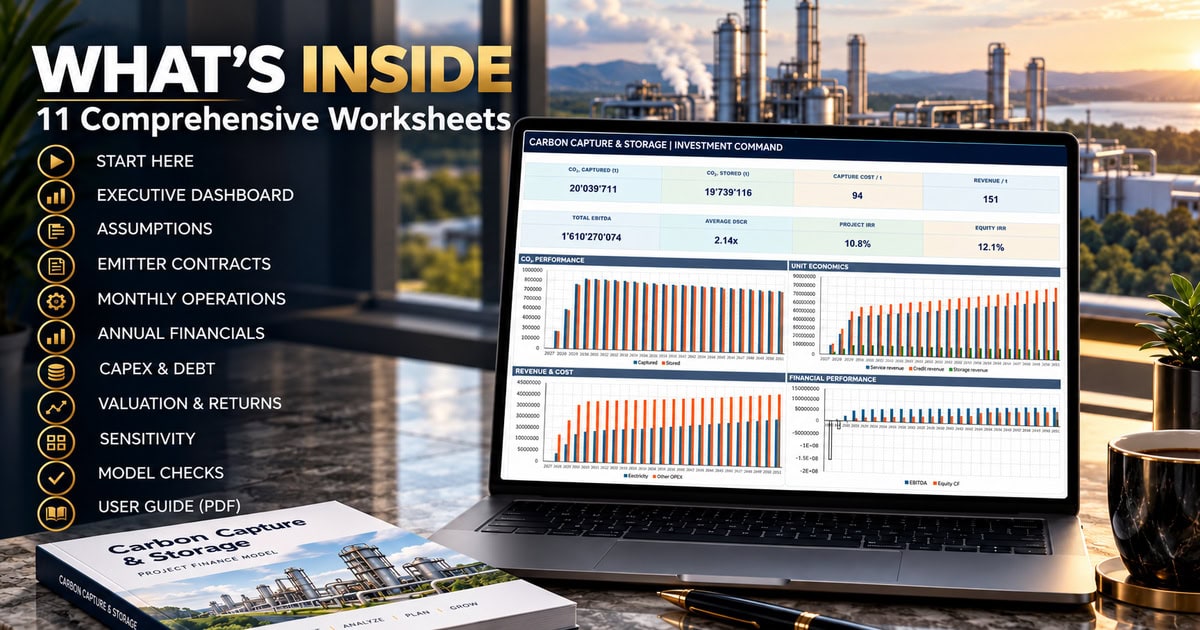
One editable macro-free Excel financial model (.xlsx) with 11 worksheets:
START HERE
EXECUTIVE DASHBOARD
ASSUMPTIONS
EMITTER CONTRACTS
MONTHLY OPERATIONS
ANNUAL FINANCIALS
CAPEX & DEBT
VALUATION & RETURNS
SENSITIVITY
MODEL CHECKS
USER GUIDE
The workbook contains 300 monthly forecast periods, 25 linked annual financial periods covering the illustrative 2027–2051 timeline, 15 sample emitter agreements, three scenarios, eight native charts and automated model checks.
One 18-page Professional How-to-Use PDF: original 16-page handbook plus a two-page model-QA addendum documenting the updated contract pricing, NPV timing, CO₂ accounting and economic warning conventions.
🧭 HOW TO USE
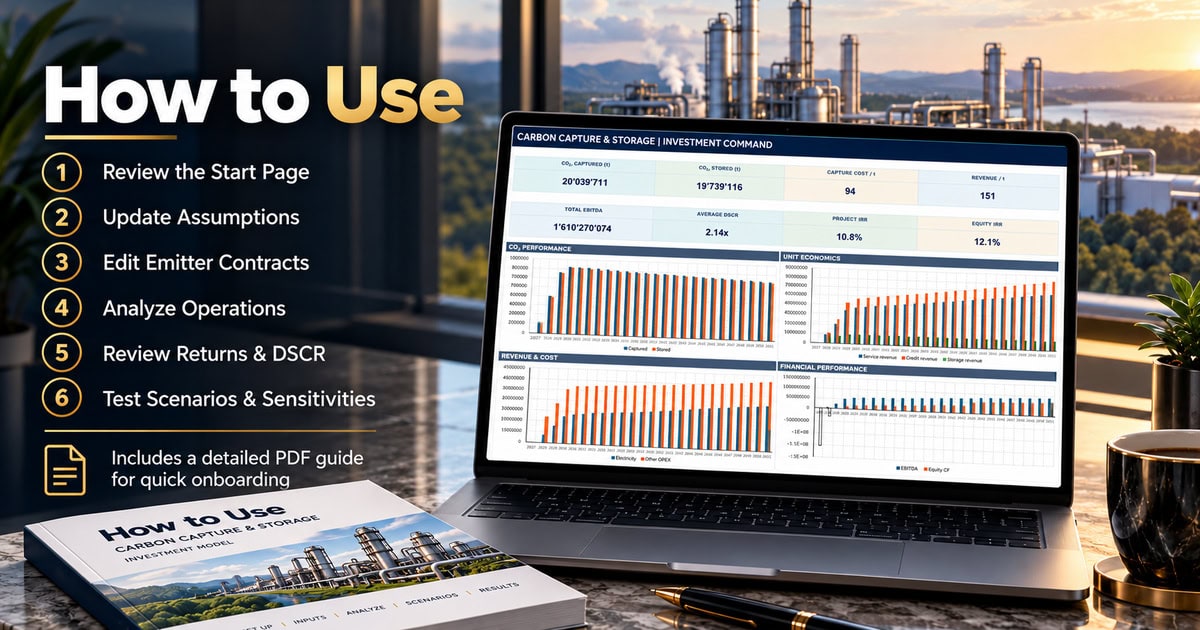
Save a separate project copy. Review START HERE and ASSUMPTIONS, select the scenario and replace project start dates, emitter contracts, tariffs, operating capacities, energy costs, investment expenses and debt conditions.
Follow MONTHLY OPERATIONS and ANNUAL FINANCIALS, review the output dashboard and investigate funding, DSCR and storage warnings before using returns for project evaluation.
⚙️ TECHNICAL SCOPE & COMPATIBILITY
Microsoft Excel .xlsx plus PDF guide. No VBA macros or live external data connections.
Desktop Excel is the reference application. Google Sheets import and chart parity have not been independently tested.
The 25-year forecast includes a construction/investment year; under sample contract dates it does not represent 25 complete operating years in addition to construction.
The currency label is illustrative and does not perform automatic FX conversion. Monthly operations and annual financing/valuation should not be confused with fully integrated monthly project-finance debt sculpting.
🛡️ IMPORTANT INDEPENDENT TEMPLATE DISCLAIMER
This is a privately produced, unofficial financial-planning and educational template.
It is not a certified carbon-storage engineering calculation, geological risk assessment, regulatory MRV validation, guaranteed credit monetization scheme, independently audited forecast or bank-approved investment model.
All example emissions, prices, contract assumptions, financing and outputs are fictional. Model controls confirm certain implemented relationships; they cannot verify project feasibility, environmental permanence, legal eligibility, market prices or funding availability.
This material does not constitute personalized investment, financial, tax, legal or engineering advice. Obtain independent professional review before making actual investment decisions.
Bring physical CO₂ flows, commercial assumptions and long-term financial trade-offs together in one editable CCS planning workbook.
Similar ProductsOther customers were also interested in...


 eFinancialModels
Electric Vehicle (EV) Charging Station Financial M...
With this comprehensive 5- or 10-year monthly tool, investors can assess the viability of setting up... Read more

Financial Model for Mobile App | Mobile App Busine...
The Mobile App Financial Plan Template in Excel allows you to develop financial projections when lau... Read more

 HenrySheykin
Food Truck Financial Model Excel Template
The Food Truck Financial Model helps entrepreneurs, founders, business owners, consultants, and anal... Read more

Green Hydrogen Production from Wind Energy Financi...
The Green Hydrogen from Wind Financial Model aims to comprehensively forecast a horizon of 40 years ... Read more

Simple Mutual Non-Disclosure Agreement Template
Protect your business secrets with ease using our Simple Mutual Non-Disclosure Agreement Template. S... Read more

Solar Energy Financial Model
The Solar Energy Financial Model Spreadsheet Template in Excel assists you in preparing a sophistica... Read more

 Peter Graf
The Customer-Centric Financial Model for Restauran...
Starting a restaurant without a financial plan is like driving a car blindfolded. You wouldn´t do i... Read more
You must log in to submit a review.