
0 ITEMS

Biochar Carbon Removal Financial Model Excel | 20-Year Pyrolysis, Carbon Credits & Project Finance
Evaluate biochar pyrolysis and carbon removal economics with a 240-month Excel financial model. Includes 23 worksheets, feedstock and credit issuance calculations, three financial statements, debt financing, NPV, five indicative scenarios, eight native dashboard charts and a professional 25-page PDF guide.

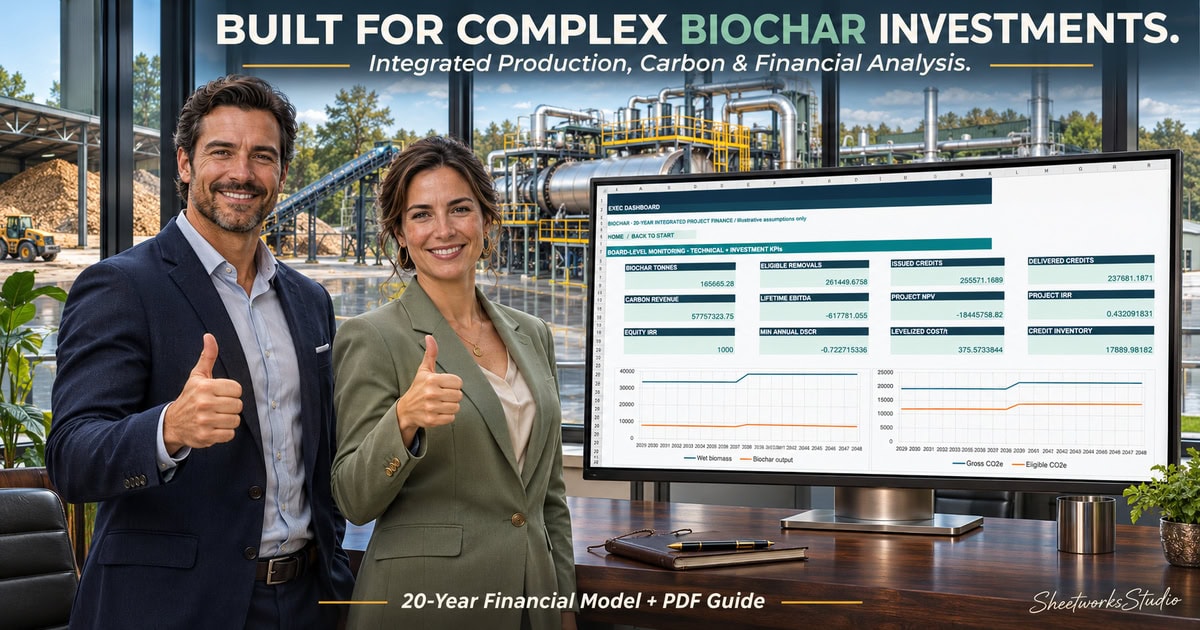
BIOCHAR CARBON REMOVAL FINANCIAL MODEL | 20-YEAR SIGNATURE LUXURY EDITION
Biomass Pyrolysis • Carbon Credits • Project Cash Flow • NPV • DSCR
FROM BIOMASS TO CARBON REMOVAL ECONOMICS.
Understand how biomass feedstock, pyrolysis performance, carbon removal eligibility, credit pricing and financing influence the economics of a commercial biochar project.
The Biochar Carbon Removal Financial Model by SheetworksStudio connects physical production, carbon accounting, credit issuance, product revenues and project financing in one structured Excel workbook.
Built for biochar developers, pyrolysis operators, carbon removal consultants, infrastructure analysts and finance professionals, this editable template supports 20-year financial planning and assumption-based project evaluation.
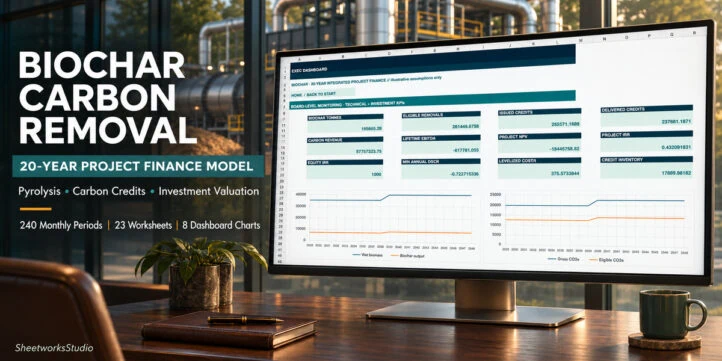
Explore 240 monthly periods, 20 annual summaries, 23 worksheets and eight native dashboard charts within a premium navy, teal and sage interface.
All example data and financial projections are fictional and illustrative.
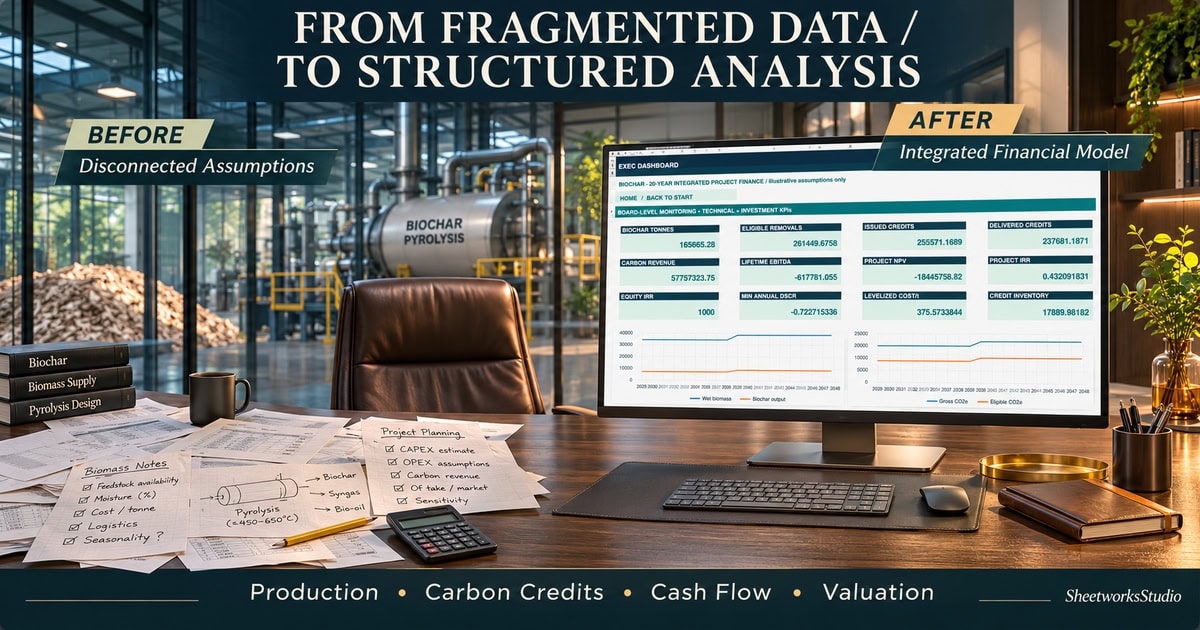
📊 EXECUTIVE DASHBOARD & PROJECT KPIs
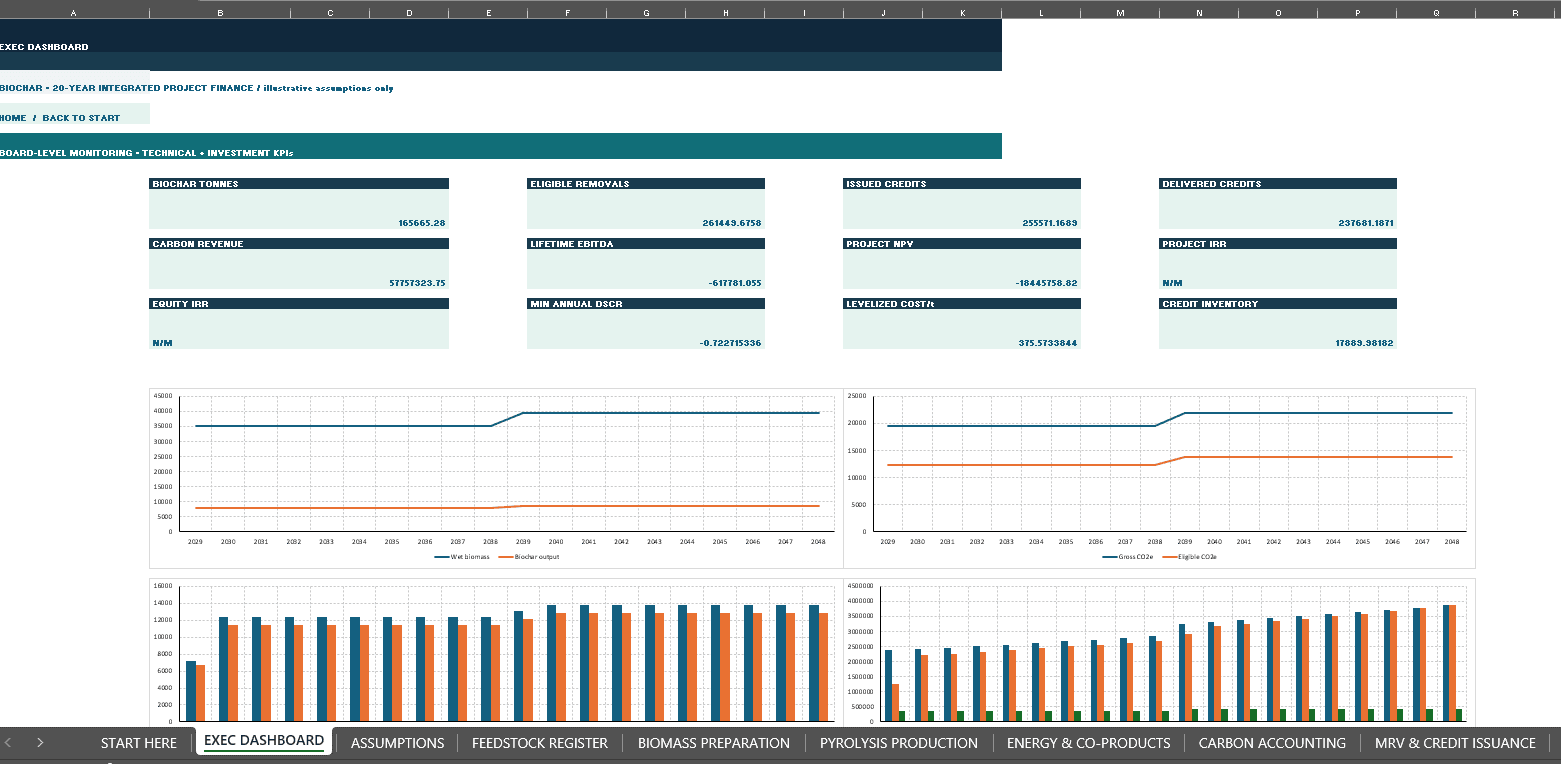
Review twelve linked operating and financial KPI fields covering biochar output, eligible carbon removals, carbon credits, revenue, EBITDA, project NPV, investment-return status, debt coverage and levelized removal costs.
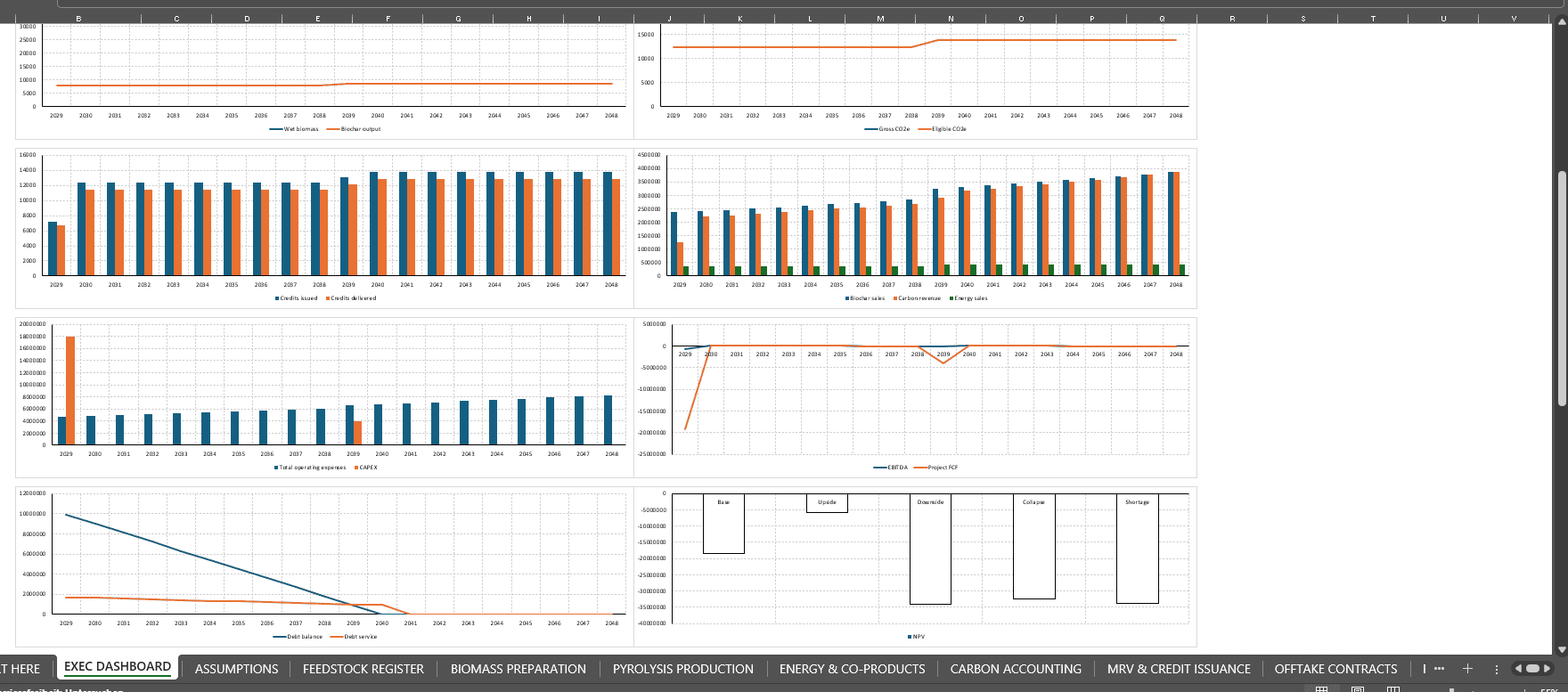
Eight native Excel charts visualize:
• Biomass Input vs Biochar Production
• Gross vs Eligible Carbon Removal
• Carbon Credit Issuance vs Delivery
• Revenue Composition
• Operating Cost Structure
• EBITDA vs Free Cash Flow
• Debt Balances & DSCR
• Indicative Scenario Investment Metrics
The dashboard connects physical operating assumptions with financial results and investment risks.
⚙️ FEEDSTOCK & PYROLYSIS PRODUCTION
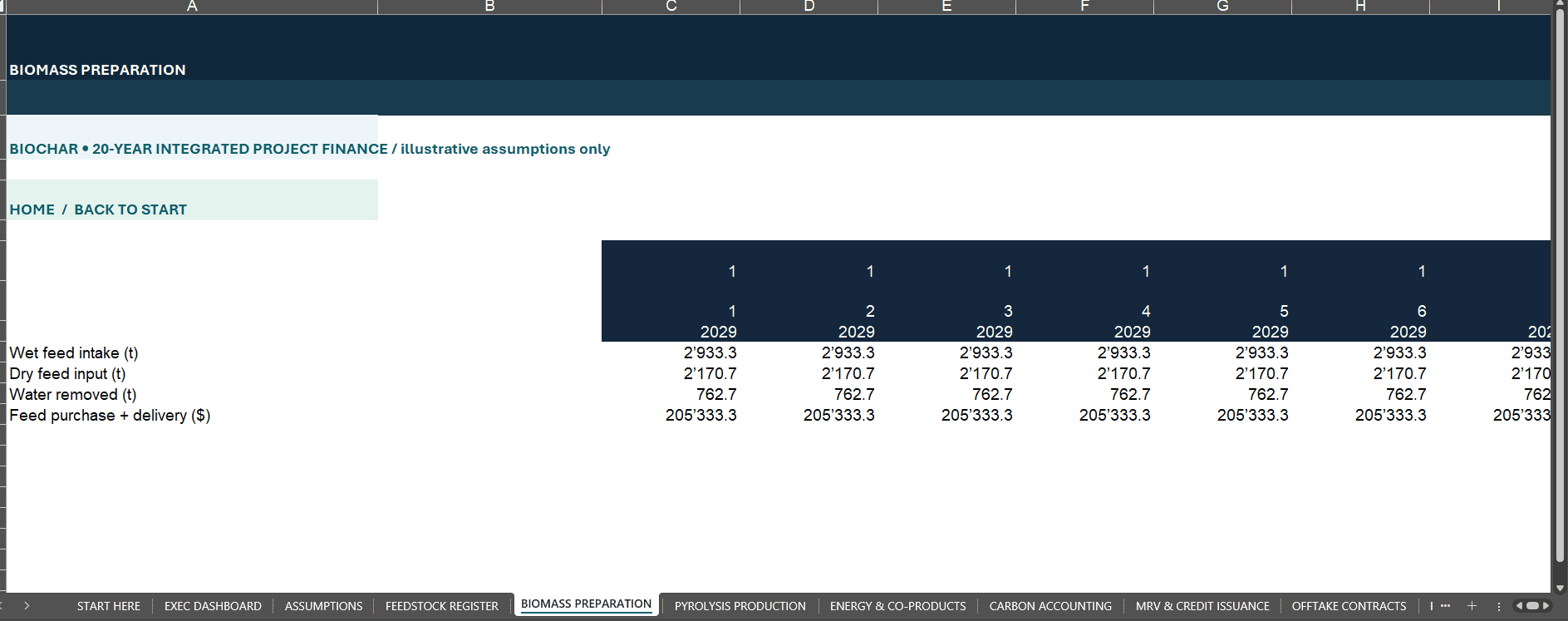
Model the transformation of wet biomass into dry feedstock and finished biochar.
Configure biomass processing capacity, moisture content, plant availability, production yield and energy recovery assumptions.
Review wet and dry feedstock quantities, modeled biochar production and product sales.
Separate physical production from commercial deliveries to better understand plant utilization and operating economics.
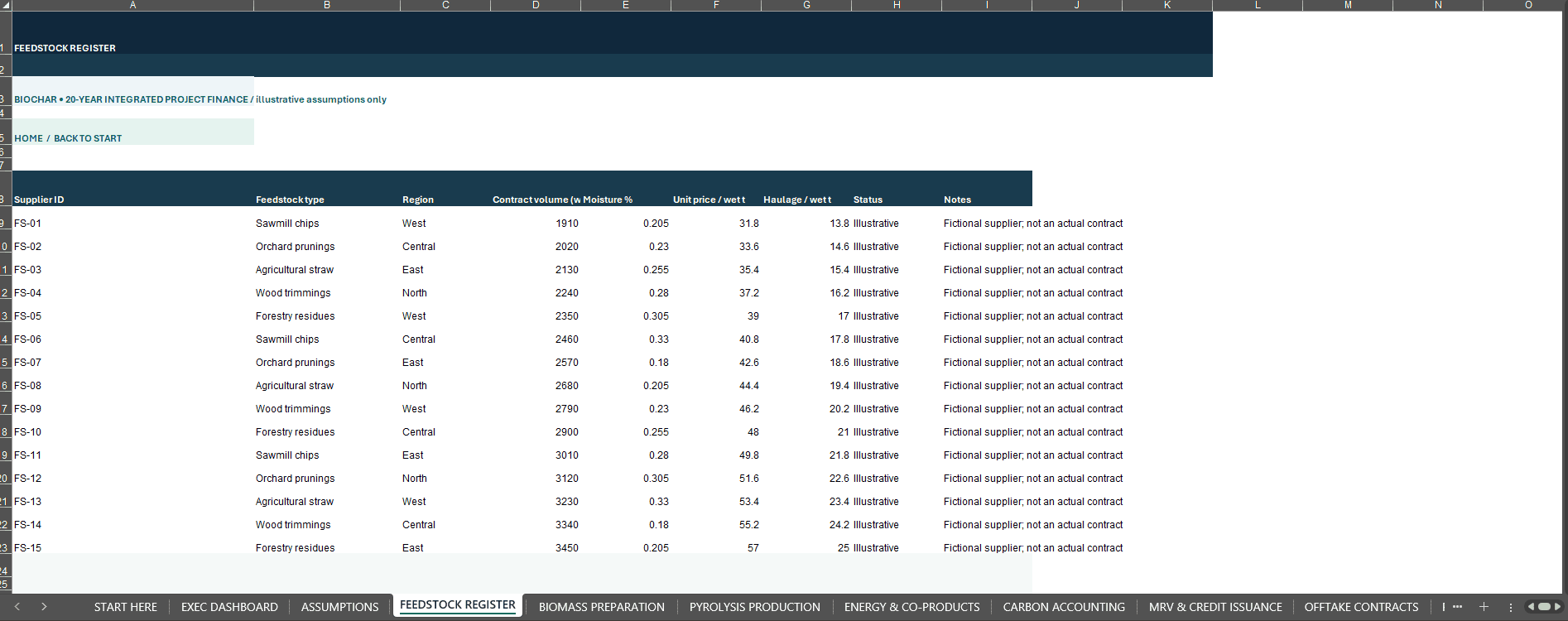
The workbook also contains illustrative feedstock supplier and operating registers. Core production calculations are driven by central project assumptions; example register entries are not automatically a complete contract-level operating engine.
◈ CARBON ACCOUNTING & CREDIT ISSUANCE
Trace the carbon removal calculation from biochar production through estimated stable carbon and CO₂-equivalent sequestration.
The model incorporates editable assumptions for:
• Stable carbon content and permanence
• Lifecycle emissions deductions
• Carbon removal eligibility
• Verification success
• Credit buffer withholding
• Issuance delays
• Credit deliveries and remaining inventory
A dedicated MRV & CREDIT ISSUANCE worksheet distinguishes modeled eligible removals from issued, delivered and undelivered credit quantities.
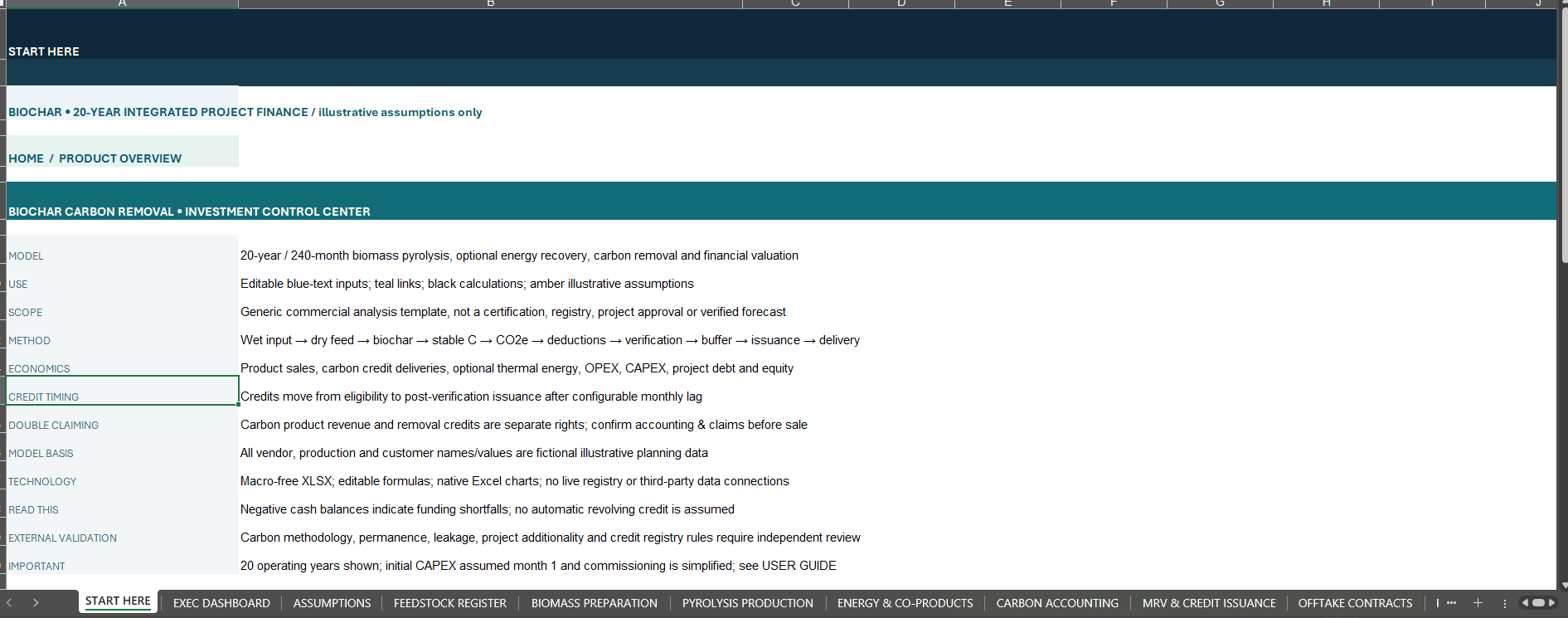
These calculations are planning assumptions, not certified carbon removal claims or evidence of registry-issued credits.
💼 REVENUE, OPERATING COSTS & INVESTMENT
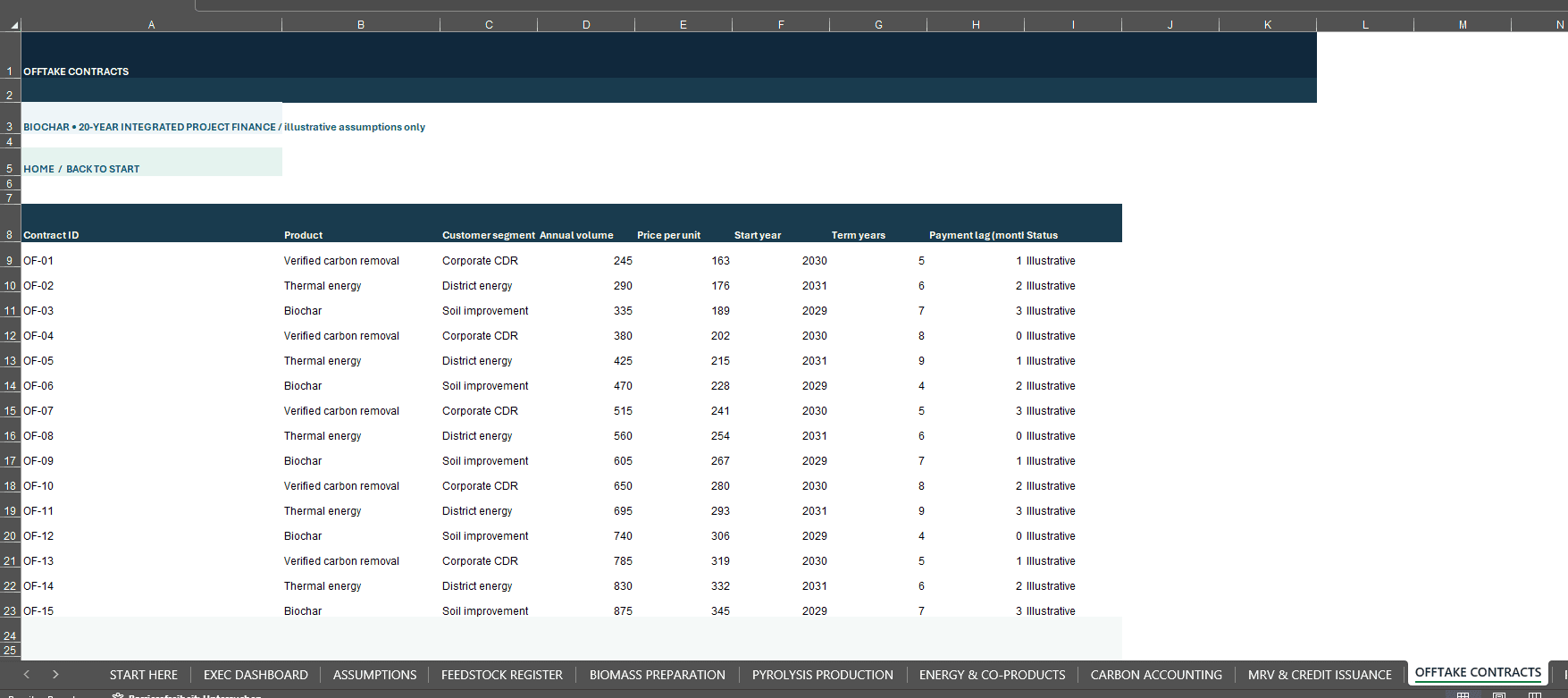
Evaluate three potential commercial revenue streams:
BIOCHAR SALES — Modeled product deliveries and selling prices.
CARBON CREDITS — Modeled credit deliveries and realized prices.
ENERGY RECOVERY — Illustrative recoverable energy and commercial energy revenue.
Operating costs cover feedstock purchasing, logistics, preparation, pyrolysis processing, labor, fixed overhead and monitoring, reporting and verification (MRV).
Dedicated schedules connect initial CAPEX, equipment renewal, working capital, depreciation and financing to project cash flow.
📑 FINANCIAL STATEMENTS & PROJECT FINANCE
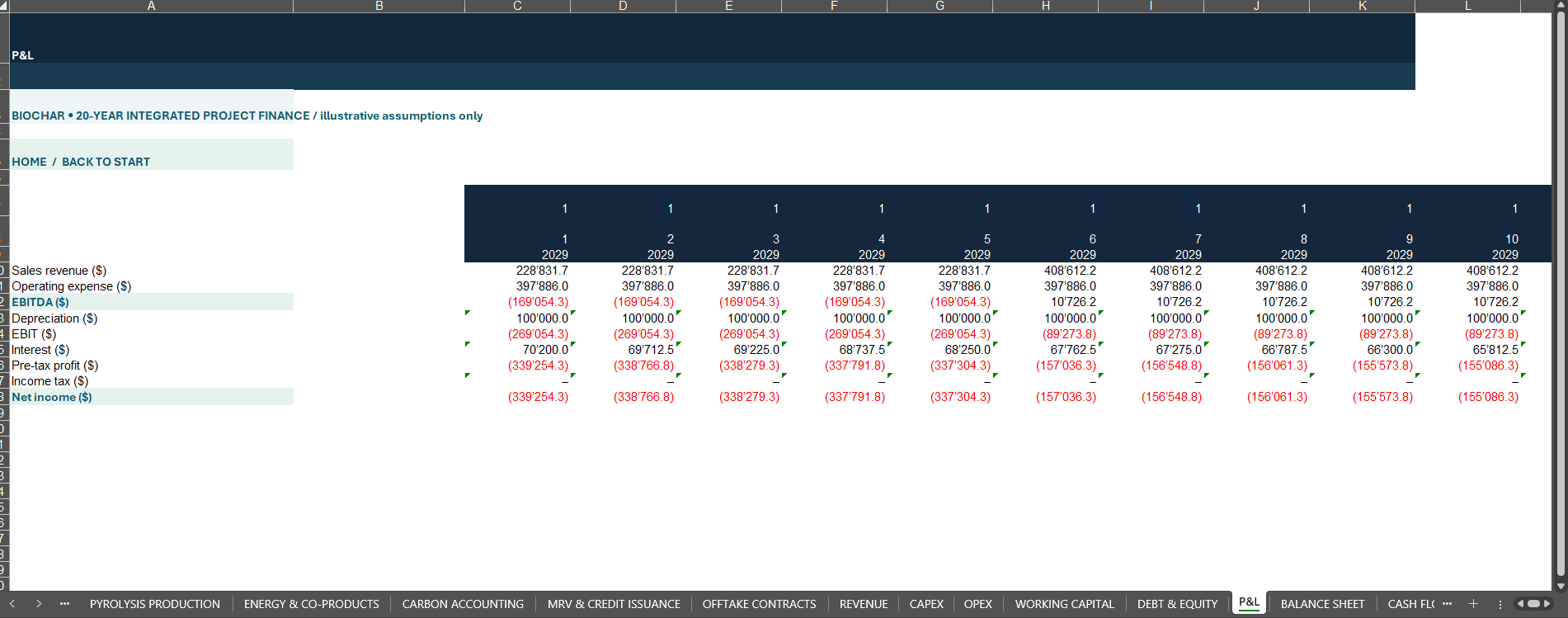
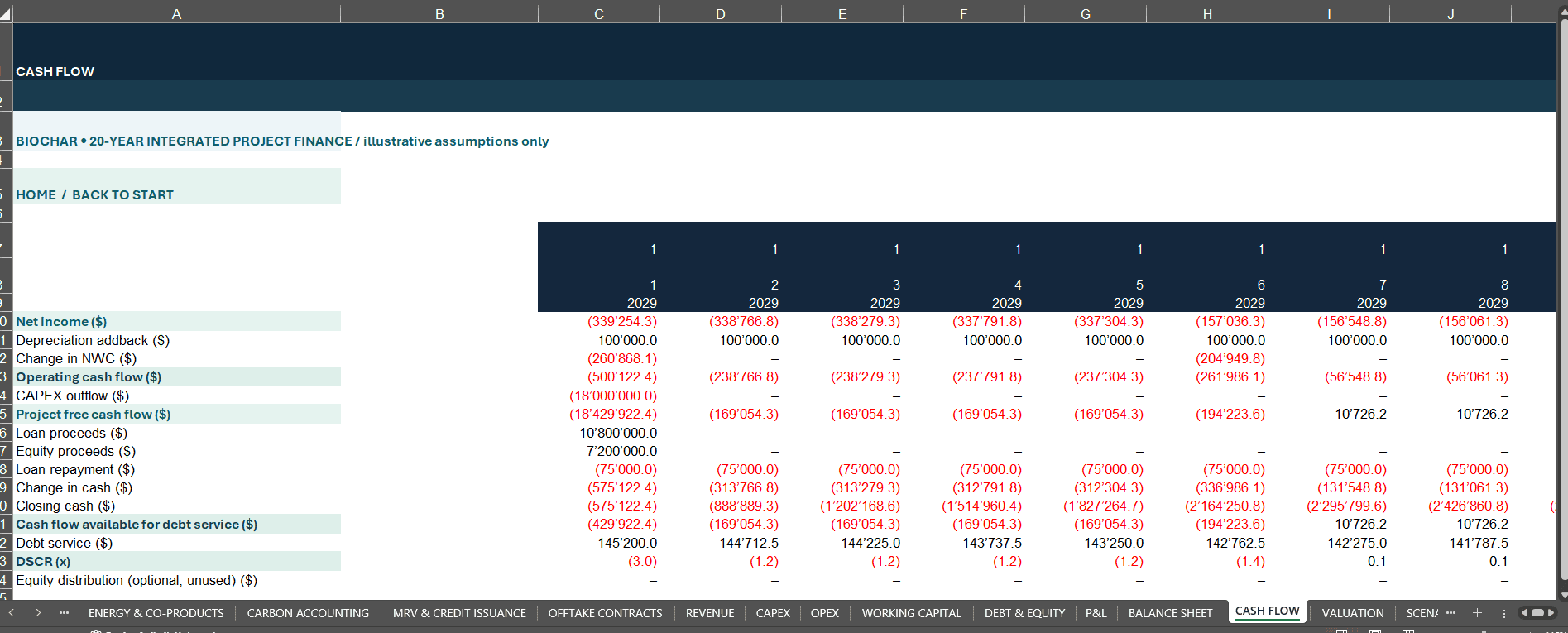
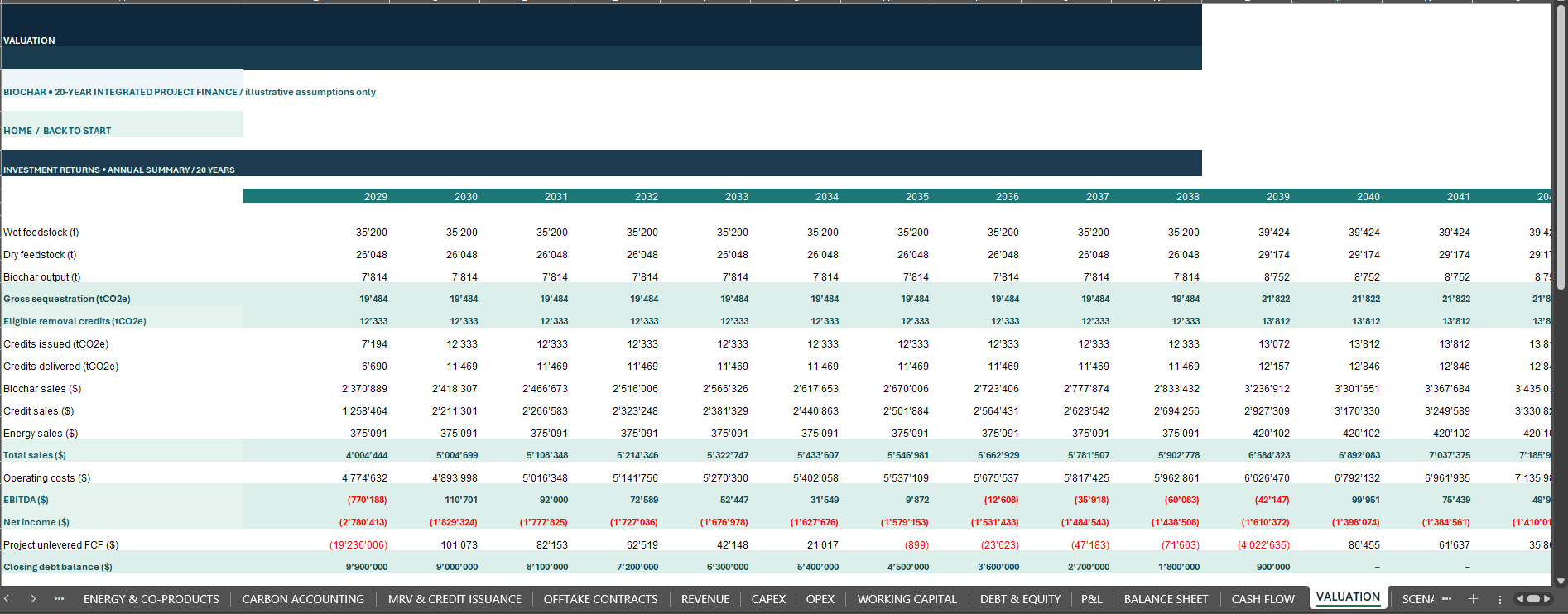
Review connected monthly Profit & Loss, Cash Flow and Balance Sheet calculations across the twenty-year planning horizon.
The financing structure includes sponsor equity, project debt, interest expenses and scheduled principal repayments.
Analyze EBITDA, free cash flow, closing cash, outstanding debt and debt-service coverage.
Negative cash balances remain visible, allowing users to identify funding requirements instead of assuming automatic additional financing.
🔀 FIVE INDICATIVE SCENARIOS & SENSITIVITY
Compare five named planning cases:
BASE — Central illustrative assumptions.
UPSIDE — More favorable prices and operating conditions.
DOWNSIDE — Weaker operating and commercial assumptions.
CREDIT PRICE COLLAPSE — Material pressure on carbon credit revenue.
FEEDSTOCK SHORTAGE — Reduced biomass availability and production.
Scenario comparisons use simplified economic calculations rather than five independently recalculated 240-month financial statement models.
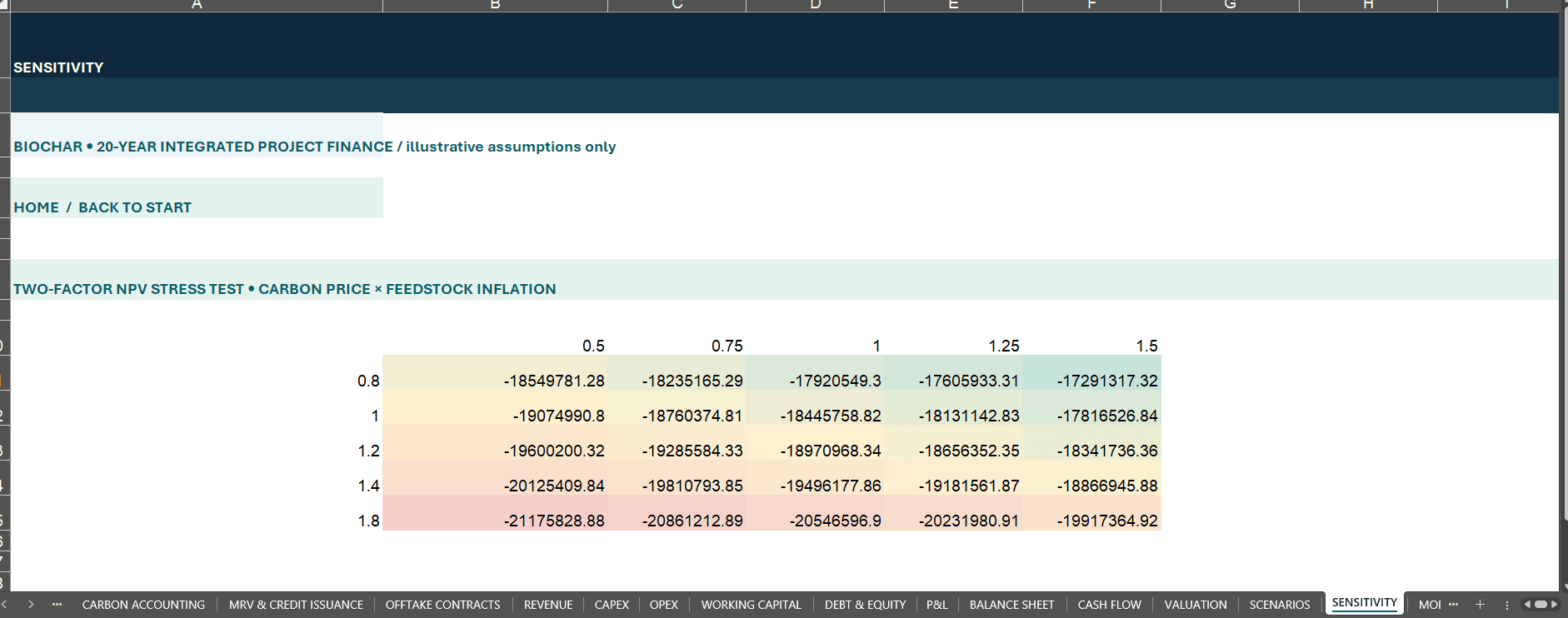
A separate sensitivity worksheet explores how carbon credit prices and feedstock costs affect indicative project value.
📈 PROJECT VALUATION & RETURN ANALYSIS
Review project NPV, discounted project cash flows, DSCR, payback status, equity cash returns and levelized carbon removal costs.
The workbook distinguishes mathematical reconciliation from commercial viability.
When a valid IRR cannot be established, return indicators display N/M rather than a misleading percentage. The illustrative Base Case currently shows negative project NPV, significant funding requirements and no achieved project payback.
Users should review the underlying cash flows, discount-rate assumptions and financing needs before interpreting valuation results.
✓ MODEL CHECKS & NAVIGATION
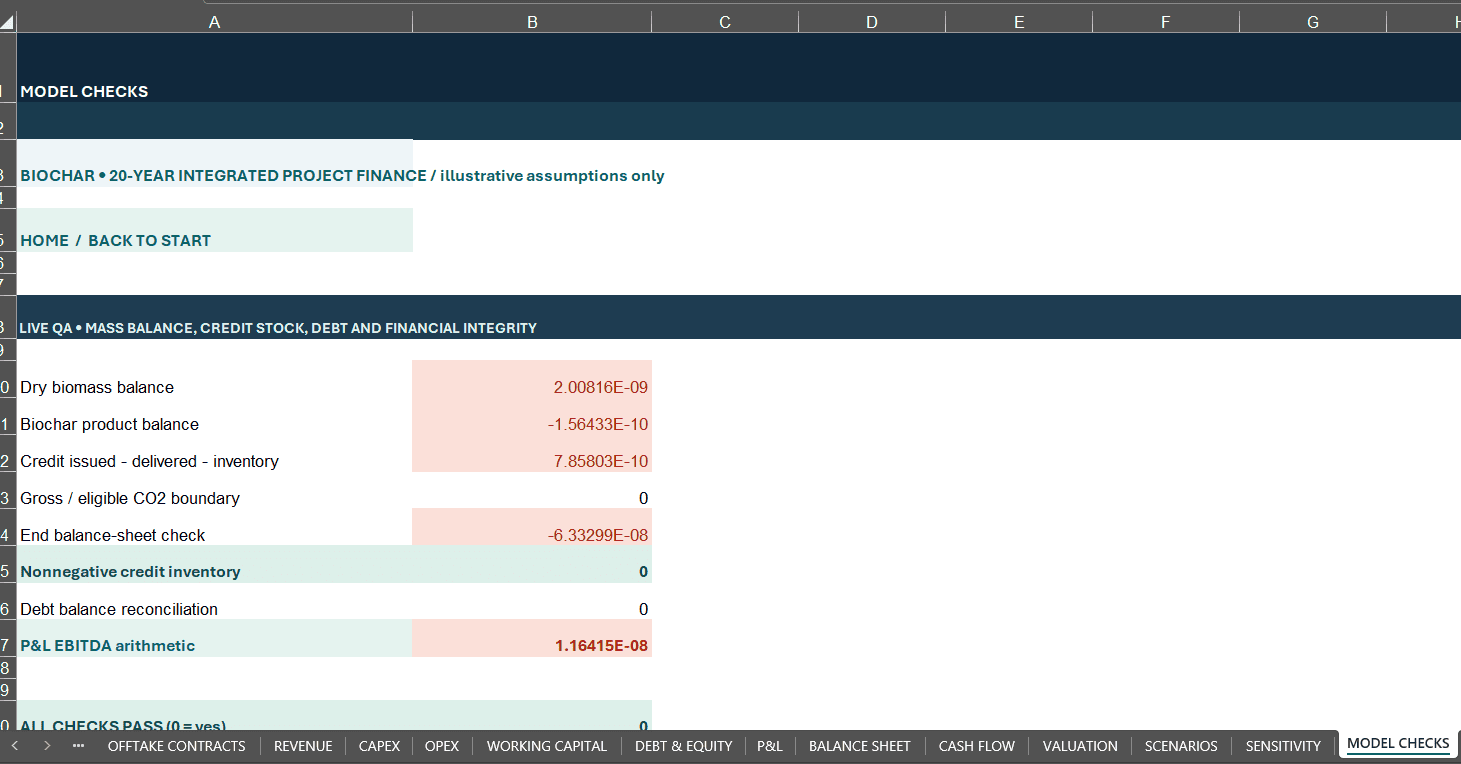
Built-in checks review biomass balances, biochar production, carbon-credit movements, debt, cash and financial statement consistency.
Economic warnings are distinguished from arithmetic reconciliations.
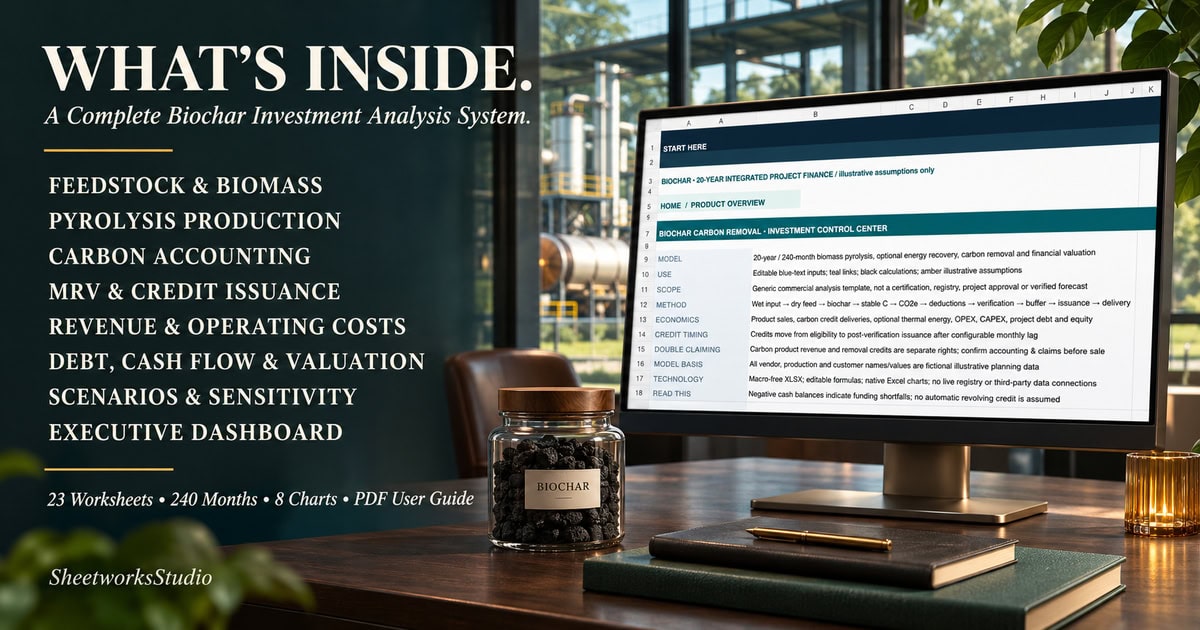
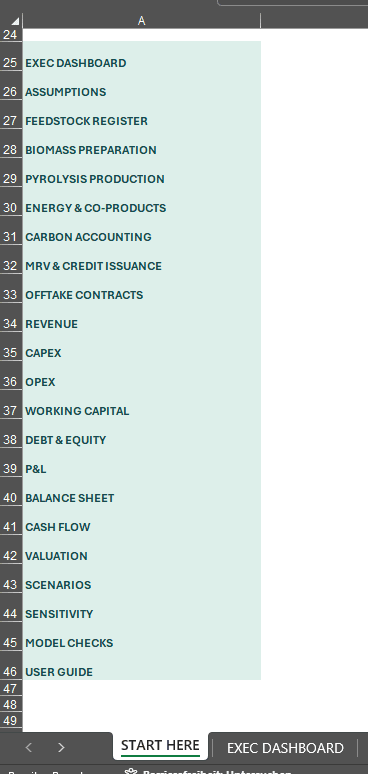
A START HERE page provides navigation, while editable assumptions and calculated outputs are visually differentiated.
A PASS result confirms selected internal calculations, not independent engineering feasibility, carbon credit certification or financing approval.
📦 WHAT YOU RECEIVE
1. PREMIUM EXCEL FINANCIAL MODEL (.XLSX)
• 23 connected worksheets
• 240 monthly forecast periods
• 20 annual financial summaries
• 12 executive KPI fields
• 8 native Excel dashboard charts
• Biomass and pyrolysis calculations
• Carbon removal and credit issuance schedules
• Revenue, OPEX, CAPEX and working capital
• Three financial statements
• Debt and equity financing
• NPV, DSCR and return-status analysis
• 5 indicative scenarios and sensitivity analysis
• Integrated model checks
2. PROFESSIONAL 25-PAGE ENGLISH PDF GUIDE
A detailed user manual explaining setup, assumptions, feedstock, pyrolysis, carbon accounting, credit timing, revenue, financing, financial reporting, valuation, dashboard interpretation, troubleshooting and model limitations.
The PDF guide is also available separately as a complimentary download without the editable Excel workbook.
🧭 GETTING STARTED
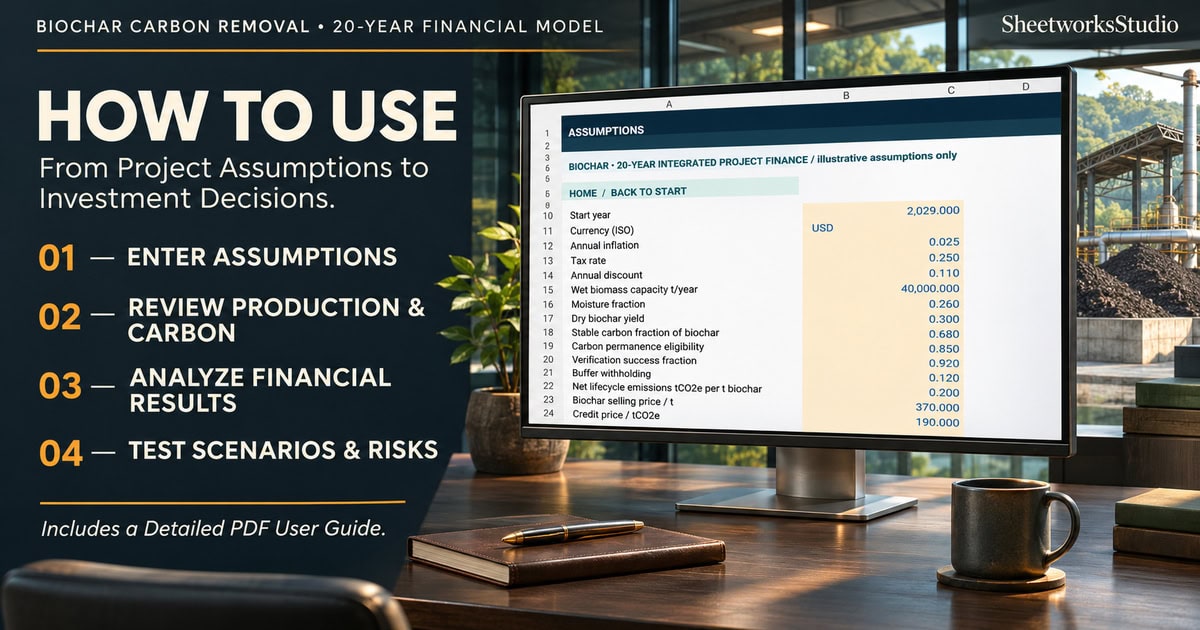
- Open START HERE and read the PDF guide.
- Customize project assumptions, feedstock and plant performance.
- Review carbon eligibility, MRV and commercial pricing.
- Examine operating costs, CAPEX, financing and cash flow.
- Compare indicative scenarios and valuation results.
- Investigate MODEL CHECKS and funding warnings.
👥 WHO IS THIS MODEL FOR?
Biochar project developers, pyrolysis plant operators, biomass businesses, carbon removal consultants, infrastructure investors, financial analysts and sustainability teams.
Suitable for project screening, operating cost planning, carbon credit revenue analysis, sensitivity testing and illustrative financing discussions.
⚙️ COMPATIBILITY & MODEL SCOPE
Format: Editable Microsoft Excel (.xlsx)
Forecast: 240 months / 20 years
Illustrative Period: 2029–2048
Macros / VBA: None
External Data Connections: None required
Recommended Software: Microsoft Excel Desktop
The model uses simplified technical, financial, tax and carbon accounting assumptions. It is not an engineering design, certified lifecycle assessment, carbon registry system or independently validated investment appraisal.
Microsoft Excel Desktop is recommended. Full native Excel and Google Sheets compatibility have not been independently certified; calculations, charts and formatting should be verified in the intended application.
🛡️ IMPORTANT DISCLAIMER
This is an independent, unofficial financial planning template by SheetworksStudio.
All sample data, carbon removal quantities, financial assumptions and investment results are illustrative. No project feasibility, financing, credit issuance or investment return is guaranteed.
The product is not audited, certified, registry-approved, bank-approved or endorsed by any carbon standard, regulator, lender or software provider.
Users must independently assess feedstock sustainability, carbon eligibility, permanence, verification, contractual rights, financing, taxation and applicable regulations.
This template does not provide individualized financial, investment, engineering, environmental certification, tax or legal advice.
Digital download only. No physical product is included.
Bring biochar production, carbon credit economics and long-term project finance into one transparent 20-year Excel planning framework.
Created by SheetworksStudio.
Similar ProductsOther customers were also interested in...



 eFinancialModels
Electric Vehicle (EV) Charging Station Financial M...
With this comprehensive 5- or 10-year monthly tool, investors can assess the viability of setting up... Read more

Financial Model for Mobile App | Mobile App Busine...
The Mobile App Financial Plan Template in Excel allows you to develop financial projections when lau... Read more

 HenrySheykin
Food Truck Financial Model Excel Template
The Food Truck Financial Model helps entrepreneurs, founders, business owners, consultants, and anal... Read more

Green Hydrogen Production from Wind Energy Financi...
The Green Hydrogen from Wind Financial Model aims to comprehensively forecast a horizon of 40 years ... Read more

Simple Mutual Non-Disclosure Agreement Template
Protect your business secrets with ease using our Simple Mutual Non-Disclosure Agreement Template. S... Read more

Solar Energy Financial Model
The Solar Energy Financial Model Spreadsheet Template in Excel assists you in preparing a sophistica... Read more

 Peter Graf
The Customer-Centric Financial Model for Restauran...
Starting a restaurant without a financial plan is like driving a car blindfolded. You wouldn´t do i... Read more
You must log in to submit a review.