
0 ITEMS

13-Week Rolling Cash Flow Forecast – Excel Template with Actuals Tracking, Credit Line & Scenarios
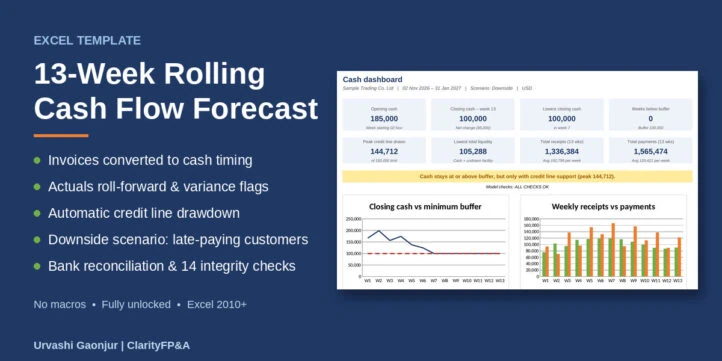
A weekly direct-method cash flow forecast for SMEs, bookkeepers and advisers. Enter invoiced sales once and the model converts them into cash timing using your collection and supplier-payment patterns. Each week, replace forecast with actuals, reconcile to your bank statement and review variances. An automatic credit line shows how much you need to borrow and when, and a Downside scenario stress-tests late-paying customers. No macros, fully unlocked, with 14 built-in integrity checks.
What is this template for?
A monthly forecast can hide a two-week gap where payroll can’t be met. This 13-week rolling cash flow forecast shows your cash position week by week for the next quarter, so you can spot a shortfall early and act: draw on a facility, delay a purchase or chase a late customer. It is built for SME owners, bookkeepers and accountants running forecasts for clients, and advisers preparing for a bank conversation.
Main features
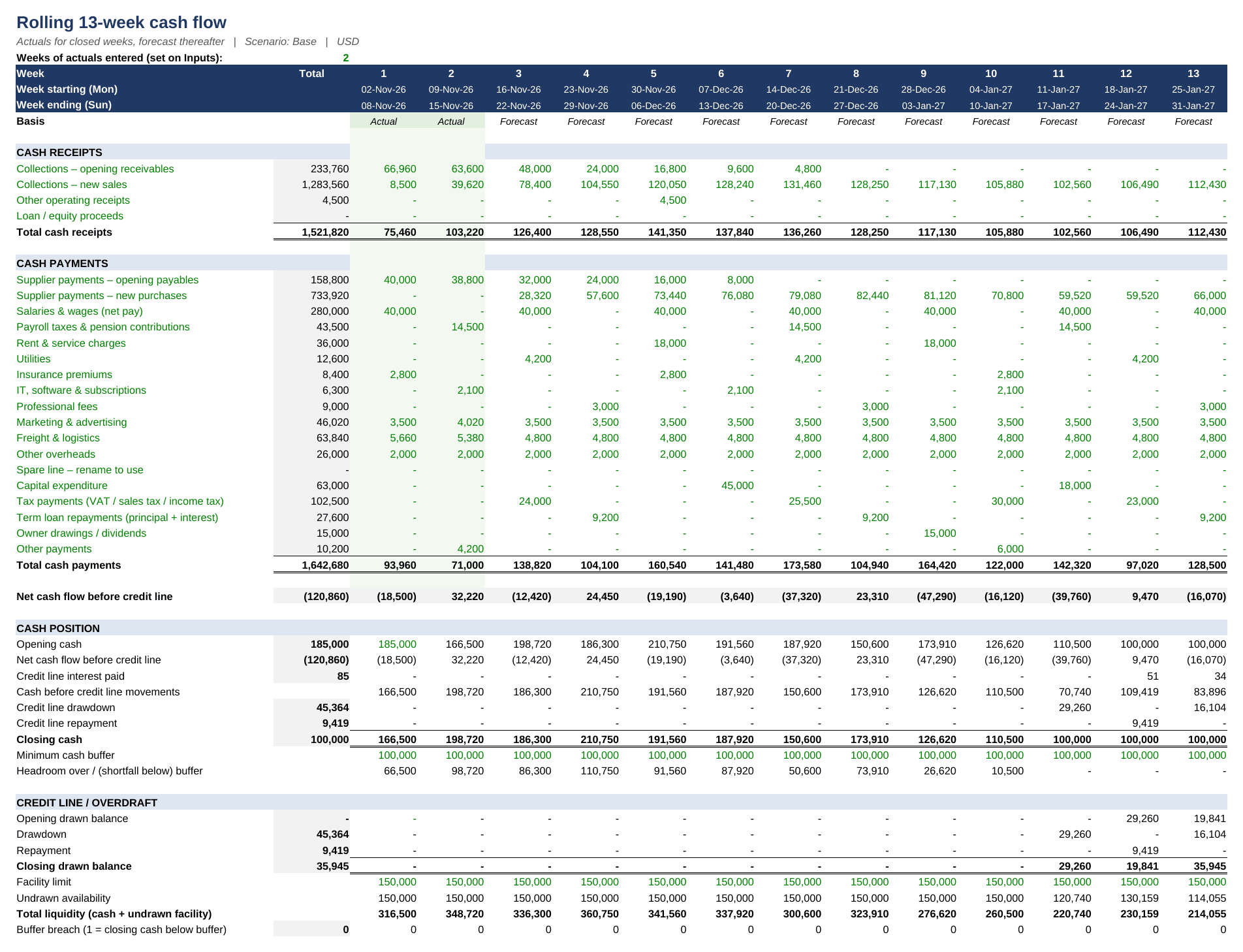
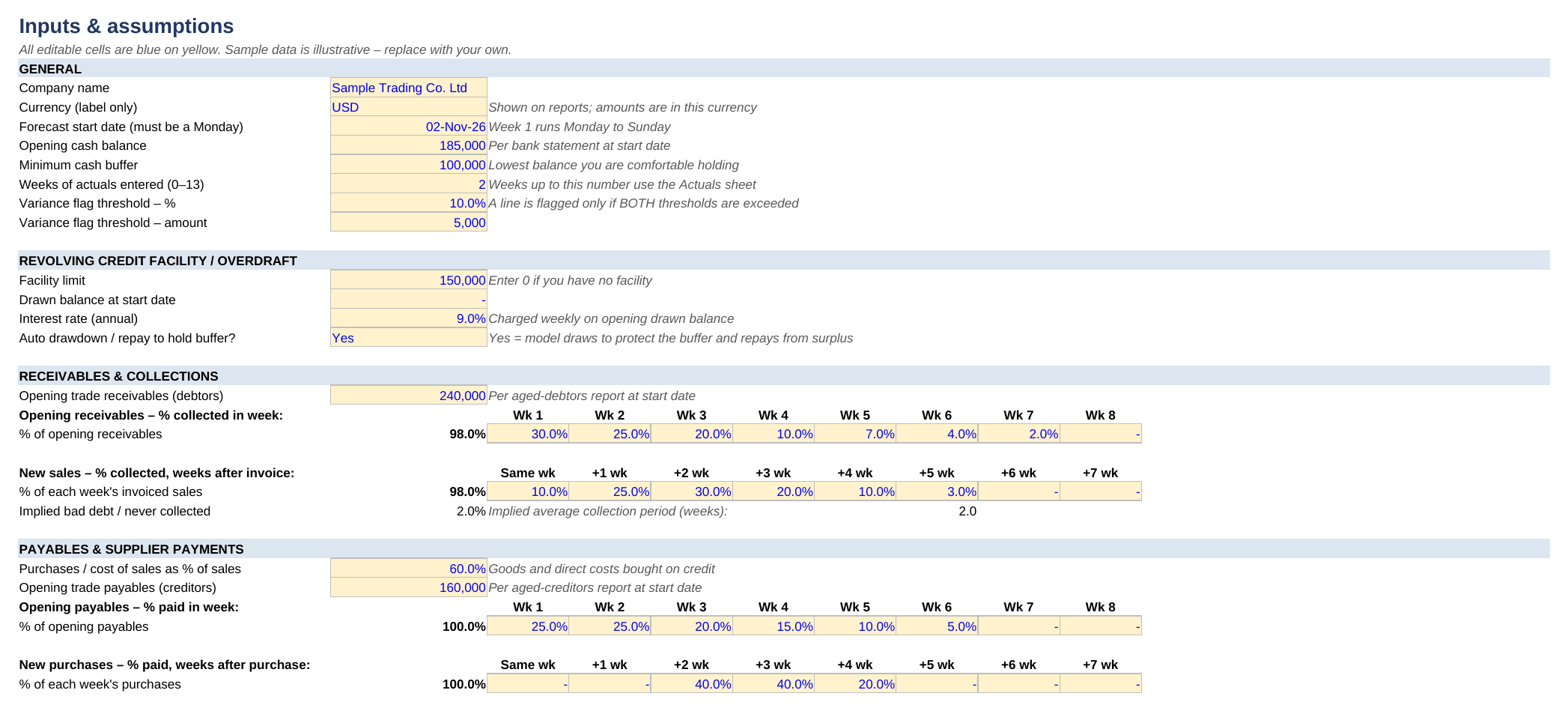
- Cash timing driven by invoices. Enter sales when invoiced. Collection patterns (same week, +1 week, +2 weeks…) convert them into receipts, and supplier payment patterns do the same for purchases. Opening receivables and payables are scheduled from your aged reports.
- Genuine roll-forward. Enter last week’s actuals and increase one counter. Closed weeks switch to actuals while open weeks stay forecast.
- Bank reconciliation. Enter the closing balance from your bank statement each week. The model shows any difference from its own figure.
- Automatic credit line or overdraft. The model draws on the facility to keep cash at your minimum buffer and repays it from surplus, with weekly interest. It reports peak usage and total liquidity.
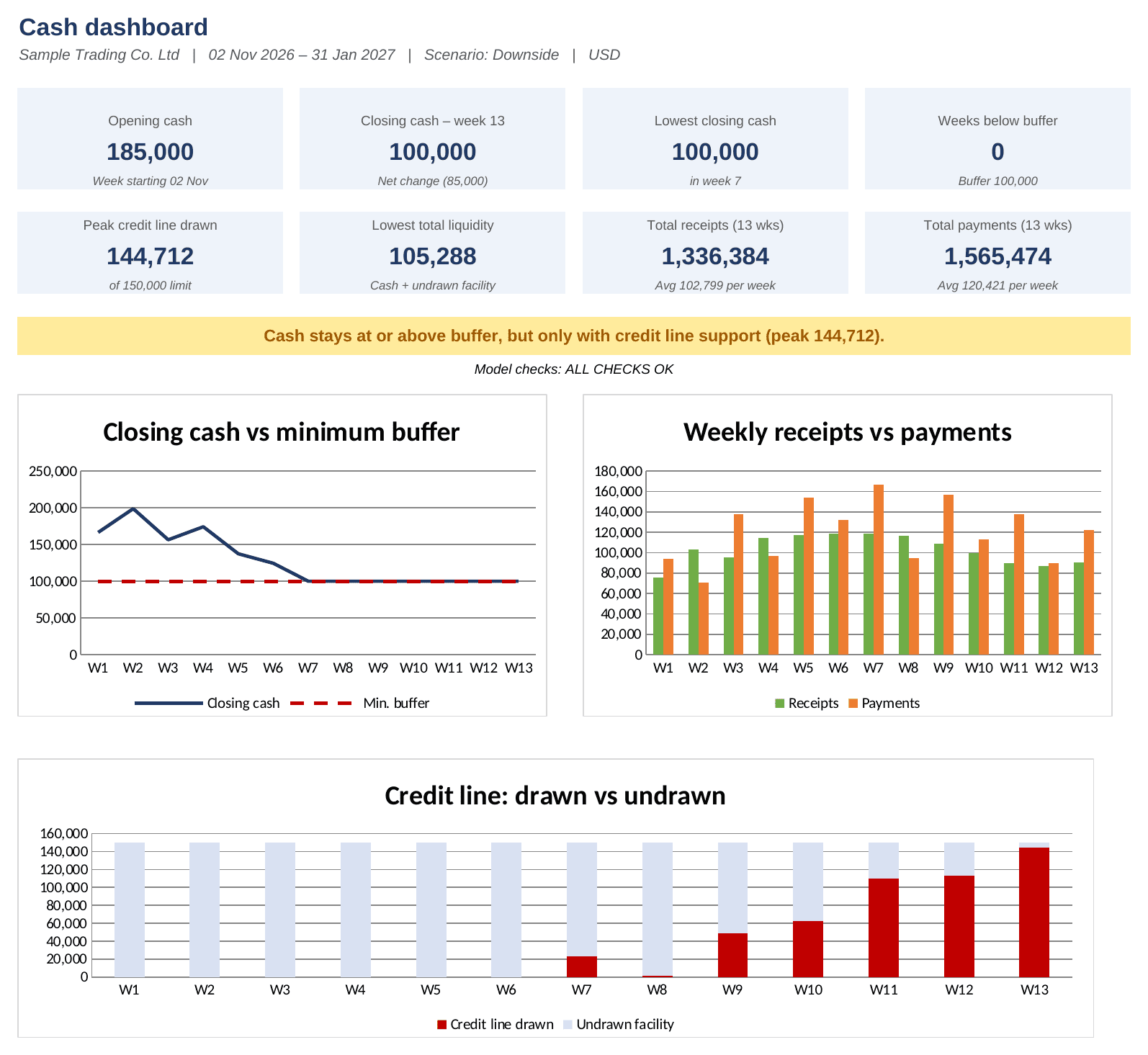
- Scenarios. Base, Downside and Upside, with levers for sales volume, customer payment delay in weeks, recurring cost increases and purchase price changes.
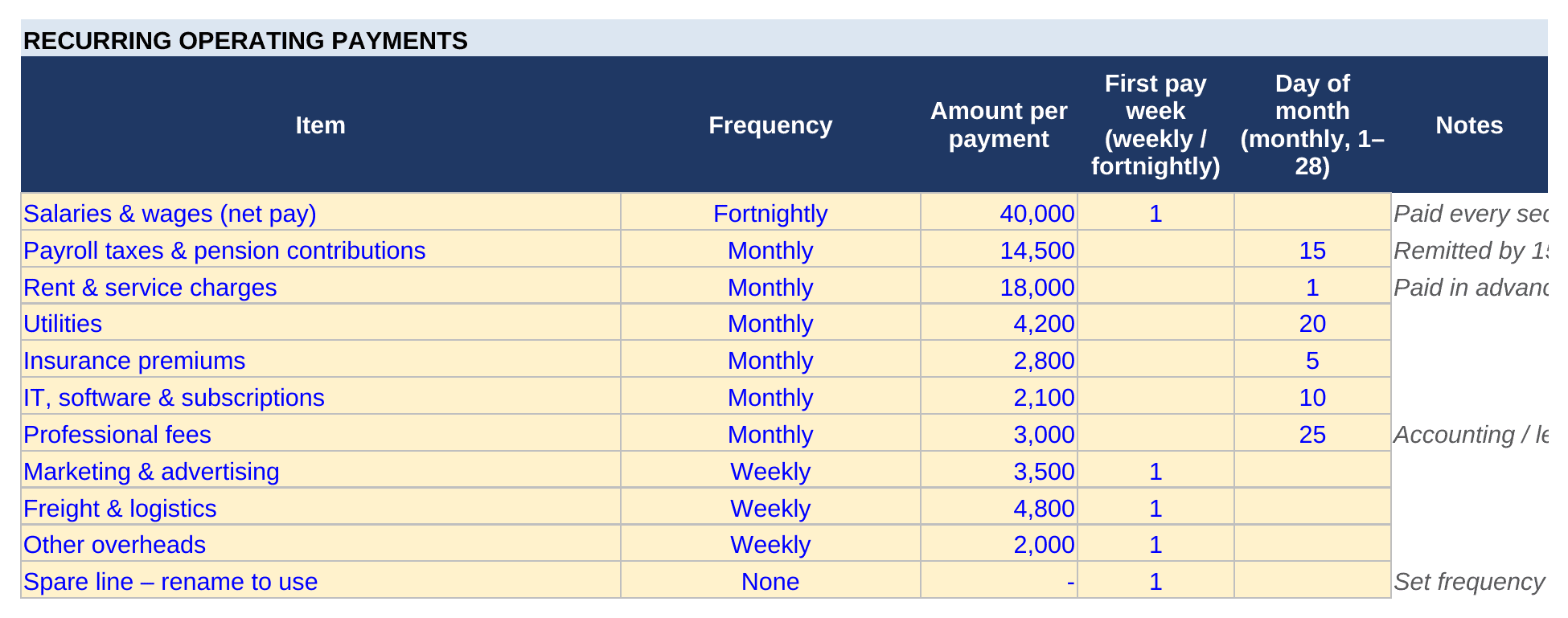
- Recurring payments that schedule themselves. Payroll, rent, utilities and other costs can be set as weekly, fortnightly or monthly, on a chosen day of the month.
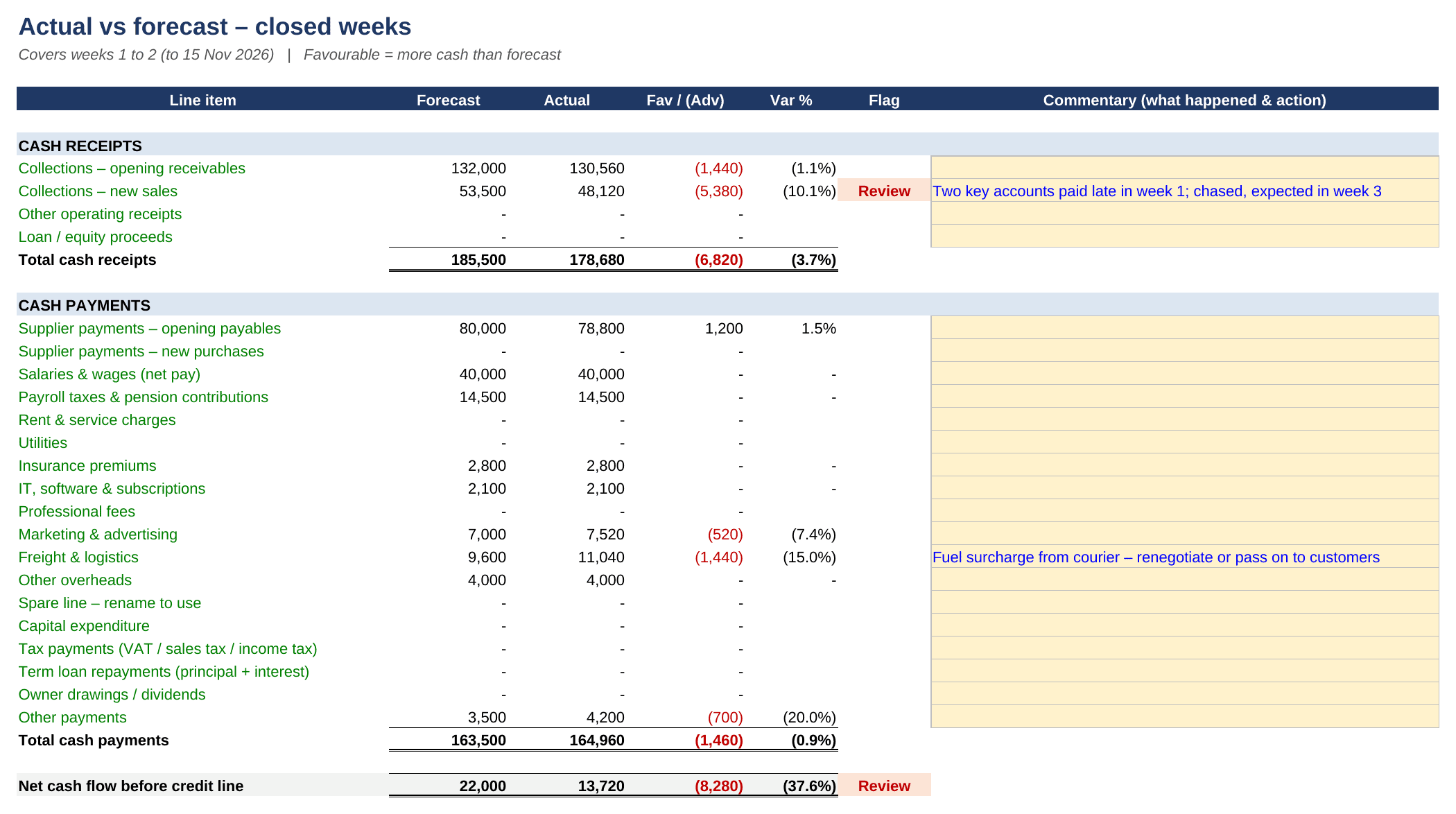
- Variance analysis. Actual vs forecast for closed weeks, with materiality flags based on both a percentage and an amount, and a commentary column.
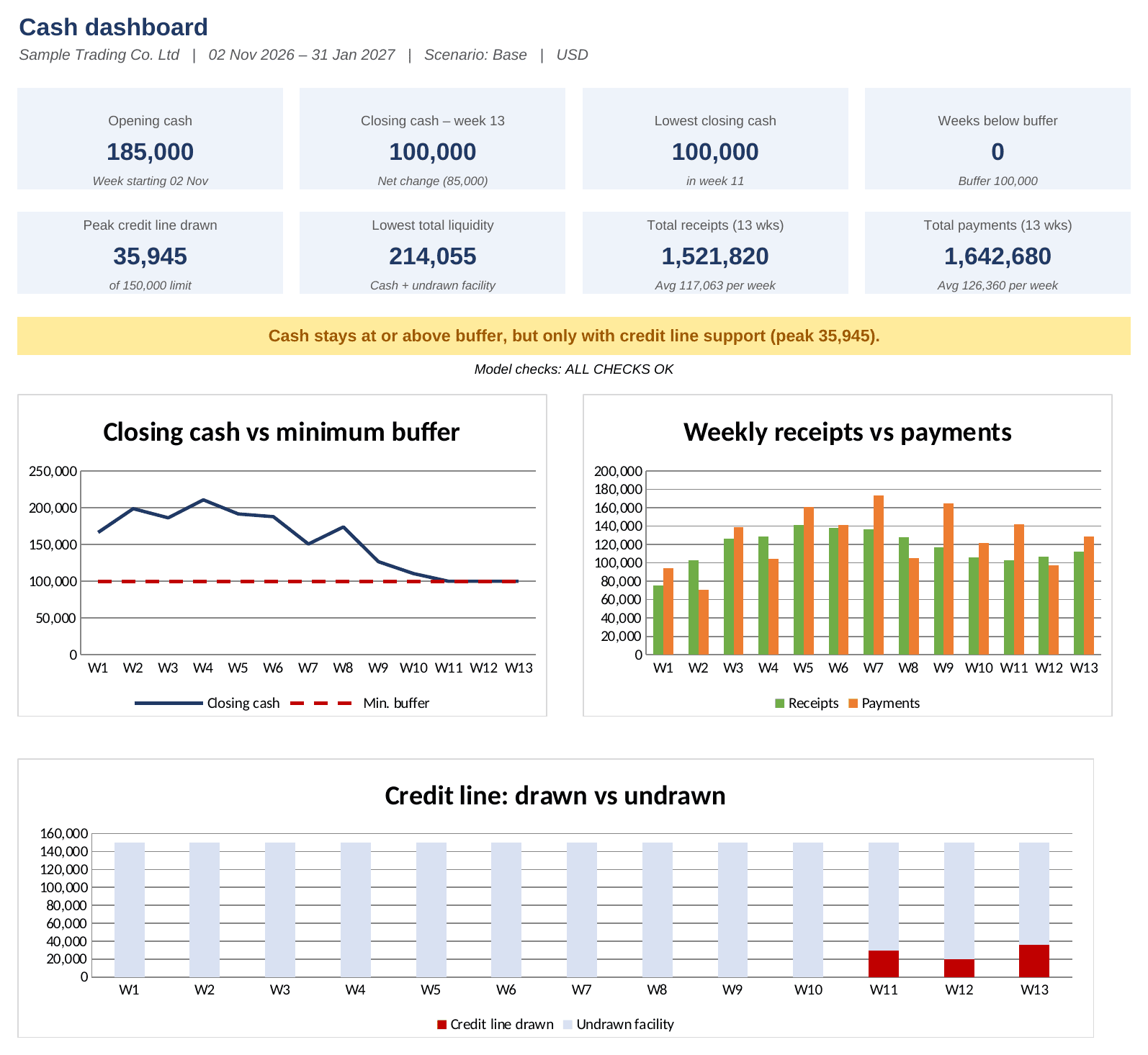
- Dashboard. KPI cards, a red, amber or green liquidity alert, and charts for closing cash vs buffer, receipts vs payments, and credit line usage.
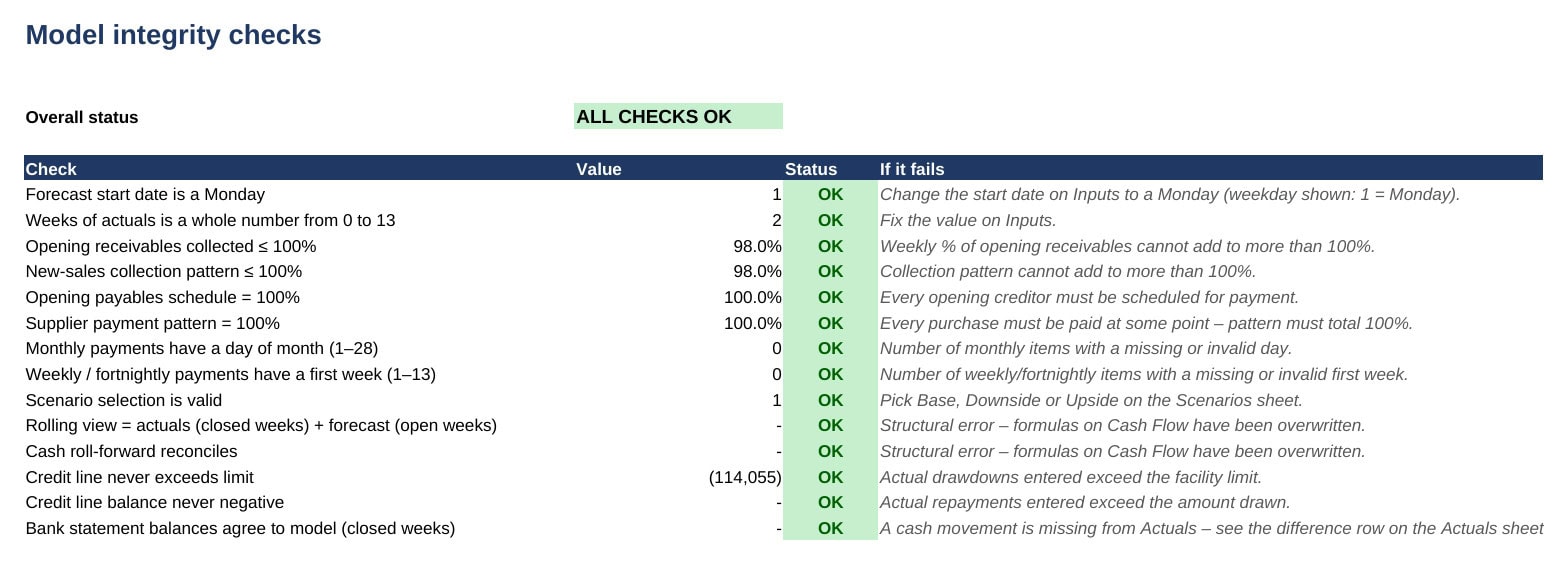
- 14 integrity checks, including the cash roll-forward and the bank reconciliation.
How to work with it
Set-up takes about 30 minutes on the Inputs sheet: your start date, opening cash, minimum buffer, credit facility, aged receivables and payables, recurring costs, and weekly sales and one-off items such as tax, capex and loan repayments. After that, the weekly update takes about 10 minutes: enter actuals, increase the counter and review variances. A step-by-step Instructions sheet is included.
Why you need it
Lenders, turnaround advisers and CFOs use the 13-week horizon because it is short enough to be accurate and long enough to act on. This template gives you that discipline without building a model from scratch.
Technical details
Excel (.xlsx), 11 sheets, all formulas visible and unlocked, no macros and no password protection. Colour-coded inputs, with illustrative sample data you can overwrite. Built for Excel 2010 and later, including Excel 365 and Excel for Mac.
Similar ProductsOther customers were also interested in...



 eFinancialModels
Electric Vehicle (EV) Charging Station Financial M...
With this comprehensive 5- or 10-year monthly tool, investors can assess the viability of setting up... Read more

Financial Model for Mobile App | Mobile App Busine...
The Mobile App Financial Plan Template in Excel allows you to develop financial projections when lau... Read more

 HenrySheykin
Food Truck Financial Model Excel Template
The Food Truck Financial Model helps entrepreneurs, founders, business owners, consultants, and anal... Read more

Green Hydrogen Production from Wind Energy Financi...
The Green Hydrogen from Wind Financial Model aims to comprehensively forecast a horizon of 40 years ... Read more

Simple Mutual Non-Disclosure Agreement Template
Protect your business secrets with ease using our Simple Mutual Non-Disclosure Agreement Template. S... Read more

Solar Energy Financial Model
The Solar Energy Financial Model Spreadsheet Template in Excel assists you in preparing a sophistica... Read more

 Peter Graf
The Customer-Centric Financial Model for Restauran...
Starting a restaurant without a financial plan is like driving a car blindfolded. You wouldn´t do i... Read more
You must log in to submit a review.