
0 ITEMS

Green Hydrogen Electrolysis Financial Model Excel – 25-Year Project Finance, LCOH, DSCR & IRR
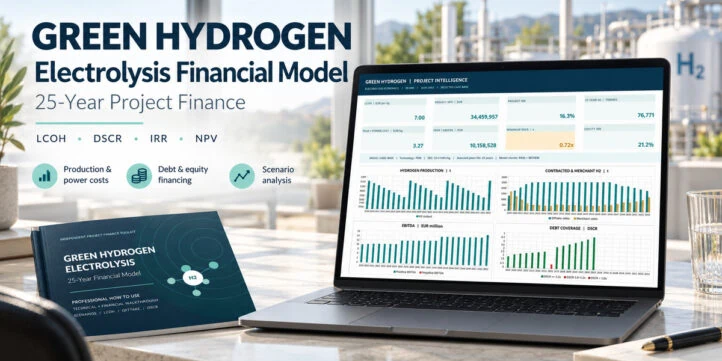
Model 25 years of green hydrogen production, electricity procurement, 15 offtake contracts, funding, LCOH, NPV, project/equity IRR and annual DSCR in an editable Excel workbook. Includes 19 worksheets, three scenarios, eight native charts, 24 model checks and a 32-page English guide.
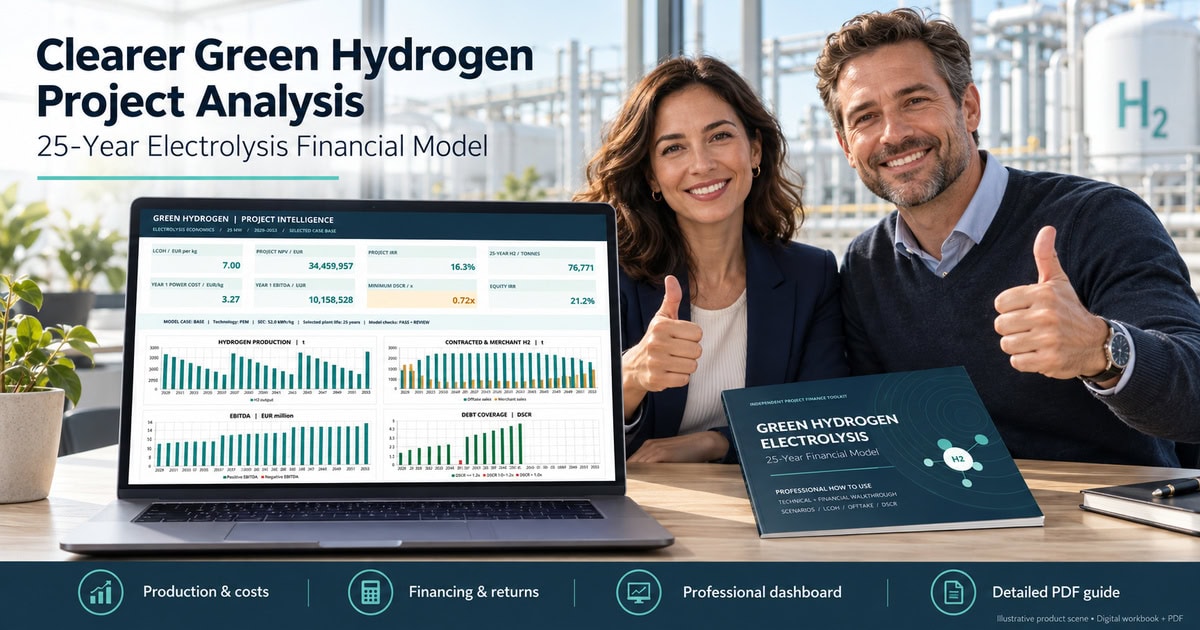
GREEN HYDROGEN ELECTROLYSIS FINANCIAL MODEL – 25-YEAR SIGNATURE EDITION
From electrolyzer capacity and electricity sourcing to hydrogen offtake, financial statements and investor returns — one integrated Excel planning model.
The Green Hydrogen Electrolysis Financial Model by SheetworksStudio is an editable, annual project-finance and investment analysis template for hydrogen developers, renewable-energy analysts, finance teams, consultants and educators.
The workbook connects physical production, power procurement, 15 individual offtake contracts, operating expenditure, stack replacement, debt financing, cash generation and valuation over 25 annual forecast periods. The illustrative example runs from 2029 through 2053.
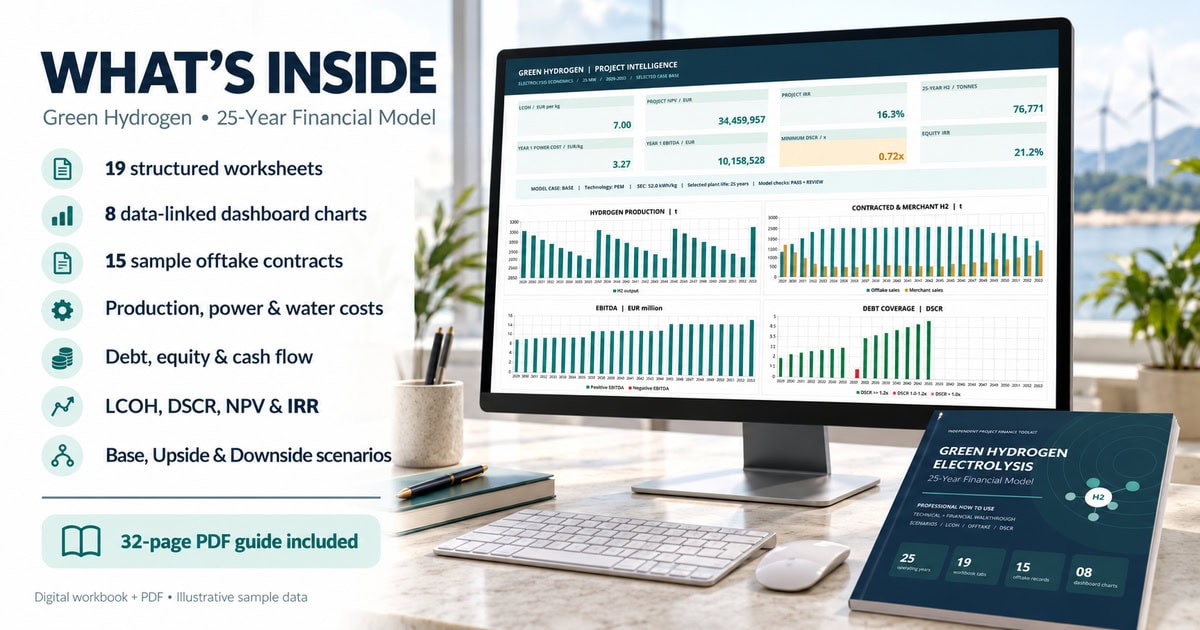
The complete package includes 19 worksheets, eight native Excel dashboard charts, three integrated scenarios, 24 formula-based model controls and a detailed 32-page English PDF handbook.
📊 EXECUTIVE DASHBOARD & FINANCIAL INTELLIGENCE
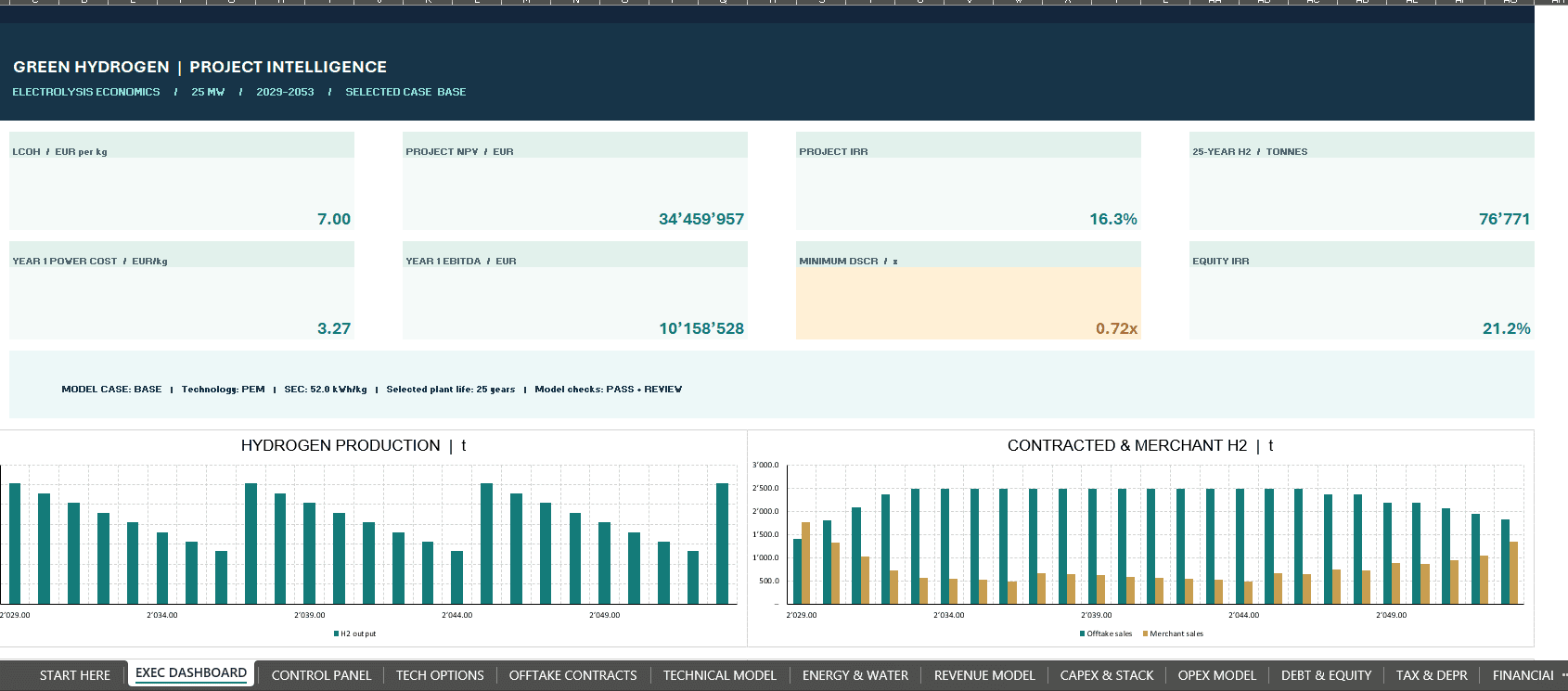
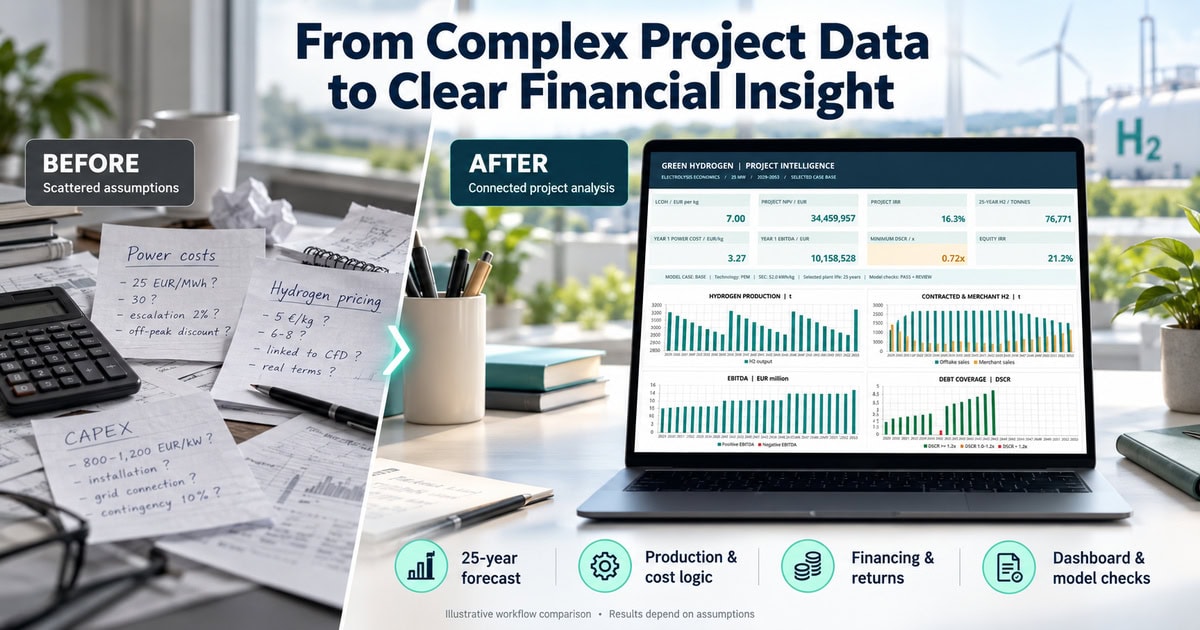
Review eight headline metrics: Levelized Cost of Hydrogen (LCOH), Project NPV, Project IRR, Lifetime Hydrogen Production, Year-1 Electricity Cost per kg, Year-1 EBITDA, Minimum DSCR and Equity IRR.
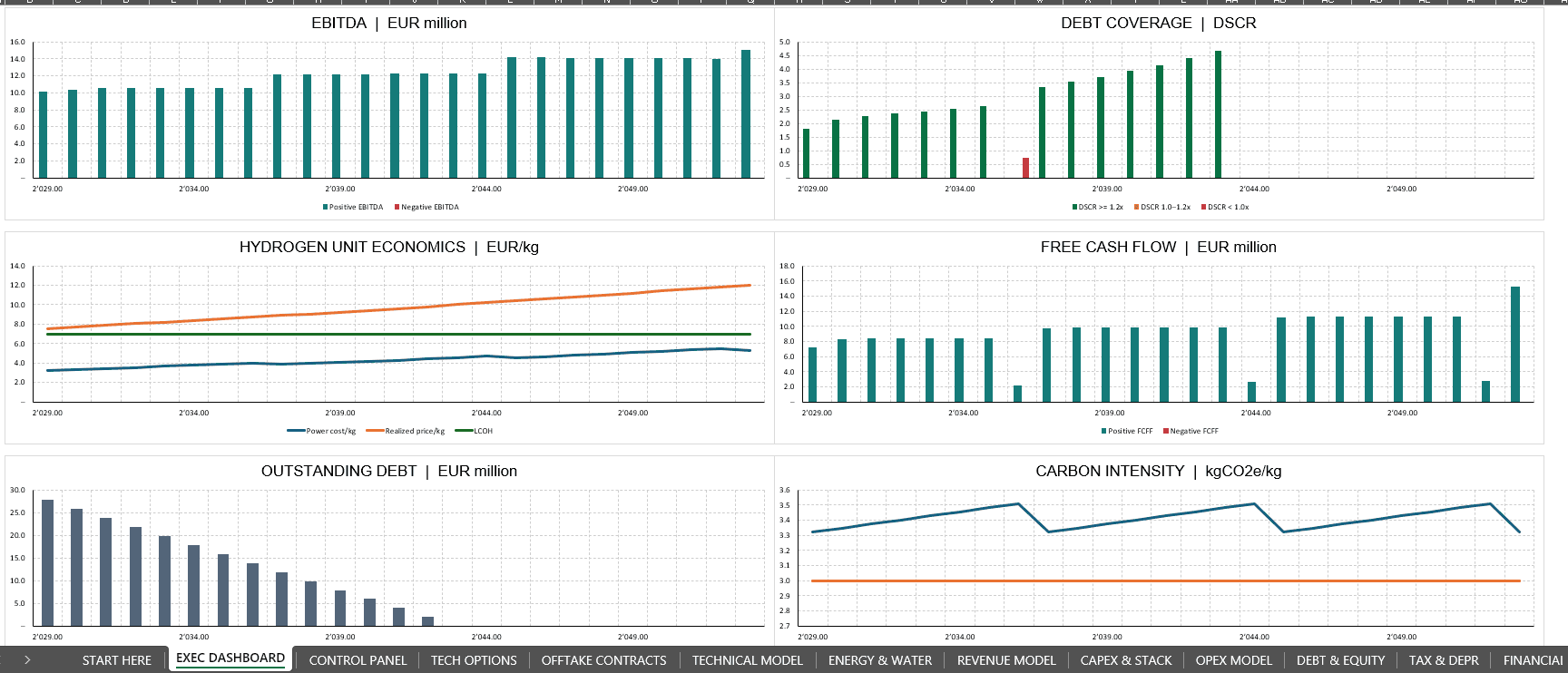
Eight native, linked Excel charts illustrate annual hydrogen production; contracted versus merchant hydrogen volumes; EBITDA; debt coverage; hydrogen unit economics; project free cash flow; outstanding debt; and electricity-related operating carbon intensity.
Charts use the actual 25 annual forecast years. The selected scenario drives connected operating calculations and dashboard values.
⚙ HYDROGEN PRODUCTION & ELECTROLYZER TECHNOLOGY
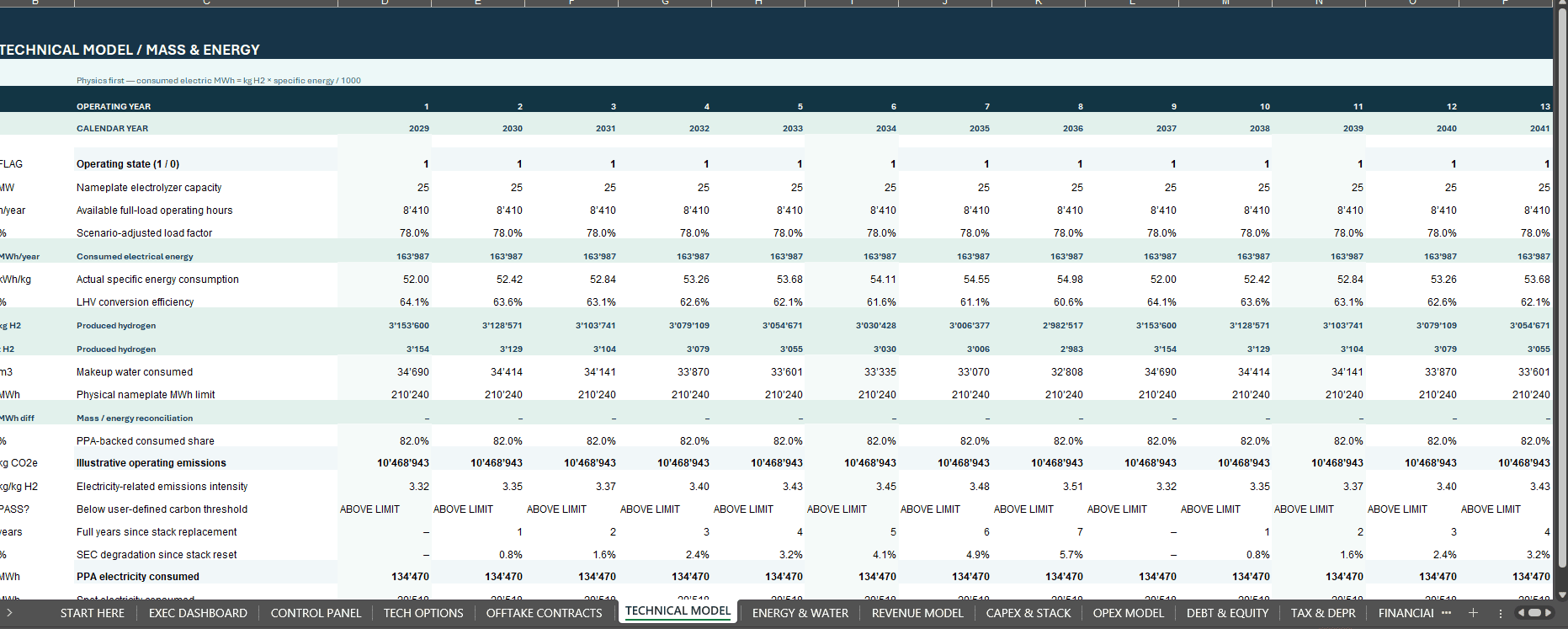
Model capacity in MW, operating availability, dispatch utilization and specific electrical energy consumption (kWh/kg H2). The production calculation connects annual consumed electricity to produced kilograms and tonnes of hydrogen, with the associated water requirement.
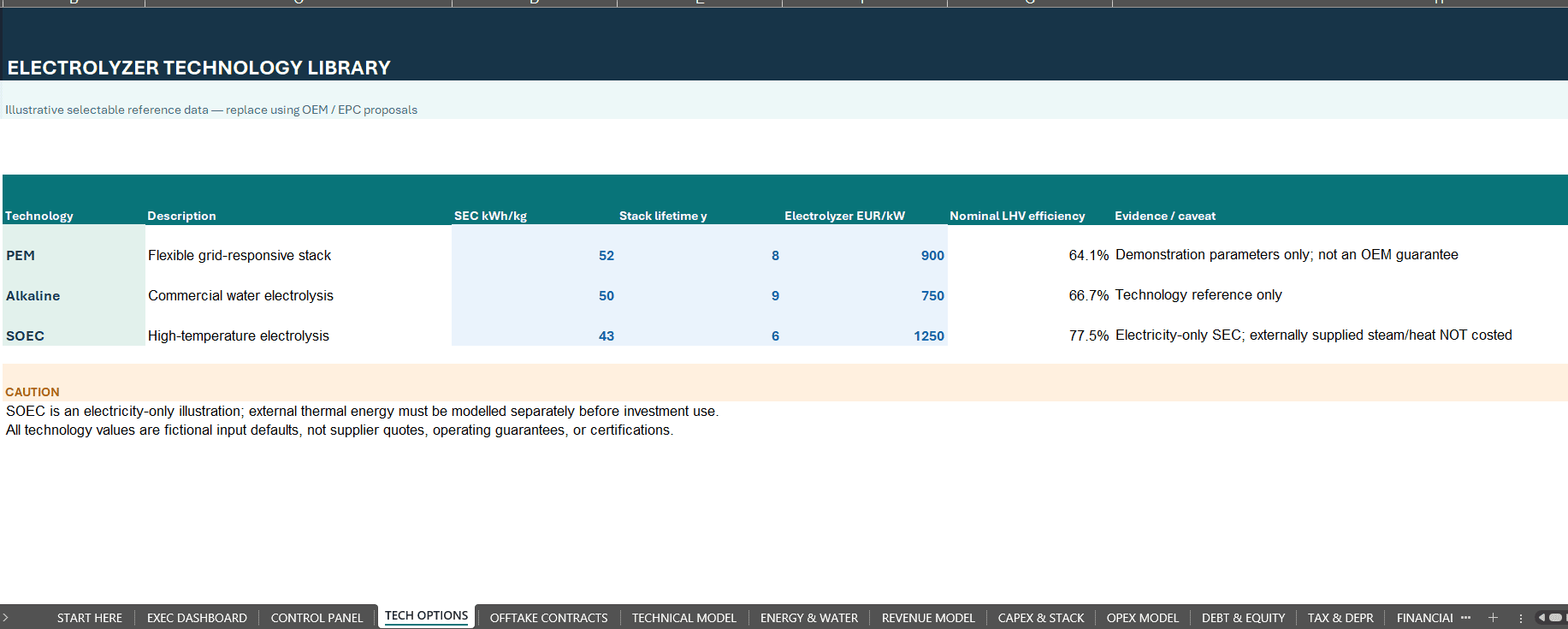
Compare PEM, Alkaline and SOEC reference assumptions. Optional technology overrides allow you to adjust electricity intensity, stack life and equipment capital cost. Stack degradation, replacement timing, operating delay and a selected active plant life are reflected within the fixed 25-year forecast horizon.
SOEC calculations represent electricity requirements only. Additional process steam and external thermal energy are not included. Technical inputs are fictional reference assumptions, not certified OEM performance data.
⚡ ELECTRICITY PROCUREMENT & OPERATING COSTS
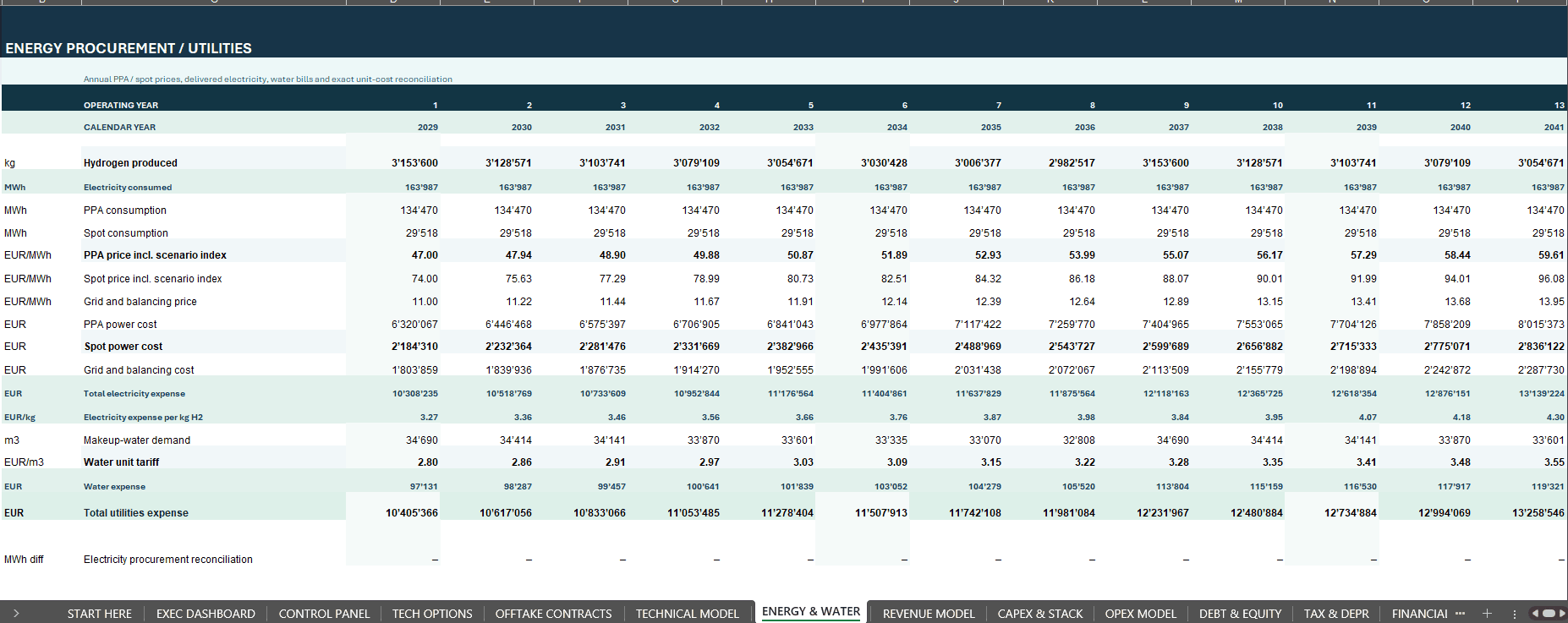
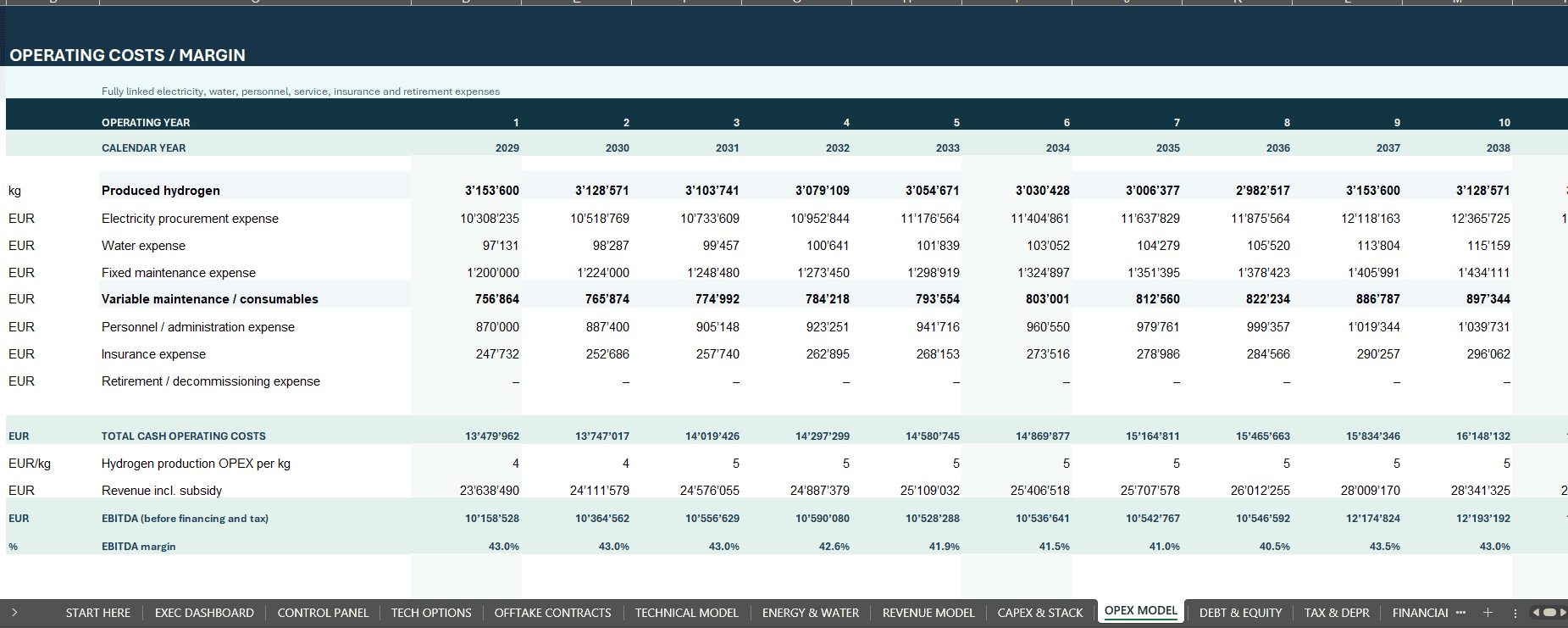
Separate consumed electricity into PPA and spot-market shares. Model starting electricity tariffs, annual escalation, grid/balancing charges and a linked electricity-expense-per-kg indicator.
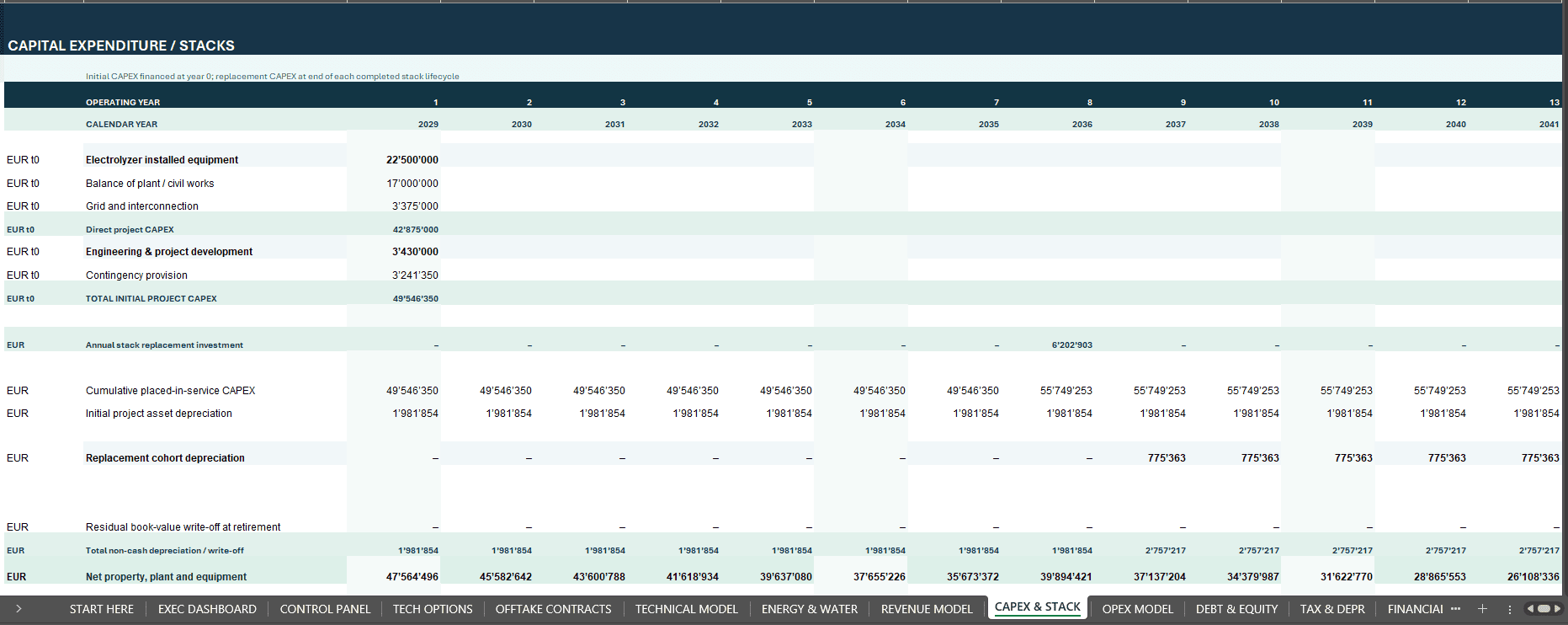
Operating schedules cover water, fixed and variable maintenance, payroll and administration, plant insurance and terminal retirement expense. Capital schedules include electrolyzer equipment, balance of plant, grid connection, engineering, contingency and periodic stack replacement.
This structure helps explain how power tariffs, electrolyzer efficiency and asset replacement affect LCOH, profitability and cash generation.
▦ FIFTEEN LINKED HYDROGEN OFFTAKE CONTRACTS
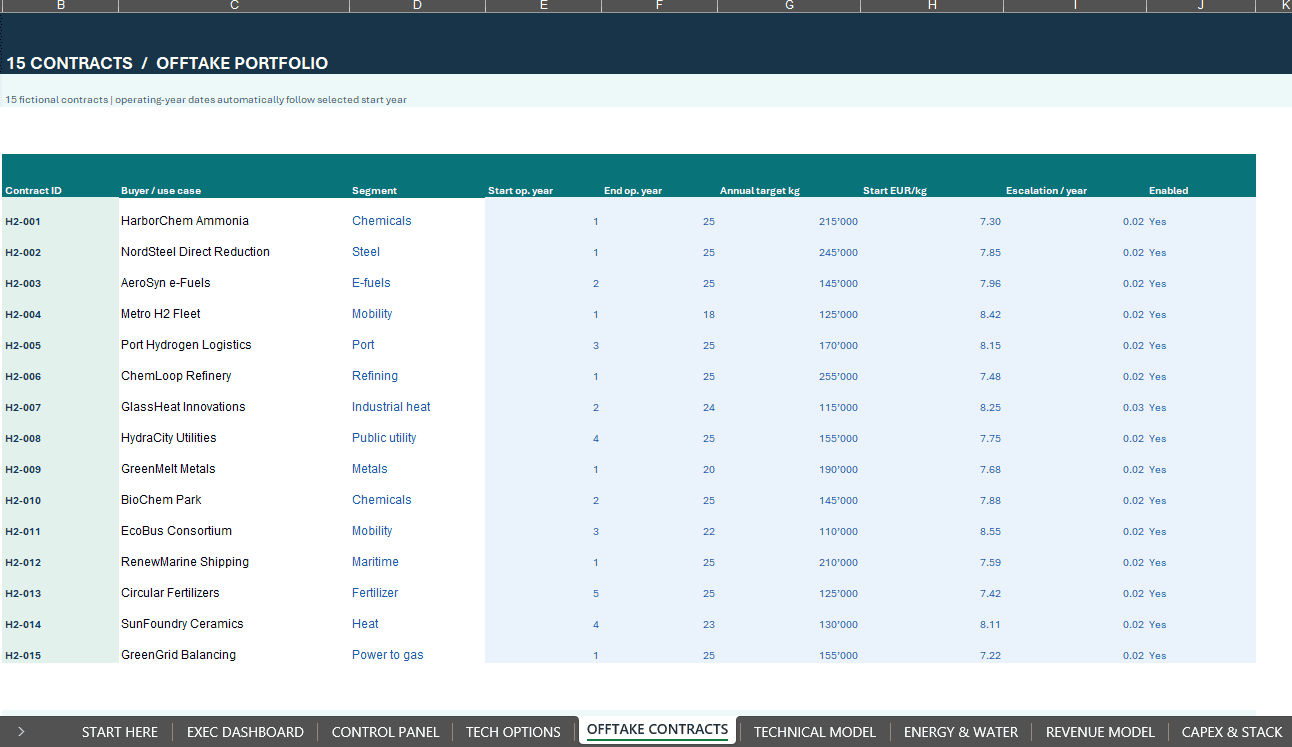
The model contains 15 directly linked fictional contract records. Configure customer identifiers, Yes/No activation, contract years, annual target volume, initial price and price escalation.
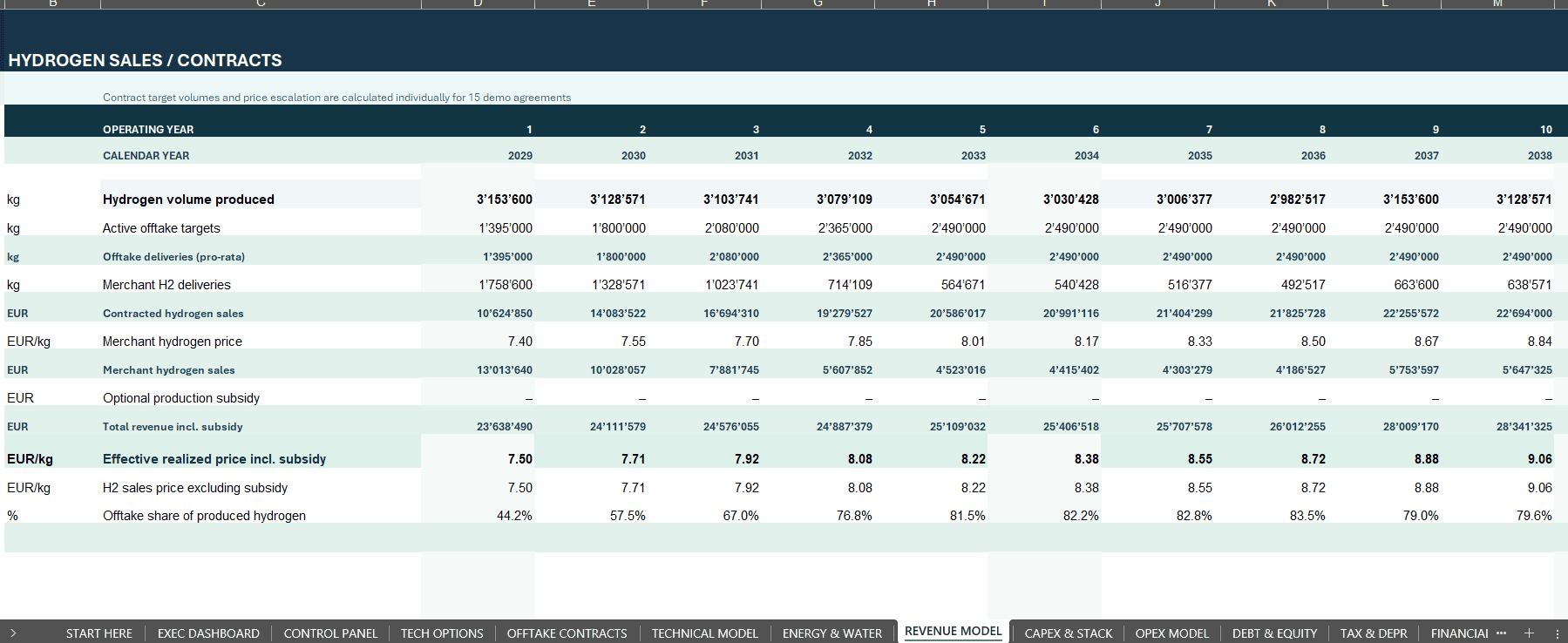
Available hydrogen production caps total fulfilled deliveries. If active contract targets exceed available production, output is allocated proportionally across contracts. Residual production is treated as merchant sales at the user-selected price. An optional production-grant input is also available.
All supplied counterparties and prices are illustrative. The revenue engine supports 15 directly linked contracts; adding more contracts requires extending the calculations rather than simply inserting new rows.
🏦 DEBT FINANCING, EQUITY & THREE FINANCIAL STATEMENTS
The model connects opening project CAPEX to an editable senior debt/equity mix. Configure loan interest rate, amortization tenor and annual principal service. Review the resulting debt schedule and annual debt-service coverage.
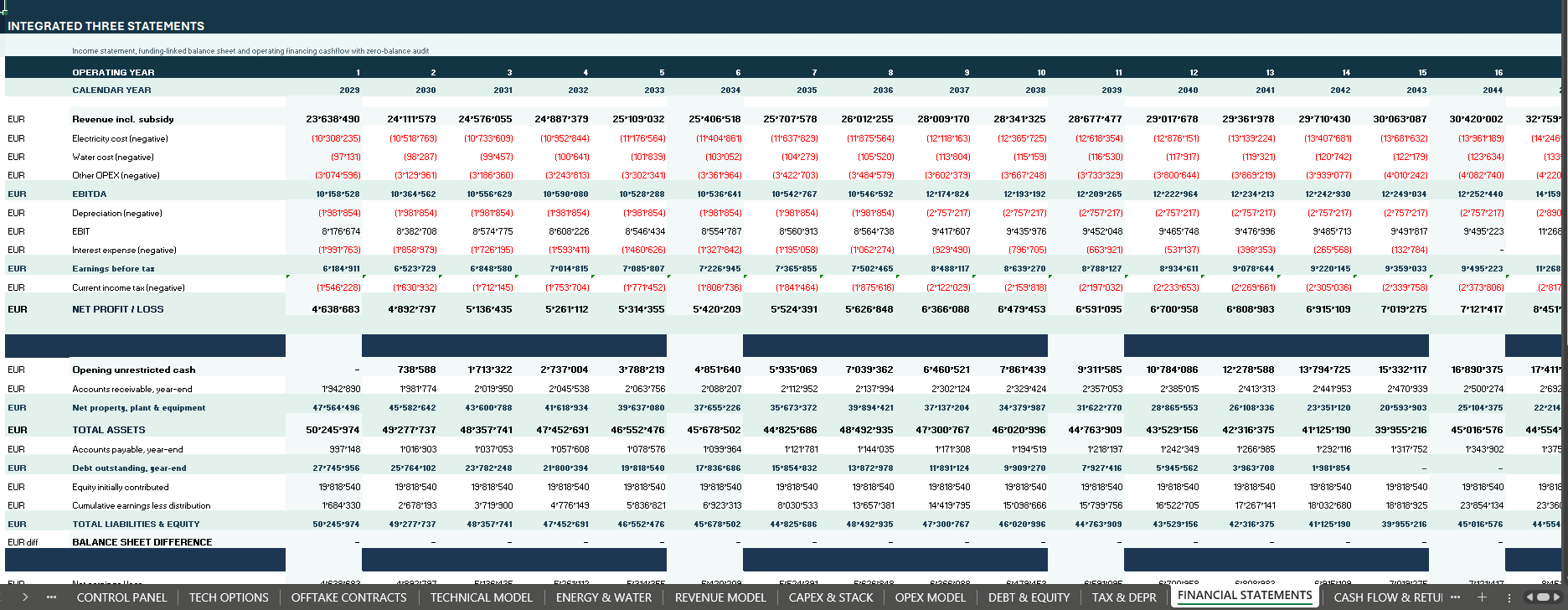
The integrated financial reporting includes an Income Statement, Balance Sheet and Cash Flow Statement. Supporting schedules address depreciation, simplified tax-loss carryforwards, working capital, capital expenditure and annual available cash.
Separate unlevered project free cash flow and investor equity cash flows distinguish project economics from financing effects.
The model does NOT include construction-phase debt draws, interest during construction, debt sculpting, refinancing, detailed lender reserves or a full contractual cash waterfall.
📈 LCOH, NET PRESENT VALUE & PROJECT RETURNS
Evaluate discounted Levelized Cost of Hydrogen, Project NPV, Project IRR, Equity IRR, EBITDA, project free cash flow, electricity expense per kg and annual/minimum DSCR.
Nominal cash flows use an editable project discount rate. The user guide explains included cost categories, discounting conventions and why alternative scopes can produce different hydrogen cost estimates.
These outputs are assumption-driven illustrations, not a certified economic assessment or project-specific valuation opinion.
🔀 THREE SCENARIOS – BASE, UPSIDE & DOWNSIDE
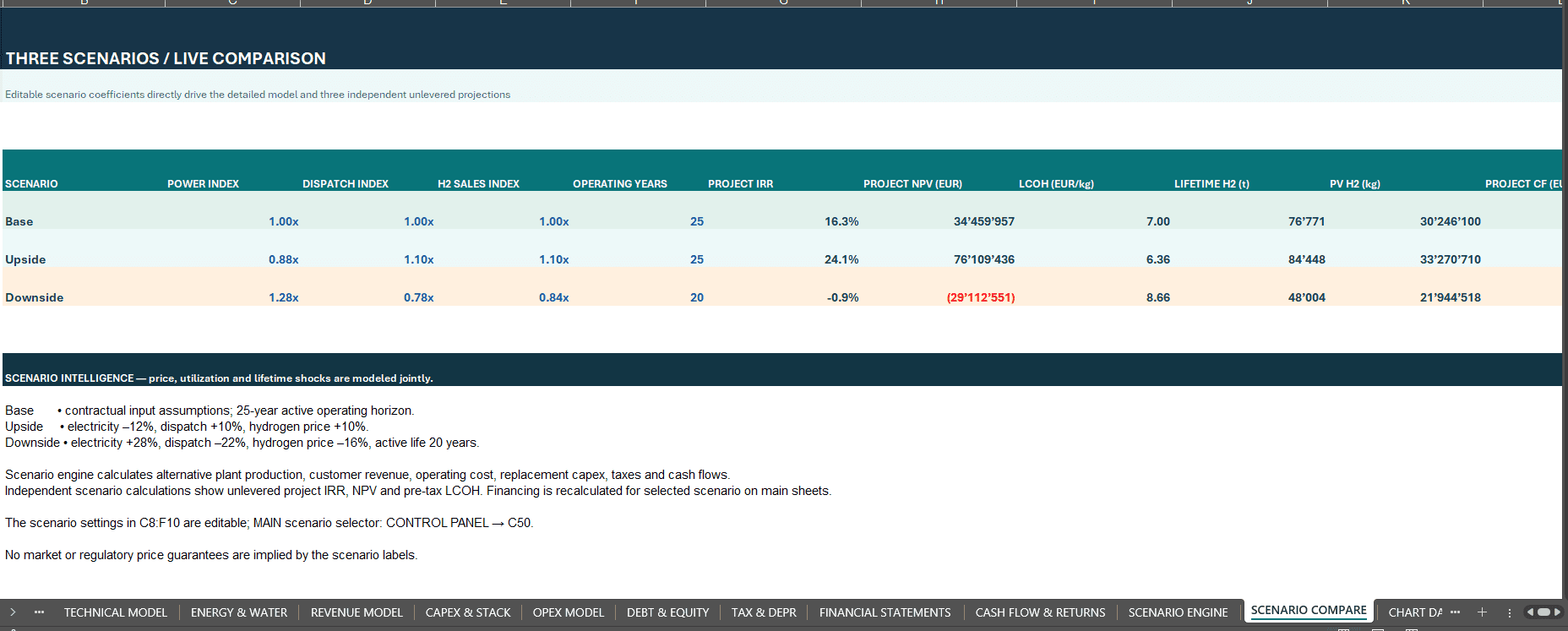
Compare three selectable cases that vary power purchase costs, dispatch utilization, hydrogen selling prices and active project lifetime.
An independent formula-driven scenario comparison supports side-by-side review of Project IRR, Project NPV, LCOH and lifetime production. A single selected scenario feeds the detailed annual operating and financial schedules.
The fictional Base example generates a positive Project NPV but includes a real lender-style coverage warning. In the supplied case the minimum DSCR is approximately 0.72x, below the template’s 1.20x reference threshold. This warning is intentionally preserved.
The Downside scenario produces a negative Project NPV under its assumptions. Passing mathematical reconciliation checks does not mean every case is economically viable.
✅ MODEL CHECKS, NAVIGATION & USER EXPERIENCE
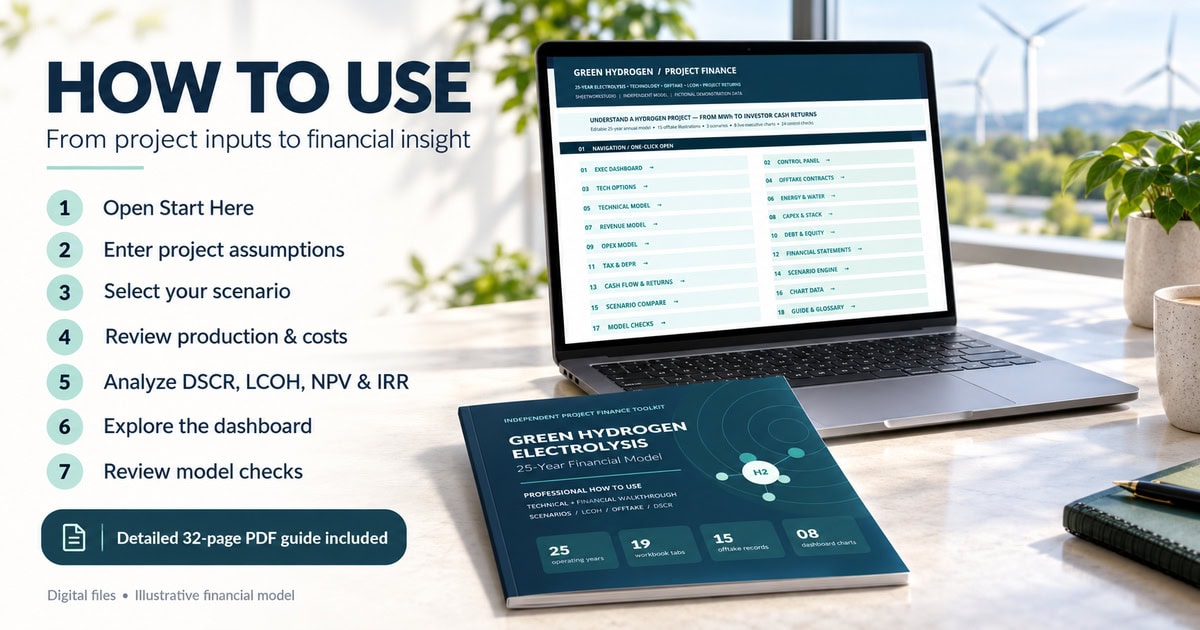
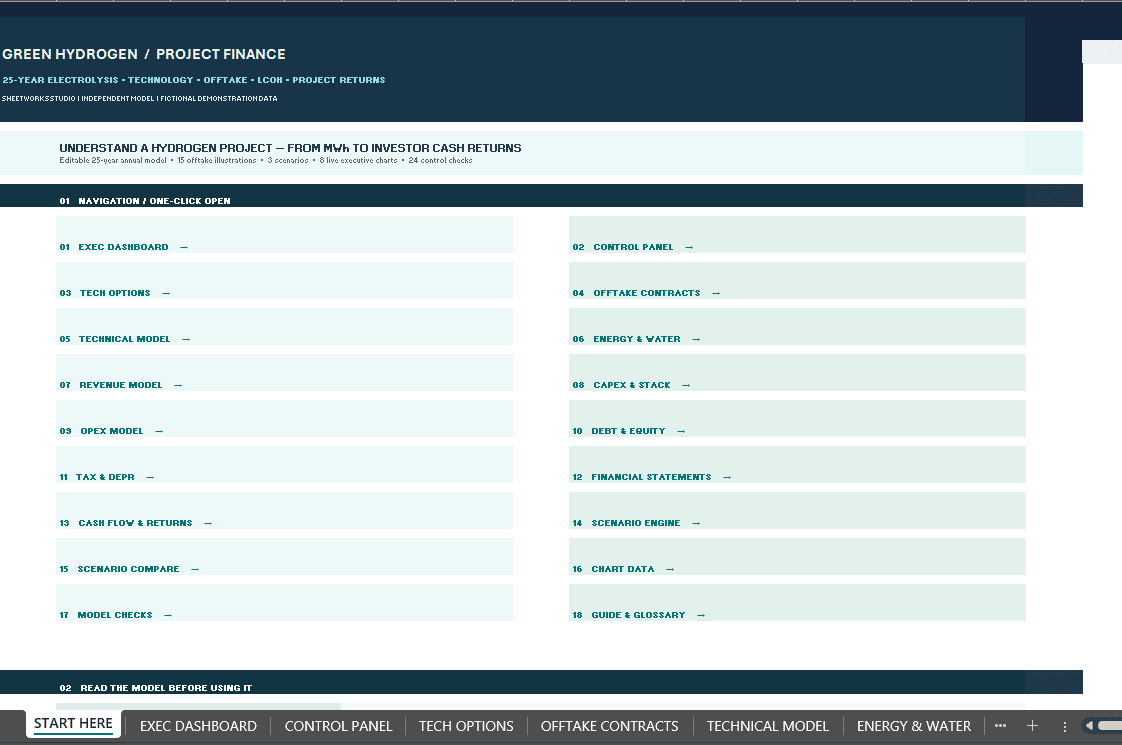
START HERE provides navigation and a guided workflow. Editable inputs, linked values and calculations use a consistent professional navy/teal interface.
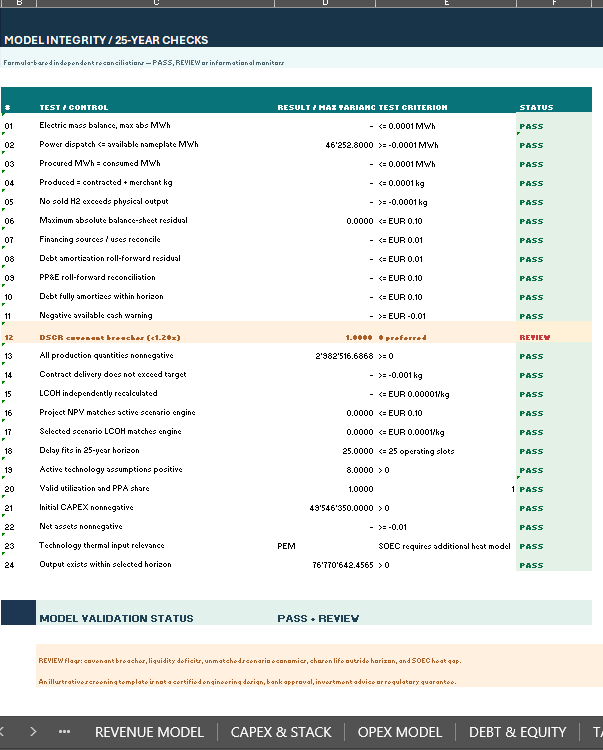
24 formula-based model controls cover physical production and electricity balances, contract sales allocation, debt continuity, balance-sheet reconciliation, cash, financing sources and uses, selected valuation outputs and operating constraints.
The default stored results show 23 PASS and one REVIEW (debt-coverage covenant breach). The workbook separates numerical consistency from financial and environmental screening warnings.
📦 WHAT YOU RECEIVE
FILE 1 — GREEN HYDROGEN ELECTROLYSIS FINANCIAL MODEL (.XLSX)
✓ 19 interconnected worksheets
✓ 25 annual forecast periods, initially 2029–2053
✓ 15 editable, directly linked offtake records
✓ PEM, Alkaline and SOEC reference options
✓ Electrolyzer capacity, electricity and water calculations
✓ PPA/spot procurement and operating costs
✓ Initial and replacement capital expenditure
✓ Senior debt, project cash flow and equity returns
✓ Income Statement, Balance Sheet and Cash Flow
✓ Three operating/valuation scenarios
✓ Eight native dashboard charts
✓ 24 formula-based model controls
FILE 2 — PROFESSIONAL HOW-TO-USE GUIDE (.PDF)
✓ 32-page English documentation
✓ Setup, sheet navigation and input references
✓ Technical production and electricity conventions
✓ Contract revenues and operating costs
✓ Financing, LCOH, NPV, IRR and DSCR methodology
✓ Scenario walkthroughs and model checks
✓ Troubleshooting, glossary and important limitations
Both paid files are supplied in one downloadable ZIP package. The user guide may also be offered separately as a complimentary documentation download; it does not include the working Excel model.
🧭 HOW TO GET STARTED
Save a working copy and open START HERE.
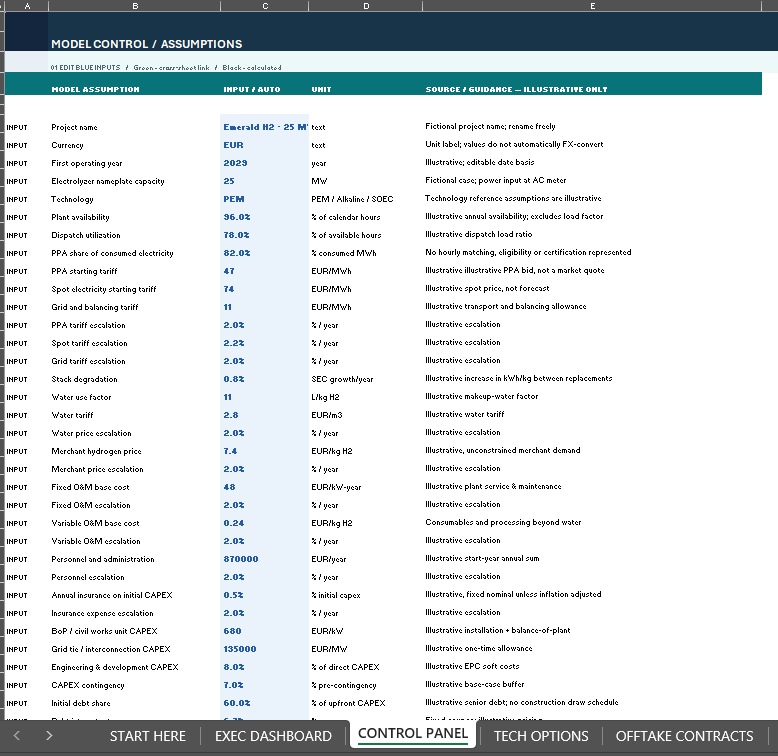
Set the technology, capacity, electricity, financing and valuation assumptions in CONTROL PANEL.
Replace the 15 fictional offtake examples with your own supported commercial assumptions.
Review technical production, power procurement, CAPEX, operating costs and the linked financial statements.
Compare Base, Upside and Downside outcomes and inspect the Executive Dashboard.
Investigate MODEL CHECKS, minimum DSCR, liquidity and carbon-screening indicators before using the forecast.
👥 WHO THIS TEMPLATE IS FOR
Green hydrogen project developers, renewable-energy investment analysts, financial consultants, project-finance teams, hydrogen entrepreneurs, engineering-commercial teams and advanced financial modeling students.
⚙ COMPATIBILITY & MODEL SCOPE
Format: Editable XLSX workbook + English PDF handbook
Forecast: 25 annual periods (not 300 monthly periods)
Technology reference cases: PEM, Alkaline, SOEC
Contracts: 15 directly linked records
Scenarios: Base, Upside, Downside
Charts: 8 native Excel charts
Recommended application: Microsoft Excel Desktop
Macros / VBA / Live APIs: None required
Google Sheets compatibility has not been independently verified. Dates, formulas, validations, navigation and charts should be rechecked after importing.
The reporting-currency field changes the displayed currency label; it does not convert cash amounts into another currency.
The model does not provide hourly renewable matching, borrower-level underwriting, detailed storage/compression/transport economics, construction interest, lender approval, official hydrogen certification, lifecycle emissions verification or local tax compliance. Merchant volume assumes a buyer at the entered price.
🛡 IMPORTANT DISCLOSURE
An independent, unofficial SheetworksStudio template for financial planning, illustration and education. All borrower/customer examples, engineering parameters, contracts and market prices are fictional.
This workbook is not an official, audited, certified, regulator-approved, government-approved or lender-approved document. Outputs are assumption-based and do not constitute investment, engineering, tax, accounting, financial or legal advice or guarantee project returns, green-hydrogen qualification or financing.
Users are responsible for verifying all inputs, financial outputs, technical assumptions and contract terms through appropriately qualified professionals.
PLAN HYDROGEN. MODEL POWER COSTS. ANALYZE FUNDING. UNDERSTAND RETURNS.
SheetworksStudio | Premium Financial Modeling Templates
Similar ProductsOther customers were also interested in...


 eFinancialModels
Electric Vehicle (EV) Charging Station Financial M...
With this comprehensive 5- or 10-year monthly tool, investors can assess the viability of setting up... Read more

Financial Model for Mobile App | Mobile App Busine...
The Mobile App Financial Plan Template in Excel allows you to develop financial projections when lau... Read more

 HenrySheykin
Food Truck Financial Model Excel Template
The Food Truck Financial Model helps entrepreneurs, founders, business owners, consultants, and anal... Read more

Green Hydrogen Production from Wind Energy Financi...
The Green Hydrogen from Wind Financial Model aims to comprehensively forecast a horizon of 40 years ... Read more

Simple Mutual Non-Disclosure Agreement Template
Protect your business secrets with ease using our Simple Mutual Non-Disclosure Agreement Template. S... Read more

Solar Energy Financial Model
The Solar Energy Financial Model Spreadsheet Template in Excel assists you in preparing a sophistica... Read more

 Peter Graf
The Customer-Centric Financial Model for Restauran...
Starting a restaurant without a financial plan is like driving a car blindfolded. You wouldn´t do i... Read more
You must log in to submit a review.