
0 ITEMS

AI Project Estimation Model
Excel workbook that estimates AI project cost and effort as P50, P80 and P90 ranges using three-point PERT, instead of a single figure. It adds a non-linearity multiplier for model development and fine-tuning work and a token-based cost model for LLM and API usage. Built for delivery leads and PMO teams who need a defensible estimate before an AI programme is approved.
AI Project Estimation Model by Viksya
AI Project Estimation Model is an Excel template (XLSX) available for download on purchase.
Estimating an AI project differs from estimating traditional software delivery, yet most templates still apply a single number plus a flat contingency percentage. Estimates built this way tend to break down during delivery, because AI-specific cost drivers such as data readiness, training iteration cycles and token-based inference spend are not represented in the model.
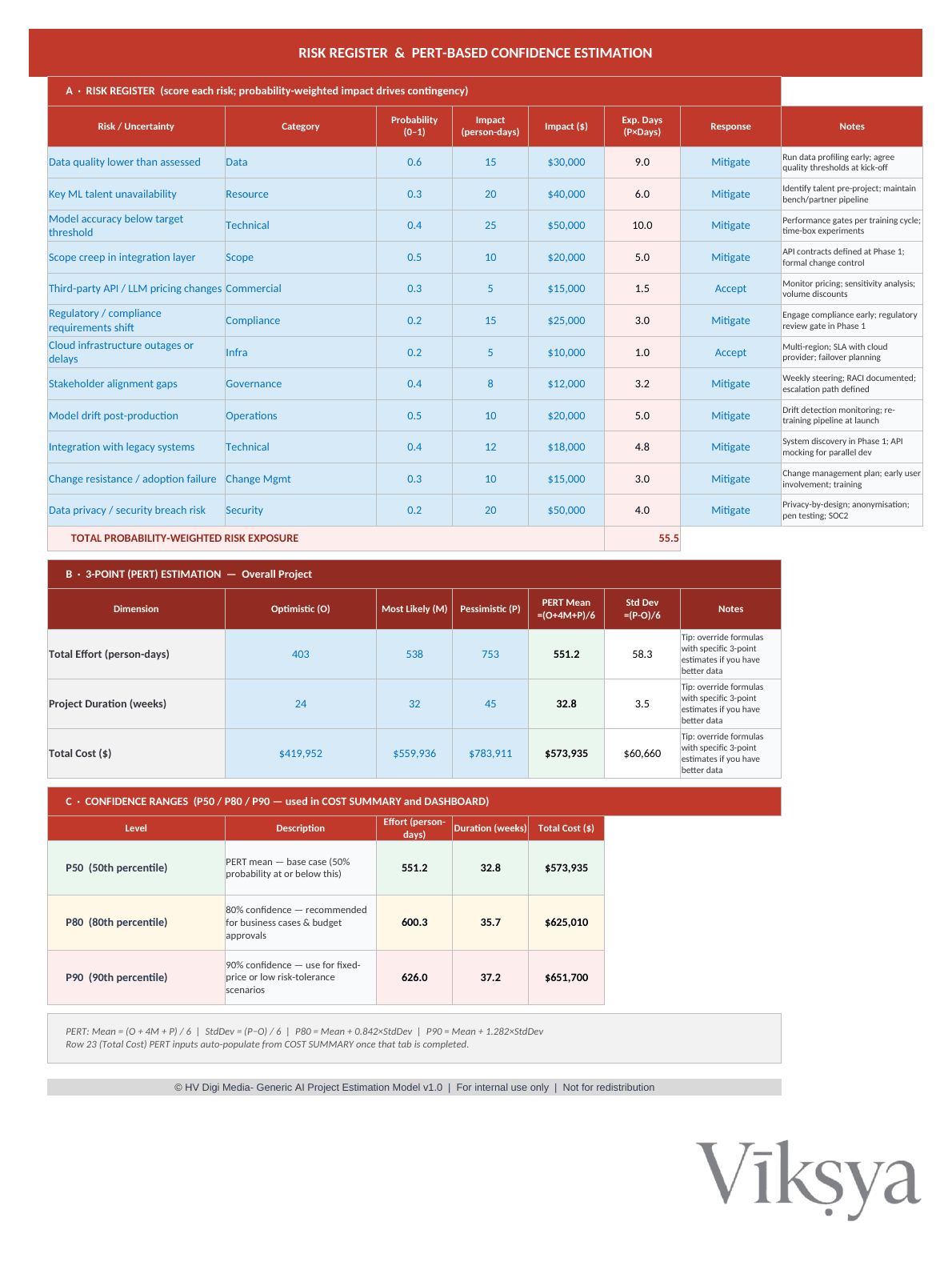
This workbook produces confidence-ranged estimates. Using three-point PERT (Optimistic / Most Likely / Pessimistic), it calculates P50, P80 and P90 cost and effort ranges, so a base case, a business-case figure and a fixed-price ceiling all come from the same inputs.
WHAT THE MODEL DOES
- Confidence-ranged estimates: P50, P80 and P90 cost and effort from three-point PERT, replacing single-point figures with a range.
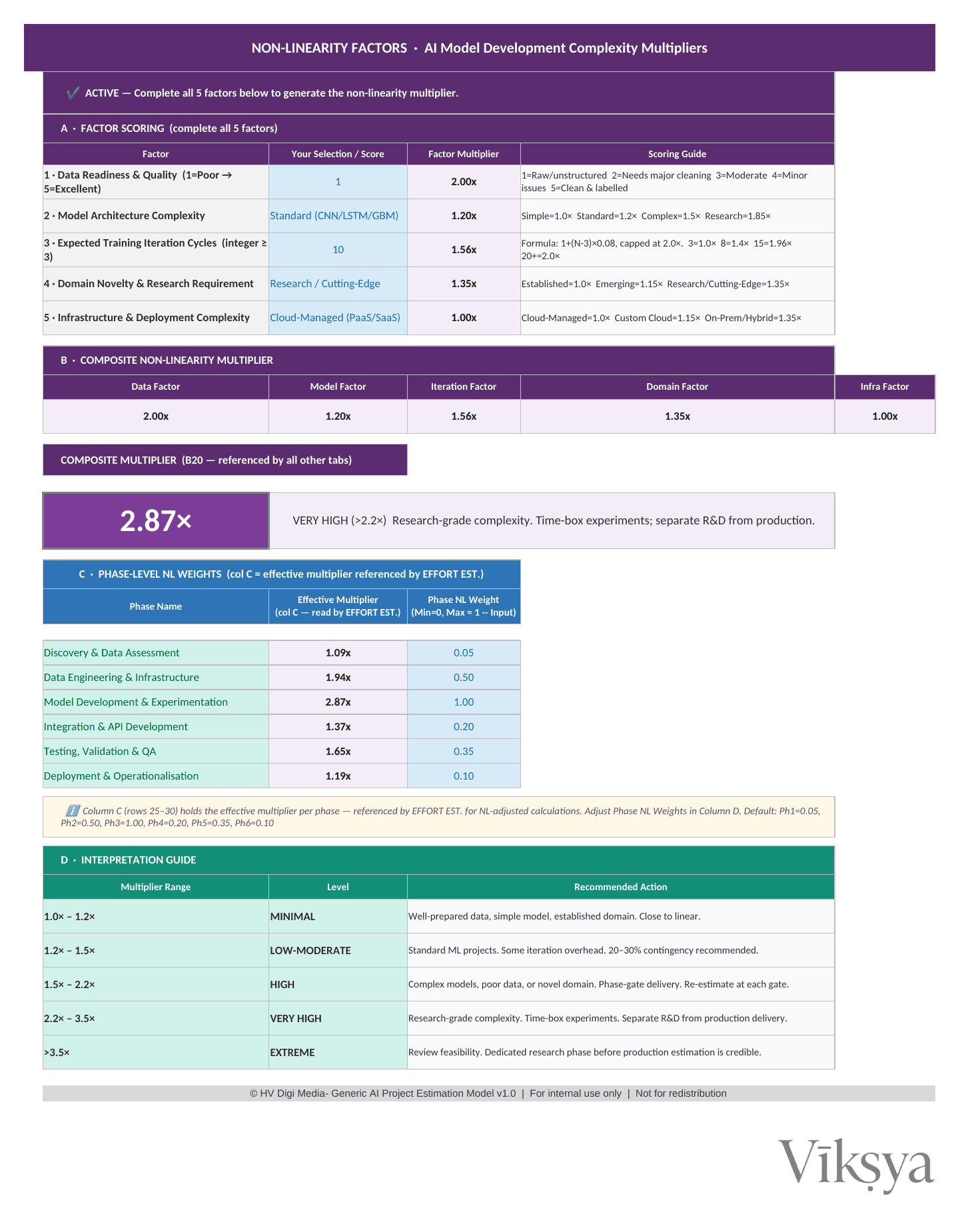
- Non-linearity engine for model development, fine-tuning and training projects: five factors (data readiness, model architecture complexity, training iteration cycles, domain novelty and infrastructure complexity) produce a composite multiplier applied phase by phase across the work breakdown structure.
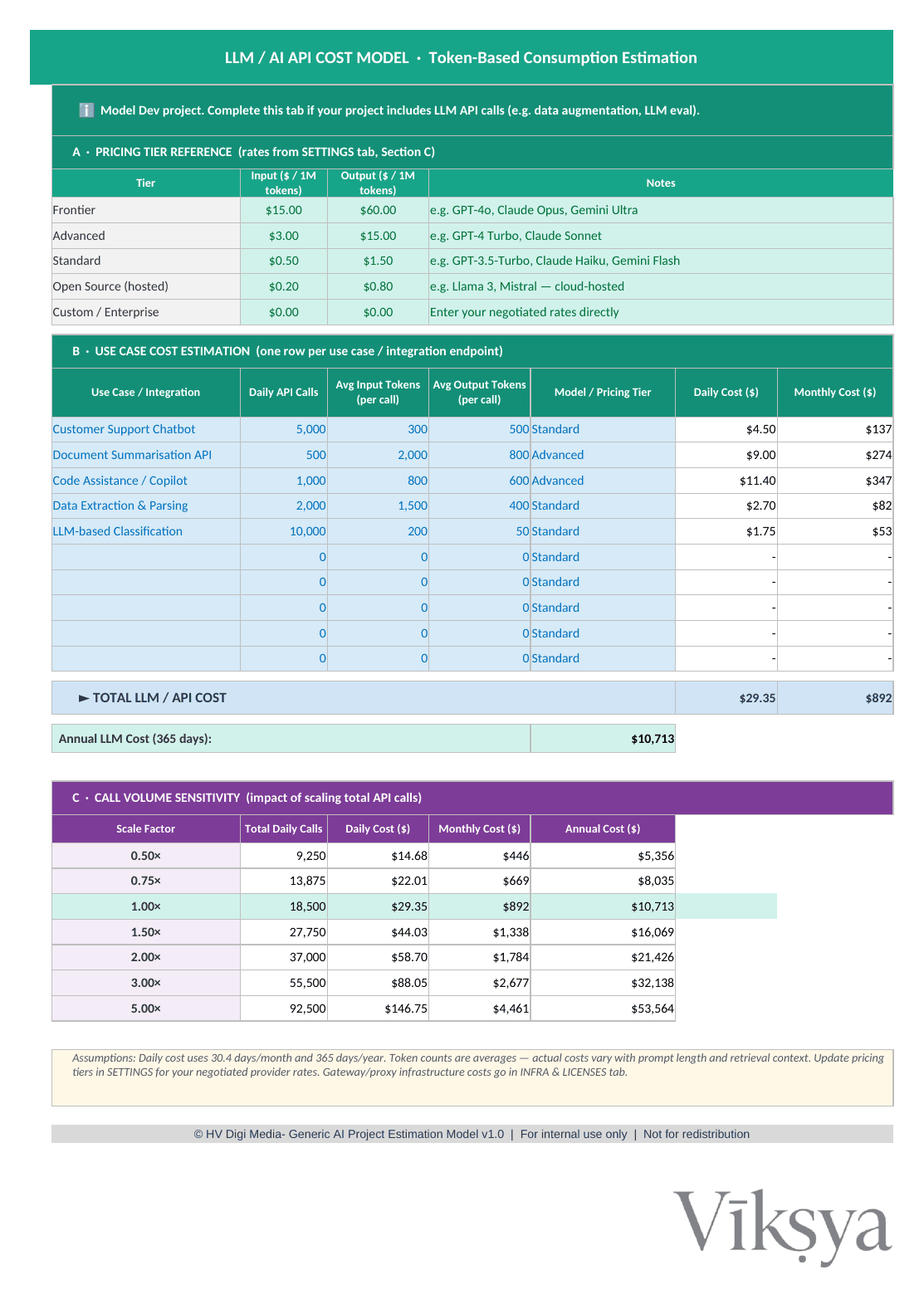
- LLM cost model for integration and consumption projects: token-based projections of daily, monthly and annual API spend across five pre-built use cases, with a call-volume sensitivity table from 0.5x to 5x of baseline volume.
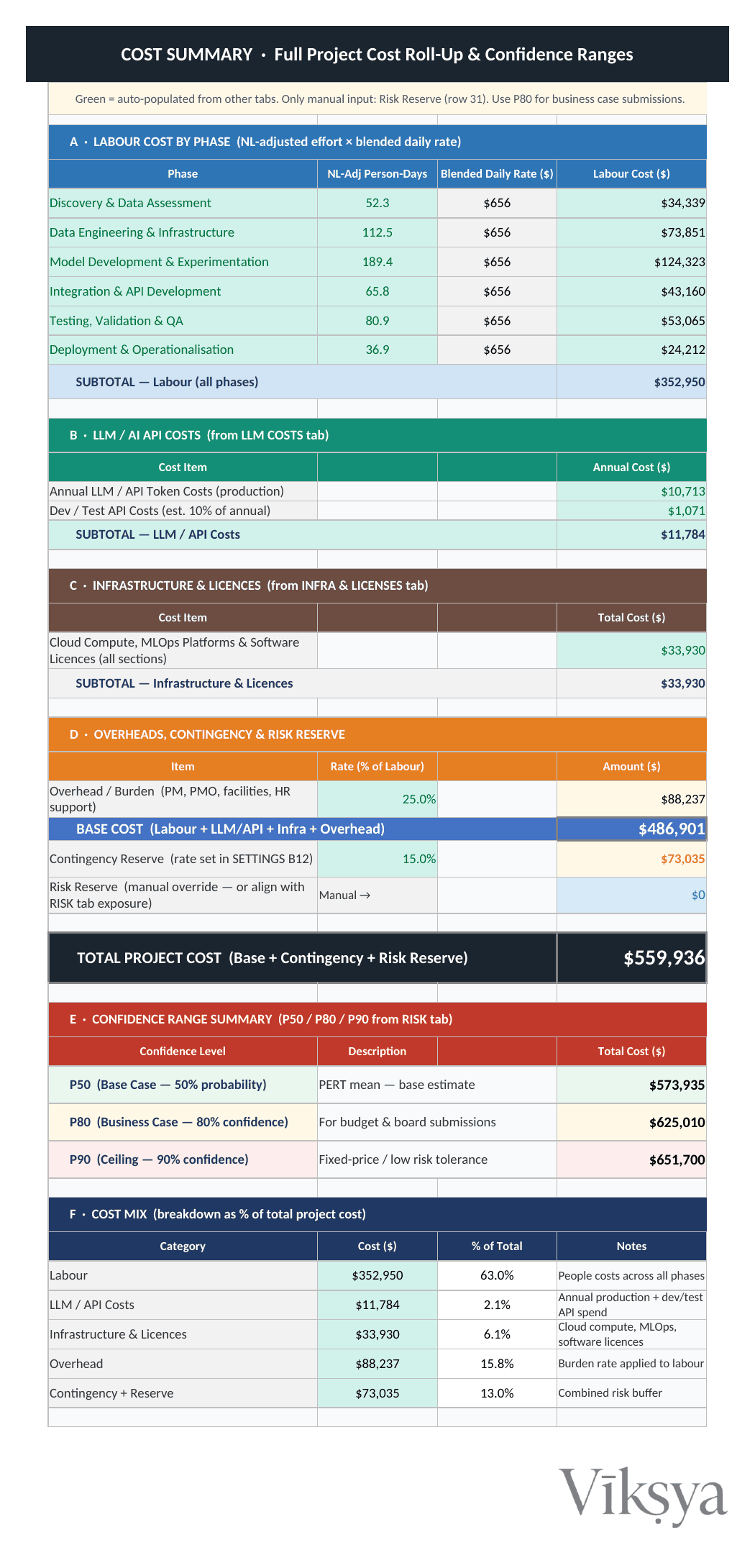
- Full cost roll-up: labour, LLM/API costs, infrastructure, overhead and contingency in one summary.
WORKBOOK STRUCTURE
A cover page plus ten working tabs:
1. Instructions: colour-coding convention and step-by-step workflow
2. Settings: currency, role-based daily rate card, LLM pricing tiers, overhead and contingency rates
3. Project Setup: project type, delivery methodology and six configurable phases
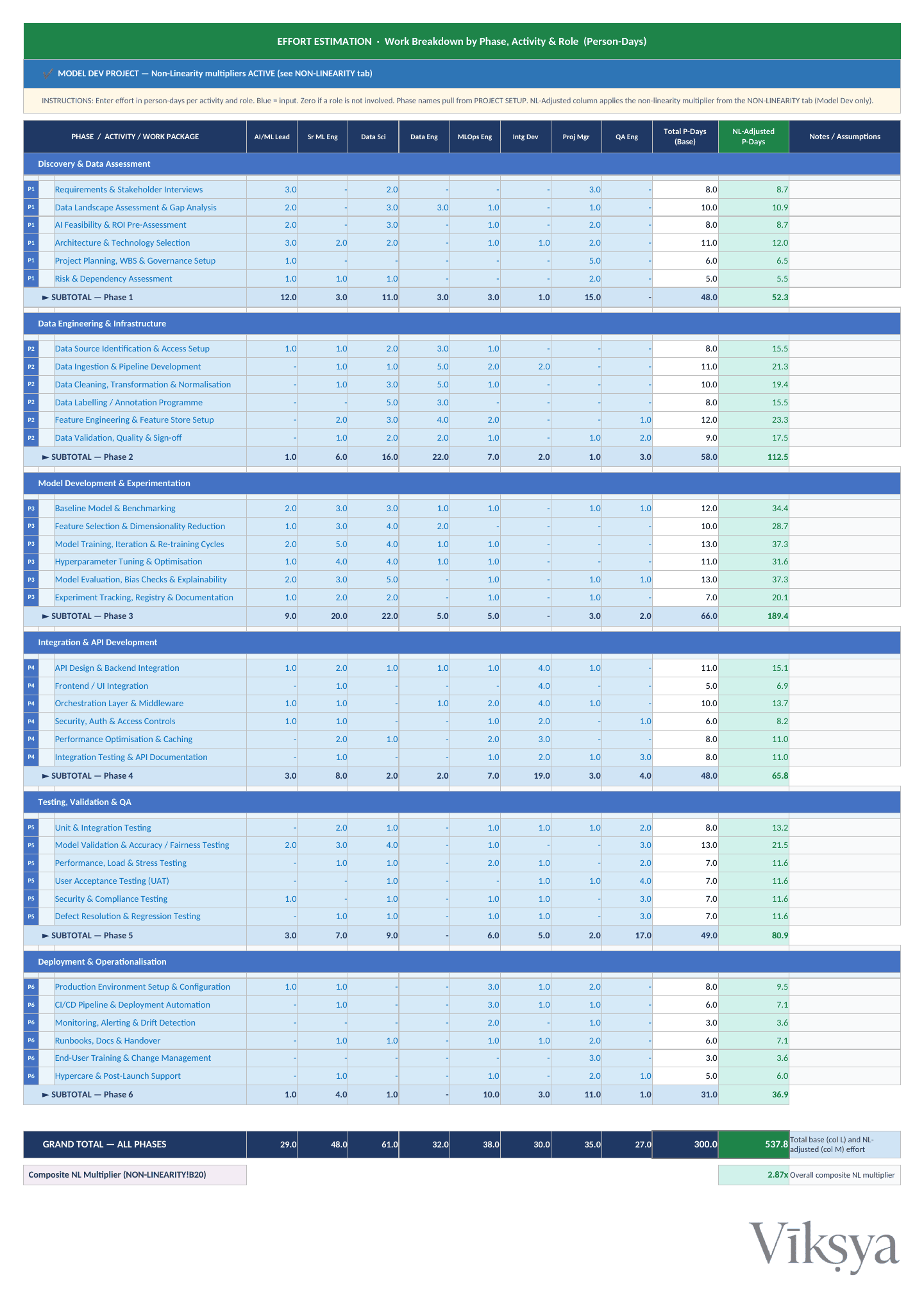
4. Effort Estimation: 36-activity work breakdown across six phases and eight roles
5. Non-Linearity: five-factor multiplier engine
6. LLM Costs: token-based cost model with call-volume sensitivity
7. Infrastructure & Licences: compute, MLOps platform and software licence cost sections
8. Risk: twelve-item risk register with probability-weighted exposure and PERT confidence ranges
9. Cost Summary: cost roll-up across all cost categories
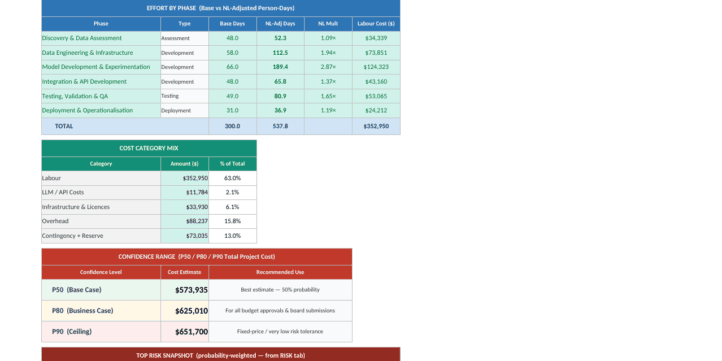
10. Dashboard: cost ranges, effort by phase, cost mix and top risk exposure on one screen
WHO IT IS FOR
Engineering leads, AI/ML architects, programme and project managers, PMO teams and delivery heads who need to submit a defensible cost and effort estimate before an AI programme is approved, rather than a single number that will not withstand scrutiny at a steering committee or budget review.
The workbook is methodology-agnostic. Phases can represent sprints, program increments or waterfall stages, and effort is entered uniformly in person-days. Currency and rate cards are set on the Settings tab, so the model can be used in any currency.
FORMAT AND NOTES
– Excel (.xlsx), no macros or VBA
– Works in Excel 2016 and later
– All formulas and inputs are visible and editable
All estimates produced are indicative and depend on the quality of the inputs provided. Outputs should be validated against your organisation’s own assumptions, governance standards and delivery context before use in business cases or procurement decisions.
Published by Viksya.
Similar ProductsOther customers were also interested in...



 eFinancialModels
Electric Vehicle (EV) Charging Station Financial M...
With this comprehensive 5- or 10-year monthly tool, investors can assess the viability of setting up... Read more

Financial Model for Mobile App | Mobile App Busine...
The Mobile App Financial Plan Template in Excel allows you to develop financial projections when lau... Read more

 HenrySheykin
Food Truck Financial Model Excel Template
The Food Truck Financial Model helps entrepreneurs, founders, business owners, consultants, and anal... Read more

Green Hydrogen Production from Wind Energy Financi...
The Green Hydrogen from Wind Financial Model aims to comprehensively forecast a horizon of 40 years ... Read more

Simple Mutual Non-Disclosure Agreement Template
Protect your business secrets with ease using our Simple Mutual Non-Disclosure Agreement Template. S... Read more

Solar Energy Financial Model
The Solar Energy Financial Model Spreadsheet Template in Excel assists you in preparing a sophistica... Read more

 Peter Graf
The Customer-Centric Financial Model for Restauran...
Starting a restaurant without a financial plan is like driving a car blindfolded. You wouldn´t do i... Read more
You must log in to submit a review.