
0 ITEMS

COGS Decomposition, Inflation & Pricing Scenario Excel Model
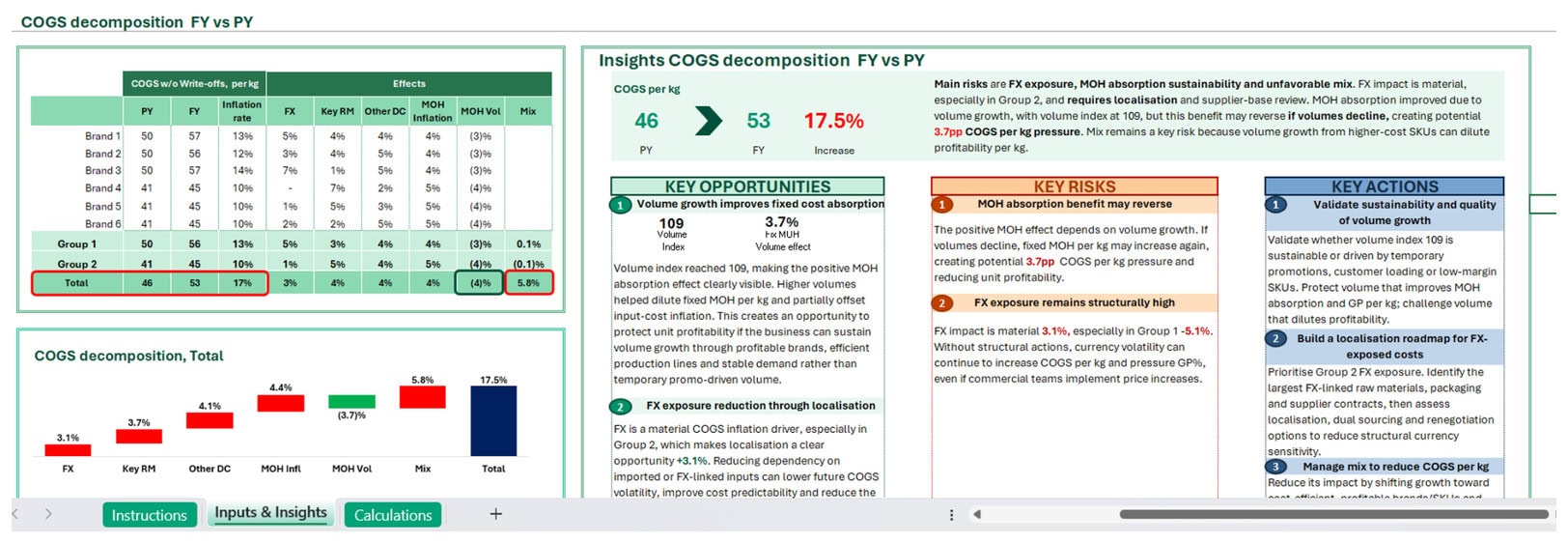
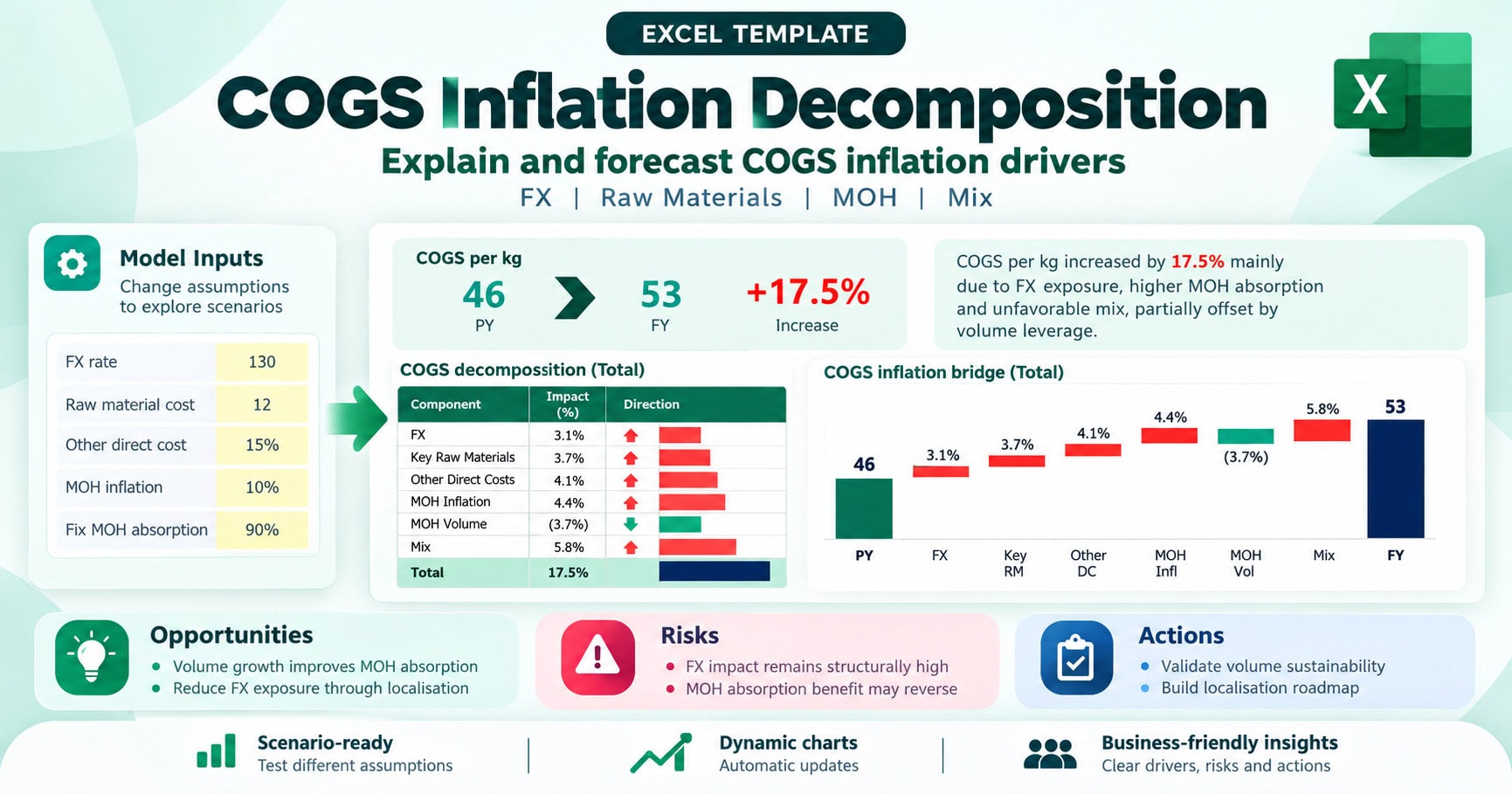
Costs are rising. How much pricing do you need to protect profitability? This COGS decomposition and scenario model shows what is really driving unit cost — FX, Raw Materials, Other Direct Costs, MOH inflation, Volume absorption and Mix — and helps separate structural cost pressure from volume-driven effects. Understand TODAY: compare any two periods and identify exactly what increased or reduced COGS, including how higher or lower volumes dilute or increase fixed manufacturing cost per unit. Plan TOMORROW: change FX, raw material, inflation, volume and mix assumptions to forecast future COGS and quantify the pricing and/or productivity required to offset cost pressure and protect profitability. Built for FP&A, Commercial Finance, RGM, Pricing, Operations, Finance Managers and Business Owners who need to move from “costs increased” to why, what happens next, and what action is required.

Costs are rising. How much pricing do you need to protect profitability?
Knowing that COGS increased is not enough.
Raw materials may rise. FX can move against you. Manufacturing costs can inflate. Mix can change. And even when total fixed manufacturing costs remain stable, lower volumes can push fixed cost per unit higher.
The real questions are:
What is driving the increase? What happens if conditions change again? And how much pricing or productivity do you need to compensate?
The COGS Decomposition, Inflation & Pricing Scenario Excel Model is designed to answer all three.
1 | Understand TODAY — What is driving your COGS?
Compare any two selected periods and decompose unit COGS movement into:
FX | Raw Materials | Other Direct Costs | MOH Inflation | Volume Absorption | Mix
See which factors increased COGS, which helped offset the pressure, and where action is required — instead of stopping at one total cost variance.
2 | Understand the VOLUME effect
Volume can change unit economics even when total fixed costs remain unchanged.
Volume ↓ → Fixed cost per unit ↑
Volume ↑ → Fixed cost per unit ↓
The model isolates this effect, helping you distinguish genuine cost inflation from volume absorption or dilution.
Don’t mistake poor absorption for inflation — or temporary volume benefits for sustainable cost improvement.
3 | Plan TOMORROW — Test what happens next
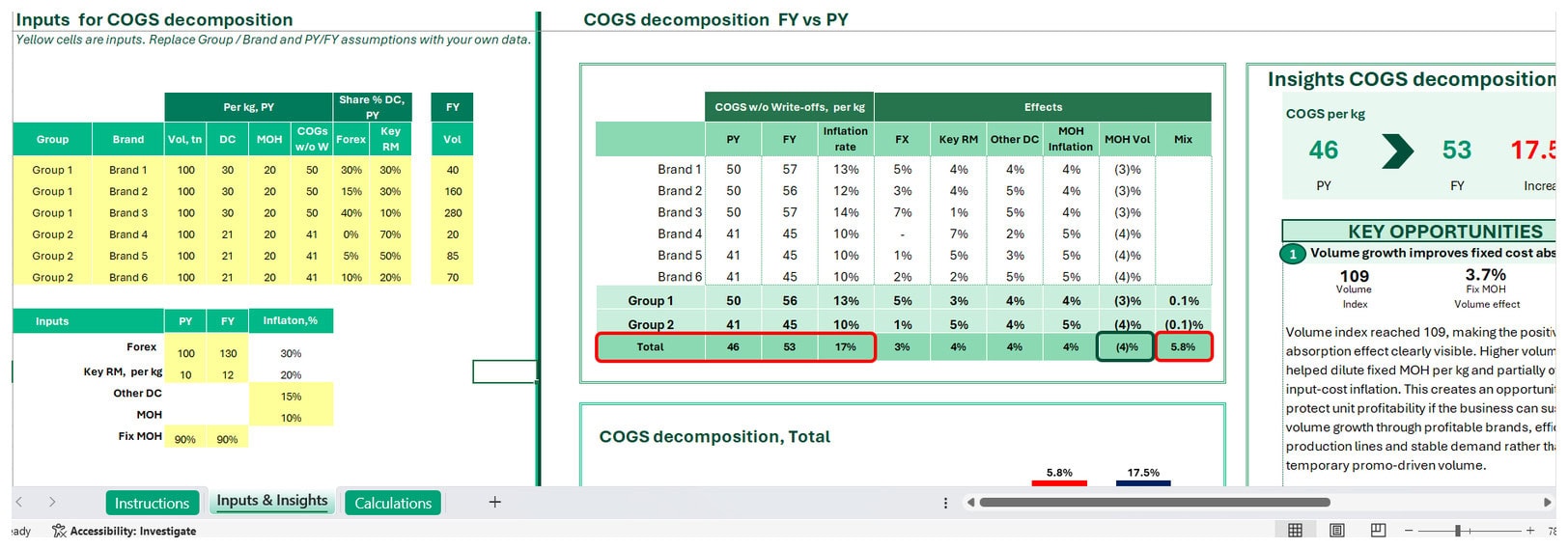
Change forward-looking assumptions and see the impact on future COGS:
FX changes — what happens?
Raw materials +10% — what is the impact?
Volume falls — how much does fixed cost per unit increase?
Mix changes — what happens to average unit cost?
Use scenarios to understand cost exposure before it hits actual results.
4 | Know how much action you need
Understanding cost pressure is only half the job.
The model helps quantify the pricing and/or productivity required to offset cost increases and protect profitability.
Move the conversation from:
“COGS will increase.”
to:
“This is the expected impact — and this is the pricing or productivity we need to compensate.”
From analysis to management-ready decisions
Linked decomposition views, charts and executive insights turn the analysis into nearly ready-to-use management presentation materials, structured around:
Performance | Drivers | Risks | Opportunities | Actions
Useful for forecasting, budgeting, cost reviews, pricing, RGM, productivity planning and management presentations.
Built for people responsible for cost and profitability
Designed for FP&A, Commercial Finance, Finance Business Partners, RGM, Pricing, Operations, Finance Managers and Business Owners.
What you get
✓ COGS decomposition across any two periods
✓ FX, Raw Material, Other Direct Cost and MOH impacts
✓ Volume absorption / dilution analysis
✓ Mix impact
✓ Forward-looking COGS scenarios
✓ Required pricing / productivity assessment
✓ Automatically updated management visuals
✓ Risks, Opportunities and Actions
✓ Fully editable Excel model with sample data
Don’t just report cost inflation. Decide what to do about it.
Understand TODAY. Model TOMORROW. Quantify the action required to protect profitability.
Similar ProductsOther customers were also interested in...



 eFinancialModels
Electric Vehicle (EV) Charging Station Financial M...
With this comprehensive 5- or 10-year monthly tool, investors can assess the viability of setting up... Read more

Financial Model for Mobile App | Mobile App Busine...
The Mobile App Financial Plan Template in Excel allows you to develop financial projections when lau... Read more

 HenrySheykin
Food Truck Financial Model Excel Template
The Food Truck Financial Model helps entrepreneurs, founders, business owners, consultants, and anal... Read more

Green Hydrogen Production from Wind Energy Financi...
The Green Hydrogen from Wind Financial Model aims to comprehensively forecast a horizon of 40 years ... Read more

Simple Mutual Non-Disclosure Agreement Template
Protect your business secrets with ease using our Simple Mutual Non-Disclosure Agreement Template. S... Read more

Solar Energy Financial Model
The Solar Energy Financial Model Spreadsheet Template in Excel assists you in preparing a sophistica... Read more

 Peter Graf
The Customer-Centric Financial Model for Restauran...
Starting a restaurant without a financial plan is like driving a car blindfolded. You wouldn´t do i... Read more
You must log in to submit a review.