0 ITEMS

How Much Does It Cost to Start an Airline in 2025
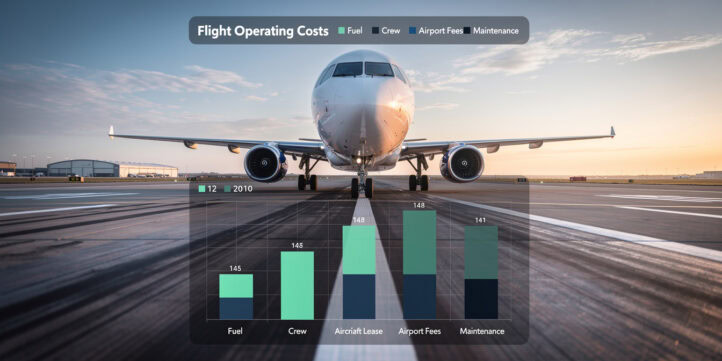
A single London–New York flight on a Boeing 777-300ER earns about $21,000 in operating profit on $174,000 in revenue — a 12% margin that vanishes entirely the moment fuel costs move against you, as they did in 2025 when a wide-body fill jumped 58% in four months. That fragility is why Boeing’s own benchmark of $10–$20 million for a regional startup is a floor rather than a comfortable target, and why most new airlines fail on financial planning long before they fail on operations.
Key Takeaways
- Boeing’s StartupBoeing program benchmarks regional airline startup capital at $10–$20 million, while larger carriers require $100 million or more depending on fleet size and route strategy.
- A single long-haul Boeing 777-300ER flight from London to New York generates roughly $21,000 in operating profit on $174,000 in revenue — a margin of just 12%, with zero room for fuel spikes.
- Wide-body jet fuel costs jumped from $114,000 per fill in February 2025 to approximately $180,000 by mid-2025, a 58% increase that can erase startup margins entirely.
- U.S. airline costs rose 36% between 2019 and 2022 (Airlines for America index: 219.7 to 298.6), meaning JetBlue’s $130 million 2000 launch would cost materially more today.
- The average U.S. domestic itinerary fare was $382 in 2023, setting the revenue ceiling that startup pricing must work within.
- Global passenger traffic grew 6.5% in 2024 and a further 6% in 2025, creating market opportunity — but also intensifying competition for airport slots and qualified pilots.
- Most new airlines fail on financial planning, not operations: the 12–24 month pre-revenue certification period burns cash before a single ticket is sold.
The Capital Stack: Boeing’s Benchmark for Airline Startup Costs
Starting an airline requires between $10 million and $100 million or more in startup capital, depending entirely on fleet size, route type, and business model. According to Boeing’s StartupBoeing program, a small regional operation typically needs $10–$20 million, while larger carriers routinely exceed $100 million (Boeing StartupBoeing).
Those figures cover far more than aircraft. The capital stack for a new airline includes:
- Aircraft acquisition or lease deposits (largest single line item)
- FAA Part 121 certification costs (legal fees, consulting, inspector time: typically $500,000–$2 million)
- Working capital reserve for 12–24 months of pre-revenue operations
- Insurance premiums (hull and liability coverage for a single narrowbody: $500,000–$1.5 million annually)
- Gate leases and slot fees at target airports
- Technology infrastructure (reservation system, crew scheduling, maintenance tracking)
- Initial fuel inventory and hedging deposits
- Marketing and brand launch costs
The regional vs. major carrier gap is driven primarily by fleet size and airport access. A two-aircraft regional startup serving secondary airports faces a fundamentally different cost structure than a carrier targeting JFK or LAX slots, where gate leases alone can run $1–$3 million per gate annually.
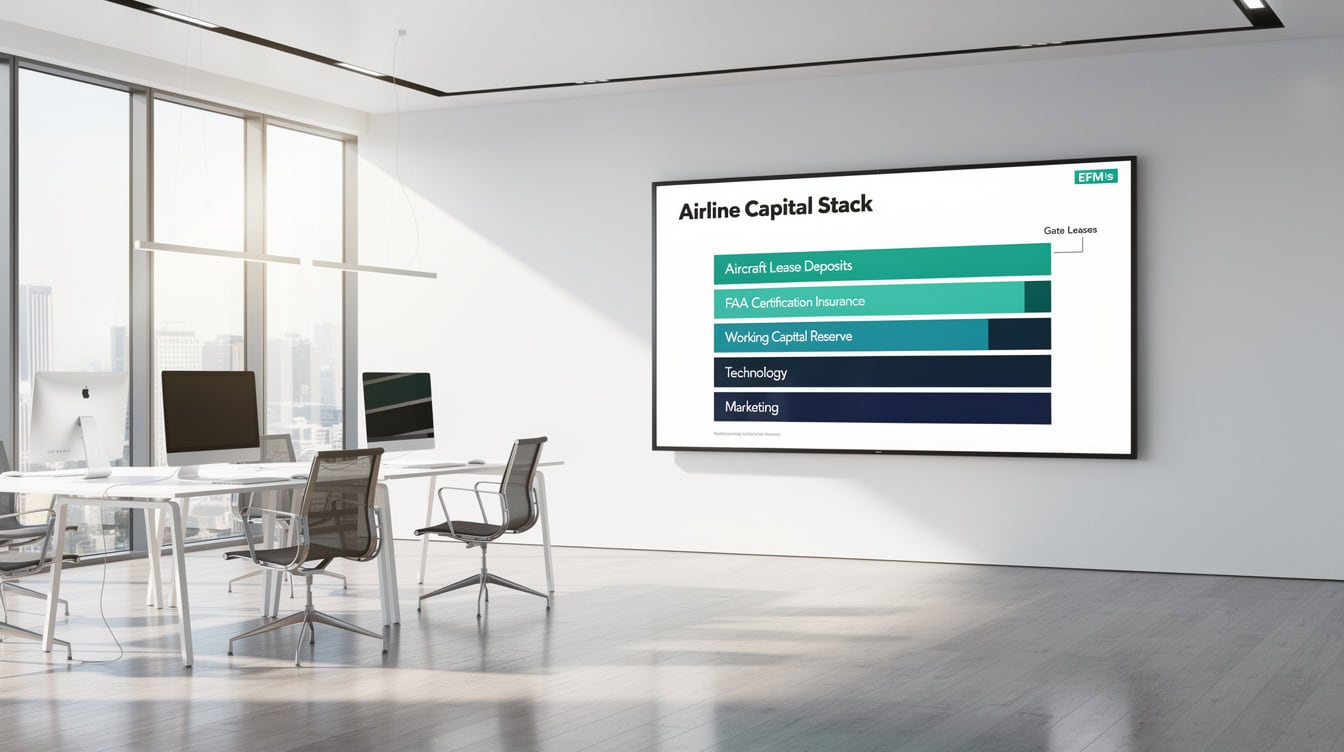
The capital stack for a new airline spans 8 distinct cost categories — aircraft deposits and working capital reserves are the two largest pre-revenue commitments.
Aircraft Acquisition vs. Leasing: The Core Capital Decision
For most airline startups, leasing aircraft is the only realistic path to launch — outright purchase of a single narrowbody consumes the entire startup capital budget. A new Boeing 737 MAX 8 lists at approximately $121 million, and an Airbus A320neo at around $110 million, making purchase economics prohibitive for early-stage carriers. The Boeing 737 MAX family has accumulated over 5,000 orders from airlines worldwide (Boeing), reflecting how dominant this aircraft type is in the narrowbody market that most startups target.
Leasing shifts the capital requirement dramatically. A typical operating lease (a contract where the airline pays monthly rent for the aircraft without owning it) for a narrowbody aircraft runs $350,000–$500,000 per month. Wide-body aircraft like the Boeing 787-9 lease for $900,000–$1.2 million per month. Beyond the monthly payment, lessors require maintenance reserves — a per-flight-hour deposit held against future heavy maintenance events. For a narrowbody, maintenance reserves typically run $150–$250 per flight hour, adding $30,000–$50,000 per month per aircraft at normal utilization.
| Aircraft Type | Purchase Price (List) | Monthly Lease Rate | Maintenance Reserve (per flight hour) |
|---|---|---|---|
| Boeing 737 MAX 8 | ~$121M | $350K–$500K | $150–$250 |
| Airbus A320neo | ~$110M | $320K–$480K | $140–$230 |
| Boeing 787-9 | ~$292M | $900K–$1.2M | $300–$450 |
| Boeing 777-300ER | ~$375M | $1.1M–$1.5M | $400–$600 |
| ATR 72-600 (regional) | ~$26M | $120K–$180K | $80–$130 |
For a startup launching with two narrowbody aircraft, lease deposits (typically 3–6 months of rent) plus first-month payments and maintenance reserve prefunding can consume $4–$8 million before the first flight. That figure alone explains why Boeing’s $10–$20 million regional benchmark is tight, not generous.

A 787-9 operating lease costs $900K–$1.2M per month before maintenance reserves — making wide-body fleet decisions the single largest capital commitment for a new carrier.
Per-Flight Economics: The McKinsey London-New York Model
A single flight’s profit-and-loss statement reveals why airline economics are so unforgiving. McKinsey’s detailed analysis of a Boeing 777-300ER operating London to New York with 221 passengers shows total operating costs of approximately $153,000 against total revenue of approximately $174,000 — generating an operating profit of $21,000 per flight (McKinsey & Company, 2019).
Here’s the math for that single flight:
Revenue side:
- 221 passengers × average fare: ~$787 per seat = $174,000 total revenue
Cost side (approximate breakdown):
- Fuel: ~$60,000–$70,000 (at 2019 prices; see fuel section for 2025 reality)
- Crew (flight deck + cabin): ~$18,000–$22,000
- Aircraft ownership/lease: ~$20,000–$25,000
- Maintenance reserve: ~$8,000–$12,000
- Airport and navigation fees: ~$10,000–$15,000
- Sales and distribution: ~$3,300 ($15 per passenger × 221 passengers)
- Catering and passenger services: ~$8,000–$12,000
- Overhead allocation: ~$5,000–$8,000
- Total: ~$153,000
Operating margin: $21,000 / $174,000 = 12.1%
Sales and distribution costs alone — the fees paid to global distribution systems (GDS), travel agents, and booking platforms — run approximately $15 per passenger (McKinsey & Company, 2019). For a startup relying heavily on third-party booking channels rather than direct sales, this cost layer compounds quickly across a full schedule.
For a startup airline, this margin is the ceiling, not the floor. Established carriers achieve it through decades of supplier relationships, optimized scheduling, and negotiated fuel contracts. A new entrant will face higher per-unit costs across nearly every line item.
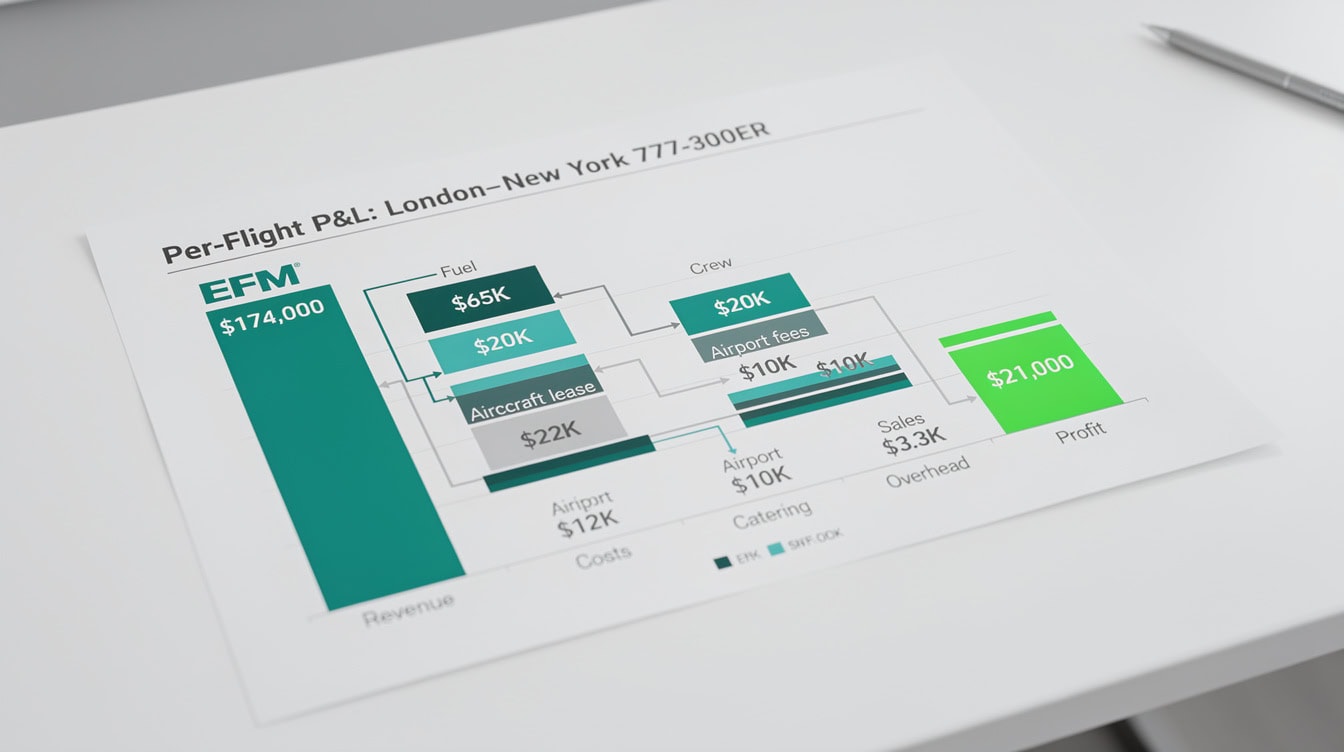
A 12% operating margin on a single long-haul flight leaves no buffer: a $17,000 fuel increase on this route turns the $21,000 profit into a $17,000 loss.
Fuel Cost Volatility: When $114,000 Becomes $180,000
Fuel is the single largest variable cost in airline operations, and its volatility can destroy a startup’s financial model faster than any other factor. According to the U.S. Bureau of Transportation Statistics, filling a wide-body aircraft with jet fuel cost approximately $114,000 in February 2025, and by mid-2025 the same fuel load cost approximately $180,000 — a 58% increase in roughly four months (U.S. Bureau of Transportation Statistics, 2025). The BTS tracks that U.S. airlines collectively consumed over 10 billion gallons of jet fuel in a single year (U.S. Bureau of Transportation Statistics), illustrating the enormous scale at which fuel price swings translate into financial exposure across the industry.
Applied to the McKinsey London-New York example: if fuel costs jump from $65,000 to $103,000 on that single flight, the $21,000 operating profit becomes a $17,000 operating loss. The entire margin is gone, and the airline is now paying to operate.
Startup airlines face three compounding fuel disadvantages:
- No hedging history. Fuel hedging (buying forward contracts to lock in future fuel prices) requires credit facilities and counterparty relationships that new carriers don’t have.
- No volume discounts. Major carriers negotiate bulk fuel purchasing agreements at major hubs. Startups pay spot prices.
- No route optimization. Established carriers continuously optimize flight paths and altitudes for fuel efficiency. New operations run less efficiently until data accumulates.
A startup financial model that uses a single fuel price assumption without sensitivity analysis is not a financial model — it’s a best-case scenario. Any serious airline business plan must stress-test fuel costs at +20%, +40%, and +60% above base case.
For startup financial models in capital-intensive industries, fuel sensitivity is the first scenario any investor will ask about.
A 58% fuel cost increase in four months in 2025 demonstrates why single-scenario fuel assumptions are the most dangerous mistake in airline startup financial models.
The 36% Cost Inflation Reality: Post-Pandemic Economics
The post-pandemic cost environment fundamentally changed the feasibility calculus for new airline entrants. The Airlines for America Passenger Airline Cost Index rose from 219.7 in 2019 to 298.6 in 2022, an increase of approximately 36% (Airlines for America, 2022).
This inflation hit every cost category simultaneously: labor (pilot shortages drove captain salaries above $300,000 at major carriers), maintenance (parts supply chains disrupted), and airport access (slot scarcity at major hubs intensified post-consolidation).
JetBlue launched in 2000 with $130 million. Adjusting that figure for 36% cost inflation alone — before accounting for fleet size differences or today’s slot premiums — implies a comparable launch today would require at least $177 million. Add current pilot salary premiums and technology infrastructure requirements, and the real equivalent is likely $200–$250 million for a similar-scale operation.
Breeze Airways, launched in 2021 by JetBlue’s founder David Neeleman, raised approximately $100 million at launch but targeted secondary airports specifically to avoid the cost structure of major hubs. That strategic choice — accepting lower passenger volumes in exchange for lower airport costs — is a direct response to the post-pandemic cost environment.

Post-pandemic cost inflation means JetBlue’s $130M 2000 launch would require at least $200–$250M today — before accounting for current pilot salary premiums.
Airport Infrastructure: Gates, Slots, and Ground Equipment
Airport access costs are often underestimated in startup financial models, yet they represent a fixed cost that accrues whether or not aircraft are flying. Gate leases at major U.S. hubs run $1–$3 million per gate annually. Landing fees at large airports are typically calculated per 1,000 pounds of maximum takeoff weight — at JFK, this runs approximately $6–$9 per 1,000 lbs, meaning a single 737 MAX landing costs roughly $400–$600 in landing fees alone.
Slots — the rights to take off or land at a specific time at a slot-controlled airport (JFK, LaGuardia, Reagan National, and Chicago O’Hare) — are a separate and often prohibitive cost. Slots at JFK have traded for $10–$75 million each in secondary market transactions. New entrants cannot simply buy their way into these airports; the FAA slot allocation process is competitive and slow.
Ground support equipment (GSE) adds another $2–$5 million per base for a startup operating its own ground handling. This includes:
- Aircraft tugs and pushback tractors: $150,000–$400,000 each
- Belt loaders and baggage carts: $30,000–$80,000 per unit
- Ground power units (GPU): $50,000–$120,000 each
- De-icing equipment (where applicable): $200,000–$500,000 per unit
Most startups outsource ground handling to third-party providers to avoid this capital outlay, paying $8–$15 per passenger turn instead.
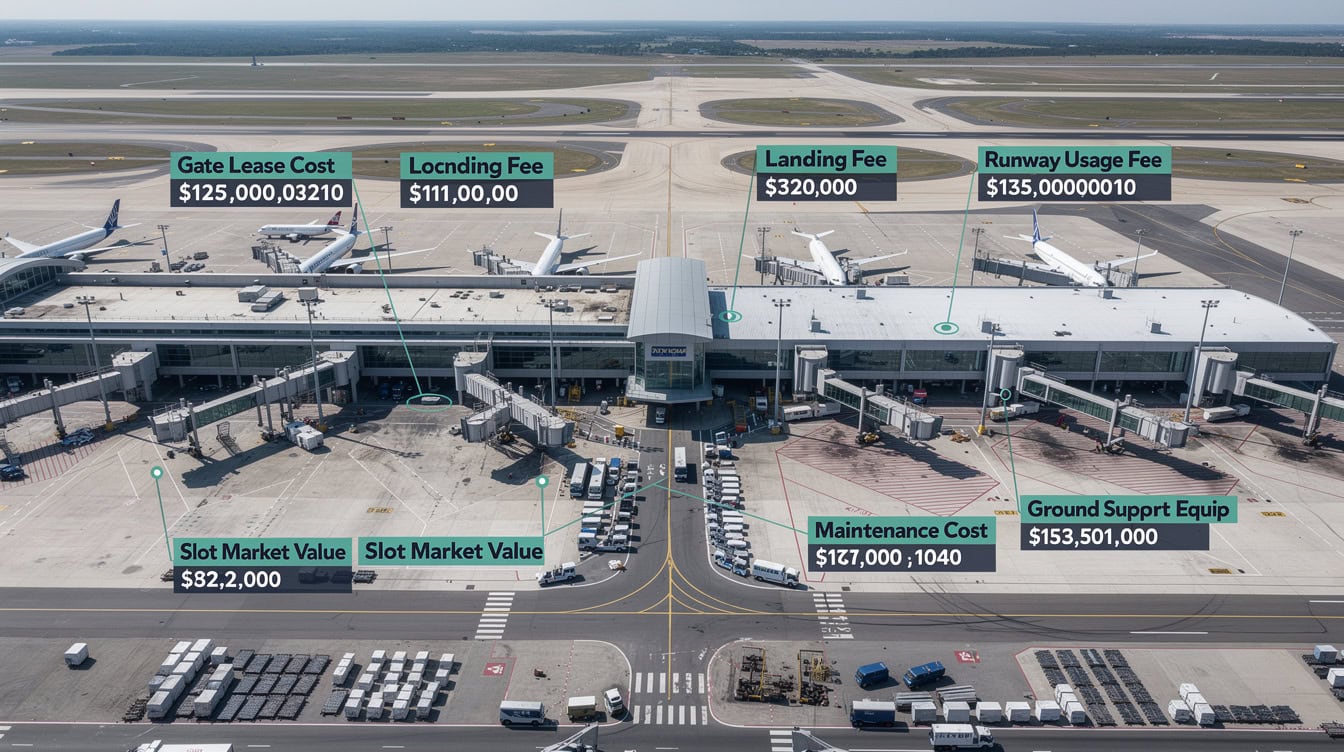
Airport slot rights at JFK have traded for $10–$75M each — a cost that makes major-hub entry impossible for most airline startups without a secondary-airport strategy.
Human Capital: Certification, Training, and Retention
Pilot costs represent the most structurally challenging labor expense for a new airline. An ATP (Airline Transport Pilot) certificate — the minimum qualification to serve as a commercial airline captain — requires 1,500 flight hours under FAA rules (FAA). Type rating training for a specific aircraft (the certification to fly a particular jet model) costs $25,000–$45,000 per pilot. For a startup launching with 10 pilots, type rating costs alone reach $250,000–$450,000 before a single revenue flight.
Ongoing salary costs reflect the post-pandemic pilot shortage. First officers at regional carriers start at $60,000–$90,000 annually; captains at major carriers earn $200,000–$350,000. Cabin crew salaries run $45,000–$75,000 for experienced flight attendants. A two-aircraft startup operating 10 hours per day requires approximately 12–16 pilots and 8–12 cabin crew, putting annual crew costs at $2.5–$4 million.
Recurrent training — mandatory simulator sessions every 6–12 months — adds $8,000–$15,000 per pilot per year. For a 14-pilot operation, that’s $112,000–$210,000 annually in training costs that produce no revenue.
Revenue Benchmarks and Route Economics
Revenue planning must be grounded in market data, not optimism. The U.S. Department of Transportation reports that the average domestic itinerary fare in the United States was $382 in 2023 (U.S. Department of Transportation, 2023). That figure is the revenue ceiling a startup must work within on domestic routes — not a floor.
Load factor (the percentage of available seats filled with paying passengers) is the critical variable. At 70% load factor on a 150-seat narrowbody at $382 average fare, a single flight generates $40,110 in revenue. At 85% load factor, revenue rises to $48,705. The difference — $8,595 per flight — determines whether the operation is profitable or loss-making.
Global passenger traffic grew 6.5% in 2024 and a further 6% in 2025 year-on-year, according to BCG’s Air Travel Demand Outlook (Boston Consulting Group, 2026). That growth creates genuine market opportunity, particularly on underserved secondary routes where slot constraints are lower and competition is thinner. Breeze Airways’ secondary-airport strategy is the clearest recent example of exploiting this gap.
For detailed cost projections and revenue modeling, route-level economics must be built bottom-up, not top-down from industry averages.
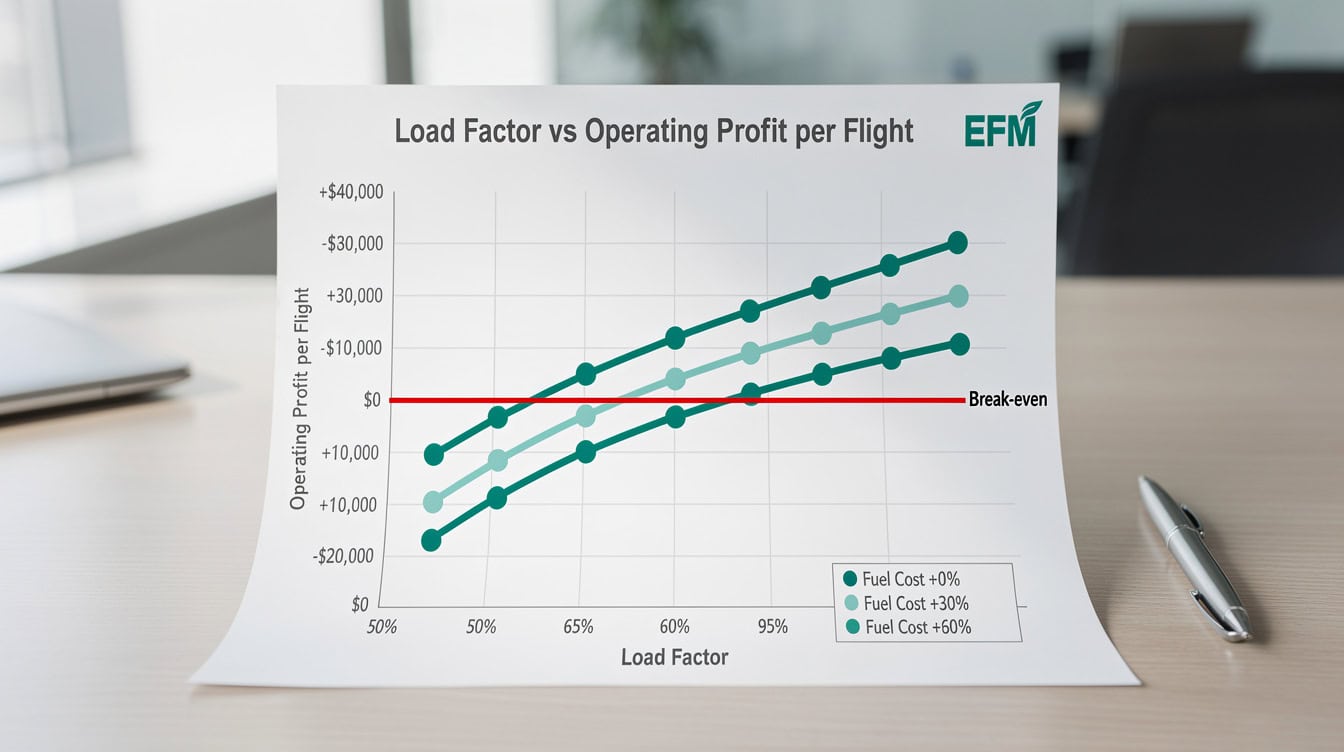
At +60% fuel costs, a 150-seat narrowbody needs a 90%+ load factor to break even — a threshold most new routes cannot sustain in their first 12 months.
Regulatory Compliance and Insurance: Non-Negotiable Costs
FAA Part 121 certification — the operating certificate required to carry passengers for hire on scheduled service — is not a form you file online. The process typically takes 12–24 months and involves hiring dedicated compliance staff, retaining aviation legal counsel, and funding multiple rounds of FAA inspector review. Total certification costs including legal fees, consulting, and staff time typically run $1–$3 million.
The DOT also imposes financial fitness requirements: new carriers must demonstrate sufficient liquidity to operate for at least 3 months without revenue. For a startup with $500,000 in monthly fixed costs, that means $1.5 million in reserved liquidity that cannot be deployed elsewhere.
Insurance is non-negotiable and expensive. Hull insurance (covering physical damage to the aircraft) for a single narrowbody runs $400,000–$900,000 annually. Third-party liability coverage adds $300,000–$600,000 per aircraft. A two-aircraft startup should budget $1.5–$3 million annually for insurance alone — before the first passenger boards.
For airline financial models that properly account for these regulatory and insurance line items, the pre-revenue cash burn during certification is typically the most underestimated cost in startup projections.
Common Financial Planning Mistakes in Airline Startups
Most airline startups don’t fail because of bad flying. They fail because of bad financial modeling. Here are the 5 most common and costly mistakes:
1. Single-scenario fuel pricing. Using one fuel price assumption without sensitivity analysis is the fastest path to insolvency. Build three scenarios: base, +30%, and +60% fuel cost. If the +60% scenario shows negative cash flow within 18 months, the capital structure is insufficient.
2. Ignoring the pre-revenue cash burn. The 12–24 months between company formation and first revenue flight consume capital with no offsetting income. Certification staff, legal fees, lease deposits, and insurance premiums all accrue during this period. Startups that budget only for post-launch operations routinely run out of cash before their first flight.
3. Optimistic load factor assumptions. New routes take 6–18 months to build passenger awareness. Assuming 80%+ load factors from month one is unrealistic. Model 50–60% load factors for the first 6 months, ramping to 70–75% by month 12.
4. Underestimating working capital for fuel inventory. Airlines pay for fuel before they collect ticket revenue. A startup operating 4 daily flights on a narrowbody needs $200,000–$400,000 in fuel working capital at any given time — capital that doesn’t appear in a simple P&L model.
5. Treating all airport costs as variable. Gate leases, slot fees, and ground handling contracts often have minimum annual commitments. These are fixed costs that accrue regardless of how many flights operate. Misclassifying them as variable costs produces dangerously optimistic break-even analyses.
Airline Business Model Comparison
Not all airlines face the same cost structure. The business model chosen at launch determines which cost categories dominate and which can be minimized.
| Business Model | Typical Startup Capital | Key Cost Driver | Revenue Strategy | Failure Risk |
|---|---|---|---|---|
| Ultra-Low-Cost (ULCC) | $50M–$150M | Aircraft utilization, ancillary fees | High volume, low base fare + fees | Fuel spikes, slot access |
| Regional/Commuter | $10M–$30M | Crew costs, thin routes | Capacity purchase agreements | Pilot shortage, thin margins |
| Full-Service Legacy | $200M–$500M+ | Labor, hub infrastructure | Premium cabin, loyalty revenue | High fixed costs, competition |
| Charter/On-Demand | $5M–$20M | Marketing, variable scheduling | Contract and event-based | Demand volatility |
| Long-Haul Low-Cost | $100M–$300M | Wide-body leases, fuel | Point-to-point international | Yield management complexity |
The regional model offers the lowest entry cost but faces the most acute pilot shortage pressure. The ULCC model requires disciplined ancillary revenue execution — Spirit Airlines generated over $70 per passenger in ancillary fees at its peak, which is what made its low base fares viable.
Frequently Asked Questions
How much money do you actually need to start a small regional airline?
Boeing’s StartupBoeing program estimates $10–$20 million for a small regional operation, but that figure assumes favorable lease terms, secondary airport access, and a lean two-aircraft fleet. In practice, most regional startups need $15–$30 million to cover lease deposits (typically 3–6 months of rent at $120,000–$180,000 per month for an ATR 72), FAA Part 121 certification costs of $1–$3 million, 12 months of working capital, and initial insurance premiums of $800,000–$1.5 million. Founders who budget to Boeing’s minimum figure often discover they’re undercapitalized before their operating certificate is issued. A realistic pre-revenue cash burn model is essential before approaching investors.
What is the biggest single cost when starting an airline?
Aircraft acquisition or lease commitments represent the largest single cost category, but the most dangerous cost is the pre-revenue cash burn during FAA certification. A startup can spend $3–$8 million over 12–24 months on certification staff, legal counsel, lease deposits, insurance, and working capital before generating a single dollar of revenue. This period is where most airline startups fail: they raise enough capital to launch but not enough to survive the certification timeline. The FAA Part 121 process requires multiple rounds of inspector review, compliance documentation, and operational demonstrations — none of which can be rushed.
How does fuel price volatility affect an airline startup’s financial model?
Fuel volatility is the most acute financial risk for a startup airline because new carriers lack the hedging infrastructure and credit facilities that established airlines use to stabilize fuel costs. When wide-body fuel costs jumped from $114,000 to $180,000 between February and mid-2025 — a 58% increase — any startup operating on a 10–12% operating margin would have moved into loss-making territory on every flight. The fix is scenario modeling: build your financial model with fuel at base, +30%, and +60% above your base assumption, then calculate the load factor required to break even at each scenario. If the +60% scenario requires a 95% load factor to break even, your capital structure is insufficient and must be addressed before launch.
What regulatory approvals does a new U.S. airline need before its first flight?
A U.S. airline operating scheduled passenger service must obtain FAA Part 121 Air Carrier Operating Certificate, DOT Economic Authority (fitness determination and certificate of public convenience and necessity), and TSA security program approval. The FAA Part 121 process alone involves five phases: pre-application, formal application, document compliance, demonstration and inspection, and certification. The full process typically takes 12–24 months and requires the airline to demonstrate adequate management personnel, operations manuals, training programs, and maintenance systems. Total regulatory compliance costs including legal fees, consulting, and dedicated compliance staff typically run $1–$3 million. The DOT also requires proof of financial fitness — typically 3 months of operating expenses in liquid reserves.
How do you calculate break-even load factor for a new airline route?
Break-even load factor is the percentage of seats that must be filled at a given fare to cover all costs on a specific route. Here’s the formula: Break-Even Load Factor = Total Flight Operating Costs / (Available Seats × Average Fare). For a 150-seat narrowbody with $45,000 in total operating costs per flight and an average fare of $382, the calculation is: $45,000 / (150 × $382) = $45,000 / $57,300 = 78.5%. That means 118 of 150 seats must be filled just to cover costs. If fuel costs rise 30% and operating costs increase to $52,000, the break-even load factor rises to 90.6% — a threshold that most routes cannot sustain consistently. This calculation should be run for every route in a startup’s network plan, at multiple fuel price scenarios.
Why do most new airlines fail within the first five years?
New airlines fail primarily because of financial structure problems, not operational failures. The core issues are: undercapitalization relative to the pre-revenue certification period, fuel cost assumptions that don’t account for volatility, load factor projections that assume mature route performance from day one, and fixed cost structures (gate leases, slot fees, lease commitments) that don’t flex with demand. The post-pandemic cost environment intensified these pressures: the Airlines for America cost index rose 36% between 2019 and 2022, pilot salaries surged due to shortage conditions, and airport slot scarcity at major hubs increased. Airlines that survive typically have 24+ months of operating capital at launch, a secondary-airport strategy that avoids the highest fixed costs, and a management team with prior airline operating experience.
What is the difference between an operating lease and a finance lease for aircraft?
An operating lease is a rental agreement where the airline pays monthly rent for the aircraft and returns it to the lessor at the end of the term, typically 6–12 years. The airline carries no ownership risk and no residual value exposure. A finance lease (also called a capital lease) is structured more like a loan: the airline makes payments that build toward ownership, carries the asset on its balance sheet, and assumes residual value risk at lease end. For startups, operating leases are almost universally preferred because they preserve capital, avoid balance sheet leverage, and allow fleet flexibility. The monthly cost is higher than an equivalent finance lease payment, but the absence of a large balloon payment or residual value obligation at term end is worth the premium for a capital-constrained new entrant.
Conclusion
Starting an airline in 2025 requires a minimum of $10–$20 million for the smallest regional operation and $100 million or more for any carrier targeting major markets. The financial reality is more demanding than most startup projections acknowledge: fuel costs that can swing 58% in four months, a 36% post-pandemic cost inflation baseline, 12–24 months of pre-revenue cash burn during FAA certification, and per-flight margins of 10–12% that disappear the moment any cost assumption moves against you.
The airlines that succeed — JetBlue in 2000, Breeze in 2021 — do so because their founders built financial models that stress-tested every assumption, capitalized the business for the worst-case scenario, and chose market entry points (secondary airports, underserved routes) where fixed costs were manageable.
I recommend downloading the EFM Airline Financial Projection Model to build a detailed 5-year capital requirement projection with sensitivity analysis for fuel costs, load factors, and pricing scenarios — the exact framework any serious airline investor will require before committing capital.