
0 ITEMS

Martial Arts School Financial Model Excel Template
The Martial Arts School Financial Model helps founders, school owners, consultants, and business planners turn a dojo, self-defense academy, or combat sports gym concept into a structured financial forecast. Instead of building spreadsheets from scratch, users can work from a ready-to-use financial model template designed around the economics of a martial arts school, including membership revenue, class capacity, private lessons, events, merchandise, startup costs, payroll, operating expenses, cash flow, and profitability. It gives you a practical way to estimate how much capital is needed, what level of enrollment is required, and how the business may perform over time. This template is especially useful for entrepreneurs preparing a business plan, owners evaluating a new location, consultants supporting clients, analysts reviewing investment potential, or operators seeking funding from lenders, partners, or investors. The model helps organize revenue assumptions such as student capacity, occupancy rates, monthly membership fees, age-based programs, workshops, and one-on-one training. It also supports expense planning by helping users think through rent, instructor compensation, utilities, marketing, equipment, insurance, software, inventory, and other recurring costs that affect the financial health of a martial arts school. The Martial Arts School Financial Model is built to support financial planning and decision-making across multiple scenarios. Users can adjust assumptions, compare low, base, and high cases, review projected statements, evaluate cash flow, and understand how changes in enrollment, pricing, staffing, or marketing spend may affect profitability. The template also helps identify break-even timing, estimate return potential, and prepare clearer financial outputs for stakeholder conversations. This makes it easier to move from a broad idea to a more realistic financial plan that can be reviewed, refined, and presented. Because the model is editable, it can be adapted for different types of martial arts businesses, including karate schools, Brazilian jiu-jitsu academies, taekwondo studios, MMA gyms, youth training programs, women’s self-defense schools, and hybrid fitness and martial arts concepts. Whether you are launching a new dojo, expanding an existing school, preparing funding documents, or testing the feasibility of a new program mix, this financial model template provides a structured foundation for forecasting revenue, managing costs, monitoring cash flow, and making more confident business decisions.



Financial Model Overview
The Martial Arts School Financial Model is a ready-to-use financial model template designed to help entrepreneurs, dojo owners, consultants, analysts, and business planners evaluate the financial potential of a martial arts school before launch, expansion, or funding discussions. It brings together the core drivers of a martial arts business, including student capacity, membership fees, class occupancy, private lessons, events, merchandise, staffing, rent, equipment, operating expenses, cash flow, profitability, and investor return metrics. For a business such as a karate school, taekwondo studio, Brazilian jiu-jitsu academy, MMA training center, or self-defense school, financial planning depends on understanding how recurring membership revenue interacts with fixed facility costs, instructor payroll, marketing spend, and student retention. This template gives users a structured way to replace rough estimates with editable assumptions, automated calculations, and presentation-ready outputs. It is useful for building a business plan, preparing lender documents, reviewing investment needs, comparing scenarios, and making practical decisions about pricing, enrollment targets, program mix, and growth strategy.
All-in-One Dashboard
The all-in-one dashboard gives users a central place to review the most important inputs and outputs of the Martial Arts School Financial Model without needing to search through multiple worksheets. It is designed to bring together the assumptions that matter most to a martial arts school, such as student capacity, occupancy rates, membership pricing, event revenue, private lesson activity, staffing costs, fixed overhead, startup investment, cash balance, revenue, EBITDA, profit, and return metrics. By consolidating these figures into one view, the dashboard helps owners and stakeholders quickly understand whether the business plan is financially realistic and where the main opportunities or risks may be. For example, a founder can adjust student enrollment assumptions, membership fees, or instructor payroll and immediately see the effect on revenue, margins, cash flow, and profitability. This is especially useful when preparing for a lender meeting, investor conversation, partner review, or internal planning session because it translates a detailed spreadsheet into an accessible financial summary. Instead of manually assembling figures for every discussion, users can rely on the dashboard as a practical control center for decision-making, planning updates, and performance review.
Low, Base, and High Scenario Analysis
The low, base, and high scenario analysis component allows users to evaluate how the martial arts school may perform under different market and operating conditions. A single forecast can be misleading if it assumes everything goes exactly as planned, so this section helps users test a more cautious case, a realistic operating case, and an upside case. Inputs may include variations in starting occupancy, student growth, monthly membership fees, event participation, private lesson demand, merchandise sales, payroll requirements, marketing spend, rent, and other operating costs. The outputs help show how revenue, EBITDA, net profit, cash flow, funding needs, and payback timing change when assumptions become stronger or weaker. This is valuable for founders who want to understand how sensitive the business is to enrollment levels, pricing power, or instructor scheduling. It is also useful for investors and lenders because it demonstrates that the owner has considered risk rather than presenting only an optimistic forecast. A low scenario can highlight the amount of cash reserve needed if student sign-ups are slower than expected, while a high scenario can show the upside if pre-opening marketing, referral programs, and class demand outperform expectations. By using scenario analysis, the Martial Arts School Financial Model supports smarter contingency planning and more balanced financial presentations.
Professional Charts
The professional charts component converts key financial outputs into clear visual reports that are easier to understand and present than raw spreadsheet data. Martial arts school planning often involves many connected variables, including memberships, occupancy, revenue streams, expenses, cash flow, EBITDA, and profitability trends. Charts help users quickly identify patterns, compare performance over time, and communicate the business case to partners, lenders, investors, or internal teams. This component may visualize monthly and annual revenue growth, membership expansion, cost structure, cash balance, profit margins, break-even movement, scenario comparisons, and other important metrics. The practical benefit is that users can move from detailed calculations to a more presentation-ready format without manually designing graphs from scratch. A founder preparing a pitch deck can use these charts to explain how the school grows from initial enrollment to stronger occupancy over time. A consultant can use them to show a client how marketing, staffing, and pricing decisions affect financial results. An existing owner can use them in monthly reviews to compare actual performance against the original plan. The charts make the Martial Arts School Financial Model more useful not only as a calculation tool but also as a communication tool for financial planning and stakeholder confidence.
ROE Components and DuPont Analysis
The ROE components and DuPont analysis section helps users understand what is driving return on equity rather than looking only at a final return percentage. In a martial arts school, profitability can be influenced by pricing, occupancy, instructor efficiency, facility costs, retail margins, working capital, debt structure, and the amount of owner or investor capital required to launch. DuPont analysis breaks return on equity into more meaningful components, often connecting profit margin, asset efficiency, and financial leverage to show why returns improve or weaken over time. Inputs may include revenue, net income, total assets, equity investment, debt balances, and operating performance metrics generated elsewhere in the model. The output helps users see whether the school’s projected return is coming from strong operating profits, efficient use of assets, leverage, or a combination of factors. This is useful for investors who want to evaluate the quality of returns and for owners who want to identify which levers can improve financial performance. For example, if returns are being limited by low margins, the owner may focus on pricing, instructor scheduling, or merchandise profitability. If returns depend too heavily on debt, the funding structure may need to be revisited. This component adds depth to the Martial Arts School Financial Model by turning return analysis into a practical management and investment decision tool.
Revenue Inputs
The revenue inputs section is where users define the assumptions that drive projected sales for the martial arts school. Because this type of business is usually built around recurring membership revenue, the model allows users to enter assumptions related to student capacity, available class spots, occupancy rates, pricing by program or age group, and expected growth over time. It can also account for additional revenue streams such as special events, workshops, seminars, belt testing, private one-on-one lessons, branded merchandise, training gear, camps, or other paid programs. These inputs are important because small changes in enrollment, pricing, or capacity utilization can have a major effect on monthly revenue and long-term profitability. For example, a school serving kids, teens, and adults may use different membership rates and capacity assumptions for each group, while an academy with strong private lesson demand may add a separate revenue stream to reflect premium instruction. The revenue inputs section helps users build a forecast that matches the way the specific school plans to operate rather than forcing a generic sales model. It is also useful for testing strategic decisions, such as whether to increase adult program pricing, add weekend workshops, expand kids’ classes, or invest in marketing to raise occupancy. By documenting the revenue assumptions clearly, the Martial Arts School Financial Model makes the sales forecast easier to review, defend, and update.
Bank-Ready Reports
The bank-ready reports component generates financial outputs in a format that is suitable for lenders, investors, partners, and other stakeholders who need to review the business in a structured way. A martial arts school seeking financing will often be asked for projected income statements, cash flow statements, balance sheets, startup budget details, profitability forecasts, and repayment capacity indicators. This component helps organize those outputs so the user is not forced to manually build lender-friendly reports from scattered assumptions. Inputs from the model, including revenue forecasts, operating expenses, payroll, capital expenditures, debt assumptions, taxes, and working capital, flow into the financial statements and related summaries. The resulting outputs help show whether the school can generate enough revenue to cover rent, salaries, equipment, insurance, loan payments, and other obligations while maintaining positive cash flow. This is particularly useful for founders requesting startup capital, owners opening a second location, or consultants preparing financial documents for a client. Clean reports also support better internal decision-making because they show the full financial picture rather than focusing only on sales or profit. With bank-ready outputs, the Martial Arts School Financial Model helps users approach funding conversations with clearer numbers, more professional formatting, and a stronger understanding of what lenders and stakeholders typically want to see first.
Revenue Breakdown
The revenue breakdown component provides a detailed view of how total revenue is built across the different income streams of the martial arts school. Rather than showing only one combined revenue number, this section separates the major sources of sales so users can understand which programs or services contribute most to financial performance. It may include kids’ memberships, teen memberships, adult memberships, private lessons, special events, workshops, merchandise, gear sales, belt testing fees, camps, and other optional offerings. Inputs may include monthly price, number of students, class capacity, occupancy rate, purchase frequency, event attendance, lesson volume, or product margin assumptions, depending on the revenue type. The outputs help users evaluate the mix of recurring and non-recurring income and determine whether the business is too dependent on one category. For example, a dojo may discover that kids’ programs generate the largest recurring revenue, while private lessons provide high-margin incremental income and merchandise adds seasonal upside. This level of detail supports pricing decisions, marketing priorities, staffing plans, and program development. It also helps investors and lenders see that the revenue forecast is based on specific operating assumptions rather than a single top-down estimate. The revenue breakdown gives the Martial Arts School Financial Model a practical connection to how the school will actually make money each month.
KPI Dashboard
The KPI dashboard focuses on the key performance indicators that help users monitor the operational and financial health of a martial arts school. While financial statements are important, school owners also need metrics that connect day-to-day activity with long-term performance. This section may track indicators such as total students, occupancy rate, average revenue per student, revenue by program, membership growth, retention assumptions, payroll as a percentage of revenue, marketing spend as a percentage of revenue, EBITDA margin, cash balance, break-even timing, and return metrics. Some versions may also allow comparison against industry benchmarks or target ranges, helping users see whether their assumptions are realistic. The KPI dashboard is useful because it simplifies complex financial data into measurable signals that can guide management decisions. If occupancy is below target, the owner may need to increase lead generation, improve conversion, add referral incentives, or adjust class scheduling. If payroll as a percentage of revenue rises too high, the school may need to review instructor utilization or class sizes. If cash flow weakens despite revenue growth, the model can help identify the pressure points. For a founder, the KPI dashboard supports funding presentations and strategic planning. For an existing operator, it can become a monthly review tool that helps compare actual results against the forecast and adjust the plan as the business evolves.
Startup Costs and Launch Budget
The startup costs and launch budget component helps users estimate the initial capital required to open or prepare a martial arts school for operations. Launching a dojo or combat sports training facility usually requires several categories of upfront investment, including lease deposits, facility build-out, mats and flooring, safety equipment, training gear, signage, furniture, technology, booking or billing software, licenses, insurance deposits, initial inventory, pre-opening marketing, and working capital reserves. This section allows users to organize these costs in one place and separate one-time capital expenditures from recurring operating expenses. The outputs help estimate the total funding requirement before the school begins generating consistent membership revenue. This is important because even a business that becomes profitable quickly can face cash pressure if the initial setup budget is underestimated. A detailed launch budget also helps founders decide whether they need personal investment, a bank loan, partner capital, equipment financing, or a combination of funding sources. For lenders and investors, a clear startup cost schedule makes the use of funds easier to understand and review. For owners, it supports better budgeting and prevents important items from being missed, such as safety flooring, mirrors, changing areas, point-of-sale systems, or initial merchandise inventory. In the Martial Arts School Financial Model, the startup budget connects directly to cash flow planning, funding needs, and the opening balance sheet, making it an essential component for launch readiness.
Similar ProductsOther customers were also interested in...



 HenrySheykin
Martial Arts School Financial Model Excel Template
The Martial Arts School Financial Model helps founders, school owners, consultants, and business pla... Read more

Dance School Financial Model Excel Template
The Dance School Financial Model helps users turn a studio concept into a structured financial forec... Read more

 Giorgos
Scuba Diving Center – 5 Year Financial Model
Scuba diving affords an unparalleled experience with the underwater world. However, safe diving requ... Read more

Dance Studio Financial Model – 5 Year Financial ...
Provides an advanced 5-year financial plan for a startup or operating Dance Studio and is a flexible... Read more

Sky Diving Center – 5 Year Financial Model
Skydiving is the sport of jumping from an aircraft and performing acrobatic maneuvers in the air dur... Read more

Baby Swimming School – Dynamic 10 Year Financial...
Financial model providing a dynamic 10-Year Financial Plan for a Baby Swimming School for children u... Read more

 City Finance
Swimming School Financial Model Excel Template
A comprehensive editable, 5-year 3 statement MS Excel spreadsheet for tracking Swimming School finan... Read more
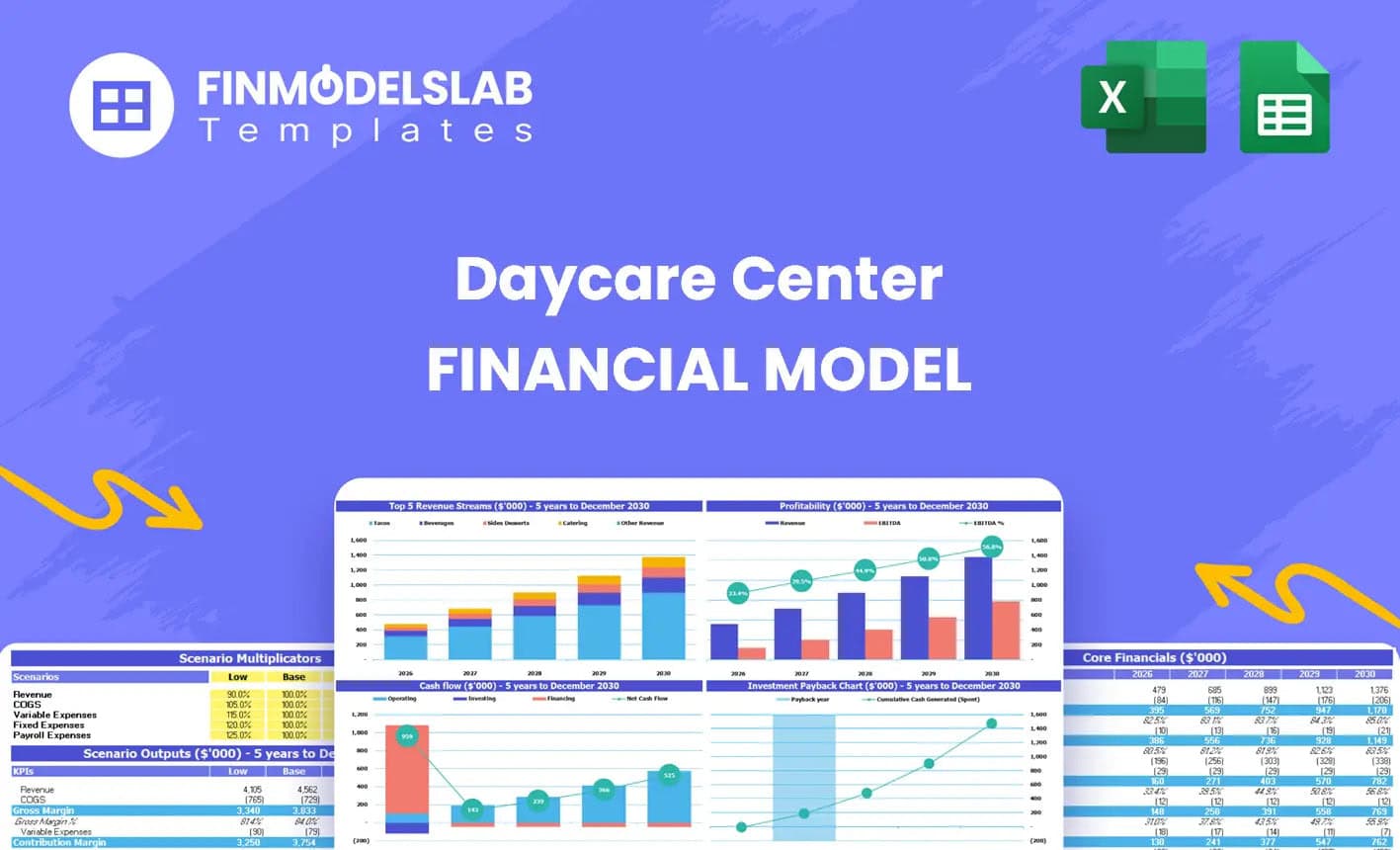
Day Care Financial Model Excel Template
The Daycare Center Financial Model helps entrepreneurs, childcare founders, consultants, analysts, a... Read more

Driving School Financial Model Excel Template
The Driving School Financial Model Template helps users turn a driving school concept into a structu... Read more

Foreign Languages School Financial Model Excel Tem...
The Language School Financial Model helps users turn a language academy, tutoring center, or languag... Read more
You must log in to submit a review.