0 ITEMS

Is Morocco Solar a Good Investment in 2026-2031?

Morocco has built Africa’s most credible solar story, and the next five years are where it either delivers or stalls. The country pairs a world-class solar resource with a renewable target that demands a near tenfold jump in capacity, opening one of the continent’s largest pools of bankable solar capital. The fundamentals are unusually clean for an emerging market: irradiation that rivals Saudi Arabia, LCOEs that fall below most of Europe, and a project finance framework that international lenders already trust. But the returns turn on two variables that headline forecasts tend to gloss over, the mismatch between dirham revenues and dollar costs, and a southern grid that takes up to thirty months to connect. This guide sizes the investment gap to 2030, works through the PV and CSP cases side by side, builds a full IRR model for a representative utility-scale project, and quantifies each risk with the mitigation structures that make Moroccan solar financeable.
Key Takeaways
- Morocco held 881 MW of installed solar PV capacity at end-2023, implying a 6.2% CAGR from 736 MW in 2020, with the 2026–2031 period requiring a step-change to roughly 400–500 MW of annual additions to meet policy targets.
- The 52% renewable electricity target by 2030 translates to approximately 6.5 GW of new solar capacity needed from the 2023 baseline, representing $6–9 billion in capital deployment at current MENA capex benchmarks.
- Morocco’s GHI exceeding 2,000 kWh/m²/year across large parts of the country supports capacity factors of 22–28% for fixed-tilt PV and up to 40% for CSP with thermal storage, directly compressing LCOE below $35/MWh in optimal sites.
- A representative 50 MW utility-scale PV project in Morocco can achieve levered IRRs of 12–16% under a 20-year PPA at $45–55/MWh, assuming 70% debt gearing at 6–7% interest and $650–750k/MW all-in capex.
- The investment gap between Morocco’s current 1.6 GW solar base and the 13 GW combined wind/solar requirement for 1.5°C alignment implies $10–14 billion in solar-specific capital through 2030, with the 2026–2031 window capturing the bulk of deployment.
- ONEE (Office National de l’Electricité et de l’Eau Potable), Morocco’s national utility and primary PPA offtaker, carries sovereign-backed payment obligations, but currency mismatch between USD/EUR project costs and MAD-denominated revenues remains the primary bankability risk.
- Utility-scale projects dominate the addressable market at roughly 85% of pipeline, but distributed generation (rooftop and C&I) represents the fastest-growing segment, with Law 13-09 enabling direct sales to industrial offtakers.
Morocco Solar Market Snapshot: Installed Capacity and 2026 Baseline
Morocco’s solar sector entered 2026 with a combined installed base of approximately 1.46 GW, comprising 881 MW of PV and 580 MW of CSP, making it the most diversified solar market in Africa by technology mix.
Solar PV reached 881 MW by end-2023, up from 736 MW in 2020 (RES4Africa Foundation), a 6.2% CAGR that, while positive, falls well short of the deployment velocity required to meet national targets. Solar PV represented approximately 23% of Morocco’s 3.8 GW total renewable capacity in 2023 (RES4Africa Foundation), with hydro and wind accounting for the remainder. The Noor Ouarzazate CSP complex contributes 580 MW of concentrated solar power capacity (RES4Africa Foundation), making it one of the world’s largest CSP installations and a proof-of-concept for large-scale solar bankability in the MENA region.
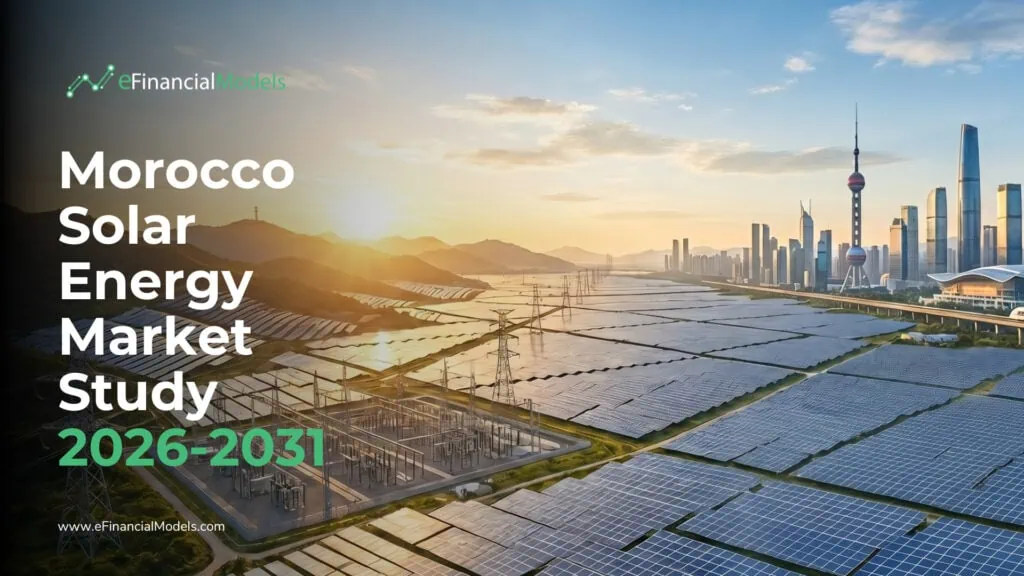
For financial modeling purposes, analysts should use 1,461 MW as the 2026 opening installed base, applying a conservative 5% annual degradation adjustment to existing assets when projecting net available capacity. The Morocco Solar Market Study 2026-2031 sets out this baseline alongside the capacity, technology-split, and deployment data that underpin the financial modeling throughout this analysis.
Investment Gap Analysis: Bridging 1.6 GW to 13 GW by 2030
The gap between Morocco’s current solar position and its climate-aligned target is the single most important number for capital allocation decisions: roughly 11.4 GW of combined wind and solar must be added in under six years.
In 2022, Morocco’s total solar installed capacity (PV and CSP combined) stood at approximately 1.6 GW (RES4Africa Foundation). Reaching the 13 GW combined wind and solar threshold required for a 1.5°C pathway by 2030 (Climate Action Tracker) requires adding roughly 1.9 GW per year across both technologies from 2024 onward. Assuming a 55/45 solar-to-wind split consistent with Morocco’s resource endowment and policy emphasis, solar-specific additions must average approximately 1.0–1.1 GW per year through 2030.
Here’s the math on capital requirements: at a blended capex of $750k/MW for utility-scale PV (the dominant technology in new additions), 1.0 GW of annual solar deployment requires $750 million per year in gross capital expenditure, or roughly $6 billion over the 2024–2030 period for solar alone. Add CSP repowering, grid integration, and distributed generation, and the total solar capital requirement through 2031 reaches $8–10 billion. This figure positions Morocco as a top-5 solar investment destination in Africa by absolute capital volume.
Solar Resource Economics: Translating 2,000+ kWh/m²/year GHI into Project Returns
Morocco’s solar resource is not just abundant — it is financially material. The difference between a 1,800 kWh/m²/year site (Southern Europe average) and a 2,200 kWh/m²/year site (Moroccan south) translates directly into a 15–20% improvement in annual energy yield per MW installed, compressing LCOE by $5–8/MWh at equivalent capex.
Global horizontal irradiation (GHI, the total solar energy received per square meter per year on a horizontal surface) exceeds 2,000 kWh/m²/year across large parts of Morocco (RES4Africa Foundation). For a fixed-tilt PV system, this GHI level supports a capacity factor (the ratio of actual annual output to theoretical maximum output at full rated power) of 22–26% in northern regions and 25–28% in the Souss-Massa and Draa-Tafilalet zones. CSP with six hours of thermal storage achieves capacity factors of 35–42% in the same southern zones, explaining the Noor Ouarzazate siting decision.
LCOE (Levelized Cost of Energy, the all-in cost per MWh over a project’s lifetime) for a greenfield 100 MW fixed-tilt PV project in Morocco’s high-irradiation zones calculates as follows, using a 25-year project life, $700k/MW capex, $12k/MW/year O&M, and a 26% capacity factor:
- Annual energy output: 100 MW × 8,760 hours × 26% = 227,760 MWh
- Total lifetime energy: 227,760 MWh × 25 years = 5,694,000 MWh (applying 0.5% annual degradation)
- Total lifetime cost: ($70M capex) + ($1.2M/year O&M × 25 years) = $100M
- LCOE: $100M / 5,694,000 MWh = approximately $17.6/MWh
This LCOE sits well below current PPA clearing prices of $40–55/MWh in Morocco, creating a substantial margin that supports project bankability and equity returns.
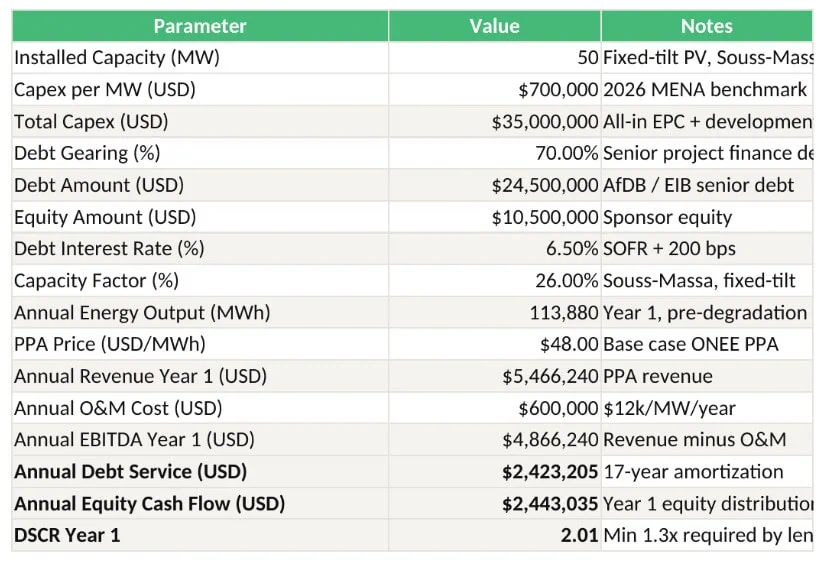
Base case: $700k/MW capex, 70% debt at 6.5%, 26% capacity factor, $48/MWh PPA price yields 13.8% levered IRR over a 20-year PPA term.
Technology Mix Investment Cases: PV vs. CSP Financial Modeling
PV and CSP serve different investment theses in Morocco: PV offers lower capex, faster deployment, and higher near-term IRRs, while CSP with storage provides dispatchable power that commands premium PPA pricing and longer-duration revenue certainty.
| Parameter | Utility-Scale PV (100 MW) | CSP with Storage (100 MW) |
|---|---|---|
| Capex per MW | $650–750k | $4,500–5,500k |
| Construction period | 12–18 months | 36–48 months |
| Capacity factor | 24–28% | 35–42% |
| Estimated LCOE | $16–22/MWh | $85–120/MWh |
| Typical PPA price | $40–55/MWh | $120–160/MWh |
| Project IRR (levered) | 12–16% | 8–12% |
| Debt gearing | 65–75% | 60–70% |
| Loan tenor | 15–18 years | 18–22 years |
| Technology risk | Low | Medium-High |
| Dispatchability | No | Yes (6–10 hrs storage) |
For the 2026–2031 investment window, PV dominates the opportunity set. CSP development is unlikely to restart at scale without a dedicated government tender, given the cost differential and the falling price of battery storage as an alternative dispatchability solution. Investors evaluating Morocco should weight PV at 80–85% of solar portfolio allocation.
Policy Framework and Regulatory Bankability for Foreign Investors
Morocco’s regulatory environment for solar investment is among the most developed in Africa, but bankability depends on understanding three specific mechanisms: the auction framework, the PPA enforcement structure, and the foreign investment repatriation rules.
Morocco’s National Energy Strategy targets 52% of installed electricity capacity from renewables by 2030, with approximately 20% from solar technologies (RES4Africa Foundation). This policy commitment underpins a competitive tender process managed by MASEN (Moroccan Agency for Sustainable Energy), which has run multiple auction rounds with clearing prices trending downward. Law 13-09 on renewable energy, amended in 2016, permits independent power producers (IPPs) to sell electricity directly to large industrial consumers via the national grid, opening a merchant and C&I route alongside ONEE-backed PPAs.
For foreign investors, key bankability parameters include: 100% foreign ownership permitted in project companies; profit and dividend repatriation allowed under the Investment Charter; corporate tax rate of 31% with a five-year exemption available for qualifying renewable projects in designated zones; and VAT exemption on imported solar equipment. Land lease costs in high-irradiation southern regions typically run MAD 2,000–5,000 per hectare per year (approximately $200–500/ha/year at current exchange rates), representing less than 1% of project revenue at utility scale.
The primary bankability concern is ONEE’s creditworthiness. ONEE carries an implicit sovereign guarantee but no explicit investment-grade rating from Moody’s or S&P as a standalone entity. Lenders typically require a government letter of support or partial risk guarantee from the World Bank’s MIGA or AfDB to achieve investment-grade debt pricing.
Market Segmentation and Addressable Opportunity 2026–2031
The Morocco solar market splits into three investable segments with distinct risk-return profiles: utility-scale IPP projects (50–500 MW), C&I distributed generation (1–50 MW), and residential/small commercial rooftop (under 1 MW).
Utility-scale projects represent approximately 85% of the 2026–2031 addressable market by capital value, driven by MASEN tender pipelines and the scale economics of large-site development. The C&I segment is growing fastest in percentage terms, with Law 13-09 enabling direct industrial PPAs at negotiated prices typically 10–20% below ONEE tariffs, creating a compelling value proposition for energy-intensive manufacturers. The residential segment remains nascent due to net metering policy gaps, but regulatory reform expected in 2026–2027 could unlock 200–400 MW of rooftop potential.
Total addressable solar market for 2026–2031: applying the 1.0–1.1 GW/year deployment target and a blended capex of $700k/MW, the six-year capital deployment opportunity totals $4.2–4.6 billion in solar PV alone, with an additional $500–800 million in associated grid infrastructure and storage.
Project-Level Financial Modeling: 50 MW PV Case Study with IRR Scenarios
A 50 MW fixed-tilt PV project in Morocco’s Souss-Massa region, financed under a 20-year ONEE PPA, provides the clearest lens for evaluating risk-adjusted returns under 2026–2031 market conditions.
Base Case Assumptions:
- Capex: $700k/MW = $35 million total
- Debt: 70% gearing = $24.5 million at 6.5% interest, 17-year tenor
- Equity: 30% = $10.5 million
- Annual O&M: $12k/MW = $600k/year
- Capacity factor: 26%
- Annual energy output: 50 MW × 8,760 hrs × 26% = 113,880 MWh
- PPA price: $48/MWh (base case), escalating at 1.5%/year
- Annual revenue (Year 1): 113,880 MWh × $48 = $5.47 million
- Annual EBITDA (Year 1): $5.47M – $0.6M O&M = $4.87 million
- Annual debt service (Year 1): approximately $2.1 million
- Annual equity cash flow (Year 1): approximately $2.77 million
Here’s the IRR sensitivity across three scenarios:
| Scenario | PPA Price | Capacity Factor | Capex/MW | Levered IRR |
|---|---|---|---|---|
| Bear | $40/MWh | 23% | $800k | 9.2% |
| Base | $48/MWh | 26% | $700k | 13.8% |
| Bull | $55/MWh | 28% | $650k | 17.4% |
The base case 13.8% levered IRR compares favorably to the 10–12% hurdle rate typical for MENA infrastructure equity, providing a 180–380 basis point spread above the regional benchmark. Currency risk is the primary variable not captured in this USD-denominated model: if MAD depreciates 3% per year against USD (the historical average over 2015–2023), unhedged equity IRR falls by approximately 250–300 basis points.
Risk Quantification and Mitigation Structures for Morocco Solar Investments
Morocco’s solar investment risks are quantifiable and largely mitigable through standard project finance structures, but three risks require specific attention: currency exposure, offtaker credit, and grid integration.
Currency Risk: PPA revenues denominated in MAD against USD/EUR project costs create a structural mismatch. The Moroccan Dirham has depreciated at approximately 1.5–2.5% per year against the USD over the past decade. Hedging via cross-currency swaps is available from local banks (Attijariwafa, CIH Bank) and international institutions, typically at a cost of 150–250 basis points per year, which reduces but does not eliminate the IRR drag.
Offtaker Risk: ONEE’s payment track record for existing IPPs has been generally reliable, but the utility carries significant debt (estimated at MAD 40+ billion) and depends on government transfers to balance its accounts. Mitigation structures include: escrow accounts funded by ONEE, partial risk guarantees from AfDB or World Bank, and political risk insurance from MIGA (available at 0.5–1.0% of insured value per year).
Grid Integration Risk: Morocco’s transmission grid, managed by ONEE, has limited capacity in high-irradiation southern regions. Grid connection timelines for new projects average 18–30 months, and connection costs of $50–150k/MW can add 7–20% to total project capex. Investors should conduct grid capacity studies before committing to site selection.
Political and Regulatory Risk: Morocco scores 55/100 on the World Bank’s Regulatory Quality Index, above the MENA average of 42. The country has maintained consistent renewable energy policy since 2009, reducing retroactive change risk, though investors should structure PPAs with stabilization clauses covering tax and regulatory changes. Morocco’s solar sector has benefited from over 15 years (World Bank) of continuous policy support since the National Energy Strategy was first adopted, a track record that meaningfully reduces regulatory risk compared to peer markets.
| Risk Factor | Probability | IRR Impact | Mitigation | Residual Risk |
|---|---|---|---|---|
| MAD depreciation (3%/yr) | High | -250 to -300 bps | Cross-currency swap | Medium |
| ONEE payment delay | Medium | -100 to -150 bps | Escrow + MIGA | Low |
| Grid curtailment (10%) | Medium | -80 to -120 bps | Curtailment compensation clause | Low-Medium |
| Regulatory change | Low | -50 to -200 bps | Stabilization clause | Low |
| Construction overrun (10%) | Medium | -60 to -100 bps | EPC fixed-price contract | Low |
Capital Requirements and Funding Landscape Through 2031
Morocco’s solar sector draws capital from a layered funding stack: development finance institutions (DFIs) at the senior debt level, commercial banks for mezzanine and working capital, and international private equity and infrastructure funds at the equity level.
Senior debt is typically available at 65–75% loan-to-value from AfDB, EIB, IFC, and EBRD at spreads of 150–250 basis points over SOFR (approximately 6.5–7.5% all-in as of 2025), with tenors of 15–20 years. Local commercial banks (Attijariwafa, BMCE Bank of Africa) provide supplementary financing at higher rates (8–10%) but with MAD denomination, which partially hedges currency risk. Equity investors include infrastructure funds (Meridiam, Actis, Masdar), sovereign wealth funds (Abu Dhabi’s Mubadala has existing Morocco exposure), and development-oriented investors (CDC Group, Proparco).
The Moroccan government’s Investment Charter, updated in 2022, provides a 30% investment premium grant for projects in priority sectors including renewables, reducing effective equity requirement and improving IRR by 150–200 basis points for qualifying projects. The IFC has invested and mobilized more than $1.3 billion in Morocco’s private sector over the past three fiscal years — spanning infrastructure, energy, agribusiness, and financial services — reflecting deep DFI appetite for Moroccan project risk.
Investment Thesis: Morocco Solar Positioning in MENA Portfolio Context
Morocco offers the most compelling risk-adjusted solar investment case in North Africa for the 2026–2031 period, combining a proven policy framework, world-class solar resource, and a credible deployment pipeline that institutional investors can underwrite.
Compared to Egypt (larger market but higher political risk and currency volatility), Saudi Arabia (massive scale but dominated by state-owned developers), and Tunisia (similar resource but weaker policy framework), Morocco provides the optimal balance of market access, bankability, and return potential for international capital. The 13 GW combined wind/solar target creates a visible, policy-backed pipeline through 2030, reducing the market risk that plagues earlier-stage emerging market energy investments. Africa’s total installed renewable energy capacity stood at approximately 56 GW as of 2023 (IRENA), meaning Morocco’s 13 GW solar and wind target alone would represent roughly 23% of the entire continent’s current renewable base — a figure that underscores both the ambition of the program and the scale of the investment opportunity.
The primary constraint on deployment is not capital availability or resource quality — it is grid infrastructure and permitting velocity. Investors who can navigate the 18–30 month grid connection process and structure bankable PPAs with ONEE or direct industrial offtakers will capture the bulk of the available return premium.
Frequently Asked Questions
What is the current installed solar capacity in Morocco and what growth rate should financial models assume?
Morocco’s installed solar PV capacity reached 881 MW at end-2023, growing from 736 MW in 2020 at a 6.2% CAGR (RES4Africa Foundation). Adding the 580 MW Noor Ouarzazate CSP complex gives a combined solar base of approximately 1.46 GW entering 2026. For financial models covering 2026–2031, analysts should assume a step-change in deployment velocity: the policy-required 1.0–1.1 GW/year of new solar additions implies a 35–40% CAGR in annual additions, not in total installed base. A conservative model should use 500–700 MW/year of new PV capacity additions, reaching 4.5–5.5 GW of PV alone by 2031. This assumption is consistent with Morocco’s MASEN tender pipeline and the capital availability from DFI and private equity sources currently active in the market.
What IRR can investors realistically expect from a utility-scale solar PV project in Morocco?
A 50–100 MW fixed-tilt PV project in Morocco’s high-irradiation southern regions can achieve levered equity IRRs of 12–16% under base case assumptions: $700k/MW all-in capex, 70% debt gearing at 6.5% interest, a 20-year PPA at $45–55/MWh with ONEE or a creditworthy industrial offtaker, and a 25–26% capacity factor. The bear case (lower PPA price, higher capex, currency depreciation) compresses IRR to 9–10%, while the bull case (premium PPA, optimal site, government grant) can push IRR above 17%. The 13.8% base case IRR provides approximately 200 basis points of spread over the 10–12% hurdle rate typical for MENA infrastructure equity, which most institutional investors consider adequate compensation for emerging market risk.
How does Morocco’s solar resource compare to other MENA markets for LCOE purposes?
Morocco’s GHI exceeds 2,000 kWh/m²/year across large parts of the country (RES4Africa Foundation), which is comparable to Saudi Arabia’s Empty Quarter and superior to Egypt’s Nile Delta region. This resource quality supports capacity factors of 24–28% for fixed-tilt PV and 35–42% for CSP with storage, translating to LCOEs of $16–22/MWh for utility-scale PV at current capex benchmarks. By comparison, Southern European projects with 1,700–1,900 kWh/m²/year GHI achieve LCOEs of $22–30/MWh at similar capex. The $5–8/MWh LCOE advantage directly improves project margins and provides a buffer against PPA price compression in competitive tenders.
What are the main risks for foreign investors in Morocco’s solar sector and how are they typically mitigated?
The four primary risks are currency mismatch (MAD revenues against USD/EUR costs), ONEE offtaker credit quality, grid integration delays, and regulatory change. Currency risk is the most financially material: a 3% annual MAD depreciation against USD reduces unhedged equity IRR by approximately 250–300 basis points. Mitigation options include cross-currency swaps (cost: 150–250 bps/year), MAD-denominated debt from local banks, and partial natural hedging through local O&M contracts. ONEE credit risk is mitigated via escrow accounts, AfDB/World Bank partial risk guarantees, and MIGA political risk insurance at 0.5–1.0% of insured value annually. Grid connection risk requires early-stage grid capacity studies and contractual curtailment compensation provisions in the PPA.
What financing structures are available for solar projects in Morocco and what are typical debt terms?
Solar projects in Morocco access a multi-tiered debt market. DFIs including AfDB, EIB, IFC, and EBRD provide senior project finance debt at 65–75% loan-to-value, with tenors of 15–20 years and all-in rates of approximately 6.5–7.5% (150–250 bps over SOFR as of 2025). Local commercial banks offer MAD-denominated debt at 8–10%, which provides a natural currency hedge but at higher cost. The Moroccan government’s 2022 Investment Charter offers a 30% investment premium grant for qualifying renewable projects, reducing effective equity requirements and improving IRR by 150–200 basis points. Typical project finance structures require a debt service coverage ratio (DSCR) of at least 1.3x and a loan life coverage ratio (LLCR) of 1.5x to satisfy DFI credit committees.
How does the PV versus CSP investment case differ for the 2026–2031 period?
PV and CSP serve fundamentally different investment theses. PV offers capex of $650–750k/MW, 12–18 month construction, and levered IRRs of 12–16% under current PPA pricing. CSP with thermal storage costs $4,500–5,500k/MW, takes 36–48 months to build, and achieves IRRs of 8–12% despite higher PPA prices of $120–160/MWh, because the capital intensity overwhelms the revenue premium. For the 2026–2031 window, new CSP development is unlikely without a dedicated government tender, as falling battery storage costs are eroding CSP’s dispatchability advantage. Investors should allocate 80–85% of solar portfolio capital to PV and treat CSP as a specialized opportunity requiring specific government support structures and longer investment horizons.
What policy mechanisms support solar investment bankability in Morocco?
Morocco’s bankability framework rests on three pillars. First, the National Energy Strategy’s 52% renewable target by 2030 (with 20% from solar) creates a legally anchored demand signal for new capacity (RES4Africa Foundation). Second, MASEN’s competitive auction process provides transparent price discovery and standardized PPA contracts with ONEE as the sovereign-backed offtaker. Third, Law 13-09 (amended 2016) enables direct sales to industrial consumers, creating a merchant route that reduces dependence on ONEE credit. Additional bankability supports include 100% foreign ownership rights, profit repatriation under the Investment Charter, a five-year corporate tax exemption for qualifying projects, and VAT exemption on imported solar equipment. Together, these mechanisms allow international lenders to underwrite project finance debt at investment-grade terms when combined with DFI credit enhancement.
Conclusion
Morocco’s solar sector presents a quantifiable, policy-backed investment opportunity for the 2026–2031 period. The combination of world-class solar resource (2,000+ kWh/m²/year GHI), a credible 52% renewable target, an 11+ GW deployment gap to fill, and a proven project finance framework creates conditions for 12–16% levered IRRs on well-structured utility-scale PV projects. Currency risk and grid integration timelines are the primary variables that separate successful investments from underperformers, and both are manageable with the right contractual and financial structures.
I recommend downloading the EFM Solar Project Finance Model with Morocco-specific assumptions, including irradiation-based capacity factors, MENA capex benchmarks, ONEE PPA revenue structures, and multi-scenario IRR analysis, to build your investment case for North African solar opportunities with institutional-grade rigor.